From the Reformation to the Third Reich: Protestantism’s Impact on Western Culture – Part 4
The following is part four of a multi-part series.
Taken from John Immel’s third session
at the 2014 Conference on Gospel Discernment and Spiritual Tyranny
~ Edited by Andy Young
In the previous article we were discussing the re-introduction of Aristotle into Western thought. This is a breakthrough of epic proportions because the ideas of Aristotle are directly responsible for liberty and the explosion of human achievement that takes place in the 17th century.
Aristotle understood that universals do not exist in some transcendent world of Forms as Plato taught, but rather they are the product of human cognition. Man’s capacity for reason makes it possible for him to understand similarities in identities  in the physical world and categorize them in such a way that brings order to reality. This is in stark contrast to Plato and other contributors to Western thought to this point. They held human reason in contempt and regarded human senses as inferior for being able to interpret the word around them.
Aristotle’s metaphysical premise regarding the nature of existence and the subsequent epistemological qualification that resulted in acknowledging man having ability to correctly interpret reality led Aristotle to some logical conclusions regarding the behavior of particulars. The behavior of a particular is defined by its nature. The essential characteristics of a particular are what define its identity. The essence of each thing is unique to that thing. This is what all science is based on. The axiom of human existence are understood in three laws.
The Law of Identity
This is the primary axiom of which the other two laws are corollaries. The Law of Identity says that any object cannot both be and not be at the same time. Man cannot be both “man” and “not man.” A horse cannot be both “horse” and “not horse.” “A” cannot be both “A” and “not A.” Aristotle said it this way:
“If, however, a definition, for example, man, horse, A, were not limited, but one were to say that the word is an infinite number of meanings, obviously, reasoning would be impossible. For not to have one meaning is to have no meaning. If words have no meaning, our reasoning with one another and ourselves has been annihilated, for it is impossible to think if anything we do not think of but one thing.”
Think of the conversations that you have had and how frustrating it is how often the Neo-Calvinists change definitions, and they place mutually exclusive ideas together. This is what they are doing. They are annihilating reason.
Paul Dohse is very fond of talking about the grammatical approach. Words are really a description of entities, and it is our means by which we communicate the nature of our perceptual experience. Words hold abstractions and concepts. So when somebody says to you, “the clear meaning of scripture,” what you first must say is “clear by what context?” Because unless you have the Law of Identity in action, you will find that they don’t have a context. It is usually a free-floating abstraction, and they are treating the abstraction as if it is the only thing that matters. The Neo-Calvinists are masters of wrecking the Law of Identity.
 The Law of Non-Contradiction
The first corollary to the Law of Identity says this:
“It is impossible then that being a man should mean precisely not being a man. And it is not possible to be and not be at the same time. But the point in question is not whether the same thing can at the same time be and not be in name, but whether it can be [and not be] in fact.”
This is the important part. Can something actually exist as two mutually exclusive things? The answer is no, never. A perfect example of this is the expression coined by Martin Luther, Simul justus et peccator – “simultaneously saint and sinner.”
The Law of the Excluded Middle
The second corollary to the Law of Identity says this:
“But on the other hand, there can be no intermediate between contradictories, but if one subject, we must either affirm or deny on any one predicate. This is clear, in the first place, if we define what the true and the false are.”
He is basically saying you can’t punt. If you cannot figure out how to reconcile a contradiction, you cannot relegate it to the abyss of “mystery.” In the book, Atlas Shrugged, Ayn Rand put it this way:
“Contradictions do not exist. If you believe you have found a contradiction, check your premises. One of them is wrong.”
The problem within the Medieval world was they would never check their premise. They always had an explanation for what it was, and so they could never identify an error. You see this dramatically within churches. It is stunning to watch them rationalize one of two directions, either why God is for them or God is with them. The church’s roof falls on everybody; God is against them. The church’s roof falls on everybody; God is with them. And in each instance, you have mutually exclusive ideas. Is it God’s judgment or is it God’s blessing? And they will do Herculean reasoning efforts to try to justify why are they both and the same – the exact same event is basically two separate outcomes. You are ultimately looking at a violation of the Law of Excluded Middle. You cannot punt. If you find an inconsistency in your thinking, you have something fundamentally wrong with your thinking. Consider how that impacts a vast percentage of Christian doctrines!
In summation, the identity of “A” is in fact the identity of “A”. The particulars of “A” must never contradict. For “A” to maintain its identity, there can be no middle compromise on something not “A”. This is the foundation of causality. It is because man can identify “A” and hold no contradiction on the identity of “A” that empowers man to successfully make a distinction and see the relationship on how the particulars interact.
Without causality, everything in reality remains a totally unprecedented event. Man cannot tell why one thing happens versus another. This is crucial to understanding reality. The foundations of causality, the laws that govern causality, are a corollary to the correct judgment of reality. The inability to identify cause and effect is man’s central and greatest failing, and insanity is directly tied to the inability to act to identify causality. Our internal “reality testers” are directly related to our ability to identify cause and effect between objects in space; abstractions and action and motion.
So now you can begin to grasp why it is that all effective human cognition flows from Aristotle- all laws of logic, all of man’s conceptual capacity, all of man’s reason, and most importantly, man’s capacity to grasp the world in which he lives.
Question: Why is this a threat to despots the world over?
Second question: Why has every oppressive ideology sought to unseat Aristotle?
Third question: Why do tyrants cling to Aristotle’s shoulders while trying to cut off his head?
Here is the answer. Because Aristotelian thought means that:
- Existence is knowable, understandable, and practicable.
- All men have the ability to arrive at the truth.
- Knowledge is available for all who would use the laws and the rules of logic to obtain it.
This foundational concept was revolutionary. It was the original Copernican shift from the transcendent world of Plato’s Forms. Indeed, without Aristotle’s foundation, Copernicus was not possible, and neither is any other advance in human knowledge.
Here is Aristotle’s greatest impact on Western thought. When using the laws of thought, the mind of man is effective to understand man’s existence. An existence that is identifiable is an existence that is understandable. An existence that is understandable is an existence that is explorable. An existence that is explorable is an existence that is controllable. An existence that is controllable is an existence that man can master.
And this is exactly what happened. Thomas Aquinas introduced Aristotle into the horror story that was the Augustinian Dark Ages, where crime was a starving serf eating the king’s deer, where punishment was an iron maiden or the rack or the stocks, where civil liberties meant the government could do no wrong because the king had a divine right to any action, where child labor law was mandatory 16-hour days scratching in the fields of the lord’s property with a stick to plant the lord’s crops so that the father can pay the lord’s taxes, where plagues were heaped on the heads of sinners, where the princes and kings waged yet another war against the Lollards or the Catholics or the Protestants, and teenagers pledged their oath of loyalty to fight in religious wars.
Aristotle’s ideas soon inspired the Renaissance. I want you to notice the contrast between Medieval art and the art of the Renaissance. Consider the impact of Aristotle in the Sistine Chapel. Now man is no longer this cringing, horrified, tormented beast, writhing in the flames in the pit of hell. Now man is  portrayed as the very image of his own Maker! It is a powerful contrast. This is how the entire progression of ideas have impact as this metaphysical statement rolls out to people, and now they begin to roll back to themselves through art in the images and the pictures that affirm their metaphysical, epistemological and ethical assumptions.
For the next hundred years, this philosophy moves in fits and starts. It travels down blind alleys, intellectual cul-de-sacs. By the time we get to the 17th century, philosophers are exceedingly aware that they need a new start. A new start equated throwing off the Augustinian metaphysical and epistemological framework. Mysticism and dogmatism continued to wreck everything it touched. Something was very obviously wrong.
The thinkers in the 17th century merely had to observe that the human history was dominated by ignorance, superstition, poverty, and despotism. Revelations did not work. “Faith” was merely government-enforced superstition. Dogmatism was really despotism. Despotism led to oppression and poverty. Philosophers needed a new method. This new method was Reason.
The Age of Reason gave way to the Enlightenment of the 17th century. Reason became the standard, and the world was beginning to actually understand the world which man lives. Notice the explosion. You should recognize most of these names – Bacon, Galileo, Newton, Descartes, Locke. These men represent the core, the explosion of the power of human reasoning and what it ultimately produced. Here is where man finally gains freedom.
There is the one thing, however, that remained to be figured out – political thought. The power of Aristotle’s metaphysics and epistemology ultimately worked out into the area of ethics. We now have an  ethical standard where man is able to determine value, and the nature of this ability is what empowers him towards self-governance.
I consistently ask this question, who owns man? There have only been two options in the whole history of the human race: either the State owns man or man owns himself. In political action, this is how man finally came out from underneath the horror story that was the Middle Ages, the horror story that was the Augustinian doctrine, the horror story that was made after Calvin.
This brings me to the emergence of John Locke and the issue of capitalism. This will be the central issue in National Socialist Germany and ultimately how it impacts the United States.
To be continued…
From the Reformation to the Third Reich: Protestantism’s Impact on Western Culture – Part 2
The following is part two of a multi-part series.
Taken from John Immel’s second session
at the 2014 Conference on Gospel Discernment and Spiritual Tyranny
~ Edited by Andy Young
I’m going to continue with my case on the nature of philosophy, how it is a driving force of human action. It has impacted the evolution of Western thought in particular, and specifically it shaped National Socialist Germany. It is currently shaping the United States of America.
At the TANC Conference of 2013, I began to explain the evolution of Western thought, and I started all the way back from Thales around 600 BC. One of the biggest challenges I have is that Christians tend to believe that Christianity just sprang up out of a whole cloth, but it actually has a very specific place in the larger context of the evolution of Western thought. The roots of those ideas can be seen as far back as Plato and Pythagoreans, and many of our doctrines come from the Cynics and the Stoics.
I’m going to pick up where I left off in the timeline I began last year, around 150 AD, because this will lay a foundation. I’m going to touch briefly on Plato because the roots of current Christian doctrine can be traced from Plato to Augustine to Luther to Calvin. Actually, it is not really all that much of a dirty secret. The fact of the matter is that anyone can find this relationship with no effort at all. It is hidden in plain sight for anybody to find.
You will recall from our study of the Cynics and the Stoics that they believed the flesh, the material world was corrupt. They were responsible for the introduction of the soul-body dichotomy into Western thought.
Christianity largely picks up this soul-body dichotomy from these ancient Western thinkers. The Cynics and Stoics ultimately believe that the way man achieves knowledge and virtue was by the discipline of the flesh. Because the flesh was weak, it required kind of like an athlete’s training.

Plotinus
Around 200 AD a man by the name of Plotinus picks up on the Cynic and Stoic doctrines. Plotinus takes these concepts to the next logical progression. Not only is the material world inferior, it is in fact totally morally depraved.
Consider what Plato taught. Plato believed that this earth was a shadow variation of a perfect world. This world was not true reality. It was really the reflection, the shadow on the wall of a cave. The otherworldly realm was called the world of Forms. Plato believed that man’s grasp of reality was limited. Plato believed that man’s ethical standard was his subordination to the state. He believed that man was inferior. He believed that certain men, what he called philosopher kings, should be in charge. They should dictate good.
Plato still has a secular philosophy. In other words, he still believed that select men can get to this transcendent world, this world of Forms, by virtue of his reason. Now it wasn’t a clean blanket statement that all men had this ability. It was really reserved for a select few men who specifically practice virtues that gave them access to the forms and higher levels of knowledge, but it was still a secular version.
By contrast, Plotinus dropped all vestiges of the human element. According to Plotinus’ disciples, Plotinus had zero interest in the physical life. His entire obsession was attaining a transcendent reality. But his transcendent reality was a religious transcendence. He accepted the premise of the mystery cults, the Gnostics, where because man is specifically corrupt, there was a certain initiating practice that gave them access to the knowledge, and they were uniquely qualified to get to this knowledge by virtue of their specific denial of fleshly existence.
This means that the secular transcendent world is graspable because man is the secularizing part. But a religious transcendent world is not graspable because man has no place in that world. Here is how Plotinus described this. Listen to the echoes of what becomes Christianity.
“The One is, in truth, beyond all statement; whatever you say would limit It; the All-Transcending, transcending even the most august Mind, which alone of all things has true being, has no name. We can but try to indicate, if possible, something concerning it. If we do not grasp it by knowledge, what does that not mean that we do not seize it. How does man come to seize knowledge of a transcendent being? It is impossible for man to cease transcendent knowledge by reason.”
I want you to notice that he wanted reason to be part of man’s incompetence.
Once you understand Plotinus, it becomes very simple to understand Augustine, because this is the version of Platonism that Augustine got hold of. He did not have the original Plato. Augustine sees in his mind the one, the All-Transcendent, as the Christian God. It is from this framework within which he places Christianity, because there was a problem with early Christianity.
When Jesus showed up on the scene, He was in Israel talking to Israelites about Israel issues. He repeatedly stated that He came to the lost children of Israel. This is why, particularly in the Gospel of Mark and the Gospel of Matthew, you see virtually no recognition of a world beyond Palestine. You see functionally no understanding of the broader Hellenistic world.
By the time we get to the Gospel of Luke, being a Roman and having much more concern with the broader Hellenistic world, his original works are actually addressed to someone named Theophilus. While Luke’s interest is to a broader Greek world, even then Luke’s focus is only inasmuch as he wants to show the progression of the Great Commission going to the outermost parts of the earth to these people. So even by the time we get to the Book of Acts, he is still just focused on that evolution.
And herein lay the problem. As this Jewish movement, which started out in this little backwater no nothing territory of the Roman Empire, moves in to the broader Hellenistic world it is confronted with some profound intellectual problems.
The Hellenistic world has no association with the Jewish background of the things that Jesus said and did. There was no quick way to explain the nature of the Jesus movement to this broader Hellenistic world because there was no full philosophical statement. It was a collection of stories and aphorisms and parables. And so to that world and to that mind, Christianity did not have a lot of direct relevance.
By the time we get into the 2nd century, Christianity is really reeling. Christianity needed an integration into a broader philosophical statement. One of the first who tried to do this was Philo. Philo was a Jew, and he was definitely a Hellenistic Jew, and his goal was to take Platonism and merge it into Judaism. He is one of a number who were making these attempts at philosophical integration.
This is the fundamental problem that landed on Augustine’s lap. Augustine set out to finalize the integration of these ideas, and he used the turnkey solution of Platonism to do it. Concurrent with this, the Roman Empire was crumbling. There was a lot of chaos happening in the world, both political and social. People were looking for some means and some way to begin to explain these things, so a corrupt material world and a corrupt man in a war-torn and war-ravaged and famine-ravaged existence seems to make an enormous amount of sense.

First Council of Nicea
Then there is the political side of this equation to consider. Around 250 AD, Christianity began to emerge as a player in the social-political structure of the world. By 300, the Church was full of all sorts of political ambition. Bishops became effectively synonymous with rulers.
Constantine then capitalizes on the Christian statist ambition as he presided over the Council of Nicaea. Constantine says, “You know what, guys? I’m tired of hearing you bicker. I’m going to put an end to this.” He declared a specific orthodoxy to be upheld. He called all opposing positions to be demented and insane, and then he proceeded to persecute anyone who happened to believe otherwise.
Constantine galvanized ecumenical support for his power in the failing Roman Empire, using his civil authority to condemn. In trade, the winning bishops pledged their allegiance to Constantine. Constantine died in 337, but the Council of Nicaea lasted for almost another 25 years. With each year that passed, the Church became increasingly more embroiled in civil governance.
Fast forward to the appointment of Flavius Theodosius to emperor in 379. Theodosius’ role in history and more importantly, Church history, has been airbrushed out of existence, as Charles Freeman notes in his book AD 381. This is a profound failing because in 381, for the first time in Greco-Roman history, religious orthodoxy became synonymous with political power. In 381, the power of the state was galvanized into Christianity forever. This forever changed the face of the world. From this point forward, the leading Christian theological concern was who had the authority, the force, to compel doctrinal outcomes. No matter the specific theological hair being split, the underlying fight was who held the force to suppress the dissenting opinion.
Here’s why this is important. Secularism gets a black eye because we tend to assume that secular means immoral. But secularism only means the division of religious orthodoxy from political orthodoxy. A secular state is effectively an agnostic state where the force of government does not care what the specific religious convictions of people are. Even though they believed in hundreds of gods, the Hellenistic world, and in particular the Classical Greek world, was effectively a secular state. Man could believe what he chose. He was not compelled by doctrine to believe anything.
The only other manifestation of a truly secular state in the history of the world is the United States of America. It is important for people to grasp this. The single greatest political achievement the world has ever seen was a secular state, meaning that man was free to believe what he wanted. I’m going to talk about this at length later on.
Theocracy on the other hand is the merging of political power with the theological orthodoxy. A theocracy means that man is compelled to a given theological standard by force of government. And this is exactly what happened with Theodosius. Augustine’s doctrine was then able to reign effectively for the next thousand years without contest. No one could muster an objection because it was considered treason to object to Augustinian doctrine.
Augustine decides he has cared for all the basic premises:
- The soul/body or mind/body dichotomy derived from ancient Greek doctrine
- Man is epistemologically corrupt
- The abandonment of reason
- A commitment the presumption that select men are morally correct to dictate intellectual content (dogmatism)
- The primacy of the state (the church)
Central to all of these premises is asceticism. Asceticism is a philosophical commitment of the individual to destroy every facet of his physical existence. Asceticism is the practical application of the soul-body dichotomy put into practice. Christian asceticism took the apostle Paul’s determination to beat his body literally and seriously.
The Church taught that asceticism gave access to the supernatural through mortification, literally, the death of the flesh. Paul Dohse has written at length about the doctrines of mortification and vivification. Most Christians tend to assume that when we talk about mortification, we’re really talking about something they can pick and choose. But in this case is means the literal death of the flesh. Self-destruction would earn God’s pity. Self-destruction showed that man was full of guilt.
Some examples of ascetic practices included celibacy. This was very common. Virginity was considered an ethical ideal tied to the belief that the natural world was evil. This actually hit women very hard through the Dark Ages because women were either virgins or whores. Women were seen as tempters of men. Celibacy was the means to prevent. Celibacy was also a means by which the Catholic Church could keep their property from disappearing into inheritance. Priests that don’t marry don’t have kids, won’t have wives. The Church gets the money. The Church gets taxes. The Church keeps it, because when the priests dies, he doesn’t give it away to his family.
 Another ascetic practice was the renunciation of material possessions. For example, a man by the name of Alexander married poverty, which I think is hilarious considering our current preoccupations with re-defining marriage in America. Alexander would beg for his food and did not keep his excess. One commenter on Alexander’s wife said that his form of monasticism was better because it didn’t create the housekeeping problems of say, the Franciscans. In other words, he didn’t have cleric. I think that’s hilarious.
Another ascetic practice is the renunciation of food. The ideal Christian fasted for 40 days, as practiced by Jesus. It also turns out that starvation past 40 days killed you.
They reduced or prevented sleep. They turned sleep into torture. They slept on beds of nails. They were beaten if they fell asleep. Syrian monks tied ropes around their abdomens and slept standing up. Others hung themselves in awkward positions.
They condemned hygiene. They refused to cut their hair, fingernails, or toenails. They dressed in filthy rags and allowed sweat and dirt to accumulate.
They abandoned movement. It was common to lock themselves away in monasteries, but then they would take it further and lock themselves into ever-smaller and smaller cells. Truly horrific is that some ascetics would go into the desert, sit down on a pile of rocks and stay there until their legs are rotten away. They beat their bodies. Men would stare into the sun until they were blind so that they would never succumb to the lusts of the eyes. Monastic orders wore girdles around their loins so that they would not desire women. Castration and self-flagellation were very common.
Here is the point that I want to make. These practices never made it into general practice for the simple reason that it is not livable. It is by definition designed to kill. It is a commitment to death and destruction that cannot be practiced. But the point is that these kinds of practices were venerated. It was seen as an ethical ideal. The men who did practice such action were considered saints. The Church turned these people into heroes.
Because of Augustine, throughout the Dark Ages we have an entire intellectual collapse. Reason cannot grasp God, and there is no earthly reality. Imagine an entire culture built around this fundamental presumption. This is the proof-text mindset- the need to use authority to validate ideas. The proof-text mind cannot think in terms of causality. It is a mind that equates causality with authority. It is a mind that does not grasp principles.
Of course, what this really means is that we are talking about an entire culture built on rational dependence. In other words, it is a culture that gets all of its rational content from somebody who dictates. This is impossible for a scientific society, because a scientific society is built around rational independence, the ability to independently review and explore the world find commonalities and causalities.
What were the results of the Dark Ages?
Intellectual stagnation. It paralyzed all critical thinking. Authority was what governed human interaction, and the result was war, war, war, and more war. God was always in the business of smiting someone else who got it wrong through the sword of the church/state. The concept of “rights” was really a discussion of prerogatives. The “Divine Right of Kings” is really the divine prerogative of kings.
The intellectual stagnation of the Dark Ages produced infant mortality rates estimated at 50 percent, some sources suggest maybe as low as 30. A villager serf, his wife, and surviving children shared a living space of roughly 700 square feet, and they shared that space with livestock.
By age 12, a boy was considered old enough to pledge his life to his sovereign, meaning he was considered old enough to go to war. By 12, girls were considered old enough to marry. They were sold as a chattel, considered a societal burden because they were a mouth to feed. They could not endure the rigors of agricultural life. The concept of a dowry was designed to make marriageable females more attractive to male suitors. Men were basically paid to take on women.
Ninety-five percent of the population worked at agriculture with farm implements out of the Stone Age. Yields were estimated at a quarter of the seed sown. Therefore, it took roughly two acres to feed one person. By comparison, modern farming methods yield in excess of 80 percent, and it takes less than a third of an acre to feed o ne person. There was no concept of germs, no antibiotics, no vaccines, no anesthetic. Anesthetic was considered sinful. Your pain was necessarily the product of your sin, and God deliberately did it to you. And this all made sense because suffering was a virtue.
Death was a virtue. Pain was merely the natural state of human existence. Practically 95 percent of the populace were slaves, 2 percent did nothing, and the nobility fought wars of conquests for profit. The largest class were the people called the villani. It means villager, but it is the root of our modern word villain. They were born into generational slavery.
This is important to understand. As a class society based on determination, if you were born a serf, you would be a serf. Your grandson would be a serf. Your great grandson would be a serf. Your great grandfather would be a serf. There was effectively no escape. You were committed. You were basically born into subservience, and there was no ability to get out of it. This is the logical conclusion of Augustine’s theories of predestination carried out to their practical application.
 “Justice” was meted out with brutal efficiency. A man who stole from a lord’s property, which was effectively everything in sight, could be penalized by being pilloried, drawn and quartered, cut open, or have limbs, noses, or ears cut off. Women, who were accused of crimes, say, daring to seduce a priest or lord (and when I mean by seduced, I mean they lusted after her) had their genitals impaled with hot irons, were locked in iron maidens, burned at the stake, or drowned.
The Church sanctioned all of these actions by government using Romans 13:1-2
“Let every soul be subject unto the higher powers. For there is no power but of God: the powers that be are ordained of God. Whosoever therefore resisteth the power, resisteth the ordinance of God. And they that resist shall receive to themselves damnation.”
This is the foundation of the “Divine Right of Kings”; the presumption that the king is appointed of God, and whatever he happens to do is exactly what God chooses. This is also a corollary of the doctrine of predestination. It is what God intends. What you see manifest is specifically what God desires.
The Dark Ages are dark in principle, and it is imperative that you understand what this means. Philosophically, it is specifically trying to separate all of man from any good. The fundamental formulations of Augustinian doctrine sought to eradicate man on every fundamental level. Christianity elevated pain and suffering and pestilence and poverty to the highest ethical ideal.
The whole of historic Christian doctrine revolves around the veneration of death. Human suffering reaches its pinnacle in Western thought. Destruction of the flesh is the ethical ideal. It doesn’t take an art scholar to understand why the symbol of a fish (the Greek word ιχθυς “ic-thoos”) in remembrance of the disciples was replaced by the cross as an enduring icon of Christianity. For the first 400 to 500  years, the cross does not appear in Christian art. But by the start of the 6th century, the cross, which is an emblem of political subjugation and torture, becomes Christianity’s central icon.
But then, what other icon would be appropriate for a religion built on human suffering? Four hundred years after Jesus came to preach life in the covenants of promise, Christianity became a cult of death that ruled the world with a nihilistic iron fist.
I get some heat on occasion for calling Christianity a cult of death. But I challenge you, show me I’m wrong. The sum of Christian doctrine is based on the death of man. It is obsessed and fixated on man’s death. And it worships an icon of death and culture. It holds out Jesus’ death and destruction as its highest ethical action. At its root, it preaches that man’s highest ethical ideal is his own self-destruction.
In the introduction I challenged you with this statement: The only thing necessary for evil to triumph is for good men to do nothing. But that statement requires a necessary assumption. If there are men who are good, that presupposes they have values. And the nature of values are such that good men must act consistent with those values.
So then, what causes good men to take no action? What must be the primary assumption?
Change the definition of good!
Turn death and destruction into “good.”
If you want to understand what happened in National Socialist Germany, you must understand that the resulting behavior stemmed from a metaphysical premise that assumed a change in the definition of what was “good.”
Now for me to actually explain why this is so important, we are going to have to do some more remedial work, because most people reading this don’t hold the Augustinian standard of “good” in their head. Most modern Calvinists don’t hold the Augustinian, Luther, and Calvin doctrine of good in their head. Most of them get their definition of good from a very different source. And that’s what we’re going to talk about in part three.
To be continued…
From the Reformation to the Third Reich: Protestantism’s Impact on Western Culture – Introduction
The following is part one of a nine-part series.
Taken from John Immel’s first session
at the 2014 Conference on Gospel Discernment and Spiritual Tyranny
~ Edited by Andy Young
 This specific 2014 conference represents the culmination of at least 20 years of thinking for me. And to give you a sense of scope, I need to begin with some history. In America, Christianity first had the opportunity to disagree, starting in the early 19th century, with the Pentecostal and charismatic movements. They were a unique brand of Christianity that were the first to diverge from historic Calvinist roots.
Because there really is no formal definition for Pentecostal and charismatic, there are some profound limitations to the definitions of either. I can tell you what they tend to emphasize. They are renewal movements, a return to the gifts of the Spirit – speaking in tongues, healing – and a very immediate, very specific present kind of Christianity. They were rooted in and had some of their intellectual roots in the Wesleyan movement. They rejected determinism. They rejected predestination. And they believed in free will.
All renewal movements are necessarily movements of personality. Most of the early revival movements in the United States came from men with specific messages- John Alexander Dowie, John G. Lake, William J. Seymour. If you have any interest at all in learning the evolution of charismatic/Pentecostal movements, these names are going to be at the top of the list.
When I came into Christianity around 1981-82, the charismatic renewal was still unformed. There weren’t really mega churches as you and I know mega churches. Back then we were still arguing over whether or not you could have guitars and drums in church, whereas today, if you don’t have contemporary music and guitars and drums, nobody shows up.

Oral Roberts University – Tulsa, OK
One of the primary leading figures of that timeframe would be men like Oral Roberts, one of the first men in the history of the world to impact the globe by mass media. For a series of reasons, I end up going to Oral Roberts University thinking that I would arrive at charismatic utopia. Given my love for ideas, I found myself terribly attracted to studying theology. I hold a degree in Systematic and Historical Theology with a minor in Old Testament. What that basically means is that the sum of my education was in church history, the progression of church doctrine and systematic theology.
The head of the Department of Theology at the time was Siegfried Chasman who was a committed Calvinist from Europe. As such, he organized the Department of Theology around that body of ideas, but he also knew he had an entire student body committed, for the most part, to Pentecostal/charismatic concepts. The problem is that most people make the fundamental mistake in assuming that Calvinism is somehow negotiable, that we can somehow pick and choose which parts of Calvinism we want. And so then they try to hybridize a lot of these ideas.
Herein is the implicit conflict. You would go to chapel Tuesdays and Thursdays, and the charismatic speaker of the day would blow through and say whatever they had to say. Meanwhile, those in the Theology Department would sit front and center of the auditorium,and without fail they would be visibly and universally outraged at whatever was said from the platform.
So I was dead square in the middle of this ongoing fight- the power and the effectiveness of charismatic-style doctrines, and the critique of the only form of academic theology that is Protestantism.
by the time I had graduated from college, I had no home. Charismatic churches didn’t have the interest in what I had learned or what I knew, but by the same token, I got to spend an entire college career addressing the fundamental problems that I saw with Calvinism as such; combating those arguments, being aware of these arguments, writing endless papers on those arguments, defending those papers against myself and the entire classroom. So I am no stranger to the fight.
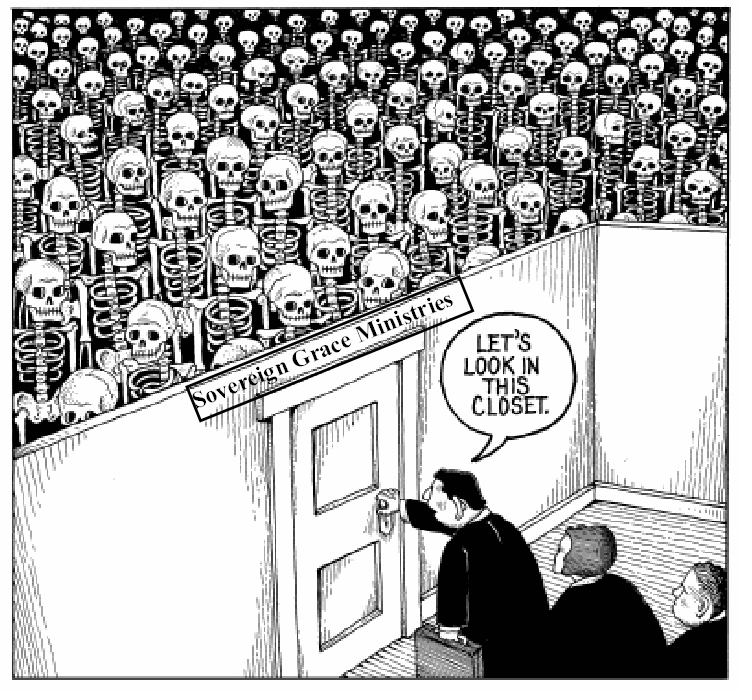 When I was 26 years old, I found myself in Gaithersburg, MD on the doorstep of what was then a People of Destiny International church (which would eventually become Sovereign Grace Ministries). When I first got there, they presented themselves as these very broad-minded, interested in ideas thinkers, social commentators, and frankly, I thought it felt like home. I was to eventually learn that was totally false. Around 1991 they started to make a transition into what I knew was Calvinism, and I had fundamental objections to Calvinism. They had no interest in ideas, and they had no interest in anybody else’s input. I made the faulty assumption that I could object, that this was a reasonable action on my part, on anybody’s part, if they saw a problem with the doctrine; that anyone should be able to say, “No, that’s not true.”
This of course embroiled me in all manner of church conflict to the point that they eventually told me I was deleterious. “And oh, by the way, why don’t you go out and start your own church?” The irony of that has never ceased to amaze me, that I could be considered deleterious (evil, wicked, pernicious, and destructive) but yet it was perfectly acceptable for me to go out and start my own church. To this day, I think that’s hilarious.
It took me a long time to unravel the problems, but because of the way I tend to approach the world, I saw commonalities. Now of course the original criticism was, “Well, the reason there’s a conflict, John, is because you’re here. The conflict is you.”
Okay.
And inasmuch as you accept that assumption, then that makes abundant sense. But remember, I had almost a decade of Christian life behind me. I already had an identity that spanned a number of different denominations, a number of different church flavors, plus the intention to create theology as a professional pursuit. So the standard denunciations and the standard objections to me didn’t work. I did not quickly embrace the notion that I could be so fundamentally wrong. But this ultimately set me on the path of identifying what is the commonality here.
I had already seen these doctrines in some form and in some fashion even in the charismatic churches. I would eventually get out of Sovereign Grace Ministries, and I would go participate in other churches and I would still see the same themes, the same ideas. And trust me, I was one of the few people going around actually objecting to the broader actions of Sovereign Grace Ministries. I was absolutely a lone voice. So any preacher I ever heard that ever said to me, “Your job is to submit to me. It is my job to defend the sheep,” I would specifically exhort them to get involved in protecting the sheep in the context of the conduct of that ministry. Universally, they said no way.
In all these churches, fundamental to them was the doctrine of submission and authority; the presumption that select men had the moral right to dictate to me intellectual conclusions. Concurrent with that submission was that they were somehow uniquely qualified to understand the truth and nobody else really was, and that by virtue of that authority, they had the right to treat me however they chose. In whatever way they qualified such a justification, at the root, that’s what they presumed. If I was not willing to embrace what they said, it was somehow a moral failing on my part. The presumption was always that the moral failing began with me. And for a while of course I accepted the presumption, but then I realized, wait a minute, this stuff exists whether I’m at this church or not.
There was only one other common denominator…
…and that was the doctrine.
With my degree and historical background I was able to trace the evolution of Christian thought effectively from the 1st century to about the 18th century. I had enough church history to understand that this pattern was actually not uncommon. Once I identified those fundamental elements, I realized this has happened before, and it has happened over and over and over. I finally had to ask myself, how is it possible that the Church either finds itself in bed with tyrants, abetting tyrants, or behaving as tyrants itself?
And that’s when I came up with this. I’ve shown this in pretty much every conference.
The Gospel According to John Immel, chapter 3:1-3
- All people act logically from their assumptions.
- It does not matter how inconsistent the ideas or insane the rationale. They will act until that logic is fulfilled.
- Therefore, when you see masses of people taking the same destructive actions, if you find the assumptions, you will find the cause.
 Now of course when I formulated this, I hadn’t yet read James Madison and his Memorial and Remonstrance against Religious Assessments, in which he states:
“7. Because experience witnesses that ecclesiastical establishments…during almost fifteen centuries has the legal establishment of Christianity been on trial. What have been its fruits? More or less in all places, pride and indolence in the clergy, ignorance and servility in the laity, and in both, superstition, bigotry and persecutions.”
“8. Because…what influence in fact have ecclesiastical establishments had on civil society? In some instances they have been seen to erect a spiritual tyranny on the ruins of civil authority; in many instances they have been seen upholding the thrones of political tyranny; and in no instance have they been seen as the guardians of the liberties of the people.”
James Madison nailed it. The bulk of Christian history is one, long, slow motion train wreck of tyranny. This is a problem that bothered me viscerally. We genuinely believe that God is love, yet with stunning consistency, the church that God sees and is supposed to call His own ends up at the forefront of tyranny. There is something seriously wrong with this picture!
The example of National Socialist Germany is an instructional morality event of epic proportions. In the 1920s, Germany was Christian by any definition. Not only was it Christian, it was Lutheran Christian by any definition. Of the 60 million people that resided in Germany, 40 million identified themselves as evangelicals. The other 20 million identified themselves as Catholic or some variation of Protestantism, with only about 1 percent embodying a genuinely non-Christian mysticism.
There is a common objection that the reason the evil in Germany took place is because a select few did bad things and that good men did nothing. The only thing necessary for evil to triumph is for good men to do nothing. Does this explain what happened to National Socialist Germany?
I’m going to let you ponder that question.
Before we can genuinely answer that question, we need to do some serious remedial work. We need to understand what shaped Germany in the 1920s. And the reason we need to understand history is because, as Adolf Hitler once said, “A man who has no sense of history is a man who has no ears or eyes.”
Now for me to do my job, I’m going to have to introduce you to philosophy.
Disciplines of Philosophy
– Metaphysics
– Epistemology
– Ethics
– Politics
– Aesthetics (art)
The nature of existence is metaphysics. How man knows what he knows is called epistemology. How we value what we know is ethics. How we interact with people is politics. And how man creatively reflects his existence back to himself is called aesthetics or art.
Man cannot help but integrate his ideas. It’s the way he’s built. From the time he is a toddler, the first thing he wants to understand is how things fit together. Man must organize his ideas into a cohesive system just like a fish must breathe in water. For man, his ideas do not hang in a vacuum. His ideas must be attached to something. And he must start from the most rudimentary part of his existence. He must start at the beginning.
It is a hard thing to learn to think in essentials, to think in principles, to think in terms of ideological relationships. It is hard to learn to think philosophically. However, most people are unaware of this big picture. Most people don’t think in these terms, yet most people treat ideas as some kind of smorgasbord. Oh, I like this one, and I like this one. Nah, I don’t like that one. I like this one. And they put it all in a basket and from time to time they will pull out an idea and say, “Yeah, that’s pretty good. Yeah, that’s pretty good.” They treat ideas very carelessly.
Often they find themselves dead square in the middle of some form of conflict, some form of psychic pain. And because they treat ideas carelessly, they don’t recognize that the psychic pain they hold is directly tied to mutually exclusive ideas that are in conflict. This is because they have not done a successful job at integrating ideas, or eliminating the errors from the most rudimentary level of their ideas to the practical outworking. The result is uncertainty. Then, one of the first things man tends to do when he encounters a conflict or an inconsistency is to punt the inconsistency into the abyss so that he doesn’t have to deal with it.
Since it is the subject of this conversation, we are already familiar with how this actually breaks down with Augustine, with Calvinistic thought. What is the metaphysical assumption of Augustine? Man is corrupt. Man is existentially corrupt. He is corrupt from the nature of his existence. He has no redeeming good quality in his existence. Anytime you think you’ve got something good, you don’t. Because man is metaphysically corrupt, that means, epistemologically, man cannot know anything. Because man cannnot know anything, his moral responsibility – his ethical responsibility – is his own self-destruction. And because man cannot do good, he will not follow through on this ethical standard. This means he necessarily needs a government that will compel him to that action. So if you won’t sacrifice you, there will be a government that will sacrifice you.
And last is aesthetics. This is how man reflects the world back to himself. Man needs a means by which he refuels his existence. He needs a means by which he takes his most rudimentary assumptions about his life and puts that into a form so that when he looks back at it, he is refreshed. This is the root of aesthetics.
However, if you presume man’s metaphysical corruption and you presume all of these fundamental things that Augustine presumes, what kind of art do you create? You create churches lined with gargoyles. You create Dante’s Inferno where the nature of your art specifically reflects man’s catastrophe, destruction, impotence, fear, terror, anxiety, neuroses, and psychoses. Your art will always follow your most rudimentary philosophical assumptions.
The dominant philosophy on the planet is collectivism. It is the presumption that man is first and foremost the property of the state, the property of society, the property of tribe, the property of community or denomination or local church or sect.
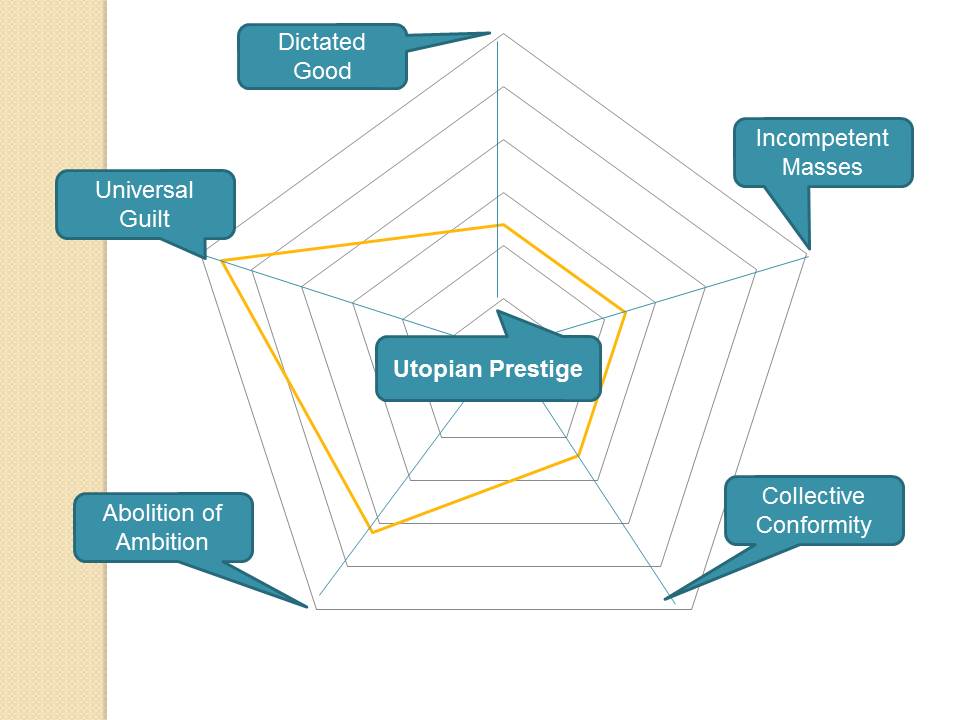 Here is my contribution to philosophy. I have identified five fundamental elements of all collectivist doctrines that are designed to produce tyranny. The reason I have organized this as a web is because I want you to understand that this is not linear. All of these elements are interdependent and do not necessarily follow in a progression. There is a dynamic tension between all the arguments. Some arguments that you hear will have facets of each of these elements. Let’s look at each one of these more closely.
Incompetent Masses
The underlying conclusion throughout Western thought has been that man’s senses or his ability to reason were fundamentally flawed. Man could not understand the world in which he lived. This is the bedrock of incompetence. If you separate man from his mind, man from his body, and man from reality there is no other place for man to live. So if you presume that man is incompetent then you set the groundwork for the next concept.
Universal Guilt
This is a tool designed to drive you to accept your own incompetence. All men are guilty of moral depravity so that no one can advocate a moral standard. If you will accept guilt, a universal guilt, a guilt for no crime whatsoever, a guilt for nothing else than for simply being an incompetent human, you will accept the standard that you are morally incapable of running your own life. If you cannot presume your own moral good then the only thing left is…
Dictated Good
Because man is guilty and incompetent to carry out the important actions, he necessarily needs someone to save him from himself. This is why there has always been a separation between the willing elite and the general masses. This is where the class society comes from. There has always been the presumption that the “true philosopher” had a special access to truth.
Abolition of Ambition
Because man is by nature an individual and not a collective being, he must be talked out of individual action. He must be persuaded that any action done independent of group sanction is the height of moral failing.
Collective Conformity
This is the end game. This is where the full force of government is brought to bear for the sole purpose of creating a neutered humanity without complexion, or variation, or distinction. This outcome is held out as an ethical ideal and forced into existence at all costs.
Utopian Prestige
All arguments are in service to the collective reputation. Notice the outcome is at the center of the web of these five elements. How many times have you heard a preacher talk about the reputation of the church? The argument is that individual action will impact the prestige of his “local collective.” This is the presumption of Utopian Prestige. In every collectivist ideology, you will ultimately see the proclaimed ideal is some utopian ideal, whether it’s the Marxist’s workers’ paradise, whether it’s the Gaia, the utopia of earth, nature rule, nature worship, whether it be heaven, racial purity, it is always some utopian ideal that has no material expression. In other words, you will never see it here.
Most people have very little exposure to formal metaphysical or epistemological science. What they will do consistently is quote ethical expectations, and they do not realize that they are in fact admitting and committing to an ethical formulation that is part of a bigger picture. This is where most people encounter the philosophical system, ethics. Usually, our culture’s social values are expressions of ethics. What we find offensive, what we get offended by in public is specifically a reflection of our ethical values. People don’t know where these ethical formulations come from, which means they don’t really think about what they mean.
Ethics is where man experiences a political or philosophical formulation. Now consider the statement, “The only thing necessary for evil to triumph is for good men to do nothing.” So then the question becomes, how is it possible for good men to sit by and do nothing? Remember that all behavior flows from metaphysical assumptions and is driven by logic. In order to answer the question, we must first consider, what are the root assumptions, and what is the progression of thought that leads to a behavior where good men will not act against evil?
To be continued…
The History of Western Philosophy and Its Societal Impact on the Church – Part 8
The following is the final part of an eight-part series.
Taken from John Immel’s third session
at the 2013 Conference on Gospel Discernment and Spiritual Tyranny
~ Edited by Andy Young
| Click here for part one Click here for part two Click here for part three Click here for part four |
Click here for part five Click here for part six Click here for part seven |
 The Concept of the “Common Good”
The “common good” is a collectivist myth designed to achieve the outcome of subordinating the individual to the majority. The collective well-being is the supreme measure of ethics. The phrase implies that if the individual acts for the “good” of the group, the individual is taking moral action. Notice the equation; action for the group = morality. However, there are three primary problems with the concept of the “common good”
1. It is deception.
By definition, “common” is a synonym for a generalization, and by definition a generalization does not have a specific definition. So when a person speaks of the “common good”, they are appointing themselves the spokesman for some loosely defined group. In conversation, the “common good” is used to refer to the good of the public or the community or society or the tribe. However, each of these words is merely a poor label for the intangible sum of individual interaction. The point is, such “groups” do not really exist.
- “The public”: an adjective describing individual conduct exposed to general view.
- “The community”: little more that the interaction of individual people in close proximity.
- “Society”: The aggregate actions of many “sub-groups” within a geographic location.
- “The Tribe”: A “group” based on genetic similarities. A religious denomination is merely a tribal preoccupation shifted from genetic pedigree to doctrinal pedigree.
 So the thing that is “common” is not really common at all. There is no “thing” that is the direct recipient of good, because there is no specific object to receive the “good”. The work you do doesn’t benefit the good of the group, it benefits the good of individuals within the group.
The purpose of the deception is to conceal the root presumption that the collective stands supreme to its individual members, for the “common good” is really the good of the group at the expense of the individual members. Or said another way, the individual is a sacrificial animal to the will of the collective. Any individual who is perceived as a threat to the survival of the group must be sacrificed.
Every time I hear somebody talk about altruism and the “common good”, the conceit in this means that if my life is to be sacrificed to you, the necessary presumption is that your life in turn should be sacrificed to me. I own your life by default, and you think that’s morality? You think that’s just and good? So we’re reduced to moral cannibalism?
2. It poses as morality
The “common good” is really a moral subterfuge because it is an indefinable, elastic concept that can be shaped to apply to any outcome for any political whim. Since the group is elastic based on momentary standards of inclusion, the definition of “good” constantly changes. There is really no constant “yardstick” of measurement but rather a thick syrup that clouds the eyes and ears of its victims and makes them abandon morality rather than cling to it.
The “common good” inspires people to lay down values in service to a select few who claim to be spokesmen for the majority. We see this in political conversation all the time. The outcome is that the spokesmen have a moral blank check that every individual is obligated to cash.
You wonder why you hear stories of molestation coming out of church groups and Christian universities and missionary organizations, where the leadership and authority specifically tried to conceal the crimes against the children and members and students. This is the moral blank check that parents are supposed to cash in behalf of the child who was molested. This is EVIL, fundamental evil!
3. It masquerades as good.
 If taken literally, the error within the expression “common good” itself becomes glaringly obvious. When people advocate for the “common good”, they think they are saying the “good” of all individuals admitted to the group. Or maybe if they paused to consider more deeply, they are saying the “good” of the majority. This doesn’t yet sound too scandalous because “good” is what is done numerically for the greatest amount of individuals. People do a loose moral calculus and decide that the greater the sum, the more moral the action.
But here is the result of that rationale: moral action is quantifiable by statistical outcome. If morality is nothing more than statistics then it is a trivial exercise to justify the Holocost. Stalin created a famine and killed 7 million people, but by the standard of the “common good” his actions are “moral” because the mathematical formula benefits 100 million faithful communists. The “common good” is used to justify taking enormous sums of money from individuals in order to pay for other people’s medical care, or whatever your favorite government program happens to be.
Having identified the three problems with the notion of “common” good, let us examine how this is all used at the root of tyranny.
We now know that the “common good” does not exist because the concepts of group do not exist, and they are never the recipient of any action. Only individuals receive good. Only individuals receive value. It is a false morality designed to subordinate all people to the collective, but who defines the collective?
At the root of all collectivist organizations there is usually only one person holding the yardstick of group inclusion. This person surrounds himself with a gang to defend against any interloper. He is the voice of the people, the voice of community, the voice of society, the voice of the tribe, the voice of the church.
 What people fail to grasp is the “good” of the people is really subterfuge to justify the violation of individual rights. The function of this expression is designed to violate individual rights, and when you violate individual rights you are really abolishing all rights. Groups do not have rights. When you tell me I must subordinate my rights to the group, the group does not gain them by proxy. They have been forfeited.
If there is no such thing as “rights”, the thug, surrounded by his gang, is free to use force (government) to achieve whatever outcome they fancy.The collectivist thug is at once empowered to force people to conform to the collective and shielded against all outcomes. It doesn’t matter what happens next.
This is why you have the brutal absurdity of Soviet Russia. The USSR was built in service to the “common good”, yet the only people who prospered were the tiny gang who surrounded the bloodiest despot in history, Joseph Stalin. The rest of the population lived in sub-human misery for almost three generations.
This is why you have the mystical tyranny of the medieval Catholic church. The Catholic church portrayed itself as the greatest proponent of human good on the planet, yet from effectively 600AD to almost 1500 AD the church leadership lived a comparatively lavish lifestyle, and the serfs existed generation after generation in squalor.
 In the modern age, think of any social program that is said and done for “the people,” for “the society,” for “the community”. Now define exactly what the program does; give money for college, pay for medicine, feed the hungry. If you look at the actual event, only a select number of individuals actually receive the benefit, and all of the authority (force) is invested in a bureaucrat whose sole function is to weed out those who never receive the “good”.
Some of you are squirming because I have placed “community” in the same pot of condemnation. You long for community. You conceptualize your local church as a community. You think this is a social ideal. You think that the community does good. And you like the fact that you vicariously participate in the moral reputation, the prestige, of the group. You want the prestige plus you long for an inter-personal connection, and you yearn to find friends and have “relationships.” You pine for an indescribable thing that is a cross between a Norman Rockwell painting and the television sitcom, “Cheers”, where everybody knows your name. For the life of you, you struggle to see how this is the same seedbed of evil that I have been talking about.
Unfortunately, I am about to tell you that Santa Clause does not exist.
Look closely at the real social dynamic of your community. The connectedness, the relationships that you seek is really the exchange of individual value on an inter-personal level. You long to live in Mayberry R.F.D., filled with “Aunt Beas” baking apple pies waiting on the porch, never once realizing that the safety and security and fraternity that you want cannot happen if the highest moral standard is sacrifice of personal desires and personal values for the “common good.”
 The price of admission to the community is the very self that you must surrender for public consumption. Think about that. To participate in community means that you must get rid of the very thing that makes you unique. This is why most communities (read “churches”) are petty, and gossipy, and back-stabbing, and cliquey. Everyone in the community is constantly vying for some piece of the “common good.” In the end, you realize that the mindless hoards sitting in the pews are there to graze over you like a buffet table.
Now let’s back up to the 10,000-foot view. Now you can see why metaphysics and epistemology are so important. Now you can see how everything revolves around a specific body of ideas that begins with Thales and evolves all the way down to the Cynics and the Stoics, formalized and systematized by Plato, and eventually shape Augustine, Calvin, and Luther. Inasmuch as you continue to accept their premises, you will continue to achieve the same outcome.
If you think the Neo Calvinists are ugly now, you wait and see what happens when you give them just an ounce of civil authority. There will be bloodshed. I know you think that’s scandalous, I get that. It may not even be the guys in the pulpits right this minute. But if you let this construct get hold of civil government, if you have the marriage of faith and force, they will make John Calvin look like a choir boy and Geneva look like a day at the beach. Make no mistake, at the root of this doctrine lie death and destruction.
When you separate man from his mind and his mind from reality, the only thing he has left to deal with another man is a club. The moment we have a club in our hands we are no longer offering an argument. And these guys don’t offer arguments. They have to bail on the conversation every single time they are pressed on the points of their doctrine. They must punt into the grand “mystery” of God. They don’t have a choice.
 Once they are finally confronted with the dead end of their logic, all they can do next is attack and posture and threaten. Inasmuch as you fear that retaliation and extortion, you will willingly shut your mouth. This is why you see such enormous fear coming out of the pews. The discernment blogs and survivor blogs start discussing how they were treated. Everybody online is anonymous, not because they are trying to be deceitful, but because they are terrified!
They have accepted the premise.
What made me specifically so dangerous to them is that I rejected the premise. And that will make you dangerous. When you reject the premise, they will become terrified of you. They do not have the power, and if they ever get close to civil government, resist them with all of your might!
All collectivist cultures are tyrannies.
The philosophy of collectivism claims that there is a mystical, supernatural, social organism that embodies the highest moral values. Of course, only a few elite people with special insight can fully grasp this truth. Somehow they have access to special source knowledge that transcends the average man’s mind. Average men are incompetent, helpless, mindless creatures, depraved and unworthy of social interactions. So they must be purified to serve the collective organism.
Men cannot deal with other men voluntarily because they have no peaceful means to settle disputes. They have no means to act as contractual beings because they are metaphysically incapable of doing good. Human salvation always boils down to an elite clique endowed with some mystical insight, and that insight qualifies them to rule men. They are dictators of an omnipotent, benevolent state, doing what is best for the “common good.”
 All collectivist ideologies hold the same political assumption. All collectivist doctrines seek the exact same end – subjugation of the individual. Man must be chained to the collective. Man is property of the state. Statism is always implemented by force.
The measure of social slavery is directly proportional to how much the slogan of “common good” is embraced. Conversely, the measure of civil liberty is directly proportional to how much the same slogan is overtly rejected. Our Founding Fathers rejected this notion of “common good”. They recognized that the legitimate role of government was specifically to defend the individual and his life, his liberty, and his pursuit of happiness. These are notions contrary to “common good.”
It is an easy slogan to reject because there is no such thing as a generalized good, because only individuals receive values. As soon as you realize it is a hoax it becomes a matter of course to refuse to pay homage to the fraud. Good is not being done. The reality is that people are enslaved to the fancies of others. No man has a moral obligation to subjugation to another man.
The Longing for Revival
We erroneously believe that a return to God will naturally be a return to morality. A return to morality is really a return to a belief in divine extortion. When morality is the product of divine command, the fight becomes about which divine we follow. What the Platonist/Augustian/Calvinsit version of Christianity has shown is that it has nothing to offer as a counter to militant ideologies.
Their first test was Islam. The eastern church showed itself impotent to stop the ideological tide of Islam. Christianity had so gutted the intellectual rigor of intellectual thought, that when confronted with a totally irrational ideology based on war, it could offer no counter.
Of course, Protestants like to push these things off as “those dastardly Catholics.” But Protestants have not fared any better. The Southern Presbyterian Church was in the forefront of slavery within the United States. Of course, Presbyterianism has a direct pedigree line with ties to the reformed tradition.
The reformed tradition’s next test would be National Socialist Germany. It failed miserably. Lutheran churches, with almost no exception, joined “the party” and remained committed to National Socialism until the collapse of the Third Reich.
Christianity has shown itself impotent to offer any intellectual defense against Marxism, National Socialism, and Islam, and that’s just in the modern day.
But they cannot lay claim to mere impotence. It isn’t “God’s will.” Christianity has with far too much consistency been connected to the tyranny. This is not a new observation.
“7. Because experience witnesseth that ecclesiastical establishments, instead of maintaining the purity and efficacy of Religion, have had a contrary operation. During almost fifteen centuries has the legal establishment of Christianity been on trial. What have been its fruits? More or less in all places, pride and indolence in the Clergy, ignorance and servility in the laity, in both, superstition, bigotry and persecution.”
~ James Madison, “A Memorial in Remonstrance Against Religious Assessments”, 1786
“In every country and in every age, the priest has been hostile to liberty. He is always in alliance with the despot, abetting his abuses in return for protection of his own.”
 ~ Thomas Jefferson
“Millions of innocent men, women, and children, since the introduction of Christianity, have been burned, tortured, fined, and imprisoned, yet we have not advanced one inch towards uniformity. What has been the effect of coercion? To make one half the world fools, and the other half hypocrites; to support roguery and error all over the earth”
~ Thomas Jefferson
“I could never join Calvin in addressing his god. He was indeed an atheist, which I can never be, or rather his religion was demonism. If ever a man worshipped a false god!”
~ Thomas Jefferson, in a letter to John Adams, April 1823
 Here is the absolute conclusion of all we have studied in this series. For anyone with intellectual integrity, these things should be fully and entirely unacceptable. This should compel you to evaluate the content of Christianity for what it has said for the whole of its history. It is not an accident that the same tyranny abetted by the church has occurred over and over and over.
And now, having heard where all this is rooted, you are without excuse. Now you have seen where the core of Protestant doctrine comes from. The intellectual pedigree goes as far back as Heraclitus and the Pythagoreans. It finds its full philosophic formation in Plato, it is welded into Christian thinking by Augustine, and it is put into practice by Luther and Calvin – from Augustine to Luther to Calvin to the Synod of Dort to the Westminster Confessions to the Puritans to the local pastor pounding the pulpit.
The dots are all connected, and now it rests on you to resist the disaster.
~ John
| Click here for part one Click here for part two Click here for part three Click here for part four |
Click here for part five Click here for part six Click here for part seven |

 Paul's Passing Thoughts
2 comments