Calvinism and New Calvinism: When the Black Lamb of the Family is the Patriarch
 “Nevertheless, it is interesting to see the tacit admissions that Calvinism has a history that makes some Calvinists, ‘uncomfortable.’”
There are a lot of Presbyterian pastors that I have much respect for. And I understand their dilemma: Lutheran = Luther, Methodist = Wesley, etc., and Presbyterian = John Calvin. I mean, this is tough: “Hi, my name is Fred. I have been a Presbyterian all of my life, which is a denomination founded on a murdering mystic despot.” Geez, I feel for them—I really do.
Nevertheless, it is interesting to see the tacit admissions that Calvinism has a history that makes some Calvinists, “uncomfortable.” This is where New Calvinism is like a distinguished family getting a visitation from a long lost relative with a long dark past. It’s like already having several dinner parties planned in a small town where a past relative is new in town, and meaner than a junkyard dog, and starts blabbing about family roots. That’s when you cancel the dinner parties or preplan your responses: “Well, many of our relatives are uncomfortable with that part of our family tree.” It is then hoped the guests will be polite and not mention that it is the root of the tree.
As will be thoroughly documented in The Truth About New Calvinism: Volume 2, New Calvinism has the history, doctrine, and character of authentic Calvinism down pat—they are the incarnation of the original article to a “T.” This is a simple thing; the present-day church being awash in spiritual abuse is merely Calvin’s Geneva: act 2. It is what it is. And thanks to the Australian Forum, all of the heavy lifting in regard to the research has been done.
These thoughts bring me to an article that was sent to me by a reader. It was from The Aquila Report which is “Your independent source for news and commentary from and about conservative, orthodox evangelicals in the Reformed and Presbyterian family of churches.” Recently, Aquila reported on a family forum held (I think) in Dallas TX where the Reformed family tried to get some understanding between them and the part of the family tree that showed up again in 1970—wreaking havoc on the rest of the family in the form of Sonship Theology and New Calvinism. Unfortunately, in regard to Powlison, Keller, and Duncan, et al, these are your daddy’s Presbyterians. Presbyterians that have truly grown in grace, but kept the name, are in a quandary to say the least.
The article was reposted on The Aquila Report by Matt Tuininga , a blogger of the United Reformed stripe. It is a commentary on an article written by sociologist Phillip Jenkins who, in the original article written by him, states uncanny parallels between early Reformed clans and Islam. Tuininga begins his post this way:
In a fascinating column in RealClearReligion the famous sociologist of religion Philip Jenkins compares the radical Islam of figures like Sayyid Qutb (author of Milestones and an intellectual father of modern day Islamism) with 16th Century Calvinism.
Well, that’s not good!
But then Tuininga adds this:
Jenkins’s overall point is to demonstrate that a religion often evolves in positive ways only by first passing through dark times.
I’m not sure that’s Jenkins’ overall point, but hey, let’s roll with it. This would then indicate that the “dark” side of the family tree is back with a vengeance in the form of New Calvinism. And be sure of this: the only difference between the behaviors is the filter of American jurisprudence. I have dealt with New Calvinists first hand (some well-known), and trust me, they would light me up with the green wood in a heartbeat if they could get away with it. What they actually did wasn’t much less.
Incredibly, Tuininga then makes the exact same point that author John Immel has been making for years and propagated on Spiritual Tyranny .com and in his book, Blight In The Vineyard. Tuininga quotes Jenkins with conspicuous undisagreement:
In the case of the West, he suggests, the Enlightenment followed the radicalism and iconoclasm of the Reformation; Protestants had to destroy much of what came before them in medieval Christianity in order to forge new ways to the future.
The fact that America’s founding fathers were children of the Enlightenment which was a pushback against European spiritual despotism was a major theme of our 2012 TANC conference. Immel presented the thesis brilliantly, and left little room for denial in regard to the fact that the Reformers were separated from Rome on doctrine (both false, by the way), but not the underlying philosophy that leads to spiritual tyranny. Overall, knowing beforehand that people are not lining up to hear this proposition, we are happy with how the conference turned out and are looking forward to next year.
Hence, “Protestants had to destroy much of what came before them in medieval Christianity in order to forge new ways to the future” focuses on iconic superstition and conveniently leaves out superstitions like the truth test to determine if someone was a witch: if you can swim, you get hung or burned at the stake; if you can’t swim—you drown. Suspicion equaled certain death, so I imagine woman of that era were particularly well behaved. The present-day replacement is the Patriarchy Movement.
ADMISSION
Tuininga continues:
In the process of making this argument Jenkins accurately portrays a side of 17th Century Calvinism that most present-day Calvinists would find troubling. Speaking of the Dutch Reformed iconoclasts of the 1560s, he writes,
“Beyond smashing images, the insurgents had other ideas that look strikingly familiar to anyone familiar with radical Islam today, with thinkers like Sayyid Qutb and Maulana Mawdudi.
The Calvinists of the 1560s sought to remodel society on the basis of theocratic Old Testament law strictly interpreted, with the role of the sovereign measured by how far he or she submitted to God’s will. Some thinkers devised a pioneering theory of tyrannicide, justifying the removal of any allegedly Christian ruler who betrayed Christ’s true church. Protestant radicals pursued a harsh policy of reading rival believers out of the faith, defining the followers of images as utterly anti-Christian, deadly enemies of God.…
In the English-speaking world, the heirs of 1566 were the Puritans, the radicals who dreamed of an austere New England. When Puritans seized power in England itself in the 1640s, their agents toured the country, smashing statues and windows in every parish church they could find. By the 1640s, at the height of Europe’s death struggle between Protestants and Catholics, Calvinist ideas that to us seem intolerably theocratic dominated not just the Netherlands, but also New England, Switzerland and Scotland, and were struggling for ascendancy in the whole British Isles. Religious zeal often expressed itself through witchcraft persecutions.”
DENIAL
….To be sure, what Jenkins describes here was not true of all Calvinists. John Calvin himself, living in an earlier century, explicitly rejected the sort of strict allegiance to the Old Testament civil law that Jenkins here describes, and he absolutely rejected the theories of tyrannicide and rebellion articulated by some of his followers. But Jenkins nevertheless accurately describes a strand of Calvinism, and his description of the violence and disorder that was sparked by radical Calvinist notions of what allegiance to God in the public square demanded is truthful, if not representative of the whole tradition.
In regard to Calvin himself, this is blatant denial in the face of historical fact that is not even difficult to find, but he finishes with this head-scratcher:
But Jenkins nevertheless accurately describes a strand of Calvinism, and his description of the violence and disorder that was sparked by radical Calvinist notions of what allegiance to God in the public square demanded is truthful, if not representative of the whole tradition.
The “whole tradition”? Is it a “strand” or the “whole tradition”?
THE DINNER PARTY
….One question we might ask here is to what extent was this old militant Calvinism different from the Islamism with which our nation is in conflict today. If Calvinists today were advocating theories of resistance and revolution, or if they were suggesting that the current U.S. government of Barack Obama is illegitimate such that Christians do not owe it allegiance, would the state have to launch a campaign against them as well? What if they were defending tyrannicide, based on the belief that Barack Obama is a tyrant?
Actually, this is not so theoretical. If there is one thing I have learned since starting this blog, it is that there are a number of Calvinists out there today who would espouse virtually all of these views (perhaps even tyrannicide? I’m not sure …). I don’t think most Reformed Christians give the time of day to these thinkers, but there is a minority that is with them all the way…. But I would like to ask those who find these arguments persuasive, do you really want to go back to the heyday of Calvinist revolution and theocracy? Is it the American project that you reject – with its commitment to religious liberty and the separation of church and state? And if so, how do you distinguish your own cause from that of the Islamists, especially the more respectable groups like the Muslim Brotherhood, or the intellectual followers of Sayyid Qutb? To those who, like me, find this brand of Calvinism profoundly troubling, how do you reject it without some sort of distinction between the two kingdoms, between the kingdom of Jesus, and the political institutions of this age?
Well, obviously, Tuininga has no intentions of cancelling his dinner parties. And hopefully, the guests won’t bring up the new family in town who claim kinship: while the children of other families build snowmen and sandcastles, the children of the new family in town build guillotines and gallows. And the New Calvinist’s constant haranguing of the “American dream” has become a constant drumbeat. The particular video of a New Calvinist stating that “every corner of the Earth belongs to us” is also particularity chilling. Just two weeks ago, Susan and I sat under the teaching of a well-known college professor at a Christian University (who is a New Calvinist). His message was absolutely nothing short of a Communist manifesto. Recently, I have received emails from people who attend a Southern Baptist church that is strongly influenced by David Platt. His social socialist gospel is beginning to give people the creeps big-time.
John Immel is way ahead of the curve on this stuff. I recently heard John Piper say that he didn’t believe in a marriage between church and state; I DON’T BELIEVE HIM. In fact, I am going to attempt to meet with people who have information on this for my upcoming book project. More and more, a formula is emerging that seems to explain everything: a united front of denominations (think: John MacArthur hanging with CJ Mahaney etc) who can all agree on a central theme/doctrine: the total depravity of all mankind including Christians, and the need for philosopher kings to save humanity from themselves with the use of the sword if necessary. And by the way, agreement with a knowing nod from Communists and Muslims lingers not far behind. This formula begins to make sense of perplexing love affairs; such as, MacArthur/Mahaney, Horton/ Warren, Piper/Warren, Piper/Wilson, Obama/Warren, Mohler/United Nations, Dever/United Nations, etc., etc., ect., add cold chills.
A SORT-OF ADMISSION
But lastly, to bolster this point, Tuininga’s conclusion is to die for:
Jenkins appreciates the fact that the violence and revolution associated with early Calvinism was an important part of the story of how the democratic liberties and political structures that we take for granted came to exist. Calvinism had its own growing pains, and the best political theological insights from its earlier years need to be extracted from a number of assumptions and applications that were inconsistent with the teaching of Scripture. But not every Calvinist views things this way. That’s why we need to keep making the point.
Can we say, I-m-m-e-l? John has shared something with me that I agree with: in my own words; America’s founding fathers were humming Willy Nelson’s “You Were Always on My Mind” while framing the Constitution, and the “you” pertained to John Calvin in particular. While I think that Tuininga would give tacit merit to that assertion….
The Dinner Party:
Host:
….Calvinism had its own growing pains, and the best political theological insights from its earlier years need to be extracted from a number of assumptions and applications that were inconsistent with the teaching of Scripture. But not every Calvinist views things this way. That’s why we need to keep making the point.
Guest: (Polite silence)
paul
The Doctrine of Centralism Will Save First Baptist Church of Hammond and IFB
 In my recent post, The Doctrine of Centralism and the “Cult” Misnomer, I explain the doctrine of control, or centralism. First, Western culture is predicated on the idea that philosophers should rule over the ignorant masses. This was formulated in the first philosophical think tank and institution of higher learning located in Athens Greece circa 400BC. From there, the philosophy moved forward and made its impact on Western culture through the secular realm and the religious realm.
In the religious realm, Plato’s philosopher kings became popes and Reformation elders. That is why the Reformers and the popes both believed (and still do) in the integration of religion and state for purposes of enforcing “God’s law” on society. The state gets a unifying belief system that unites the populous in the deal, and the philosopher kings get an army to enforce discipline on the totally depraved sheep if necessary. The whole idea that the Reformation was a contention for the true gospel of grace is just really bad history—it was a fight for control of the mutton.
The founding fathers of America were contemporary observers of the results, which have never been good. The U.S. constitution was predicated on the idea of keeping the church separate from state with the latter being in complete servitude to the people. But centralism remains dominate in American religion. However, it can’t enforce its control by the stake or gallows, so it improvises through indoctrination. In years past, popes and the likes of John Calvin did not have to be good at indoctrination because the state enforced their doctrine—contemporary proponents of centralism have to craft their doctrine well in order to gain control of people.
And the Independent Fundamental Baptist (IFB) pastor kings are among the very best. We will now examine the art of centralism indoctrination. Keep in mind that a lot of the indoctrination is already in place via years of “preaching” by Jack Hyles and his recently fired son-in-law who had sex with a sixteen year old girl. We will focus on the centralism being used to deal with this recent scandal, and paving the way for business as usual at the First Baptist Church of Hammond and IFB churches in general.
Because of my busy schedule, I do not have time to document the actual footage I have seen in this situation that fit into the following criteria, but perhaps readers could comment and add the citations for each.
1. The philosopher king has fallen. The emphasis is on the great loss of this vital pastor king whom the totally depraved sinner-saints depend on. He will be mentioned 100 to one in comparison to the victim. “Oh my! The sheep are without a shepherd!”
2. Enlightened, but still of the earth. Remember, though pastor kings are enlightened and “called” of God to lead the totally depraved zombie sheep home through the dark maze of sanctification, they are still SINNERS. These poor souls have been called of God to vex their righteous souls among the totally depraved, and bless their hearts, sometimes they “fall.” How dare we judge them when they have forfeited their rightful place in heaven to lead us amidst this pigpen called Earth!
3. It’s the congregations’ fault. I have heard several comments by IFB big guns who have been brought in to apply the centralism protocol that implements this element, including the interim pastor king. Basically, the idea that because of the inherent selfishness of the zombie sheep, too much pressure was put on Schaap—leading to his “fall.” The kingdom of darkness targets the pastor kings specifically, and the congregation has been an unwitting accomplice with the devil. THEY SHOULD BE ASHAMED!
4. Certification/reassurance by secondary pastor kings. The sub-pastor kings at FBCH reassure the totally depraved zombie sheep that Schaap is still God’s anointed pastor king. They point to his many years of faithful service as proof [this guy was fairly good, it took 11 years to catch him]. As one sub-pastor king noted, “I love this church.” Ah, and if a pastor king loves that church—you must also. Thou pastor king has spoken—let it be written. Who can forget the infamous words of daddy Jack Hyles: “Now I want you to close your Bibles and listen to me.”
5. Dualism. All that IFB does that manifests heaven is a testimony to godly unity, and proof that there is an IFB temple in heavenly Jerusalem. But when something bad happens, it has absolutely NOTHING to do with the heavenly IFB. Because after all, they are “independent” of each other. You idiot, can’t you read the “independent” in “IFB”? In all of their “unity” (IFB has a cooperative network unmatched anywhere on Earth), is heaven manifested on earth, but when they fall get caught, that is a manifestation of the “independent” church’s evil matter. “You can’t just swath a big brush across all of IFB because of this!” Oh yes you can. All IFB affiliated churches run by the same playbook that is driven by the same philosophy. Hence, the results will be duplicated. Look, this prism is exact across all denominational, religious, and cultic lines. It is based a specific presupposition concerning mankind as opposed to a true emphasis on the priesthood of believers. This protocol can be seen to a “T” in the SBC, and especially SGM. Therefore, the massive network based on a given philosophy that produces the behavior is preserved.
6. Us against them. The “world” and competing philosopher kings would love to see the heavenly IFB’s representation on earth fall. Don’t let that happen! Be a team player! “Please, stick with us.”
Yes, much is at stake. IFB philosopher pastor kings could be deprived of the concubines that they so deserve—a small price for us to pay for their sacrifice for us in the evil realm of earthly matter. Fathers should feel privileged and proud as their raped daughters sign confessions for being the devil’s advocates in bringing down the great pastor kings.
And this isn’t just IFB, this is a mirror image of the SBC, SGM, LDS, GARB, etc., etc., etc., etc..
paul
Recent Movie Theater Massacre Further Reveals Christian Sloth
I begin this post with the following illustration. It is a hypothetical conversation between Mary Mystic (a good Christian woman) and Perry Prosecutor (an unregenerate district attorney) at an auto repair waiting room:
Mary: while reading the discarded newspaper lying on the waiting room table; “Oh my, did you hear about that tragedy?”
Perry: “What tragedy?”
Mary: “The woman who drowned her three children by driving her car into a pond.”
Perry: “Yes, I heard about it, I am the one prosecuting the case.”
Mary: “Oh my! Such a tragedy!”
Perry: “Tragedy?”
Mary: “Yes! The lives of those precious children are cut short, and of course, the poor mother has lost her mind!”
Perry: “Actually, her mind was well with her, and not lost. The scheme was well planned. The only thing that broke the case quickly was the fact that our seasoned detectives have seen the same well planned scheme before.”
Mary: “Oh, I see. But yet, you would have to be crazy to do something like that to your own children!”
Perry: “Why is it only crazy because it was ‘her own children’? Is killing the children of others less crazy?”
Mary: “Uh, well, I see your point, but why in the world would a mother do such a thing?”
Perry: “The answer is quite simple; her newly found boyfriend doesn’t like children, and the children were getting in the way of the relationship.”
Mary: “Oh come now! Surely it is not that simple! No mother is that selfish!”
Perry: “Well, you’re right, it is not entirely that simple; the mother somewhat resented the children because they reminded her of her ex-husband, who she hates.”
Mary: “How can you be so sure about that?”
Perry: “That’s what she told us when she confessed.”
Mary: “Uh, well, uh, really?”
Perry: “Yes, ‘really.’”
Mary: “Well, for the grace of God, there goes us.”
Perry: “Hmmm. So, you’re a Christian?”
Mary: “Oh yes, for sure!”
Perry: “Thanks for telling me that. I now know not to hire any Christians because we wouldn’t solve any cases.”
Such is the case when such “tragedies” surface in American culture from time to time and the recent movie theater massacre in Colorado is no exception. Nobody has answers, especially Christians. While waxing eloquent about how Christ came to save the world from such things, we don’t know why they happen and what can be done to prevent them. Certainly, making people Christians by faith in Christ alone is not the answer because Christians don’t act any different than unbelievers. Statistically, whether divorce, depression, suicide, sexual abuse—you name it—there is no significant difference.
Is this a surprise? If we don’t know why things happen, how can we prevent them? The world doesn’t know why, so stuff happens. Neither do Christians know, so just as much misery accompanies Christianity regardless of the fact that Christ said He came to give us life—and that more abundantly. Present tense. This hypothetical (in the minds of Chrsitians) result suggested by the God-Man should result in another hypothetical result suggested by the Apostle Peter: people see by our lives that we have hope, and come to us when no one is looking to get some answers. But they aren’t asking. Why would they? There is no less human carnage and decadence lying about the landscape in Christianville.
And the reason is Christian sloth, primarily in the area of THINKING. American Christianity has become a flock of lazy thinkers. We like our Christianity easy, and mindless, and are willing to endure the misery that comes with it. Sound bites, clichés, and truisms long ago replaced Christ’s exhortation to seek with all of our heart, soul, and mind. In the recent TANC conference on Gospel Discernment and Spiritual Tyranny, John Immel got it right: “thinking is hard” and “ideas are hard” and Christians are up to neither. This is why we prefer things that are EASY. Thinking is hard. And the Colorado massacre reveals such.
I am not going to cite specific examples, but the Christian articles going viral on the internet are the ones offering the pat answers and borrowing sound bites from the world; for example, calling the massacre a “senseless act.” No it wasn’t. The act was masterfully planned. When the goal of the individual is considered, the act makes perfect sense and again, was very well planned. Like the world, Christians continue to call such well-planned actions “senseless”—because that’s easy and we don’t have to make sense of it—that’s hard.
As John Immel also discussed in the aforementioned conference, we home school our children and shelter them from the world. That is much easier than teaching them to think. Because Christians have lost their will to work hard in the arena of ideas and thinking, we are no match for the world or a cure for them. Therefore, we need to stay separate. Given the circumstances, that’s probably wise. But here is why the world will look to its psychologists for answers rather than us, even though the young man who committed the act was studying to be a psychologist: they at least work hard at trying to figure stuff out. Give them that. Christians don’t do that because it supposedly violates the principle of child-like faith. As Immel aptly pointed out in the same conference, faith is a license to be simpleminded. Figuring stuff out by studying what the Apostle Paul called “the mind of Christ” is pragmatic arrogance.
God is taking care of a mass of different kinds of business in the lives of people through these events. Even with me. Not but two days ago, my son Phillip walked past me with what is known as “alternative music” blaring on some kind of newfangled device. The lyrics of said music is known to espouse its ideas regarding, murder, rape, suicide, authority, virginity, knowledge, and host of other subjects. One such band named “Slipknot,” has hanging one’s self with this device (which strangles the victim slowly rather than the hangman’s noose that breaks the neck and brings a quick death) as their major theme. Has our family sat down to discuss this issue in regard to the mind of Christ? No, because that’s hard. It’s much easier to say, “Well, song lyrics are just words. Certainly, my well-bred child would not be persuaded by such things. Besides, teenagers are focused on the beat, not the words.” That’s easy. What the Scriptures say about thinking isn’t.
In the Great Commission, Christ said to make disciples, not saved people. But we disobey because making disciples is hard—believing in Jesus and signing a card is easy. “Praying about it” is very easy when compared to the very difficult business of CHANGE. And in regard to thinking, the Apostle Paul calls us to a shocking duty: to take EVERY THOUGHT captive and bring it into obedience to Christ. If we think about that, which we don’t, because of the ramifications, we must conclude that our disobedience in this regard can lead to nothing other than unhappiness and ill results. But that’s hard—we want merry mindlessness and a plea of ignorance when things happen that are “difficult questions” that we dare not answer lest we be deemed arrogant know-it-alls. Better that people suffer on the altar of child-like faith. Besides, the unpleasant challenge to vigorously pursue wisdom will be quickly whisked away by the pastor’s pat answers, the caretaker, or a chemical lobotomy if death is stubborn.
The movie was the midnight premier of the most recent Batman trilogy. Just a movie, right? Of course, to give pause and think about all of the craziness surrounding this movie, including its very dark character, would be taking the whole thing too seriously. When people wait in long lines dressed up like the characters to proclaim their “obsession” with everything Batman, such should not give us pause—it’s all just a bunch of fun. But again, the Apostle’s call to hard thinking upsets our merry mindlessness and challenges us to consider these things. In Philippians, chapter 4, Paul exhorts us to “dwell” on what is “true” with the result being “peace.” The Scriptures continually warn of living in a fantasy world and dwelling on untruth. A pastor once shared with me about a certain lady in a midweek Bible study who requested prayer for characters in a daily soap opera that she watched on TV. Her mind was so saturated with the show that the lines between fantasy and reality became blurred.
Hence, while Christians are clueless, I heard solid answers in regard to the massacre from a secular thinker on a morning program. He proposed that three primary elements led to the perpetration of the crime:
1. The individual was taken over by the fantasy and wanted to actually place himself in the narrative (apparently, he was dressed like the Joker and yelled, “I am the Joker” before he started shooting).
2. He may have been overly enamored with the power that the Joker had over other people’s lives and was willing to throw his whole life away, and the lives of others in order to experience that—if even for one hour.
3. He was recently experiencing personal failures and disappointments in his life.
Good points. And there is something for Christians to learn here: we are instructed in Scripture to watch our thinking very carefully, and the Bible addresses thinking in regard to disappointments, attitudes towards others, attitudes towards self, and a myriad of other headings under the topic of thinking. Thinking is hard work, and Christian sloth in regard to thinking is exactly why we are no different than the world.
Bless their hearts, the world works hard at thinking, but they don’t have the answers. We do, but don’t think—our faith is a license for mindlessness. Enough with the softball truisms on this thing. Christians should not be surprised about this event or perplexed about it: uncaptivated, sinful thinking leads us away from guarding the mind which the Bible calls the “wellspring of life.” Sin is powerful, and this event should cause Christians to take pause and reconsider how serious they are concerning the words of the Holy Spirit.
This is not an “isolated incident.” God has knowledge of every person on Earth who has fantasized about doing the same thing (which by the way is depicted in a Batman comic book to a “T”), but didn’t actually act on the fantasy. I seriously doubt that those incidents of sin in the mind are “isolated.” And “isolated” from what exactly? Reality? Good grief.
Paul
Authentic Calvinism has Always Been Anti-Thinking
 Of course, sanctified Calvinists like Jay Adams have always been pioneers in teaching Christians to think biblically. Adams was also the pioneer in advocating the competence of believers to counsel themselves and others from the Scriptures. Adams’ revolution began in 1970 and included themes that embraced the church’s greatest needs at that time and yet today, such as, “Competent to Counsel,” and “More Than Redemption.”
However, in that same year, Robert Brinsmead and the Australian Forum were systematizing the newly rediscovered Authentic Calvinism that dies a social death every hundred years or so. It dies a social death because it is vehemently opposed to major themes that are critical for the Christian life; namely, among many, competence, and the idea that the Christian life is more than “the gospel.”
Let there be no doubt: these two emerging movements clashed continually, and continue to do so today. The Forum doctrine, Authentic Calvinism, found life at Westminster Seminary in the form of Sonship theology. The father of it was Dr. John “Jack” Miller, and he had two understudies named Tim Keller and David Powlison. Powlison formulated the doctrine into a counseling construct known as “The Dynamics of Biblical Change” which is the foundation for Westminster’s counseling curriculum—otherwise known as CCEF.
Powlison himself, while lecturing at New Calvinist heretic John Piper’s church, stated precisely what the contention is between these two schools of thought:
This might be quite a controversy, but I think it’s worth putting in. Adams had a tendency to make the cross be for conversion. And the Holy Spirit was for sanctification. And actually even came out and attacked my mentor, Jack Miller, my pastor that I’ve been speaking of through the day, for saying that Christians should preach the gospel to themselves. I think Jay was wrong on that. I – it’s one of those places where I read Ephesians. I read Galatians. I read Romans. I read the gospels themselves. I read the Psalms. And the grace of God is just at every turn, and these are written for Christians. I think it’s a place where Jay’s fear of pietism, like his fear of speculation, psychologically actually kept him from tapping into just a rich sense of the vertical dimension. And I think Biblical Counseling as a movement, capital B, capital C, has been on a trajectory where the filling in of some of these neglected parts of the puzzle has led to an approach to counseling that is more mature, more balanced. It’s wiser. It has more continuity with the church historically in its wisest pastoral exemplars.
After the Forum got the ball rolling, Authentic Calvinism, dubbed, “The Centrality of the Objective Gospel Outside of Us,” became Sonship theology, and eventually exploded into the present-day New Calvinist movement. Interestingly enough, in the same lecture, Powlison also articulated further upon another difference in the two schools of thought:
I had an interesting conversation with Jay Adams, probably 20 years ago when I said, why don’t you deal with the inner man? Where’s the conscience? Where’s the desires? Where’s the fears? Where’s the hopes? Why don’t you talk about those organizing, motivating patterns?
And his answer was actually quite interesting. He said, “When I started biblical counseling, I read every book I could from psychologists, liberals, liberal mainline pastoral theologians. There weren’t any conservatives to speak of who talked about counseling. And they all seemed so speculative about the area of motivation. I didn’t want to speculate, and so I didn’t want to say what I wasn’t sure was so.
One thing I knew, obviously there’s things going on inside people. What’s going on inside and what comes out are clearly connected cause it’s a whole person, so I focused on what I could see.”
In other words, Adams insisted on drawing conclusions from what could be observed objectively and is uncomfortable with “helping” people with subjective truth/facts. And Powlison has a problem with that. Why? Because authentic Reformed doctrine contains two ideas that are the mega anti-thesis: the average Christian is not competent, and the Christian life is not more than the gospel. THINKING, and worse yet, objective thinking, is a dangerous stunt that shouldn’t be tried at home by the average parishioner. The parishioner has but two duties: See more Jesus and our own depravity, and follow the spiritually enlightened gospel experts. They are responsible for saving as many totally depraved numbskulls as possible—despite themselves. Their “knowledge” is the latest “breakthroughs” regarding the eternal depths of the “unknowable” gospel because it is the only “objective” source of reality. And reality is deep.
And this is messy business where there is no time to fiddle with totally depraved sheep who think they can know things, and worse yet, figure something out on their own. And of course, the unpardonable sin: critiquing the teachings of the spiritually enlightened with critical thinking. Calvin dealt with such by the sword and burning stake. His New Calvinist children are deprived of such tools, but substitute with character assassination (because what the totally depraved are really guilty of is much worse anyway), bogus church discipline, and the supposed power to bind someone eternally condemned by heavenly authority granted to the spiritually enlightened on earth. Luther himself said of Calvin’s Geneva, “All arguments are settled by sentence of death.”
This brings me to a comment that was posted here on PPT by a reader who uses the handle, “Lydia Seller of Purple.” It was in response to a Calvinist that had the audacity to suggest that Calvinism is an intellectual endeavor meant for the masses. Her superb observations:
Submitted on 2012/07/20 at 3:21 am
“Calvinism appeals to the intellect because the Word of God appeals to the intellect. ”
LOL!!! This is hysterical. Right. Jesus was really impressed with those learned intellectual Pharisees. That sermon on the mount was meant for the intellectual elite of Israel. Kinda embarrassing, Christianity appealed to so many ignorant peasants, too. But you Reformed guys took care of that for us by going along with the state church because they were so much smarter than the ignorant peasants. Yep, they understood the Word better which is why Reformed comes out of the state church tradition. .
“The proper order is intellect, then emotions, then will. Much of so called Christianity appeals to emotions first, then will and never intellect. God made us rational beings for a reason. He wants us to think. When we think properly about God’s truth, our emotions will invariably be affected if we have a heart for God. Such an emotional response will move us to make right choices. Paul put it this way working backwards from the will to the intellect, “You obeyed (the will), from the heart (emotions), that form of doctrine (intellect) unto which you have been handed over.””
But you are totally depraved and unable. That is not rational, Randy. 😮 )
The last paragraph is in quotations, so I assume Lydia uses her last statement to comment on that as being from the same guy, but I have some observations on it either way. The only thing that authentic Calvinists want us to think on is the gospel, and with “redemptive” outcomes only, and “redemptive” applications only. And, the emotions always preceding the will, and controlling it, is right out of John Piper’s Christian Hedonism; ie, gospel intellect (gospel contemplationism), then gospel treasure (delight), resulting in joyful obedience which is really a gospel manifestation or “Christ formation” that doesn’t really come from our actions directly. It is also Michael Horton’s Reformed paradigm of doctrine=gratitude=doxology=obedience. I believe my friend, and church historian John Immel has it right: Christian Hedonism was devised to soften the despair and hopelessness that always follows Authentic Reformed theology (leading to its social death) while maintaining Reformed fatalistic determinism.
Such is an insult on the most loving act of all cosmic history. Christ drew deep from truth to overcome his human emotions in obedience to the cross. He endured for the “joy that was set ahead.” His agony preceded obedience in depths that are incomprehensible. Christian Hedonism mocks the very passion of Christ prior to the cross. Hence, the insistence that the totally depraved sheep ignore common sense in exchange for the “gospel context” is the demand of today’s mystical despot abusers. It is also the major ministry theme of Powlison minion Paul David Tripp; this theme can be seen throughout his Gnostic masterpiece, “How People Change.”
I conclude with another apt observation by Lydia regarding the “Reformation”’s tyranny throughout history:
One has to wonder about the Dutch Reformed tradition that made them think making a fortune in the slave trade was Christian. Same with the Presbyterian trained pro slavery Calvinists who were part of the founding of the SBC. Then you have the Calvinist Boers in South Africa and Apartheid. Of course there were no Calvinist slave owners but history seems to show Calvinists have always thought themselves superior to others.
However, I somewhat disagree with the last sentence about Calvinistic slave owners. “The Reformation Myth” will examine the happy Presbyterian slave advocates of the Confederacy, and how their doctrine was an important part of the Confederate machine. And not to mention the roots of Patriarchy that came from the same era as well.
paul
Immelism is Best Argument for Discernment/ Abuse Blogs
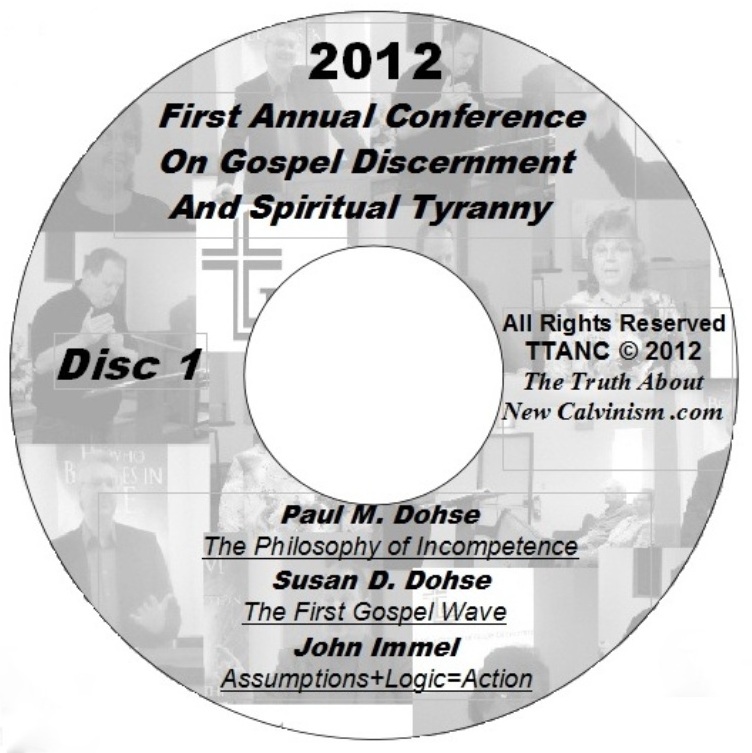
There may be a problem with John Immel over at Spiritual Tyranny .com. Perhaps Immelism should come with the following instructions:
WARNING:
The content herein requires thinking, and includes simple solutions for some problems that others assume are complex. This may cause extreme fear in many who have an existing condition known as mindless-saintaphobia. Remove all household items that could be used to inflict self-harm before reading this material.
This condition, in the same way that pyromania has an irrational fearlessness of fire, has an irrational fear of thinking for oneself, and may cause panic among those challenged to do so.
The church has a long way to go in regard to recovering and rediscovering the lost gospel of thinking. “Gospel” means “good news,” and many Christians are clueless in regard to the fact that the Holy Spirit sees critical thinking as “honorable,” and in fact, is an activity that we can partake in without suffering the wrath of God. What were we thinking? We weren’t. Mindless-saintaphobia was not a problem in that day, so they had John the Baptist. We have John the Provoker.
In case you are wondering what brought this post to bear, let me share, for that is only fair for those who care. I have been cooped up in our tech room for two weeks (as the last sentence clearly indicates) producing the DVD set for the First Annual Conference on Gospel Discernment and Spiritual Tyranny. After necessarily listening to John’s first message roughly fifty times, two words he used as a primary theme for much of his first session hit me right between the eyes. The ten points under that theme aside, those two simple words beg an argument that ends the discussion concerning the validity of discernment/abuse blogs. After wading through the gargantuan internet wordage for pro and con, pray tell, what are those two words?
“Private virtue.”
Though John outlines ten elements of “private virtue” in his first session, the very two words immediately beg the question: can virtue be private?
The apostle Paul didn’t recommend it. He said to let our good works be “evident to all.” Try the private virtue thing with your wife sometime: “Oh baby, I love you sooooooo much, but I am just not good at showing it.” Next interpretive question: how comfortable is your living room couch.
I get letters all of the time that state something like the following: “We are trying to figure out what is going on in our church”; “We can’t figure it out, we are confused, why won’t the elders just explain it to us so we can decide for ourselves?” “Everyone is just walking around confused ‘like zombies’ [actual quote]. We just want to know what’s going on.”
If I know what’s going on, and I don’t tell them, is that virtuous? It’s a rhetorical question.
In Immel’s conclusion to his first session, he referred to “men of private virtue.” John the Provoker is much nicer than John the Baptist. John the Baptist called them cowards.
paul

 Paul's Passing Thoughts
3 comments