World Philosophy, Politics, and Christianity: John Immel, TANC 2014; Sessions 1-3
SESSION ONE
JOHN IMMEL: I know that people online can’t see this, but this is – luckily, you guys can see this. So about three weeks after the conference last year, I get an e-mail from Paul, Paul Dohse, the organizer of this conference. And the title of the e-mail is “Thoughts?” In the body of the e-mail it says, “See attached jpeg.” That’s it. So I read this and I can’t for the life of me figure out what he’s talking about. So I write to Paul back and I say, “Paul, can you explain this?” Now you have all heard Paul speak. So it is at no end of irony that Paul’s e-mails are notoriously short to the point of cryptic. There are no rabbit trails in Paul’s e-mails. So I write on the reply, “I have no idea what you want from me here.” So finally, Paul writes me back and he says – is this hot? Is this a little too hot?
PAUL DOHSE: A little, yeah.
JOHN IMMEL: Can you turn it down just a touch? Check, check, check? Does that work?
PAUL DOHSE: That’s better.
JOHN IMMEL: That’s a whole better? Okay, good. All right, so he writes me back and he says, the idea – now mind you, with this in mind, this is Paul’s response. “The idea that freedom of man is practically a pipedream because he is enslaved to his own desires spiritually, hence, at the very least indifferent to political freedom on a social level.” So, here’s his question. “So will the New Calvinist Movement cause political indifference in American society among Christians?” And I’m like, “Oh, I get it.” So then I go back to this. And for those of you online, you can’t see this. But this guy, Mark Ray, I get to use the cool pointer now. Mark Ray here, I don’t know who he is, don’t care, don’t matter. He says right here, “It is ordained in the eternal constitution of things that men of intemperate minds cannot be free. Their passions forge their fetters.” And this is when I finally understood what Paul’s after. And he’s interested in me commenting on the impact of New Calvinism on American culture, what it’s trying to do.
Now, of course, he, this Mark Ray, is actually quoting a guy by the name of Edmund Burke. You can look him up. He’s not really an enigmatic character. But Edmund Burke held the fundamental assumption about human existence, and this quote ultimately that the nature of man requires that man can only be governed by a totalitarian government, that the function of government is human restraint. So anyway, Paul is asking me to weigh in on this particular issue. And my response was, yes. I’ll summarize. Yes, this is exactly what the Neo-Calvinist movement is willing to do. Now my e-mail response to Paul was about 500 words. I gave a detailed explanation, and it turns out – well, I gave that explanation. I won’t tell you what I said. And so then, I send them off to Paul, and Paul says to me, “This would be a perfect progression from this year to next year. This could be your 2014 thesis for next year’s conference.” So this is exactly what we’re going talk about, the Edmund Burke comment and its specific impact on the progression of American thought, where we are. Now of course the flyer says that I’m going to talk about National Socialist Germany. That is true. We are going to talk about that.
But before I get too much farther into this, I guess I do need to make some introductions. My name is John Immel. I like to introduce myself this way. I am no one from nowhere. And the important thing about this is that there is a general trend and a general move within Christianity. The assumption being that if you’re standing behind a pulpit that you bear some form of authority, and that the expectation is that whatever I say, you have some obligation to accept. I reject that as a fundamental premise. I’m not here as a representative of authority. I am here to present to you ideas and the most powerful arguments that I can bring to you. And your part of this conversation, and it is a conversation, is for you to bring your highest and best rational self to this engagement. I’m going to make the most powerful argument I can, and I want you to engage your brain and to think and to analyze and to find out what is correct, what is true. And if I’ve done my job well, you will end up agreeing with me because I believe I hold right ideas. But here is how this works. If you can find a flaw on what I said, then you have the ability to say ,”Hey, John. Now here I think is an adjustment.” And if you make a powerful argument, if you make a good argument, and I apply my rational individuality to that, I go, “You know what? That’s true.”
Now having said that, I did write a book. I wrote a book, this book, called Blight in the Vineyard: Exposing the Roots, Myths, and Emotional Torments of Spiritual Tyranny. You can buy this online at amazon.com. It’s $23.99 online. If you like what I say in the conference, those of you who are watching online, if you like what I say, you’re going to find more of the same in here. Now I will say this. I wrote this, and I’ll get into this just a little bit more here in the moment. I wrote this using a modern denomination called Sovereign Grace Ministries as my anecdote. But the book is not about Sovereign Grace Ministries specifically. The book is about how the ideas embedded in what we’re going to talk about shaped this specific ministry. So I talk about a who so we can talk about a what. And the what are the ideas that are behind it. And in particular, the Neo-Calvinist, the new resurgent movement of Calvinism in the United States.
Now it is a little dated because when I wrote this, most of the major players, and those of you familiar within evangelical Christianity certainly will have heard names like CJ Mahaney, Brent Detwiler, Joshua Harris. These were all people at the top of the uber super apostles, whatever they want to call themselves now. There’s been a split within that denomination, and so that current history is not reflected in the book, but it actually doesn’t matter because the book is not about the personalities or the organization of that denomination. The book is about how the ideas were used to create this denomination in Sovereign Grace Ministries and ultimately how that causes them to act within that denomination. So you’ll still get the same things even though like I said it’s historically dated.
So this conference, this specific conference represents the culmination of about – at least 20 years of thinking for me. And to give you a sense of scope, which is what I think I do best, I think I give people the framework best. I need to actually talk about me personally a little bit. I got born again when I was 15. So my exposure to Christianity is going on 30 years. Now I got born again and became immediately a part of a brethren church in Eaton, Ohio, actually not too far from where we are now. And my introduction to Christianity was dramatic. I’m confident there are people that can tell you about my life during my high school career. But I took Christianity seriously, and I invested in Christianity. I invested in what I believe to be the truth with absolute commitment. So by the time I was 18, I was fully invested and fully committed to Christianity, modern American Christianity. Now I’m going to make a distinction here. (more…)
Ground Zero: Pope Gregory and New Calvinist Gospel Contemplationism
 Originally published December 13, 2012
“Monks. That’s what we are missing here. Martin Luther. Ever heard of him? He was a monk.”
“In that Disputation, Luther postulates Pope Gregory’s take on the gospel which is the exact same calling card of present-day New Calvinism.”
“Powlison points to Pope Gregory and Augustine as the pioneers of biblical counseling using a ‘Christ-centered,’ ‘full gospel’ approach. And what was that approach?”
Let’s just take one contemporary example: a Presbyterian church that is now a mere shell of what it was; the remains of a war over the arrival of a New Calvinist pastor who exhibited outrageous behavior and leadership style. Today, some parishioners stand dumbfounded that the Presbytery took positive steps to keep said pastor in place.
As TANC, our newly formed think tank that researches Reformed theology continues to journey into church history for answers, the reasons for present-day tyranny in the church become clearer every day. First, it is driven by the gospel that founded the Reformation. Simply put, it is a gospel that does not believe that people change, but are rather called to contemplate the saving works of Christ in order for His righteousness to be manifested in one of two realms. Whether Baptist, Methodist, or whatever, this Reformed seed, the idea that people really don’t change is at the core of their function though they would deny it verbally. The Western church as a whole buys into this basic concept.
Secondly, the basic concept of spiritual elitists ruling over the totally depraved. You know, the they really can’t change crowd. The Reformation clarion call of total depravity—what’s our second clue if we need one? The spiritual is accessed through the chief contemplationists, and since they have the dope directly from God, they should rule over the totally depraved. Look, I have been a Baptist since 1983, and this is how it works. Again, we wouldn’t verbalize that, but to some degree it is true of all Western denominations because we are the children of the Protestant Reformation. What were we protesting? Naughty philosopher kings; past that, not much.
If we don’t change, the church doesn’t either. Think about that. And we wonder why things are a mess. Apparent growth in numbers is being driven by something else other than a true gospel. And the Reformers deny that while pontificating total depravity. It is testimony to the depth of which this Protestant construct has dumbed down the average parishioner; i.e., the totally depraved change. And nobody blinks. The assumption is that total depravity only pertains to the unregenerate, but that’s not the case according to the Reformed gospel and its time for people to start doing the math on that. The “Nones” and the massive exodus from the evangelical church is taking place for a reason.
I’m not ready to declare Pope Gregory the Great the father of the Reformation and present-day New Calvinism just yet, but recent discoveries reveal some things that should be fairly obvious. We aren’t stupid, just trusting, and that needs to end. Christians need to take advantage of the information age and start studying for themselves as the Christian academics of our day refuse to be forthcoming. They didn’t forget to mention that sola fide is also for sanctification. They didn’t forget to mention the total depravity of mankind AND the saints. They didn’t forget to mention that the new birth is a realm and not something that happens in us—it’s deliberate deception because the Reformed gospel is “scandalous.” The totally depraved are not “ready” for what the enlightened class of philosopher kings understand. By the way, many seminary students will testify to the fact that they are told as much by their seminary professors. Seminaries are where you go to be certified for the purpose of ruling over the totally depraved in order to, in Al Mohler’s words, “save them from ignorance.” Sorry, I prefer to let the Bible and Google save me from ignorance. Thank goodness for the Gutenberg press.
Monks. That’s what we are missing here. Martin Luther. Ever heard of him? He was a monk. What is the very premise of monkism? It’s the idea that the spiritual is obtained by contemplationism. And monkism is not unique to the Catholic Church—it is the link from the Catholic Church to the ancient concept of mystic dualism. Though it pans out in various different ways, it’s the idea that matter is evil and spirit is good. In other cases, it holds to the idea that both good and evil are necessary to understand true reality. Good defines evil, and evil defines good. The more you understand both, the more “balance” you have in the universe. Then there is the goal to birth the spiritual into the physical through meditation/contemplationism. Like I said, there are many takes on the basic approach.
Monks believe that the physical or world realm is a distraction from the spiritual realm. In some cases, they believe that all matter is merely a form of the perfect, or spiritual. Hence, monasteries. Traditionally, monasteries have been clearing houses for the dope from God through contemplationism. And since they have the dope, they should rule the totally depraved for their own good. In some spiritual caste systems, the monks rule directly, in others like the Catholic Church, the monks are the Scribes and Prophets for the rulers; i.e., the Popes.
The fact that monkism would be part and parcel to any doctrine formulated by Martin Luther is a no-brainer. Mysticism is simply going to be a significant factor, and so it is with Protestantism. This becomes more apparent when you consider the core four of the Protestant Reformation: Martin Luther, John Calvin, St. Augustine, and Pope Gregory the Great. Luther’s 95 Theses was a protest against naughty Popes, but he was completely onboard with the Catholic caste system. When his 95 Theses resulted in the unexpected societal eruption that took place, he presented a doctrinal disputation to the Augustinian Order in Heidelberg. And don’t miss this:
In that Disputation, Luther postulates Pope Gregory’s take on the gospel which is the exact same calling card of present-day New Calvinism. In theses 27 of his Disputation, Luther states the following:
Thus deeds of mercy are aroused by the works through which he has saved us, as St. Gregory says: »Every act of Christ is instruction for us, indeed, a stimulant.« If his action is in us it lives through faith, for it is exceedingly attractive according to the verse, »Draw me after you, let us make haste« (Song of Sol. 1:4) toward the fragrance »of your anointing oils« (Song of Sol. 1:3), that is, »your works.«
There could not be a more concise statement in regard to the New Calvinist gospel. Deeds in the Christian life come from the same acts in which Christ saved us. Secondly, they are not our acts, but the acts of Christ applied to our Christian lives by faith alone. Thirdly, when the works of Christ are applied to our Christian lives by faith alone, it will always be experienced by the exhilarating emotions of first love—this is the mark of Christ’s active obedience being manifested in the spiritual realm through the totally depraved. We “reflect” the works of Christ by faith alone. Even John MacArthur has bought into this nonsense, claiming that obedience to the Lord is “always sweet, never bitter.” Francis Chan states that it always “feels like love.” And of course, poke John Piper’s rhetoric anywhere and this same monkish mysticism comes oozing out.
Moreover, Luther states this same concept from many different angles in his Disputation, and theses 28 is clearly the premise for John Piper’s Christian Hedonism.
No wonder then that New Calvinists of our day sing the praises of Pope Gregory. Here is what heretic David Powlison stated in an interview with Mark Dever’s 9Marks ministry:
Caring for the soul, which we try [try?] to do in biblical counseling, is not new. Two of the great pioneers in church history would be Augustine and Gregory the Great. Even secular people will credit Augustine’s Confessions as pioneering the idea that there is an inner life. Augustine did an unsurpassed job of tearing apart the various ways in which people’s desires become disordered. Gregory wrote the earliest textbook on pastoral care. He pioneered diverse ways of dealing with a fearful person, a brash and impulsive person, an angry person, an overly passive person. He broke out these different struggles and sought to apply explicitly biblical, Christ-centered medicine—full of Christ, full of grace, full of gospel, and full of the hard call of God’s Word to the challenges of life.
Powlison points to Pope Gregory and Augustine as the pioneers of biblical counseling using a “Christ-centered,” “full gospel” approach. And what was that approach? It was primarily contemplationism and dualism. In fact, Gregory practically saw “doing” as a necessary evil. In Roland Paul Cox’s Masters dissertation, Gregory the Great and His Book Pastoral Care as a Counseling Theory, Cox states the following:
The overall theme in Gregory’s dichotomies is balance. It is possible that this comes from Gregory’s own struggles in balancing his desire for the contemplative life of a monk versus his reluctant, but active, service as ambassador to Constantinople and pope.“The Regula Pastoralis was in large part devoted to describing how to reconcile the two types of life. He came to the conclusion eventually that while the contemplative life was the better and more desirable of the two, the active life was unavoidable, and indeed necessary in order to serve one’s fellow man.…There could be no better exemplar of the two lives than Gregory himself, but he would have been less than human had he not from time to time mourned the fact that so much of his time must be given over to the active at the expense of the contemplative” [Jeffrey Richards, Consul of God : The Life and Times of Gregory the Great (London ; Boston: Routledge & Kegan Paul, 1980), 57.].
Powlison, in true Reformed tradition, invokes the either/or hermeneutic, or the either cross story or glory story hermeneutic of Luther’s Disputation by suggesting that any denial of this “Christ-Centered” approach is a wholesale denial of an “inner life.” In other words, suggesting that doing something should be emphasized as much as contemplationism is paramount to denying that there is an inner life. Such statements by Powlison are indicative of his utter lack of integrity.
In addition, Gregory’s penchant for mystic dualism is seen in the same dissertation:
Gregory’s view of health revolved around balance. In Pastoral Care 34 dichotomies are given. For each one Gregory discusses how either extreme is detrimental. The following are a few examples of Gregory’s dichotomies: poor/rich, joyful/sad, subject/superiors, wise/dull, impudent/timid, impatient/patient, kindly/envious, humble/haughty, obstinate/fickly, and gluttonous/abstemious. Further, Gregory explains how certain traits although they appear to be virtues are in reality a vice. For example, in describing the dichotomy of impatient and patient, Gregory says the following about the patient: “…those who are patient are to be admonished not to grieve in their hearts over what they suffer outwardly. A sacrifice of such great worth which they outwardly offer unimpaired, must not be spoilt by the infection of interior malice. Besides, while their sin of grieving is not observed by man, it is visible under the divine scrutiny, and will become the worse, in proportion as they claim a show of virtue in the sight of men. The patient must, therefore, be told to aim diligently at loving those whom they needs must put up with lest, if love does not wait on patient” [Pastoral Care: pp. 109, 110].
In other words, self-control is a vice. Unless cross-centered love is mystically applied according to Luther’s Disputation (theses 28), the latter evil of self-control is worse than the former sin of being offended since such offences serve to humble us (LHD theses 21).
What goes hand in metaphysical hand in all of this is good ole’ ancient spiritual caste tyranny. As Cox further observes,
Shortly after becoming pope, Gregory wrote Pastoral Care. In addition as pope, he reorganized the administration of the papal states, he maintained papal authority in the face of encroachments from the Patriarch of Constantinople, he established links with the Frankish Kingdoms, and most importantly (for these English writers), he sent a party of monks, led by Augustine, to convert the Anglo-Saxons.
Gregory was very influenced by the Rule of St. Benedict and Benedictine monks who came to Rome after the monastery that St. Benedict founded was burnt. In some letters, Gregory calls his work Pastoral Rule. “There is every reason to assume that Gregory in conceiving the plan for Liber Regulae Pastoralis [Pastoral Rule] intended to provide the secular clergy with a counterpart to this Regula [the Rule of St. Benedict].
….This culture of rulers and emperors also helps explain why Gregory saw Pastoral Care and Pastoral Rule as one in the same. By modern day standards, Gregory would be considered overly authoritarian.
A culture of “rulers and emperors” had precious little to do with it, but rather ancient spiritual caste systems that answered the supposed preordained call of God to control the totally depraved. With the sword if necessary. While many of these systems were based on mythology prior to the 6th century, Plato systematized the idea and gave it scientific dignity. But his trifold theory of soul consisting of king, soldier, and producer called for a sociological counterpart that was a mirror image to fit the need. Sir Karl Raimund Popper, considered the greatest philosopher of the 20th century, fingered Platonism as the primary catalyst for religious and secular tyranny in Western culture. And Plato’s mystic dualism (shadows and forms) added not just a little to the MO of the Reformers. According to church historian John Immel:
Calvin’s Institutes (1530) is the formal systematic institutionalization of Platonist/Augustinian syncretism that refined and conformed to Lutheran thinking and became the doctrinal blueprint for the Reformed Tradition [Blight in the Vineyard: Prestige Publishing 2011].
Christ promised us that He would build His Church and the gates of hell would not prevail against it. The idea that the Reformers rescued His church from the gates of the Roman Catholic Church is both laughable and the biggest hoax ever perpetrated on mankind. The idea that Christ needed, and continues to need the services of Plato’s philosopher kings is arrogance on steroids. Somewhere, God’s church moves forward. Let us shed the Reformed load that hinders and find our place in that true church.
paul
Calvin: Christians Must Keep Their Salvation by Pursuing Perpetual Forgiveness in the “Church”
Originally published August 14, 2013
“Why does American Protestantism have such weak sanctification? Calvin taught that the apostle Paul went from house to house preaching about the same gospel that saved us rather than teaching the full counsel of God, that’s why.”
I can see clearly now; it all finally makes sense. As a young Scriptural zealot, many things in the Protestant church confused me. I was the Baptist stripe of Protestant. And kudos to church historian John Immel, he is right; there is always a logic behind an action.
Why so much emphasis on the same gospel that saved us? Why were we constantly calling on people to be saved in the church? Why don’t we have any more answers to life’s difficult problems than the world? Why so much fuss over the buildings? Why is the Lord’s Table such an uppity pious affair when it seems to have been inaugurated during a casual dinner? Why have I always struggled to be wowed by that “ordinance”? Why all the crosses all over the place? On the church, in the church, around people’s necks. Geez. And why is the same bad behavior that is in the Catholic Church also in the Protestant church?
Fact is, American religion was founded on the Pilgrims who are not very often called what they really were: Calvinistic Puritans armed with the first Bible to ever arrive on American soil; The Geneva Bible which was John Calvin’s commentary on the Bible.
Talk abounds concerning the foremost figures of the Reformation, John Calvin and Martin Luther. Many opinions abound, but everybody agrees that they are the fathers of the Protestant Reformation and spiritual heroes. They are the George Washington and James Madison of our faith.
New Calvinism is a return to the purest form of the Reformation found in the John Calvin Institutes of the Christian Religion. And there is a reason New Calvinism is taking over Protestantism by storm: Protestantism originally came from Calvinism and is well primed to be retrofitted with the original. Forget doctrine, that’s the same thing as football fans talking about stats. It’s interesting, but it doesn’t matter, the game is played on the field. Calvinism is a tradition that has little to do with the election versus freewill issue as well, that’s just a family quarrel about which sibling gets to use the bathroom next. There are two kinds of Protestants in the world: staunch doctrinal Calvinists and those who function like Calvinists. Today, that translates into New Calvinists and everybody else that’s left. New Calvinists strive to continually define the logic that drives their actions; everyone else is just coasting on the basics, but are well primed to step over to the wild side.
Why is this? We find some answers in the Calvin Institutes; specifically, 4.1.21,22. Therein we read:
Wherefore, our initiation into the fellowship of the church is, by the symbol of ablution, to teach us that we have no admission into the family of God, unless by his goodness our impurities are previously washed away (20).
Nor by remission of sins does the Lord only once for all elect and admit us into the Church, but by the same means he preserves and defends us in it. For what would it avail us to receive a pardon of which we were afterwards to have no use? That the mercy of the Lord would be vain and delusive if only granted once, all the godly can bear witness; for there is none who is not conscious, during his whole life, of many infirmities which stand in need of divine mercy. And truly it is not without cause that the Lord promises this gift specially to his own household, nor in vain that he orders the same message of reconciliation to be daily delivered to them.
This is a startling statement for any Christian paying attention. But it is also a grand example of talking about stats; i.e., Christ died once, for all of our sins and that is imputed, in totality one time, at our conversion for all past and future sins, versus how Protestants really function: a weekly focus on the gospel. Why? That’s how we keep our salvation, that’s why. New Calvinists say, “amen.” Baptists protest, but that’s how they function. I have watched it for 30+ years.
Calvin continues:
On the other hand, the Lord has called his people to eternal salvation, and therefore they ought to consider that pardon for their sins is always ready. Hence let us surely hold that if we are admitted and ingrafted into the body of the Church, the forgiveness of sins has been bestowed, and is daily bestowed on us, in divine liberality, through the intervention of Christ’s merits, and the sanctification of the Spirit.
22. To impart this blessing to us, the keys have been given to the Church (Mt. 16:19; 18:18). For when Christ gave the command to the apostles, and conferred the power of forgiving sins, he not merely intended that they should loose the sins of those who should be converted from impiety to the faith of Christ; but, moreover, that they should perpetually perform this office among believers. This Paul teaches, when he says that the embassy of reconciliation has been committed to the ministers of the Church, that they may ever and anon in the name of Christ exhort the people to be reconciled to God (2 Cor. 5:20). Therefore, in the communion of saints our sins are constantly forgiven by the ministry of the Church, when presbyters or bishops, to whom the office has been committed, confirm pious consciences, in the hope of pardon and forgiveness by the promises of the gospel, and that as well in public as in private, as the case requires. For there are many who, from their infirmity, stand in need of special pacification, and Paul declares that he testified of the grace of Christ not only in the public assembly, but from house to house, reminding each individually of the doctrine of salvation (Acts 20:20, 21). Three things are here to be observed. First, Whatever be the holiness which the children of God possess, it is always under the condition, that so long as they dwell in a mortal body, they cannot stand before God without forgiveness of sins. Secondly, This benefit is so peculiar to the Church, that we cannot enjoy it unless we continue in the communion of the Church. Thirdly, It is dispensed to us by the ministers and pastors of the Church, either in the preaching of the Gospel or the administration of the Sacraments, and herein is especially manifested the power of the keys, which the Lord has bestowed on the company of the faithful. Accordingly, let each of us consider it to be his duty to seek forgiveness of sins only where the Lord has placed it. Of the public reconciliation which relates to discipline, we shall speak at the proper place.
Why so much emphasis on the same gospel that saved us? Because it keeps saving us. Why so much fuss about buildings? Those are the temples where we find our need for perpetual salvation and forgiveness for sins that would circumvent our justification. Why are pastors put on a pedestal and allowed to rape, pillage, and steal? In them we have our absolution. Why so much fuss about the Lord’s Table and quarreling over real wine or grape juice? There is additional salvation in the sacraments. Why all of the crosses? Same thing: more gospel; more salvation. Why do we sweep scandal under the rug? It is a threat to the institution, and that’s where we find our salvation. Why does American Protestantism have such weak sanctification? Calvin taught that the apostle Paul went from house to house preaching about the same gospel that saved us rather than teaching the full counsel of God, that’s why.
Calvin’s statement about being “engrafted” into the “church” is interesting. The Potter’s House has just adopted Remnant Theology as opposed to Covenant Theology, New Covenant Theology, or Dispensationism. Are we engrafted into a “church” or an “olive tree”? In Romans 9-11, what does that olive tree symbolize? Something to think about.
John Immel is right, action is always driven by logic. In our present day, doctrine is getting lip service while Calvin’s logic is driving the actions. That is why nothing going on in the church makes any sense right now.
And I doubt it ever will until God’s people come out from among them.
paul
The “Cross Story” and Sanctified Rape in the Church
Originally published January 21, 2013
“Be sure of it: this is how Calvinists think; this is their worldview.”
“Don’t misunderstand: the problem of ‘victim mentality’ is not even on the radar screen — they have removed the word “victim” from their metaphysical dictionary.”
“Justice necessarily implies victim. Victim necessarily implies worth. All three are conspirators with the glory story.”
Martin Luther had more on his mind than silly Popes when he nailed his 95 Theses to the front door of All Saints’ Church in Wittenberg, Germany. That protest launched the Reformation, but six months later Luther presented the systematic theology of the Reformation to the Augustinian Order in Heidelberg. Luther’s Heidelberg Disputation laid the foundation, and John Calvin later articulated and applied its basic principles to the full spectrum of life in his Institutes of the Christian Religion.
The Cross Story and the Glory Story
Luther’s cross story, or theology of the cross is the crux of the Heidelberg Disputation and introduced in the first sentence of the Calvin Institutes:
Our wisdom, insofar as it ought to be deemed true and solid wisdom, consists almost entirely of two parts: the knowledge of God and of ourselves.
That’s Luther’s theology of the cross: a deeper and deeper knowledge of our putrid humanity as set against God’s holiness. And NOTHING in-between. All of creation, all events, and all reality contribute to deeper knowledge of one of these two, and then both as a deeper knowledge of each gives more understanding to the other; knowledge of both, and the experience of both. Hence, every blessing, including our good works which are done by the Holy Spirit to begin with, lends more understanding of God’s glory. Every evil event, sin, and tragedy lends deeper understanding in regard to our total depravity and worthlessness. But of course your mother is dying of cancer; I am amazed that God would give anyone as many years as He has given her. Who are we to think we deserve even one year of life? And what a wonderful opportunity for her to suffer the way Jesus suffered for us!
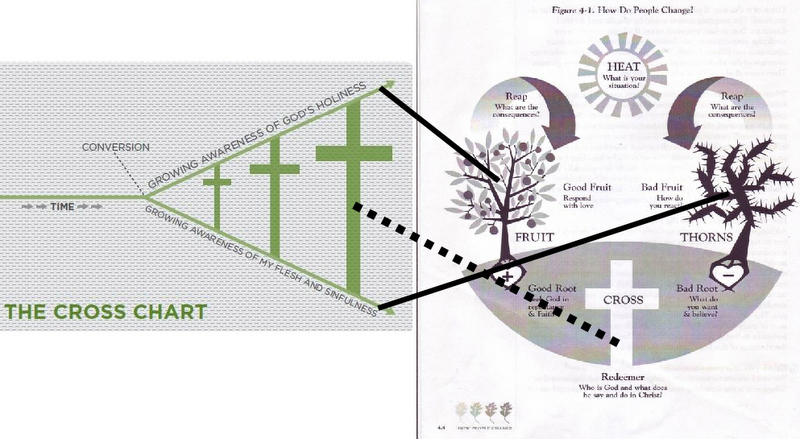
This is the cross story. See the illustration below. This is a contemporary depiction from that camp—this is their assessment:

Anything else at all that gives any credit to humanity—Christian or non-Christian is the “glory story.” That would be our glory specifically, and not Christ’s. To the degree that humanity is considered, the glory of Christ is “ECLIPSED.” This is the theses of a book written by John MacArthur associate Rick Holland: Uneclipsing The Son. Everything is perceived as speaking through one of these two perspectives. ANYTHING coming from what is perceived as the “glory story” is summarily dismissed. Be sure of it: this is how Calvinists think. This is their worldview.
In one of the former Resolved Conferences sponsored by John MacArthur and Holland, in one of his messages, Holland extols a letter written to Puritan Christopher Love by his wife as he awaited execution. Holland forgot to mention to those listening that Love was executed for espionage against the English government while letting the audience assume he was executed for loftier spiritual-like reasons. The following is excerpts from the letter:
O that the Lord would keep thee from having one troubled thought for thy relations. I desire freely to give thee up into thy Father’s hands, and not only look upon it as a crown of glory for thee to die for Christ, but as an honor to me that I should have a husband to leave for Christ…. I dare not speak to thee, nor have a thought within my own heart of my own unspeakable loss, but wholly keep my eye fixed upon thy inexpressible and inconceivable gain. Thou leavest but a sinful, mortal wife to be everlastingly married to the Lord of glory…. Thou dost but leave earth for heaven and changest a prison for a palace. And if natural affections should begin to arise, I hope that the spirit of grace that is within thee will quell them, knowing that all things here below are but dung and dross in comparison of those things that are above. I know thou keepest thine eye fixed on the hope of glory, which makes thy feet trample on the loss of earth.
Justice? That implies that humanity has some sort of value. That implies that life itself has some sort of value. That implies that humanity should be protected through threat of punishment. That’s the glory story. Therefore, Calvin stated the following:
Those who, as in the presence of God, inquire seriously into the true standard of righteousness, will certainly find that all the works of men, if estimated by their own worth, are nothing but vileness and pollution, that what is commonly deemed justice is with God mere iniquity; what is deemed integrity is pollution; what is deemed glory is ignominy (CI 3.12.4).
Death by Biblical Counseling
The church must face up to a sobering reality in our day. The vast majority of biblical counseling that goes on in our day is based on this construct—you will be counseled from the perspective of the cross story, and anything that smacks of the glory story will be snubbed. You are not a victim. There is no such thing as a victim. Christ was the only true victim in all of history. Don’t misunderstand: the problem of “victim mentality” is not even on the radar screen—they have removed the word “victim” from their metaphysical dictionary. “Victim” is part of the glory story; Christ as the only victim is the cross story. I am not a victim. That’s impossible because my sin nailed Christ to the cross. Thank you oh Lord that I was raped. Thank you for this opportunity to suffer for you. Thank you for the strength to forgive the one who raped me in the same way you forgave me. What a wonderful opportunity to show forth your gospel!
Hence, when the leaders of a Reformed church came to inform parents that a young man in that church had molested their toddler, this was the opening statement:
Today, we have before us an opportunity to forgive.
The parents were then counseled to not contact the authorities. Those who do are often brought up on church discipline. Justice necessarily implies victim. Victim necessarily implies worth. All three are conspirators with the glory story. And be not deceived: this is the logic that drives Reformed organizations that are supposed to be mediators in the church; specifically, Peacemaker Ministries and G.R.A.C.E. A major player in the Biblical Counseling Movement is Paul David Tripp. In 2006, he wrote a book that articulates the horizontal application of Luther’s theology of the cross: “How people Change.” Of course, the title is a lie; if he really believed people change, that would be the glory story. Notice also that it is, “How People Change” and not, “How Christians Change.” That’s because this bunch see no difference in the transforming power of the new birth and ordinary Christ-rejecting people.
In the book, Tripp, like all who propagate Luther’s theology of the cross, posits the Bible as a “big picture” narrative of our redemptive life. The Bible is a mere tool for one thing only: leading us more and more into the cross story and away from the glory story. This is accomplished by using the Bible to enter into the cross narrative and thereby seeing our preordained part in the “big picture” narrative of redemptive history. Though Tripp is not forthright about it in the book, this is known as the Redemptive Historical Hermeneutic. By seeing our life through the cross story, we are empowered to live life for God’s glory. This is done by seeing ALL circumstances in life (Heat) as preordained in order to show our sinfulness (Thorns) and God’s goodness (Fruit) for the purposes of having a deeper understanding of both resulting in spiritual wellbeing. In other words, all of life’s circumstances are designed to give us a deeper understanding of the cross story: God’s holiness, and our sinfulness. I have taken his primary visual illustration from the book and drawn lines to the cross story illustration to demonstrate the relationship (click on image to enlarge):
Understanding this lends insight to Tripp citations on the Peacekeepers Ministries website:
Paul Trip wrote a great post over at The Gospel Coalition blog all about the need for pastors to pursue a culture of forgiveness in their ministry. Pastors (and anyone serving Christ) have a choice:
“You can choose for disappointment to become distance, for affection to become dislike, and for a ministry partnership to morph into a search for an escape. You can taste the sad harvest of relational détente that so many church staffs live in, or you can plant better seeds and celebrate a much better harvest. The harvest of forgiveness, rooted in God’s forgiveness of you, is the kind of ministry relationship everyone wants.”
Then he describes three ways forgiveness can shape your ministry. I’ve listed them, but you can read how he explains them in detail.
“1. Forgiveness stimulates appreciation and affection.
2. Forgiveness produces patience.
3. Forgiveness is the fertile soil in which unity in relationships grows.”
He closes with this exhortation:
“So we learn to make war, but no longer with one another. Together we battle the one Enemy who is after us and our ministries. As we do this, we all become thankful that grace has freed us from the war with one another that we used to be so good at making.”
And concerning another author, they also stated:
Last week, Steve Cornell at The Gospel Coalition blog posted some really great insight into the difference between forgiveness and reconciliation. They also offered up some excellent and biblically sound steps in dealing with a situation where an offending party is hesitant to reconcile.
Here he summarizes a key distinction:
“It’s possible to forgive someone without offering immediate reconciliation. It’s possible for forgiveness to occur in the context of one’s relationship with God apart from contact with her offender. But reconciliation is focused on restoring broken relationships. And where trust is deeply broken, restoration is a process—sometimes, a lengthy one”…. His ten guidelines for those hesitant to reconcile are rooted in scripture and, I think, incredibly helpful.
1. Be honest about your motives.
2. Be humble in your attitude.
3. Be prayerful about the one who hurt you.
4. Be willing to admit ways you might have contributed to the problem.
5. Be honest with the offender.
6. Be objective about your hesitancy.
7. Be clear about the guidelines for restoration.
8. Be alert to Satan’s schemes.
9. Be mindful of God’s control.
10. Be realistic about the process.
Notice the overall blurring of distinction between the offended and offender with the subject of forgiveness.
The Cross-centered Anti-justice Pandemic is No longer Exclusively a Reformed Thing
Apart from Calvinism, the redemptive historical cross-centered approach is crossing denominational lines en masse. We at TANC see doctrines that were born of Luther’s theology of the cross in non-Reformed circles constantly; specifically, heart theology (deep repentance), exclusive interpretation of the Scriptures through a redemptive prism, Gospel Sanctification, and John Piper’s Christian hedonism. And we also see the same results. It is not beyond the pale for a pastor who has raped a parishioner to be the one counseling the victim sinner. You know, the “sinner saved by grace.”
God is a God of justice, and throughout the Scriptures He demands that we be people of justice. He demands that we come to the defense of the victim. I close with fitting words from church historian John Immel:
And this is the challenge. This is the challenge that I have as a man who is passionate about thinking: to inspire people to engage in complex ideas that drive tyranny. So here’s my challenge to those who are listening.
Do not be seduced into believing that righteousness is retreat from the world.
Do not be seduced into believing that spirituality is defined by weakness and that timid caution for fear of committing potential error is a reason to be quiet.
Do not be intimidated by vague, hazy threats of failure.
Do not let yourself believe that faith is a license to irrationality. I’m going to say that again to you. This is good. Do not let yourself believe that faith is a license to irrationality.
Do not mistake the simple nature of God’s love for a justification for simple-mindedness.
Do not deceive yourself with the polite notion that you are above the fray, that your right to believe is sufficient to the cause of righteousness. There is no more stunning conceit.
Do not pretend that your unwillingness to argue is the validation of truth.
Know this: Virtue in a vacuum is like the proverbial sound in the forest–irrelevant without a witness. Character is no private deed. To retreat is nothing more than a man closing his eyes and shutting his mouth to injustice.
Virtues are not estimates to be lofted gently against evil.
Virtues are not to be withheld from view in the name of grace.
Virtues are not to be politely swallowed in humble realization that we are all just sinners anyway.
Love is not a moral blank check against the endless tide of indulgent action.
Love is not blind to the cause and effect of reality.
Love is not indifference to plunder and injustice and servitude.
The time is now, you men of private virtue, to emerge from your fortress of solitude and demonstrate that you are worthy of a life that bears your name. The time is now, you men of private virtue, to answer Mick Jagger and all the nihilists that insist we are living on the edge and we cannot help but fall. It is time for you men of private virtue to take up the cause of human existence and think.
~TANC 2012 Conference on Gospel Discernment and Spiritual Tyranny: John Immel; session 1, “Assumptions + Logic = Action.”
paul

 Paul's Passing Thoughts
leave a comment