Romans 13:14B; Part 2, “Overcoming Sin and Living Righteously, a Righteous Life of Real and Lasting Change”

In part one we looked at condemnation and how it empowers sin. Christ went to the cross and ended the law’s condemnation. Fear of death is primarily driven by condemnation and the fear of judgment. One of the most important parts of a Christian’s identity is to know that we are no longer under condemnation.
However, in our day there is a return to authentic Reformed soteriology that actually posits fear of condemnation as the primary motivator in sanctification. In Reformed soteriology, sanctification is seen as a conduit to final justification. In order to remain in the conduit that gives us our best chance to “stand in the judgment,” we must relive our original salvation by faith alone in sanctification. How is that accomplished? By reliving the same gospel that saved us over and over again. This is done through what the Reformers called mortification and vivification. Mortification is something we can do, vivification is only a future glory experience. When you see a Charismatic-like Reformed worship service, what John Piper calls exultation worship, they believe they are experiencing the joy of “future glory.” Really, this is probably the New Calvinist claim to fame: they put feet on the vivification part of mortification and vivification through a more contemporary form of worship. Hence, the “Reformed Charismatic” movement shouldn’t surprise us.
The “mortification of the flesh” part of this doctrine is a return to the fear of judgment, the same fear of judgment that originally saved us. Said John Calvin:
By mortification they mean, grief of soul and terror, produced by a conviction of sin and a sense of the divine judgment [sec.3]… it seems to me, that repentance may be not inappropriately defined thus: A real conversion of our life unto God, proceeding from sincere and serious fear of God; and consisting in the mortification of our flesh and the old man, and the quickening of the Spirit. In this sense are to be understood all those addresses in which the prophets first, and the apostles afterwards, exhorted the people of their time to repentance. The great object for which they labored was, to fill them with confusion for their sins and dread of the divine judgment, that they might fall down and humble themselves before him whom they had offended, and, with true repentance, retake themselves to the right path [sec.5]… The second part of our definition is, that repentance proceeds from a sincere fear of God. Before the mind of the sinner can be inclined to repentance, he must be aroused by the thought of divine judgment; but when once the thought that God will one day ascend his tribunal to take an account of all words and actions has taken possession of his mind, it will not allow him to rest, or have one moment’s peace, but will perpetually urge him to adopt a different plan of life, that he may be able to stand securely at that judgment-seat. Hence the Scripture, when exhorting to repentance, often introduces the subject of judgment, as in Jeremiah, “Lest my fury come forth like fire, and burn that none can quench it, because of the evil of your doings,” (Jer. 4:4)… The stern threatening which God employs are extorted from him by our depraved dispositions [sec.7] [from the CI 3.3.3-7].
Susan and I sat in a Pentecostal service and listened to the pastor say in no uncertain terms that one is not really saved till they experience the “second blessing” usually manifested by speaking in tongues. Services from the Charismatic camps are predicated by these second blessing experiences such as speaking in tongues, Holy Spirit laughter, and “dancing in the Lord.” Though Charismatics emphasize mortification far less than the Reformed, it’s the same basic idea. The vast majority of all denominations in our day flowed out of the Reformation and are predicated by progressive justification; viz, keeping ourselves saved by the same gospel that originally saved us.
The result is a proper biblical definition of antinomianism: some sort of doctrine that separates the law from sanctification. The “Christian” remains under condemnation, and must prepare to “stand in the judgment” by other means apart from loving God and others through obedience to the law. But there is no future judgment for Christians to stand in that has to do with justification. Antinomianism, when it boils right down to it, is the fusion of justification and sanctification together. In any doctrinal construct where sanctification is the progression of justification—that’s antinomianism because the law must be separated from sanctification lest it be justification by works. This is probably the key to ecumenicalism because the primary religion of the last days, according to the Bible, will be antinomianism.
To the contrary, why is it critical that Christians know they are no longer under the condemnation of the law?
1John 4:18 – There is no fear in love, but perfect love casts out fear. For fear has to do with punishment, and whoever fears has not been perfected in love.
The word translated “perfect” in the English is τέλειος (teleios), and is translated “mature” in many other passages of the New Testament. The word means “maturity,” or possessing everything one needs to be mature. Mature love is the idea here, not a “perfect” love.
So, what do we need to understand if we are to be mature in love, overcoming sin, and living righteously? We need to understand that there is no condemnation for us and no need to fear judgment, and we need to understand how sin works against us.
We need to understand that sin is a stand-alone element. It was sin that was found in Satan at some point in time (Ezekiel 28:15). Sin, whatever it is exactly, wages war against righteousness. The location of sin is in the body, and it uses desire to tempt individuals against righteousness. So, the four elements to understand are sin, righteousness, body, and desire. Sin is the problem; its enemy is righteousness; its location is the body, and it uses desire to tempt people to wage war against righteousness.
Let’s begin by looking at how these four elements operate in an unbeliever. Every person born into the world has the works of God’s law written on their hearts. Also within every person born into the world is a conscience that uses this law to either accuse or excuse behavior. So, every person born into the world has an intuitive law and judge within as part of their being. In the final judgment of condemnation at the end of the ages, those who have never been exposed to God’s written law will be judged and condemned because they violated their consciences on many occasions. As a cosmic principle, where there is no law there is no sin, so all babies go to heaven because they do not have a developed conscience. This would also apply to mental disabilities where a conscience is not present.
The Bible also states that repeated rebellion against one’s conscience can sear it like a hot iron. A refusal to obey conscience can reduce a person’s ability to feel guilt.
1Timothy 4:1 – Now the Spirit expressly says that in later times some will depart from the faith by devoting themselves to deceitful spirits and teachings of demons, 2 through the insincerity of liars whose consciences are seared, 3 who forbid marriage and require abstinence from foods that God created to be received with thanksgiving by those who believe and know the truth. 4 For everything created by God is good, and nothing is to be rejected if it is received with thanksgiving, 5 for it is made holy by the word of God and prayer.
Sear: g2743. from a derivative of 2545; to brand (“cauterize”), i. e. (by implication) to render unsensitive (figuratively):— sear with a hot iron.
Those who lack a conscience or moral compass are referred to as sociopaths in our culture. Sin uses desire to tempt, so a person with a seared conscience will most likely follow every desire that sin uses to wage war against righteousness. Police are sometimes stunned that murderers confess to their crime and state the following motive: “I wanted to know what it felt like to kill someone.” So, the murder was committed to satisfy the murderer’s curiosity.
Civil and criminal law restrains evil when fear of punishment outweighs the desire to commit a certain act. If a person thinks they can outwit law enforcement they will be inclined to obey the desire that sin is tempting them with. They don’t see the desire as evil; they have a stronger desire to avoid punishment. Nevertheless, the desire can be strong enough that any kind of logic or self-preservation is abandoned.
Sinful desires can take on all sorts of forms. The question is whether or not we will obey the desire just because it is a desire. Sin is opposed to any kind of law and is empowered by condemnation. Sin is an entity that seeks to bring death through the condemnation of conscience and bad desires. It is a complex death system. Those who are under law are constantly bearing fruits for death although they are able to do good works. In fact, their consciences will reward them with good feelings when they do good, but they are still under condemnation and sin’s constant harassment.
In regard to the believer, sin still resides in the body, but it has been stripped of its power due to Christ dying on the cross for our sins. Sin is empowered by its ability to condemn. I can’t say that I completely understand this, but nevertheless, it is what the Bible states:
1Corinthians 15:56 – The sting of death is sin, and the power of sin is the law. 57 But thanks be to God, who gives us the victory through our Lord Jesus Christ.
Sin brings about some sort of temporary death, physical death, and ultimately eternal death. Sin is in the sowing and reaping business, and the sowing of sin is often interpreted as “getting away with it” because there has not yet been a reaping. But the point here is that sin is empowered by the condemnation of law. When Christ died on the cross to end the law, it stripped sin of its power. Hence, when a Christian is confronted with a sinful desire, they are not only able to say no to that desire, but do so for the proper motives; i.e., love for God and others.
James 1:13 – Let no one say when he is tempted, “I am being tempted by God,” for God cannot be tempted with evil, and he himself tempts no one. 14 But each person is tempted when he is lured and enticed by his own desire. 15 Then desire when it has conceived gives birth to sin, and sin when it is fully grown brings forth death.
Romans 6:1 – What shall we say then? Are we to continue in sin that grace may abound? 2 By no means! How can we who died to sin still live in it? 3 Do you not know that all of us who have been baptized into Christ Jesus were baptized into his death? 4 We were buried therefore with him by baptism into death, in order that, just as Christ was raised from the dead by the glory of the Father, we too might walk in newness of life.
5 For if we have been united with him in a death like his, we shall certainly be united with him in a resurrection like his. 6 We know that our old self was crucified with him in order that the body of sin might be brought to nothing, so that we would no longer be enslaved to sin. 7 For one who has died has been set free from sin. 8 Now if we have died with Christ, we believe that we will also live with him. 9 We know that Christ, being raised from the dead, will never die again; death no longer has dominion over him. 10 For the death he died he died to sin, once for all, but the life he lives he lives to God. 11 So you also must consider yourselves dead to sin and alive to God in Christ Jesus.
12 Let not sin therefore reign in your mortal body, to make you obey its passions. 13 Do not present your members to sin as instruments for unrighteousness, but present yourselves to God as those who have been brought from death to life, and your members to God as instruments for righteousness. 14 For sin will have no dominion over you, since you are not under law but under grace.
15 What then? Are we to sin because we are not under law but under grace? By no means! 16 Do you not know that if you present yourselves to anyone as obedient slaves, you are slaves of the one whom you obey, either of sin, which leads to death, or of obedience, which leads to righteousness? 17 But thanks be to God, that you who were once slaves of sin have become obedient from the heart to the standard of teaching to which you were committed, 18 and, having been set free from sin, have become slaves of righteousness. 19 I am speaking in human terms, because of your natural limitations. For just as you once presented your members as slaves to impurity and to lawlessness leading to more lawlessness, so now present your members as slaves to righteousness leading to sanctification.
20 For when you were slaves of sin, you were free in regard to righteousness. 21 But what fruit were you getting at that time from the things of which you are now ashamed? For the end of those things is death. 22 But now that you have been set free from sin and have become slaves of God, the fruit you get leads to sanctification and its end, eternal life. 23 For the wages of sin is death, but the free gift of God is eternal life in Christ Jesus our Lord.
Sin resides in the body, but even though the body is weak, it is neutral. When the Bible authors speak of the “body of sin,” “desires of the flesh,” etc., they are speaking of when the body is being used by the individual to do the bidding of sin. In the case of an unbeliever, they are under law and sin can provoke them to yield their members up for unrighteousness to the point of slavery while the power of sin has been broken within the believer and they have a choice:
Romans 12:1 – I appeal to you therefore, brothers, by the mercies of God, to present your bodies as a living sacrifice, holy and acceptable to God, which is your spiritual worship. 2 Do not be conformed to this world, but be transformed by the renewal of your mind, that by testing you may discern what is the will of God, what is good and acceptable and perfect.
Therefore, let me comment on this passage:
Galatians 5:16 – But I say, walk by the Spirit, and you will not gratify the desires of the flesh. 17 For the desires of the flesh are against the Spirit, and the desires of the Spirit are against the flesh, for these are opposed to each other, to keep you from doing the things you want to do. 18 But if you are led by the Spirit, you are not under the law. 19 Now the works of the flesh are evident: sexual immorality, impurity, sensuality, 20 idolatry, sorcery, enmity, strife, jealousy, fits of anger, rivalries, dissensions, divisions, 21 envy, drunkenness, orgies, and things like these. I warn you, as I warned you before, that those who do such things will not inherit the kingdom of God. 22 But the fruit of the Spirit is love, joy, peace, patience, kindness, goodness, faithfulness, 23 gentleness, self-control; against such things there is no law. 24 And those who belong to Christ Jesus have crucified the flesh with its passions and desires.
25 If we live by the Spirit, let us also keep in step with the Spirit. 26 Let us not become conceited, provoking one another, envying one another.
The “desires of the flesh” are really sinful desires spoken of in context of yielding up our members in service to sinful desires. At least for the believer, our bodies are the temple of the Holy Spirit:
1Corinthians 3:16 – Do you not know that you are God’s temple and that God’s Spirit dwells in you? 17 If anyone destroys God’s temple, God will destroy him. For God’s temple is holy, and you are that temple.
So, even among Christians, if they “Let…sin…reign in [their] mortal bod[ies], it can lead to fruits unto death, or destruction. Not eternally, but present miseries of all sort.
Through learning God’s full counsel and applying it to one’s life, Christians can learn to say no to sinful desires and live according to the desires of the Spirit. The unregenerate do not possess the desires of the Spirit because they are not born of God. There is not a war between sin and the desires of the Spirit raging within the unbeliever, only a battle between the conscience and sin, and the motives for saying yes to the conscience involve motives other than those of a kingdom citizen. The battle is a single dimension. However, here is where the importance of evangelism comes in: the Holy Spirit convicts the world of unrighteousness, and the word of God is the sword of the Spirit. Evangelism adds another dimension in regard to showing people their need for a savior.
For the Christian, they have the testimony of conscience and the Holy Spirit. The New Testament has much to say about utilizing conscience in our fight against sin. The apostle Paul instructed us to keep a clear conscience before God. This also has much to do with assurance of salvation. Even though we know intellectually that the law has been ended by Christ and we are never condemned, sin nevertheless invokes feelings of condemnation and shakes our confidence.
In the final analysis, sanctification is the growing art of knowing how to control our bodies:
1Thessalonians 4:3 – For this is the will of God, your sanctification: that you abstain from sexual immorality; 4 that each one of you know how to control his own body in holiness and honor, 5 not in the passion of lust like the Gentiles who do not know God; 6 that no one transgress and wrong his brother in this matter, because the Lord is an avenger in all these things, as we told you beforehand and solemnly warned you. 7 For God has not called us for impurity, but in holiness. 8 Therefore whoever disregards this, disregards not man but God, who gives his Holy Spirit to you.

Calvin’s False Gospel: On the Wrong Side of the Law; Galatians 3:15-25
 Originally published March 1, 2014
“If Christ had to keep the law perfectly, or if you will, fulfill it, the inheritance no longer depends on The Promise, but God in His grace gave it to Abraham through The Promise.”
“In a manner of speaking, Moses’ law was useless until Christ died. It was a will that promised an inheritance, but without the death of its testator, there is no inheritance; namely, eternal life. So why would Christ have to fulfill the law through obedience? His death alone resulted in the inheritance. Obedience to a will does not fulfil it, only death fulfills it. A will is a promise fulfilled by death only.”
The reason Calvinism is a false gospel is simple and glaring; Calvin was on the wrong side of the law. In fact, Calvin constructed the exact soteriology that the apostle Paul continually railed against. Simply stated, Paul sought to separate law from justification while Calvin sought to fuse law with justification.
Calvin condoned this by making Christ’s perfect obedience to the law part of the “atonement.” This is another caveat we will be discussing: Calvin also misused the word “atonement” and seems to have had a fundamental misunderstanding about what it is. As good Protestants we think of atonement as being central to the cross, and indeed it is VERY important, but not central. I will explain this further along—how Calvin’s understanding of atonement makes the L in TULIP an oxymoron.
Calvin made perfect law-keeping justification’s standard; Paul said, NO! law has nothing to do with being justified whatsoever! Calvin said Christ fulfilled the law for us, and His perfect obedience was imputed to us along with His personal righteousness. Hence, we are righteous positionally, and also righteous factually. Therefore, the “atonement” is a “covering”—no matter what the Christian does, when the father of wrath looks at us, He only sees Christ’s “doing and dying” and not anything we do. This is part and parcel with Martin Luther’s alien righteousness construct as well. It seems logical until you start reading the Bible. But this makes the concept of “covering” very important to the Reformation.
Also, this construct leads to various and sundry formulas for sanctification in which we conduct ourselves in a way that continually reapplies the “doing and dying” of Christ to our lives as opposed to “anything that we do”…and a lot of confusion following. And unfortunately, the elder’s soft whispering in our ear that says, “just trust us” as well. That’s not a good idea.
Let us now examine Galatians 3:15-25 to make these points:
15 Brothers and sisters, let me take an example from everyday life. Just as no one can set aside or add to a human covenant that has been duly established, so it is in this case (NIV).
Really, the crux of Christianity is the covenant God made with Abraham. EVERYTHING goes back to that. God’s complete plan for the ages is bound up in “The Promise.” That is another name, really the formal one, for the Abrahamic Covenant: “The Promise.” One must understand that Reformed theology and Calvinism in particular, is a complete deconstruction of biblical truth and the gospel. Reformed theology holds to the idea that The Promise was conditional. The idea, especially among renowned Southern Baptists, that common ground can be found with Calvinism is the epitome of biblical illiteracy, and this is just one point among many: Paul makes it clear in verse 15 that The Promise cannot be changed or annulled. Furthermore, it does not depend on anything that man does as demonstrated by the fact that God put Abraham in a deep sleep during the ceremony that consummated this covenant.
16 The promises were spoken to Abraham and to his seed. Scripture does not say “and to seeds,” meaning many people, but “and to your seed,” meaning one person, who is Christ (NIV).
Verse 16 is very helpful in understanding something basic about all biblical covenants, here referred to by Paul as “promises.” In the Bible, “promise” is an idiom for “covenant.” The two words are used interchangeably. All of the “promises,” plural, are built upon the one “promise,” singular. All of the covenants build one big historical picture, much of it future, but all based on the one Promise. It is interesting to note that Paul identifies the formally unregenerate Gentiles of his day as alienated from the Promises (plural) of Israel (Eph 2:12).
Verse 16 also makes a distinction in Abraham’s national descendants and spiritual descendants. Abraham is the father of Israel, but not all descendants of Israel are of the “seed of the woman” which is Abraham’s spiritual seed. But be sure of this: that does not negate the promises to national Israel (see Jer 31:31ff.) and those who are of “faith” within national Israel. The point of verse 16 is that belief in Christ denotes the only seed that can give life by “faith” alone apart from anything else. That’s why Paul continues in this way:
17 What I mean is this: The law, introduced 430 years later, does not set aside the covenant previously established by God and thus do away with the promise (Ibid).
The Promise is by faith alone and is the only seed that can give life. The law, which came 430 years later, does not CHANGE anything in regard to The Promise. ALL life is in faith alone, or the seed of faith. One must simply believe. Faith gives life completely separate from the law. Let us expedite the point with verse 21:
… For if a law had been given that could impart life, then righteousness would certainly have come by the law (Id).
You may argue that law can further define righteousness after the fact, but it cannot give life. The law is completely separate from justification/righteousness. The fulfillment of the law by anybody, including Christ, does not impart life—only faith imparts life. A keeping of the law for “atonement” changes the promise:
18 For if the inheritance depends on the law, then it no longer depends on the promise; but God in his grace gave it to Abraham through a promise (Id).
If Christ had to keep the law perfectly, or if you will, fulfill it, the inheritance no longer depends on The Promise, but God in His grace gave it to Abraham through The Promise. So, why the law? Paul will tell us:
19 Why, then, was the law given at all? It was added because of transgressions until the Seed to whom the promise referred had come. The law was given through angels and entrusted to a mediator. 20 A mediator, however, implies more than one party; but God is one (Id).
Moses was the mediator of the covenant of the law given at Mt. Sinai, and the angels enforced its inauguration. This was the unimaginable apocalyptic scene that guaranteed lack of interference from the forces of darkness. In the book of Revelation, we have a description of how angels will be used of God to once again enforce this covenant. Even though the law was added, this was not the addition of another seed of faith; ie., Moses, but there is only one seed that signifies The Promise and the only seed that can give life. Moses’ covenant cannot give life.
So why the law? Now we can talk about, “atonement,” well, sort of. The law was a covering of sorts by way of a will. Under the Old Covenant, if you believed God, you were in the will and guaranteed the inheritance. Remember what Paul said in verse 18?
For if the inheritance depends on the law…
The Old Testament law was a will that protected believers until Christ came and died for our sins. In that sense, they were “covered” until Christ came. Christ is the mediator of a “better” covenant because Moses’ covenant only protected believers from the consequences of sin until Christ came. Moses was the mediator of the will, but Christ is the testator:
22 But Scripture has locked up everything under the control of sin, so that what was promised, being given through faith in Jesus Christ, might be given to those who believe [Note what we have discussed in prior essays: “Scripture” and “law” are synonyms].
23 Before the coming of this faith, we were held in custody under the law, locked up until the faith that was to come would be revealed. 24 So the law was our guardian until Christ came that we might be justified by faith. 25 Now that this faith has come, we are no longer under a guardian.
Hebrews 9:15 – For this reason Christ is the mediator of a new covenant, that those who are called may receive the promised eternal inheritance—now that he has died as a ransom to set them free from the sins committed under the first covenant.
16 – In the case of a will, it is necessary to prove the death of the one who made it, 17 because a will is in force only when somebody has died; it never takes effect while the one who made it is living. 18 This is why even the first covenant was not put into effect without blood. 19 When Moses had proclaimed every command of the law to all the people, he took the blood of calves, together with water, scarlet wool and branches of hyssop, and sprinkled the scroll and all the people. 20 He said, “This is the blood of the covenant, which God has commanded you to keep.” 21 In the same way, he sprinkled with the blood both the tabernacle and everything used in its ceremonies. 22 In fact, the law requires that nearly everything be cleansed with blood, and without the shedding of blood there is no forgiveness (Id).
In a manner of speaking, Moses’ law was useless until Christ died. It was a will that promised an inheritance, but without the death of its testator, there is no inheritance; namely, eternal life. So why would Christ have to fulfill the law through obedience? His death alone resulted in the inheritance. Obedience to a will does not fulfil it, only death fulfills it. A will is a promise fulfilled by death only.
Moreover, in regard to justification, it would seem that the point of the Old Testament law was the temporary imputation of sin, and not the need for a righteous fulfillment. The law imputes NO righteousness, but in regard to justification was a “covenant of death” (2Cor 2:12, 3:6,7). More than likely, the idea is a will of death because it required a death, and can only bring death to those who attempt to be justified by it. Therefore, Christ was the “end of the law for righteousness.” If the definition of “sin” is lawlessness (and it is, see 1John), Christ didn’t merely cover sin—He ended it.
This brings us to “atonement” and the whole “covering” idea. First of all, it is likely that Christ was not crucified on the Day of Atonement because that day has exclusive Jewish cogitations for the future. It’s Jewish eschatology. It is the day when the sins of Israel are cleansed and they are restored as a nation:

(Online source: http://www.hebrew4christians.com/Holidays/Fall_Holidays/Yom_Kippur/YomKippur.pdf )
Secondly, atonement doesn’t allude primarily to “covering,” but rather an exchange:
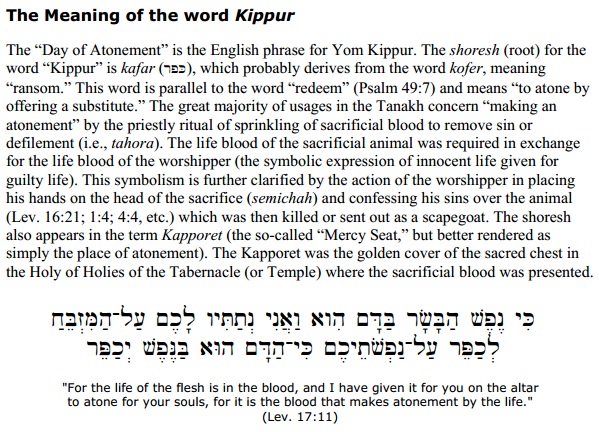
(Ibid).
Therefore, the idea of a “limited atonement” makes no sense at all. First of all, the limitation would only pertain to Israel. Secondly, in regard to Calvin’s overall soteriology, “covering” is only a plausible rendering of atonement; covering versus exchange must be weighed in the balance. In Calvinism, a covering over of our wickedness by the righteousness of Christ is feasible, but what about an exchange of death for life, and sin for righteousness? In the end, what is the passing from death to life? (1Jn 3:14). If we are only covered and not changed, that must be interpreted as mere realm transformation that is only experienced, or the allegory of choice that fits a preferred presupposition.
It’s ironic, even camps that reject the Calvinist label buy into the Calvinist idea of atonement. More buy into the idea that Christ had to keep the law for us. Even more buy into the idea that we are merely covered and not changed: “We are all just sinners saved by grace.” “When God looks at us, He only sees Christ.” We have all said these things.
This is a fundamental misinterpretation of the law’s relationship to grace. And that must change; we mustn’t be on the wrong side of the law.
paul
Calvinism and the Problem with Perfection
Originally published November 7, 2013
Augustine, Luther, and Calvin were first and foremost Platonists. They integrated the Bible with Platonism. Plato’s theory of forms posits the idea of two worlds; the mutable material world of illusion where reality can only be partially known, and another world where the immutable objective true forms exist. This material world is a shadow world; everything is shadows of the true forms. Therefore, man can only interpret and experience this world subjectively. The tendency is to interpret reality by observing the shadows. To the degree that mankind thinks the material world is reality according to the five senses, subjectivity and chaos will abound.
Therefore, Plato’s ethic was to improve the subjective experience of this life by accessing the true forms through ideas and mathematics—things that transcend the five senses (he believed math was an unchangeable rule and therefore not part of the shadow world). He believed that those who have the capability and willingness to bring more understanding of the objective into the subjective to be an elite minority. These were Plato’s philosopher kings whom he thought should rule society in order to decrease chaos as much as possible. Without philosopher kings, the world would be awash in a sea of subjectivity, everyone living by their own subjective presuppositions based on the shadows of this world. Hence, the arch enemy of the Platonic ideal is individualism.
Plato’s world of true objective forms was his trinity of the true, good, and beautiful. Experiencing the pure form of goodness in this world is impossible—only a shadow of good can be experienced subjectively. Plato’s social engineering has a doctrine, and to the degree that doctrine is applied, a higher quality of subjective existence occurs.
The Reformers put a slightly different twist on this construct. There is no doctrine to apply, only an orthodoxy that focuses on seeing and experiencing. Their version of Plato’s philosopher kings are pastors who possess the power of the keys. Orthodoxy is mediated truth determined by “Divines,” and passed down to the masses for the purpose of experiencing the objective power of the gospel subjectively. The Reformers made the true forms “the gospel,” and reality itself the gospel; ie., the work and personhood of Jesus Christ in particular.
Therefore, in the same way Plato envisioned a society that experiences the power of the true forms subjectively through ideas and immutable disciplines like mathematics; the Reformers sought a heightened subjective experience through a deeper and deeper knowledge of their own true, good, and beautiful—the gospel. And more specifically, instead of the gateway of understanding being reason, ideas, and immutable disciplines, they made the gospel itself the interpretive prism. So: life, history, the Bible; ie., everything, is a tool for experiencing true reality (the gospel) in a higher quality subjectivity. The Bible and all life events are a gospel hermeneutic. Salvation itself is the interpretive prism. All of reality is about redemption. Salvation itself is the universal hermeneutic.
But both constructs have this in common: pure goodness and perfection cannot exist objectively in the material world. This is where Calvinism and Platonism kiss. The Bible only agrees with this if it is a “gospel narrative.” But if it is God’s full orbed philosophical statement to all men to be interpreted grammatically and exegetically, contradictions abound. To wit, if man possesses goodness and the ability to interpret reality objectively, Platonism and its Reformed children are found wanting. If Reformation orthodoxy is not evaluated biblically with the very theses of its own orthodoxy as a hermeneutic, even more wantonness is found.
The Apostles rejected Platonism because they believed goodness and perfection could indeed be found in this material world. There is no question of the quality of goodness inside of man that enables mankind to interpret reality objectively, the quantity of goodness notwithstanding. In contrast, a dominate theme in the Calvin Institutes is the idea that no person lost or saved can perform a good work. Like Plato’s geometric hermeneutics, the Reformers believed the Law lends understanding to man’s inability to do good because eternal perfection is the standard. The best of man’s works are tainted with sin to some degree, and therefore imperfect. Even if man could perform one perfect work, one sin makes mankind a violator of the whole law. The Reformers were adamant that no person could do any good work whether saved or lost.
Why all the fuss over this point? Why was Calvin dogmatic about this idea to the point of annoyance? Because he was first and foremost a Platonist. The idea that a pure form of good could be found within mankind was metaphysical heresy. Because such contradicts every page of the Bible, the Reformers’ Platonist theology was made the hermeneutic as well. Instead of the interpretation method producing the theology, they made the theology the method of interpretation. If all of reality is redemptive, it must be interpreted the same way.
For the Platonist, the coming of Jesus Christ in the flesh poses a huge problem. He is the truth. He came to the material world in a material body. Platonism became Gnosticism and wreaked havoc on the 1st century church. Notice how the first sentences of 1John are a direct pushback against the Gnosticism of that day:
1John 1:1 – That which was from the beginning, which we have heard, which we have seen with our eyes, which we looked upon and have touched with our hands, concerning the word of life— 2 the life was made manifest, and we have seen it, and testify to it and proclaim to you the eternal life, which was with the Father and was made manifest to us— 3 that which we have seen and heard we proclaim also to you, so that you too may have fellowship with us; and indeed our fellowship is with the Father and with his Son Jesus Christ. 4 And we are writing these things so that our joy may be complete.
Christ is the true, good, and beautiful, and He was touched, felt, seen, heard, and understood. Game over. This is the paramount melding of Plato’s two worlds resulting in a plenary decimation of his philosophy. Nevertheless, Calvin et al got around that by keeping mankind in a subjective realm while making the material world a gospel hermeneutic. Reality still cannot be understood unless it is interpreted by the gospel—everything else is shadows.
Martin Luther took Plato’s two worlds and made them two stories; our own subjective story, a self “glory story” that leads to a labyrinth of subjectivism, or the “cross story” which is the objective gospel. Luther made Plato’s two worlds two stories, but still, they are two realms; one objective and one subjective. In the final analysis mankind is still incompetent, and void of any good whether saved or lost.
Whether the Reformed gospel or Platonism, the infusion of objective goodness is the heresy. Man cannot have any righteousness in and of himself, whether lost or saved. The pushback against this idea can be seen throughout the New Testament. A few examples follow:
1John 2:4 – Whoever says “I know him” but does not keep his commandments is a liar, and the truth is not in him, 5 but whoever keeps his word, in him truly the love of God is perfected.
1John 2:20 – But you have been anointed by the Holy One, and you all have knowledge.21 I write to you, not because you do not know the truth, but because you know it, and because no lie is of the truth.
1John 2:26 – I write these things to you about those who are trying to deceive you. 27 But the anointing that you received from him abides in you, and you have no need that anyone should teach you. But as his anointing teaches you about everything, and is true, and is no lie—just as it has taught you, abide in him.
1John 2:29 – If you know that he is righteous, you may be sure that everyone who practices righteousness has been born of him.
1John 3:2 – Beloved, we are God’s children now, and what we will be has not yet appeared; but we know that when he appears[a] we shall be like him, because we shall see him as he is. 3 And everyone who thus hopes in him purifies himself as he is pure. 4 Everyone who makes a practice of sinning also practices lawlessness; sin is lawlessness. 5 You know that he appeared in order to take away sins, and in him there is no sin. 6 No one who abides in him keeps on sinning; no one who keeps on sinning has either seen him or known him. 7 Little children, let no one deceive you. Whoever practices righteousness is righteous, as he is righteous.
Romans 15:14 – I myself am satisfied about you, my brothers, that you yourselves are full of goodness, filled with all knowledge and able to instruct one another.
Christians can know goodness, and perform righteousness objectively. This speaks to the quality of the righteousness when it is performed—it is perfect and acceptable to God. We are not limited to a mere subjective experience in regard to righteousness. When we are resurrected, the quantity thereafter will be 100%, but our present righteousness is acceptable to God when it is performed by us. If it is accepted by God, it is perfect.
Even the unregenerate know good, and can perform it. The works of the law are written on their hearts, and their consciences either accuse or excuse them (Romans 2:12-15). Though enslaved to unrighteousness, they are free to perform righteousness (Romans 6:20). The very goodness of God can be understood from observing creation as well (Romans 1:20).
The only way the Reformers can make all goodness outside of man is to make the Bible a salvation hermeneutic. It is the only way they could integrate the Bible with their Platonist philosophy.
Calvinist Catholicism, Denial of Sanctification, Denial of the New Birth, and Distortion of the Trinity Through “Emphasis”
Originally published January 3, 2013
“Those of Reformed theology are not under grace. How do we know that? Because they say Christians are still under the dominion of sin. And plainly, according to the Bible, that equals being under the law and not under grace.”
The mystery of why sanctification is so anemic today is no longer a mystery. Traditionally, this has been the case for a long time in the Western church because the fathers of the Reformation discounted sanctification all together. Sure, they used the term, but it was disingenuous then, and continues to be such with those who use the term today. Weak sanctification leads to very unexciting lives which are no incentive to share the “new life” with others. We share what we are excited about, and being no better than what we were before our “conversion” is neither good news nor worth sharing. It seems the only thing we have to share is, “We are more humble than you because we know that we are empty vessels waiting to be filled and maybe the Lord will fill us and maybe he won’t.” Such a message just doesn’t set the world on fire.
The more I learn, the more I am convinced that there is really no difference between Catholicism and Protestantism: both are “under the law.” One is Jesus plus ritual to complete your justification and the other is Jesus plus making sure you do nothing in your sanctification to complete your justification (because the “just” shall live by faith [ALONE]). And in both cases, being faithful to the authority of the church secures your salvation. Calvin believed that we stay saved through daily repentance for daily salvation, and that forgiveness can only be found in Reformed churches:
Secondly, this passage shows that the gratuitous pardon of sins is given us not only once, but that it is a benefit perpetually residing in the Church, and daily offered to the faithful. For the Apostle here addresses the faithful; as doubtless no man has ever been, nor ever will be, who can otherwise please God, since all are guilty before him; for however strong a desire there may be in us of acting rightly, we always go haltingly to God. Yet what is half done obtains no approval with God. In the meantime, by new sins we continually separate ourselves, as far as we can, from the grace of God. Thus it is, that all the saints have need of the daily forgiveness of sins; for this alone keeps us in the family of God” (Calvin’s Commentaries, Vol. 45: Catholic Epistles).
And, Calvin’s homeboy, Luther, believed that Reformed elders have the authority to forgive sins:
Confession consists of two parts. One is that we confess our sins. The other is that we receive the absolution, that is, forgiveness, from the pastor as from God himself and by no means doubt but firmly believe that our sins are thereby forgiven before God in heaven (Timothy J. Wengert: A Contemporary Translation of Luther’s Small Catechism; Augsburg Fortress PUB 1994, p.49).
And on page 35….
Daily in this Christian church the Holy Spirit abundantly forgives all sins—mine and those of all believers. On the last day the Holy Spirit will raise me and all the dead and will give me and all believers in Christ eternal life.
The granting of eternal life is future, and is based on faithfulness to the established church. Look, I have been a pastor long enough to know that many Baptists associate their salvation with church membership. I have suggested cleaning up the roles in a few churches, and the response is always one that hints of this being synonymous with taking away one’s salvation. Where did they get that idea? Whether Catholic or Protestant, you can get your absolution in a booth or an alter call—there is no difference.
Calvinism, and the Reformed gospel in general, is “under the law.” In the Scriptures, being under the law equals being under the dominion of sin:
Romans 6:14—For sin will have no dominion over you, since you are not under law but under grace.
Romans 2:12—For all who have sinned without the law will also perish without the law, and all who have sinned under the law will be judged by the law.
Romans 2:15—For the law brings wrath, but where there is no law there is no transgression.
Those of Reformed theology are not under grace. How do we know that? Because they say Christians are still under the dominion of sin. And plainly, according to the Bible, that equals being under the law and not under grace. Quotes from the Reformed that establish this are myriad, I will note one:
We are enemies of God. We are God ignoring. We are God defying. We hate God. (CJ Mahaney: Resolved Conference 2008).
Comments by Reformed pastor Matt Chandler speaking of Christians as being “wicked sinners” have apparently been scrubbed from the internet (see here, and here), but nonetheless are indicative of the Reformed position.
This simply equals nothing less than, from the biblical perspective, Christians remaining in an unregenerate state though they call it regeneration. And this, they in fact do:
Bavinck too, wrote in connection with the regenerating work of the Spirit: “The regenerate man is no whit different in substance from what He was before his regeneration” (G. C. Berkouwer: Faith and Sanctification, p. 87).
Unchanging regeneration: such oxymorons are not few in Reformed writings. And though they would deny it, sanctification and the new birth are rejected as a matter logical conclusion. There can be no sanctification or new creaturehood where we are still under the bondage and dominion of sin. This is antithetical to being under grace. The Reformed think tank that launched the present-day New Calvinist movement which is a resurgence of authentic Calvinism, wrote an article in their theological journal entitled, “The False Gospel of the New Birth.” The article can be read here.
The argument that is used is one of emphasis which is Gnostic epistemology: sure, stars are true, but they only shine because of the Sun. Sure, shadows are true, but they wouldn’t exist without the Sun either. Sure, flowers are true, but they wouldn’t be able to grow without the Sun as well. What we want to do is focus on what really gives life: the Sun. To emphasize stars, shadows, or flowers over the thing that actually supplies the life will diminish life to whatever degree that the “good thing” is emphasized over the “best thing.”

Beginning to get the picture? It enables them to acknowledge the truth of sanctification and the new birth while deemphasizing them into oblivion. Out of sight; out of mind. To say that the new birth and our ability in sanctification are deemphasized in today’s church is certainly an understatement.
Said think tank, The Australian Forum, used the same argument to emphasize Christ over the Father and the Holy Spirit as well. Christocentricity is very important to Reformed theology. The core four of this think tank was Geoffrey Paxton, Jon Zens, Graeme Goldsworthy, and Robert Brinsmead. In a book where Paxton documents the Reformed heritage of Seventh-Day Adventism, he stated the following:
Luther and Calvin did not simply stress Christ alone over against the Roman Catholic emphasis on works-righteousness. The Reformers also stressed Christ alone over against all—be they Roman Catholics or Protestants (29) — who would point to the inside of the believer as the place where justifying righteousness dwells. Christ alone means literally Christ alone, and not the believer. And for that matter, it does not even mean any other member of the Trinity! (The Shaking of Adventism: p. 41).
Likewise, the same argument is made in regard to sanctification:
The distinction between the two types of righteousness will make the final emphasis of the Reformation easier to understand. The Reformers contended that the believer is righteous in this life only by faith. In saying this, they were not denying either the necessity or the reality of sanctification in all true believers. Rather, they were asserting that in this life sanctification is never good enough to stand in the judgment. The believer must look only to the righteousness of faith (the righteousness of the God-man) for his acceptance with God.
The inadequacy of sanctificational renewal was an integral part of Reformation teaching. Its corollary was the Reformers’ steadfast gaze at the righteousness of faith—namely, the doing and dying of the God-man, Jesus of Nazareth. Though the believer fights against sin and seeks to be a faithful law-keeper, sin nevertheless remains until his dying day Luther put it forcefully:
Paul, good man that he was, longed to be without sin, but to it he was chained. I too, in common with many others, long to stand outside it, but this cannot be. We belch forth the vapours of sin; we fall into it, rise up again, buffet and torment ourselves night and day; but, since we are confined in this flesh, since we have to bear about with us everywhere this stinking sack, we cannot rid ourselves completely of it, or even knock it senseless. We make vigorous attempts to do so, but the old Adam retains his power until he is deposited in the grave. The Kingdom of God is a foreign country, so foreign that even the saints must pray: ‘Almighty God, I acknowledge my sin unto thee. Reckon not unto me my guiltiness, O Lord.’ There is no sinless Christian. If thou chancest upon such a man, he is no Christian, but an anti-Christ. Sin stands in the midst of the Kingdom of Christ, and wherever the Kingdom is, there is sin; for Christ has set sin in the House of David.
(Ibid pp. 46,47).
Hence, at least Reformed theology is consistent in regard to Christians being under the law and also still under sin’s dominion. We must live by faith alone because we will supposedly stand in a future judgment that will determine righteousness by a perfect keeping of the law. And it’s true, those under the law will stand in such a judgment. But will we? The heart of the Reformation posited the idea that if we live by faith alone in sanctification, Christ will stand in the judgment for us.
But we know well what James thought of sanctification by faith alone.
paul

 Paul's Passing Thoughts
1 comment