Absolutely Critical to Effective Ministry: Knowing the Two Realities of Protestantism

If we are to accomplish anything in contemporary Christianity, we must begin to live by a basic hard-fast rule: our actions must be guided by the knowledge that there are two realities in contemporary Christianity – grammatical-historical and redemptive-historical.
These are usually discussed as methods of Bible interpretation, but they are really much more than that according to Protestant tradition. These are two different ways of interpreting reality itself.
We will begin by defining the redemptive-historical interpretation of reality along with this caution: one of the most powerful influences that this view of reality has is the dismissal of its basic premise as mere mysticism held by fringe elements of Protestantism. Those who dismiss it out-of-hand then proceed to function by its tenets unawares. The who’s who of Protestantism care little that the masses understand this ideology, just so they function by it.
In fact, Protestant leaders assume most parishioners are unable to grasp its tenets. Therefore, redemptive-historical reality must be explained in a way that will enable congregants to apply it to their lives and function a certain way within church culture. Redemptive-historical reality is primarily the crux of Protestant orthodoxy and its spiritual caste system.
In mythology, we often link the bizarre narratives to the philosophy itself, but that’s a mistake. Roman, Greek, and Babylonian culture was not developed by superstitious idiots. What we fail to understand is the narratives are stories that convey principles to the spiritual underlings so they can apply principles of higher knowledge to their lives. They cannot understand the higher knowledge, but those who can need to tell the underlings how to live in order to obtain the best possible society.
“Orthodoxy” can be likened to mythological narratives that teach those of lesser spiritual understanding how they should live, but they are based on well thought out metaphysical (state of being) systems of knowledge. We shouldn’t be surprised that what seems to be superstition has ruled the greatest empires on earth. This is because the core ideology is always a succinct system of thought that is greatly underestimated. The ancient philosophers were not idiots. Democritus (circa 400 BC) was the originator of atomic theory. The sophist class of philosophers were the first to apply philosophy to sociology in an in-depth way (circa 500 BC). ALL present-day psychologies are founded on the basic theories of that day. For example, the basic ideology that drives the theory of rehabilitation in our modern-day prison systems came from Socrates.
Let’s now define redemptive-historical reality. I will be using a quote from Graeme Goldsworthy who is considered to be the contemporary father of redemptive-historical hermeneutics:
If the story is true, Jesus Christ is the interpretative key to every fact in the universe and, of course, the Bible is one such fact. He is thus the hermeneutic principle that applies first to the Bible as the ground for understanding, and also to the whole of reality (Graeme Goldsworthy: Gospel-centered Hermeneutics; p.48).
This is a pretty straight forward statement and accurately depicts what Protestantism is really founded on; not a theology per se, but a way to interpret reality itself. How in the world does one interpret all of reality through the one person Jesus Christ? You MUST understand: Martin Luther articulated the answer in the foundational treatise of Protestantism, the Heidelberg Disputation.
The Heidelberg Disputation is a concise systematic ideology that explains how all of reality is to be interpreted through redemption, or if you will, the man of redemption, Jesus Christ. Again, the power of this ideology is a dismissal of it out-of-hand by those who proceed to sit under its “theology.” The theology of the metaphysics redefines biblical terms, and uses them to lead the masses into a functioning Christocentric view of reality.
We will not plunge the depths of the Heidelberg Disputation in this writing, but the principles will be outlined and their inevitable functionality among Christians. Before we move forward, let’s examine additional statements that confirm this approach among Christians. This testimony was given in a recent email to me:
An old acquaintance of ours (Presbyterian as they get) has said more times than I can remember something like this: “Every verse in the Bible, from Genesis 1 through Revelation, is talking about Jesus.” Years ago that sounded so intellectual, holy; today it sounds like hogwash. I mean, are we really expected to believe that the passages talking about incestuous rape are talking about Jesus? Come on, really?
Well, as ridiculous as it sounds, the answer is, “yes.” Many function according to the theology that is predicated on this foundational interpretive method for not only the Bible, but reality itself.
Pause: keep in mind that those who function according to this interpretation of reality without understanding its premise will reflect back the resulting interpretation of Scripture. They repeat pulpit talking points without ever investigating the source of them, or the logical conclusions of the talking points. Sometimes, such people are referred to as “useful idiots.” But again we need to be cautious: people who blindly follow others do not do so for the sake of following blindly—they are functioning according to some sort of ideology that leads to the blind following.

Let’s look at some more examples from proponents of New Covenant Theology:
New Covenant Theology insists on the priority of Jesus Christ over all things, including history, revelation, and redemption. New Covenant Theology presumes a Christocentricity to the understanding and meaning of all reality (1st tenet of NCT according to the Earth Stove Society, a NCT think tank).
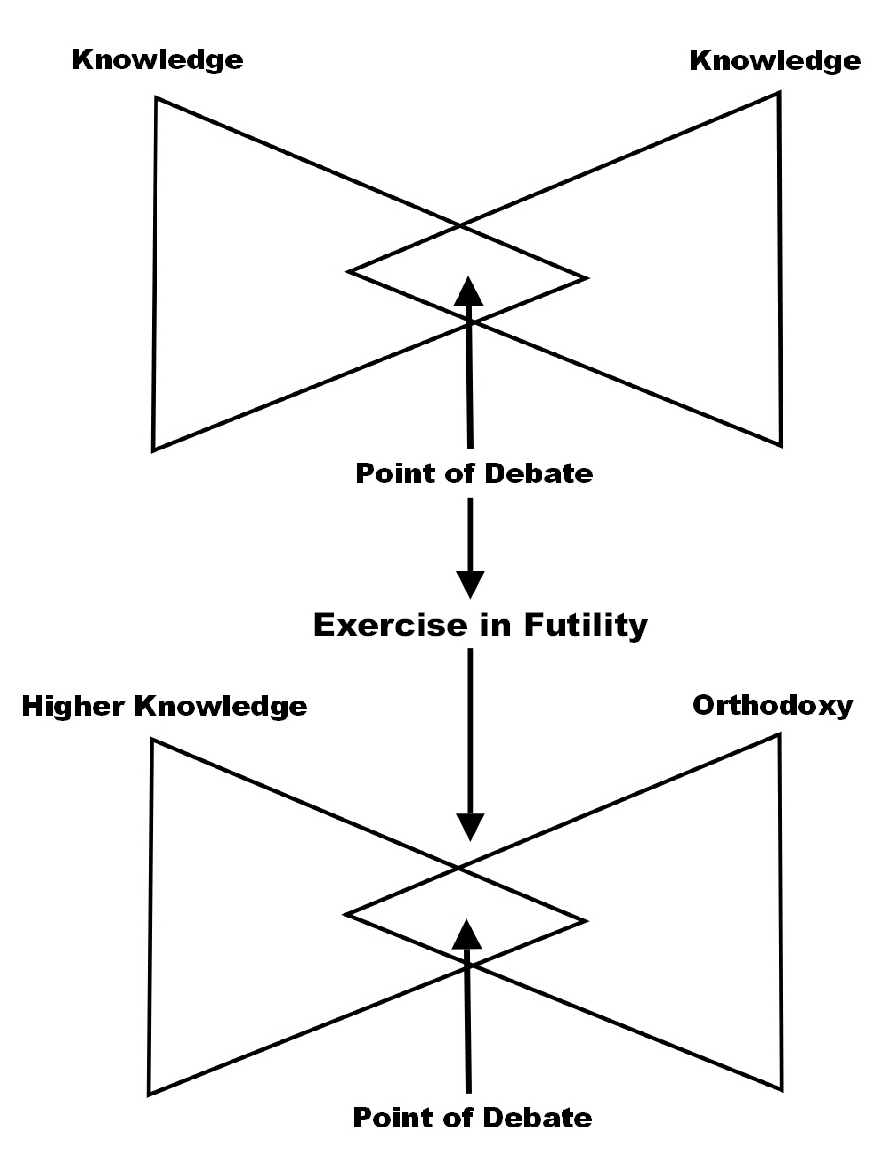
Not much ambiguity in that statement. Pretty clear on its face except for how one would apply it to real life. Again, many might scratch their head in regard to that statement, but proceed to let the theological orthodoxy that flows from it shape their life and thinking. At the point of debate with such people, their orthodoxed talking points will reflect the metaphysical premise. They will absolutely not be swayed in their thinking because they concede that they cannot understand the higher knowledge, and the authority of the higher knowledge is part of the orthodoxy.
Pause: I used to be involved in a ministry that evangelized Jehovah Witnesses. Debating the Bible with them led nowhere because their orthodoxy reinterprets all biblical terms and phraseology. When Christ is referred to, it is assumed that their presuppositions regarding Christ are the same, and they are not. Instead, we challenged their orthodoxy, i.e., the Watchtower publication. Likewise, let me reveal a concluding theme of this study: never debate the Bible with a Protestant; instead, bring their authority into question. Refuse to discuss anything else for it will be futile for reasons yet to be examined.
Let’s look at another statement from the New Covenant Theology camp:
At this time, resist the temptation to utilize subsequent passages to validate the meaning or to move out from the immediate context. Remembering that all exegesis must finally be a Christocentric exegesis.
Look for Christ even if He isn’t there directly. It is better to see Christ in a text even if He isn’t, than to miss Him where He is (The Biblical Theological Study Center: A Christo-Presuppositional Approach to the Entire Scriptures; Max Strange. Online source: http://goo.gl/5sGjP).
The question quickly becomes, “How can you see Jesus in every verse in the Bible?” This is where the Bible becomes a “meta-narrative.” That can mean, “grand narrative,” but in this case it means “metaphysical narrative.” The Bible is a narrative, or story that depicts redemptive reality. You will get confused unless you understand that the theory also posits the inclusion of multi-purpose perspectives into the metaphysical story (a story that depicts true reality). The text grammar doesn’t determine the perspective resulting in a particular objective outcome, but the assumed outcome determines the perspective. So, can “passages talking about incestuous rape” say something about redemption? Of course. In this example, the passage is not talking about Jesus specifically, but denotes why His redemptive works are needed. In some way, according to the prism, the verse always speaks of Jesus and His redemptive works.
This approach to interpreting reality (state of being, or metaphysics), what we call epistemology, plugs into the basic ancient philosophy of total inability. This proffers the idea that man cannot know or comprehend reality. The metaphysic follows: man dwells in a realm apart from true reality that he cannot comprehend. Secondly, somehow, usually via a theory of predeterminism, there are a select few that can ascertain truths from the other realm. Usually, the delineation of the realms is the material versus invisible with mankind residing in the material realm.
The Reformers recognized a reality that man functions in, but deemed it “subjective,” or shadowy. Focusing on this shadowy realm leads to despair. In the aforementioned foundational document of Protestantism, Luther contended that man’s material realm only feeds “the glory story,” or the story of man.
In Luther’s construct, ALL reality is interpreted through two stories: the glory story (the story of man), and the cross story (the story of redemption). Giving any credence to the material world or the belief that man can know the material world empirically only contributes to the story of man and his glory. Yes, man functions in this world, but it does not possess any objective wisdom that can bring true well being. Only an ever-clearer understanding of the cross story can bring well being.
What then is the cross story specifically? It is twofold: it is the holiness of God as set against the sinfulness of man. This is the only objective truth and reality that can bring well being. The goal is a deeper and deeper understanding of how inept we are in every category of life as set against the glory and holiness of God.
Pause for main point: according to this philosophy, the sole purpose of the Bible is to lead us in seeing the cross story with more and more clarity. To the extent that we do that, we will have well being. AND, to the extent that each individual lives according to the cross story, the well being of society as a whole will increase. When Reformed folks talk about “transforming society with the gospel,” this is exactly what they are talking about. To the extent that the populous embraces the doctrine of inability, society will be transformed.
One reason for lauding this epistemology is unified agreement on interpretation. If every verse is about Jesus, there is no division in opinions. Secondly on this point, it gives Christianity a pass on defending inerrancy; e.g., narratives are not meant to be technical systems of theology that require consistency in logic. Thirdly on this point, if some sort of Christocentric conclusion is drawn from the text—it can’t be wrong. If the interpretation of the text somehow demeans man and exalts God, error is impossible.
Before we address the grammatical-historical approach to interpreting reality, let me add some thoughts to the redemptive-historical perspective. This perspective now dominates the institutional church. Just yesterday, I participated in a conversation on a social media site in which the following statement was made about Proverbs chapter 8:
The Old Testament reveals shadows of what Jesus Christ will be in the New Covenant. I can easily say that wisdom personified in Proverbs 8 is Jesus Christ.
If one reads Proverbs 8, the assertion that it is about Christ is beyond presumptuous at best. It is a complete rejection of the plain sense of the grammar; even in lieu of the personification being in the female gender.
Also, these two perspectives on reality are a salvific issue with the Reformed. A denial of total inability equates with the grammatical-historical view of reality which is supposedly an attempt by man to glorify himself by writing his own story. By believing that you can understand reality, you are in essence making yourself God.
The most common question is the issue of biblical imperatives that are clearly directed at mankind. This assumes that man is able to obey because grammatically, the commands are directed at him with a demand for obedience. But again, addressing these commands with the presupposition of total inability that equates with the redemptive-historical prism, the commands are supposedly meant to deliberately frustrate man and “drive him to despair of self-righteousness.”
The Reformed continually concede that the Bible states things in grammatical form, but that is always followed with the proper “gospel context” according to the redemptive-historical interpretation of reality. The classic example is this quotation from Neo-Calvinist Paul David Tripp:
….and the Bible does call us to change the way we think about things. But this approach again omits the person and work of Christ as Savior. Instead, it reduces our relationship to Christ to “think his thoughts” and “act the way Jesus would act.” (How People Change 2006, p.27).
Notice that Tripp concedes that the Bible calls us to do things according to the grammatical context, but goes on to say that is a denial of the gospel (omits the work of Christ as savior). On page 26 of the same book, Tripp calls obedience to the word of God a “behavioral approach” that “separates the commands of Scripture from their Christ-centered gospel context.”
Lastly before we move on, when one is able to wrap their minds around the redemptive-historical approach to interpreting reality, it will be recognized that this approach now saturates the Protestant institutional church.
What is the grammatical-historical approach to interpreting reality? As with the other prism, I am not going to elaborate on the “historical” part except to say that the redemptive-historical hermeneutic makes history part of the prewritten gospel narrative. History is simply the redemptive story playing out as scripted by God.
The political commentator Rush Limbaugh often notes that “words mean things.” This is a good working definition of grammatical-historical interpretation; it draws conclusions from a technical evaluation of the words in a sentence whether spoken or written. The many categories of language that give meaning are considered also, which speaks to the “historical” part of the term. Does the sentence mean the same thing today that it meant then? For instance a sentence written in 1940 might say, “Bob is gay.” History informs us of the meaning in that day: Bob is happy. Today that means Bob is a homosexual. The etymology of words and many other factors weigh-in, but all have this in common: they are empirical tools.
This interpretive method also assumes mankind is able to comprehend the realty he dwells in according to empirical observation and can draw conclusions on his own. Man has ability.
Pause: how did Luther get away with denying that mankind had any kind of ability at all? He chalked-it-up to man’s self-perceived ability that can accomplish things in the material world. These accomplishments are of no worth and only accomplish one thing and one thing only: they serve man’s lust to glorify himself. Luther believed that satisfaction from accomplishment was nothing more than sinful pride. To Luther, the only redeeming thing about the world was that heaven manifested its works on earth according to God’s sovereign will. If man lives life subjectively and professes that his evil “good” works cannot be distinguished from heavenly manifestations “experienced subjectively,” that is venial sin that can be forgiven. In accordance with authentic Reformed tradition, Luther believed the following: the belief that any man, including Christians, can perform a good work is mortal sin.
Therefore, the Reformed often define wisdom/knowledge according to two categories: “worldly knowledge” and “wisdom from above.” Sure, man can obtain worldly knowledge that improves his circumstances, but it is all prideful according to Luther. Wouldn’t this approach propagate a lot of death and misery due to a lack of science? Yes, but that was exactly Luther’s point. Many are perplexed by the embracing of ideologies that result in third world cultures, but those who are perplexed make the point for those in the other camp: what is the perplexity of the detractors? Answer: they are perplexed that other people do not lust after materialism as they do. Hence, third world cultures are often seen as being virtuous by the Reformed.
This is why Luther introduced suffering as a hermeneutic that interprets reality. There is true wisdom in the cross story because according to Luther, “all wisdom is hidden in suffering.” According to Luther, many reject this interpretation of reality and dub it the “foolishness of the cross.” Luther also stated that men call the good evil (suffering), and evil good (anything that prevents suffering). This is why Luther called reason an “ugly whore who should have dung rubbed in her face.”
The grammatical-historical perspective of reality assumes man can interpret his own reality, and the material world is not inherently evil. Believers and unbelievers share common realities that are simply practical and not evil.
Here is the challenge: to bring biblical knowledge to bear on grammatical-historical reality when the prevailing view of Protestantism has been the redemptive prism for hundreds of years.
But there is good news as well: the grammatical prism is what man utilizes intuitively. People assume they can interpret their own reality. Of course, the Reformed see this as the very problem.
Does this mean that grammatical-historical Christians should evangelize the lost world and forgo debate with Protestants? Yes it does, because it is a futile endeavor. You are trying to reach people who define reality itself differently. Protestants are redemptive-historical religionists.

Absolutely Critical to Effective Ministry: Knowing the Two Realities of Protestantism
 If we are to accomplish anything in contemporary Christianity, we must begin to live by a basic hard-fast rule: our actions must be guided by the knowledge that there are two realities in contemporary Christianity; grammatical-historical and redemptive-historical.
These are usually discussed as methods of Bible interpretation, but they are really much more than that according to Protestant tradition. These are two different ways of interpreting reality itself.
We will begin by defining the redemptive-historical interpretation of reality along with this caution: one of the most powerful influences that this view of reality has is the dismissal of its basic premise as mere mysticism held by fringe elements of Protestantism. Those who dismiss it out-of-hand then proceed to function by its tenets unawares. The who’s who of Protestantism care little that the masses understand this ideology, just so they function by it.
In fact, Protestant leaders assume most parishioners are unable to grasp its tenets. Therefore, redemptive-historical reality must be explained in a way that will enable congregants to apply it to their lives and function a certain way within church culture. Redemptive-historical reality is primarily the crux of Protestant orthodoxy and its spiritual caste system.
In mythology, we often link the bizarre narratives to the philosophy itself, but that’s a mistake. Roman, Greek, and Babylonian culture was not developed by superstitious idiots. What we fail to understand is the narratives are stories that convey principles to the spiritual underlings so they can apply principles of higher knowledge to their lives. They cannot understand the higher knowledge, but those who can need to tell the underlings how to live in order to obtain the best possible society.
“Orthodoxy” can be likened to mythological narratives that teach those of lesser spiritual understanding how they should live, but they are based on well thought out metaphysical (state of being) systems of knowledge. We shouldn’t be surprised that what seems to be superstition has ruled the greatest empires on earth. This is because the core ideology is always a succinct system of thought that is greatly underestimated. The ancient philosophers were not idiots. Democritus (circa 400 BC) was the originator of atomic theory. The sophist class of philosophers were the first to apply philosophy to sociology in an in-depth way (circa 500 BC). ALL present-day psychologies are founded on the basic theories of that day. For example, the basic ideology that drives the theory of rehabilitation in our modern-day prison systems came from Socrates.
Let’s now define redemptive-historical reality. I will be using a quote from Graeme Goldsworthy who is considered to be the contemporary father of redemptive-historical hermeneutics:
If the story is true, Jesus Christ is the interpretative key to every fact in the universe and, of course, the Bible is one such fact. He is thus the hermeneutic principle that applies first to the Bible as the ground for understanding, and also to the whole of reality (Graeme Goldsworthy: Gospel-centered Hermeneutics; p.48).
This is a pretty straight forward statement and accurately depicts what Protestantism is really founded on; not a theology per se, but a way to interpret reality itself. How in the world does one interpret all of reality through the one person Jesus Christ? You MUST understand: Martin Luther articulated the answer in the foundational treatise of Protestantism, the Heidelberg Disputation.
The Heidelberg Disputation is a concise systematic ideology that explains how all of reality is to be interpreted through redemption, or if you will, the man of redemption, Jesus Christ. Again, the power of this ideology is a dismissal of it out-of-hand by those who proceed to sit under its “theology.” The theology of the metaphysics redefines biblical terms, and uses them to lead the masses into a functioning Christocentric view of reality.
We will not plunge the depths of the Heidelberg Disputation in this writing, but the principles will be outlined and their inevitable functionality among Christians. Before we move forward, let’s examine additional statements that confirm this approach among Christians. This testimony was given in a recent email to me:
An old acquaintance of ours (Presbyterian as they get) has said more times than I can remember something like this: “Every verse in the Bible, from Genesis 1 through Revelation, is talking about Jesus.” Years ago that sounded so intellectual, holy; today it sounds like hogwash. I mean, are we really expected to believe that the passages talking about incestuous rape are talking about Jesus? Come on, really?
Well, as ridiculous as it sounds, the answer is, “yes.” Many function according to the theology that is predicated on this foundational interpretive method for not only the Bible, but reality itself.
Pause: keep in mind that those who function according to this interpretation of reality without understanding its premise will reflect back the resulting interpretation of Scripture. They repeat pulpit talking points without ever investigating the source of them, or the logical conclusions of the talking points. Sometimes, such people are referred to as “useful idiots.” But again we need to be cautious: people who blindly follow others do not do so for the sake of following blindly—they are functioning according to some sort of ideology that leads to the blind following.
Let’s look at some more examples from proponents of New Covenant Theology:
New Covenant Theology insists on the priority of Jesus Christ over all things, including history, revelation, and redemption. New Covenant Theology presumes a Christocentricity to the understanding and meaning of all reality (1st tenet of NCT according to the Earth Stove Society, a NCT think tank).
Not much ambiguity in that statement. Pretty clear on its face except for how one would apply it to real life. Again, many might scratch their head in regard to that statement, but proceed to let the theological orthodoxy that flows from it shape their life and thinking. At the point of debate with such people, their orthodoxed talking points will reflect the metaphysical premise. They will absolutely not be swayed in their thinking because they concede that they cannot understand the higher knowledge, and the authority of the higher knowledge is part of the orthodoxy.
Pause: I used to be involved in a ministry that evangelized Jehovah Witnesses. Debating the Bible with them led nowhere because their orthodoxy reinterprets all biblical terms and phraseology. When Christ is referred to, it is assumed that their presuppositions regarding Christ are the same, and they are not. Instead, we challenged their orthodoxy, i.e., the Watchtower publication. Likewise, let me reveal a concluding theme of this study: never debate the Bible with a Protestant; instead, bring their authority into question. Refuse to discuss anything else for it will be futile for reasons yet to be examined.
Let’s look at another statement from the New Covenant Theology camp:
At this time, resist the temptation to utilize subsequent passages to validate the meaning or to move out from the immediate context. Remembering that all exegesis must finally be a Christocentric exegesis.
Look for Christ even if He isn’t there directly. It is better to see Christ in a text even if He isn’t, than to miss Him where He is (The Biblical Theological Study Center: A Christo-Presuppositional Approach to the Entire Scriptures; Max Strange. Online source: http://goo.gl/5sGjP).
The question quickly becomes, “How can you see Jesus in every verse in the Bible?” This is where the Bible becomes a “meta-narrative.” That can mean, “grand narrative,” but in this case it means “metaphysical narrative.” The Bible is a narrative, or story that depicts redemptive reality. You will get confused unless you understand that the theory also posits the inclusion of multi-purpose perspectives into the metaphysical story (a story that depicts true reality). The text grammar doesn’t determine the perspective resulting in a particular objective outcome, but the assumed outcome determines the perspective. So, can “passages talking about incestuous rape” say something about redemption? Of course. In this example, the passage is not talking about Jesus specifically, but denotes why His redemptive works are needed. In some way, according to the prism, the verse always speaks of Jesus and His redemptive works.
This approach to interpreting reality (state of being, or metaphysics), what we call epistemology, plugs into the basic ancient philosophy of total inability. This proffers the idea that man cannot know or comprehend reality. The metaphysic follows: man dwells in a realm apart from true reality that he cannot comprehend. Secondly, somehow, usually via a theory of predeterminism, there are a select few that can ascertain truths from the other realm. Usually, the delineation of the realms is the material versus invisible with mankind residing in the material realm.
The Reformers recognized a reality that man functions in, but deemed it “subjective,” or shadowy. Focusing on this shadowy realm leads to despair. In the aforementioned foundational document of Protestantism, Luther contended that man’s material realm only feeds “the glory story,” or the story of man.
In Luther’s construct, ALL reality is interpreted through two stories: the glory story (the story of man), and the cross story (the story of redemption). Giving any credence to the material world or the belief that man can know the material world empirically only contributes to the story of man and his glory. Yes, man functions in this world, but it does not possess any objective wisdom that can bring true wellbeing. Only an ever-clearer understanding of the cross story can bring wellbeing.
What then is the cross story specifically? It is twofold: it is the holiness of God as set against the sinfulness of man. This is the only objective truth and reality that can bring wellbeing. The goal is a deeper and deeper understanding of how inept we are in every category of life as set against the glory and holiness of God.
Pause for main point: according to this philosophy, the sole purpose of the Bible is to lead us in seeing the cross story with more and more clarity. To the extent that we do that, we will have wellbeing. AND, to the extent that each individual lives according to the cross story, the wellbeing of society as a whole will increase. When Reformed folks talk about “transforming society with the gospel,” this is exactly what they are talking about. To the extent that the populous embraces the doctrine of inability, society will be transformed.
One reason for lauding this epistemology is unified agreement on interpretation. If every verse is about Jesus, there is no division in opinions. Secondly on this point, it gives Christianity a pass on defending inerrancy; e.g., narratives are not meant to be technical systems of theology that require consistency in logic. Thirdly on this point, if some sort of Christocentric conclusion is drawn from the text—it can’t be wrong. If the interpretation of the text somehow demeans man and exalts God, error is impossible.
Before we address the grammatical-historical approach to interpreting reality, let me add some thoughts to the redemptive-historical perspective. This perspective now dominates the institutional church. Just yesterday, I participated in a conversation on a social media site in which the following statement was made about Proverbs chapter 8:
The Old Testament reveals shadows of what Jesus Christ will be in the New Covenant. I can easily say that wisdom personified in Proverbs 8 is Jesus Christ.
If one reads Proverbs 8, the assertion that it is about Christ is beyond presumptuous at best. It is a complete rejection of the plain sense of the grammar; even in lieu of the personification being in the female gender.
Also, these two perspectives on reality are a salvific issue with the Reformed. A denial of total inability equates with the grammatical-historical view of reality which is supposedly an attempt by man to glorify himself by writing his own story. By believing that you can understand reality, you are in essence making yourself God.
The most common question is the issue of biblical imperatives that are clearly directed at mankind. This assumes that man is able to obey because grammatically, the commands are directed at him with a demand for obedience. But again, addressing these commands with the presupposition of total inability that equates with the redemptive-historical prism, the commands are supposedly meant to deliberately frustrate man and “drive him to despair of self-righteousness.”
The Reformed continually concede that the Bible states things in grammatical form, but that is always followed with the proper “gospel context” according to the redemptive-historical interpretation of reality. The classic example is this quotation from Neo-Calvinist Paul David Tripp:
….and the Bible does call us to change the way we think about things. But this approach again omits the person and work of Christ as Savior. Instead, it reduces our relationship to Christ to “think his thoughts” and “act the way Jesus would act.” (How People Change 2006, p.27).
Notice that Tripp concedes that the Bible calls us to do things according to the grammatical context, but goes on to say that is a denial of the gospel (omits the work of Christ as savior). On page 26 of the same book, Tripp calls obedience to the word of God a “behavioral approach” that “separates the commands of Scripture from their Christ-centered gospel context.”
Lastly before we move on, when one is able to wrap their minds around the redemptive-historical approach to interpreting reality, it will be recognized that this approach now saturates the Protestant institutional church.
What is the grammatical-historical approach to interpreting reality? As with the other prism, I am not going to elaborate on the “historical” part except to say that the redemptive-historical hermeneutic makes history part of the prewritten gospel narrative. History is simply the redemptive story playing out as scripted by God.
The political commentator Rush Limbaugh often notes that “words mean things.” This is a good working definition of grammatical-historical interpretation; it draws conclusions from a technical evaluation of the words in a sentence whether spoken or written. The many categories of language that give meaning are considered also, which speaks to the “historical” part of the term. Does the sentence mean the same thing today that it meant then? For instance a sentence written in 1940 might say, “Bob is gay.” History informs us of the meaning in that day: Bob is happy. Today that means Bob is a homosexual. The etymology of words and many other factors weigh-in, but all have this in common: they are empirical tools.
This interpretive method also assumes mankind is able to comprehend the realty he dwells in according to empirical observation and can draw conclusions on his own. Man has ability.
Pause: how did Luther get away with denying that mankind had any kind of ability at all? He chalked-it-up to man’s self-perceived ability that can accomplish things in the material world. These accomplishments are of no worth and only accomplish one thing and one thing only: they serve man’s lust to glorify himself. Luther believed that satisfaction from accomplishment was nothing more than sinful pride. To Luther, the only redeeming thing about the world was that heaven manifested its works on earth according to God’s sovereign will. If man lives life subjectively and professes that his evil “good” works cannot be distinguished from heavenly manifestations “experienced subjectively,” that is venial sin that can be forgiven. In accordance with authentic Reformed tradition, Luther believed the following: the belief that any man, including Christians, can perform a good work is mortal sin.
Therefore, the Reformed often define wisdom/knowledge according to two categories: “worldly knowledge” and “wisdom from above.” Sure, man can obtain worldly knowledge that improves his circumstances, but it is all prideful according to Luther. Wouldn’t this approach propagate a lot of death and misery due to a lack of science? Yes, but that was exactly Luther’s point. Many are perplexed by the embracing of ideologies that result in third world cultures, but those who are perplexed make the point for those in the other camp: what is the perplexity of the detractors? Answer: they are perplexed that other people do not lust after materialism as they do. Hence, third world cultures are often seen as being virtuous by the Reformed.
This is why Luther introduced suffering as a hermeneutic that interprets reality. There is true wisdom in the cross story because according to Luther, “all wisdom is hidden in suffering.” According to Luther, many reject this interpretation of reality and dub it the “foolishness of the cross.” Luther also stated that men call the good evil (suffering), and evil good (anything that prevents suffering). This is why Luther called reason an “ugly whore who should have dung rubbed in her face.”
The grammatical-historical perspective of reality assumes man can interpret his own reality, and the material world is not inherently evil. Believers and unbelievers share common realities that are simply practical and not evil.
Here is the challenge: to bring biblical knowledge to bear on grammatical-historical reality when the prevailing view of Protestantism has been the redemptive prism for hundreds of years.
But there is good news as well: the grammatical prism is what man utilizes intuitively. People assume they can interpret their own reality. Of course, the Reformed see this as the very problem.
Does this mean that grammatical-historical Christians should evangelize the lost world and forgo debate with Protestants? Yes it does, because it is a futile endeavor. You are trying to reach people who define reality itself differently. Protestants are redemptive-historical religionists.
“Godly” Philosophy
 I used to be in the camp that views “philosophy” as “worldly”, “man-centered”, “evil”; all of those things as juxtaposed with “Biblical wisdom”, or “scriptural”, or “God’s Wisdom”. After all, it seemed to be a reasonable conclusion when confronted with verses of scripture like:
“Where is the wise? where is the scribe? where is the disputer of this world? hath not God made foolish the wisdom of this world? For after that in the wisdom of God the world by wisdom knew not God, it pleased God by the foolishness of preaching to save them that believe. For the Jews require a sign, and the Greeks seek after wisdom: But we preach Christ crucified, unto the Jews a stumblingblock, and unto the Greeks foolishness; But unto them which are called, both Jews and Greeks, Christ the power of God, and the wisdom of God. Because the foolishness of God is wiser than men; and the weakness of God is stronger than men. For ye see your calling, brethren, how that not many wise men after the flesh, not many mighty, not many noble, are called: But God hath chosen the foolish things of the world to confound the wise; and God hath chosen the weak things of the world to confound the things which are mighty; And base things of the world, and things which are despised, hath God chosen, yea, and things which are not, to bring to nought things that are:” ~ 1 Corinthians 1:20-28
What you choose to believe is a philosophical statement about what you believe about reality. Everyone has a philosophy whether they realize it or not. You cannot escape it. So to say that “philosophy is evil” is really a philosophy itself. It therefore unwittingly becomes its own metaphysical statement about man. If philosophy is evil, then man is evil because man has no relevance apart from his beliefs about reality. It should come as no surprise then that reformed theology holds such a metaphysical view of man with regard to its doctrine of total depravity. But that’s another topic altogether.
It is ironic that I had to get out of the church before I finally began to better understand just what the apostle Paul was addressing here with the Corinthians. Religious despots don’t see themselves as having “worldly wisdom”, but yet they are the very ones that Paul is criticizing. Religious orthodoxy is the epitome of “man’s wisdom”; crafted by the scholars and academics and elites who spend their years in seminary and other institutes of religious training for the so-called “right” that they think they have purchased for themselves in order to rule over the unenlightened.
I have come to realize that the notion of philosophy being evil is nothing more that organized religion’s attempt to keep man beholden to it; to keep him enslaved; to keep him from thinking. Those of us who call ourselves “Christians” must begin to shed this false notion of philosophy. Philosophy deals with things such as reality and the nature of existence. To believe God and what He tells us in His word is our own philosophical statement. It stems from our rational, thinking mind; a mind that is part of a creature made in the very image of God, made for the purpose of thinking and reasoning and coming to rational conclusions. I implore believers everywhere to consider what God Himself has told us: “Come, let us reason together.”
Andy
LOL! John Piper Would Only Change “One Thing” About John Calvin
Originally published May 14, 2012
….and by the way, we are all totally depraved; so you know, stuff happens.
In this video, Piper forgets a lot of history about Calvin. Listen to the short clip, and then read the following excerpt from a church historian. Listen, I’m really busy today, but it’s ok, I know the smartness/intelligence of my readers; they are not going to take Piper’s word that ONE of the people Calvin had murdered taught false doctrine about the Trinity. Remember, New Calvinists believe that emphasizing the other two members of the Trinity as much as Jesus is misguided “emphasis” and therefore a false gospel (please don’t make me dig up the Michael Horton quote on that one).
In preparation for TTANC volume 2, I am studying the teachings of theologians who contended against Calvin in his day. Very interesting, seems that some of them had a problem with Calvin’s view of the relationship between sanctification and justification. Sound familiar?
Furthermore, Piper states that the melding of church and state didn’t serve the Puritan legacy well. Oh really? This ministry is inundated with information that I unfortunately don’t have time to pursue regarding consolidated attempts by the New Calvinist movement to get in bed with the government. Trust me, they would luuuuuuuvvvvvv to silence their critics through law enforcement—starting with bloggers. In fact, the present cases on this are not that hard to find: lawsuits; outrageous defamation of character; bogus church discipline; blackmail; coercion border-lining on outright kidnapping ; etc. On the last one, I know of an actual case right now and am working with the situation. The New Calvinist church is holding an individual hostage (in regard to remaining under their authority via church membership) because of what the person knows about the church. They “have something” on the individual and are using it to control them. Which, by the way, is a criminal act according to the state law where the church is located.
Piper is right about one thing: job one for the founding fathers of America was to make sure the church did not get back in bed with the government on this side of the pond. Particularly, churches of the Reformed type, which were barely less forgiving than Rome towards those who disagreed with them. Also like Rome, the Reformers were a little uncomfortable with the free reasoning of mankind in religious issues. Consider this soundbite from Martin Luther:
“Reason is the Devil’s greatest whore; by nature and manner of being she is a noxious whore; she is a prostitute, the Devil’s appointed whore; whore eaten by scab and leprosy who ought to be trodden under foot and destroyed, she and her wisdom… Throw dung in her face to make her ugly. She is and she ought to be drowned in baptism… She would deserve, the wretch, to be banished to the filthiest place in the house, to the closets.”
—Martin Luther, Works, Erlangen Edition v. 16, pp. 142-148.
“Reason is the greatest enemy that faith has; it never comes to the aid of spiritual things, but—more frequently than not—struggles against the divine Word, treating with contempt all that emanates from God.”
—Martin Luther, Table Talks in 1569.
“Heretics are not to be disputed with, but to be condemned unheard, and whilst they perish by fire, the faithful ought to pursue the evil to its source, and bathe their heads in the blood of the Catholic bishops, and of the Pope, who is the devil in disguise.”
—Martin Luther, Table Talks (as quoted in Religious History: An Inquiry by M. Searle Bates, p. 156).
In other words, Luther would not have thought much of the “NOBLE” Bereans. And again, Piper is right because the founding fathers of America were a product of the Enlightenment era. I’m thinkin’ they didn’t agree with Luther’s attitude toward free thought; unless of course, it was Reformed, and preferably Augustinain, a forefather of Gnosticism.
As the Institutes of the Christian Religion greatly influenced the theology of the Reformation, Calvin’s Ecclesiastical Ordinances greatly affected the structure of many Reformed churches and their relation to the community. One major element of the Ecclesiastical Ordinances was the Consistory, the central church governing apparatus, composed of ministers and elders. Its purpose was to maintain ecclesiastical discipline and theological orthodoxy, but when the social community of the city is identical to the church community, the result is that ecclesiastical discipline and religious heterodoxy have social implications. Very quickly church offenses become civil offenses or at least offenses with civil consequences, as the medieval Church came to see.
The Consistory oversaw the conduct of the believers-citizens of Geneva down to the minutest detail, intervening with disciplinary measures such as public rebuke and excommunication. But because the civil and the ecclesiastical authority were so closely intertwined, condemnation by the Consistory could lead to civil punishments such as public fines and even exile and execution. People were brought before the Consistory for every sort of offense, including petty ones such as singing jingles critical of Calvin, card playing, dancing, and laughing during a sermon. The Consistory also sent out members to each parish to look for transgressors, who, if discovered, were tried by the Consistory. Every household was visited annually, before Easter, to ascertain the status of prospective communicants. If Geneva was the “Rome of the Reformation,” the Consistory was its Inquisition and Calvin its Pope.
Geneva under Calvin’s influence controlled its citizens’ lives, including their private lives, well beyond what the medieval Church did. The individual Christian in the Church of Geneva was “free” to interpret the Bible for himself, provided he interpreted it exactly as Calvin did.
Was Calvin a “dictator”? Surely not in the conventional sense. He held no elected office, nor did he exercise direct political power in Geneva. He was mainly a pastor, not a politician. And yet we mustn’t go as far as some of Calvin’s supporters, who say he was “simply” a pastor. He possessed tremendous influence in the political community, well beyond that of a mere civic leader. And that influence translated directly into civil law strictures and punishments. Geneva was not an absolute State, in the modern sense, but neither was it a free state, except perhaps for those who already accepted its rigid norms of conduct.
A prime example of Calvin’s influence in Geneva is the case of Pierre Ameaux, a member of the city council, who had criticized Calvin as a preacher of false doctrine. The council told Ameaux to retract his statement, but Calvin wanted a harsher punishment. Ameaux was forced to go through town dressed only in a shirt, with a torch in hand.
Ameaux’ fate was a mere embarrassment; the embryonic freethinker Jacques Gruet was executed for criticizing Calvin, for blasphemy and for protesting the stringent demands of Calvin’s Geneva. He was tortured and beheaded. Calvin also got Jerome Bolsec banished for the Frenchman’s disagreement with Calvin regarding predestination, thus proving that, while Geneva was a haven for Protestants throughout Europe who agreed with Calvin, it could be oppressive for those who did not.
But the most celebrated case is that of Michael Sevetus, who didn’t get off as lightly as Bolsec. The Spanish physician-writer took it upon himself to reformulate the doctrine of the Trinity in what were essentially Gnostic categories. But Sevetus made the mistake of sending Calvin an advance copy, which led, by a rather Byzantine route, to Calvin tipping off the Catholic magistrates in Vienna that the heretical Sevetus was practicing medicine in their city. That brought the apparatus of the Inquisition down on him. Sevetus managed to escape and wound up, in all places, Geneva, en route to Naples. Calvin had him arrested, tried and sentenced to death. As an act of mercy, Calvin requested that Sevetus be beheaded, instead of burned, but in this case Calvin’s request was not honored (http://goo.gl/1Y1u5) [sic].
Are Christians Losing Their Voice in the World Because They are Just Plain Stupid?
 Originally published December 30, 2013
I was born again in 1983, but being saved by God does not automatically fix stupid in the here and now. The first stupid thing I did was to join a Baptist church because, by golly, I was saved and I was going to do this Christian thing the right way. Though a selfish sinner ruled by lust, like all of humanity, I had some good God-given qualities; i.e., I took satisfaction in doing a quality job. I brought that quality with me into my Christian life.
To some degree I am not at fault. How was I to know that Baptists are Protestants? How was I to know that Baptists would teach me the ways of Protestant orthodoxy? How was I to know that the fathers of Protestantism despised reason?
Are Protestants stupid? Sure they are. What other breed of homosapien would invest thousands of dollars to learn extensive knowledge about a religion founded by men who believed mankind to be totally depraved and unable to properly understand reality? Stupid? Maybe “sane” is the better question; who endeavors to earn a PhD in total depravity? Moreover, consider the fact that men who earn these nomenclatures of knowledge that plunges the depths of man’s incompetence are themselves men of renown and respected as knowledgeable about knowing nothing.
Yes, supposedly, according to Calvin and Luther, when Paul told the Corinthians that he knew nothing but Christ and Him crucified, he wasn’t talking about knowledge of other gospels, he was talking about the “foolishness of the cross.” Hence, the world rejects the cross because they believe man can know something of value other than the salvific work of Christ. They therefore see the cross as “foolishness.” Calvin and Luther mocked the thinkers of their day and ridiculed those who proposed that the Earth was round and the solar system was in motion. Their serial killing children, the Puritans, attributed the exploits of Benjamin Franklin to demonic powers. Any knowledge other than the cross is not the “cross story,” it is the “glory story.” The glory of man rather than the glory of God.
The fruit doesn’t fall far from the tree. As a pastor, I saw no need whatsoever to learn any “vain philosophy,” and certainly didn’t learn any in high school or seminary. In both cases, Plato is a touchy subject. The Colonial Puritans were ridiculed for being Platonists by their Aristocratic detractors who were children of the same Enlightenment movement that clearly saved Europe from being a third world country shrouded in superstition. The Puritans founded our public school system. They also founded the Ivy League schools from which all of our seminaries came. These were prodigies of Socrates and Plato who defined true wisdom as knowing nothing.
From that gene pool came the Gnostics who defined the “secret knowledge” in the same way. Basically, they were peddlers of happiness in the midst of knowing nothing: “Eat and drink, for tomorrow we die.” And if you messed up the unity and happiness of the communal group led by those with the gnosis, you died a lot sooner.
So, what in the world philosophy inspired this rant? Some time ago, it came to my attention that an atheist website reposted one of my articles in a favorable light. Even after being awakened to the importance of world philosophy and ideas by church historian John Immel, I was horrified. Certainly, I had to then consider that what Calvinists say about me may be true; am I really an “enemy of the cross”? Worse yet, this is a website that has a global rating of 609 with Alexa, that’s #609 worldwide (Google is #1). This multiplied the horror of my evil deed even more. Certainly, if these atheists liked what I wrote, it was pure evil!
Fearfully, I reread the post in order to come to grips with my horrific folly. Soon the fear turned to utter disbelief. The post pointed to the authoritative wisdom of God in the Scriptures. Huh? I reread it again; why would they promote these ideas on their blog? The post, at least in my estimation, assumed metaphysical interpretation via the Bible. So, I stuck around and read some other articles on the website. Clearly, I perceived more of a problem with stupidity than with God. In fact, I couldn’t find any article that had a problem with God in particular; the consistent theme seemed to be that Christians are anti-reason, and my friends, it is no less a fact that Luther called reason a filthy whore that should have dung rubbed in her face to make her ugly.
Now enter what I perceive going on among contemporary Christian youth in our day, especially after our mission to the Cross Conference in Louisville this past weekend. The youth that were attracted to that conference are thinkers. Granted, they are hindered by Churchianity, but the desire is to be thinkers well equipped for battle in the arena of ideas. That is what draws them to this vein of Calvinism from the T4G camp—it is perceived as being an intellectual Christianity. It’s bogus, but nevertheless, T4G does a good job of selling themselves that way, compliments of hard cash from the working class laity. Hence, this particular group of youth are ripe unto harvest if you make your case. My friends, this is good news.
Now consider the Passion variety of youth (Louie Giglio versus Al Mohler et al). They are where the Louisville group will eventually end up if something isn’t done. The Passion group is quintessential Gnosticism. Louisville really hatched a vision for us, but we are researching in order to ascertain whether or not the Passion crowd is too far gone at this point. Furthermore, the youth we encountered in Louisville are more likely to be heard by those beckoning for Christianity to show itself reasonable. By the way, John Piper is the bridge between the two movements. But with both movements, a transition from less teaching to more experience orientation can be clearly seen.
When it gets right down to it, Western religion and culture is predicated on the debate between Plato and Aristotle. How ironic that the contemporary Calvinists of our day maximize the use of the very technology that their mentors despised. Though they hate Aristotle and the children he bore like Ayn Rand, without them, Al Mohler would be just another Hindu priest adding to the pollution of the Ganges River with cremation grounds. In the same way that those priests proclaim that horribly polluted river a place of purifying, Al Mohler and company are living contradictions.
At any rate, ignorance of these matters has not served Christianity or our society well. Christians do error if they think that they do not have to choose the reality that they will function in. Until Christians can define their reality, they will look stupid and act stupid. The Neo-Calvinist leaders of our day do not want our youth to know that they must make that choice, for if they do not understand the reality that they live in and how it functions intellectually…complete control is imminent.
Our ignorance of these matters is evident because we don’t understand why 900 people would voluntarily stand in line before a giant vat full of flavored poison. This is not complicated: those who interpret realty for others dictate perception. Why was I so horrified that atheists posted my article? Why was I so horrified that they listened?
I still have a lot to learn about how the world works.

 Paul's Passing Thoughts
leave a comment