An Open Letter to the President of the National Association of Nouthetic Counselors
Originally posted February 21, 2012
“This is the apostle Paul’s disparaged 3-verse system to fix a lack of peace. It is the wonderful hope that obedience to God’s word seizes upon His promises. And that’s why many NANC counselors strip their victims of hope.”
“The cited letter reflects the same things often taught by many board members of NANC and BCC. Because this doctrine combines justification and sanctification, it makes sanctification like a minefield because what we do in sanctification can affect the justification that supposedly powers it. This does not lay a healthy foundation for counseling”
Dr. Street,
The National Association of Nouthetic Counselors website states the following about your organization:
NANC exists to help pastors and those who would be ministers of the Word of God by providing help and encouragement. NANC is first and foremost a certifying organization. The certifying process is rigorous but attainable by even the busiest pastor. The process consists of the completion of an approved training course, the completion of a theological and a practical counseling test, several references, and a minimum of 50 hours of supervised counseling experience.
Furthermore, your organization refers hundreds of “counselors” certified by your organization. The purpose of this letter is to publically confront you in regard to the fact that NANC has board members, Fellows, and hoards of certified counselors who openly promote a blatant false gospel. I will first establish this fact, in case you are not aware of it, and then beseech you to tell me why this is acceptable.
Much data could be provided as I have been sent several articles written by NANC Fellows that contain outrageous teachings; and apparently, NANC thinks nothing of sending troubled people to antinomian mystics. But I only need to quote one of your present board members, David Powlison. Powlison performed a lecture at John Piper’s church while Piper was on a sabbatical to eradicate “several species of heart idols” that he saw in his heart (apparently, they were of the 8-month type because he was able to return to ministry at the pre-appointed time). Powlison stated the following at Piper’s church:
This might be quite a controversy, but I think it’s worth putting in. Adams had a tendency to make the cross be for conversion. And the Holy Spirit was for sanctification. And actually even came out and attacked my mentor, Jack Miller, my pastor that I’ve been speaking of through the day, for saying that Christians should preach the gospel to themselves. I think Jay was wrong on that.
Jack Miller was the father of Sonship Theology, a false gospel that is presently wreaking havoc on Presbyterian churches. It has also been known as Gospel Sanctification and is the primary catalyst for the present-day New Calvinist movement which has turned orthodoxy completely upside down. The doctrine is best explained by a theological journal that was its source:
Unless sanctification is rooted in justification and constantly returns to justification, it cannot escape the poisonous miasma of subjectivism, moralism or Pharisaism…. Since the life of holiness is fueled and fired by justification by faith, sanctification must constantly return to justification. Otherwise, the Christian cannot possibly escape arriving at a new self-righteousness. We cannot reach a point in sanctification where our fellowship with God does not rest completely on forgiveness of sins…. Christian existence is gospel existence. Sanctification is justification in action.
Miller adopted the theology and coined the phrase, “We must preach the gospel to ourselves every day.” “The same gospel that saved us also sanctifies us” is the New Calvinist mantra of our day. I receive many links to articles written by NANC Fellows who clearly hold to this doctrine. In fact, How People Change, written by Timothy Lane and Paul David Tripp (and based on Powlison’s Dynamics of Biblical Change) is a Sonship/Gospel Sanctification treatise. Tripp and Lane are also on the board of the upstart Biblical Counseling Coalition. That board is the who’s who of Sonship/GS/ NC, including hyper-antinomian Elyse Fitzpatrick.
On a church level, here is the fruit of this doctrine:
To the Ruling Elders of Southwood:
On September 4, 2011, our daughter and her family from Atlanta were here and we attended the Sunday worship at Southwood. After the service, our 13 year old granddaughter, who is well grounded in scripture, stated that she was very confused by the message. She had come away hearing that every good thing she does is wrong. Why would she believe that? We have gone back and listened again to that message, entitled “Duh,” and here is what we found:
The message is from Galatians 3:1-6. Paul is chastening the church for falling prey to the persuasion of the Judaizers, exhorting them again that God’s love for them was not by any of their own works but through the miraculous work of Christ and the Holy Spirit. Jean seems to take the written word beyond its intent. He subtly changes ‘God’s love’ to ‘God’s favor.’ He changes legalism to performance. He takes Jewish law and extends it to almost any action one does. Here are some paraphrased quotes from the sermon. “To keep God’s favor, the Galatians were believing they needed Christ and a dash of obedience which looks like those things called Christian disciplines. Christian walk Christianity is from the Devil. Faithfulness is feeling condemned for work you haven’t finished (as contrasted with faith: resting completely in Christ). Faith is a litmus test for teachers and leaders; the difference between faith in Christ alone and faithfulness is like the difference between truth and falsehood, between Heaven and Hell. Faith alone is all we will teach.” (Here Jean says this is what Paul is teaching but he gives no supporting scriptures to support his interpretation.) “Discern as false any book, sermon, or Bible study where you hear a dash of self justifying obedience. Self justifying obedience is from Satan.
Jean’s statements, combined with the tone and inflections in his delivery, imply that he is scornful of Christian disciplines, preachers, Christian writers, the Christian walk, obedience, faithfulness, good works, and an individual’s efforts. This message can lead to the conclusion that everything we do is evil and, by extension, that God and the Holy Spirit can do nothing through us. The message lacks balance and leaves sanctification out of the equation. A new believer under this teaching would be moribund after accepting Christ, hidebound in fear that he can do nothing right. While it is true none of us have all pure motives, it is also true that God commands us to go forward and that the Holy Spirit will be with us. God says we are His instruments for spreading the Truth. We cannot do this if we are strapped by guilt; we can do this if we seek partnership with the Holy Spirit.
From here Jean goes back to Paul saying “…since you were 100% depraved when you were brought into the Kingdom by the Holy spirit and by no works of your own, why are you trying to be perfected by your own human efforts? You are being deceived by the Devil.” I believe Jean is paralleling Paul in this. Jean then goes on to “We are like alcoholics ; we use Bible study, prayers, small groups, etc. as a crutch and the church rewards our ‘addiction’ with its approval. How would you know if you were addicted? Stop everything. If you feel anxiety, then you are afraid of leaving your ‘fix.’” So we ask: what does God have us do? Jean’s answer is “rest totally in Jesus.” So in turn we ask, what does Scripture say about resting totally in Jesus? But we hear no clear answer from the pulpit.
The cited letter reflects the same things often taught by many board members of NANC and BCC. Because this doctrine combines justification and sanctification, it makes sanctification like a minefield because what we do in sanctification can affect the justification that supposedly powers it. This does not lay a healthy foundation for counseling, and as Timothy F. Kauffman recently stated in the Trinity Review, when justification and sanctification are combined, anything we do in sanctification is works salvation—even doing nothing. It’s eerily reminiscent of Christ’s parable concerning the slothful servant. When such a parable is considered and compared to statements by Elyse Fitzpatrick and her spiritual big brother Tullian Tchividjian, it should make the hair stand up on a deceased person.
Moreover, the unfortunate results of counseling that comes from this doctrine can be seen in the following statement by a pastor who oversees a NANC counseling center:
We read this quote from Paul Tripp in last week’s Biblical Theology Study Center. Amazingly, part of the quote was used again the following evening during testimony time from someone not in our class…someone who resonated with the quote in the midst of personal crisis. For those who are involved in biblical counseling, it can be really easy (and tempting) for the Bible to become little more than a 12-verse system designed to fix a life. Tripp reminds us that the Bible isn’t a how-to manual, but a place where we find hope in a Person.
Compare that statement with what the apostle Paul said:
Do not be anxious about anything, but in every situation, by prayer and petition, with thanksgiving, present your requests to God. And the peace of God, which transcends all understanding, will guard your hearts and your minds in Christ Jesus.
Finally, brothers and sisters, whatever is true, whatever is noble, whatever is right, whatever is pure, whatever is lovely, whatever is admirable—if anything is excellent or praiseworthy—think about such things. Whatever you have learned or received or heard from me, or seen in me—put it into practice. And the God of peace will be with you.
This is the apostle Paul’s disparaged 3-verse system to fix a lack of peace. It is the wonderful hope that obedience to God’s word seizes upon His promises. And that’s why many NANC counselors strip their victims of hope. That, and confusing children who love the Lord.
So tell me Dr. Street, why is this acceptable? Why not come out from among them? Besides, the evidence that this doctrine was concocted by a Seventh-Day Adventist who is now an atheist is overwhelming. The truth will come out, and will eventually be accepted as truth. Why stick around and look stupid? Or, you could fix the problem. I beseech you Dr. Street, stop sending troubled people to false teachers. This is something that none of us want on our resume.
Paul Dohse
Ground Zero for Understanding the Biblical Counseling Movement
Originally published September 18, 2013
“I believe this will go down in church history as one of the most grotesque betrayals ever perpetrated on a man in the name of friendship and the gospel.”
A Chapter Theses for Clouds Without Water: The Biblical Counseling Movement; It’s True History and Doctrine
In the Beginning, Plato, and then Augustine.
During the first century, the upstart assemblies of the risen Christ suffered a viral affront from Gnostic sects. The first century church was made up of people from all socioeconomic strata, and the Gnostics infiltrated Christianity for that purpose. Those in the first century church well-endowed with money were a valuable resource, and this is who the Gnostic sects primarily targeted with their false doctrine.
Gnosticism has always been about elitism, power, and money. If you want to see an immaculate mural of the American church, read Philip J. Lee’s “Against the Protestant Gnostics.”
Gnosticism finds its roots in the philosophy of Plato. Every American born into the world should be thoroughly apprised of Plato the man and his philosophy. To understand Plato is to understand Western culture politically and spiritually. All the philosophers agree on this point. From there, the math is easy: Augustine was the father of Reformation doctrine, and a rabid follower of Plato. Augustine had little use for the Bible without Platonist insight, and considered Plato a Pre-Christianity Christian.
Of course, the favorite red herring is that Plato is not agreed with on every point, but the fact remains that his primary construct founded Reformed theology: the incompetence of man, and the need for a select few (the enlightened) to rule over the masses. Those with gnosis know how society best functions, and they know how the masses can find individual peace from the desires that rule over them.
The Age of Enlightenment (circa 1630) produced men who were the first to confront Plato’s construct successfully. The most formidable product of that movement was the American experiment which obviously turned out quite well. It was founded on the competence of the individual. The competition was the Platonist Puritans who unfortunately survived the voyage from Europe and wreaked havoc on the East coast. But fortunately, their worldview kept them from settling further inland. “Go west young man!” is hardly the motivational words of competence found among the purer forms of Reformed thought.
Let there be no doubt about it, the idea of merging church and state is grounded in the religion of man’s incompetence. The masses need the state to take care of them. Plato’s philosopher kings contrive orthodoxy, and the soldiers enforce it. This concept did not find its way into the Westminster Confession by accident. Even those who think the state should be separate from the church think a utopia would arise if the church ran the state. “Separation of church and state” doesn’t mean no theocracy; theocracy would be a good thing, supposedly. The state has always had an interest in ruling over religion because ideas are dangerous, and the church has always been a willing participant if the state agrees to enforce their orthodoxy. The battle between the two for the upper hand of control is the political intrigue that is European history in a nutshell. And that is how the world as we know it will end: the zenith of church statecraft as described in the book of Revelation.
This is Western history, and the children of the enlightenment would have no part of it on American soil. Ten years after the Declaration of Independence, James Madison successfully stopped a European style push for a church state in A Memorial in Remonstance Against Religious Assessments. For all practical purposes, it was an indictment against the fruits of European Reformed doctrine.
The Reformation’s Historical Cycle of Social Death and Resurgence
The Reformers, being children of Plato, didn’t interpret reality with a normative epistemology. Plato’s Achilles’ heel has always been the application of Eastern mysticism. Instead of reality being interpreted empirically, and a course of action being determined by discovery, conclusions are drawn by using interpretive gateways to the “pure” form of reality that is hopefully good. Plato thought it was good, but his interpretive gateway to reality rejected the five senses out of hand. Gnosis was the key.
The Reformers merely replaced gnosis with the personhood of Christ as a sort of stargate to reality. That reality was predicated on the difference between the unchangeable pure form of Christ, and the inherent evil of man dwelling in a world that constantly changes. Plato equated the pure forms with immutable objectivity, and evil matter with mutable subjectivity. Hence, today’s Platonist Reformers speak of the “objective gospel experienced subjectively.” This is clearly Plato’s metaphysical construct based on the incompetence of man in regard to interpreting reality. Like Plato, the Reformers of old and new alike bemoan man’s attempt to understand reality “in the shadows” of all matters that “eclipse Christ.” While donning the persona of Biblicism, pastors like Steve Lawson call for pastors to “come out from the shadows.”
This is the theme of books like “Uneclipsing the Son” by John MacArthur confidant Rick Holland. In his book, he hints at why purest Reformed theology gets lost in the minds of Christians from time to time and therefore needs periodic resurgences and rediscoveries. He notes in his book that good grammar makes bad theology. The mystic heretic Paul David Tripp makes the same assertion in “How People Change,” noting that a literal interpretation of Scripture circumvents the personhood of Christ and His saving work. What’s in an interpretation method? According to Tripp—your salvation.
This is the paramount point at hand: the Reformers did not interpret the Bible grammatically, objectively, exegetically, or literally at any point; they interpreted the Bible through the dual prism of “reality” seen in God’s holiness and our evil. The only objective truth is the person of Christ leading to a mere subjective experience of His power and grace manifestations. Hence, many Reformed purists in our day embodied in the New Calvinist movement speak of, “spiritual growth in seeing our own evil as set against the holiness of God.” Therefore, commands in the Bible become part of the narrative that helps us see what we are unable to do rather than commands to be obeyed. We merely seek to see, and wait for the subjective experience of “vivification.” The seeing is the “mortification.” Reformed theologians like Michael Horton explain this as a continual re-experience of our original baptism as we perpetually revisit the same gospel that saved us “afresh.”
This reduces the Christian life to experiences of perpetual rebirth found in Eastern concepts Plato borrowed for “practical life application.” This is the foundation of Historical Redemptive hermeneutics born of Reformed purism. This is also the interpretive method that is all of the rage in our day through programs like BibleMesh.
This is not the natural bent towards interpreting truth. We are wired to interpret truth objectively, and grammatically—tools like allegory and parables notwithstanding. This is why Reformed purism dies a social death from time to time throughout history. Thus, this metaphysical anomaly experiences “rediscovery” and “resurgence” movements. Be certain of the following: this is the New Calvinist movement in our day, and in essence, a return to the exact same viral Gnosticism that plagued the New Testament church with this caveat added: we by no means possess the doctrinal intestinal fortitude of the first century church.
Ground Zero: The 1970 Resurgence
1970 is ground zero for the present landscape of American Christianity. In that year, two movements emerged. Since colonial times, the third resurgence of Reformed purism was born through a project called the Australian Forum. In that same year, Dr. Jay E. Adams, a hybrid of Calvinism and Historical Grammatical interpretation, launched the biblical counseling movement. His movement was predicated on the competence of enabled congregants to counsel each other through the deepest of human problems. Adams also recognized the simple concept of anthropology and its relationship to helping people. Because all humans are created by God, what works well for the unsaved should work even better for the saved. If unsaved people who don’t violate their consciences are happier, this should also aid Christians in their walk with God. Bad ideas are simply bad for everyone, the ultimate need for eternal salvation notwithstanding. But that doesn’t mean you throw out the unsaved baby with the bath water of practicality. And in addition, does practicality show forth the wisdom of God and thereby point people to God? Should God not know what makes people tick? Moreover, what is the authority for interpreting human existence? Philosophy, or the Bible?
Adams’ biblical construct produced astounding conclusions, especially in areas where a medical model covered for escape mechanisms that create another reality for realties one may not like. If Bob is in big trouble, he merely becomes Ted, or maybe even Jane. This is a bad idea for Christians. Adams created a dichotomy between salvation and the Christian life. He believed in the utter incompetence of man to save himself, but abundant competence in colaboring with God for a victorious life over sin. With Adams, it is about CHANGE for the glory of God and the happiness of His people.
Thus, with the resurgence of Reformed purism at the same time, the battle lines were drawn, and a confusion of conflict emerged in the biblical counseling movement. The one predicated on the utter incompetence of man whether saved or unsaved, and the other predicated on the competence of the Spirit-filled Christian. The one predicated on Christians only being righteous positionally, and the other predicated on the idea that Christians are also practically righteous. The one predicated on contemplationism, the other predicated on obedience. This is the civil war that has raged in the biblical counseling movement from its conception until this day. It is for the most part a civil war of servility, lest two different gospels be separate, and careerism maimed.
The Forum doctrine quickly found footing at Westminster Seminary in Pennsylvania where Adams was a professor. The initial vestige of relevant infection was found in Dr. John “Jack” Miller, also a professor at Westminster Seminary. True, Westminster was founded by Reformed purists that believed the many acts of Christ’s righteousness were part of the atonement, not just His one act of death on the cross, but for the most part, the Reformation’s metaphysical anomalies had reduced Westminster to moderate Reformed ideology. If you will, a hybrid Calvinism that interpreted reality grammatically.
Miller changed that. While the doctrine was in the process of suffering a brutal death in Reformed Baptist circles by moderate Calvinists, being labeled as antinomianism, it found resurgent life at Westminster in Miller’s Sonship Theology incubator. The forerunner of this doctrine in Reformed Baptist circles, Jon Zens, discovered the doctrine in the early years of the Forum while he was a student at Westminster. He actually became heavily involved with the Forum in the 70’s, convincing them that everyday Covenant Theology would be a hindrance to infecting Christianity with the newly rediscovered disease. From that conversation came the birth of New Covenant Theology circa 1981. It was a significant addition to the present repertoire of elements that confuse the real crux of the issue. Till this day, few moderate Calvinists make this historical connection between New Covenant Theology and New Calvinism.
But it was a particular mentoree of Miller’s that saw Adam’s construct as a threat to the successful spread of the Forum’s rediscovery: Dr. David Powlison. Powlison, working closely with Miller, developed the Dynamics of Biblical Change which is a counseling construct based on Reformation purism. This became the counseling model for Westminster’s biblical counseling wing known as The Christian Counseling & Education Foundation (CCEF). Later, there was a proposal for an organization that would certify counselors for CCEF. Adams was opposed to it as it smacked of the kind of elitism that he was trying to avoid. Remember, Adams was all about the competence of the average congregant to counsel. But Purist Reformed ideology is all about elitism because Gnosticism is all about elitism; the two go hand in glove.
Show Me the Money
Gnosticism rejects the average man’s ability to understand reality. So, assimilation for purposes of functionality is the main concern; ie., that the masses are controlled by indoctrination that is not necessarily understood, but invokes behavioral goals. But another primary goal is the spiritual caste system that provides millions of dollars for elitist educators. In essence, these are the professional Sophists produced by Platonism. This is why Gnosticism always dwells in the upper socioeconomic strata, as Phillip J. Lee notes in the aforementioned book, Gnosticism is a rich man’s game. CCEF certified counselors are extremely rare in zip codes of average incomes less than $80,000 per year, and nowhere to be found in zip codes of $50,000 or less. This of course, is very telling. Their conferences require registration fees of $300.00 per person or more.
Meanwhile, NANC Happens
Powlison followed a classic mode of Gnostic deception by seeking to be identified with the persona of Adams’ successful counseling construct while despising the doctrine as a supposed false gospel. To be more specific, he wanted to gain ground by being identified with Adams’ success, and with a deliberate long-term goal of destroying the historical grammatical approach to biblical counseling.
Unfortunately, and to the chagrin of Adams, the National Association of Nouthetic Counselors was born (NANC). “Nouthetic” counseling was a Greek term introduced by Adams and often associated with him. Therefore, Powlison et al were able to be identified with the tsunami like personal transformations of the Adams reformation as a jump start for their own construct, and with a long-term goal of destroying the competition. They did this so effectively that Adams was often thought of as the founder of NANC, which was never true.
Consequently, Adams experienced an increased persecution from within the contemporary biblical counseling movement that he founded. His counseling was dubbed “first generation” biblical counseling and referred to as nothing more than “producing better Pharisees.” I believe this will go down in church history as one of the most grotesque betrayals ever perpetrated on a man in the name of friendship and the gospel.
The fallout in our day is indicative of the spiritual carnage that has always been left in the path of Gnosticism. While the spiritual peasantry cries out in hopes that the elite will police their own, the Nicolaitans of our day laugh all the way to the bank. After all, subjective reality is messy business and peasants just don’t understand. The biblical counseling community has founded organizations who seek to keep them out of court and prevent the obscuring of cash flow. The New Calvinism movement is intrinsically connected by a complicated and massive network of associations—in many cases disagreeing with each other on “secondary issues.” A prime example is the G.R.A.C.E mediatory organization headed by Boz Tchividjian. While playing the part of advocates for the spiritually abused, they are professionally networked with serial abusers of the worst sort.
Conclusion
The biblical counseling movement embodied in New Calvinism is nothing more or less than a return to the exact same Gnosticism that plagued the first century church. The fact that Eastern mysticism is often the application can be seen by what happened at a Passion Conference where the who’s who of New Calvinism led the audience in a form of Transcendental Meditation. Tim Keller, a co-mentoree of Miller along with David Powlison in the early days, is a staunch advocate of Eastern mysticism as a practical application for Christian living.
CCEF, and NANC are the epitome of false advertising. They advertise the gospel and change, but believe in neither. Like the father of their faith, St. Augustine, it is Plato they trust. The banner over them is not love, but a sense of elitist entitlement to be paid and supported by the unenlightened masses for their own good. Sheep that don’t get it are more than expendable; the one in 99 is expendable for the 99 who know their place and pay the Shamans their tax deductible dues.
They invent and sell orthodoxy, the layman’s manual for experiencing perpetual rebirth. On the one hand, there is a Christianity that posits the living water that is received once, the onetime washing, and the moving on to maturity from the beginning principles of baptisms, and then there is the gospel of our day that posits the perpetual rebirth of Eastern mysticism.
But this is not a mere disagreement about how to live the Christian life. How we see the Christian life reveals the gospel that we really believe. When our salvation is not a finished work, something must be done by us to finish it—even if that means doing nothing with intentionality. NOT living by a list of do’s and don’ts is the work that keeps us saved. It is playing it safe by hiding our talents in the ground and giving the Lord back what He originally gave.
Christians would do well to choose which gospel they will live by in our day. At this point, that conversation has not arrived yet. And to be sure, many do not want the conversation to be clarified to that point. The gospel itself has become the elephant in the room.
paul
Like John Street, Like Stuart Scott: A Celebration of Mystic Despotism

Will Speak at Clearcreek Chapel’s 2015 “Family Enrichment” weekend.
 “Hence, and don’t miss this, justice is not the point. The concept of justice and fairness digresses from Reformed Calvinistic dualism.”
“….six months after Luther’s 95 Theses launched the Reformation, the true magnum opus of the Reformation was written, his Heidelberg Disputation to the Augustinian Order. The document reflects Luther’s utter Platonist disdain for humanity.”
“Now, let’s take this information and evaluate why Scott et al are completely indifferent to suffering and injustice.”
Once again, Stuart Scott will break bread with the elders at Clearcreek Chapel (Springboro, Ohio) as he is the featured speaker at this year’s “Family Enrichment” Conference. Clearcreek Chapel having a family enrichment conference is like the Nazis sponsoring an endowment for Judaism. It’s a mockery; the Chapel has ravaged innumerable families and Christian lives since its orchestrated takeover by Russ Kennedy and aided by former Clearcreek elder Greg Cook. Cook brought in a group from another Baptist church which included present Clearcreek elders Chad Bresson and Dr. Dale Evans.
Their attempted takeover of the church they left failed, but their endeavor at the Chapel succeeded—the spiritual carnage notwithstanding. Cook, as director of Clearcreek’s counseling program, was giving wives the green light to divorce husbands who had “ruined the family finances” while he himself was just under $200,000.00 in due and owing debt. It is unclear as to whether this revelation led to his stepping down as an elder, or not. Probably not since hypocrisy is a requirement for eldership in our day.
Other present Clearcreek elders have been forced to step down in the past, but have been reinstated; specifically, Mark Schindler who was re-baptized after his prior eldership. Apparently, not being sanctified by justification was the prior cause of his disgrace. Whatever it was specifically, his wife gave testimony that she never considered divorce and was determined to make the marriage work. It’s a pity that such wifely resolve that saved Schindler’s marriage is not encouraged among wives in the counseling rooms of the Chapel in this day. But one must remember that such resolve is only honorable in regard to saving the marriages of New Calvinist philosopher kings.
It all seems insane until you realize that people act from their logic. Why would Scott give credence to such a camp? Why would he ignore the pleadings of the oppressed? Why is he, like all New Calvinists, utterly indifferent to justice? We get a clue from his book The Exemplary Husband on page 72. He states the following:
God uses everything in our lives for His perfecting (growing) purposes (Romans 8:28-29; James 1:2-4). As we learned earlier, our growth as Christians toward Christ-likeness is a life-long process, often referred to as sanctification. Because God is so intent on sanctifying us, we know that He will certainly use our most important human relationships to do this.
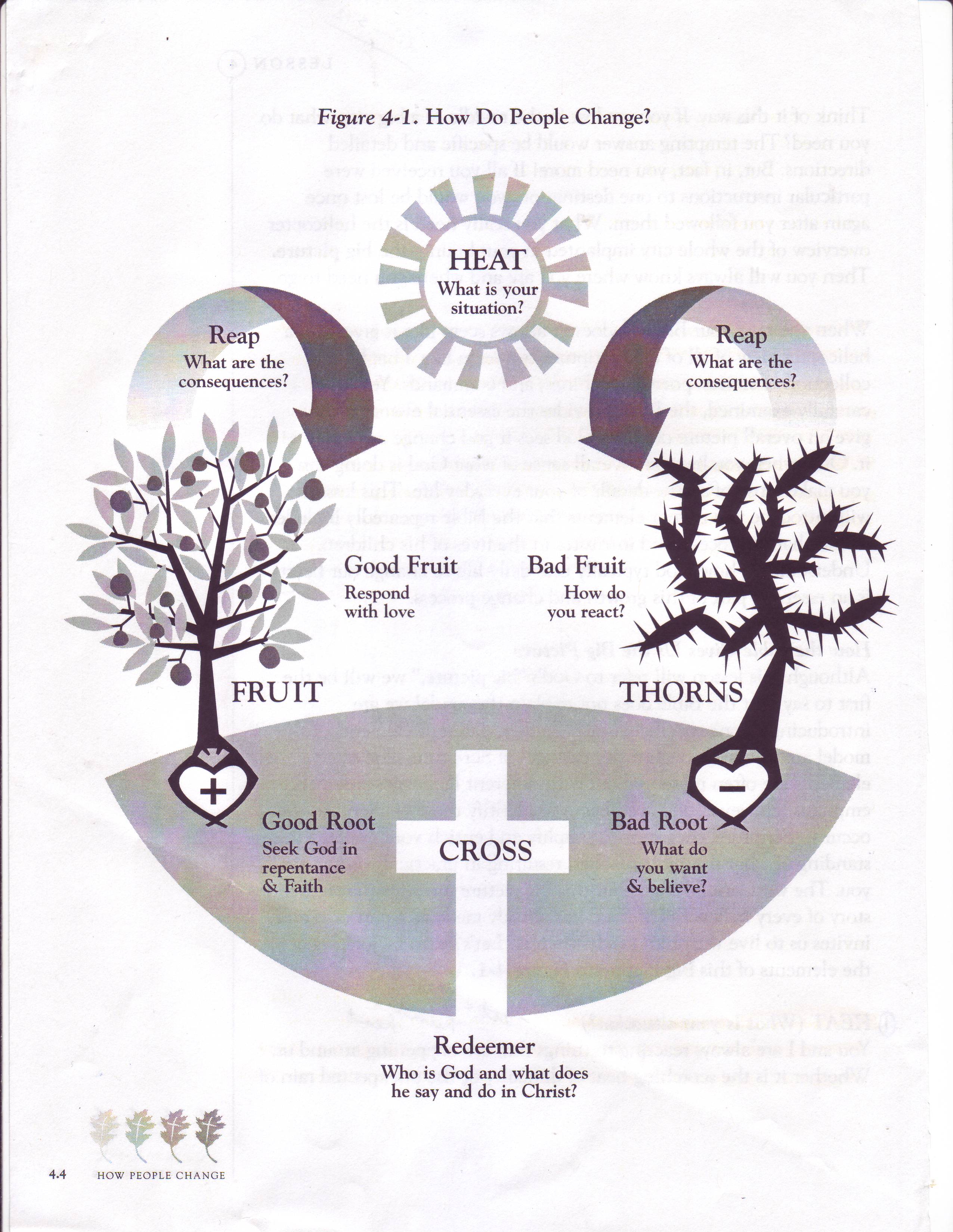
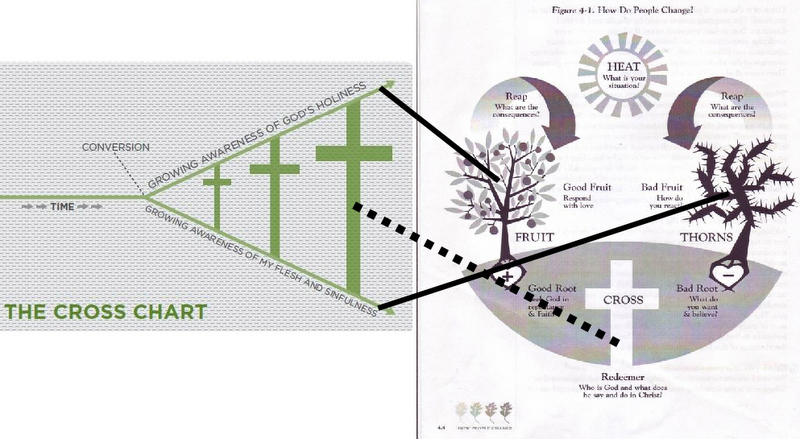
Right. As I have worn out multiple keyboards emphasizing here on PPT, New Calvinism is a dualist philosophy. Let’s go over this again. Below is THEIR illustration, NOT mine:

Note first that regardless of their verbiage, they don’t believe we really grow, it’s the cross (what it represents) that grows. That’s obviously job one. The endeavor thereof requires a primary focus on two goals and two goals only: a deeper and deeper UNDERSTANDING of our sinfulness, and absolutely nothing else, as set against God’s holiness. Part and parcel with this is also the idea of worthlessness on our part.
The cross represents bigger and bigger salvation which must be manifested more and more until the day when our “final justification” is “revealed.” This occurs as we are sanctified the same way we are saved, by partaking in the realizing of our sinful worthlessness before God and His holiness. The more we understand the difference between the two, the more our salvation is manifested. We don’t change, only the greatness of our salvation changes in order to glorify God. Of course, this obviously redefines the new birth and denies it.
As propagated in the satanic treatise “How People Change” by Paul David Tripp, ALL tragic and sinful events in life serve the bottom of the cross chart, and ALL good that occurs in our lives serves the top of the chart. As we contemplate the gospel narrative, the goodness of God is manifested which contributes to more understanding at the top of the chart. Goodness is not our fruit, its God’s fruit only for the purpose of aiding us in understanding His goodness—not ours. Hence, and don’t miss this, justice is not the point. The concept of justice and fairness digresses from Reformed Calvinistic dualism.
The next point is that in the neo-Calvinist gospel schema, the Scriptures serve as a Cross narrative to help us see this dualism in a clearer way. In the mind of the neo-Calvinist, the Scriptures do not define what is right and fair; the Scriptures define Luther’s “cross story.” Here is what the vast majority of Christians do not understand: six months after Luther’s 95 Theses launched the Reformation, the true magnum opus of the Reformation was written, his Heidelberg Disputation to the Augustinian Order. The document reflects Luther’s utter Platonist disdain for humanity.
In Luther’s Disputation, all reality must be seen through the cross story; i.e., the cross illustration at hand here, and ALL else is the “glory story” or anything at all to do with us—our glory, not the cross story that makes God bigger and mankind smaller. To any degree that we are in the equation, the cross story is diminished.
Now, let’s take this information and evaluate why Scott et al are completely indifferent to suffering and injustice. What did the Clearcreek elders do that is wrong? Nothing because the purpose of the Bible is not to judge the authority of Reformed elders, it is to show forth the cross story, not our story, and injustice is an Us Story kind of thing. Have former parishioners at Clearcreek suffered unjustly at the hands of the elders? Well, that’s a good thing! That suffering shows us the bottom of the chart. And besides, “justice”? If we got what we all deserved, there wouldn’t be any grace! Is this like Paul’s protest in Romans against propagating more evil that grace may abound? Yes, I think so. To the contrary in the minds of neo-Calvinists, we should bow down and thank God for bringing such abuse into our lives.
This is the gospel construct that rules the majority of biblical counseling in our day and is taking over the church in this country. It is a Platonist world view that set Europe on fire for hundreds of years with unspeakable horrors. And it is a story that is playing at a local church near you.
And this weekend, Stuart Scott brings his version of the show to Springboro, Ohio. A celebration of suffering in the name of Christ. But I have news for Scott: the sins of the Clearcreek elders does not cause grace to abound. And his appearance there has nothing to do with grace or love.
If there are any parishioners at Clearcreek (who may be reading this) who are presently there against their will for fear of public humiliation or things revealed in counseling —in your desperation, don’t slip Scott a note—he’s one of them.
paul
Why Christians Cannot Trust the Biblical Counseling Movement: Its True History and Doctrine
Introduction
The contemporary biblical counseling movement has brought counseling back to the church. Prior, the average evangelical congregation supplied comfort as much as they could while the experts were called on to treat whatever serious problem was at hand. Church was there to get people into heaven; the experts make people as comfortable as possible until they get there.
That has changed dramatically. In-house counseling addresses every imaginable life problem within the church. Biblical counseling organizations abound and their networks have inundated the institutional church. At the top of the biblical counseling empire is the Christian Counseling & Education Foundation (CCEF) and its offspring: Association of Certified Biblical Counselors, and the Biblical Counseling Coalition. Together, these organizations hold sway over at least 90% of all biblical counseling taking place in the evangelical church.
Who are they? How did they get here? What do they believe? And are they a help to God’s people, or a detriment? It is important to answer these questions because of the following fact: the present-day biblical counseling movement is the biggest scam ever perpetrated on God’s people, and the harm it will continue to inflict on souls is beyond measure.
The information in this booklet is far from complicated. The present-day biblical counseling movement has an easily defined history, doctrine, and track record regarding results. Are God’s people being helped, or hurt? And if the biblical counseling movement is a detriment to God’s people, what are the viable alternatives?
The biblical counseling movement is like clouds without water. That was Jude’s description of false teachers in his letter to the saints. Clouds offer hope that life-giving rain to a thirsty land is coming, but these clouds are merely a mist of empty promises and hopelessness. The goal of this booklet is to warn God’s people, and point to the only true hope of Jesus Christ and His truth.
Because only truth sanctifies (John 17:17),
Paul M. Dohse Sr.
The Beginning of the Biblical Counseling Movement
In circa 1960, a middle aged Presbyterian pastor named Jay E. Adams had a life transforming experience:
Like many other pastors, I learned little about counseling in seminary, so I began with virtually no knowledge of what to do. Soon I was in difficulty. Early in my first pastorate, following an evening service, a man lingered after everyone else had left. I chatted with him awkwardly, wondering what he wanted. He broke into tears, but could not speak. I simply did not know what to do. I was helpless. He went home that night without unburdening his heart or receiving any genuine help from his pastor. Less than one month later he died. I now suspect that his doctor had told him of his impending death and that he had come for counsel. But I failed him. That night I asked God to help me to become an effective counselor (Jay E. Adams: Competent To Counsel; Zondervan 1970, Introduction xi).
Therefore, it would be fair to say that whoever that gentleman was, he sparked the beginning of the most significant movement in recent church history. The experience must have profoundly impacted Adams because he was relentless in pursuing counseling knowledge in the years following. Then,
…suddenly, I was forced to face the whole problem in a much more definitive way. I was asked to teach practical theology at Westminster Theological Seminary. One of the courses I was assigned was Poimenics (the shepherding work of the pastor). As part of the course, I was expected to teach the basic theory of pastoral counseling. I had less than a year to think through the problem and prepare my lectures. Where would I begin? (Ibid).
How Did the Church Get There?
To say that Christians, some 2000 years after the birth of the church, had come to live by biblical generalities, and were farming serious problems out to religious and secular experts is far from painting the church of that time with a wide brush. It’s not oversimplification; it’s the simple fact of the matter. The testimony of a mainstream respected pastor like Jay Adams is sufficient.
But how did the church come to function that way? The answer is profoundly simple; the functionality of the church was a direct result from the gospel it adopted in the 16th century. The construct mentioned in the introduction of this booklet, church gets us to heaven, experts help us cope until we get there, was a direct effect caused by the Reformation gospel. So, what was that gospel?
The Reformation Gospel
The Reformation gospel was predicated on the idea that salvation was a process, or progression. In other words, the justification of a believer had a starting point, a progression, and then finality. This is sometimes referred to as beginning justification experienced subjectively followed by final justification.
So, instead of salvation, or justification being a finished work with the Christian life progressing in complete separation from justification, the Christian life is part of the progression of justification according to the Reformers. In fact, one of the primary Reformers and the father of the Presbyterian Church, John Calvin, titled one of the chapters in his Institutes of the Christian Religion, “The Beginning of Justification. In What Sense Progressive” (book 3, chapter 14).
In that chapter, Calvin explains the crux of the Reformation gospel: beginning justification only covers past sins, but because Christians continue to sin, they must revisit the same gospel that saved them in order to receive continued forgiveness for new sins committed in the Christian life (section 11). Further clarification on this position can be seen in other sections of the Calvin Institutes:
Nor by remission of sins does the Lord only once for all elect and admit us into the Church, but by the same means he preserves and defends us in it. For what would it avail us to receive a pardon of which we were afterwards to have no use? That the mercy of the Lord would be vain and delusive if only granted once, all the godly can bear witness; for there is none who is not conscious, during his whole life, of many infirmities which stand in need of divine mercy. And truly it is not without cause that the Lord promises this gift specially to his own household, nor in vain that he orders the same message of reconciliation to be daily delivered to them” (4.1.21).
On the flip side, Calvin went to great lengths in 3.14.9,10 to emphasize the idea that Christians cannot do any work that is pleasing to God because perfect law-keeping is the prerequisite for any ability to please God in any way. Therefore, Christians must continually seek repentance so that the righteousness of Christ will be perpetually imputed to our account in what we would refer to as sanctification, or the Christian life (3.14.11). Therefore, Calvin stated that the Christian life had to be a passive affair focused on perpetual repentance for new sins committed in the Christian life in order to remain justified. This meant a perpetual return to the same gospel that saved us. To Calvin, the Christian life was the Old Testament Sabbath rest if one would progress in justification:
And this emptying out of self must proceed so far that the Sabbath is violated even by good works, so long as we regard them as our own; for rightly does Augustine remark in the last chapter of the 22nd book, De Civitate Dei, ‘For even our good works themselves, since they are understood to be rather His than ours, are thus imputed to us for the attaining of that Sabbath, when we are still and see that He is God; for, if we attribute them to ourselves, they will be servile, whereas we are told as to the Sabbath, “Thou shalt not do any servile work in it.”
The Complete Commentaries on the First Book of Moses Called Genesis: Jean Calvin; translated by Charles William Bingham ,1844-1856. The Harmony of the Law: Commentaries on the Four Last Books of Moses | Its Repetition—Deuteronomy 5:12-15. ¶2.
Note that the Christian must attain the Sabbath (final justification) by the continued “emptying out of self” which results in the continued imputation of righteousness not our own. It is a perpetual “meditation” on the Sabbath to attain the Sabbath:
It may seem, therefore, that the seventh day the Lord delineated to his people the future perfection of his sabbath on the last day, that by continual meditation on the sabbath, they might throughout their whole lives aspire to this perfection (The Calvin Institutes 2.8.30).
Spiritual rest is the mortification of the flesh; so that the sons of God should no longer live to themselves, or indulge their own inclination. So far as the Sabbath was a figure of this rest, I say, it was but for a season; but insomuch as it was commanded to men from the beginning that they might employ themselves in the worship of God, it is right that it should continue to the end of the world.
The Complete Commentaries on the First Book of Moses Called Genesis: Jean Calvin; translated by John King, 1844-1856. Genesis 2:1-15, section 3.
Why then did Christians live by biblical generalities, and find themselves inept in regard to helping people? Because the Protestant gospel called for a retaining of salvation through rest and a singular meditation on the same repentance that originally saved us. Since that occurs during the Christian life, and justification is by faith alone, the Christian life must be lived by faith alone, or again, according to the Sabbath rest. Obviously, a diligent study of biblical wisdom and its application to life would not only be a very low priority, but is antithetical to the authentic Protestant gospel. This made weak sanctification in Christian living a longstanding tradition. Church became all about salvation and little else.
History
Dr. Jay E. Adams was not alone in misunderstanding the true gospel of the Reformation which led to the self-described dilemma he found himself in. Protestantism had become a soft version of the original article. Martin Luther’s alien righteousness was thought to pertain to justification only and not the Christian life as well. In other words, Luther didn’t believe Christians inherit any of God’s righteousness that becomes a part of them. Christians are only declared righteous positionally, but do not actually possess any righteousness in their being. John Calvin concurred throughout his institutes; e.g., 3.14.11.
Protestantism and its entire offspring heavily emphasized justification only because that is the very premise of its gospel though the causality became very blurred with time. According to the authentic article, sanctification is the manifestation of Christ’s life for the purpose of moving justification forward to final justification.
The “believers” role is to colabor with Christ by faith alone in order to keep things moving forward, and frankly, an endeavor to keep ourselves saved by faith alone. This requires a redefinition of what is a work in sanctification, and what is not a work in sanctification so that the obedience of Christ would continue to be imputed to us for the purpose of keeping us justified. In this way, according to the Reformers, we are “kept” by Christ because justification is not finished—it’s a process.
Hence, the Reformers classified what activities in the Christian life are of faith alone. The writings of Luther and Calvin primarily concern a formula for living the Christian life by faith alone. The crux of the formula was a perpetual return to the same gospel that saved us originally for the atonement of “present sin.” That sin is not only covered, but one also continues to be covered by the righteousness of Christ alone and NOT any righteousness inherited by us via the new birth. This is nothing new, and is what James sought to refute in his letter to the 12 tribes of Israel.
What is important to establish at this point is the fact that the Reformed community at large began to realize in 1970 that they had drifted away from the authentic Reformed gospel, and stated such emphatically. And ironically, the discovery was made by an Adventist theologian named Robert Brinsmead. This Adventist theologian turned said religion completely upside down with what was known as the Awakening Movement. Many took note, and Brinsmead was joined by two Anglicans, Geoffrey Paxton and Graeme Goldsworthy in the forming of a project named The Australian Forum. The purpose of the project was to awake Christianity to the fact that it had drifted away from the true Reformation gospel resulting in a separation of justification from sanctification, and the idea that Christians inherit a righteous state of being through the new birth.
And they were exactly correct which resulted in the Reformed community holding their noses and listening to what Brinsmead had to say. Brinsmead, Paxton, and Goldsworthy published a theological journal named Present Truth which had a massive impact on the evangelical world at large. The publication, for all practical purposes, was a contemporary rendering of the Calvin Institutes and was an astonishing articulation of authentic Reformed soteriology.
Remember, Jay Adams had been called to Westminster Theological Seminary sometime during the mid-sixties, and was buried in developing a counseling construct for the purposes of training pastors. Running parallel to his activities was the Awakening Movement which he probably paid little attention to. That is, until Westminster invited the Australian Forum to meet with the Westminster brain trust. Though it has not been established positively, the legendary Reformed theologian Edmund Clowney, who was president of Westminster at that time, was more than likely present at the meeting. Adams was not happy about the meeting because of Brinsmead, and sarcastically suggested that pork be served for lunch which in fact ended up being the case (The Truth About New Calvinism: TANC Publishing 2011; pp. 59-65).
After several years of hammering out a counseling construct for the institutional church, Adams published his counseling treatise titled, Competent To Counsel. This was a landmark publication and highly controversial. The theses of the book suggested that Christians, armed with the word of God, were competent to counsel each other and bring about changed lives. Said another way, Christianity is more than Redemption alone, but is also about changed lives for the glory of God. Adams even published another book that makes the same point: More Than Redemption. And yet another book, How To Help People Change. Adams is rightly known as the father of the biblical counseling movement, but he may better be described as the father of aggressive sanctification.
The Perfect Storm of Conflict: 1970
Ordinarily, this Christian living revolution would have dramatically changed Christianity until the second coming, but remember something else happened the same year that Adams unveiled his counseling treatise in 1970: the advent of the Australian Forum. Therefore, you had two antithetical movements growing side by side in the Protestant community, especially in the halls of Westminster: the resurgence of authentic Protestantism and the biblical counseling movement. One emphasized the fusion of justification and sanctification, and the other emphasized the separation of the two.
Early in Adams’ tenor at Westminster, a counseling wing of Westminster was established named, The Christian Counseling & Education Foundation, or CCEF. This was a biblical counseling think tank of sorts, and the academic counseling wing of Westminster as well. Its embodiment included proponents of both movements. Later, an accreditation organization was formed known as The Association of Nouthetic Counselors, or NANC. The purpose of the organization was to certify biblical counselors. This organization was also embodied with proponents of both movements.
Be advised that it is unlikely that many were conscious of the historical distinctions between the two movements. All in all, the differences were chalked up to disagreement in regard to application, but not anything that pointed to any questions regarding the Reformation gospel itself.
That would change when a contemporary of Jay Adams at Westminster, Professor John “Jack” Miller developed the Sonship Discipleship program. Clearly, the program was based on the authentic Reformed gospel recovery movement. As the movement grew, Adams, who was gaining significant notoriety as the father of the biblical counseling movement, was called on more and more to weigh-in on the movement.
This resulted in a contention between Miller and Adams which consummated into Adams writing a book published by Timeless Texts that contended against the program: Biblical Sonship; An Evaluation of the Sonship Discipleship Course. Adams published the book in 1999, the movement began circa 1986, or about 16 years after the resurgence began in 1970.
Take note: though the program was based on the Reformation principle of fusing justification and sanctification together, it was wreaking havoc on the Protestant church during this time, and that is why Adams jumped into the fray. The point being that Presbyterianism was functioning according to Calvinism Light, and when the original article began to emerge, many Presbyterians, including Adams claimed the Sonship program was not according to the Reformed tradition. Several of these like confrontations pepper church history—usually in the form of antinomian controversies.
It is important to pause here and establish the fact that these controversies arise because Calvinists often misunderstand what Calvin really believed, and this misunderstanding is most prevalent among Bible scholars and Christian academia at large. This is because seminaries rarely teach anything new, but are merely institutions that regurgitate the traditions of men.
This is established by the fact that at the beginning of the 1970 resurgence, the Reformed community themselves admitted that the original gospel of the Reformation had been lost. Also, the very nomenclature of their ministries admit it as well; i.e., “The Resurgence,” “Modern Reformation,” etc.
More to the point, Reformed scholar John H. Armstrong, who co-authored a book with John MacArthur Jr., stated the following in an article titled Death of a Friend on August 31, 2010:
One summer, in the late 1970s I believe, I attended a small gathering associated with the ministry of a popular magazine of the time called Present Truth. The magazine actually opened my eyes to the need for recovering gospel truths in an age that was fast losing its grasp on the grace of God. Two teachers were leading this small gathering and there could not have been more than 75 people in the room. One of those in the audience, and sharing insights only as a humble participant, was Dr. Don Bloesch. I was impressed that a man of such profound scholarship would take the time to share in a small event where he was not a featured speaker. Don believed something important was going on in that room and wanted to interact with it. So did I.
Why was Armstrong impressed with Bloesch’s willingness to participate in a small Australian Forum Bible study using their theological journal Present Truth? First, because Bloesch was a Reformed heavyweight, but back to the main point: this is one of a myriad of open admissions that the Reformed community at large misunderstood the authentic Reformation gospel. Nevertheless, Jay Adams misunderstood Calvin for the better, and in a big way.
Yet another example of this can be seen in Dr. John Macarthur Jr.’s keynote address at the 2007 Shepherd’s Conference: Why Every Self-Respecting Calvinist is a Premillennialist. One blogger aptly described the fallout this way:
John MacArthur’s first message at the Shepherds’ Conference set off shock waves throughout the reformed evangelical church by upholding Premillennialism as being the only consistent position for any person who holds to the doctrine of sovereign electing grace.
online source: faithbyhearing.wordpress.com/2007/03/15/macarthur-why-every-self-respecting-calvinist-should-be-a-premillenialist/
Amillennialism posits the idea that Israel lost its election (Supersessionism or Replacement Theology) because of rebellion, and this was MacArthur’s contention. If God sovereignly elected Israel, how could they lose their election? However, that idea is in fact perfectly consistent with John Calvin’s theology. He separated election into three categories of people, the non-elect, the called, and those who persevere until the end. The called, are in-fact temporarily illumined but then fall away at some point (The Calvin Inst. 3.24.7,8). Moreover, the massive Reformed pushback against this assertion by MacArthur was completely void in regard to this fact, viz, according to Calvinism, one can lose their election. Calvin stated such in no uncertain terms. In the final analysis, most Calvinists have no idea what Calvin believed.
Meanwhile, back to Westminster
Let’s now resume our place in contemporary history at Westminster Theological Seminary. We have two notable Calvinists teaching at the same seminary representing two different Calvinist gospel camps, and teachers from both camps are participating in CCEF and NANC. This is where Jay Adams began to come under serious attack within Reformed ranks, mostly from two mentorees of Dr. Miller, David Powlison and Paul David Tripp. These two men are key figures because they were working hard to develop a counseling version of the Reformed resurgence gospel to answer Adams’ counseling construct that heavily emphasized learn and do. In fact, one of the mantra’s among Adams counselors was, “the power is in the doing.”
At any rate, the counseling construct developed by Powlison and Tripp while at Westminster is known as Theology of the Heart, and was heavily predicated on Miller’s deep repentance model that aligned well with Luther and Calvin’s ideology and practical application of gospel contemplationism. Their pilot program was operational from circa 2003 to 2005, and culminated in an impressive treatise in 2006 titled How People Change authored by Tripp and another former student of Powlison’s at Westminster.
During the pilot program with the same name as the book, Powlison listed himself as a “contributor.” This was for the express purpose of plausible deniability because these men knew that the counseling construct they were promoting was counter intuitive to most evangelicals. The pilot program “tested” the material in hundreds of local churches between 2003 and 2005.
In the introduction to the book (Punch Press 2006), Tripp in essence states that if anyone has a problem with the book, they should blame him, but Powlison should get credit for anything they agree with (the earliest literature from the program named Powlison as the actual “developer” of the curriculum). This was/is a ploy to make the book disagreement proof and protect the face of Theology of the Heart, David Powlison. This good cop—bad cop ploy has been utilized several times to defer criticism of the book.
Consequently, the 2006 NANC conference was fraught with plenary session addresses and workshops that presented a host of contradictory views. Clearly, the civil war between the generally accepted relationship between justification and sanctification (the two are separate), and the gospel recovery movement was in full swing. During a biblical counseling seminar at John Piper’s church, Powlison stated outright that the difference between “first generation” biblical counseling and “second generation” biblical counseling was two different gospels. However, this was the elephant in the biblical counseling room that no one wanted to talk about:
This might be quite a controversy, but I think it’s worth putting in. Adams had a tendency to make the cross be for conversion. And the Holy Spirit was for sanctification. And actually even came out and attacked my mentor, Jack Miller, my pastor that I’ve been speaking of through the day, for saying that Christians should preach the gospel to themselves. I think Jay was wrong on that (David Powlison speaking at John Piper’s church May 8, 2010).
Ironically, Adams’ primarily criticism of secular psychology has always been the lack of continuity plus the various and sundry theories of change that number over 200 within the discipline, but even though the biblical counseling movement doesn’t have that many varying theories, they are split on the issue that makes the whole discussion worthwhile, the gospel of Jesus Christ.
This is the first reason the biblical counseling movement must be utterly rejected out of hand—because no one in the movement will draw a deep line in the sand in defense of the gospel. These difference are treated as matters of opinion concerning method instead of what it really is, a contention between two different gospels with heaven and hell in the balance.
The one thing both camps unwittingly agree on is that the biblical counseling industrial complex must be preserved at the expense of the gospel. In the final analysis, those who function in this way cannot help people change, and will most likely do more harm than good. The movement is pregnant with counselors who lack conviction and love for the truth. They are best avoided at all cost.
The issue concerning these two different gospels is far from complicated: if one must preach the gospel to themselves every day, that must mean they still need the same gospel that originally saved them, which means their salvation is not a finished work, which also means that they must play some role in finishing their salvation—this would seem evident. If Justification is not finished, works salvation is unavoidable on every wise, and a gospel contemplationism dubbed as a faith-alone work by no means changes this reality.
And incredibly, this is verbally conceded often. Consider what John Piper said in his three part series, How Does The Gospel Save Believers?
We are asking the question, How does the gospel save believers?, not: How does the gospel get people to be believers? When spoken in the power of the Holy Spirit, the gospel does have power to open people’s eyes and change their hearts and draw them to faith, and save them. That’s what is happening on Tuesday nights and Wednesday nights this summer. People are being drawn to Christ through the power and beauty of the gospel. But I am stressing what Paul says here in verses 16 and 17, namely, that “the gospel is the power of God for salvation to everyone who believes.” Believers need to be saved. The gospel is the instrument of God’s power to save us. And we need to know how the gospel saves us believers so that we make proper use of it (August 16, 1998, part 2).
This is the very essence of the Reformation gospel: the idea that salvation is a process in which the “believer” is gradually drawn to Christ for a final salvation. The only way that this process towards final salvation can continue is if we continually return to the same gospel that saved us. This is egregious heresy perpetrated in broad daylight.
Eventually, Jay Adams was driven out of any association with CCEF and NANC and started The Institute of Nouthetic Studies (INS) with Baptist pastor Donn Arms. INS experiences a significant contention with CCEF and NANC until this day, but unfortunately, the contention primarily focuses on sanctification issues, viz, heart theology, and not the truthfulness of the true gospel. The CCEF/NANC camp applied its latest slap in the face to Adams by changing the name of NANC to The Association Of Certified Biblical Counselors (ACBC).
INS has two individuals on their staff that also have close relations to CCEF and ACBC. Adams and Arms are to be commended for their confrontation regarding the application of Theology of the Heart to counseling people, but unfortunately, they have not yet made it a salvific gospel issue.
The Big Lie
Primarily, people go to counseling for one reason: because they see a need for change in their lives. The brain trust of the CCEF counseling empire and their aforementioned affiliates know that they do NOT believe that people change. The magnum opus of heart theology, How People Change, is a misrepresentation of its counseling construct and they know it. As we have seen, the authentic Reformation gospel rejects the idea that people can change in totality.
Therefore, the goal of biblical counseling is to teach people to see life differently. If they merely see life differently, wellbeing occurs regardless of what is happening in the material world. What happens in the material world is entirely God’s business and not yours. Right seeing is the goal, not right doing, the doing is God’s job—not yours.
In fact, according to the construct that has taken over the biblical counseling culture, any counseling that emphasizes doing is a false gospel. We, as John Piper often likes to say, must practice a “beholding as a way of becoming.” But remember, the “becoming” speaks to a progression of mere seeing while God himself manifests the doing in the material realm. This booklet will not explore all of the metaphysical constructs that may be applied, but one example comes from page 215 of How People Change:
When we think, desire, speak, or act in a right way, it isn’t time to pat ourselves on the back or cross it off our To Do List. Each time we do what is right, we are experiencing what Christ has supplied for us.
In other words, we are only experiencing the works of Christ and not actually doing the work ourselves. There are many philosophical applications for this approach including subjective Idealism. This is the idea that reality is defined by how it is perceived. In other words, there is really no material world per se; it only exists in the minds of individuals. Therefore, change a person’s thinking and you change their reality.
Another approach is realm manifestation. The invisible world manifests reality in the visible world by whatever means, but those who dwell in the material realm are only experiencing what the invisible realm is manifesting. For the most part, the Reformers, particularly Martin Luther and his spiritual mentor Saint Augustine seemed to believe something along these lines.
Luther stated in the Heidelberg disputation that the Christian life is lived subjectively; i.e., we really don’t know when we are doing a work or when God is doing the work. However, to believe that whatever we do is evil, and whatever good is done is only experienced by us, but not us doing it, is saving faith. To believe that we can actually do a good work, according to Luther, is mortal sin. To experience a good work as us doing it is only venial sin if we disavow our ability to do any good work and attribute the work to God only:
He, however, who has emptied himself (cf. Phil. 2:7) through suffering no longer does works but knows that God works and does all things in him. For this reason, whether God does works or not, it is all the same to him. He neither boasts if he does good works, nor is he disturbed if God does not do good works through him. He knows that it is sufficient if he suffers and is brought low by the cross in order to be annihilated all the more. It is this that Christ says in John 3:7, »You must be born anew.« To be born anew, one must consequently first die and then be raised up with the Son of Man. To die, I say, means to feel death at hand (Theses 24).
This is also how Luther defined the new birth. Since we, even as “Christians,” can only do evil, we only seek to live a perpetual “lifestyle of repentance” as Paul Tripp et al call it resulting in a resurrection experience. But remember, we are never sure when these experiences are actually from God, but joy may be an indication, though we are never certain. Remember, this connects us back to “justification experienced subjectively.”
Hence, we get ourselves to heaven with an ability to “stand in the judgment by faith alone” by revisiting our original salvation. THIS IS KEY, the new birth is not a onetime event which makes us a new creature, the new birth is redefined as a perpetual death and rebirth experience, or a perpetual repeating of our original salvation in order to keep ourselves saved by this living by faith alone formula. Simply stated, it is daily resalvation. We must be resaved or rejustified daily by “preaching the gospel to ourselves every day.”
There is actually a formal doctrine from the Reformed tradition that defines the new birth in this way, it is called mortification and vivification. It is a perpetual reliving of our original baptism in order to keep ourselves saved. It is returning to the same gospel that saved us daily in order to remain saved. We focus on our need for repentance (mortification, or death), and we then experience perpetual resurrection (vivification, or a joy experience) in ever-increasing levels.
Though identified with the Reformed tradition, the father of contemporary biblical counseling, Jay Adams, believes the new birth to be a onetime event and would reject a proper understanding of mortification and vivification. In the same year that he unveiled his biblical approach to a more aggressive sanctification, the Australian Forum began to awaken the Reformed community to the fact that they had lost their way. Roughly sixteen years later, the original article began to be integrated into the biblical counseling movement which put the movement at odds with the very man who started It.
Jay Adams believes that Christians can change because they are born again. They don’t merely experience a subjective justification; their changed behavior is proof of the new creature. Adams stated in no uncertain terms in the aforementioned treatise against Sonship Theology that justification is a declaration, and sanctification is NOT powered by it. In contrast, sanctification is powered by regeneration, or the new birth. The Christian can change through obedience to biblical wisdom and is helped in doing so by the Holy Spirit.
But this clearly puts Adams at odds with the true Reformation gospel, and his hesitancy to completely break ties with CCEF et al will only continue to muddy the waters while Adams is accused of propagating a “behavioral model.”
Yet, a behavioral approach to change is hollow because it ignores the need for Christ and his power to change first the heart and then the behavior. Instead, even the Christian version of the approach [Adams] separates the commands of Scripture from their Christ-centered, gospel context (How People Change 2006, p. 26).
This is egregiously disingenuous. On pages 64 and 65 of the same book, Tripp describes Christians the same way Luther would: “alienated enemies” who “suppress the truth in unrighteousness” and “dead,” and “When you are dead, you cannot do anything.” Tripp goes on to say on page 65 that denying we are unchanged is to deny Christ. The key to change is not getting better, but seeing ourselves for who we really are. This entails a peeling away of layers to see the “sin beneath the sin” as their mentor Dr. John Miller put it. So-called “heart change” is really just an ability to see or perceive, NOT an ever-increasing ability to do anything.
Conclusion
The biblical counseling movement as it now stands is not about change. Unfortunately, the movement’s willingness to knowingly state otherwise is indicative of its character. It is predicated on this lie and a false gospel. It cannot help people, and must be utterly rejected in totality.
Moreover, in our endeavor to find real change via the Scriptures, Christian academia must be held at arm’s length and viewed with suspicion in all respects. The very character of every Christian academic must be questioned, and their gospel assumed false. Why? Because after 2000 years and trillions of dollars, what do we have? Nothing more than those who proudly call themselves Calvinists while having no idea what Calvin really believed! We are not obligated to follow their zeal not according to knowledge resulting in our own demise.
Secondly, Christians need to educate themselves in regard to full-orbed reality. Unfortunately, a lack of knowledge in the area of world philosophy, a discipline we are often told we do not need, is essential in understanding the foundations and functioning of traditional Protestantism. Clearly, the Reformers forced the Bible into their own philosophical presuppositions. The Bible must be perceived grammatically, literally unless stated otherwise, and according to its historical backdrop.
Thirdly, Christians must discern who we are! Are we merely declared righteous because Jesus obeys for us, or are we actually recreated as righteous beings through the new birth? And what is our relationship to the law accordingly?
Fourthly, we need to take up Jesus Christ on His promise to lead us in all truth if we seek it. We ourselves need to seek this truth while ceasing to listen to a Christian academia that has failed miserably. They have done little more than create mass confusion, and have charged us trillions of dollars for the privilege of doing so.
We live in an information age, and it is time for a new movement by those who originally made up the church:
“Brothers and sisters, think of what you were when you were called. Not many of you were wise by human standards; not many were influential; not many were of noble birth.”
In the same way the Corinthian church was vexed by the bondage of academia as if God chose the haughty things of the world rather than the meek, we find ourselves in the same tyranny and bondage to aristocratic lords. Let us break free and break bread together as noble first century Bereans, and let us change for the glory of God, and help others to do the same.
We will close, perhaps ironically, with the verse of Scripture that Jay Adams chose as the thesis of his groundbreaking work, Competent To Counsel:
“As far as I am concerned about you, my brothers, I am convinced that you especially are abounding in the highest goodness, richly supplied with perfect knowledge and competent to counsel one another”
~ Romans 15:14 (Williams)
The Truth About Paul Tripp’s “How People Change”
 How People Change
by Paul David Tripp and Timothy S. Lane
Punch Press: Winston-Salem (2006, 2008)
Reviewed by Donn R. Arms
The Journal of Modern Ministry: Volume 8, Issue 1, Winter 2011
Jay E. Adams Founder and Senior Writer; Kevin Backus General Editor
_________________________________________________
The traditional view of the gospel’s relationship to change is that salvation is foundational to change. Once a person is justified before God by believing in Christ’s saving work on the cross, and made a new creature, he then begins the work of co-laboring with God in the growth process, also known as sanctification. The traditional view sees our role, after being made a new creature (born again), as many-faceted in regard to biblical instruction—the primary role being the learning of God’s Word and the application of it to life via obedience in how we think and behave (Matthew 7:24).
The traditional view makes a significant distinction between justification (redemption), sanctification (growing into Christ-likeness), and glorification (complete transformation). It sees justification and glorification as acts of God alone apart from human participation or monergistic, but sees sanctification as synergistic or a cooperative (but none the less dependent) work with God. Obviously, an accurate view and description of our participation is vital to affecting real and lasting change.
For Tripp and Lane, the gospel message is not only for the unregenerate, but efficacious for real and lasting change in the life of a believer. Certainly, as Christians move into our relationship with Christ as not only Savior, but also Lord, we should never leave behind an appreciation for the sacrifice of Christ that saved us. The authors claim, however, that the same elements of justification must be carried forward into sanctification without anything being added. In fact, for believers to even make an effort to align our thinking with Scripture is an act on our part that denies Christ as Savior:
. . . and the Bible does call us to change the way we think about things. But this approach again omits the person and work of Christ as Savior. Instead, it reduces our relationship to Christ to “think his thoughts” and “act the way Jesus would act” (p. 27, 2006 edn).
Throughout the book, the authors embrace parts of the traditional view, but view the traditional elements through a non-traditional prism, and give the traditional elements of change a different meaning. In this case they trade the traditional idea that Christians are to make an effort to align our thoughts with Scripture with the idea that we should do something else instead that leads to biblical thinking as a natural result of the “living Christ” acting on our behalf and apart from our initial efforts. According to the authors, the traditional approach omits the “work” of Christ in our sanctification and omits Christ as “Savior.”
Lane and Tripp do not deny that Christians have a role in the sanctification process. But what exactly is that role? If the traditional view of our exertion (effort in aligning our life with Scripture) in sanctification is out, what is in? Answer: deep repentance, the second major thrust of the book.
Repentance is a form of emptying the heart . . . Along with deep repentance, Scripture calls us to faith that rests and feeds upon the living Christ. He fills us with himself through the person of the Holy Spirit and our hearts are transformed by faith. (p 28)
Our efforts are out; a faith that “rests and feeds” is in. So, like justification, sanctification is limited to the narrow elements of faith and repentance only. We don’t apply effort to align our lives with Scripture in order to be saved, and we don’t for sanctification (real and lasting change) either.
Throughout HPC, Christ is referred to as “the living Christ.” Believers have no ability to perform works, or add works to their faith because believers are still spiritually dead, and the only life within us is Christ. On pages 64 and 65 of the 2006 edition Christians are described as being dead, powerless, enslaved, alienated from God, enemies of God, fools, and those who suppress the truth in unrighteousness. In other words, our condition is not changed from what we were before salvation. Referring to believers, the authors write: “when you are dead, you can’t do anything” (p. 64). Therefore, we can’t do anything leaving only the “living Christ” to perform works on our behalf.
This is a synthesizing of justification and sanctification. Our ability to perform works pleasing to God is in the same context as those who are unregenerate. We are clearly unable. The authors illustrate this with the story of Andy:
In both phases of his Christian life, the work of Christ on the cross was radically minimized by Andy’s own efforts. The first three years evidenced a Christ-less activism that produced pride and self-sufficiency (p. 184, 2006 edn).
Andy’s “own efforts” in “his Christian life” are in direct relation (according to the authors) to how prevalent redemption (“the work of Christ on the cross”) was in Andy’s life. The fact that Andy’s efforts to obey might have been misguided is not the point that the authors are making here. The authors only cite Andy’s “own efforts” in “his Christian life” with no traditional consideration of erroneous efforts to obey that are inconsistent with the Scriptures being rightly divided.
In essence, it resembles an ongoing need to be saved (redeemed) daily through the works of Christ only. Referring to 1 Cor. 10:13-14 the authors state:
What Paul envisions here is not just the change that takes place when we come to Christ, but the lifestyle of change that results from an ongoing sense of our need for redemption (progressive sanctification) [p. 102, 06 edn].
Progressive sanctification is redefined as “an ongoing sense of our need for redemption.” However, the redemption he is speaking of is the same redemption that originally saved us (“when we came to Christ…and the ‘ongoing’ need for it”). Tripp and Lane believe that there is little difference between justification and sanctification. If we can’t do works to be saved, neither can we do works in the sanctification process.
But what about all the commands in the Bible that are obviously directed toward us? Are we not supposed to obey the principles and commands of Scripture? Yes, but . . .
. . . a behavioral approach to change is hollow because it ignores the need for Christ and his (sic) power to change first the heart and then the behavior. Instead, even the Christian version of this separates the commands of Scripture from their Christ-centered, gospel context. [p. 26]
By “Christ-centered, gospel context,” they mean obedience via the cross (works of Christ, not ours). This can also be seen in their view of the use of Scripture as instruction, or “directions” to be read and then followed:
One of the mistakes we make in handling God’s Word is that we reduce it to a set of directions on how we live. We look for directions about relationships, church life, sex, finances, marriage, happiness, parenting, and so on…..This does violence to the very nature of the Word of God and robs it of its power. The Bible is the world’s most significant story, the story of God’s cosmos-restoring work of redemption. The Bible is a “big picture” book. It introduces us to God, defines our identity, lays out the meaning and purpose of life, and shows us where to find help for the one disease that infests us all—sin. If you try to reduce the Bible to a set of directions, not only will you miss its overall wisdom, you will not make sense of the directions. They only make sense in the context of the whole story (p. 92, 2006 edn).
Seeking, then, to find in the Scriptures instruction in Godliness (2 Tim 3:16) “does violence to the very nature of the Word of God and robs it of its power.”
The second tenet advocated by Tripp and Lane is deep introspection, or “deep repentance.”
Repentance is a form of emptying the heart….Along with deep repentance, Scripture calls us to faith that rests and feeds upon the living Christ. He fills us with himself through the person of the Holy Spirit and our hearts are transformed by faith. [p. 28]
Deep repentance, also called “intelligent repentance” by the authors, is a necessarily embellished form of orthodox repentance because of the narrow approach (faith and repentance only as our role) the book’s theory takes in regard to change. Heart idols must first be identified. Then repenting of them leads to the elimination thereof, creating a void that is filled by Christ and the release of His power accordingly.
Elements of deep repentance include asking God to forgive us of our own efforts, i.e, “repenting of righteousness” (p.190, 2006), and “seeing the sin beneath the sins” (p. 190, 2006) which requires an understanding that it is impossible to violate commands 4-10 (of the 10 commandments) without first violating commands 1-3, which are the commands that speak to heart idols. Therefore, you must get to the heart of why you sinned (idols of the heart covered in commands 1-3) before the violation of all other sins can be prevented. On pages 163-165 Lane and Tripp suggest a list of “X-ray questions” to determine types of desires linked to heart idols to aid in this “deep repentance.”
The third tenet is that of “the Bible as a narrative for change.” The authors say that the Bible is a simple story that all Christians can understand, and that God uses creation to write the book in word pictures (p. 93, 2006). The very purpose of the Bible, according to the authors, is to supply believers with a model of change that involves four basic elements: heat, thorns, cross, and fruit (p. 96, 2006). The authors say the Bible is a grand gospel story that encompasses all of the necessary elements needed for life and godliness in regard to our life story. Therefore, God calls us to come to the grand story with our story, and He invites us to place our life story into the grand story, discovering where our experience of life fits into one of the four elements of heat, thorns, cross, and fruit:
This big picture model is the story of every believer. God invites us to enter into the plot!”(p. 94, 2006).
All of Scripture falls under one of these categories, and these categories form the grand gospel story, which is the sole purpose of the Bible—to present a gospel story of real change that reveals God’s grace and provision accordingly.
By seeing our circumstances in heat (circumstances of life), thorns (desires and idols of the heart that cause us to sin), fruit (Christ working in us, or the consequences of sin), and God’s provision for all three (cross), we gain wisdom, encouragement, and a mentality that seeks to know a deeper need and dependence on Christ. Using Scripture for this purpose exalts Christ in our minds, makes us desire Him more, and deepens our sense of dependence on Him. This deepening sense of our dependence on Christ, which results from using the Scriptures in this way, creates a lifestyle of change because we come to realize that we need redemption every day, not just when we were originally saved. Total dependence on Christ becomes synonymous with faith to the exclusion of almost everything else. The Bible, then, is designed for the sole purpose of aiding the believer in faith (total dependence on God) and deep repentance.
How People Change is a pronounced departure from the traditional (or nouthetic) model of biblical change. It starts by synthesizing justification and sanctification, and narrowing our role in spiritual growth to faith and repentance only. The authors then present a “big picture” model of interpretation that describes their view of the proper use of Scripture in the change process, and the role the Bible plays accordingly. Their model presents the Bible as a gospel narrative, and to the exclusion of all other purposes. The authors of HPC present a strange picture of believers who are still dead in trespasses and sins while being indwelled by Christ who is the only life within us, and therefore the only one working in the change process. Accordingly, total dependence on Christ is the key to real change—a Christ Who obeys for us!
Christ referred to the Holy Spirit as our “helper” in John 14:16. Who is he helping? And what is He helping with? The verse begins with a coordinating conjunction that connects it to the idea presented in the preceding verse, which says: “If you love me, you will keep my commandments.” One of the ministries of the Holy Spirit is to help us obey Christ. Let’s teach counselees to do just that.

 Paul's Passing Thoughts
leave a comment