It’s All About the “O” – Mohler, DeYoung, Lucas: We Own You
 Originally posted September 15, 2012
Join a New Calvinist Church if you will, but let it be known: they now own you. Newsflash for the husbands: Calvinist elders believe they have the ultimate say and authority in your home. And another thing: the gospel they hold to rejects synergism in sanctification as works salvation. So, guess what? If your wife buys into that, you are now in what they call a mixed marriage. You are now dangerously close to divorce court as the divorce rate in these churches has skyrocketed.
At the TANC 2012 conference, in his third session, author John Immel nailed it—it boils down to who owns man: in the Christian realm, does Christ own you or Reformed elders? In the secular realm, does man own man or does government own man? Recently, our President stated that government owns man. Recently, in a trilogy of articles by three Reformed pastors published by Ligonier Ministries, it was stated that the church owns Christians, and I will give you three wild guesses as to who represents the authority of the church. That would be the elders.
So it’s all about the “O.” It’s all about “ownership.”
As we shall see, these articles plainly state the Reformed tradition that came from Catholic tyranny. The Reformers never repented of the same underlying presuppositions concerning man’s need to be owned by enlightened philosopher kings. The Reformation was merely a fight for control over the mutton with the Reformers seeing themselves as the moral philosopher kings as opposed to the Romish ones. Their doctrine was just a different take on how the totally depraved are saved from themselves. But both doctrines reflect the inability of man to participate in sanctification.
The three articles posted were: Should I Stay or Should I Go? by Albert Mohler; Where and How Do We Draw the Line? by Kevin DeYoung; and, Who Draws the Line? by Sean Michael Lucas. All linked together for your indoctrination convenience.
Al Mohler states in his ownership treatise that Christians have “no right” to leave one church for another because of preferences. Emphasis by underline added:
Swami Albert Mohler
Far too many church members have become church shoppers. The biblical concept of ecclesiology has given way to a form of consumerism in which individuals shop around for the church that seems most to their liking at that moment. The issue can concern worship and music, relationships, teaching, or any number of other things. The pattern is the same, however – people feel free to leave one congregation for another for virtually any reason, or no reason at all.
Church shopping violates the integrity of the church and the meaning of church membership. When members leave for insufficient reason, the fellowship of the church is broken, its witness is weakened, and the peace and unity of the congregation are sacrificed. Tragically, a superficial understanding of church membership undermines our witness to the gospel of Christ.
There is no excuse for this phenomenon. We have no right to leave a church over preferences about music, personal taste, or even programming that does not meet expectations. These controversies or concerns should prompt the faithful Christian to consider how he might be of assistance in finding and forging a better way, rather than working to find an excuse to leave.

Where to begin? First of all, while many New Calvinist churches will bring you up on church discipline for leaving because of “unbiblical” reasons, those reasons vary from church to church. So, not only do the reasons for leaving vary among parishioners, but what constitutes proper “biblical…. ecclesiology” in regard to departure varies as well. Mohler states in the same post that doctrine is a valid reason to leave a church, but yet, one of the more prominent leaders of the New Calvinist movement (CJ Mahaney), who is strongly endorsed by Mohler, states that doctrine is not a valid reason to leave a church. CJ Mahaney substantiated that New Calvinist position and clearly indicated what New Calvinists are willing to do to enforce that position when he blackmailed the cofounder of SGM, Larry Tomczak:
Transcript of Phone Conversation between C.J., Doris and Larry Tomczak on October 3, 1997 pp. 10-11:
C.J.: Doctrine is an unacceptable reason for leaving P.D.I.
Larry: C.J., I’m not in sync with any of the T.U.L.I.P., so whether you agree or not, doctrine is one of the major reasons I believe it is God’s will to leave P.D.I. and it does need to be included in any statement put forth.
C.J.: If you do that, then it will be necessary for us to give a more detailed explanation of your sins [ie, beyond the sin of leaving for doctrinal reasons].
Larry: Justin’s name has been floated out there when there’s statements like revealing more details about my sin. What are you getting at?
C.J.: Justin’s name isn’t just floated out there – I’m stating it!
Larry: C.J. how can you do that after you encouraged Justin to confess everything; get it all out. Then when he did, you reassured him “You have my word, it will never leave this room. Even our wives won’t be told.”
I repeatedly reassured him, “C.J. is a man of his word. You needn’t worry.” Now you’re talking of publically sharing the sins of his youth?!
C.J.: My statement was made in the context of that evening. If I knew then what you were going to do, I would have re-evaluated what I communicated.
Doris: C.J., are you aware that you are blackmailing Larry? You’ll make no mention of Justin’s sins, which he confessed and was forgiven of months ago, if Larry agrees with your statement, but you feel you have to warn the folks and go national with Justin’s sins if Larry pushes the doctrinal button? C.J., you are blackmailing Larry to say what you want!―Shame on you, C.J.! As a man of God and a father, shame on you!
This will send shock waves throughout the teens in P.D.I. and make many pastors’ teens vow, “I‘ll never confess my secret sins to C.J. or any of the team, seeing that they‘ll go public with my sins if my dad doesn‘t toe the line.”―C.J., you will reap whatever judgment you make on Justin. You have a young son coming up. Another reason for my personally wanting to leave P.D.I. and never come back is this ungodly tactic of resorting to blackmail and intimidation of people!
C.J.: I can‘t speak for the team, but I want them to witness this. We’ll arrange a conference call next week with the team.
Doris: I want Justin to be part of that call. It’s his life that’s at stake.
C.J.: Fine.
(SGM Wikileaks, part 3, p.139. Online source)
Of course, this example and many others makes Mohler’s concern with the “integrity” of the church—laughable. But nevertheless, Mohler’s post and the other two are clear as to what common ground New Calvinists have on the “biblical concept of ecclesiology.”
 Besides the fact that parishioners “have no right” to leave a church based on preference, what do New Calvinists fundamentally agree on in this regard? That brings us to the article by Sean Michael Lucas :
Because the church has authority to declare doctrine, it is the church that has authority to draw doctrinal lines and serve as the final judge on doctrinal issues. Scripture teaches us that the church serves as the “pillar and buttress of the truth.”
So, even in cases where New Calvinists believe that doctrine is an acceptable reason for leaving a church, guess who decides what true doctrine is? “But Paul, he is speaking of doctrine being determined by the church as a whole, not just the elders.” Really? Lucas continues:
In our age, this understanding—that the church has Jesus’ authority to serve as the final judge on doctrinal matters— rubs us wrong for three reasons. First, it rubs us wrong because we are pronounced individualists. This is especially the case for contemporary American Christians, who have a built-in “democratic” bias to believe that the Bible’s theology is accessible to all well-meaning, thoughtful Christians. Because theological truth is democratically available to all, such individuals can stand toe to toe with ministerial “experts” or ecclesiastical courts and reject their authority.
Creeped out yet? Well, if you are a blogger, it gets better:
Perhaps it is this individualistic, democratic perspective that has led to the rise of websites and blogs in which theology is done in public by a range of folks who may or may not be appropriately trained and ordained for a public teaching role. While the Internet has served as a “free press” that has provided important watchdog functions for various organizations, there are two downsides of the new media, which ironically move in opposite directions. On the one side, the new media (blogs, websites, podcasts, Facebook, Twitter) allow everyone to be his own theologian and judge of doctrinal matters. But because everyone is shouting and judging, the ironic other side is that those who are the most well known and have the biggest blogs gain the most market share and actually become the doctrinal arbiters of our electronic age. In this new media world, the idea that the church as a corporate body actually has authority to declare doctrine and judge on doctrinal issues is anathema.
Lucas continues to articulate the Reformed tradition that holds to the plenary authority of elders supposedly granted to them by Christ:
For some of us, again reflecting our individualism, such understanding of the church unnecessarily limits voices and perspectives that might be helpful in conversation. But restricting access to debates and judgments about theology to those who have been set apart as elders in Christ’s church and who have gathered for the purpose of study, prayer, and declaration actually ensures a more thoughtful process and a surer understanding of Christ’s Word than a pell-mell, democratic, individualistic free-for-all. Not only do we trust that a multiplicity of voices is represented by the eldership, but, above all, we trust that the single voice of the Spirit of Jesus will be heard in our midst.
So, bottom line: the priesthood of believers is a “pell-mell, democratic, individualistic free-for-all.” Still not creeped out? Then consider how they answer the question in regard to elder error:
Of course, such slow and deliberate processes do not guarantee a biblically appropriate result. After all, the Westminster Confession of Faith tells us that “all synods or councils, since the apostles’ times, whether general or particular, may err; and many have erred” (WCF 31.3). Sometimes, entire denominations err significantly as they prayerfully consider Scripture and judge doctrine. Such error, however, does not negate Jesus’ own delegation of authority to the church and set the stage for a free-for-all.
This brings us to another issue that DeYoung propogates in his post: since Reformed elders have all authority, their creeds and confessions are authoritative and not just commentaries. Hence, they declared in the aforementioned confession cited by Lucas that even though they may be in error, they still have all authority. Whatever happened to the Apostle Paul’s appeal to only follow him as he followed Christ?
DeYoung:
Those who wrote the ancient creeds, such as the Apostles’ Creed, the Nicene Creed, and the Chalcedonian Definition, were not infallible, but these creeds have served as effective guardrails, keeping God’s people on the path of truth. It would take extraordinary new insight or extraordinary hubris to jettison these ancient formulas. They provide faithful summaries of the most important doctrines of the faith. That’s why the Heidelberg Catechism refers us to the Apostles’ Creed, “a creed beyond doubt, and confessed through the world,” when it asks, “What then must a Christian believe?” (Q&A 22–23).

FYI: If you see something in your own Bible reading that contradicts a Reformed creed or confession, you are partaking in visions of grandeur.
This is the crux of the matter, the question of authority. It is almost crazy that Christians don’t have this issue resolved in their mind before they join a church. You could be in a church that is subtly indoctrinating your family with the idea that they are owned by the government; in this case, church polity.
Let there be no doubt about it, New Calvinists are drooling over the idea of another Geneva theocracy with all the trimmings. And someone shared with me just the other day how this shows itself in real life. “Mike” is a local contractor in the Xenia, Ohio area. He is close friends with a farmer in the area who lives next door to a man and his family that attend a New Calvinist church.
One day, his new New Calvinist neighbor came over to inform him that he needed to stop working on Sunday because it is the Lord’s Day, and the noise of his machinery was disturbing their day of rest. Mike’s friend told him, in a manner of speaking, to hang it on his beak. Mike believes what transpired after that came from the neighbor’s belief that he was a superior person to his friend, and that his friend should have honored the neighbors request by virtue of who he is.
The neighbor has clout in the community, and to make a long story short—found many ways to make Mike’s friend miserable through legal wrangling about property line issues; according to my understanding, 8” worth. It was clear that Mike’s friend was going to be harassed until he submitted to this man’s perceived biblical authority.
New Calvinists have serious authority issues, and you don’t have to necessarily join in official membership to be considered under their authority. A contributor to Mark Dever’s 9 Marks blog stated that anyone who comes in the front door of a church proclaiming Christ as Lord is under the authority of that church.
It’s time for Christians to nail down the “O.” Who owns you? Are you aware of who owns you (or at least thinks so)? And are you ok with that?
paul
Moving On As a Contemporary Child of God; All Those Who Do So Have Their Own Blessed Broken Road
 “The Protestant teachers proudly proclaim themselves as bad people and even laugh about it, but yet the simplicity of cause and effect somehow escapes us.”
“In all cases, orthodoxy is the knowledge handed down to the spiritual peasants to inform them on how to be progressively saved by the institution.”
“…in the final judgment followers will stand alone before God.”
Recently, the host and domain address for eldersresolution.org came up for renewal. With everything I have going on with TANC Ministries the due date slipped between the cracks and the site is temporarily down although there are other extensions of the site online (clearcreekchapel.com).
Looking through the information that the site documents was a defining moment and one of deep reflection. I decided to renew the domain address and move it to another site that I will develop sometime in the near future. Perhaps this very post will be the centerpiece.
Before I move on to the primary ideas of this post, let me say that eldersresolution.org, which can now be found in pdf format at http://clearcreekchapeleldersresolution.weebly.com/ was the work of my son-in-law, Pastor David Ingram, and pioneered the concept of using websites to hold the institutional church accountable in a public way. He came up with the idea as a way to take a stand in my situation (circa 2008), and to my knowledge there were no such sites on the internet at that time. It would seem that the Bangladesh missionary kids (https://bangladeshmksspeak.wordpress.com/) were also innovators in regard to the concept early on. In 2009, the concept went viral in response to the heavy-handed leadership mode of the New Calvinist movement which had finally come of age after 39 years of covert growth; what many called the “Quite Revolution” (http://founders.org/library/quiet/).
Reviewing the information made me cringe as it revisited what a weak and confused person I was at the time. With that said, it was also a major turning point in my life that I find impossible to regret. How many times did I dismiss the numerous and serious problems I saw in the church with, “What else is there?” For 27 years I struggled to find relevance in the church.
The turning point was the New Calvinist movement, and specifically the New Calvinists that covertly obtained control of Clearcreek Chapel (Springboro, Ohio). I had been a member there for 20-years-plus and a former elder. As these leaders began transforming Clearcreek from Reformation Light to Reformation Lager, I wondered if I had finally stumbled upon the answers to why Protestant sanctification is so anemic, illogical, and irrelevant.
Like the Protestant leaders I had rubbed shoulders with in the past, they couldn’t answer the hard questions, but this time I really pressed the issue because they were just adding more confusion to the confusion I had found a way to live with. That was troubling to me. Then, when they started responding to my persistence with passive forms of aggression, and later not so passive, I figured I was on to something.
Funny, one question I kept asking publically in Sunday school seemed to be the lightning rod: “How do we know when we are trying to please God ‘in our own efforts’ and what exactly does that mean to begin with? How should we do effort?” It was very obvious to the congregation that they didn’t want to answer the question, but I kept pushing the issue and that’s when all of the trouble started. It would seem that in my search for Protestant relevance, I had finally found the right question. If Christians are to rightly partake in a right effort versus a wrong effort, how is that determined?*
And of course, now I know why they didn’t want to answer the question. Protestantism teaches that sanctification is a “Sabbath rest” in which we “rest in what Jesus has done—not anything we do.” This is what Protestant Light formally criticized as let go and let God theology. But of course in the scheme of things, the folly of this construct is fully realized: not doing things is a metaphysical impossibility; so, what we are talking about is two different types of works. That would be, not working work and working work. Or if you may, faith alone works and work work.
This boils down to Protestant orthodoxy classifying works according to the traditions of men. They determine what faith alone works are as opposed to works that are “self-justifying.” It boils down to the following: obedience to their definitions determine your salvation. Non-self-justifying works pertain to Protestant ritual that keeps you saved. And of course, the sacrament of tithing keeps the money pouring in for infrastructure that bolsters the aurora of authority. What will people pay for their eternal salvation? Observe the splendor of Protestant temples and institutions that pollute the landscape everywhere.
Eldersresolution.org is merely a documenting of the symptoms. The domain will always be there, but I am not really sure why it is a good idea. It was originally constructed to warn others about the Clearcreek Chapel elders who had supposedly distorted Protestant orthodoxy and done really bad things to other people. What I know now is that Protestantism itself is the bad thing. Bad things happen in church because church is bad. In fact, one of the premier leaders of the present-day Protestant church, Dr. John Piper, brags about being bad (https://youtu.be/6-GxkAJ1OBU). The Protestant teachers proudly proclaim themselves as bad people and even laugh about it, but yet the simplicity of cause and effect somehow escapes us.**
Other mediators other than Christ necessarily demand institutional salvation based on what is supposedly God’s authority by proxy. This is why the body of Christ is a literal family and NOT an institution in any way, shape, or form. It is a literal family that one is literally born into by the baptism of the Spirit otherwise known as being “born again.” It is the literal “household of God” and the family of God the Father—not an institution any more than any family is an institution. Christ’s mandate to His assemblies is to be carried out through a family format—the literal family of God. Any vestige of institutionalism will cripple the cause of Christ to the degree that it exists within the assemblies of Christ expressed where families dwell: in homes, not institutional purpose buildings.
ALL institutional churches and religions have these things in common: mediators other than Christ or mediators in addition to Christ. There is a claim of authority other than Christ or a shared authority with Christ, and finally, there is always a gnosis caste system; the haves and have-nots in regard to the ability to know truth owned by the institution. In all cases, orthodoxy is the knowledge handed down to the spiritual peasants to inform them on how to be progressively saved by the institution.
False religion is always a broken road, but unfortunately, the pain of that road will rarely lead people to other places. But when it does, the pain of that road becomes an irrelevant and distant concern. It is a pain that is finished and its purpose completed. It is swallowed up by the experience of where the road has taken you. The story of your broken road will rarely warn others of danger or save anyone; people will forgive or look the other way in many, many things in order to gain eternal life. In the minds of the “good Germans” during WWII Germany was not perfect, but what else was there? In their minds; nothing.
In the mind of a good Protestant or Catholic what else is there? Nothing. It may be a nasty bus, but it’s the only bus going to heaven because the authority of men says so. But in the final judgment followers will stand alone before God.
And so it is. The broken road has led me to a place that makes its potholes and highway robbers a distant and irrelevant memory. Their work is finished. When experience teaches you a new way, and you begin to live in that new way, that’s healing.
Staying on the broken road and revisiting its experiences will never heal. Never. When pain is a finished work…you are healed. It is little different than Christ’s obedience to the cross which He despised and bore for the joy that was set ahead.
It is finished.
paul
*Chad Bresson, an elder at Clearcreek Chapel once prayed before the congregation: “Lord, we know that we have tried to please you in our own efforts this week, please forgive us.”
**The father of the Reformation, Martin Luther, stated in a letter to Philip Melanchthon: “If you are a preacher of mercy, do not preach an imaginary but the true mercy. If the mercy is true, you must therefore bear the true, not an imaginary sin. God does not save those who are only imaginary sinners. Be a sinner, and let your sins be strong, but let your trust in Christ be stronger, and rejoice in Christ who is the victor over sin, death, and the world. We will commit sins while we are here, for this life is not a place where justice resides.”
What a Protestant Would Say to the Mentality Disabled Guy
 A close friend of mine shared something with me witnessed in a residential care facility that happened recently. My gig in the world of home health care (HHA) is not in the realm of mental health, but I enjoy hearing how our trade applies there.
At any rate, a lot of God-happenings occur in both realms. As readers here at PPT know, one reason among many that I chose this career is to facilitate a greater knowledge of Christian living (sanctification) which is devalued in Protestantism by design. Protestant orthodoxy dismisses the idea that Christians have a separate life that is Christ-like-in-kind because we have the same Father, and propagates the idea that we have NO life apart from Christ’s life. In other words, Protestantism redefines biblical new birth and is therefore a false gospel.
As the children of God exit the church and begin fellowshipping in a home setting; i.e., family-of-God setting, viz, “household of God” setting, we will see people actually being saved not the reshuffling of sheep within the denominational/institutional church. It’s all about Christ’s mandate to make disciples.
This is where the event shared with me is apt in furthering this point. As the friend walked through a mental health facility, one resident said to another: “You aren’t going to come over here where I am because you know I will kick your ass.” It is not uncommon for some mentality disabled persons to be aggressive in nature. According to my friend who witnessed the event, the other resident responded, “No, no, I prayed to God this morning that He would help me be perfect today. So, I am not paying you any mind; I am not going to get sucked into your sin.”
This event is barely less than a perfect opportunity to illustrate the difference between the Protestant false gospel of progressive justification and the true biblical gospel. The Protestant would show this precious soul a “better way” as follows:
No, no, God is not going to HELP you be perfect because it is impossible for any person to be perfect—saved or unsaved. But, in fact, you must be perfect in order to be accepted by God. You must be perfect to be justified. This is why Christ came to die: to pay the penalty for our sin. ALSO, He lived a PERFECT life according to the law so that your imperfect life could be substituted for His.
Therefore, you must presently live life by faith alone in what “Jesus has done, not anything you do.” You must be faithful to church and its sacraments, and other faith-alone-works that fulfill the law through what Jesus has done, not anything you do…except faith alone works. Whatever works Christ wills to do through you will then be manifested according to His will…Not yours.
At this point, we may imagine for illustration purposes that a truly born again believer joins the conversation. It might go something like this:
Excuse me, but I must object to what the Protestant has just told you. First of all, he has redefined the word “perfect” as defined by the Bible. In the Bible, “perfection” is not defined by flawless law-keeping, but rather means, “maturity.” It also pertains to those who are already justified/righteous/saved. So, you were actually praying to be something that you already are; you are already perfect. This is why the Bible calls believers “holy” in many places…because we are.
Let me show you a better way to pray—pray that God would help you to love Him with all that is in you and love others the same way as well. We obtain reward in this life and the life to come for doing so. Unfortunately, we also reap consequences for failing to love because we are “weak,” but not “wicked.” We do not remain as “sinners” which is the biblical definition for the unregenerate. This is where the Protestant has also redefined “sin.” He interprets the word “sin” from a single perspective. Sin is the same for the saved or the unsaved: it condemns according to the law’s “righteous demands.” In contrast, the believer has a willing spirit to love, but the flesh is “WEAK” not inherently sinful. This is why the believer can use their bodies for holy purposes or what the Bible calls living sacrifices acceptable to God.
Because the believer has been literally born again, he/she has died with Christ and is no longer judged by the law. There is now no condemnation for the believer. A continual imputation of Christ’s payment for sin and good works are not needed for the believer because there is no law to judge him or her. Christ died to end the law and its condemnation for all those who believe.
The believer is also resurrected to new life with Christ, and this results in a different relationship to the law. Instead of being under its condemnation and therefore needing the continual imputation of Christ’s death and obedience to the law via “the means of grace” according to Protestant orthodoxy, the law is now something the believer is endeared to for purposes of wisdom in loving others. What was previously used by the Spirit to condemn is now used (in cooperation with the believer) to mature or perfect the believer in love.
Your goal is not perfection according to the law; your goal is maturing in love. You are under grace NOT under law and a perpetual imputation of Christ’s love in substitution for your obedient love is not only unneeded—it is a FALSE gospel that denies the new birth. Protestants remain as “sinners” yet under law and therefore need to continually return to the cross for “double imputation.”
One does well in asking God for perfection according to mature love, but not a love that is substituted for the fulfilment of a law that is ended.
We are under grace, not law. You don’t fear the law; you love the law. That doesn’t mean there is no law in grace it means that it is a law for love NOT condemnation.
paul
The “Cross Story” and Sanctified Rape in the Church
Originally published January 31, 2013
 “Be sure of it: this is how Calvinists think; this is their worldview.”
“Don’t misunderstand: the problem of ‘victim mentality’ is not even on the radar screen—they have removed the word “victim” from their metaphysical dictionary.”
“Justice necessarily implies victim. Victim necessarily implies worth. All three are conspirators with the glory story.”
Martin Luther had more on his mind than silly Popes when he nailed his 95 Theses to the front door of All Saints’ Church in Wittenberg, Germany. That protest launched the Reformation, but six months later Luther presented the systematic theology of the Reformation to the Augustinian Order in Heidelberg. Luther’s Heidelberg Disputation laid the foundation, and John Calvin later articulated and applied its basic principles to the full spectrum of life in his Institutes of the Christian Religion.
The Cross Story and the Glory Story
Luther’s cross story, or theology of the cross is the crux of the Heidelberg Disputation and introduced in the first sentence of the Calvin Institutes:
Our wisdom, insofar as it ought to be deemed true and solid wisdom, consists almost entirely of two parts: the knowledge of God and of ourselves.
That’s Luther’s theology of the cross: a deeper and deeper knowledge of our putrid humanity as set against God’s holiness. And NOTHING in-between. All of creation, all events, and all reality contribute to deeper knowledge of one of these two, and then both as a deeper knowledge of each gives more understanding to the other; knowledge of both, and the experience of both. Hence, every blessing, including our good works which are done by the Holy Spirit to begin with, lends more understanding of God’s glory. Every evil event, sin, and tragedy lends deeper understanding in regard to our total depravity and worthlessness. But of course your mother is dying of cancer; I am amazed that God would give anyone as many years as He has given her. Who are we to think we deserve even one year of life? And what a wonderful opportunity for her to suffer the way Jesus suffered for us!
This is the cross story. See the illustration below. This is a contemporary depiction from that camp—this is their assessment:

Anything else at all that gives any credit to humanity—Christian or non-Christian is the “glory story.” That would be our glory specifically, and not Christ’s. To the degree that humanity is considered, the glory of Christ is “ECLIPSED.” This is the theses of a book written by John MacArthur associate Rick Holland: Uneclipsing The Son. Everything is perceived as speaking through one of these two perspectives. ANYTHING coming from what is perceived as the “glory story” is summarily dismissed. Be sure of it: this is how Calvinists think. This is their worldview.
In one of the former Resolved Conferences sponsored by John MacArthur and Holland, in one of his messages, Holland extols a letter written to Puritan Christopher Love by his wife as he awaited execution. Holland forgot to mention to those listening that Love was executed for espionage against the English government while letting the audience assume he was executed for loftier spiritual-like reasons. The following is excerpts from the letter:
O that the Lord would keep thee from having one troubled thought for thy relations. I desire freely to give thee up into thy Father’s hands, and not only look upon it as a crown of glory for thee to die for Christ, but as an honor to me that I should have a husband to leave for Christ…. I dare not speak to thee, nor have a thought within my own heart of my own unspeakable loss, but wholly keep my eye fixed upon thy inexpressible and inconceivable gain. Thou leavest but a sinful, mortal wife to be everlastingly married to the Lord of glory…. Thou dost but leave earth for heaven and changest a prison for a palace. And if natural affections should begin to arise, I hope that the spirit of grace that is within thee will quell them, knowing that all things here below are but dung and dross in comparison of those things that are above. I know thou keepest thine eye fixed on the hope of glory, which makes thy feet trample on the loss of earth.
Justice? That implies that humanity has some sort of value. That implies that life itself has some sort of value. That implies that humanity should be protected through threat of punishment. That’s the glory story. Therefore, Calvin stated the following:
Those who, as in the presence of God, inquire seriously into the true standard of righteousness, will certainly find that all the works of men, if estimated by their own worth, are nothing but vileness and pollution, that what is commonly deemed justice is with God mere iniquity; what is deemed integrity is pollution; what is deemed glory is ignominy (CI 3.12.4).
Death by Biblical Counseling
The church must face up to a sobering reality in our day. The vast majority of biblical counseling that goes on in our day is based on this construct—you will be counseled from the perspective of the cross story, and anything that smacks of the glory story will be snubbed. You are not a victim. There is no such thing as a victim. Christ was the only true victim in all of history. Don’t misunderstand: the problem of “victim mentality” is not even on the radar screen—they have removed the word “victim” from their metaphysical dictionary. “Victim” is part of the glory story; Christ as the only victim is the cross story. I am not a victim. That’s impossible because my sin nailed Christ to the cross. Thank you oh Lord that I was raped. Thank you for this opportunity to suffer for you. Thank you for the strength to forgive the one who raped me in the same way you forgave me. What a wonderful opportunity to show forth your gospel!
Hence, when the leaders of a Reformed church came to inform parents that a young man in that church had molested their toddler, this was the opening statement:
Today, we have before us an opportunity to forgive.
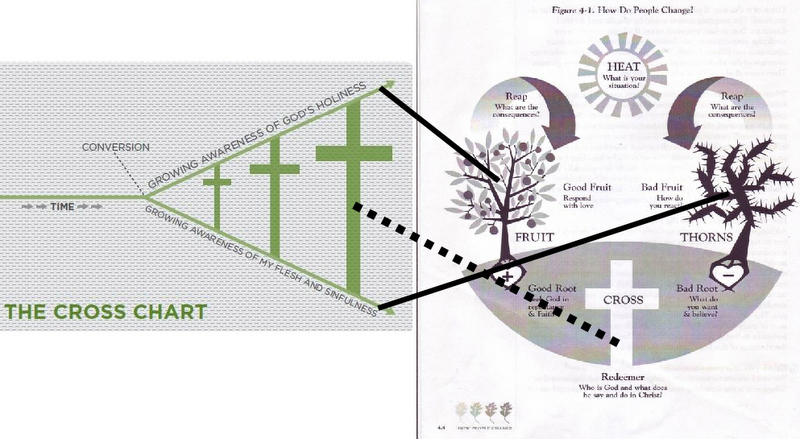
The parents were then counseled to not contact the authorities. Those who do are often brought up on church discipline. Justice necessarily implies victim. Victim necessarily implies worth. All three are conspirators with the glory story. And be not deceived: this is the logic that drives Reformed organizations that are supposed to be mediators in the church; specifically, Peacemaker Ministries and G.R.A.C.E. A major player in the Biblical Counseling Movement is Paul David Tripp. In 2006, he wrote a book that articulates the horizontal application of Luther’s theology of the cross: “How people Change.” Of course, the title is a lie; if he really believed people change, that would be the glory story. Notice also that it is, “How People Change” and not, “How Christians Change.” That’s because this bunch see no difference in the transforming power of the new birth and ordinary Christ-rejecting people.
In the book, Tripp, like all who propagate Luther’s theology of the cross, posits the Bible as a “big picture” narrative of our redemptive life. The Bible is a mere tool for one thing only: leading us more and more into the cross story and away from the glory story. This is accomplished by using the Bible to enter into the cross narrative and thereby seeing our preordained part in the “big picture” narrative of redemptive history. Though Tripp is not forthright about it in the book, this is known as the Redemptive Historical Hermeneutic. By seeing our life through the cross story, we are empowered to live life for God’s glory. This is done by seeing ALL circumstances in life (Heat) as preordained in order to show our sinfulness (Thorns) and God’s goodness (Fruit) for the purposes of having a deeper understanding of both resulting in spiritual wellbeing. In other words, all of life’s circumstances are designed to give us a deeper understanding of the cross story: God’s holiness, and our sinfulness. I have taken his primary visual illustration from the book and drawn lines to the cross story illustration to demonstrate the relationship (click on image to enlarge):
Understanding this lends insight to Tripp citations on the Peacekeepers Ministries website:
Paul Trip wrote a great post over at The Gospel Coalition blog all about the need for pastors to pursue a culture of forgiveness in their ministry. Pastors (and anyone serving Christ) have a choice:
“You can choose for disappointment to become distance, for affection to become dislike, and for a ministry partnership to morph into a search for an escape. You can taste the sad harvest of relational détente that so many church staffs live in, or you can plant better seeds and celebrate a much better harvest. The harvest of forgiveness, rooted in God’s forgiveness of you, is the kind of ministry relationship everyone wants.”
Then he describes three ways forgiveness can shape your ministry. I’ve listed them, but you can read how he explains them in detail.
“1. Forgiveness stimulates appreciation and affection.
2. Forgiveness produces patience.
3. Forgiveness is the fertile soil in which unity in relationships grows.”
He closes with this exhortation:
“So we learn to make war, but no longer with one another. Together we battle the one Enemy who is after us and our ministries. As we do this, we all become thankful that grace has freed us from the war with one another that we used to be so good at making.”
And concerning another author, they also stated:
Last week, Steve Cornell at The Gospel Coalition blog posted some really great insight into the difference between forgiveness and reconciliation. They also offered up some excellent and biblically sound steps in dealing with a situation where an offending party is hesitant to reconcile.
Here he summarizes a key distinction:
“It’s possible to forgive someone without offering immediate reconciliation. It’s possible for forgiveness to occur in the context of one’s relationship with God apart from contact with her offender. But reconciliation is focused on restoring broken relationships. And where trust is deeply broken, restoration is a process—sometimes, a lengthy one”…. His ten guidelines for those hesitant to reconcile are rooted in scripture and, I think, incredibly helpful.
1. Be honest about your motives.
2. Be humble in your attitude.
3. Be prayerful about the one who hurt you.
4. Be willing to admit ways you might have contributed to the problem.
5. Be honest with the offender.
6. Be objective about your hesitancy.
7. Be clear about the guidelines for restoration.
8. Be alert to Satan’s schemes.
9. Be mindful of God’s control.
10. Be realistic about the process.
Notice the overall blurring of distinction between the offended and offender with the subject of forgiveness.
The Cross-centered Anti-justice Pandemic is No longer Exclusively a Reformed Thing
Apart from Calvinism, the redemptive historical cross-centered approach is crossing denominational lines en masse. We at TANC see doctrines that were born of Luther’s theology of the cross in non-Reformed circles constantly; specifically, heart theology (deep repentance), exclusive interpretation of the Scriptures through a redemptive prism, Gospel Sanctification, and John Piper’s Christian hedonism. And we also see the same results. It is not beyond the pale for a pastor who has raped a parishioner to be the one counseling the victim sinner. You know, the “sinner saved by grace.”
God is a God of justice, and throughout the Scriptures He demands that we be people of justice. He demands that we come to the defense of the victim. I close with fitting words from church historian John Immel:
And this is the challenge. This is the challenge that I have as a man who is passionate about thinking: to inspire people to engage in complex ideas that drive tyranny. So here’s my challenge to those who are listening.
Do not be seduced into believing that righteousness is retreat from the world.
Do not be seduced into believing that spirituality is defined by weakness and that timid caution for fear of committing potential error is a reason to be quiet.
Do not be intimidated by vague, hazy threats of failure.
Do not let yourself believe that faith is a license to irrationality. I’m going to say that again to you. This is good. Do not let yourself believe that faith is a license to irrationality.
Do not mistake the simple nature of God’s love for a justification for simple-mindedness.
Do not deceive yourself with the polite notion that you are above the fray, that your right to believe is sufficient to the cause of righteousness. There is no more stunning conceit.
Do not pretend that your unwillingness to argue is the validation of truth.
Know this: Virtue in a vacuum is like the proverbial sound in the forest–irrelevant without a witness. Character is no private deed. To retreat is nothing more than a man closing his eyes and shutting his mouth to injustice.
Virtues are not estimates to be lofted gently against evil.
Virtues are not to be withheld from view in the name of grace.
Virtues are not to be politely swallowed in humble realization that we are all just sinners anyway.
Love is not a moral blank check against the endless tide of indulgent action.
Love is not blind to the cause and effect of reality.
Love is not indifference to plunder and injustice and servitude.
The time is now, you men of private virtue, to emerge from your fortress of solitude and demonstrate that you are worthy of a life that bears your name. The time is now, you men of private virtue, to answer Mick Jagger and all the nihilists that insist we are living on the edge and we cannot help but fall. It is time for you men of private virtue to take up the cause of human existence and think.
~TANC 2012 Conference on Gospel Discernment and Spiritual Tyranny: John Immel; session 1, “Assumptions + Logic = Action.”
paul
Do you Misrepresent the Pharisees? Well Then, You Just Might Be an Antinomian
Originally published September 7, 2010
 I heard it again yesterday in a Sunday morning message: the Pharisees were really, really good at keeping the Law, but at the end of the day Jesus said that our righteousness must surpass that of the Pharisees. Alas, proof that we can’t be justified by keeping the Law (which no one would argue with). The pastor, in this message that is one of many in his series on The Sermon on the Mount, even said something like this: “The Pharisees’ efforts at keeping the Law wasn’t the issue, they were good at keeping the Law.” But is that true? And by the way, considering who the audience was at that church (primarily saints gathered for worship and the hearing of the word), and the fact that his topic was the role of the Law in Christian living, why was he even discussing justification in that context? Based on his view of the Pharisees and their supposed efforts to be justified by keeping the Law, one of his statements to *us* was “you don’t keep the Law by trying to keep the Law.” Hmmm, really?
We certainly are not justified by “trying” to keep the Law, but should we try to keep the Law in order to please and obey our Lord? Yes, I think so. Now, I don’t know this pastor very well, but I know him well enough to know that he wouldn’t dream of synthesizing justification and sanctification, but due to the fact that our present church culture is awash in an antinomian doctrine that does just that, are pastors propagating such a synthesis unawares? Yes, I think so. In his sermon notes, the top of the page has statements like ”Things Jesus wants us (“us” would presumably be Christians) to know about the Law.” The top part of the notes are also replete with “we” in regard to the Law, but the bottom part has statements like: “We live in the Age of Grace; salvation is not of works,” but yet, the whole message clearly regards the role of the Law in the life of a Christian. Therefore, whether unawares or otherwise, he clearly extended the relationship of the Law in regard to Justification into the realm of sanctification.
Here is where we must call on our good friend Jeff Foxworthy who developed a program for helping people who may be rednecks but don’t know it. He presents several different questions from different angles of thought, and depending on the answers to the questions, “you just might be a redneck.” Likewise, if you misrepresent the Pharisees, you just might be an antinomian without knowing it.
First of all, we can see from the very same proof text used to demonstrate the idea above that the Pharisees were not guilty of attempting to keep the Law in order to be justified:
[9] “Anyone who breaks one of the least of these commandments and teaches others to do the same will be called least in the kingdom of heaven, but whoever practices and teaches these commands will be called great in the kingdom of heaven. [20] For I tell you that unless your righteousness surpasses that of the Pharisees and the teachers of the law, you will certainly not enter the kingdom of heaven” (Matthew 5:19,20).
So, as the reasoning goes, verse 19 indicates that “we” should revere God’s Law, but since the Pharisees were really, really good at keeping the Law (an assumed interpretive criteria) we shouldn’t “try” to keep the Law because that’s what they tried to do, and our righteousness must surpass theirs because you can’t be saved by keeping the Law (and again, why are we discussing salvation in this context to begin with?). But we can see just from this text alone that this interpretation is not true. In every literal English translation that I could find, the coordinating conjunction “for” links verses 19 and 20. As we know, coordinating conjunctions join two complete ideas together and indicates the connection between the two. In all cases, the translators saw fit to translate the conjunction “for” from the Greek texts. If Jesus was contrasting the two ideas, a different conjunction would have been used like “but,” ie., the Pharisees do verse 19 really well, “but” not perfectly, therefore you need a righteousness that is perfect (this is true, but not what Christ is referring to here). No, the conjunction used is “for” which indicates “reason”(reason why): because the Pharisees were guilty of verse 19, they (the audience) were not going to enter the kingdom of heaven if they where like the Pharisees in regard to habitually breaking the Law of God and teaching others to do so. Also, I think the Lord’s reference to being the least or the greatest “in the kingdom” (verse 19) is in reference to degree and set against the example of the Pharisees who were guilty of doing (breaking the Law and teaching others to do so) habitually which was an indication that their souls were in peril. Therefore, even if the assumption regarding the Pharisees ability to obey the Law outwardly is true, it’s the wrong transition; a better transition would be “but” and would read something like this: “Christians should obey the Law ‘but’ even if you keep the law as good as the Pharisees do, it will not get you into the kingdom, so you need a righteousness that surpasses theirs.”
Granted, depending on how you diagram the sentence, you might be able to make a case either way, but is it true that the Pharisees were experts at keeping the Law outwardly? No. From other Scriptures we know that the Pharisees were guilty of verse nineteen; specifically, they replaced the Law with their own traditions. That’s why Jesus immediately launches into the whole “you have heard that it was said….but I tell you”starting in the following sentence (verse21). Not only that, Jesus says specifically in Matthew 15:1-9 that His contention with the Pharisees (and the teachers of the law as exactly referred to in verse 20) was the fact that they twisted the Scriptures according to their traditions:
[1] Then some Pharisees and teachers of the law came to Jesus from Jerusalem and asked, [2]”Why do your disciples break the tradition of the elders? They don’t wash their hands before they eat!”[3] Jesus replied, “And why do you break the command of God for the sake of your tradition? [4] For God said, ‘Honor your father and mother’ and ‘Anyone who curses his father or mother must be put to death.’ [5] But you say that if a man says to his father or mother, ‘Whatever help you might otherwise have received from me is a gift devoted to God,’ [6] he is not to ‘honor his father’ with it. Thus you nullify the word of God for the sake of your tradition. [7] You hypocrites! Isaiah was right when he prophesied about you: [8] ‘These people honor me with their lips, but their hearts are far from me. [9] They worship me in vain; their teachings are but rules taught by men.'”
The Pharisees were not proficient at keeping God’s law outwardly. In fact, they didn’t do so at all, but rather propagated teachings that were “rules taught by men.” Therefore, the Pharisees were guilty of neglecting the true Law and teaching others to do so (Matthew 5:19). They were not the poster-children for some campaign to demonstrate the futility of Law-keeping, especially in regard to believers. In fact, Christ said their lax attitude toward the Law was indicative of those who will not enter the kingdom. For this reason the Pharisees were not the greatest in heaven as the masses supposed, but the least, if they were even in the kingdom at all. Therefore, when Christ told the crowd that their righteousness must exceed the righteousness of the Pharisees, He wasn’t talking about the imputed righteousness of Christ that the Pharisees were supposedly trying to obtain themselves for salvation (besides, they were not attempting to do that to begin with as I have demonstrated), but rather the true righteous behavior demanded of kingdom citizens. If Christ was talking about an imputed righteousness (for sanctification), why would He have not simply said so? For example: “Your righteousness must not only exceed that of the Pharisees (which wouldn’t have been hard to do anyway, and therefore by no means a profound statement by Christ), but ( a contrast conjunction) must be a righteousness that comes from God alone”…for sanctification.
If you misrepresent the Pharisees as the first century poster-children for “let go and let God theology” because they supposedly tried to keep the Law, you just might be an antinomian. But in part two, we discuss another question that may give credence to the possibility: Do you misrepresent obedience as outward alone? Well then, you just may be an antinomian.
paul

 Paul's Passing Thoughts
1 comment