The History of Western Philosophy and Its Societal Impact on the Church – Part 1
The following is part one of an eight-part series.
~ Edited by Andy Young
| Click here for part two Click here for part three Click here for part four |
Click here for part five Click here for part six Click here for part seven Click here for part eight |
 We have actually talked many times before about the challenges before us. I understand our obsession. The scope of this issue is vast. It seems a little conspiratorial and a little overwhelming to put it in those terms. When we start talking about Plato and him being a pagan and what John Calvin preached, it starts to come off as if we’re trying to find the boogie man in bad places.
While our challenge is lofty, it is much more personal, because our challenge deals with what happens in the pews. You show up at church, you hear doctrine, you get some people that shake your hand and look longingly into your eyes and say, “you belong.” That is hard to resist. Most people go to church because their kids have a place to stay, or they like the music, and they genuinely like the people. But that’s not where it ends. It is personal because at some point you may have ended up on the wrong side of the pastors. Something happens, it doesn’t matter what, but originally you have been told that you are part of this grand party, and then you find yourself under scrutiny, and suddenly the marketing and packaging is all wrong. You thought you were right to object or to challenge or to just be you, and one day that just was no longer so.
The problem that you have is that you look at your Bible and show supporting references for your objection, but you are told that’s not what that really says, and it really doesn’t matter because you should be submitting to some authority. Suddenly, you look around and life is now insane. All those people that hugged you and said “ye, verily, we are glad you are with us,” have now turned on you in less than a minute. All those friends you had, where’d they go? They have no interest in what you have to say. And the crazy part is the more you try to justify or to explain your position, the worse it gets. Without fail they accuse you of being “defensive”, and of course only “defensive” people are sinners. If you were really humble you wouldn’t dare walk down this line of self-defense.
You look around and you are bewildered. After you wade through the thousand and one emotions that have come out of you in ways that you could not have begun to fathom, you stand back incredulous and wonder, what the heck just happened? “God’s church is not supposed to be this way,” we tell ourselves. And yet here we are, dead square in the middle of a conflict that is almost unintelligible.
Of course these types of experiences within Christianity have been going on for generations. But in our modern age of blogs and the internet, we now have the ability to start comparing notes. Individuals are suddenly able to tell their story about what happened to them, and somebody else will read that and affirm those experiences with their own. As the solidarity among hurt and abused individuals grew, one day we stopped and said, wait a minute, there is a systemic problem here.
This is where we sit within Christianity today. We know we have a conflict, but we haven’t been able to identify the problem. The explanations run the gamut from:
“Doctrines of men” – Well, all doctrines are doctrines of men. God does not come down here, stand up in the public square and start talking. It’s all doctrines of men. Everybody is standing around all the time talking about the content of what they think and proclaiming that in general to the masses. What they really mean is it’s not authentic. If it were true doctrine we wouldn’t have a problem.
“God is testing you” – This one is fabulous. Basically what you are saying is the manifestation of reality is God’s intent. So why then are you seeking to solve the problem? This is how God means it to be.
“All churches have problems” – This a neo reformed classic. They like to pretend that people fussing over the color of the carpet is somehow the same thing as a child being molested and the pastor covering it up and refusing to let the parents go to the authorities. As if there is a moral equivalency.
“We’re all just sinners” – The tried and true “get out of jail free” card. We can’t really fuss and moan about the fact that somebody’s done bad things.
“It’s a failure of ‘polity’” – If you had the right government structure then these bad things wouldn’t happen because we’d have checks and balances, and of course Christians have come to believe that the nature of checks and balances is really designed to restrain our sinful appetites and desires, and so that’s what would make a better government structure that would prevent these bad things from happening, never once realizing that all governments are always in service to a series of values. And so it doesn’t matter the structure you put in place, at the end of the day, if you have the same values, you will continue to govern towards those values.
“If we just had the right people” – Which is ironic considering we assume the problem is the doctrines of men. By definition, if we’re just looking for the right person, what we’re really saying is there is an idealized person out there who somehow magically gets it all right and finally gets to come down from Mt. Sinai and tell us the truth. Well, that’s nutty, because that never works.
The one thing we never challenge is the doctrine itself. There is something wrong with that picture.
Some of you have experienced this tumult. You started looking for answers, and you’ve heard all of these points belabored in endless cycles – if we loved more, if we prayed more, if we prayed louder, if we prayed quieter. Finally you heard somebody say, “No, it’s not any of that. It is the doctrine.” You heard a man named Paul Dohse say, “No, it’s the doctrine.” You heard a guy by the name of John Immel say, “No, it’s the doctrine.” That’s the problem.
And it’s not just a problem. It is EVIL!
That one is a big one for a lot of people, because they want to sustain some kind of moral equivalency between doctrines, as if to say, well, it’s got some good ideas, but, you know, there are some things here that are good, and these guys aren’t all bad from top to bottom. And so we want to parse it out. We don’t want to take a position on the content of what they teach. The doctrine is evil. It is fundamentally and substantively hostile to human existence.
But this leads people to a serious problem. If it is the doctrine, if Calvinism is error, [gasp!] how can that be so? It’s orthodoxy. This is what the church has believed for 500 years, or at least the Protestant church. We would like to pretend that we’re different from the Catholics, but hey, how can you debate orthodoxy? Reformed theology is sacred. John Calvin and Martin Luther, are you kidding? They are at the base of God’s left hand, right beside Peter, James, and the other guys. How can you possibly begin to challenge who these guys are? The reformation, my goodness, if it hadn’t been for those guys we’d all still be Catholics. And those dastardly Catholics, my goodness, they’re just corrupt, and the Pope is of the devil.
Anybody ever heard that before?
Then you have to ask yourself, if that is the problem, if the Reformation is not what we’ve all been told that it is, and the people at the top of the intellectual food chain are not who we’ve been told they are, then we have to ask the really hard question; why has this happened?
Here is my challenge to you. Take a look in the mirror. You are the reason this happens. It isn’t any more complicated than that. Now you might say to me, but isn’t that what everybody else has told me? Everybody else told me that I was a sinner and that I was the reason there was this conflict. Yes, but this isn’t for the same reason.
To understand what really happened we need to start at the beginning. But before we can start that the beginning, people must take responsibility for the content of their own mind. I will bet money that very few people have ever heard a preacher say that before. A preacher might tell you to “think”, but maybe not so much. Here’s the thing. Paul and Susan Dohse and I can detail for you the list of doctrinal failures. We can detail all of the root issues and all of the spiritual manipulations. I have been thinking about these issues for almost twenty years of my life, so I have the ability to do this. But until you personally are committed to the content of your own mind, your own life, and your own purpose, nothing I say here will matter.
Here is why.
 At the end of the day, if you’re not willing to take responsibility for the content of your own mind, your worldview exempts you from everything that comes after that. You have capitulated. You have tossed up your hands and said, oh well, it’s not that big of a deal. At some point you’ll let your brain go tilt, you’ll shrug at the complexity of the world, and toss up your hands in surrender, and insist that Jesus’ message is just simple. All this “brainy” stuff is just added torture for your peaceful soul.
This sounds like a “churchy” answer. You will console yourself for a while, evading the reality that you are letting other men fill the blanks of your own mind. Eventually you will find someone else that will take up the cause of organizing your life yet once again. And not too long after that you will be confronted with the very same spiritual tyranny, the very same social conflicts, the very same church dynamic.
But maybe this time it’s worse. And maybe this time, the spiritual/church tyranny is actually joined with political power. Somehow the guy in front of the pulpit managed to get himself elected to office. And now, not only does he have a body of doctrine, but he has guns.
In Christianity we have failed to understand that government is force. Polity is force. When people start talking government, when people start talking about passing laws, what they are really saying that what they are entitled to do is force you, to compel you, to bring violence against you to bring a desired outcome. And then tyranny will have been joined with political power. And liberty will be dying under its assault.
What will you do then?
The options are very limited because you have already abandoned self-directed thinking. The only thing left will be a wail and a tumult of gnashing of teeth that men are just sinners and who can save us? You will toss up your hands in despair, retreat into some church where the intellectual barricades rule over the doors and you can fortify against the evil.
This all sounds very grim. That course of non-action is a dead end, and it has only one outcome. And that outcome is, you deserve what you get.
You are the reason tyranny happens, from top to bottom, throughout history. Not because you are a wretched old sinner who fails to submit to authority. The reason your interpersonal church relational problems happen is because you refuse to reason, because you refuse to be an independent mind, because you refuse to be an individual.
Now, how many people does that statement make nervous?
How many of you cringe at the notion that you should be more individualistic? How many of you think that having “ego” is deviant sin? How many of you equate being individualistic with “selfish”. How many of you equate selfishness with the greatest expression of moral failing?
 What if I told you that your reaction to self and “selfishness” and individuality and ego is by design? What if I told you that despots and tyrants throughout history the world over have specifically set out to persuade all of humanity that the problem is always the individual, and the only solution to the problem is sacrifice?
Disturbing thought, right?
So now we get to think. I need to bring you up to speed on some basic thoughts that most people have never heard before.
The Gospel According to John Immel, chapter 3:1-3
- All people act logically from their assumptions.
- It does not matter how inconsistent the ideas or insane the rationale. They will act until that logic is fulfilled.
- Therefore, when you see masses of people taking the same destructive actions, if you find the assumptions, you will find the cause.
Here is the underlying logic.
Verse 1 – Assumption + logic = action.
Verse 2 – Faulty logic, erroneous rationalizations, are still ideas that flow from one to the next, until they get to an outcome. That’s important. Just because something is “rational” doesn’t mean it’s not wrong.
Verse 3 – Mass action + destructive outcomes = common premise.
I want you to see the specific relationship between actions and ideas. I submit that man, as a rational, cognitive being, is specifically designed to operate from this standard. What makes man utterly unique in the world is his ability to cognitively and rationally approach the world. He is the only creature that does not automatically by nature adapt to an environment. The exact opposite is true. Man must adapt his environment to himself, and the only way he does that is by reason.
Once you understand that the nature of man’s existence requires him to integrate ideas, then it becomes amazingly simple to understand that the integration of ideas is what he is always after. He’s always trying to figure out how to take his ideas and put them together.
Unfortunately, most people have a big basket in their head, and they toss in this idea and that idea, and they shake it all up, and from time to time they will pull an idea out of this basket and decide, this is a good idea, and then they will act on it. It gets a little dangerous when they start pulling out two or three ideas. It doesn’t matter if they are mutually exclusive, they will try to force them together. They then look at the world, and it still makes no sense to them. Never once has it occurred to them to go back and check their premise; what is your assumption?
This study is called philosophy. Of course when I say “philosophy” in the context of Christians they immediately think of Paul’s major condemnation of “vain philosophies”, and they start to tune out because they think they have an intellectual “get out of thinking free” card.
Disciplines of Philosophy
– Metaphysics
– Epistemology
– Ethics
– Politics
These four studies drive all of human existence. The nature of existence is called metaphysics. How we know what we know is called epistemology. How we value what we know is called ethics. And how we interact with people is called politics.
Each of these disciplines of philosophy is a function of the previous one, forming a progression of thought. What you assume about man’s existence will ultimately impact what you believe man can know. What you believe man can know will ultimately impact how you think he should ethically act. How you think man should ethically act will ultimately form your government structure.
We can debate endlessly about the issues that create the problems within the church or fixing those problems with the right government structure, but government structure is always in service to ideas. This is the reason why. Politics is at the end of a philosophical progression of thought that begins with a metaphysical assumption.
Philosophy is the broad study of how man integrates his ideas. It is how we know what we know. It is where ideas come from, their objective value, and how those ideas impact our human interaction. With this in mind, you can grasp the implication of what I’m saying in the Gospel According to John Immel:
The Gospel According to John Immel, chapter 3:1-3
- All people act logically from their assumptions.
- It does not matter how inconsistent the ideas or insane the rationale. They will act until that logic is fulfilled.
- Therefore, when you see masses of people taking the same destructive actions, if you find the assumptions, you will find the cause.
This is why when you go to church you end up in the exact same spot. You find masses of people taking the same action. If you find their assumption, the roots of their ideas, you will find the cause of their actions.
So my goal last year at the 2012 TANC Conference was to introduce the systemic nature of human thought; to illustrate how this system dynamic impacts human action. Without this mindset it is almost impossible to understand what is happening. To be sure, without this intellectual tool, no specific doctrinal discussion will matter. It won’t matter how much we dissect sanctification, justification, and the centrality of the cross. It won’t matter how many scriptures we stack up in service to our pet doctrines. It won’t matter how much we rail against misplaced church government.
Ladies and gentlemen, that has been done over and over, council after council, synod after synod, internecine fight after internecine fight. And yet the church is a slow-motion train wreck of tyranny and counter-revolution. If you make even a cursory study of the evolution of Christianity from the mid-second century to about 1200 it is a laundry list of bloodshed and tyranny and counter-revolution.
To put this into “church speak”, church history is an endless cycle between legalism and revival. Revival in this instance is nothing more than the return of life, to revive what is actually dying, and the body politic continues to die because it keeps cycling through these same tyrannical ideas. But we have never broken out of the cycle because we have never understood the method underlying the madness.
“All men can see the tactics whereby I conquer, but what they cannot see is the strategy out of which victory has evolved.” ~ Sun Tzu, The Art of War
The tyrants and the mystic despots of the ages have been winning because we have never once challenged their assumptions. In the 21st century we are once again rolling through a philosophical cycle that has repeated itself over and over in history. This cycle is of course why Christians are living through ever-increasing manifestations of abuse.
People are confronted with the same tyranny that our forefathers set out to resist. As of now, the only real response has been to toss up our hands and look mystified at the stars. We know we are impotent. We remain impotent, caught in the cycle of doctrinal fight, church splits, and human tragedy. All we can do is wail about human depravity and mumble feebly about needing more faith. Pray harder. Sacrifice more.
Blah, blah, blah.
I tell you the truth, the answer to why this is happening is as easy to diagnose as the common cold. But the first thing we must do is dare to take responsibility for the content of our own minds. Mystic despots have ruled the world with portents of disaster for anyone with the ambition to live life beyond the substantive, beyond the mediocre.
Here’s where you come in. Autocrats rely on being able to compel outcomes because no one opposes their ideas. Tyrants only succeed when men refuse to think.
In then next session we are going to learn how tyrants have been so successful at waging war against liberty. Put on your thinking caps. We’re about to jump into the deep end of the pool.
~ John
| Click here for part two Click here for part three Click here for part four |
Click here for part five Click here for part six Click here for part seven Click here for part eight |
The Disaster of Sacrifice as the Ultimate Moral Standard – Part 1
The following is part one of a four-part series.
Taken from John Immel’s first session at the 2016 Conference on Gospel Discernment and Spiritual Tyranny
~ Edited by Andy Young
Click here for part two • Click here for part three
(Links to the archived files are found below)
We get to talk about philosophy!
The Gospel According to John Immel, chapter 3:1-3
- All people act logically from their assumptions.
- It does not matter how inconsistent the ideas or insane the rationale. They will act until that logic is fulfilled.
- Therefore, when you see masses of people taking the same destructive actions, if you find the assumptions, you will find the cause.
Here is the fundamental premise that I’m trying to bring to light. People act consistently from their body of ideas. They will fulfill that logical conclusion. They cannot escape it because human beings are designed to integrate their concepts from the most basic premises all the way to the highest concepts.
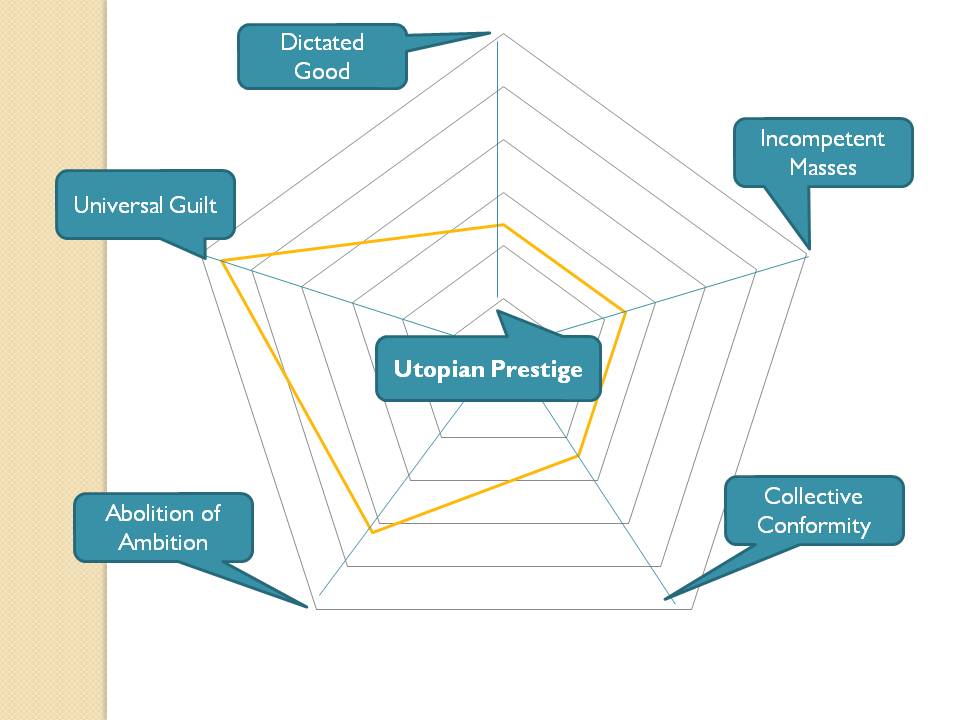 This explanation is best captured in the diagram at the right. My claim to fame within TANC Ministries is to discuss the roots of tyranny. Where does tyranny come from, and why does it exist? This is my contribution to philosophy. I’ve identified five pillars which are the basis for all tyranny. I’ve arranged them into a spider web because I want you to understand that they are all inter-connected. These are not stand-alone events: universal guilt, incompetent masses, collective conformity, abolition of ambition, and dictated good.
In all tyrannies, you will find these fundamental doctrines (and I don’t care if the tyranny is communist, socialist, or Calvinist) behind the arguments that people use to sustain such tyranny.
Man organizes his ideas in a hierarchy. I laid this out consistently in both the 2012 and 2013 TANC conferences – find the assumption and you will find the cause. One of the most challenging things I think people have when they are evaluating the content of ideas is learning to see root principles; learning to see what is at the bottom of what everyone is thinking.
To do that you have to learn to think philosophically. All men organize their ideas into a cohesive whole, and that science is called philosophy. Now they might not be aware of it, it may not be explicit, but all men have an integration of their ideas. In the world of philosophy that process goes by these sub-divisions or disciplines:
Disciplines of Philosophy
– Metaphysics
– Epistemology
– Ethics
– Politics
– Aesthetics (art)
The nature of existence is metaphysics. How man knows what he knows is called epistemology. How we value what we know is ethics. (The bulk of this series will involve the discussion of ethics) How we interact with people is politics. And how man creatively reflects his existence back to himself is called aesthetics or art.
This series of discussions will focus on the central ethical assumption of the Western world, indeed, the whole world:
Gospel According to John Immel 7:17
”Sacrifice as the highest moral ideal is the lynch pin of the coming Protestant Dark Age.”
Ponder that for a minute.
You can see that I crossed out the word “Protestant”, and I did that, not to minimize Calvinist Christianity’s role in the coming Dark Age, but to emphasize that Western culture is heading towards a collapse. The Western world is committing ideological treason to the ideas that brought liberty and light to the whole world. The Western world’s central philosophical betrayal is the  renewed embrace of the primary ethic of sacrifice. Twenty-first century man has decided to abandon the power of individualism a replace it with the primordial ethics of shamens, tribal warlords, and despots.
There is no small irony that in the Western slide into self-destruction, Christianity is paving the way with Augustinian and Calvinist doctrines from ages past that have already proved what they will create. They have already proved that the ideas taken to their logical conclusion will create death, poverty, suffering, and darkness.
It is ironic because Christians like to pretend they are ethical innovators. They love to talk about being separate from the world, and that being “worldly” is the same as being evil, that as Christians they have unique and transforming ideas. Christianity likes to pretend that it originated all the good ideas, and only the bad ideas exist in the world. Christians like to think that self-sacrifice is a wholly unique Christian concept that started when Jesus hung on the cross. They like to think that the world is committed to selfishness and ego, and individuals engaging in self-interest are “worldly.”
But like most myths, when studied beyond the surface it becomes clear that Christianity regularly steals its ideas from other sources. It becomes clear that Christianity repackages worldly ideas and presents them in its own name. For example: taking over Sunday as a day of divine service (it was originally a Greco-Roman holiday dedicated to Zeus); taking over a pagan winter festival and decorating trees and calling it “Christmas”; and probably amongst the most egregious rip-offs in history is the ex-appropriation of Jewish scriptures as the source of Christian authority all the while persecuting and killing the very people to whom the documents were written.
So here is the myth revealed: Christianity did not invent sacrifice for the “greater good”. Indeed, the oldest of all worldly ideas is sacrifice as the highest moral standard. The oldest moral standard known to man, practiced in all cultures and in all continents, is the foundational premise that man must sacrifice himself, must sacrifice his self-interest for the gods, for the tribe, for the people, for the king, for the nation, and the “greater good.”
For the whole of human history, it has been presumed that man is a sacrificial animal. Don’t be deceived that because we don’t see virgins tied to alters and priests holding bloody knives that we in the twenty-first century are more enlightened. We are not. Indeed, the nature of sacrifice today is more pervasive, more destructive, and more vicious. In ages past a sacrifice was done to receive a favor from the gods. It was expected that the destruction of one value would provide something of greater value. Today it is presumed that to receive any benefit from a sacrifice disqualifies the action. Today we sacrifice for the sake of sacrifice alone.
The result is the modern man is offered two existential options:
Sadism – sacrifice enforced as the hands of others
Masochism – self-inflicted sacrifice
Sacrifice is destroying America!
- Sacrifice is destroying a free society at the root
- Sacrifice corrupts government
- Sacrifice destroys achievement
- Sacrifice destroys the meaning of words
- Sacrifice destroys marriages
- Sacrifice gives Calvinist thugs the moral power to perpetrate their tyranny.
But before we trip too far down that path I want to give you a sense of history.
Sumerians – 3500 BCE
 From the land of Ur, kings were gods, and the people were created to serve the gods. Fertility was the most sought-after boon from the gods. To acquire these boons people gave sacrifices. There were sacrifices of animals, and there were sacrifices of grain, and there were sacrifices of people. The belief was that the sacrifice of people made it possible to follow the king into the after-life. It was also a common practice for women to sacrifice themselves to follow their husbands into the after-life.
Hindu Vedas – 1700 BCE to 1100 BCE
The belief is that the Vedas are divinely inspired documents without human authors. Within these scriptures they detail human sacrifice. Some scholars say that human sacrifice was continued in Bengal in the ancient world through the 19th century. The Thuggee cult that was dramatized in the film, Indian Jones and the Temple of Doom was real. They followed Kali, the goddess of destruction, and it is believed they killed somewhere in the neighborhood of 2 million people!
Shang Dynasty – 1523 BCE to 1050 BCE
The Chinese culture was dominated by ancestor worship. When a man died he passed into the “upper regions.” These ancestors had the power to impact the lives of descendants back down on earth. To inspire these ancestors to act on their behalf, people on earth gave sacrifices – animals, food, grain, wine, and other men. It was believed that man’s abasement before the spirits by offering these sacrifices would show the correct humility so that they might be worthy of good fortune. When the kings died, it was common practice to slaughter members of his elite guard and bury them in the tombs to guard the Shang kings in the after-life.
Abraham (Abram) – 1700 BCE
Now consider the geographical region of these first three civilizations: Mesopotamia (Middle East), India, and China. The Bible in the book of Genesis tells about a man named Abram who came from this very same general region, Ur of the Chaldeans.
“Terah took Abram his son and Lot the son of Haran, his grandson, and Sarai his daughter-in-law, his son Abram’s wife, and they went forth together from Ur of the Chaldeans to go into the land of Canaan, but when they came to Haran, they settled there.” ~ Genesis 11:31
“After these things God tested Abraham and said to him, ‘Abraham!’ And he said, ‘Here I am.’ He said, ‘Take your son, your only son Isaac, whom you love, and go to the land of Moriah, and offer him there as a burnt offering on one of the mountains of which I shall tell you.’ So Abraham rose early in the morning, saddled his donkey, and took two of his young men with him, and his son Isaac. And he cut the wood for the burnt offering and arose and went to the place of which God had told him.” ~ Genesis 22:1-3
There are two things I want you to see from these passages. First, notice where Abraham and his whole family is from; Ur, the land of the Sumerians. Second, notice that Abraham never considers the command to sacrifice Isaac to be something unusual. The chances are that he was not the first man to believe that some god somewhere told him to sacrifice his child.
This is very important. Abraham would have been amidst a pantheon of gods. In his culture, everywhere he looked there was a god. And he has this personal God of his own called “Yehowah” (Jehovah) who isn’t know to too many people, if anybody other than Abraham. His household knows Him simply because they have seen Abraham prosper because of Him. So this obscure God says to this man, “Go kill your kid,” – there’s nothing abnormal here to Abraham’s mind.
It is crucial that you understand that at no point in history is sacrifice as a concept unique. Let that sink in for a moment.
Pythagoreans – 570 BCE
I did a full analysis on the Pythagoreans and their impact on Western thought at the 2013 TANC Conference. But a brief review is in order. Their abiding and enduring impact begins with their contributions to music and mathematics. However their greater impact on Western culture is metaphysical. What they offer is profound and unique.

The Pythagoreans celebrate sunrise.
“Man has two parts, a high part and a low part. The low part is the body, the high part the soul. These two are in eternal conflict with each other. The soul is akin to God, to another dimension. Once, it was a god-like creature, inhabiting another, superior, spiritual world. But it sinned. And the result was it fell from grace. And as punishment was included in the body on this earth. The body is therefore the prison, the tomb of the soul. And we are destined, each of us, to go through a series of “reincarnations”. At the end of our earthly span, our soul goes back to the other world, and it gets the appropriate reward or punishment (depending upon its behavior), and then it comes around again, what they call the “wheel of birth.” Sometimes it comes up in another human body, sometimes in an animal body. It lives out its cycle…until…the soul can escape from this body and earth permanently, reunite once and for all with God, and thereby achieve true happiness and salvation…
“How do you [get to it]?…purification…you have to live a good life…an ascetic life…[but] the Pythagoreans at their most ascetic are frenzied hedonists in comparison to the Christians that are yet to come…”
“…to be free of the flesh is man’s highest ethical ideal.”
You can hear the echoes of later Christian doctrine all over this. Here is what the Pythagoreans did. For the first time there was formal concept of man divided against himself – that man was actually two things; spiritual and material. The spiritual was good and the material was functionally evil. They are the developers of human depravity in Western thought.
Most cultures prior to this accepted that the gods were to be revered and their domains were set apart, but it was assumed that man had a right to engage or interact with the gods on some level. The divine was not specifically hostile to man as such, and man by definition could beseech the gods and get boons from them. The Pythagorean premise begins the separation between the material and the spiritual.
Now to my knowledge the Pythagoreans do not participate in human sacrifice in the literal meaning, but they introduce what amounts to a “living death.” For the first time in philosophical history, the presumption is that this stuff (body, matter) that we inhabit is somehow functionally and morally wrong.
Plato to Plotinus to Augustine

Plotinus
I detailed the in a previous conference, but I never get tired of pointing this out. Augustine’s theological pedigree is rooted in Plato’s philosophy via the neo-platonist Plotinus. Plato’s The Republic basically says this: Lesser men are driven by their passions and not fit to rule themselves. Lesser men must subordinate themselves (a.k.a. sacrifice) their base nature to the Philosopher Kings. This is the appropriate order of the world.
Those intellectuals who have the ability to formulate a full philosophical statement, as Plato did, are the ones with the most intellectual power. It is very difficult for people to be philosophical and intellectual innovators. One percent of one percent of one percent of one percent of people in world history will every try to do such a thing. Most people uncritically adopt philosophical statements from whomever they are learning.
Plotinus picks up ideas from the Pythagoreans, the Cynics, and the Stoics who all believed in the soul/body dichotomy, a doctrine which metastasizes as it develops throughout history. While the Pythagoreans would have been considered raving hedonists by comparison, by the time we get to the Cynics, their commitment to the destruction of the body is transcendent. And this is what Plotinus picks up on. By the time we get to Plotinus, he is determined to philosophically eradicate the material world as such, and that specifically means the body.
Plotinus drops all vestiges of the humanist element in Plato’s philosophy. What I mean by that is while Platos’s ideas were wrong, he still held that humanity had virtue. He believed man had value and he still advocated for the betterment of man, but Plato’s was not a religious position even though it had religious elements. But by the time we get to Plotinus, the religious element of spirit-good/matter-evil had reached a peak.
Plotinus probably would have faded into oblivion had it not been for Augustine. Augustine uses Plotinus’ anti-material metaphysic and weaves the Pythagorean’s soul/body dichotomy into Christianity. Augustine said that the nature of man’s sacrifice is individual. This is important. Up until Augustine, men didn’t really consider themselves individuals. They might have identified that they were sole people, but they were always part of something larger. Their nationalities mattered, their participation in the tribe mattered, they conceptualized themselves in the collective mindset. Augustine is the first philosopher to introduce individuality and more importantly, a morbid introspection. Most of you are very keen on doing self-analysis and looking inside and then finding your flaws. This is Augustine’s heritage.
He metastasizes the Pythagorean concept of asceticism and turns it on human life as such. Life qua life is the greatest threat to define existence. The whole of this theology has a singular aim; to make man’s life unlivable and make death the moral ideal.
So now here is the problem. Augustine’s doctrine becomes the de facto standard of Christian orthodoxy for effectively the next thousand years. He stands intellectually unopposed. There is no legitimate intellectual resistance to Augustine’s doctrine until St. Thomas Aquinas. The reason he is so successful at this is because his doctrine is both heresy and treason to oppose. In other words, it is backed by government power.
The logical conclusion of a doctrine that condemns is called asceticism. Asceticism is the soul/body dichotomy – the intentional destruction of the evil material world put into practice. It is no longer a theory. The kind of asceticism the worked its way across Europe was the practice of trying to incrementally destroy the body. Consider the lengths to which they went to destroy the body: staring into the sun until blind so as not to lust after women, sitting on rocks until their legs wasted away, drinking dirty laundry water.
So Christian Europe basically decides that the apostle Paul’s metaphor to beat his body into submission is to be taken literally. Asceticism was the social ideal during the Dark Ages. The problem is, you can’t really practice asceticism because it will kill you, yet the cultural heroes were all ascetics. They are individually self-destructive but they are held up as a moral ideal. They are venerated even though you don’t really do what they do.
 This is the mind set of the European Dark Ages. The Dark Ages are dark in principle because the ideas behind the societal action are dark in principle. If your metaphysics is dark, man can’t know anything because his epistemology, what he knows, his mind, is dark. If his mind is dark, by definition he seeks out darkness. He values darkness. He seeks to destroy. And that means his politics, how he interacts with people, is by definition destructive. Notice the progression. You start with the Augustinian premise of original sin and self-destruction, man is materially and fundamentally evil, it results in a logical conclusion.
Four hundred years after Jesus came preaching life in the covenants of promise, Christianity becomes a cult of death that rules the world with a nihilistic iron fist. But for all of the destruction that Augustine’s ideas created he had one flaw in his theology. He left one avenue of self-interest in his doctrine. That flaw left the world one last glimmer of hope, one last place for man to escape the destruction of human sacrifice. That flaw would remain in human thought for about a thousand years.
…To be continued
John Immel 2016 Session 1 Archive Video (YouTube) Audio Only (mp3)
From the Reformation to the Third Reich: Protestantism’s Impact on Western Culture – Part 8
The following is part eight of a nine-part series.
Taken from John Immel’s sixth session
at the 2014 Conference on Gospel Discernment and Spiritual Tyranny
~ Edited by Andy Young
Christianity’s Solidarity with Socialism
 There has been observation that the Founding Fathers were Christians and that a lot of the impetus for the American Revolution came from their Christian perspective. Certainly any reading of George Washington makes it almost impossible to turn him into a deist. While it is true that many of the Founding Fathers were Christians and considered themselves Christian, they were primarily sons of the Enlightenment, and they held man as an effective, potent, rational creature.
This is in absolute defiance of historical orthodoxy. There is no way you can massage historic Augustinian/Lutheran/Calvinist orthodoxy into rational, competent, successful men. The practical outworking in the United States was that man’s exposure to the Dark Ages was directly centered around the Puritan doctrine, and it was that same Puritan doctrine that the Founding Fathers made an overt effort to separate from government and, in many instances, to defeat.
The reason Americans get so fussy about their right to define their own religion is not because they are emulating orthodox Christian doctrines. It is because they are children of the Enlightenment. It is the Enlightenment that told you that you had the rational capacity to read the Bible for yourself and understand it for yourself. That is entirely an Enlightenment conclusion.
And let me expand this a little further. One of the best contrasts to do is to look how Luther reasoned. He would make an assertion, and then he would stick a reference to a Bible quote. At one point in time, systematic theology was called the “queen of the sciences”, because it was this ability to be able to rattle off every scripture that was supposed to have been somehow designated to any of the main disciplines within theology.
Now if you actually look back through Bible interpretation from effectively Augustine forward, the dominant means by which the Bible was interpreted was by allegory,typology, and metaphors. It was not something that was rationalized. It was nothing more than putting one’s finger on a verse and saying, “Because it says this, that necessarily means God means this.”
Of course, my degree was in systematic theology, and this is why I eventually abandoned systematic theology because it is really an interpretive methodology. It is not indicative of what the Bible says. The ability to take passages and verses of scripture and somehow cut and paste them together to arrive at doctrines is not reflective of audience, purpose, and intent of author.
That process of learning to identify audience and context are all concepts that came out of the Enlightenment. Once the Church lost control of the universities, men could start inquiring about the truth behind the doctrines in question that had been held for so long because the force of government could be brought to bear from descent. Men finally started to go out and do research, and the vast percentage of that research is actually very recent. Most biblical scholarship has been done probably within maybe the last 80 to 90 years.
All of these scholastic elements are born from the process of higher critical methodology, and most of the men who advanced these higher critical methods were considered outcasts by the Orthodox Church. One such individual who comes to mind is a guy by the name of Friedrich Schleiermacher. He insisted that you have to learn to identify context, audience, speaker, and context for the writer of the  book. Now here in 2014, finding some guy on the computer that can actually do a word study and start parsing out Greek verbs in an effort to recover, at least in his mind, an intent or meaning behind the text, is reflective of Enlightenment thought.
This is not the historic orthodox position, and you will notice in most of the Neo-Calvinist movement, they abhor higher critical methodology with impunity. They demagogue the moral high ground, and then they employ an interpretive methodology. It is the manipulation of interpretive methodologies that gives them all the power to create any doctrine they want. And the moment you try to pause them and say, “Wait a minute. How can you just arbitrarily say, ‘Oh, Galatians here, Romans here and Genesis here and let’s all put this together,'” they become indignant.
Typically throughout the medieval times, other types of orthodoxy never had any ability to gain any traction because ultimately, you would be condemned for heresy and penalized by government. But in the United States those types of ministries had the opportunity to rise up. And more specifically, the men who actually carried them were either largely uneducated or not seminary-educated, which meant they were not Harvard or Yale graduates, which meant they were not indoctrinated into the Calvinist construct. They were committed to their own rational understandings of their own individual reading of the Bible. And this is crucial to understand.
The problem, however, is that such movements usually had nowhere to go because they had no intellectual framework. It turns out that that is exactly like Christianity back in the 1st century. It did not have a framework. It needed a framework, and unfortunately Christianity became attached to Platonism. Its abiding and enduring capacity is within that overarching philosophical statement. In philosophy the most consistent formulation wins, and as of right this minute in 21st century America, the only overarching full-formulation of Christian thought – and trust me, I have read thousands of pages from lots of different people – is the reformed Augustinian/Lutheran/Calvinist construct.
So having said all of that, let us revisit what inspired my part of this conference.
“The idea that freedom of man is a practicality is a pipe dream because he is enslaved to his own desires spiritually; hence, at the very least, indifference to political freedom on a social level. So will the New Calvinist movement cause political indifference in American society among Christians?”
That the idea of “freedom for the masses” is called a “pipe dream” is the political premise of collectivist governments. Such governments presume man’s nature precludes liberty because man can never control his impulses. Therefore, man’s true freedom is found in subordination to the state. The belief is that the state is a definer of morality, and individuals are at their highest and best when looked after by a paternalistic government.
Of course, we know where this logic leads because history gives us two absolute examples: the Soviet Union and National Socialist Germany. The fundamental political premise of Augustine/Lutheran/Calvinist doctrine is that Christians are to accept whatever government comes to power. This means that Christians must submit to any thug with a gun.
 Socially and politically, the most disastrous part of the current New Calvinist movement is the doctrine that demands submission to authority. They do not teach indifference. They teach an intentional servitude. Intentional servitude is far, far worse because it is a doctrine of deliberate capitulation. Such a doctrine demands that Christians presume that any man claiming authority is ordained of God. This means that it does not matter how bad the oppression gets. People must assume that righteous action is submission. “Righteous” action is therefore non-action.
Political indifference can be ignited into political fervor in a blink if social pain becomes too great. But by contrast, people choosing to be passive in the name of “righteous” action is by definition already expressed in passion. It is simply a passion for doctrinal submission.
The Lutheran Church gutted the Christian will to resist the rise of National Socialism. To be sure, the Evangelical Church was on the forefront of ushering in Hitler’s rise to power, and this is exactly what the historic doctrine will do today here in America. It will demand that people accept any thug with a gun who acts in behalf of the people, who acts in behalf of righteousness, who acts to establish God’s kingdom, to help usher in tyranny here.
Now you know the contrast between the philosophical foundations for collectivist tyranny and individual liberty. You have seen the root ideas of Augustinian and Calvinist theology. You have seen that this ideology sees no conflict with socialist economic doctrines. This ideology sees no conflict with a totalitarian state. Germany could make no distinction between Hitler’s socialism and Luther’s Christianity. I’m going to say that again…
The German people could make no distinction between Hitler’s socialism and Luther’s Christianity.
- Augustine, Luther, and Calvin said, “Man is nothing. The Church is everything.” The Nazis said Du bist nichts; Dein Volk ist alles. “You are nothing. The people are everything.”
- Augustine, Luther, and Calvin denounced reason. The Third Reich denounced reason.
- Augustine, Luther, and Calvin had a doctrine that demanded submission to church authority. Church authority demanded submission to the state. The Nazis demanded submission to the state authority.
- Augustine, Luther, and Calvin said the only real world was the transcendent, heavenly world. The Nazis said the only real world was the transcendent world created by the German people’s state.
- Augustine said the material world was immoral. The Nazis fought the perceived Jewish materialistic spirit within and around them.
- Augustine, Luther, and Calvin condemned men’s private interest, which meant they condemned private property. The Nazis condemned private interest which means they condemned private property.
- Augustine demanded sacrifice. The Nazis demanded sacrifice.
- There were no individual rights during the Dark Ages. There were no individual rights during the rise of National Socialism.
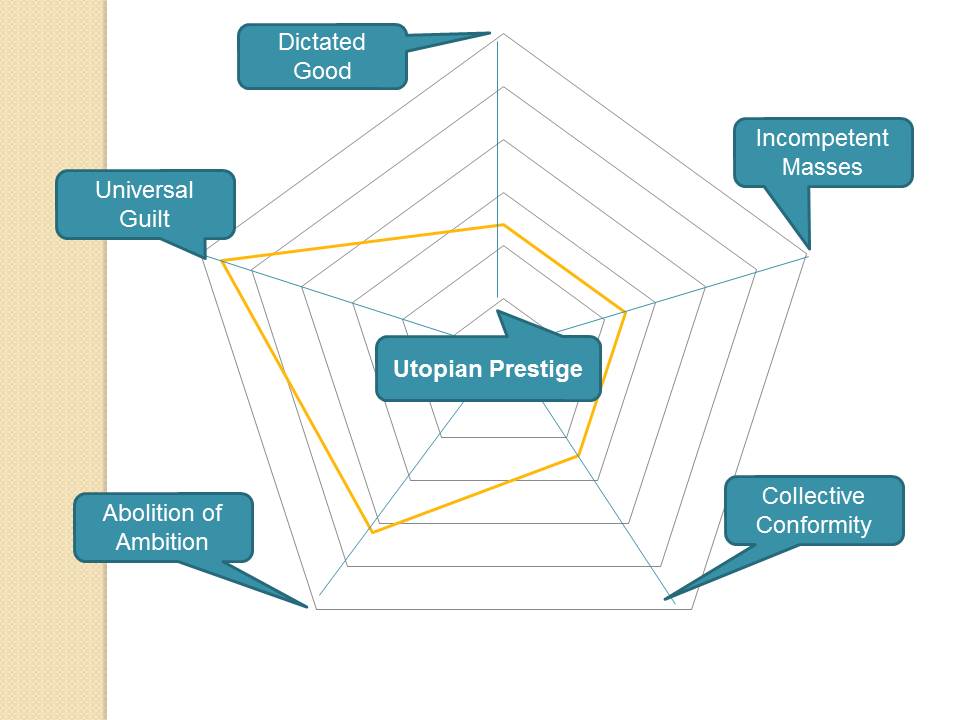 The Church and the National Socialists agreed in the fundamentals of human existence. From metaphysics, to epistemology, to ethics, to politics, to art, the Church and the National Socialists agreed that man is corrupt and egoistic – incompetent masses. Individualism is evil – universal guilt. Dogmatism is the only acceptable intellectual standard – abolition of ambition. The highest moral virtue is self-sacrifice to the state – collective conformity. Government is synonymous with providential divine will, and evil must be banished with force of government – utopian prestige. The method is dictated good.
The Gospel According to John Immel, chapter 3:1-3
- All people act logically from their assumptions.
- It does not matter how inconsistent the ideas or insane the rationale. They will act until that logic is fulfilled.
- Therefore, when you see masses of people taking the same destructive actions, if you find the assumptions, you will find the cause.
I have outlaid to you all of the assumptions, and now you can understand why people take the same mass action; why 40 to 65 million Germans remained complicit with the actions that went on within Nazi Germany. They all accepted the exact same premise. They held the exact same assumptions, and  they followed those assumptions to the logical conclusion. When someone says to me that the state can dispose of man’s property at will, he has conceded the premise that the state owns man totally. So if they can take your money, they can take your life. If they can take your stuff, they can stick you in an oven. The moral justification does not change.
Sacrifice is the collectivist mantra, and it ends with tyranny. Once you establish the moral standard of submission to authority, there is no argument to be made for independent action. Once you accept the premise that it is immoral to take self-appointed action, all self-appointed actions are immoral. Once you accept the premise that personal inclinations are immoral, then all inclinations are immoral, and this includes your inclination to stand against tyranny. The same argument that shuts your mouth when the preacher says something you disagree with is the same argument that keeps your mouth shut when the tyrant starts shooting people in the head.
People blithely condemn self-interest as immoral, but if self-interest is immoral, then so is self-preservation. Self-interest and self-preservation are inseparable. So if you wipe out self-interest as a moral standard, you will existentially wipe out self-preservation. If you wipe out self-preservation, how then can you justify fighting against a tyrant who seeks your destruction? If you won’t fight for your own liberty, how can you live to fight for someone else’s liberty? If you don’t hold liberty as an ideal for your own existence, how can you advocate liberty for Jews, for African-Americans, for rich white people?
Hear me now.
Tyrants know this truth. If they can talk people out of self-interest, they have talked them out of life itself. Tyrants know that if your moral standard is sacrifice, you are already dead. All they have to do is hand you the knife. You will cut your own throat seeking to be moral. National Socialist Germany showed this history. The marriage of the Third Reich with the church doctrine of self-sacrifice brought the Western world within a hair’s breadth of returning to the Dark Ages. This is no accident. The doctrines at the root are the same.
In 21st century America, we are once again rolling through a philosophical cycle that has been repeated over and over in history. We are intentionally moving towards socialism. We have bought into the lie that socialism is a kinder, gentler economic organization. America’s root philosophy is the antithesis of all collectivist ideologies. Communism, socialism, Catholicism, and Calvinism, these are all collectivist ideologies. The Founding Fathers believed in the rational, effective, motivated individual man. They organized a government around the defense of the individual. The defining shape of government was to defend the sovereign individual against all encroachments.
We are sprinting headlong down the path of despotism. The slogans have only changed in name. A century ago, a fundamental transformation was done in behalf of the volk. Hope and change were done in behalf of the German people. Now the move towards socialism is done in the name of grandma’s healthcare. Christian grandma would never dream of walking next door with a gun and demanding her neighbor pay for her doctor visit, but she will think nothing of electing a politician who will hold a gun for her. Christian grandma insists that her politics are compassion, but never mind that compassion and compulsion are mutually exclusive. Never mind that compelling someone to provide an ability or a skill or an expertise at the point of a gun is slavery. Christian grandma, and everyone else who votes with her, handed the keys of the doctor’s office to men with guns. And if they can compel doctors to work for free, they can compel people to stay away from doctors for free.
Ladies and gentlemen, there is nothing hidden here. This is not any different than 1926. The documents have been written, and all you have to do is read. All you have to do is listen. There is nothing mysterious happening in modern American politics. History has repeatedly proven that  socialist countries will slaughter millions to sustain the power of a select few. The moment you concede that seizing a man’s property is a moral government action, you have conceded that man is property of the state. The moment that man is property of the state, man can be disposed of as the state sees fit.
This is, of course, why Christians, with ever-increasing manifestation, are confronted with the abuse and tyrannies that our forefathers tried to resist. People wail about human depravity, moan that their leaders have the wrong form of church government, mumble feebly that the parishioners should pray more for their pastors, and demand that people sacrifice more in behalf of the church. The church is impotent to stop the problem because the church refuses to diagnose the problem.
I tell you the truth that the answer as to why this is happening is as easy to diagnose as the common cold, but the first thing you must do is dare to take responsibility for the content of our own minds. Mystic despots have ruled the world with portents of disaster for anyone with the ambition to challenge the traditions of power. Autocrats rely on being able to compel outcomes because no one opposes their arguments. Tyrants can only succeed when we refuse to think.
To be continued…
From the Reformation to the Third Reich: Protestantism’s Impact on Western Culture – Introduction
The following is part one of a nine-part series.
Taken from John Immel’s first session
at the 2014 Conference on Gospel Discernment and Spiritual Tyranny
~ Edited by Andy Young
This specific 2014 conference represents the culmination of at least 20 years of thinking for me. And to give you a sense of scope, I need to begin with some history. In America, Christianity first had the opportunity to disagree, starting in the early 19th century, with the Pentecostal and charismatic movements. They were a unique brand of Christianity that were the first to diverge from historic Calvinist roots.
Because there really is no formal definition for Pentecostal and charismatic, there are some profound limitations to the definitions of either. I can tell you what they tend to emphasize. They are renewal movements, a return to the gifts of the Spirit – speaking in tongues, healing – and a very immediate, very specific present kind of Christianity. They were rooted in and had some of their intellectual roots in the Wesleyan movement. They rejected determinism. They rejected predestination. And they believed in free will.
All renewal movements are necessarily movements of personality. Most of the early revival movements in the United States came from men with specific messages- John Alexander Dowie, John G. Lake, William J. Seymour. If you have any interest at all in learning the evolution of charismatic/Pentecostal movements, these names are going to be at the top of the list.
When I came into Christianity around 1981-82, the charismatic renewal was still unformed. There weren’t really mega churches as you and I know mega churches. Back then we were still arguing over whether or not you could have guitars and drums in church, whereas today, if you don’t have contemporary music and guitars and drums, nobody shows up.

Oral Roberts University – Tulsa, OK
One of the primary leading figures of that timeframe would be men like Oral Roberts, one of the first men in the history of the world to impact the globe by mass media. For a series of reasons, I end up going to Oral Roberts University thinking that I would arrive at charismatic utopia. Given my love for ideas, I found myself terribly attracted to studying theology. I hold a degree in Systematic and Historical Theology with a minor in Old Testament. What that basically means is that the sum of my education was in church history, the progression of church doctrine and systematic theology.
The head of the Department of Theology at the time was Siegfried Chasman who was a committed Calvinist from Europe. As such, he organized the Department of Theology around that body of ideas, but he also knew he had an entire student body committed, for the most part, to Pentecostal/charismatic concepts. The problem is that most people make the fundamental mistake in assuming that Calvinism is somehow negotiable, that we can somehow pick and choose which parts of Calvinism we want. And so then they try to hybridize a lot of these ideas.
Herein is the implicit conflict. You would go to chapel Tuesdays and Thursdays, and the charismatic speaker of the day would blow through and say whatever they had to say. Meanwhile, those in the Theology Department would sit front and center of the auditorium,and without fail they would be visibly and universally outraged at whatever was said from the platform.
So I was dead square in the middle of this ongoing fight- the power and the effectiveness of charismatic-style doctrines, and the critique of the only form of academic theology that is Protestantism.
by the time I had graduated from college, I had no home. Charismatic churches didn’t have the interest in what I had learned or what I knew, but by the same token, I got to spend an entire college career addressing the fundamental problems that I saw with Calvinism as such; combating those arguments, being aware of these arguments, writing endless papers on those arguments, defending those papers against myself and the entire classroom. So I am no stranger to the fight.
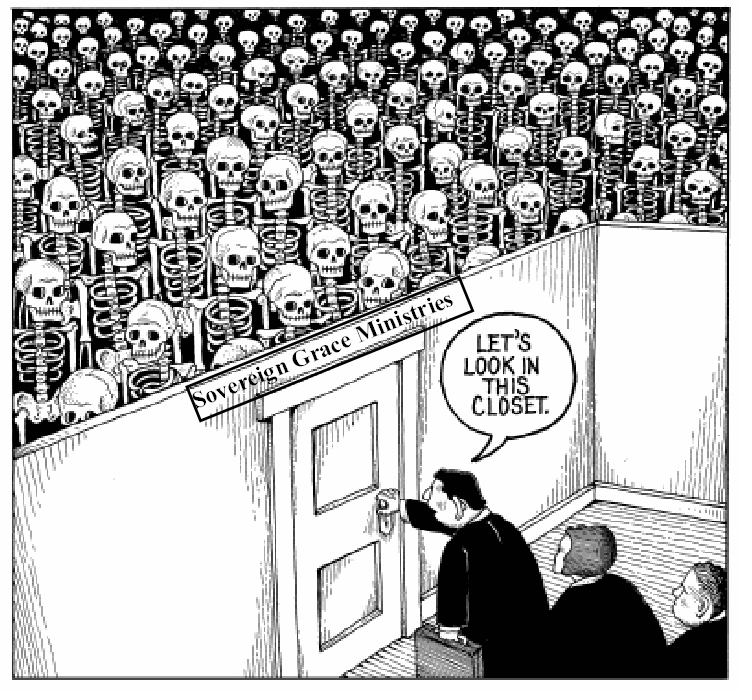 When I was 26 years old, I found myself in Gaithersburg, MD on the doorstep of what was then a People of Destiny International church (which would eventually become Sovereign Grace Ministries). When I first got there, they presented themselves as these very broad-minded, interested in ideas thinkers, social commentators, and frankly, I thought it felt like home. I was to eventually learn that was totally false. Around 1991 they started to make a transition into what I knew was Calvinism, and I had fundamental objections to Calvinism. They had no interest in ideas, and they had no interest in anybody else’s input. I made the faulty assumption that I could object, that this was a reasonable action on my part, on anybody’s part, if they saw a problem with the doctrine; that anyone should be able to say, “No, that’s not true.”
This of course embroiled me in all manner of church conflict to the point that they eventually told me I was deleterious. “And oh, by the way, why don’t you go out and start your own church?” The irony of that has never ceased to amaze me, that I could be considered deleterious (evil, wicked, pernicious, and destructive) but yet it was perfectly acceptable for me to go out and start my own church. To this day, I think that’s hilarious.
It took me a long time to unravel the problems, but because of the way I tend to approach the world, I saw commonalities. Now of course the original criticism was, “Well, the reason there’s a conflict, John, is because you’re here. The conflict is you.”
Okay.
And inasmuch as you accept that assumption, then that makes abundant sense. But remember, I had almost a decade of Christian life behind me. I already had an identity that spanned a number of different denominations, a number of different church flavors, plus the intention to create theology as a professional pursuit. So the standard denunciations and the standard objections to me didn’t work. I did not quickly embrace the notion that I could be so fundamentally wrong. But this ultimately set me on the path of identifying what is the commonality here.
I had already seen these doctrines in some form and in some fashion even in the charismatic churches. I would eventually get out of Sovereign Grace Ministries, and I would go participate in other churches and I would still see the same themes, the same ideas. And trust me, I was one of the few people going around actually objecting to the broader actions of Sovereign Grace Ministries. I was absolutely a lone voice. So any preacher I ever heard that ever said to me, “Your job is to submit to me. It is my job to defend the sheep,” I would specifically exhort them to get involved in protecting the sheep in the context of the conduct of that ministry. Universally, they said no way.
In all these churches, fundamental to them was the doctrine of submission and authority; the presumption that select men had the moral right to dictate to me intellectual conclusions. Concurrent with that submission was that they were somehow uniquely qualified to understand the truth and nobody else really was, and that by virtue of that authority, they had the right to treat me however they chose. In whatever way they qualified such a justification, at the root, that’s what they presumed. If I was not willing to embrace what they said, it was somehow a moral failing on my part. The presumption was always that the moral failing began with me. And for a while of course I accepted the presumption, but then I realized, wait a minute, this stuff exists whether I’m at this church or not.
There was only one other common denominator…
…and that was the doctrine.
With my degree and historical background I was able to trace the evolution of Christian thought effectively from the 1st century to about the 18th century. I had enough church history to understand that this pattern was actually not uncommon. Once I identified those fundamental elements, I realized this has happened before, and it has happened over and over and over. I finally had to ask myself, how is it possible that the Church either finds itself in bed with tyrants, abetting tyrants, or behaving as tyrants itself?
And that’s when I came up with this. I’ve shown this in pretty much every conference.
The Gospel According to John Immel, chapter 3:1-3
- All people act logically from their assumptions.
- It does not matter how inconsistent the ideas or insane the rationale. They will act until that logic is fulfilled.
- Therefore, when you see masses of people taking the same destructive actions, if you find the assumptions, you will find the cause.
 Now of course when I formulated this, I hadn’t yet read James Madison and his Memorial and Remonstrance against Religious Assessments, in which he states:
“7. Because experience witnesses that ecclesiastical establishments…during almost fifteen centuries has the legal establishment of Christianity been on trial. What have been its fruits? More or less in all places, pride and indolence in the clergy, ignorance and servility in the laity, and in both, superstition, bigotry and persecutions.”
“8. Because…what influence in fact have ecclesiastical establishments had on civil society? In some instances they have been seen to erect a spiritual tyranny on the ruins of civil authority; in many instances they have been seen upholding the thrones of political tyranny; and in no instance have they been seen as the guardians of the liberties of the people.”
James Madison nailed it. The bulk of Christian history is one, long, slow motion train wreck of tyranny. This is a problem that bothered me viscerally. We genuinely believe that God is love, yet with stunning consistency, the church that God sees and is supposed to call His own ends up at the forefront of tyranny. There is something seriously wrong with this picture!
The example of National Socialist Germany is an instructional morality event of epic proportions. In the 1920s, Germany was Christian by any definition. Not only was it Christian, it was Lutheran Christian by any definition. Of the 60 million people that resided in Germany, 40 million identified themselves as evangelicals. The other 20 million identified themselves as Catholic or some variation of Protestantism, with only about 1 percent embodying a genuinely non-Christian mysticism.
There is a common objection that the reason the evil in Germany took place is because a select few did bad things and that good men did nothing. The only thing necessary for evil to triumph is for good men to do nothing. Does this explain what happened to National Socialist Germany?
I’m going to let you ponder that question.
Before we can genuinely answer that question, we need to do some serious remedial work. We need to understand what shaped Germany in the 1920s. And the reason we need to understand history is because, as Adolf Hitler once said, “A man who has no sense of history is a man who has no ears or eyes.”
Now for me to do my job, I’m going to have to introduce you to philosophy.
Disciplines of Philosophy
– Metaphysics
– Epistemology
– Ethics
– Politics
– Aesthetics (art)
The nature of existence is metaphysics. How man knows what he knows is called epistemology. How we value what we know is ethics. How we interact with people is politics. And how man creatively reflects his existence back to himself is called aesthetics or art.
Man cannot help but integrate his ideas. It’s the way he’s built. From the time he is a toddler, the first thing he wants to understand is how things fit together. Man must organize his ideas into a cohesive system just like a fish must breathe in water. For man, his ideas do not hang in a vacuum. His ideas must be attached to something. And he must start from the most rudimentary part of his existence. He must start at the beginning.
It is a hard thing to learn to think in essentials, to think in principles, to think in terms of ideological relationships. It is hard to learn to think philosophically. However, most people are unaware of this big picture. Most people don’t think in these terms, yet most people treat ideas as some kind of smorgasbord. Oh, I like this one, and I like this one. Nah, I don’t like that one. I like this one. And they put it all in a basket and from time to time they will pull out an idea and say, “Yeah, that’s pretty good. Yeah, that’s pretty good.” They treat ideas very carelessly.
Often they find themselves dead square in the middle of some form of conflict, some form of psychic pain. And because they treat ideas carelessly, they don’t recognize that the psychic pain they hold is directly tied to mutually exclusive ideas that are in conflict. This is because they have not done a successful job at integrating ideas, or eliminating the errors from the most rudimentary level of their ideas to the practical outworking. The result is uncertainty. Then, one of the first things man tends to do when he encounters a conflict or an inconsistency is to punt the inconsistency into the abyss so that he doesn’t have to deal with it.
Since it is the subject of this conversation, we are already familiar with how this actually breaks down with Augustine, with Calvinistic thought. What is the metaphysical assumption of Augustine? Man is corrupt. Man is existentially corrupt. He is corrupt from the nature of his existence. He has no redeeming good quality in his existence. Anytime you think you’ve got something good, you don’t. Because man is metaphysically corrupt, that means, epistemologically, man cannot know anything. Because man cannnot know anything, his moral responsibility – his ethical responsibility – is his own self-destruction. And because man cannot do good, he will not follow through on this ethical standard. This means he necessarily needs a government that will compel him to that action. So if you won’t sacrifice you, there will be a government that will sacrifice you.
And last is aesthetics. This is how man reflects the world back to himself. Man needs a means by which he refuels his existence. He needs a means by which he takes his most rudimentary assumptions about his life and puts that into a form so that when he looks back at it, he is refreshed. This is the root of aesthetics.
However, if you presume man’s metaphysical corruption and you presume all of these fundamental things that Augustine presumes, what kind of art do you create? You create churches lined with gargoyles. You create Dante’s Inferno where the nature of your art specifically reflects man’s catastrophe, destruction, impotence, fear, terror, anxiety, neuroses, and psychoses. Your art will always follow your most rudimentary philosophical assumptions.
The dominant philosophy on the planet is collectivism. It is the presumption that man is first and foremost the property of the state, the property of society, the property of tribe, the property of community or denomination or local church or sect.
Here is my contribution to philosophy. I have identified five fundamental elements of all collectivist doctrines that are designed to produce tyranny. The reason I have organized this as a web is because I want you to understand that this is not linear. All of these elements are interdependent and do not necessarily follow in a progression. There is a dynamic tension between all the arguments. Some arguments that you hear will have facets of each of these elements. Let’s look at each one of these more closely.
Incompetent Masses
The underlying conclusion throughout Western thought has been that man’s senses or his ability to reason were fundamentally flawed. Man could not understand the world in which he lived. This is the bedrock of incompetence. If you separate man from his mind, man from his body, and man from reality there is no other place for man to live. So if you presume that man is incompetent then you set the groundwork for the next concept.
Universal Guilt
This is a tool designed to drive you to accept your own incompetence. All men are guilty of moral depravity so that no one can advocate a moral standard. If you will accept guilt, a universal guilt, a guilt for no crime whatsoever, a guilt for nothing else than for simply being an incompetent human, you will accept the standard that you are morally incapable of running your own life. If you cannot presume your own moral good then the only thing left is…
Dictated Good
Because man is guilty and incompetent to carry out the important actions, he necessarily needs someone to save him from himself. This is why there has always been a separation between the willing elite and the general masses. This is where the class society comes from. There has always been the presumption that the “true philosopher” had a special access to truth.
Abolition of Ambition
Because man is by nature an individual and not a collective being, he must be talked out of individual action. He must be persuaded that any action done independent of group sanction is the height of moral failing.
Collective Conformity
This is the end game. This is where the full force of government is brought to bear for the sole purpose of creating a neutered humanity without complexion, or variation, or distinction. This outcome is held out as an ethical ideal and forced into existence at all costs.
Utopian Prestige
All arguments are in service to the collective reputation. Notice the outcome is at the center of the web of these five elements. How many times have you heard a preacher talk about the reputation of the church? The argument is that individual action will impact the prestige of his “local collective.” This is the presumption of Utopian Prestige. In every collectivist ideology, you will ultimately see the proclaimed ideal is some utopian ideal, whether it’s the Marxist’s workers’ paradise, whether it’s the Gaia, the utopia of earth, nature rule, nature worship, whether it be heaven, racial purity, it is always some utopian ideal that has no material expression. In other words, you will never see it here.
Most people have very little exposure to formal metaphysical or epistemological science. What they will do consistently is quote ethical expectations, and they do not realize that they are in fact admitting and committing to an ethical formulation that is part of a bigger picture. This is where most people encounter the philosophical system, ethics. Usually, our culture’s social values are expressions of ethics. What we find offensive, what we get offended by in public is specifically a reflection of our ethical values. People don’t know where these ethical formulations come from, which means they don’t really think about what they mean.
Ethics is where man experiences a political or philosophical formulation. Now consider the statement, “The only thing necessary for evil to triumph is for good men to do nothing.” So then the question becomes, how is it possible for good men to sit by and do nothing? Remember that all behavior flows from metaphysical assumptions and is driven by logic. In order to answer the question, we must first consider, what are the root assumptions, and what is the progression of thought that leads to a behavior where good men will not act against evil?
To be continued…
The History of Western Philosophy and Its Societal Impact on the Church – Part 3
The following is part three of an eight-part series.
Taken from John Immel’s second session at the 2013 Conference on Gospel Discernment and Spiritual Tyranny
~ Edited by Andy Young
| Click here for part one Click here for part two Click here for part four |
Click here for part five Click here for part six Click here for part seven Click here for part eight |
We have been discussing the major contributors in the progression of Western thought. Many concepts and doctrines that we have traditionally come to think of as Biblical orthodoxy in reality have their roots in ancient philosophies. Here is a brief summary of the thinkers and their contribution that we studied in part two:
Thales – The first scientific approach to explaining reality as opposed to a pantheistic approah. The concept of one universal “stuff” and its various forms.
Heraclitus – Because everything is in a constant state of “flux”, man is unable understand the nature of reality. The first to introduce a division of reality. Two “realms”.
Parmenides – Precursor to Aristotle’s “Law’s of Identity” and existence. Existence is real, but change is not. Change is only apparent because of man’s faulty perception.
This brings us to part three, and we will pick up where we left off.
 Zeno
Zeno
I want to address Zeno and his paradoxes, because they are very commonly used as proofs of Parmenides’ philosophy. Zeno was a disciple of Parmenides. He continued the arguments against Heraclitean thought. His goal was to prove that movement was an illusion and plurality and change was impossible. His proofs are said to support Parmenides’ conclusions. Here is his most famous paradox.
The Dichotomy Paradox: “That which is in locomotion must arrive at the half-way stage before it arrives at the goal.” – as recounted by Aristotle, Physics
This is basically the endless half-life of infinity. The theory is that you can’t ever cross a room, because in order to do so you must first cross half, and then must cross half of that, and so on, to the point where you could never actually arrive at your destination, and in this way, motion does not really exist. It is an illusion. Zeno is using this paradox to deny the implications of change.
Now you can see the utter quagmire that western thought is in. Now mind you, this is a monstrous step up from the rest of the world that is still under the tyranny of pantheism and the endless cycle of man is nothing more than a cog in the wheel of life-birth-death-life-birth-death. The developments these men are making are light-years forward in comparison to everybody else.
 The Pythagoreans
The Pythagoreans represent a school of thought that is unique from both Thales and Heraclitus. They have an impact on western thought that persists throughout most of the rest of the timeline that we are going to cover. They are important because we are talking about a school of thought that has almost 500 years to develop before the onset of Christianity onto the scene. Pay close attention, because I am confident that you will find the Pythagoreans disconcerting.
When one talks about Pythagoras it is usually in reference to the school that he founded. While we know almost nothing about Pythagoras specifically, what we do know comes from a whole scope of literature that came out of the school and from writers like Parmenides, Aristotle, and others.
Please make a note: the Pythagoreans profoundly impacted Plato. This is the root source of the majority of Plato’s ideology. Again, this will become apparent later as we move on.
Most of you have probably heard of the Pythagorean Theorem, a2 + b2 = c2. It is most often attributed to Pythagoras, but it was most likely a product of someone else within the sect. It was a communistic, religious school, and many people contributed to the school’s intellectual content. While this equation and many other mathematical proofs are attributed to Pythagoras, it is more accurate to understand that intellectual movement was substantially beyond its founder.
Their claim to fame is primarily rooted in their extraordinary work in mathematics, music, and astronomy. Scholars talk of early, middle, and late Pythagoreans, but for our purposes, these distinctions don’t matter much because as you will see their influence continues to this day.
The Pythagoreans celebrate sunrise.
In contrast to the previous thinkers I have discussed there is one crucial distinction I want to make. This group was a part of the Orphic mystery religions, meaning that the previous thinkers were secular by comparative standards. While we would call Plato a pantheist, the fact of the matter is, by comparison he was agnostic at best.
Editorial Note: The following link will provide some insight into the tenets of the Orphism.
https://campus.aynrand.org/campus/globals/transcripts/pythagoras-mathematics-and-the-mysticism
Here is an excerpt just to give you an idea:
“Man has two parts, a high part and a low part. The low part is the body, the high part the soul. These two are in eternal conflict with each other. The soul is akin to God, to another dimension. Once, it was a god-like creature, inhabiting another, superior, spiritual world. But it sinned. And the result was it fell from grace. And as punishment was included in the body on this earth. The body is therefore the prison, the tomb of the soul. And we are destined, each of us, to go through a series of “reincarnations”. At the end of our earthly span, our soul goes back to the other world, and it gets the appropriate reward or punishment (depending upon its behavior), and then it comes around again, what they call the “wheel of birth.” Sometimes it comes up in another human body, sometimes in an animal body. It lives out its cycle…until…the soul can escape from this body and earth permanently, reunite once and for all with God, and thereby achieve true happiness and salvation…
“How do you [get to it]?…purification…you have to live a good life…an ascetic life…[but] the Pythagoreans at their most ascetic are frenzied hedonists in comparison to the Christians that are yet to come…”
This is the roots of gnosticism that would take hold in the first and second centuries. We have a mystery religion, man in a flesh body that is functionally depraved needing some form of enlightenment that is given to him by the gods, enlightenment that is unique to a select few. This is where it starts.
They said failure to live a pure life brought punishments after death in the lower plains of the underworld. Harmony is divine. Disharmony is material and flesh. And now you can see why they arrived at a duality of existence. Their religious worldview led them to conceptualize two different states, but they didn’t leave it there. The Pythagoreans identified three kinds of men:
- Theoretic – The lowest class of man; a crass materialist; committed only to material gain and the preoccupation with his fleshly life.
- Practical – Comes seeking to participate in enlightened action; wants higher virtues; still physically working to attain those values.
- Apolistic – The highest class; those who simply look at life; exists in pure contemplation; the philosopher who contemplates science and mathematics who is released from the cycle of birth; a root desire to free oneself from the flesh
Freeing oneself from the flesh became the ethical ideal. Not only did they conceptualize two worlds, but they added the concept of a fundamental depravity of human existence. Heraclitus and Parmenides assumed that man’s senses were suspect, but it wasn’t a metaphysical corruption. The Pythagoreans’ notion of depravity goes beyond a mere inability, it makes man depraved as a function of his physical existence. Because he is material he is necessarily depraved.
So the question is, if they were a mystic sect, why would they become so dominant? Throughout history there have been many mystery religions, most of which you will never know even existed. By definition the mystery dies with the last follower who knew the secret. But the Pythagoreans sustained mystical influence because their advances in science were so compelling. Words fail when trying to describe the Pythagorean impact on music, math, and science. Their work in mathematics and astronomy makes possible men such as Kepler, Newton, and Einstein. We don’t get to the moon without the Pythagoreans. Without their foundation, physics would be impossible. So their mystical metaphysical worldview piggybacked into subsequent generations of thinkers because of the power of their contributions to the physical sciences.
This should not really be any surprise. Frankly, Christians do this sort of thing all the time. How many times do we presume that if a person has one crucial thing correct that he must have the authority to have everything else correct? As a result we accept, rather uncritically, whatever comes out of the preacher’s mouth. How could C.J. Mahaney, John Piper, John MacArthur, et al, ever get to where they are without this presumption?
Here is the introduction of the soul/body dichotomy into western thought. It is the origin for Martin Luther’s cross story/glory story, Augustine’s “original sin”, and Plato’s two realm idea that requires a philosopher king to bring enlightenment to the incompetent masses. The conclusions of such ideas always result in the dividing of humanity into classes. As we move forward into the development of Western thought, this division is almost never challenged. It becomes the dominant theme in Christianity almost from the outset.
 The Atomists
Up to this point the progression of thought has been a-systematic, meaning there has been no systematic approach to the nature of things. There has been some tossing around of ideas back and forth, but this begins to change with the Atomists. For the first time, thinkers tried to develop a whole approach to primary philosophical questions, metaphysics, epistemology, ethics, and politics.
Like everyone else before them, the Atomists are trying to reconcile Thales and Heraclitus. They were materialists, meaning that reality is matter in motion. Everything, including non-material and mental phenomena is explained entirely in physical material terms. They were pluralists. Instead of one universal “stuff”, as Thales proposed, there are many “stuffs”. Each “stuff” is unchangeable. This would serve to satisfy Parmenides assertion that everything is unchangeable and indestructible. The smallest unit of these universal “stuffs” is the only thing that can move or change, which of course satisfies Heraclitus.
This has a serious flaw because, after all, we’re looking for a one-world substance that integrates everything and explains change. The Atomist’s explanation makes everything you see, taste, touch, smell, and hear have to contain its own unique “stuff”. The world would then collapse on itself for the sheer weight of things, and man would be lost in a blindingly chaotic world.
So the Atomists decided that all physical things have two parts: qualitative characteristics, and quantitative characteristics. This evolution of thought gave them the ability to sub-divide qualities (colors, smells, sounds) versus quantities (number, length, motion). It was pretty ingenious. It gave them the ability to categorize some things and not others. By removing quantities from consideration they were able to reduce the number of “stuffs” needed to explain the universal “stuff”. But they still needed to reconcile their ideas with Parmenides. They had a solution to absolutes, but now they had to figure out what to do with flux.
The solution to this was the question, “Are qualities real?”
The logic went like this. When a man smells, is he smelling something real or is his nose playing tricks on him? The simple answer is, no, it is not real, because “smell” is a quality based on man’s nose, and the easiest way to address quality was to conclude that nothing was real. Qualities are merely the way “stuff” affects man.
Once again, the conclusion is that man’s faculties are the problem.
But the conclusion begs the question: if there are no qualities, then how do these things operate? The answer was that the motion seen is from the physical pressure, the impact of the universal “stuff” against other universal “stuff”. This mental model formed the basis for what we now call “atoms”, but they were applying a mechanical model to the discipline of metaphysics.
Can you guess what this means?
If you have everything metaphysical acting mechanically what you end up with is an endless stream of causation. And since man is made up of the same universal “stuff”, this leaves man without independent will. He is simply a product of mechanical forces outside of his control. This is the foundation of determinism, and this is the concept that the Atomists introduced into Western though. The entire scope of Atomists’ philosophy doesn’t affect Christianity as a whole, but this one concept of determinism did. This concept is what influenced St. Augustine, Martin Luther, John Calvin, and others to come.
To be continued…
| Click here for part one Click here for part two Click here for part four |
Click here for part five Click here for part six Click here for part seven Click here for part eight |

 Paul's Passing Thoughts
2 comments