John Piper’s Works Salvation via Gospel Contemplationism
Originally posted August 7, 2013
“’Preaching the gospel to ourselves every day’ and ‘living by the gospel’ are not cute little truisms for sanctification help, they are the prescription for keeping your salvation.”
In the following video excerpt, John Piper explains how you keep your salvation through riveting YOURSELF to the works of Christ seen in the whole Bible. I have posted before on Piper’s view of how Christians continue to be saved by the same gospel that saved us. According to Piper, and the Calvinistic gospel in general, moving on to maturity in sanctification is works salvation. We have to keep our salvation by an ambiguous definition of what is not works in sanctification and what is works in sanctification. “Preaching the gospel to ourselves every day” and “living by the gospel” are not cute little truisms for sanctification help, they are the prescription for keeping your salvation.
Notice that he presents Romans 10:9, a clear onetime event that saved us (a justification verse), as something that we have to continue to confess in order to have assurance of salvation (a perpetual believing and confessing). This is works salvation and heresy of the first order.
Smoking Gun: ACBC is a Nationwide Divorce Mill
 Christ made it clear that what God has brought together NO man is to separate. Does this mean God predetermines every marriage in regard to particular spouses? I doubt it. This probably refers to God’s covenant of marriage and the theology of vows. At any rate, death, unrepentant adultery, and an unbeliever who abandons their believing spouse are the only exceptions.
How does one live happily with a spouse who has become difficult? For Protestants, that is a hard question because the focus has been on justification for 500 years with little emphasis on the biblical art of godly living (sanctification). When you are supposedly sanctified by a perpetual “return to the gospel afresh”… knowledge on how to repair a marriage is going to be what it is today, practically nonexistent. And of course, living by the same gospel that saves us (not saved us) is a very complex matter needing the ongoing “research and development” of gospel-centered experts.
Add to that: Protestants don’t even have justification right. Little wonder then that the institutional church is a train wreck after 500 years of scholarship and trillions of hard-earned laity dollars. What is the answer? The answer is a laity movement that will reclaim the priesthood of believers seized by Gnostic hacks dressed in biblical garb.
The answers will come through one Lord, and one word interpreted by individuals indwelt by the Spirit who gives all knowledge needed for life and godliness liberally. In case we forget the obvious, “I was only obeying the elders” will not cut it when you stand before Christ and His blazing eyes of fire. The Nazis were very good at being “subordinate,” and many were hanged accordingly. I realize Reformed elders claim God gave them His authority to rule on earth, but you may want to rethink that claim.
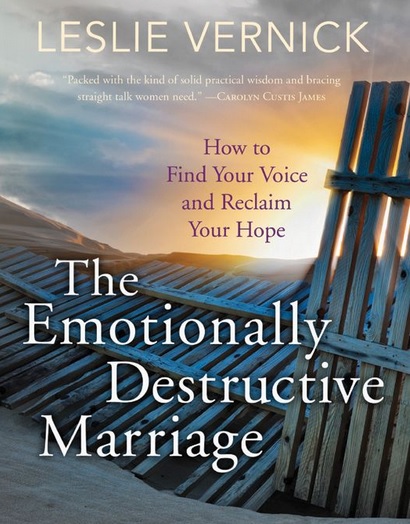
As predicted, the biblical counseling movement overseen primarily by the Association of Certified Biblical Counselors (ACBC) has become a divorce mill via its efforts to build marriages that “look like the gospel.” And the smoking gun is a book written by Leslie Vernick titled The Emotionally Destructive Marriage: How to Find Your Voice and Reclaim Your Hope that is widely used among ACBC counselors.
The obvious problems here are first seen in the title of the book. As Christians, is it really our goal to, “find our voice”? I thought it was our goal to please God in every circumstance. Secondly, the idea of emotional destruction is subjective at best and a ticket to do anything you want at worst. To make the point here, Google “American Civil Law.” In a culture judging anything that causes bad feelings to be abuse, such an approach to “biblical counseling” should give one pause.
Thirdly, why do Christians need a 240 page book written by a serial regurgitator of other people’s thoughts to FIND hope? You would think that by now Christians would be fairly certain about where hope is found.
Chilling is the examination of the 61-question survey found in the book that supposedly determines if one is in an abusive relationship or not. In the hands of a person that is unhappy in their marriage, the outcome will be a foregone conclusion. It’s like asking a chicken if Colonel Sanders is an emotional abuser.
The lynchpin becomes the ACBC’s loose interpretation of 1Corinthians 7:12-16. If the spouse is already an unbeliever, emotional abuse is tantamount to departing from the marriage even if they have not left physically or filed for divorce. Church discipline takes care of the pesky obstacle of the “abusive” spouse being a believer—they can be declared an unbeliever…actually MADE an unbeliever by elder authority supposedly vested to them by God. This paves the way for sanctified divorce.
It boils down to this: whoever is handed the book by the counselor is coronated as the abused spouse. Be sure of this: if both counselees in a bad marriage were handed the book, both would be guilty of the same thing. This is the smoking gun: it depends on who the ACBC “biblical counselor” wants to label abusive for whatever the motives might be.
I think a present situation that I am involved in says it all. I know enough about the situation to know that if the person I am talking with took the book’s survey, the other spouse would be judged as emotionally abusive hands down. The other spouse was handed the book because of who the ACBC counselor wanted to label “abusive.”
This is the niche service that Leslie Vernick now supplies to ACBC counselors.
paul
Gospel Sanctification: The End Times False Gospel
The Potter’s House 7/5/2015
Part 1 – 50 minutes.
Part 2 – 15 minutes.
What Your Sanctification Says About Your Justification: Is Your Gospel True or False?
 Originally posted February 27, 2015
“The law is the standard for love, not justification. In all of the aforementioned systems of sanctified justification by works, faith doesn’t work because it can’t lest salvation be lost. In the Christian life faith works because it can for the sake of love without condemnation.”
“Knowing that justification is a settled issue that has nothing to do with the law anyway, the true Christian only sees law-keeping as an opportunity to love. Christians not only have the anthropologic law of conscience written on the heart, the new birth writes the Bible there as well. In other words, we love the law.”
“Obviously, those who must focus on faith alone works in order to remain justified cannot focus on aggressive obedience to the law that defines love.”
What do you believe about salvation? Your Christian life will tell you. Therefore, the parable of the talents in Matthew 25:14-30 should not confuse us. The “wicked” servant was not cast into outer darkness because he didn’t put his talents to work, but rather what he thought it meant to be a servant. In other words, in order to be saved, you need to know what a Christian is. That should be fairly evident.
Do you live your Christian life by “faith alone”? That is a statement in regard to what you believe about salvation, or what happened to justify you, viz, justification.
This is not complicated. Don’t complain that I am making your touchy-feely “simple” gospel a theological treatise. I am sure you concur that some Bible words have to be understood in order to be saved. The Bible splits humanity into two categories: saved and unsaved, i.e., “under law” or “under grace” (Romans 6:14).
“Under law” is the biblical nomenclature for the unregenerate lost. Under law means that sin rules you. Not in a plenary sense, because man’s conscience and fear of punishment from civilian law restrains people. Yet, they are under the condemnation of God’s law and every violation is documented. Unless they are saved, they will be judged according to their works in the final judgment. Though some who followed their conscience more than others will receive a lesser condemnation, it is still eternal separation from God. They are under law, and enslaved to sin. The last judgment DOES NOT determine justification; it ONLY determines the degree of eternal condemnation. It doesn’t determine justification; it only determines the wages of sin.
Moreover, sin uses the condemnation of the law to provoke people to sin. Primarily, sin uses desires to tempt people, but sin’s incentive is the law because it condemns. Sin lives for the purpose of condemning people, and uses desire to get people to sin against God’s law. This leads to present and eternal death. Sin’s desire is to bring death. When the Bible speaks of “the desires of the flesh” it is referring to instances when the flesh is serving the desires of sin.
The flesh can also be used to serve the desires of the Spirit (Romans 12:1). The flesh has NO desires; it is used by the dweller for good or evil purposes. We will either use our bodies to serve the desires of sin or the desires of the Spirit. Of course, people have their own desires, but unfortunately, the unregenerate are guided by the desires of sin. They assume sinful desires are their own desire which is true. In contrast, sinful desires are not part and parcel with the regenerate soul.
Said another way: among the lost, the desires of sin are very much the same desires possessed by the individual who are indifferent to the law of God. A desire for God’s law is absent while their life is continually building a death and condemnation dividend. Some of that dividend is paid in this life until the full wages of death are paid at the final judgment.
Under grace is not void of law. The law (same as “Scripture” or same as “Bible”) has a different relationship to the saved, or those under grace. A literal baptism of the Holy Spirit takes place, as symbolized in water baptism, which puts to death the old person under law and resurrects the new person under grace. The saved person is now a new creature created by the Spirit of God. The person under grace is literally born of God—he/she is God’s literal offspring.
Therefore, the old person is no longer under the condemnation of the law in the same way a dead person cannot be brought under indictment for a crime. Consequently, the motivation for sin is gone. The power of sin is the law’s condemnation that leads to death (1Corintians 15:56, 57). In addition, the person under grace has been given a new heart that loves God’s law and its way of life. The book that could only bring death is now a book that brings life. Either way, it is the Spirit’s law; He uses it to condemn those that are under it, or uses it to sanctify those who are under grace (John 17:17).
THEREFORE, how you see the law determines what you believe about salvation. If you believe that you can somehow obey the law in a way that unwittingly seeks to be justified by law-keeping, you are still under law. If you believe justification is defined by perfect law-keeping, you are still under law. Those who believe this also believe they need a salvation system that filters all their works into a category of faith alone. The Christian life is categorized or departmentalized into works that attempt to be counted for justification and faith alone works that qualify as “living by faith alone.” Do not miss the point that this also includes abstaining from certain things that aren’t necessarily sin as defined by the Bible.
Yes, hypothetically, a person would need to keep the law perfectly to be justified by the law, but that doesn’t make perfect law-keeping the standard for righteousness. If that were the case, the law is a co-life-giver with the Holy Spirit, and a death would not be necessary. We are justified APART from the law—law has NO part in justification. The Bible defines justification, but it’s not a standard of justification (Rom 3:21, Gal 2:19, 4:21). Law-keeping by anyone does not justify.
If one is trusting in a system that fulfills the law for justification, particularly if it calls for not doing something in order that the law is fulfilled in our place, that is works salvation through some kind of intentionality whether passive or active. These kinds of systems are always indicative of being under law rather than under grace. One such system that has several variances calls for doing certain things or not doing certain things on the Sabbath which can be Saturday or Sunday depending on the stripe of system. If you follow the system on the Sabbath, all works done by you during the week are considered to be by faith alone.
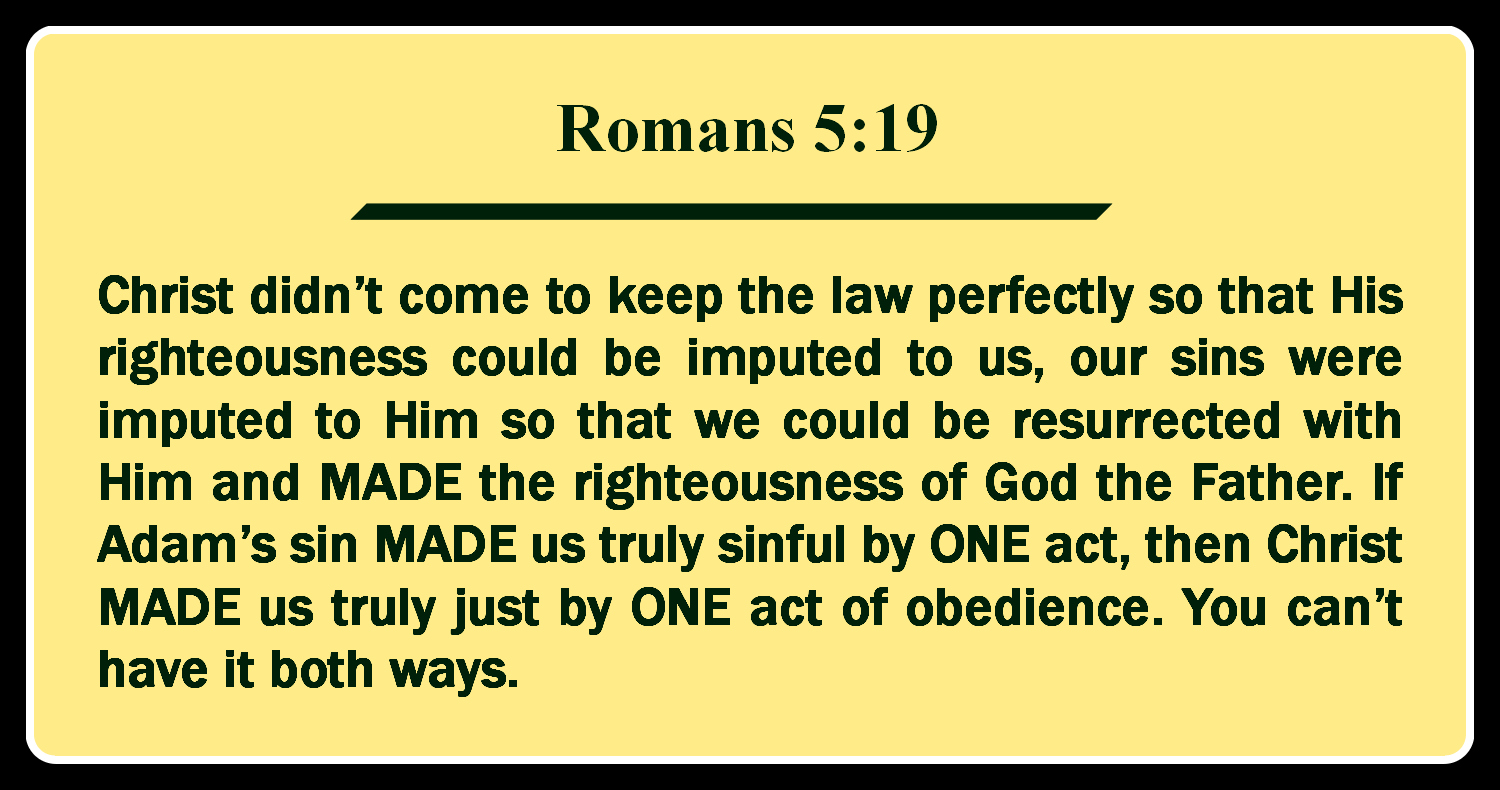
In Reformed theology, particularly authentic Calvinism, contemplation on your sin leading to a return to the same gospel that saved you imputes the perfect law-keeping of Christ to your life. Notice that a fulfillment of the law is required to keep you saved, but we do faith alone works in order that Christ’s perfect law-keeping is imputed to our account. The problem here is that a fulfillment of the so-called “righteous demands of the law” is the standard for justification. Hence, clearly, this keeps so-called “Christians” UNDER LAW. In addition, a so-called faith alone work is still a work.
Not so with under grace. We are now free to follow our new desire to obey the law out of love without fear of condemnation. The law is the standard for love, not justification. In all of the aforementioned systems of sanctified justification by works, faith doesn’t work (or love) because it can’t lest salvation be lost. In the Christian life (sanctification) faith works because it can for the sake of love without condemnation (Galatians 5:6).
Knowing that justification is a settled issue that has nothing to do with the law anyway, the true Christian only sees law-keeping as an opportunity to love. Christians not only have the anthropologic law of conscience written on the heart, the new birth writes the Bible there as well. In other words, they love the law. Obviously, those who must focus on faith alone works in order to remain justified cannot focus on aggressive obedience to the law that defines love.
This is exactly what the books of James and 1John are about. Faith is not afraid to work because there is no condemnation. Faith without works is dead, “being alone” (James 2:17 KJV).
Are you in a religious system that propagates faith “alone” in the Christian life? Your faith is not only dead, it speaks to what you believe about justification. You believe justification has a progressive aspect and is not completely finished. Secondly, you believe the law has a stake in justification. Thirdly, your system categorizes works as faith alone works (an oxymoron of sorts) or works that are unfiltered in some way and therefore are efforts to “self-justify.”
If you believe the right gospel, you know that it is impossible to unwittingly partake in an endeavor to justify yourself. It’s a metaphysical impossibility—it’s not in the realm of reality. No false religion teaches that you earn your justification by perfect law-keeping—there is always a system that prescribes sanctified do’s and don’ts that in turn fulfill the law for you, otherwise known as “the traditions of men.”
It’s the fallacy of faith alone works for justification. But any work for justification is justification by works whether doing nothing (abstinence is still doing something), something passive (contemplationism or prayer is also a work) or anything active.
Law and justification are mutually exclusive, and true faith is “faith working through love” (Galatians 5:6). Faith works because there is no fear in love (1John 4:18). Don’t be like the servant who was afraid and hid his talents in the ground. Christ said it best:
“If you love me, keep my commandments.”
paul

 Paul's Passing Thoughts
leave a comment