Calvinists: Going to Hell and Proud of It
 I hear it often, but I think this is the first time I have really parked on it and pondered; this whole thing with Calvinists being proud of the fact that they will “stand in the final judgment with no righteousness of their own.”
PPT logged a comment yesterday from “Frank” that once again proffers this idea with all of the delight of a newborn’s arrival into the world. This is why we should in no wise be surprised that an Adventist theologian rediscovered the real Protestant gospel in 1970 which is predicated on this idea.
The SDA gospel focuses on being able to “stand in the final judgment.” So, the “Christian” life focuses on that; the endeavor of sanctification is to prepare for this one final judgment. For years, the mainline SDA take followed: beginning salvation takes care of past sin, and then the new “believer” labors with the Holy Spirit to become good enough to stand in the final judgment. Some substitution by Christ to achieve perfectionism was involved, but it required the best efforts possible by “believers” in order to warrant Christ topping off the difference with His own righteousness. The doctrine, known as the “investigative judgment” is extremely complex and downright confusing, but what I have stated here is the gist:
While the investigative judgment is going forward in heaven, while the sins of penitent believers are being removed from the sanctuary, there is to be a special work of purification, of putting away of sin, among God’s people upon earth.
Those who are living upon the earth when the intercession of Christ shall cease in the sanctuary above are to stand in the sight of a holy God without a mediator. Their robes must be spotless, their characters must be purified from sin by the blood of sprinkling. Through the grace of God and their own diligent effort they must be conquerors in the battle with evil.
Ellen White ~ The Great Controversy, chapter 24.
The understandable angst among the SDA faithful peaked in the 1950’s which spawned the Progressive Adventist movement. One of the major players in that movement was an Adventist theologian named Robert Brinsmead. Due to his intellectual prowess, he was able to plow through the writings of the Reformers and understand what their take was on the final judgment. Not only that, Brinsmead was, and I assume still is, a master communicator of ideas.
The message he brought to the SDA faithful follows: one is able to stand in the final judgment if they live their Christian life by the same gospel that saved them; i.e., by faith alone. If you do that, Christ will continue to cover you with His righteousness. If you disavow any righteousness of your own, and believe in being covered by the alien righteousness of Christ as depicted in the wearing of a white robe, you will be able to stand in the judgment.
So, let’s be clear: formally, the SDA as a whole advocated a do your best to keep the law and if you do that well enough Christ will completely cleanse you and declare you righteous. Then you will be able to stand in the judgment. What is the problem with that other than its fundamental falsehood? The SDA faithful had no way of knowing until the final judgment whether or not they did that well enough to warrant Christ’s complete cleansing.
Brinsmead traded that for what the Reformers advocated: rather than partaking in the heavy burden of law keeping, if one only lives by faith alone apart from the law, Christ will stand in the judgment for us. The one who lives their Christian life by faith alone will stand in the judgment covered by the righteousness of Christ apart from any righteousness of their own.
This spawned the Awakening movement which turned the SDA completely on its head. But not only that, it also spawned a return to the authentic Reformation gospel by evangelicals worldwide who had drifted away from it through a more literal interpretation of the Bible because literal interpretation is intuitive. In other words, that’s our natural bent.
The Reformers saw the Bible as a tool for continually returning to the same gospel that saved us by faith alone in order to keep oneself covered by the righteousness of Christ, and therefore making one able to stand in the final judgment.
A literal interpretation of the Bible suggests that God’s people are to work in sanctification, or the Christian life. That’s a problem because the Reformers saw the Christian life as the progression of salvation to a final salvation determined at a one, final judgment. Therefore, biblical imperatives must be interpreted in their “gospel context,” viz, God commands us to do things in order to show us we are not able to obey perfectly. Hence, many of the Reformed in our day suggest that a literal interpretation of the Bible is tantamount to works righteousness.
Again, let’s pause for some clarification: The SDA and the Reformers BOTH saw the Christian life as part of salvation culminating in a final determinative judgment. Both define justification, the state required to be saved, as an ability to keep the law perfectly. Both believe that a means of obtaining a perfect law-keeping as something accredited to our account for standing in the final judgment is paramount. The SDA believed that best effort law-keeping resulted in Christ topping off our account at the judgment. The Reformers believed that effortless living by faith alone resulted in being covered by the righteousness of Christ alone at the judgment. For example, John Calvin believed that the Christian life is the Old Testament Sabbath rest.
Luther described the believer’s “triumphant” declaration to God at the final judgment as, we have NO righteousness but Christ’s. This motif was once again echoed by Frank on PPT.
But there is only one problem; the Bible is absolutely clear that ALL of those who will supposedly bark triumphantly at that judgment are already damned by virtue of the fact that they are standing at that judgment. That judgment is called the “second death” in Scripture; all who stand there are already damned. Yet, Calvinists constantly boast that they will stand in that judgment.
Revelation 20:4 – Then I saw thrones, and seated on them were those to whom the authority to judge was committed. Also I saw the souls of those who had been beheaded for the testimony of Jesus and for the word of God, and those who had not worshiped the beast or its image and had not received its mark on their foreheads or their hands. They came to life and reigned with Christ for a thousand years. 5 The rest of the dead did not come to life until the thousand years were ended. This is the first resurrection. 6 Blessed and holy is the one who shares in the first resurrection! Over such the second death has no power, but they will be priests of God and of Christ, and they will reign with him for a thousand years.
7 And when the thousand years are ended, Satan will be released from his prison 8 and will come out to deceive the nations that are at the four corners of the earth, Gog and Magog, to gather them for battle; their number is like the sand of the sea. 9 And they marched up over the broad plain of the earth and surrounded the camp of the saints and the beloved city, but fire came down from heaven and consumed them, 10 and the devil who had deceived them was thrown into the lake of fire and sulfur where the beast and the false prophet were, and they will be tormented day and night forever and ever.
11 Then I saw a great white throne and him who was seated on it. From his presence earth and sky fled away, and no place was found for them. 12 And I saw the dead, great and small, standing before the throne, and books were opened. Then another book was opened, which is the book of life. And the dead were judged by what was written in the books, according to what they had done. 13 And the sea gave up the dead who were in it, Death and Hades gave up the dead who were in them, and they were judged, each one of them, according to what they had done. 14 Then Death and Hades were thrown into the lake of fire. This is the second death, the lake of fire. 15 And if anyone’s name was not found written in the book of life, he was thrown into the lake of fire.
In the Bible, there are multiple resurrections and judgments. Believers, who are already deemed righteous because they are in fact righteous, will be judged for rewards, not righteousness, because they are already righteous. They are resurrected to determine rewards, not righteousness. In the passage cited here, it is obvious that these are two different resurrections and two different judgments. One judgment has multiple thrones, while the other only has one throne and one judge. The latter judgment is the second death, and those who partake in the first resurrection are blessed. And, the latter judgment is identified as the one Calvinists say they will attend because it judges righteousness, and Calvinists, generally speaking, advocate a one judgment only position. Said another way, this is the only judgment they could possibly be talking about because there is only one according to them.
Why do they advocate a one judgment only when there is obviously more than one? Well, because that matches their gospel of beginning salvation, progressive salvation, and final salvation. It also matches the idea that perfect law-keeping is the required standard for being saved. If salvation is a settled issue that takes place for each individual in a moment of time, why would there be a need to finalize salvation at any other time? Also, there is only a future need to judge righteousness if perfect law-keeping remains the standard for Christians. If perfect law-keeping is not a determinative standard for Christians, the judge at the final judgment is without a law in which to judge righteousness. The judgment is without any law to judge.
In contrast, this is the case with the true gospel: the believer is made righteous through the new birth, and the law is ended for righteousness. The new birth is a gift, but like any gift, once you receive it, it belongs to you. This whole “righteousness of our own” business is a red herring. It’s like looking at someone living and besmirching them for believing they have a life of their own because they were born. We are righteous because we have the seed of God within our very being because of the new birth (1Jn 3:9). We still sin because the flesh is weak while our righteous soul is willing. It is sin against our Father, not our righteousness because Christ ended the law for that purpose.
This happened through the new birth. We were once under the law and its power to condemn us. Because we were unregenerate, sin within us used the law to provoke us to sin. When we died with Christ, it was like the death of a spouse—we are no longer obligated to that marriage covenant (law).
Or do you not know, brothers—for I am speaking to those who know the law—that the law is binding on a person only as long as he lives? 2 For a married woman is bound by law to her husband while he lives, but if her husband dies she is released from the law of marriage. 3 Accordingly, she will be called an adulteress if she lives with another man while her husband is alive. But if her husband dies, she is free from that law, and if she marries another man she is not an adulteress.
4 Likewise, my brothers, you also have died to the law through the body of Christ, so that you may belong to another, to him who has been raised from the dead, in order that we may bear fruit for God. 5 For while we were living in the flesh, our sinful passions, aroused by the law, were at work in our members to bear fruit for death. 6 But now we are released from the law, having died to that which held us captive, so that we serve in the new way of the Spirit and not in the old way of the written code (Romans 7).
So, we now “serve” in the “new way of the Spirit.” What’s that? That’s sanctification which is the use of Scripture to love God and others (Jn 17:17, Rom 8:4, Rom 8:7, Matt 4:4, Ps 1:1-6, Ps 119). Perfect law-keeping is not the standard for being justified—there is no law in justification, we are justified apart from the law (Rom 3:21). It would be futile for real Christians to stand in a judgment where Calvinists are present, the law they will be judged by doesn’t pertain to us:
Romans 3:19 – Now we know that whatever the law says it speaks to those who are under the law, so that every mouth may be stopped, and the whole world may be held accountable to God. 20 For by works of the law no human being will be justified in his sight, since through the law comes knowledge of sin.
Romans 4:15 – For the law brings wrath, but where there is no law there is no transgression.
Calvinists say it’s alright to still be under the law because Jesus keeps the law for us if we live by faith alone, and that is the definition of being under grace: we are under grace if we live by faith alone and the perfect obedience of Christ is imputed to our account. But that’s being under law and under grace at the same time; the Bible is clear that we are either under one or the other (Rom 6:14). Calvinism advocates the idea that the unregenerate are only under law, but are under both law and grace if they are saved. Hence, this is why they cannot advocate separate judgments, but only one. If under law and under grace are separate, any judgment regarding law for the believer is an anomaly regardless of who keeps it—the question of perfect law-keeping is the reason for the judgment in the first place.
This is why in fact there is a separate resurrection for the saved: because their judgment concerns rewards, not a just standing that has already been determined. This is why Jesus called it the “resurrection of the just” because they are already just, only their rewards need to be determined:
Luke 14:12 – He said also to the man who had invited him, “When you give a dinner or a banquet, do not invite your friends or your brothers[b] or your relatives or rich neighbors, lest they also invite you in return and you be repaid. 13 But when you give a feast, invite the poor, the crippled, the lame, the blind, 14 and you will be blessed, because they cannot repay you. For you will be repaid at the resurrection of the just.”
Salvation is earned by no one—it is a gift, but rewards are earned by those who are born again. In fact, God would be unjust not to reward them for what they have earned:
Hebrews 6:10 – For God is not unjust so as to overlook your work and the love that you have shown for his name in serving the saints, as you still do.
If Calvinists are under grace and not under law, why do they need Jesus to keep the law for them? The only possible reason that they could need Jesus to keep the law for them is if they are still under law. This is why they find themselves at a one final judgment that is the “second death.” That is where they will be judged by a law that has “nothing to say” to the born again.
One can only surmise that when they triumphantly claim that they have no righteousness of their own, God will respond with something like…
“You were never born of me, and those born of me are righteous even as I am righteous. My Son died to end the law for condemnation so that you could obey the law in order to love me and your neighbors. You see me as a hard god that reaps where I have not sown, and now present to me the same gospel that I originally gave. You are a lazy wicked servant and confess that you have no love towards me or others. Now your fear of being righteous is your condemnation.”
paul
How Election Promotes the Institutional Church
 Election is scary stuff. Bottom line: before the foundation of the earth, God decided who will be saved and who will not be saved. This is even a gospel in and of itself known as the “gospel of sovereignty” or the “gospel of sovereign grace.”
Did God save me or not? In the final analysis, the Reformed admit that we can’t know for certain. You cannot put any stock in your choice to believe the gospel, because you have no choice—it’s God’s choice alone. In fact, telling people they can choose violates the gospel of sovereign grace and is deemed a false presentation of the gospel for that reason. We are to merely “show forth” the gospel and wait to see what God does or doesn’t do. We are to never tell anyone that they can do anything to be saved—that includes believing itself. Pastor John MacArthur even advocates telling people that they can only do one thing and one thing only; “ask.” Yep, ASK and hope for the best.
Some cynically ask if this is really “good news.” It could also be asked if this is a “promise” because no one really knows who the promise is to for certain.
Ah, but a Protestant institutional church near you offers a get out of election free card. They have a program initiated by John Calvin known as the “power of the keys.” Whatever an ordained Reformed elder or elders bind on earth will be bound in heaven, and whatever they loose on earth will be loosed in heaven as well. So, if the elders like you, and you are a “member in good standing,” you’re in! Or, at the very least it’s your best shot.
So, “be faithful” to your local institutional church and obey your elders—it probably means that you are in fact one of God’s elect. Calvin categorized three classes of elect: nonelected, called, and those who persevere. The “called” are those who are temporarily illumined and do not remain faithful to the institutional church. Those who persevere remain in good standing till the end.
So sign up and remain faithful my dear friend—membership has its privileges.
paul
Additional Reading: Calvinism’s Get Out of Election Free Card
Are Babies Totally Depraved? Follow the Protestant Money
 No, because man is not totally depraved. This is simple theological math. Man is not totally depraved by virtue of how God creates us. Every human being born into the world is born with the works of God written on their hearts. They are also born with a conscience that either excuses them or accuses them of wrongdoing.
Romans 2:14 – For when Gentiles, who do not have the law, by nature do what the law requires, they are a law to themselves, even though they do not have the law. 15 They show that the work of the law is written on their hearts, while their conscience also bears witness, and their conflicting thoughts accuse or even excuse them 16 on that day when, according to my gospel, God judges the secrets of men by Christ Jesus.
Those who have the law, that is, the written word of God plus the works of the law written on their hearts, are under the law’s judgment. This is why religious people will be judged more harshly than the nonreligious—they are responsible for two laws, not just one.
Christ came to die on the cross to end the law’s condemnation for those under it, or those under law, and was resurrected so that the same can find life in the law apart from any condemnation. Under grace means that we are now under the “law of the Spirit of life” (Rom 8:2). What does that mean? It means the Spirit now imparts life to us through the same law that condemned us prior to our salvation (Jn 17:17, Eph 6:1-3). The old us that was under law literally dies with Christ, and is resurrected by the Spirit as a new creature who finds life in the law (see Psalms 119).
Andy Young and I were having this discussion this morning. In the garden, there was only one law: you may eat of any tree in the garden except the one. As long as they obeyed, there was life in that law; when they disobeyed, death came into the world.
But, back to babies. Babies are not totally depraved, and in fact go to heaven because they are not yet under law; where there is no law there is no sin (Rom 5:13). Don’t confuse this with the pre-fall of man where there was only one unbroken law. Babies do NOT have a developed conscience; therefore, they cannot negotiate right and wrong as administered by conscience according to the written law or the law written on their hearts. So, babies are born under law like all people, but are not accountable to it, and therefore NOT condemned by it until they have a developed conscience that can ascertain right from wrong. I believe mentally handicapped people would fall under this category as well.
Where there is no law, there is no sin. So if babies cannot know law, they have no sin. And if they have no sin—they are going to heaven:
Roman 7:7 – What then shall we say? That the law is sin? By no means! Yet if it had not been for the law, I would not have known sin. For I would not have known what it is to covet if the law had not said, “You shall not covet.” 8 But sin, seizing an opportunity through the commandment, produced in me all kinds of covetousness. For apart from the law, sin lies dead. 9 I was once alive apart from the law, but when the commandment came, sin came alive and I died. 10 The very commandment that promised life proved to be death to me. 11 For sin, seizing an opportunity through the commandment, deceived me and through it killed me. 12 So the law is holy, and the commandment is holy and righteous and good. 13 Did that which is good, then, bring death to me? By no means! It was sin, producing death in me through what is good, in order that sin might be shown to be sin, and through the commandment might become sinful beyond measure.
Babies have no concept of law. People are accountable to the law when their consciences are developed to the point of knowing right from wrong.
Follow The Protestant Money
Early in the Protestant Reformation the subject of total depravity was a big deal. This also included the total depravity of the saints. Simply stated, the Reformers believed little different than Rome in regard to salvation via church membership. The biggest draw for the Protestant Reformation was no fault salvation through church membership. The Reformers clearly stated that new sins committed by “believers” removed them from grace, and continued forgiveness of sins through the perpetual reappropriation of Christ’s death was needed to keep oneself saved (for example: The Calvin Institutes, 3.14.9-11). This reapplication of Christ’s death was only valid when administered by the institutional church through baptism, the Lord’s Table, and the grace-infusion of preaching by ordained Reformed elders, in today’s Neo-Calvinist vernacular, “We must preach the gospel to ourselves every day.” Why? Because we need the same gospel that saved us initially to keep us saved daily because the new sins we commit remove us from grace. This would seem fairly evident.
The Reformers believed that baptism initiated church membership, and as long as the baptized remained in good standing as church members, their baptism retained its saving efficacy (Calvin Inst. 4.15.1ff). Salvation is maintained within the institutional church, so baptism doesn’t save you per se, but is necessary for church membership which keeps you saved through faithful attendance to “gospel preaching” by ordained elders and the Lord’s Table. This ministry has compiled a mass of citations by “New” Calvinists who state this in no uncertain terms.
And this is the crux of the infant baptism debate. Protestants were big on baby baptism because it made the babies church members and therefore guaranteed them salvation as long as they remained faithful to the institutional church as they grow up. This led to the birth of Baptists who became half pregnant Protestants over the baby baptism issue. Unfortunately, this boiled down to when a child was old enough to be a church member which was also synonymous with being saved among the Baptists. This closer approximation to truth created the whole never ending “Do babies go to heaven?” debate.
No, Babies are not totally depraved, and yes, they go to heaven. The Baptists only focused on the baby baptism issue without further investigating what was driving the belief to begin with; i.e., salvation by institution.
This began a long deep-seated tradition by Baptists to focus on symptoms and not causes. This is why Presbyterians and Lutherans are far less confused than Baptists—Baptists are both confused and wrong, while the Protestants and Lutherans are just merely wrong…about the gospel.
paul
Why Calvinists Need to be Saved
You can click on screen shots to enlarge, and then use back arrow to return to post.
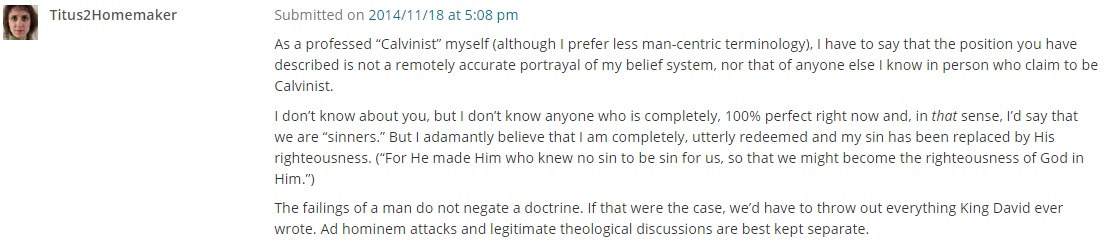
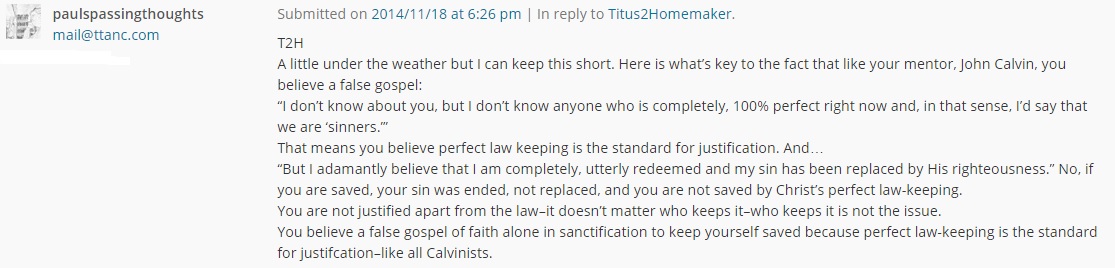
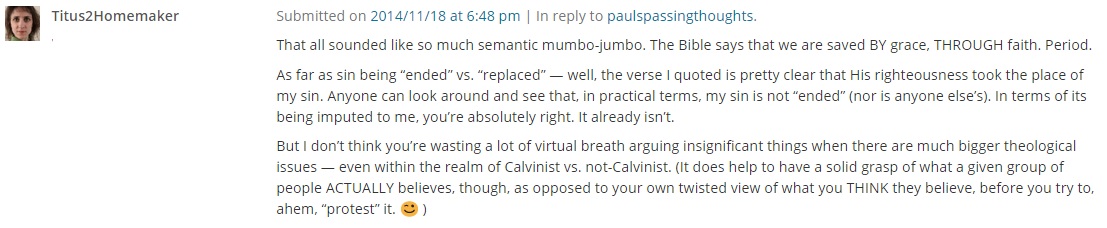







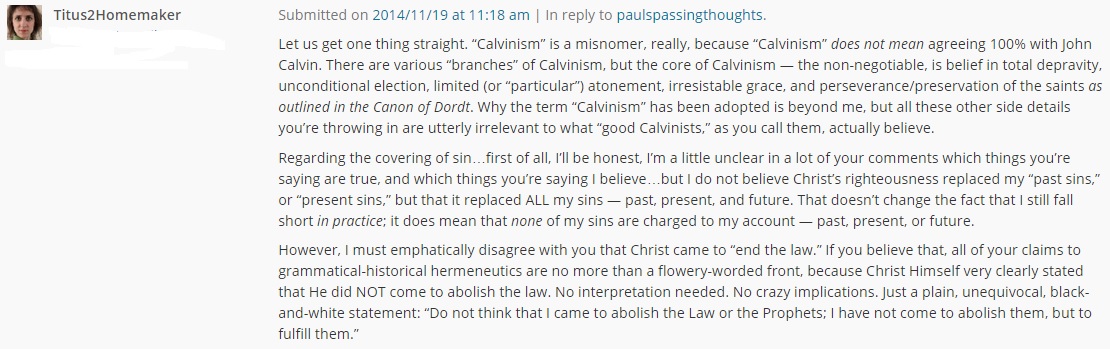

Calvinism and the Problem with Perfection
Originally published November 7, 2013
Augustine, Luther, and Calvin were first and foremost Platonists. They integrated the Bible with Platonism. Plato’s theory of forms posits the idea of two worlds; the mutable material world of illusion where reality can only be partially known, and another world where the immutable objective true forms exist. This material world is a shadow world; everything is shadows of the true forms. Therefore, man can only interpret and experience this world subjectively. The tendency is to interpret reality by observing the shadows. To the degree that mankind thinks the material world is reality according to the five senses, subjectivity and chaos will abound.
Therefore, Plato’s ethic was to improve the subjective experience of this life by accessing the true forms through ideas and mathematics—things that transcend the five senses (he believed math was an unchangeable rule and therefore not part of the shadow world). He believed that those who have the capability and willingness to bring more understanding of the objective into the subjective to be an elite minority. These were Plato’s philosopher kings whom he thought should rule society in order to decrease chaos as much as possible. Without philosopher kings, the world would be awash in a sea of subjectivity, everyone living by their own subjective presuppositions based on the shadows of this world. Hence, the arch enemy of the Platonic ideal is individualism.
Plato’s world of true objective forms was his trinity of the true, good, and beautiful. Experiencing the pure form of goodness in this world is impossible—only a shadow of good can be experienced subjectively. Plato’s social engineering has a doctrine, and to the degree that doctrine is applied, a higher quality of subjective existence occurs.
The Reformers put a slightly different twist on this construct. There is no doctrine to apply, only an orthodoxy that focuses on seeing and experiencing. Their version of Plato’s philosopher kings are pastors who possess the power of the keys. Orthodoxy is mediated truth determined by “Divines,” and passed down to the masses for the purpose of experiencing the objective power of the gospel subjectively. The Reformers made the true forms “the gospel,” and reality itself the gospel; ie., the work and personhood of Jesus Christ in particular.
Therefore, in the same way Plato envisioned a society that experiences the power of the true forms subjectively through ideas and immutable disciplines like mathematics; the Reformers sought a heightened subjective experience through a deeper and deeper knowledge of their own true, good, and beautiful—the gospel. And more specifically, instead of the gateway of understanding being reason, ideas, and immutable disciplines, they made the gospel itself the interpretive prism. So: life, history, the Bible; ie., everything, is a tool for experiencing true reality (the gospel) in a higher quality subjectivity. The Bible and all life events are a gospel hermeneutic. Salvation itself is the interpretive prism. All of reality is about redemption. Salvation itself is the universal hermeneutic.
But both constructs have this in common: pure goodness and perfection cannot exist objectively in the material world. This is where Calvinism and Platonism kiss. The Bible only agrees with this if it is a “gospel narrative.” But if it is God’s full orbed philosophical statement to all men to be interpreted grammatically and exegetically, contradictions abound. To wit, if man possesses goodness and the ability to interpret reality objectively, Platonism and its Reformed children are found wanting. If Reformation orthodoxy is not evaluated biblically with the very theses of its own orthodoxy as a hermeneutic, even more wantonness is found.
The Apostles rejected Platonism because they believed goodness and perfection could indeed be found in this material world. There is no question of the quality of goodness inside of man that enables mankind to interpret reality objectively, the quantity of goodness notwithstanding. In contrast, a dominate theme in the Calvin Institutes is the idea that no person lost or saved can perform a good work. Like Plato’s geometric hermeneutics, the Reformers believed the Law lends understanding to man’s inability to do good because eternal perfection is the standard. The best of man’s works are tainted with sin to some degree, and therefore imperfect. Even if man could perform one perfect work, one sin makes mankind a violator of the whole law. The Reformers were adamant that no person could do any good work whether saved or lost.
Why all the fuss over this point? Why was Calvin dogmatic about this idea to the point of annoyance? Because he was first and foremost a Platonist. The idea that a pure form of good could be found within mankind was metaphysical heresy. Because such contradicts every page of the Bible, the Reformers’ Platonist theology was made the hermeneutic as well. Instead of the interpretation method producing the theology, they made the theology the method of interpretation. If all of reality is redemptive, it must be interpreted the same way.
For the Platonist, the coming of Jesus Christ in the flesh poses a huge problem. He is the truth. He came to the material world in a material body. Platonism became Gnosticism and wreaked havoc on the 1st century church. Notice how the first sentences of 1John are a direct pushback against the Gnosticism of that day:
1John 1:1 – That which was from the beginning, which we have heard, which we have seen with our eyes, which we looked upon and have touched with our hands, concerning the word of life— 2 the life was made manifest, and we have seen it, and testify to it and proclaim to you the eternal life, which was with the Father and was made manifest to us— 3 that which we have seen and heard we proclaim also to you, so that you too may have fellowship with us; and indeed our fellowship is with the Father and with his Son Jesus Christ. 4 And we are writing these things so that our joy may be complete.
Christ is the true, good, and beautiful, and He was touched, felt, seen, heard, and understood. Game over. This is the paramount melding of Plato’s two worlds resulting in a plenary decimation of his philosophy. Nevertheless, Calvin et al got around that by keeping mankind in a subjective realm while making the material world a gospel hermeneutic. Reality still cannot be understood unless it is interpreted by the gospel—everything else is shadows.
Martin Luther took Plato’s two worlds and made them two stories; our own subjective story, a self “glory story” that leads to a labyrinth of subjectivism, or the “cross story” which is the objective gospel. Luther made Plato’s two worlds two stories, but still, they are two realms; one objective and one subjective. In the final analysis mankind is still incompetent, and void of any good whether saved or lost.
Whether the Reformed gospel or Platonism, the infusion of objective goodness is the heresy. Man cannot have any righteousness in and of himself, whether lost or saved. The pushback against this idea can be seen throughout the New Testament. A few examples follow:
1John 2:4 – Whoever says “I know him” but does not keep his commandments is a liar, and the truth is not in him, 5 but whoever keeps his word, in him truly the love of God is perfected.
1John 2:20 – But you have been anointed by the Holy One, and you all have knowledge.21 I write to you, not because you do not know the truth, but because you know it, and because no lie is of the truth.
1John 2:26 – I write these things to you about those who are trying to deceive you. 27 But the anointing that you received from him abides in you, and you have no need that anyone should teach you. But as his anointing teaches you about everything, and is true, and is no lie—just as it has taught you, abide in him.
1John 2:29 – If you know that he is righteous, you may be sure that everyone who practices righteousness has been born of him.
1John 3:2 – Beloved, we are God’s children now, and what we will be has not yet appeared; but we know that when he appears[a] we shall be like him, because we shall see him as he is. 3 And everyone who thus hopes in him purifies himself as he is pure. 4 Everyone who makes a practice of sinning also practices lawlessness; sin is lawlessness. 5 You know that he appeared in order to take away sins, and in him there is no sin. 6 No one who abides in him keeps on sinning; no one who keeps on sinning has either seen him or known him. 7 Little children, let no one deceive you. Whoever practices righteousness is righteous, as he is righteous.
Romans 15:14 – I myself am satisfied about you, my brothers, that you yourselves are full of goodness, filled with all knowledge and able to instruct one another.
Christians can know goodness, and perform righteousness objectively. This speaks to the quality of the righteousness when it is performed—it is perfect and acceptable to God. We are not limited to a mere subjective experience in regard to righteousness. When we are resurrected, the quantity thereafter will be 100%, but our present righteousness is acceptable to God when it is performed by us. If it is accepted by God, it is perfect.
Even the unregenerate know good, and can perform it. The works of the law are written on their hearts, and their consciences either accuse or excuse them (Romans 2:12-15). Though enslaved to unrighteousness, they are free to perform righteousness (Romans 6:20). The very goodness of God can be understood from observing creation as well (Romans 1:20).
The only way the Reformers can make all goodness outside of man is to make the Bible a salvation hermeneutic. It is the only way they could integrate the Bible with their Platonist philosophy.

 Paul's Passing Thoughts
6 comments