Calvinists: Going to Hell and Proud of It
 I hear it often, but I think this is the first time I have really parked on it and pondered; this whole thing with Calvinists being proud of the fact that they will “stand in the final judgment with no righteousness of their own.”
PPT logged a comment yesterday from “Frank” that once again proffers this idea with all of the delight of a newborn’s arrival into the world. This is why we should in no wise be surprised that an Adventist theologian rediscovered the real Protestant gospel in 1970 which is predicated on this idea.
The SDA gospel focuses on being able to “stand in the final judgment.” So, the “Christian” life focuses on that; the endeavor of sanctification is to prepare for this one final judgment. For years, the mainline SDA take followed: beginning salvation takes care of past sin, and then the new “believer” labors with the Holy Spirit to become good enough to stand in the final judgment. Some substitution by Christ to achieve perfectionism was involved, but it required the best efforts possible by “believers” in order to warrant Christ topping off the difference with His own righteousness. The doctrine, known as the “investigative judgment” is extremely complex and downright confusing, but what I have stated here is the gist:
While the investigative judgment is going forward in heaven, while the sins of penitent believers are being removed from the sanctuary, there is to be a special work of purification, of putting away of sin, among God’s people upon earth.
Those who are living upon the earth when the intercession of Christ shall cease in the sanctuary above are to stand in the sight of a holy God without a mediator. Their robes must be spotless, their characters must be purified from sin by the blood of sprinkling. Through the grace of God and their own diligent effort they must be conquerors in the battle with evil.
Ellen White ~ The Great Controversy, chapter 24.
The understandable angst among the SDA faithful peaked in the 1950’s which spawned the Progressive Adventist movement. One of the major players in that movement was an Adventist theologian named Robert Brinsmead. Due to his intellectual prowess, he was able to plow through the writings of the Reformers and understand what their take was on the final judgment. Not only that, Brinsmead was, and I assume still is, a master communicator of ideas.
The message he brought to the SDA faithful follows: one is able to stand in the final judgment if they live their Christian life by the same gospel that saved them; i.e., by faith alone. If you do that, Christ will continue to cover you with His righteousness. If you disavow any righteousness of your own, and believe in being covered by the alien righteousness of Christ as depicted in the wearing of a white robe, you will be able to stand in the judgment.
So, let’s be clear: formally, the SDA as a whole advocated a do your best to keep the law and if you do that well enough Christ will completely cleanse you and declare you righteous. Then you will be able to stand in the judgment. What is the problem with that other than its fundamental falsehood? The SDA faithful had no way of knowing until the final judgment whether or not they did that well enough to warrant Christ’s complete cleansing.
Brinsmead traded that for what the Reformers advocated: rather than partaking in the heavy burden of law keeping, if one only lives by faith alone apart from the law, Christ will stand in the judgment for us. The one who lives their Christian life by faith alone will stand in the judgment covered by the righteousness of Christ apart from any righteousness of their own.
This spawned the Awakening movement which turned the SDA completely on its head. But not only that, it also spawned a return to the authentic Reformation gospel by evangelicals worldwide who had drifted away from it through a more literal interpretation of the Bible because literal interpretation is intuitive. In other words, that’s our natural bent.
The Reformers saw the Bible as a tool for continually returning to the same gospel that saved us by faith alone in order to keep oneself covered by the righteousness of Christ, and therefore making one able to stand in the final judgment.
A literal interpretation of the Bible suggests that God’s people are to work in sanctification, or the Christian life. That’s a problem because the Reformers saw the Christian life as the progression of salvation to a final salvation determined at a one, final judgment. Therefore, biblical imperatives must be interpreted in their “gospel context,” viz, God commands us to do things in order to show us we are not able to obey perfectly. Hence, many of the Reformed in our day suggest that a literal interpretation of the Bible is tantamount to works righteousness.
Again, let’s pause for some clarification: The SDA and the Reformers BOTH saw the Christian life as part of salvation culminating in a final determinative judgment. Both define justification, the state required to be saved, as an ability to keep the law perfectly. Both believe that a means of obtaining a perfect law-keeping as something accredited to our account for standing in the final judgment is paramount. The SDA believed that best effort law-keeping resulted in Christ topping off our account at the judgment. The Reformers believed that effortless living by faith alone resulted in being covered by the righteousness of Christ alone at the judgment. For example, John Calvin believed that the Christian life is the Old Testament Sabbath rest.
Luther described the believer’s “triumphant” declaration to God at the final judgment as, we have NO righteousness but Christ’s. This motif was once again echoed by Frank on PPT.
But there is only one problem; the Bible is absolutely clear that ALL of those who will supposedly bark triumphantly at that judgment are already damned by virtue of the fact that they are standing at that judgment. That judgment is called the “second death” in Scripture; all who stand there are already damned. Yet, Calvinists constantly boast that they will stand in that judgment.
Revelation 20:4 – Then I saw thrones, and seated on them were those to whom the authority to judge was committed. Also I saw the souls of those who had been beheaded for the testimony of Jesus and for the word of God, and those who had not worshiped the beast or its image and had not received its mark on their foreheads or their hands. They came to life and reigned with Christ for a thousand years. 5 The rest of the dead did not come to life until the thousand years were ended. This is the first resurrection. 6 Blessed and holy is the one who shares in the first resurrection! Over such the second death has no power, but they will be priests of God and of Christ, and they will reign with him for a thousand years.
7 And when the thousand years are ended, Satan will be released from his prison 8 and will come out to deceive the nations that are at the four corners of the earth, Gog and Magog, to gather them for battle; their number is like the sand of the sea. 9 And they marched up over the broad plain of the earth and surrounded the camp of the saints and the beloved city, but fire came down from heaven and consumed them, 10 and the devil who had deceived them was thrown into the lake of fire and sulfur where the beast and the false prophet were, and they will be tormented day and night forever and ever.
11 Then I saw a great white throne and him who was seated on it. From his presence earth and sky fled away, and no place was found for them. 12 And I saw the dead, great and small, standing before the throne, and books were opened. Then another book was opened, which is the book of life. And the dead were judged by what was written in the books, according to what they had done. 13 And the sea gave up the dead who were in it, Death and Hades gave up the dead who were in them, and they were judged, each one of them, according to what they had done. 14 Then Death and Hades were thrown into the lake of fire. This is the second death, the lake of fire. 15 And if anyone’s name was not found written in the book of life, he was thrown into the lake of fire.
In the Bible, there are multiple resurrections and judgments. Believers, who are already deemed righteous because they are in fact righteous, will be judged for rewards, not righteousness, because they are already righteous. They are resurrected to determine rewards, not righteousness. In the passage cited here, it is obvious that these are two different resurrections and two different judgments. One judgment has multiple thrones, while the other only has one throne and one judge. The latter judgment is the second death, and those who partake in the first resurrection are blessed. And, the latter judgment is identified as the one Calvinists say they will attend because it judges righteousness, and Calvinists, generally speaking, advocate a one judgment only position. Said another way, this is the only judgment they could possibly be talking about because there is only one according to them.
Why do they advocate a one judgment only when there is obviously more than one? Well, because that matches their gospel of beginning salvation, progressive salvation, and final salvation. It also matches the idea that perfect law-keeping is the required standard for being saved. If salvation is a settled issue that takes place for each individual in a moment of time, why would there be a need to finalize salvation at any other time? Also, there is only a future need to judge righteousness if perfect law-keeping remains the standard for Christians. If perfect law-keeping is not a determinative standard for Christians, the judge at the final judgment is without a law in which to judge righteousness. The judgment is without any law to judge.
In contrast, this is the case with the true gospel: the believer is made righteous through the new birth, and the law is ended for righteousness. The new birth is a gift, but like any gift, once you receive it, it belongs to you. This whole “righteousness of our own” business is a red herring. It’s like looking at someone living and besmirching them for believing they have a life of their own because they were born. We are righteous because we have the seed of God within our very being because of the new birth (1Jn 3:9). We still sin because the flesh is weak while our righteous soul is willing. It is sin against our Father, not our righteousness because Christ ended the law for that purpose.
This happened through the new birth. We were once under the law and its power to condemn us. Because we were unregenerate, sin within us used the law to provoke us to sin. When we died with Christ, it was like the death of a spouse—we are no longer obligated to that marriage covenant (law).
Or do you not know, brothers—for I am speaking to those who know the law—that the law is binding on a person only as long as he lives? 2 For a married woman is bound by law to her husband while he lives, but if her husband dies she is released from the law of marriage. 3 Accordingly, she will be called an adulteress if she lives with another man while her husband is alive. But if her husband dies, she is free from that law, and if she marries another man she is not an adulteress.
4 Likewise, my brothers, you also have died to the law through the body of Christ, so that you may belong to another, to him who has been raised from the dead, in order that we may bear fruit for God. 5 For while we were living in the flesh, our sinful passions, aroused by the law, were at work in our members to bear fruit for death. 6 But now we are released from the law, having died to that which held us captive, so that we serve in the new way of the Spirit and not in the old way of the written code (Romans 7).
So, we now “serve” in the “new way of the Spirit.” What’s that? That’s sanctification which is the use of Scripture to love God and others (Jn 17:17, Rom 8:4, Rom 8:7, Matt 4:4, Ps 1:1-6, Ps 119). Perfect law-keeping is not the standard for being justified—there is no law in justification, we are justified apart from the law (Rom 3:21). It would be futile for real Christians to stand in a judgment where Calvinists are present, the law they will be judged by doesn’t pertain to us:
Romans 3:19 – Now we know that whatever the law says it speaks to those who are under the law, so that every mouth may be stopped, and the whole world may be held accountable to God. 20 For by works of the law no human being will be justified in his sight, since through the law comes knowledge of sin.
Romans 4:15 – For the law brings wrath, but where there is no law there is no transgression.
Calvinists say it’s alright to still be under the law because Jesus keeps the law for us if we live by faith alone, and that is the definition of being under grace: we are under grace if we live by faith alone and the perfect obedience of Christ is imputed to our account. But that’s being under law and under grace at the same time; the Bible is clear that we are either under one or the other (Rom 6:14). Calvinism advocates the idea that the unregenerate are only under law, but are under both law and grace if they are saved. Hence, this is why they cannot advocate separate judgments, but only one. If under law and under grace are separate, any judgment regarding law for the believer is an anomaly regardless of who keeps it—the question of perfect law-keeping is the reason for the judgment in the first place.
This is why in fact there is a separate resurrection for the saved: because their judgment concerns rewards, not a just standing that has already been determined. This is why Jesus called it the “resurrection of the just” because they are already just, only their rewards need to be determined:
Luke 14:12 – He said also to the man who had invited him, “When you give a dinner or a banquet, do not invite your friends or your brothers[b] or your relatives or rich neighbors, lest they also invite you in return and you be repaid. 13 But when you give a feast, invite the poor, the crippled, the lame, the blind, 14 and you will be blessed, because they cannot repay you. For you will be repaid at the resurrection of the just.”
Salvation is earned by no one—it is a gift, but rewards are earned by those who are born again. In fact, God would be unjust not to reward them for what they have earned:
Hebrews 6:10 – For God is not unjust so as to overlook your work and the love that you have shown for his name in serving the saints, as you still do.
If Calvinists are under grace and not under law, why do they need Jesus to keep the law for them? The only possible reason that they could need Jesus to keep the law for them is if they are still under law. This is why they find themselves at a one final judgment that is the “second death.” That is where they will be judged by a law that has “nothing to say” to the born again.
One can only surmise that when they triumphantly claim that they have no righteousness of their own, God will respond with something like…
“You were never born of me, and those born of me are righteous even as I am righteous. My Son died to end the law for condemnation so that you could obey the law in order to love me and your neighbors. You see me as a hard god that reaps where I have not sown, and now present to me the same gospel that I originally gave. You are a lazy wicked servant and confess that you have no love towards me or others. Now your fear of being righteous is your condemnation.”
paul
Simple Theological Math: Protestantism’s Age-Old Gospel of Death and Misery
 Originally published June 6, 2014
“When it gets right down to the nitty gritty there is NO difference between John MacArthur Jr. and Joseph Prince. The theological math equation is exactly the same.”
“And of course, there are many different takes on which sanctification by faith alone formula best keeps us justified by reoffering the perfect obedience of Christ upon the alter of the law.”
“Instead of the death of Christ ending the law of condemnation and setting us free to obey the law in order to glorify God, please God, love Christ and others, and abstain from grieving the Spirit by offering our bodies as a living sacrifice, we are told that we must instead continually reoffer the living sacrifice of Christ’s obedience instead… This takes the privilege and calling to love Christ with our obedience in sanctification and makes it part of justification. It circumvents the ability to love our Lord, and makes it works salvation.”
A friend of this ministry sent me some books that have confirmed a suspicion I have had for some time: Protestants, regardless of the stripe, have always primarily functioned by the same core doctrine of “justification by faith.” I heard Joseph Prince use the term just the other day as I walked past a flat screen here at the Potter’s House.
What is “justification by faith” specifically? This is the core doctrine/gospel that has always driven all forms of Protestantism. Even though there are obviously various and sundry applications—the core ideology that drives its function is the same. When it gets right down to the nitty gritty there is NO difference between John MacArthur Jr. and Joseph Prince. The theological math equation is exactly the same.
The least common denominator is the fact that justification is not finished. As I was walking past the aforementioned monitor, Prince also stated in regard to justification by faith… “it is finished.” Yes, Protestants say that, but that’s not how we function—we function according to what the doctrine is really about; the doctrine is really about a justification that is not finished.
When justification is not finished, souls are skittish about what they do as disciples for fear that it will mess up their salvation, and there will be mass confusion in regard to the relationship between law and gospel. The Christian life will become complicated and in need of a priestly expert to give us our best shot at “standing in the judgment.” Protestant souls will be suspicious of obedience and their motives for doing so. Unhealthy introspection and paralyzing fear in sanctification has been the hallmark of Protestantism from the beginning.
“Yes,” they say, justification is a finished work in regard to our “positional justification,” but Jesus’ work is really not finished, He must keep working to KEEP us in that position where we are covered by His righteousness. So, positional justification and practical justification are both a work of Jesus, and we are justified by faith. This is because God has declared us righteous positionally, but that isn’t true unless we are really righteous practically which begs the question:
“How can we be considered truly righteous as people?”
‘The law must be kept perfectly.’
“But we can’t keep the law perfectly.”
‘Yes, that’s why we are saved by justification by faith.’
Therefore, according to the authentic gospel of justification by faith, there are two things we must believe in order to be saved: Christ’s passive obedience, and Christ’s active obedience. Stalwarts of the Protestant faith like Gresham Machen have stated that there is “no hope” without this belief also known as “double imputation.” Christ died for our positional justification, but He also came to live a perfect life of obedience for our positional justification. There are TWO justifications: positional and practical. One is finished, but Christ continues to be an “advocate” for us to keep us justified positionally:
“So, I must believe that Christ died for my justification and lived for my sanctification?”
‘Right.’
“So, what we call sanctification is really a work by Christ that keeps us justified.”
‘Right.’
“…until our resurrection?”
‘Right, we call that final justification.’
“So, there is positional justification, practical justification, and final justification?”
‘Right.’
“So, why do they call practical justification sanctification?”
‘Because sanctification means to be set apart for holiness.’
“Oh, so sanctification describes what practical justification does—it describes the function of practical justification.”
‘That’s a good way to state it.’
“But I can’t keep the law perfectly.”
‘Right, that’s where justification by faith comes in.’
“So, justification by faith means I am justified by faith alone in what Jesus did on the cross for my positional justification, and faith alone in His perfect life of obedience for my practical justification, or what we call sanctification.”
‘You are correct.’
“So, positional justification is a finished work, but practical justification is not.”
‘Both are finished; Christ fulfilled the law by His perfect life so that it could be applied to our sanctification in order to keep us justified positionally. We are justified by Christ positionally and practically.’
This is a false gospel for several key reasons from a biblical perspective, and the reason that Protestantism, like Catholicism, has borne fruits of death over the centuries. It’s a matter of simple theological math. The Bible states explicitly that this very gospel will bear fruits of death for the following reason…
IT KEEPS US UNDER THE LAW OF SIN AND DEATH.
Clearly, the Protestant gospel focuses on one relationship to the law that never changes for the believer. That’s the first and primary element of the equation. Secondly, justification is a finished two-part work for Christ, but not us. The Reformers believed that the essence of all sin was a propensity on the part of man to believe that he/she can contribute to salvation in some way. Because the Protestant gospel demands a standard for justification that defines righteousness as a perfect keeping of the law, what people believe about practical righteousness becomes paramount. The bottom line becomes the following reality: we can’t keep the law perfectly, and if we can’t, we are not really righteous.
All and all, the issue at hand is what the Reformers believed about justification’s standard. Only recognizing ONE relationship to the law, they also made perfect law-keeping the standard for justification. This also necessitated the belief that because man falls short of perfection, even believers, that man remains fundamentally unchanged until the resurrection. Man remains under the same law that he/she was under before salvation, and that law demands perfection. And that is true, THAT one law does demand perfection, and in fact does nothing but condemn those who are under it. Therefore, justification by faith holds to the idea that Christ died to pay the penalty for our sins, and came to also fulfill all of the righteous requirements of the law of sin and death.
The fact that Protestantism keeps man under the law of sin and death is really the crux of the issue. Christ is one who has “satisfied the law” in our stead. But the law is not “satisfied” by His death only, it is also “satisfied” by His life. And if we are still under this one law, it cannot be satisfied by anything we do because we cannot keep it perfectly. Therefore, as ones still under it, we must be COVERED by the righteous obedience of Christ until final justification. Here are the elements of the equation:
One law + perfect covering – man’s contribution = final justification.
The following explanation from a Reformed publication could not explain it better:
The Holy Spirit gives the sinner faith to accept the righteousness of Jesus. Standing now before the law which says, “I demand a life of perfect conformity to the commandments,” the believing sinner cries in triumph, “Mine are Christ’s living, doing, and speaking, His suffering and dying; mine as much as if I had lived, done, spoken, and suffered, and died as He did . . . ” (Luther). The law is well pleased with Jesus’ doing and dying, which the sinner brings in the hand of faith. Justice is fully satisfied, and God can truly say: “This man has fulfilled the law. He is justified.”
We say again, Only those are justified who bring to God a life of perfect obedience to the law of God. This is what faith does—it brings to God the obedience of Jesus Christ. By faith the law is fulfilled and the sinner is justified (The Australian Forum Present Truth Journal: Law and Gospel; volume, 7 article 2, Part 2).
Contemporary Reformed theologian John Piper states it this way:
We are united to Christ in whom we are counted as perfectly righteous because of his righteousness, not ours. The demand for obedience in the Christian life is undiminished and absolute. If obedience does not emerge by faith, we have no warrant to believe we are united to Christ or justified (Matthew 6:15; John 5:28-29; Romans 8:13; Galatians 6:8-9; 2 Thessalonians 2:13;James 2:17; 1 John 2:17; 3:14). But the only hope for making progress in this radical demand for holiness and love is the hope that our righteousness before God is on another solid footing besides our own imperfect obedience as Christians. We all sense intuitively-and we are encouraged in this intuition by the demands of God-that acceptance with God requires perfect righteousness conformity to the law (Matthew5:48; Galatians 3:10; James2:10). We also know that our measures of obedience, even on our best days, fall short of this standard (John Piper: Counted Righteous in Christ; Page 123, 2002).
Though Piper often uses nuance to shade the reality of the less ambiguous prior statement, “We all sense intuitively-and we are encouraged in this intuition by the demands of God-that acceptance with God requires perfect righteousness conformity to the law… We also know that our measures of obedience, even on our best days, fall short of this standard.”
Hence, THE ONE LAW IS STILL THE STANDARD THAT MUST BE SATISFIED IN ORDER FOR US TO REMAIN JUSTIFIED POSITIONALLY.
This requires an ongoing work by us to live our Christian life via a formula that perpetually presents the righteous obedience of Christ upon the alter of the law. This keeps us justified. And of course, there are many different takes on which sanctification by faith alone formula best keeps us justified by reoffering the perfect obedience of Christ upon the alter of the law.
According to Romans 6:14, we are not under law, but under grace :
For sin will have no dominion over you, since you are not under law but under grace.
The word for “over,” kyrieuō, means to “have authority or lordship over.” However, Protestantism holds to the idea that Christians are still under the authority of this particular law which requires/required Christ to fulfill its demands. Remember what John Piper stated?
We all sense intuitively-and we are encouraged in this intuition by the demands of God-that acceptance with God requires perfect righteousness conformity to the law… We also know that our measures of obedience, even on our best days, fall short of this standard.
Clearly, Protestantism keeps us under the authority of this law. This requires a “covering” by Christ to protect us from its condemnation because we are unable to fulfill its righteous requirements. But yet, this does not subtract from the fact that we remain under its jurisdiction.
Law + fulfilment + covering = righteousness ≠ justification.
Another problem is that even if the law is fulfilled, its fulfillment cannot give life:
Galatians 3:21 – Is the law then contrary to the promises of God? Certainly not! For if a law had been given that could give life, then righteousness would indeed be by the law.
We see two things here: the law cannot give life even if it is fulfilled, “For if a law had been given that could give life,” and even if it was fulfilled, it is not the standard for justification; “then righteousness would indeed be by the law.” It doesn’t matter who fulfills it, whether it is fulfilled or not, it cannot give life and it is not the standard for justification—it can only condemn.
8:1 – There is therefore now no condemnation for those who are in Christ Jesus. 2 For the law of the Spirit of life has set you free in Christ Jesus from the law of sin and death. 3 For God has done what the law, weakened by the flesh, could not do. By sending his own Son in the likeness of sinful flesh and for sin, he condemned sin in the flesh, 4 in order that the righteous requirement of the law might be fulfilled in us, who walk not according to the flesh but according to the Spirit.
The apostle Paul drives this point home by reminding us that our father of the faith was declared righteous 430 years before the law:
Galatians 3:17 – This is what I mean: the law, which came 430 years afterward, does not annul a covenant previously ratified by God, so as to make the promise void. 18 For if the inheritance comes by the law, it no longer comes by promise; but God gave it to Abraham by a promise.
What is being missed is the two different relationships of the law: it is the law of sin and death to unbelievers, but it is the law of the Spirit of life to believers. Those UNDER GRACE are led by the law of the Spirit of life, and are not UNDER the law of sin and death. We are no longer under that law’s dominion or jurisdiction. Why would Christ need to fulfill a law that has no jurisdiction over us? Moreover, why does the righteousness of Christ need to cover us in the fulfilling of that law when those under it have died?
Romans 7:1- Or do you not know, brothers—for I am speaking to those who know the law—that the law is binding on a person only as long as he lives? 2 For a married woman is bound by law to her husband while he lives, but if her husband dies she is released from the law of marriage. 3 Accordingly, she will be called an adulteress if she lives with another man while her husband is alive. But if her husband dies, she is free from that law, and if she marries another man she is not an adulteress.
4 Likewise, my brothers, you also have died to the law through the body of Christ, so that you may belong to another, to him who has been raised from the dead, in order that we may bear fruit for God. 5 For while we were living in the flesh, our sinful passions, aroused by the law, were at work in our members to bear fruit for death. 6 But now we are released from the law, having died to that which held us captive, so that we serve in the new way of the Spirit and not in the old way of the written code.
Did not John Piper, like all of the Reformed, state that the law is still binding on us? Not if we died with Christ, and we did:
Romans 6:5 – For if we have been united with him in a death like his, we shall certainly be united with him in a resurrection like his. 6 We know that our old self was crucified with him in order that the body of sin might be brought to nothing, so that we would no longer be enslaved to sin. 7 For one who has died has been set free from sin. 8 Now if we have died with Christ, we believe that we will also live with him.
A dead person who is no longer under the jurisdiction of law does not need to be “covered” with the righteous of Christ’s perfect obedience; we don’t need a covering, in fact, Christ’s death put an END to the law:
Romans 10:4 – For Christ is the end of the law for righteousness to everyone who believes.
We don’t need a righteous covering for a law that has been ended. Our sins are not “covered,” they are ENDED:
Romans 3:19 – Now we know that whatever the law says it speaks to those who are under the law, so that every mouth may be stopped, and the whole world may be held accountable to God.
Romans 4:15 – For the law brings wrath, but where there is no law there is no transgression.
If the law has nothing to say to us, how can we be, as John Piper asserts, under its demands? Why would Christ have to fulfill the law for us when it has nothing to say to us in the first place? Christ didn’t end the law for us because He fulfilled it, he ended it by His death, and if he ended it by His death, why would He have to fulfill it?
Romans 5:8 – but God shows his love for us in that while we were still sinners, Christ died for us.
Romans 5:13 – for sin indeed was in the world before the law was given, but sin is not counted where there is no law.
Romans 10:4 – For Christ is the end of the law for righteousness to everyone who believes.
The Protestant gospel keeps people under the law, and requires a continual living sacrifice on the part of Christ to fulfill the righteousness of the law of sin and death. But that law is ended, and we are set free to follow the Spirit by obedience to the law out of a pure motive of love:
Romans 7:6 – But now we are released from the law, having died to that which held us captive, so that we serve in the new way of the Spirit and not in the old way of the written code.
We are now free to obey the law of the Spirit of life:
Romans 8:1 – There is therefore now no condemnation for those who are in Christ Jesus. 2 For the law of the Spirit of life has set you free in Christ Jesus from the law of sin and death. 3 For God has done what the law, weakened by the flesh, could not do. By sending his own Son in the likeness of sinful flesh and for sin, he condemned sin in the flesh, 4 in order that the righteous requirement of the law might be fulfilled in us, who walk not according to the flesh but according to the Spirit. 5 For those who live according to the flesh set their minds on the things of the flesh, but those who live according to the Spirit set their minds on the things of the Spirit. 6 For to set the mind on the flesh is death, but to set the mind on the Spirit is life and peace. 7 For the mind that is set on the flesh is hostile to God, for it does not submit to God’s law; indeed, it cannot. 8 Those who are in the flesh cannot please God.
Christ died to set us free from the law of sin and death so that we would be free to obey the law of the Spirit of life. It is really the same law, but this all speaks of two different relationships to the law; i.e., those who are under its condemnation, and those who are free to obey it in order to please God. In regard to these two different relationships…
Galatians 4:21 – Tell me, you who desire to be under the law, do you not listen to the law?
Instead of the death of Christ ending the law of condemnation and setting us free to obey the law in order to glorify God, please God, love Christ and others, and abstain from grieving the Spirit by offering our bodies as a living sacrifice, we are told that we must instead continually reoffer the living sacrifice of Christ’s obedience instead.
Romans 12:1 – I appeal to you therefore, brothers, by the mercies of God, to present your bodies as a living sacrifice, holy and acceptable to God, which is your spiritual worship. 2 Do not be conformed to this world, but be transformed by the renewal of your mind, that by testing you may discern what is the will of God, what is good and acceptable and perfect.
This takes the privilege and calling to love Christ with our obedience in sanctification and makes it part of justification. It circumvents the ability to love our Lord, and makes it works salvation.
But it gets worse as keeping people under the law has additional consequences. It not only replaces our obedience in sanctification with the obedience of Christ in order to keep us justified by a perpetual reoffering of Christ’s living sacrifice instead of ours which Paul said was our reasonable service to God, it even takes the death of Christ and reoffers it continually in order to keep us justified as well. Think about it; if we are still under the law of condemnation and its demands, its righteousness requirement not only requires righteous actions, but sinlessness. Therefore, if the law of sin and death is not ended, Christ not only died for our sins under the law, but He must have also died for our sins committed as Christians because we are still under the law. This requires a reapplication of Christ’s death to present sins when we repent of them. Accordingly…
Nor by remission of sins does the Lord only once for all elect and admit us into the Church, but by the same means he preserves and defends us in it. For what would it avail us to receive a pardon of which we were afterwards to have no use? That the mercy of the Lord would be vain and delusive if only granted once, all the godly can bear witness; for there is none who is not conscious, during his whole life, of many infirmities which stand in need of divine mercy. And truly it is not without cause that the Lord promises this gift specially to his own household, nor in vain that he orders the same message of reconciliation to be daily delivered to them (The Calvin Institutes: 4.1.21).
…by new sins we continually separate ourselves, as far as we can, from the grace of God… Thus it is, that all the saints have need of the daily forgiveness of sins; for this alone keeps us in the family of God (John Calvin: Commentaries on the Catholic Epistles; The Calvin Translation Society 1855. Editor: John Owen, p. 165 ¶4).
…forgiveness of sins is not a matter of a passing work or action, but comes from baptism which is of perpetual duration, until we arise from the dead (Luther’s Works: American ed.; Philadelphia: Muhlenberg Press; St. Louis: Concordia, 1955, vol. 34, p. 163).
For the forgiveness of sins is a continuing divine work, until we die. Sin does not cease. Accordingly, Christ saves us perpetually (Ibid., p.190).
Daily we sin, daily we are continually justified, just as a doctor is forced to heal sickness day by day until it is cured (Ibid., p.191).
This is a perpetual return to the same gospel that saved us. In regard to that, the Hebrew writer stated the following:
Hebrews 6:1 – Therefore let us leave the elementary doctrine of Christ and go on to maturity, not laying again a foundation of repentance from dead works and of faith toward God, 2 and of instruction about washings, the laying on of hands, the resurrection of the dead, and eternal judgment. 3 And this we will do if God permits. 4 For it is impossible, in the case of those who have once been enlightened, who have tasted the heavenly gift, and have shared in the Holy Spirit, 5 and have tasted the goodness of the word of God and the powers of the age to come, 6 and then have fallen away, to restore them again to repentance, since they are crucifying once again the Son of God to their own harm and holding him up to contempt. 7 For land that has drunk the rain that often falls on it, and produces a crop useful to those for whose sake it is cultivated, receives a blessing from God. 8 But if it bears thorns and thistles, it is worthless and near to being cursed, and its end is to be burned.
In the final analysis, being yet under the law of sin and death can only bring forth fruits for death, and by and large, that is the testimony of Protestantism. Its original gospel keeps people under the law of sin and death, and under the slavery of sin. Those under the law of the Spirit of life have the seed of God in them because they are born of God, and are not under a law that can condemn them. A perfect fulfilling of the law of sin and death is not the standard of justification. Christians are under the law of liberty (James 1:25) that frees them from that law of sin and death to walk in the Spirit.
In the same way that one act of sin violates the whole law (James 2:10), one act of love fulfills the law of the Spirit of life (Galatians 5:14). It is obedience motivated by love, but weakened by the flesh. Nevertheless, we ARE righteous practically in sanctification accordingly.
paul
For the Sake of the True Gospel STOP Saying that Christ’s Righteousness is Imputed to Us
Originally published December 3, 2013
Please stop picking up on every little jingle that sounds good and mindlessly repeating it. In Christian circles, every hour on the hour, whether on TV, radio, or a blog, we see or hear, “the imputed righteousness of Christ,” or “we have the righteousness of Christ” etc. Is this technically true? And why does it matter? The fact is, the Bible never states that the righteousness of Christ has been imputed to us, but rather states in many, many, many places that the righteousness of God the Father has been imputed to us. Is that distinction, or if you will, technicality, relevant? Yes it is; very much so.
Why the constant emphasis on the righteousness of Christ being imputed to us when the Bible emphasizes the righteousness of the Father instead? Well, this is a tradition originally promoted during the Reformation out of necessity. It is the righteousness of Christ that must be imputed to us because the Reformers taught that Christ had to keep the law perfectly during His life in order to secure our justification. Hence, righteousness had to be secured by someone fulfilling the law. So, since the righteousness had to be earned or established by Christ, it can only come from Him. If this approach creeps you out—it should.
Reformed types call this the active obedience of Christ. His death on the cross is the passive obedience of Christ. This makes Christ the primary procurer of our salvation and devalues the role of God and the Holy Spirit. God calls and declares us righteous (imputation), Christ died for our sins (the imputation of our sins to Christ), and the Holy Spirit regenerates (the new birth). Salvation is Trinitarian. If God doesn’t call and impute righteousness, no salvation. If Christ doesn’t die for our sins, no salvation. If the Holy Spirit doesn’t regenerate, no salvation.
A Trinitarian view of salvation keeps law in its proper place, a Christocentric view of salvation causes all sorts of problems with the law. It posits the idea that the law had to be fulfilled as a standard for justification—that’s a huuuuge problem.
We are justified APART from the law. This makes it possible for us to aggressively obey the law in sanctification without it affecting our justification.
Adding to the creepiness is the idea that since the law is a standard for our justification, and we can’t keep it perfectly, the perfect obedience of Christ is continually applied if we live by the same gospel that saved us. This also necessitates the death of Christ being perpetually applied to our lives as well (the Calvin Institutes 3.14.11).
When Christians speak of the imputed righteousness of Christ, they are unwittingly partaking in a distortion of the Trinity. Because the Reformers were Platonists, they believed that Christ was the true, good, and beautiful, and everything else, and everyone else, are shadows. And I do mean everyone else, including the Father and the Holy Spirit. Consider these quotes by Reformed teachers:
Christ alone means literally Christ alone, and not the believer. And for that matter, it does not even mean any other member of the Trinity!
~ Geoffrey Paxton
The pastor who makes anything or anyone other than Christ the focus of his message is actually hindering the sanctification of the flock…We don’t ‘see’ Christ literally and physically, of course (I Peter 1:8). But His glory is on full display in the Word of God, and it is every minister’s duty to make that glory known above all other subjects.
~John MacArthur Jr.
And in regard to the Holy Spirit:
But to whom are we introducing people to, Christ or to ourselves? Is the “Good News” no longer Christ’s doing and dying, but our own “Spirit-filled” life?
~Michael Horton
How Calvinism is in League with the Accuser of the Brethren
The born again Christian is no longer under law but under grace. In regard to justification, the Christian is sinless because Christ died on the cross to end the law, and where there is no law there is no sin.
So, the believer dies with Christ as one born under the slavery of sin, law, and death. The sting of death is sin, and the power of sin is the law. That is why it is the “law of sin and death” to the unbeliever. The one who is also resurrected with Christ is no longer under any condemnation whatsoever. The law now guides the believer in love, but in no way condemns.
Those whom Satan cannot keep out of the kingdom he seeks to neutralize by keeping them under condemnation. The power of sin is the law’s ability to condemn. Therefore, by a variety of means, he seeks to keep Christians under law and away from love. Not being under law enables the Christian to aggressively obey without fear of condemnation. Fear has to do with judgment and condemnation; those who fear are not mature in love.
Calvinism keeps the “Christian” under law via a particular view of double imputation. Instead of the biblical imputation being OUR sins imputed to Christ and God’s righteousness imputed to us APART from the law, Calvinism teaches that Christ lived a perfect life to fulfill the law so that His obedience to the law, in addition to Him dying for our sins, is imputed to our Christian life in order to keep us saved. This not only keeps Christians under the law, and is not justification apart from the law, but requires the “Christian” to live by faith alone in the Christian life in order for the obedience of Christ to perpetually fulfill the law for justification in order to keep us saved.
It is a satisfaction/fulfillment of the law of sin and death rather than the law of the Spirit of life.
Hence, supposedly, the Christian life must be lived by faith alone so that the law may be continually satisfied by Christ’s obedience and not ours until the final judgment. At the final judgment, if we lived by faith alone well enough, our sins are covered by Christ’s righteousness. This removes the Christian from actual acts of obedience for purposes of loving God and others, and replaces them with faith only in Christ’s loving acts that replace anything we would do lest it be works salvation. So, when Christ says, “well done faithful servant,” He is not going to be talking about anything that we really did, but what we didn’t do by faith alone.
All in all, this keeps Christians under law and condemnation. They must live in constant fear that they are not “trusting” in the works of Christ well enough for the law to be satisfied; or, in Calvin’s words, resting enough. In this construct, sin is empowered because the law’s ability to condemn is still operational. To the contrary, Christ died to end the law (Rom 10:5) for justification, and we are quickened by the Holy Spirit so that the law might be fulfilled by us in our loving acts towards God and others:
Romans 8:1 – There is therefore now no condemnation for those who are in Christ Jesus. 2 For the law of the Spirit of life has set you free in Christ Jesus from the law of sin and death. 3 For God has done what the law, weakened by the flesh, could not do. By sending his own Son in the likeness of sinful flesh and for sin, he condemned sin in the flesh, 4 in order that the righteous requirement of the law might be fulfilled in us, who walk not according to the flesh but according to the Spirit. 5 For those who live according to the flesh set their minds on the things of the flesh, but those who live according to the Spirit set their minds on the things of the Spirit. 6 For to set the mind on the flesh is death, but to set the mind on the Spirit is life and peace. 7 For the mind that is set on the flesh is hostile to God, for it does not submit to God’s law; indeed, it cannot. 8 Those who are in the flesh cannot please God.
Calvinism keeps Christians under the law of sin and death via its double imputation view of law. By faith alone in the obedience of Christ while in the flesh, the law is actually doing something that Scripture clearly says it can’t do: give life in justification. It doesn’t matter who keeps it; there is not a law that can give life for justification (Gal 3:21).
Listen: Christ came to set us free from the law of sin and death, not to fulfill it for us so that His obedience can replace our loving acts in sanctification. He came to end the law of sin and death, not fulfill it. Our sin is not covered, it is ended. Because it is ended, we are free to serve the law of the Spirit of life without fear of condemnation. We fulfill the law of liberty and are blessed in the doing of it (James 1:25), and are not under the condemnation of the law of sin and death. The fulfillment of that law cannot bring forth life—only condemnation.
In the Calvinist double imputation approach, we continually seek to see our own condemnation in order to achieve a deeper and deeper gratitude for our original salvation. If we do so, the law of sin and death continues to be satisfied by Christ’s obedience to it and we remain justified by the blood. Instead of there being no condemnation in the Christian life, we are exhorted by the Calvinists to seek a deeper and deeper understanding of our condemnation to make the cross bigger (deeper gratitude for our original salvation).
This is a satanic objective dressed up in Christian garb. We are helping the accuser of the brethren by continually seeking to accuse ourselves. Instead of seeking to love through obedience, we are told to partake in “deep repentance,” “repentance from good works,” and “revealing the sin under the sin.” They tell us that the Christian life is a sin onion, and that the gospel is made bigger by continually peeling back the layers of sin.
There is NO sin onion. The law is ended, and there is no onion to peel. Sinning as God’s children and the grieving of the Holy Spirit is another issue that has nothing to do with justification. Well, sort of.
Obviously, Calvinism also seeks to grieve the Holy Spirit through us by empowering sin in our lives because sin is empowered by condemnation. And it also denies the primary reason Christ went to the cross…
…to end the law of sin and death, and to set us free to love Him through obedience to the law of the Spirit of life.
paul
A Doctrinal Evaluation of the Anti-Lordship Salvation Movement: Part 2
Originally published August 14, 2014
The root of all controversy: the golden chain of salvation.
Before we start part 2, we have a little unfinished business from part 1. The astute observer will ask, “If Jay Adams had the right idea about sanctification while misunderstanding what Calvin really believed, what of his biblical counseling movement that moved from mere generalities to the finer points of Christian living?” Answer: it WAS a revival…probably the only real revival the church has seen since the previous focus on practical application of the Scriptures versus redemptive focus/meditation. And when was that? I have no idea.
You remember my mention of the John “Jack” Miller disciple David Powlison. He started a contra biblical counseling movement against the Jay Adams movement. This is often referred to as first generation biblical counseling versus second generation biblical counseling. The second generation effectively wiped out the first. The crux of that civil war is relevant to this study. One model sees salvation and sanctification as separate. Salvation is completely vertical, but sanctification is mostly horizontal. Jay Adams argued in his aforementioned book against Sonship theology that the source of power in the Christian life is not salvation, but regeneration. In other words, justification is a finished work and a static declaration while the Christian life flows from the “quickening” of the new birth. We don’t return to the cross for power in the Christian life, we learn and obey the Spirit’s instrument for changing us, the law of the Spirit of life. What Adams didn’t realize is that this whole idea of life coming from a perpetual revisitation of our justification is in fact authentic Reformed dogma (see the Calvin Institutes 3.14.9-11).
Every Christian controversy from the Reformation till the present finds its roots in the golden chain. Reformed pastors wax eloquent in regard to who builds the links in the chain between justification and glorification: it’s either us, or the Holy Spirit using “what Jesus has done, not anything we do.”
From the latter 40’s to 1970, the first gospel wave (Billy Graham et al) ruled the Christian scene via EB. Cogous pushed back with a vengeance from 1970 till the present with the second gospel wave. The first wave saw a commitment to obedience as synonymous with keeping yourself saved because of the golden chain idea. To say that they overemphasized the gospel would be a gargantuan understatement. Obviously, they saw a commitment to obedience as transposed upon the Christian life. The second gospel wave demanded a commitment, and recognition of Christ as Lord, but also demanded a life of faith alone to keep the law satisfied with Christ’s perfect obedience. Again, the ALS camp misunderstands the Reformed on this point. Both camps hold to sanctification by faith alone. This is the very idea that James rudely pushed back against in his epistle.
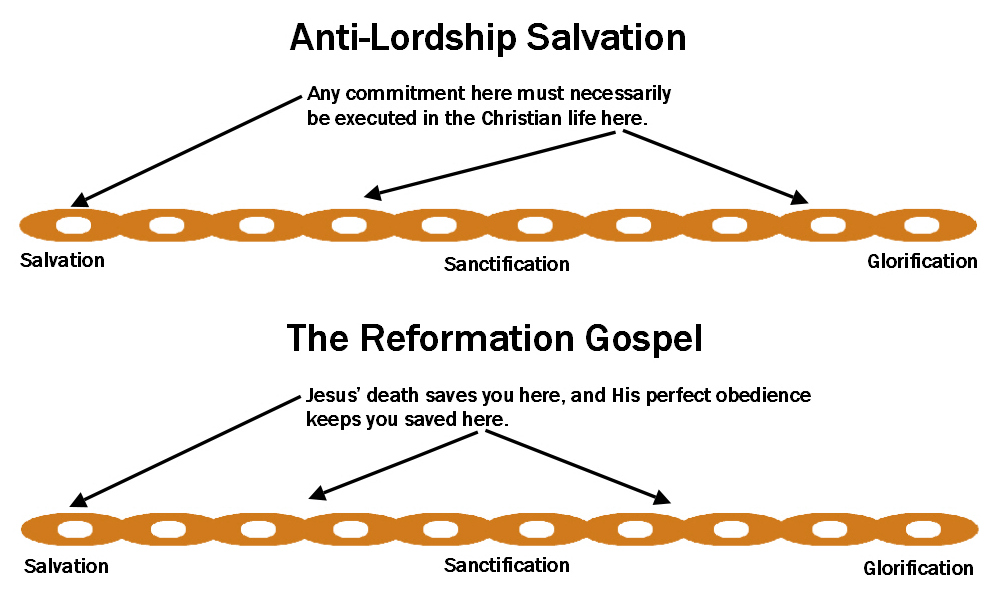
The issue made simple: Romans 8:30.
In Romans 8:30 we read the following:
And those whom he predestined he also called, and those whom he called he also justified, and those whom he justified he also glorified.
Notice that sanctification is missing from this verse even though the context spans the beginning of our salvation to our resurrection. This is the distinction between all golden chain gospels and the real gospel, the kingdom gospel. Jesus came preaching the “gospel of the kingdom.” Hereafter, KG. The golden chain gospel says that sanctification is missing from this verse because justification and sanctification are the same thing. The KG says that sanctification is missing from this verse because justification and sanctification are mutually exclusive. The context is assurance of salvation (see verses 31ff.).
Curiously, the golden chain gospel which includes both ALS and LS/Calvinism, teaches us to remind ourselves of God’s grace alone regardless of anything we do. If our behavior brings doubt, this is evidence of a fundamental misunderstanding of God’s grace and we should therefore remind ourselves of such. ALS says that concern over behavior suggests that you believe behavior finishes justification and not grace alone. With the KG, that consideration is not even on the radar screen because justification and sanctification are completely separate; finishing a finished work is impossible. You can’t have that mentality if you understand it to be an impossible reality. I might also add that simply returning to the same gospel that saved us to cure a troubled conscience instead of changing behavior sears the consequence over time. This is ill advised.
In other words, the KG says it is impossible to unwittingly attempt to please God to gain justification because that work is finished. One is free to aggressively obey God without any fear that they are unwittingly attempting to earn their justification. ALS and LS/Calvinism do not have this convenience because justification is both finished and not finished. The Reformed, already, but not yet construct that relates to predestination cannot be discussed here for lack of room and fear of confusion, but suffice to say for this study that the convenience is not there for either ALS or LS because justification is not finished. You must continue to remind yourself of free grace because you are in a continuum where unwitting works salvation can take place, and the only solution is to disavow good behavior as an evidence of conversion. Obedience must be completely optional. This used to be criticized as “Let go and let God” theology. According to the KG, such a continuum is impossible and not reality.
Consider some dialogue I have had recently with ALS proponents:
Paul, While you ponder my answer, I’d like to ask you, if you’d identify what you believe you must do, before, during and after, in order to be given eternal life. Thank you, In Him, Holly
“Before, during, and after”? to… “be given eternal life.”? The implied answer is: nothing in justification; nothing in sanctification; and nothing in glorification. But again “during” shouldn’t even be deemed possible.
LS in Cogous form already states that perpetual double imputation is needed, so bad behavior is actually a good thing because it “shows forth the gospel.” In contrast, advocates of the KG are concerned with evidence of the new birth, not the overcoming of a propensity to misunderstand the grace of God because all doing in the Christian life is attached to justification somehow. Advocates of the KG understand that nothing they do in the Christian life has anything at all to do with justification. Much assurance comes from that. However, lazy discipleship forfeits assurance because it violates the conscience, and judgment begins in the household of God regarding consequences for bad behavior in this life. The fear generated from that can get confused with fear of eternal judgment.
But don’t miss my main point here: the solution for a lack of assurance in both ALS and LS are the same: preach the gospel to yourself. Remind yourself that works done by us are completely irrelevant to our salvation which also includes sanctification (the Christian life). Both camps woefully devalue the new birth and its expectations. In effect, we have no righteousness and obedience is not really performed by us, but performed by the Holy Spirit if we are “abiding” in Christ. This is a passive sanctification of our works in sanctification in order to categorize them as living by faith alone. ANY work we do is accredited to the justification process, so it must be sanctified by the right process. In the final analysis, Christians must only EXPERIENCE an obedience imputed to us by Christ. Citations by the Reformed abound, and I can cite one from the aforementioned conversation with advocates of ALS:
We can have righteousness of our own, that is self-righteousness. I didn’t notice, did you answer any of the questions? Do you sin? How much? Or not? Are you sinless?
Park on the fact that both camps assert that the Christian has no righteousness. To have any righteousness is a “righteousness of our own.” It’s either ALL us or ALL Christ. Therefore, we can only EXPERIENCE righteousness imputed to us, but it really isn’t us performing it; hence, in relationship to the same conversation:
This passage has nothing to do with becoming saved or providing evidence through our works that we are saved. The passage is about living experientially in a manner that is consistent with our position on [sic] Christ.
Notice that the Christian lives “experientially” according to “our position [i]n Christ.” In other words, Christians only experience their position, they don’t actually perform obedience themselves. In addition, when talking to either camp, one is challenged with the question, “Did you sin today?” And in both cases, when you qualify the question with, “In justification or sanctification?”…without exception they are thrown for a loop. Why? Because they see sin in justification as no different than sin in sanctification—that’s why they ask the question in the first place. If you believe the Christian is personally righteous as well as positionally righteous, you are immediately challenged by both camps with, “Did you sin today?” Why? Because the same assumption is that righteousness and sin are mutually exclusive. For the world, this is true, but not for Christians.
Another fact of the Reformation gospel is “righteousness” is defined as a perfect keeping of the law. To remove the law’s perfect standard, and its demands for perfection from justification is the very definition of antinomianism according to the Reformers. A perfect law keeping must be maintained for each believer if they are to remain justification.
If you remember, this is a direct quote from part one. ALS and LS/Calvinism both define righteousness by perfect law keeping. Again, why the air of profundity in the terse rhetorical question designed to end the argument on the spot by coup de grace? The very essence of the question reveals a profound misunderstanding of law and grace.
Let’s get a little more full circle now with part one. Because the Christian, according to both camps, cannot be righteous if he/she sins even once (“Do you sin? How much? Or not? Are you sinless?”), the good old Reformed mainstay of double imputation is needed for both of these applications of the same golden chain gospel. From part one:
Thirdly, this requires what is known as double imputation. Christ not only died for our sins so that our sins could be imputed to Him, He lived a life of perfect obedience to the law so that His obedience could be imputed to our sanctification.
The windsock of double imputation is the idea that the righteousness of Christ is imputed to our sanctification. He died for our justification, and His perfect obedience to the law was imputed to our sanctification to keep justification rolling forward:
Model A asserts that since we cannot keep the law perfectly, we must invoke the double imputation of Christ by faith alone in order to be saved and stay saved (part 1).
Now let’s look again at the same recent conversation with ALS proponents:
Thanks Mark, I agree. We are qualified as saints, because of Christ’s righteousness imputed to us, but we still sin,..
Therefore, we only “qualify” as saints because we still sin, in order to keep our sainthood the righteousness of Christ must be imputed to us daily. Yes, that would be daily salvation. In the quote immediately prior, “Holly” was responding to this statement:
Hope you don’t mind me adding a thought, I think Paul is saying we were sinners but we are now saints (forgive me if I am wrong), it is true of course that we are saints but I believe it is also still true that we are sinners saved by grace because the Apostle Paul said, “Christ Jesus came into the world to save sinners; of whom I am chief”, present tense.
So, if Christians are still sinners, because we sin, and Christ came to save sinners, it would only make since that our need for salvation is still ongoing. Direct citations that agree with that point by John Calvin and Martin Luther is abundant low hanging fruit, but granted, such statements from the ALS camp are somewhat surprising. To further the point, I might add that “Holly” referred me to a message taught by a notable figure in the ALS movement who interpreted Romans 7:24 as a daily salvation. This is a very common rendering of that verse by the Reformed as well. The verse obviously refers to the redemption of the body and not a daily salvation.
Both are guilty of the same thing: a false double imputation construct must be applied to the Christian life by faith alone and the subjective experience thereof is optional. Like ALS—like Calvinism.
What is wrong with this gospel?
The golden chain gospel misrepresents the Trinity. The Father is removed from His role in salvation because it is His righteousness imputed to the believer before the foundation of the world. According to Romans 8:30, this guarantees glorification. The Holy Spirit is also misrepresented in regard to His role in salvation. His setting us apart before the foundation of the world is confused with His work in regeneration. Christ’s role is redefined beyond His death for our sins as a onetime act that ended sin. This is not a covering—it’s an ending. Even though the Reformed and ALS both concur that Christ died once, His death is perpetually reapplied to sins we commit as Christians when there is no such need. Neither is there a need to impute Christ’s righteousness to us perpetually. At the Bema event, it will not be God the Father looking at us and only seeing Jesus, it will be Jesus Himself judging His righteous followers. He will not be judging His own righteousness. The golden chain gospel is an egregious distortion of the Trinity.
True double imputation is our sins being imputed to Christ, and the Father’s righteousness imputed to us apart from the law. Christ came to end the law. It is because of this, and the new birth, that we are truly righteous in and of ourselves, but of course not apart from God’s power and plan of salvation. We have God’s seed in us, are no longer under any law that can judge us, and are able to please God with our lives. We are new creatures who are sinless according to justification because even if the old us that died with Christ was exhumed and brought into court, there would be no law to condemn us.
This gospel not only distorts the Trinity, rejects the new birth, and distorts double imputation, it misrepresents sonship. The sins we commit as a family member are considered to be sin against justification: “Did you sin today?” Again, if you ask them, “Sin in justification or sanctification?” all you will here is crickets, or the babblings of confused narcissists.
The golden chain gospel also strips the Christian of ability to love Christ and others by keeping Christians under the law of sin and death that Christ came to end. Said gospel makes that law the standard for righteousness. However, there is no law standard in justification, it is APART from any law—it is God’s righteousness imputed to us. Those under grace serve the law of the Spirit of life which is fulfilled by loving Christ and others:
“If you love me, keep my commandments.”
It is impossible to love Christ by keeping the law of sin and death. Besides, that law is ended when we believe. All of our sins committed before faith were against that law and in essence imputed to it. Before we were saved, we were enslaved to that law and it provoked us to sin. Consider two spouses: we were the spouse that was under the law of sin and death until we died with Christ, now we are free to serve another. Sins we now commit are against family relationship, not sins that fall short of the law of sin and death.
Said gospel prevents us from making a commitment to God’s kingdom because the commitment would have to be executed perfectly in kingdom living to maintain our citizenship. Said gospel demands that we only recognize Christ in a one-way relation while ignoring His kingdom, its law, and the king. Yea, we can only accept Him as savior in a one-way relationship. This assumes that a decision to flee the present kingdom of darkness for the kingdom of light cannot be a commitment totally separate from the kingdom citizenship. If we make a commitment, the commitment must be executed perfectly in order to remain a citizen. No, the commitment is totally separate from our citizenship in the same way justification is totally separate from sanctification.
I realize that only repentance was emphasized to the Jews, but they were already saturated with the concept of God’s kingdom. From the beginning, Abraham looked for a city built by God. As we see Gentiles coming into the church, they must be brought up to speed on their new Jewishness. We should read the Bible with this in mind and the way it affected the presentation of the gospel, and the very definition of the word “gospel” itself.
The golden chain gospel rejects the new birth by ignoring the difference in slavery between two different laws: the law of sin and death that will condemn the world, and the law of the kingdom; the law of the Spirit of life. It makes the law of the Spirit of life a fulfilment of the law of sin and death that is in fact ended. In essence we remain enslaved to a law of condemnation as “sinners.” This is a rejection of the new birth.
It also adds another seed to the covenant of promise. If the law of sin and death could impart life, it would be a second seed from which life would come to the world. It doesn’t matter who obeys it, it cannot impart life.
The golden chain gospel distorts the Trinity, distorts double imputation, misrepresents sonship, strips the Christian of ability to love Christ and others, rejects a biblical definition of the new birth, keeps Christians under the law of sin and death, distorts the atonement, perpetually reapplies the death of Christ to salvation, replaces the righteousness of God with a law standard, propagates a one-way relationship with God, makes sin as a kingdom citizen the same as condemning sin, enslaves us as a spouse still under the law of sin and death, calls for us to accept Christ as savior in a one-way relationship while ignoring His Lordship.
Do Christians have two natures? This will be examined in part 3.
paul

 Paul's Passing Thoughts
6 comments