The Protestant Twisting of 1John: A Clarification, Part 1
Listen to audio or download audio file.
Welcome to Blogtalk Radio False Reformation this is your host Paul M. Dohse Sr. Tonight, we are going to attack and unravel interpretive abuses of 1John, particularly 1John 1:9 and 2:1. There is only one other text twisted for ill use more than these two verses, and that would be Galatians 2:20 and 3:1-3. Later, In part 2, I will toss in an exegesis of those verses as a bonus.
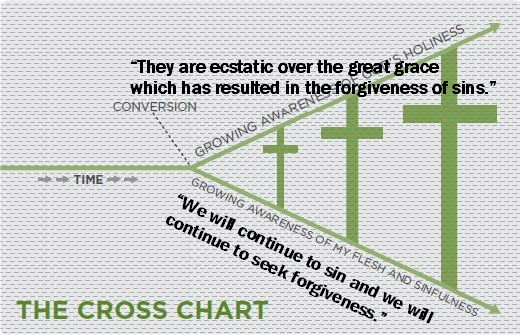
There may be a lot of different religions and even more denominations, but for all practical purposes they all have one thing in common: this whole idea that salvation is a process with a beginning and an end. This makes salvation a process that includes our present life.
So, the argumentation between religions and denominations involves the correct way of getting from point A to point B. But there is no point A and point B. When you believe God unto salvation, you get the complete package and the salvation part of your life is finished. It is an instantaneous quickening of the Spirit that transports you from one kingdom to another, from one master to another, from being under law to being under grace, from the old person to the new person, and from darkness to light. You don’t become a servant of righteousness on the installment plan, and you don’t become a kingdom citizen on an installment plan.
How is 1John used to argue for a progressive salvation, and what is John really saying in his epistle? That’s what we are discussing tonight. If you would like to add to our lesson or ask a question, call (347) 855-8317. We will check in with Susan towards the end of the show and listen to her perspective. If you would like to comment on our subject tonight, you can also email me at paul@ttanc.com. That’s Tom, Tony, Alice, Nancy, cat, paul@ttanc.com. I have my email monitor right here and can add your thoughts to the show.
Way back at the beginning of this ministry, I had this nailed down. If salvation is a process, and eternal life as opposed to eternal punishment is at stake, the Christian life is really a minefield. The focus isn’t being the best kingdom citizen; the focus is making sure you don’t mess up your salvation. The focus is salvation, not discipleship. The focus is fear of judgement, not love.
I realize many Christians hold to OSAS, once saved always saved, but the problem is how they are led by pastors trained in seminaries deeply grounded in Protestant tradition. That tradition looks to the institutional church as the primary way of getting God’s people from point A to point B in regard to their salvation. Whether OSAS or not, they are led to do the same things week in and week out. Be here at this time or that time; stand up; sing; sit down; listen to announcements; stand up; sing; sit down; listen to the special music presentation; put your tithe in the plate; listen to the sermon (always about the gospel just in case there are lost people present, wink, wink); stand up; sing “Just As I Am” until someone walks the isle so you can stop singing “Just As I Am”; pray; be dismissed; be cordial to people and tell them how much you love them; go home, and come back next week and do it again.
Why? Because all of that ritualism “imparts grace” and enables us to “grow in grace.” It enables us to “grow up in our salvation.” After all, discipleship is the “growing part of our salvation.” We have all said it, but salvation doesn’t grow. While believing in OSAS, most parishioners are led by pastors who believe in progressive salvation/justification which was clearly the foundational premise of Protestantism with the progression being overseen by the Protestant institutional church.
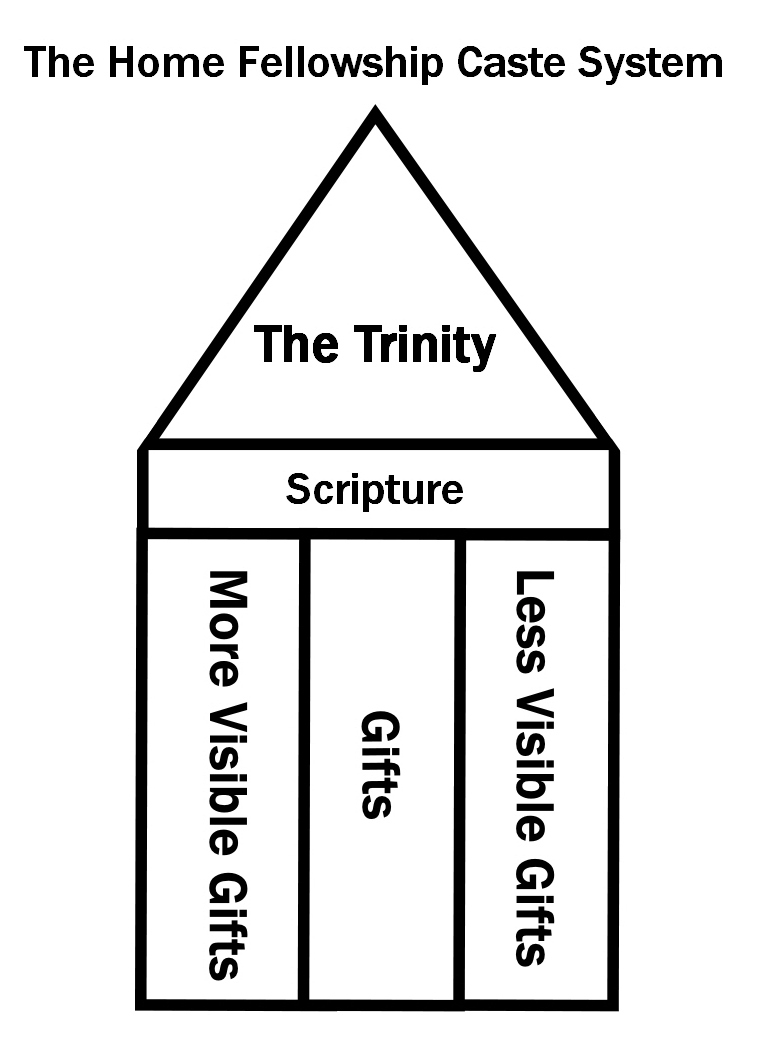
Moreover, let’s face it; while believing in OSAS, there is only one reason people put up with all of the nonsense and drama of the institutional church—OSAS means that if someone leaves the institutional church, they were never saved to begin with. Right? In other words, they function according to the idea that they are led by. It’s OSAS as long as you are “faithful” to the institution. Then each church has its own little “faithfulness” caste system. Those who show up for all of the services are the “core members” that run the church. Those “less faithful” that only come on Sunday mornings are a lower class of member in the caste system.
You have the pastors, staff and deacons, then the “faithful” that attend all of the services and tithe at least 10%, the “casual” attenders that tithe, and then the bottom of the caste strata, even lower than the serfs, the putrid “nonmembers.”
Whether Calvin or Luther, the two icons of Protestantism, these beliefs follow after the doctrine they established for the Protestant institutional church. Access to the institutional church was through water baptism, and the critical need according to the Reformers for formal church membership follows: as Christians, forgiveness for present and future sins can only be found in the institutional church, and those sins condemn us. Forgiveness for all sins does not occur at salvation, but only for past sins. Water baptism initiates us into church membership where forgiveness for present and future sins can be obtained through the sacraments; ie., “gospel preaching,” the Lord’s Table, and anything else deemed as acts of faithfulness to the institutional church not to exclude tithing by any means. Calvin states this explicitly in his institutes, 4.15.1.
All in all, you can say that in Protestantism, the status of sin does not change for the believer—it still condemns requiring perpetual resalvation for every sin committed.
Therefore, 1John 1:9 and 2:1 is interpreted in this light: “If we confess our sins, he is faithful and just to forgive us our sins and to cleanse us from all unrighteousness” (1:9). “My little children, I am writing these things to you so that you may not sin. But if anyone does sin, we have an advocate with the Father, Jesus Christ the righteous” (2:1).
These verses seem to bolster the authentic Protestant position on justification. Confession of sin in our Christian lives keeps us saved. And if we confess our sins, Jesus is up in heaven as our advocate with the Father continuing His work as a propitiation for our sins.
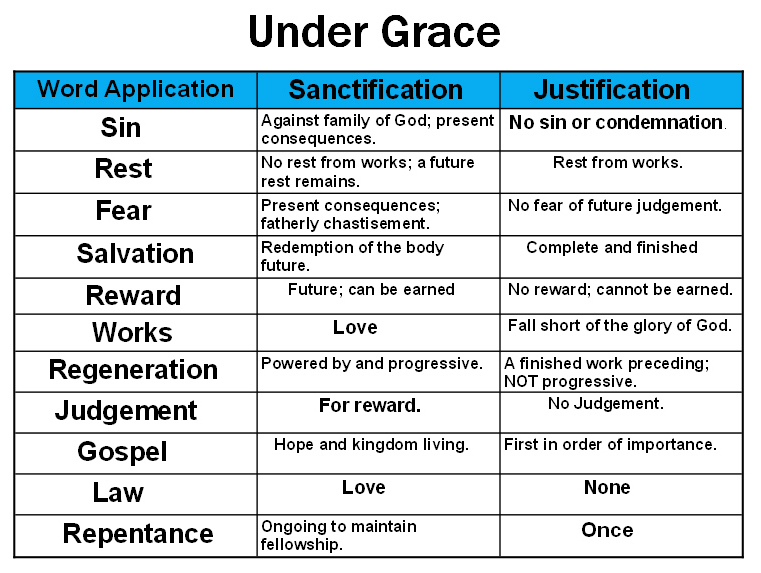
The problem is that this interpretation stands in stark contrast to what other Scriptures state about justification. Biblically, sin has a different classification after salvation—it can’t condemn; it can bring chastisement and present consequences, but it can’t condemn—its ability to condemn has been taken away. Hence, there is no need to have some institution that prevents future condemnation.
Nevertheless, it is easy to understand why the institutional church not only gets a pass on outrageous behavior, but the money keeps pouring in. What will people pay for their salvation and décor that glorifies the institution that saves them? Apparently, no price or compromise is too large. One can also appreciate the fear of so-called excommunication because the institutional church is the only place where one can receive continued forgiveness for present and future sins.
Before I move on, I will solidify my present point. Romans 8:1 states that there is presently NO condemnation for those who are in Christ. In Contrast, Calvin stated that “even saints cannot perform one work which, if judged on its own merits, is not deserving of condemnation” (CI 3.14.9, last sentence). Obviously, the focus is going to be avoiding condemnation, not our freedom to pursue aggressive love in discipleship.
So what are these verses in 1John really saying? Let’s begin to unpack that using the historical grammatical approach to interpretation as opposed to the traditional Protestant means of interpretation, the historical redemptive method. Since Protestantism sees salvation as a process, “redemptive” means that the Bible must be approached with a redemptive prism; ie., the Bible is about salvation. Clearly, this is eisegesis; going to the Bible with a presupposition.
In regard to the history part, this is the belief that history is an unfolding drama about salvation. Hence, all of reality is interpreted through salvation. All of history and the Bible continually reveals the one two-fold redemptive truth/reality: the sinfulness of man and the holiness of God. Salvation begins when we see or understand this reality, and the experience of that reality increases until final salvation.
In contrast, the historical grammatical method uses historical facts to bring more meaning to the text, and all truth is determined by what can be concluded by the grammar—this is known as exegesis. All meaning and truth comes out of the text without anything being read into the text except conclusions from other texts.
In fact, Protestant tradition holds to the idea that a historical grammatical approach to the Scriptures invariably leads to works salvation. Protestant tradition insists that the Scriptures must be interpreted through the prism of total depravity. In this year’s TANC conference, this is what I am going to be hitting on. Christians, save a few, have no idea that Protestant pastors that are leading them view reality in a totally different way than most parishioners. And this is why church looks like it does. And there is no salvaging it—it’s a completely broken system.
So, if you interpret said verses in 1John redemptively, it fits right into their narrative, right? You have to continue to repent for new sins in your Christian life in order to not be condemned and to keep your salvation. A good old fashioned Baptist lady who I am sure would hold OSAS stated this to my wife Susan in the grocery store a couple weeks ago. When Susan asked her why Christians need to go forward during alter calls, she answered, “they have sin that needs to be forgiven.” Well, why can’t they get that forgiveness by praying at home? You ought to see the reaction Susan and I get when we suggest her mother was saved even though not a member of a church.
Protestantism and all of its offshoots including the Baptists is nothing more or less than functioning Calvinism. Election isn’t the point, progressive salvation is the point. Protestants think salvation grows—salvation doesn’t grow—you are either forgiven once and for all time or you aren’t. Look, if you are going to stay in the institutional church, it makes absolutely no difference where you go. Please, stop driving 15 miles to the Baptist church when there is a Catholic Church right across the street—it’s a shameful waste of gas. It’s all progressive justification.
In contrast, we have to see 1John in its exegetical historical context. It must be interpreted according to what was going on during the time that prompted this letter. And what was that?
John was pushing back against the number-one nemesis of the assemblies during that time: Gnosticism. Now, there were many, many different veins of Gnosticism during that time, but like denominationalism, there are basics that are fundamentally the same. Denominationalism quibbles about how to get from point A to point B, but it is all progressive salvation.
When you understand the basics of Gnosticism, it is easy to see that John’s first epistle is a point by point rebuttal of Gnosticism, and NOT the proffering of progressive justification. Protestants can bicker with Catholics all they want to about how to get from point A to point B, but again, it’s all progressive justification. If it’s a religious institution, it’s selling final salvation, PERIOD.
If we follow John’s arguments in this epistle, it also apes the fundamental basics of Gnosticism, and that’s what we are going to do:
1John 1:1 – That which was from the beginning, which we have heard, which we have seen with our eyes, which we have looked upon, and our hands have handled, of the Word of life; 2 (For the life was manifested, and we have seen it, and bear witness, and shew unto you that eternal life, which was with the Father, and was manifested unto us;) 3 That which we have seen and heard declare we unto you, that ye also may have fellowship with us: and truly our fellowship is with the Father, and with his Son Jesus Christ. 4 And these things write we unto you, that your joy may be full. [KJV].
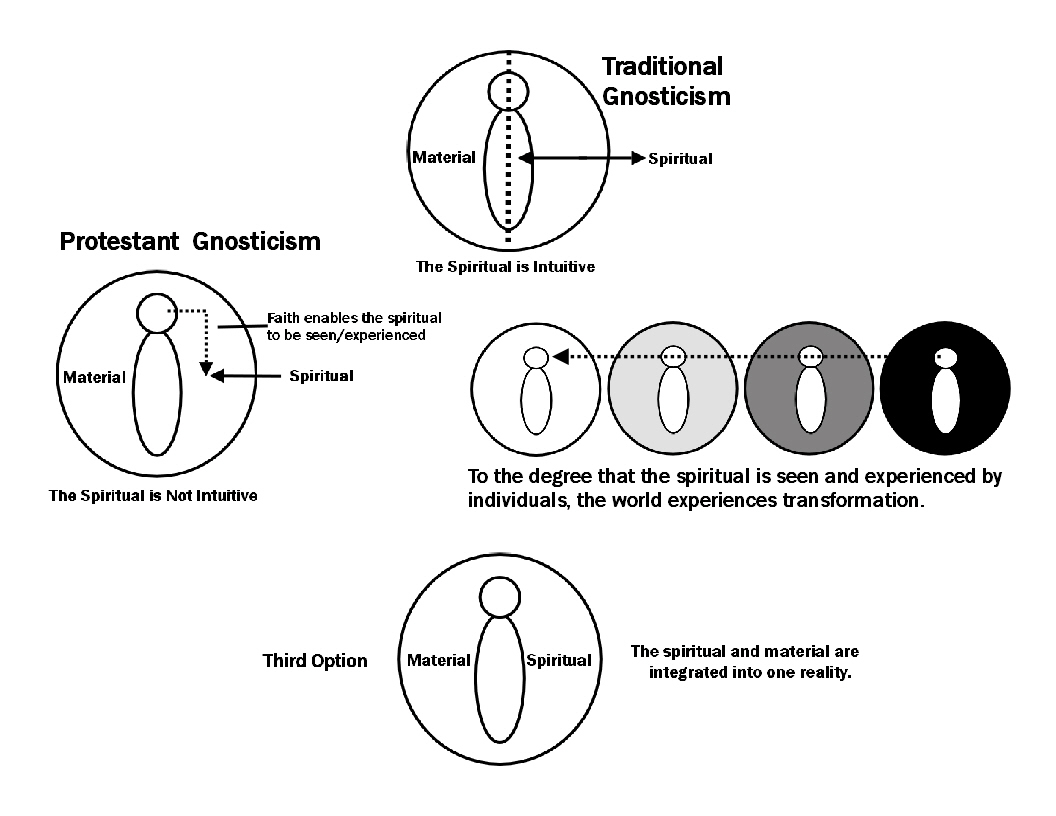
The Gnostics taught that it really wasn’t the spiritual Christ that died on the cross. Gnosticism holds to the idea that material is evil and only the invisible spiritual world is good. Gnosticism rejected the idea that the spiritual realm, or godhood can be one with the material. You must understand: the biblical concept of Godman is a direct affront to the foundation of all false religions, or the knowledge of good and evil. It is the idea that true knowledge cannot be one with the material. Knowledge is good, material is evil and is only a shadow of true knowledge. Knowledge of the material is enslaved and dependent on the five senses.
Now, stop right there. Let me simplify this for you. All false religion flows from the religion of the knowledge of good and evil presented to Eve in the garden. This is also the first sentence of the Calvin Institutes and all of the Calvin Institutes flow from the foundation of 1.1.1., first sentence, viz, ALL wisdom is the knowledge of man and the knowledge of God; man is inherently evil and God is inherently good.
Also, the first sentence of the Calvin Institutes is the primary theses of Luther’s Heidelberg Disputation which is the Magnum Opus of the Reformation. All fundamentals found in contemporary evangelicalism can be found in the Heidelberg Disputation and flow from it. Calvin’s Institutes further articulated the former. In contemporary evangelicalism, we hear constantly that true biblical knowledge is “the knowledge of our own sinfulness as set against God’s holiness.” This is also the pronounced fundamental foundation of the contemporary biblical counseling movement as constantly stated publically in no uncertain terms.
Why am I interjecting this? Because even though much of our knowledge concerning first century Gnosticism comes from the writings of the early church fathers and while they railed against Gnosticism, they themselves were also Gnostics. However, in the process of railing against Gnosticism, they confirm unequivocally that John’s letter addressed the Gnosticism of their day; it just wasn’t the Gnosticism that they preferred.
And by the way, according to some church fathers, John was addressing a Gnostic named Cerinthus who was a contemporary of John and a personal nemesis.
Cerinthus was a gnostic and to some, an early Christian, who was prominent as a heresiarch in the view of the early Church Fathers. Contrary to proto-orthodox Christianity, Cerinthus’s school followed the Jewish law, used the Gospel according to the Hebrews, denied that the Supreme God had made the physical world, and denied the divinity of Jesus. In Cerinthus’ interpretation, the Christ came to Jesus at baptism, guided him in his ministry, but left him at the crucifixion.
He taught that Jesus would establish a thousand-year reign of sensuous pleasure after the Second Coming but before the General Resurrection, a view that was declared heretical by the Council of Nicaea. Cerinthus used a version of the gospel of Matthew as scripture.
Cerinthus taught at a time when Christianity’s relation to Judaism and to Greek philosophy had not yet been clearly defined. In his association with the Jewish law and his modest assessment of Jesus, he was similar to the Ebionites and to other Jewish Christians. In defining the world’s creator as the demiurge, he emulated Platonic philosophy and anticipated the Gnostics.
Early Christian tradition describes Cerinthus as a contemporary to and opponent of John the Evangelist, who may have written the First Epistle of John and the Second Epistle of John to warn the less mature in faith and doctrine about the changes he was making to the original gospel. All that is known about Cerinthus comes from the writing of his theological opponents (Wikipedia).
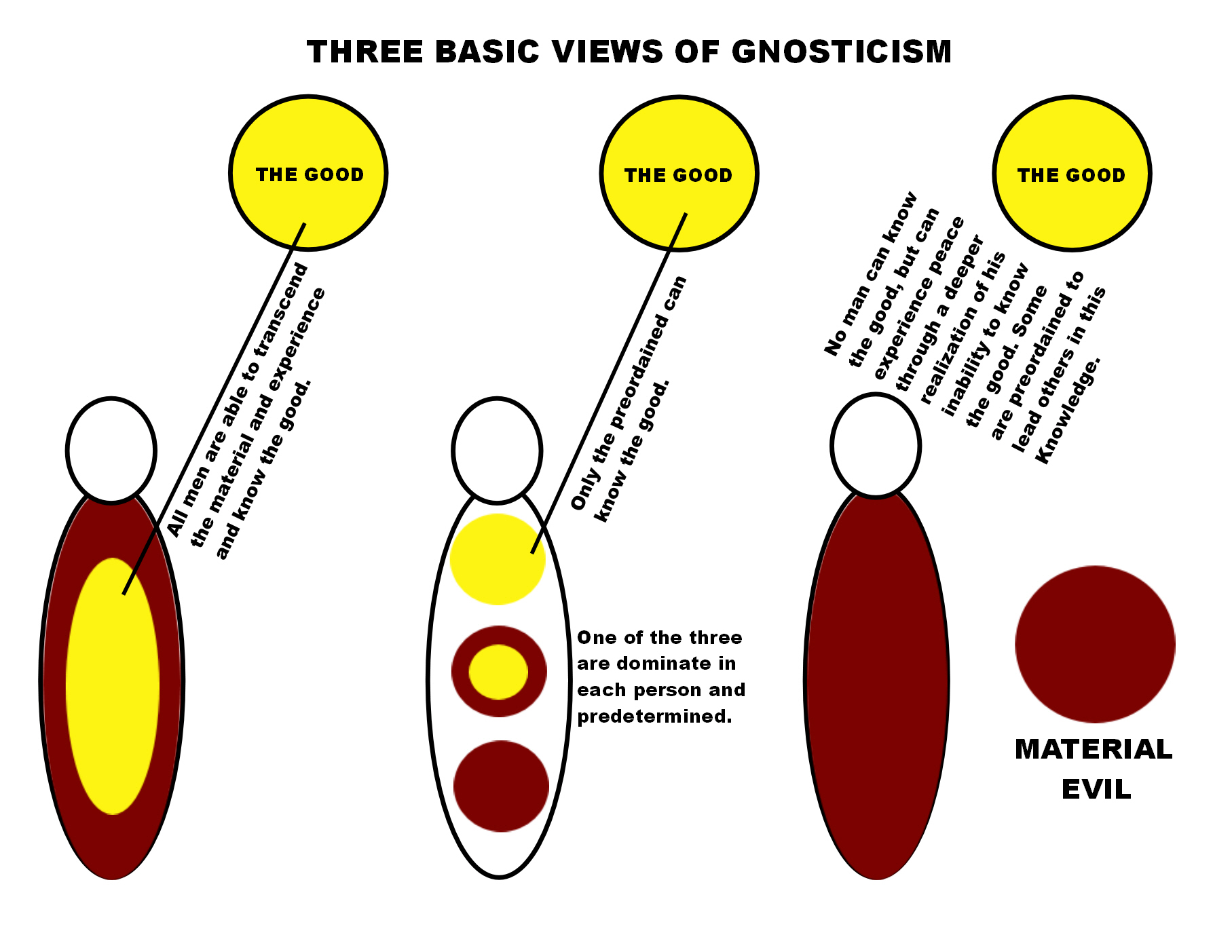
At any rate, the teachings of Cerinthus follow the basic fundamentals of 1st century Gnosticism of which there were two schools of thought unchanged from the cradle of society: intuitive knowledge within versus knowledge outside of man. While both schools held to the strict dichotomy of material being evil and the invisible good, and true knowledge being beyond the five senses, they disagreed on where that knowledge is found and whether or not it is intuitive among all men, or a select few preordained by nature or some supreme being.
Cerinthus followed the philosophical school of Idealism which holds to the belief that the one cosmic mind has an intuitive connection within every individual. Finding that knowledge is often a complex mind-numbing epistemology, but curiously, Luther and Calvin had their own angle that built on the Neo-Platonic teachings of St. Augustine.
This Gnostic bent actually allowed for Christ to be human, or at least some form of humanity. Apparently, God became exasperated with man’s penchant for trying to gain knowledge through the material world, and said in essence, “Ok, since you like to think you can know something and try to gain knowledge through the things that are seen, I am going to send my Son to die on the physical cross, and now all knowledge will only be gained through suffering—there mankind, take that!” This is the essence of the Heidelberg Disputation which is a philosophical treatise, not a theological one by any stretch of the imagination. Luther states plainly in the document that ALL knowledge is hidden in the suffering of the cross. Anyone who thinks they can understand Protestantism without a good grasp of world philosophy is sadly misguided. It is one of the historical necessities of historical grammatical hermeneutics.
Hence, in the Gnostic Protestant construct, Christ and His gospel is the only true objective knowledge and is outside of man. Man is not to seek any knowledge within himself, but all knowledge must be sought outside of him in contemplation of the gospel. All of reality is interpreted by the suffering of the cross. The cross is the epistemology from the material to the invisible, or from the evil to the good.
In contrast, other schools believe the epistemology is intuitive within all men because all men have a spiritual being separate from their material being, and the spiritual part of man is nonmaterial and therefore SINLESS. The material body of man is evil because it is material, but his invisible being is good and has a connection to the cosmic spiritual world that must be cultivated by transcending the material. This was key to the drug culture of the 60’s as LSD trips enabled the individual to transcend the five senses and see into the invisible spiritual world. Supposedly.
Other schools of thought believed that even though all men have a material and spiritual aspect, the spiritual anthropology has classifications in regard to who is able to see true knowledge and who isn’t as determined by the cosmos or cosmic mind; ie., determinism. And consequently, if utopia is to ever be achieved, those with the ability to see knowledge must rule over those who have the inability to transcend the material and are enslaved to it. How do you reason with people hopelessly enslaved to the material? They either understand that they can’t know reality and get with the program, or you kill them.
According to the Reformers, utopia is achieved by understanding that all reality is interpreted through the cross of redemption. This concept was established by Luther’s Heidelberg Disputation and is known as being a “theologian of the cross.” Theologians of the cross are able to know the “cross story,” or interpret reality through the cross, and all others are enslaved to the “glory story” or the story of man. This is the dichotomy of the knowledge of good and evil, or material versus spiritual.
Furthermore, the Reformers believed that the new birth entailed the gift of outward seeing only. All goodness remains outside of man. This is the pious distinction they claim over their fellow Gnostics. Unlike Cerinthus, who would be the modern equivalence of existentialism, no good can be in man, because that does not limit knowledge to suffering and the cross. Even though the early church fathers believed that material is evil and only the invisible is good like all ancient Gnostics, they labeled those heretics who believed that the invisible spirit within man was a connection to the good. That was heresy in their minds. And if you really understand what John Piper et al believe in our day, NOTHING HAS CHANGED.
The true Christians of that day had a different metaphysical take: the material realm is NOT evil, it’s weak. Something that is weak can still be good. The born again Christian struggles with sin because he/she is weak, not because the material realm is inherently evil. Christ really did come adorned in humanity in every since of the meaning because the material is not evil. This understanding of being fits together with the true gospel.
But what Cerinthus et al was teaching speaks directly to what John wrote in his first epistle, and we have addressed some of it in John’s introduction. John, in essence, said the following: Christ was 100% humanity and 100% God. We saw Him, we heard Him, we touched Him, we saw Him die on the cross, there isn’t two Christs, there is only one.
What Cerinthus et al taught explains everything John wrote in this epistle and why he wrote it. It not only explains why John wrote what he wrote in 1:9 and 2:1, it sheds light on why John wrote what he wrote in the rest of the book as well.
And that is what we will look at next week. We will do a point by point fly over of 1John while interpreting it according to this historical context of Gnosticism. John will address the definition of sin in contrast, the definition of knowledge and truth in contrast, the definition of the true gospel in context, the definition of love and hate in contrast, and the definition of the new birth in contrast.
See you next week.



A Doctrinal Evaluation of the Anti-Lordship Salvation Movement: Part 3
Originally published August 15, 2014
Do Christians Have Two Natures?
My belief strata is probably similar to most Christians: A. Dogma, firm on that fact; B. Not dogmatic, sounds logical, going with that for now; C. That’s a bunch of boloney. The idea that Christians have two natures has always been categorized under B for me.
Where do I think a stake needs to be driven most in the arena of Christianity right now? Who we are. We are righteous. We are able. We are good. We are not just righteous positionally, we are in fact righteous in and of ourselves. Righteousness is a gift from God, we cannot earn it, but once we have accepted the gift, we possess it. I fear that most gospels in our day propagate a rejection of the righteousness gift, and I strongly suspect that this is the point of the Parable of the Talents. Clearly, the paramount gospels of our day promote a meditation on the gift in order to keep our salvation. To put the gift into practice is to make His story our own story exclusively.
What is the gift? Is the gift just a gift, or is it also a calling? The “church” is a “called out assembly.” Is answering the call works salvation? And what are we called to? We are called to holiness. In part 2 we have looked at the primary problem with anti-Lordship Salvation. They make answering the call works salvation. How do they rationalize this? As we have discussed, it is the age-old Protestant golden chain gospel. Because justification and sanctification are not separate, a calling to holiness is a declaration that progresses in sanctification; if we commit to holiness in order to be saved, we now have to participate in that progression by obedience to the law.
ALS solves that problem by eliminating the commitment all together and making obedience in sanctification optional—a nice gesture unto the Lord, and it will kinda make your life better. If we doubt our salvation because of behavior, it shows a fundamental misunderstanding of grace; so, the solution is to return to the same gospel that saved us and re-preach it to ourselves. Both ALS and the Calvinists they despise proffer this same construct.
Calvinists deal with the progression of justification in sanctification a different way: by all means we are saved by making a commitment to obedience, but the commitment we are making is a commitment to living by faith alone in sanctification which results in the commitment being fulfilled by Christ. In fact, both camps speak of experiential sanctification; viz, we only experience the works of the Spirit being done through us and we kinda really aren’t doing the work. In Reformed circles, even our “good” works are sin, and our demeanor in obedience gives a clue that the work may be executed by the Lord in that instance, but we don’t know for certain. They call this the “subjective nature of sanctification.” It is manifested in Arminian camps via, “I didn’t do it—it was the Holy Spirit doing it through me.” Really, in all Protestant camps, accomplishment and meekness are mutually exclusive; you can’t have both.
And with ALS as well as Calvinism, righteousness is defined by perfect law-keeping. When their fusion of justification and sanctification is challenged, both camps retort, “Did you sin today?” In BOTH cases, they make no distinction between sin against the law of sin and death, and sin against the law of the Spirit of life in sanctification—violations that grieve the Spirit. That’s because they see justification and sanctification as the same (though both camps are outraged in regard to the accusation).
Because ALS, like Calvinism, makes perfect law-keeping the essence of righteousness, they cannot not deem the Christian perfect in regard to justification. They posit the idea that the Christian is only positionally righteous and not practically righteous. Unfortunately, that same view of our righteousness is then juxtaposed into sanctification because they fuse the two together. To not continually drive home the idea that we are just “sinners saved by grace” is to suggest that we can keep the law perfectly. But the question is… “What law?” There is no law in justification, and where there is no law there is no sin (Rom. 4:15).
Christ primarily died on the cross to end the law of sin and death. Now there is no law to judge us, and that can be coupled with the fact that we are born again of the Spirit and have the seed of God within us (1Jn. 3:9). The new birth is a reversal of slavery resulting in a change of direction. We were once enslaved to sin and free to do good, resulting in a direction away from God (under law Rom. 6:14), but now are enslaved to righteousness and free to sin (Rom. 6:20). As we will see in Romans 7, we were once enslaved to the law of sin and death (Rom. 8:2), but now we are enslaved to the law of the Spirit of life. In both cases, there is a reverse freedom as well. Unfortunately, the Christian is still harassed by the law of sin and death, which is a law standard by the way, and free to sin against it. We will discuss exactly how this happens.
But, because ALS, like the Reformed only see one nomos (law), and Christians obviously sin, the Christian must be both saint and sinner in sanctification. This is Martin Luther’s Simul iustus et peccator—at the same time righteous and a sinner. But, this means saint by declaration and position only while the Christian remains in the same state. The only change is the recognition of his vileness—this defines faith according to Reformed ideology.
Likewise, since the Christian cannot keep the law of sin and death perfectly, and that is justification’s standard, the ALS has its own version of the Simul iustus et peccator: the two natures. Sure, it’s soft Simul iustus et peccator, or Simul iustus et peccator Light, but it’s the same concept. I am not going to take time here to articulate all of the versions, but suffice to say all denominations are spawned by the question of how we do justification in sanctification. There are only two religions in the world: Progressive Sanctification and Progressive Justification. One is a call to holiness and you get justification in the bargain. The other is a call to be declared righteous while remaining a sinner. The former is a call to be made righteous. Answering the call saves you, following the call sanctifies you, but the two are separate with the demarcation being the new birth—following the call does not justify you. Accepting the gift justifies you—but the gift is a calling to holiness. Seeing the gift and the execution of the gift as being the same is the monster of confusion known as Protestantism.
The idea of two natures is contradictory to the new birth.
There is only one us. The other guy is dead. His nature is not hanging around with us. He is not sort of dead, and we are not sort of under the law. We are not under the law at all. The guy’s death did not merely weaken him, it utterly slaughtered him. You are not kinda the old you, there is no old you, that person is not you at all, he is dead.
So what’s going on? I am going to pull the theses out of the barn from the get-go. Think, “sin.” This all starts with a very simple word that has very deep metaphysical ramifications that will not be investigated here, but it all begins with sin as a master. Sin was originally found in God’s most magnificent angel, Lucifer, “son of the morning.” How did sin get there? Far be it from us to discuss that here, but there are theories.
Secondly, a law that should promise life, but sin uses the law to create sinful DESIRES within the individual.
Thirdly, this is daring, but it is best to think of the “flesh,” also, “members” as neutral. Our members can be used for both good and evil. The “flesh” IS NOT the old nature.
Fourthly, fruits unto death and fruits unto life.
The Theses Articulated
Much more study needs to be done in this area; this study is designed to get the ball rolling, but you could spend a lifetime articulating it.
When man is born into the world, sin is within him and sin is a master. When people are born into the world, they are sold into slavery:
Romans 7:14 – For we know that the law is spiritual, but I am of the flesh, sold under sin.
Paul is not saying that flesh =’s evil, he is saying that sin resides in our mortal members. He is saying our birth sold us under sin. Sin is a master. According to the New Testament, this is synonymous with being born “under law” as in… “the law of sin and death.” Christ was the only man ever born under that law who could keep it perfectly. All others are condemned by it.
Let’s look at sin as master:
Genesis 4:6 – The Lord said to Cain, “Why are you angry, and why has your face fallen? 7 If you do well, will you not be accepted? And if you do not do well, sin is crouching at the door. Its desire is for you, but you must rule over it.”
Sin is a master who desires to rule over the individual. Sin is the problem. This does not mean mankind is totally depraved and his will is in complete bondage to sin, he/she is still free to do good and obey the conscience, but the overall direction is away from God and to sin.
Sin resides in the mortal body, but the mortal body, as we shall see, is somewhat neutral. I am not going to get into anthropological dichotomies and theories, but the Bible seems to say that the mind within the body is what’s redeemed when we are saved. Our thesis here contends that the battle within is between our redeemed righteous minds and SIN, not the old us that is dead. However, we are using the same body that the old man (the former us) used and the body can be habituated to some degree. We are to put off those habits and build new ones into our lives:
Ephesians 4:17 – Now this I say and testify in the Lord, that you must no longer walk as the Gentiles do, in the futility of their minds. 18 They are darkened in their understanding, alienated from the life of God because of the ignorance that is in them, due to their hardness of heart. 19 They have become callous and have given themselves up to sensuality, greedy to practice every kind of impurity. 20 But that is not the way you learned Christ!— 21 assuming that you have heard about him and were taught in him, as the truth is in Jesus, 22 to put off your old self, which belongs to your former manner of life and is corrupt through deceitful desires, 23 and to be renewed in the spirit of your minds, 24 and to put on the new self, created after the likeness of God in true righteousness and holiness.
The putting off of the old self is the likeness of the old self, not the literal old self. The body is habituated by the old ways, and we can bring those same habits into the Christian life with the same ill results. Note that the mind is being renewed, and we are putting off the old ways and putting on new ways. We are not “sinners” just because we fall short of perfect putting off and putting on, we are righteous persons in the process of renovation. The flesh is not inherently evil because it can be used for righteousness:
Romans 12:1 – I appeal to you therefore, brothers, by the mercies of God, to present your bodies as a living sacrifice, holy and acceptable to God, which is your spiritual worship.
Romans 6:19 – I am speaking in human terms, because of your natural limitations. For just as you once presented your members as slaves to impurity and to lawlessness leading to more lawlessness, so now present your members as slaves to righteousness leading to sanctification.
The flesh is weak, sin resides there, and our bodies will be redeemed; in that sense, “nothing good dwells in me,” but our members are to be used as instruments for righteousness nevertheless. Let me caution in regard to this study. This is not a study that should be approached with sloppy research. For instance, consider Romans 7:24:
Wretched man that I am! Who will deliver me from this body of death?
We now hear, “See! See! Paul stated that we are still wretched sinners!” Problem is, the Greek word translated “wretched” in this verse means to persevere in affliction. Paul is longing to be saved from his mortal body where the conflict rages. He is not saying that Christians remain as wretched sinners. Likewise, was Paul really saying elsewhere that at the time of his writing that he was the premier sinner in the entire world at that time? The “chief” of sinners? I doubt it. One may ponder the idea that…it’s obviously not true. Paul was making some other point that will not be addressed here.
So, what is the dynamic that we are really fighting against? We are set free from the law of sin and death because Christ purchased us on the cross:
1 Corinthians 6:19 – Or do you not know that your body is a temple of the Holy Spirit within you, whom you have from God? You are not your own, 20 for you were bought with a price. So glorify God in your body.
When we are saved, ownership is transferred to another master. We are no longer enslaved to Master Sin. Let’s look at what that slavery looked like:
Romans 7:4 – Likewise, my brothers, you also have died to the law through the body of Christ, so that you may belong to another, to him who has been raised from the dead, in order that we may bear fruit for God. 5 For while we were living in the flesh, our sinful passions, aroused by the law, were at work in our members to bear fruit for death. 6 But now we are released from the law, having died to that which held us captive, so that we serve in the new way of the Spirit and not in the old way of the written code.
As Christians, we are no longer enslaved to sin which used our passions aroused by the law to provoke us to sin. Apparently, the cancelation of the law’s ability to condemn us comes into play here. If we cannot be condemned by the law, sin’s motivation is gone. Being condemned by the law is how sin enslaved us. If Christ died for sin, and the penalty is paid, and there is no condemnation in regard to the Christian, sin is robbed of its power. In addition, I assume it goes much deeper than this, but that is another study. We may assume that the intrinsic power of sin over us was broken as well.
Sin was able to produce sinful desires within us that provoked us to break God’s law; we were enslaved to a lawless master. Hence, and this is VERY important, phrases like, “For while we were living in the flesh” should not be interpreted as flesh=evil; it means that the unbeliever was living in a mortal body that was controlled by the Master Sin dynamic that used the law to condemn us and control us, and destroy us. No doubt, sin uses sinful desires to get even unbelievers to violate their consciences against the works of the law written on their hearts (Rom. 2:12-16).
This is why many unbelievers will obey their passions in things that are in the process of destroying them. They are enslaved by passions that Sin uses to get them to violate their consciences. In this sense, we were living according to the flesh—our flesh was controlled by the triad dynamic of sin, sinful desire, and the law of sin and death. Now we are controlled by a different triad dynamic: the Holy Spirit, His law, and godly desires. To insinuate in any way that a believer remains the same as before or is in some way marginally different borderlines on blasphemy against the Holy Spirit and troddens underfoot the blood of Christ.
We will look at another text to build on our point:
Galatians 5:16 – But I say, walk by the Spirit, and you will not gratify the desires of the flesh. 17 For the desires of the flesh are against the Spirit, and the desires of the Spirit are against the flesh, for these are opposed to each other, to keep you from doing the things you want to do. 18 But if you are led by the Spirit, you are not under the law. 19 Now the works of the flesh are evident: sexual immorality, impurity, sensuality, 20 idolatry, sorcery, enmity, strife, jealousy, fits of anger, rivalries, dissensions, divisions, 21 envy,[d] drunkenness, orgies, and things like these. I warn you, as I warned you before, that those who do such things will not inherit the kingdom of God. 22 But the fruit of the Spirit is love, joy, peace, patience, kindness, goodness, faithfulness, 23 gentleness, self-control; against such things there is no law. 24 And those who belong to Christ Jesus have crucified the flesh with its passions and desires.
A problem arises when we interpret “flesh” without the full corpus of the subject. When we “walk” we are using the flesh. When we walk according to the Spirit, we are using our flesh (members/body) for holy purposes. The full dynamic of sin’s mastery is then interpreted by one word used in various and sundry ways to make any number of points. And, any idea that the Christian is still under the law of sin and death is particularly egregious. Worse yet, if one believes that the law still condemns them as most teach today, this empowers the Sin Master. The word of God can now be used to provoke even Christians with sinful desires.
Furthermore, since sin still remains in the body, it still attempts to use the law to provoke us with evil desires. I imagine that ignorance of the Scriptures supplies a field day for sin in the life of believers accordingly:
James 1:13 – Let no one say when he is tempted, “I am being tempted by God,” for God cannot be tempted with evil, and he himself tempts no one. 14 But each person is tempted when he is lured and enticed by his own desire. 15 Then desire when it has conceived gives birth to sin, and sin when it is fully grown brings forth death.
The desire James is talking about are sinful desires provoked by sin. When we are tempted by a sinful desire, we should know exactly where that is coming from; sin is still trying to master us by using the former scheme. A Christian can produce fruits of death in this life by succumbing to those desires. These are temporary death fruits, not eternal. The former you could generate fruits of death in both this life and the life to come, but the believer can only generate temporary fruits of death. Peter referred to it this way: suffering as an unbeliever.
With all of this in mind, let’s look at some verses from Romans 7:
Romans 7:14 – For we know that the law is spiritual, but I am of the flesh, sold under sin. 15 For I do not understand my own actions. For I do not do what I want, but I do the very thing I hate. 16 Now if I do what I do not want, I agree with the law, that it is good. 17 So now it is no longer I who do it, but sin that dwells within me.
Precisely. But note, when Paul writes, “I am of the flesh, sold under sin,” he is not saying that we are still enslaved to the same master or dynamic, he is saying the dynamic is still at work in us, but we are obviously no longer enslaved to it. Hence…
16 Now if I do what I do not want, I agree with the law, that it is good. 17 So now it is no longer I who do it, but sin that dwells within me.
So, “Did you sin today?” Well, what sayeth Paul? Unless you take all that we observed in these three parts, this statement by Paul would seem outrageous, but we know what he is saying, and no, we are NOT “sinners.” Note as well, the law is not sinful, our flesh is “weak,” but it is sin itself that causes us to sin. Before we were saved, we desired sin and were ruled by it, but now, we have the desires of the Spirit and love His law…
For I do not do what I want, but I do the very thing I hate.
And:
Romans 7:21 – So I find it to be a law that when I want to do right, evil lies close at hand. 22 For I delight in the law of God, in my inner being, 23 but I see in my members another law waging war against the law of my mind and making me captive to the law of sin that dwells in my members. 24 Wretched man that I am! Who will deliver me from this body of death? 25 Thanks be to God through Jesus Christ our Lord! So then, I myself serve the law of God with my mind, but with my flesh I serve the law of sin.
There remains a rest for God’s people, but it is not now. This is war, but we must know who the enemy is and how he works. Let me also add that simplicity is not the duty of the “learner,” aka disciple. Christians are to study in order to show themselves an approved “worker.” Lazy thinkers make for poor disciples and are the fodder for the wicked. The final analysis is this:
So then, I myself serve the law of God with my mind, but with my flesh I serve the law of sin.
We are enslaved to the law of the Spirit of life, and fight against the law of sin and death that sin uses to provoke us with evil desires.
Romans 8:1 – There is therefore now no condemnation for those who are in Christ Jesus. 2 For the law of the Spirit of life has set you free in Christ Jesus from the law of sin and death. 3 For God has done what the law, weakened by the flesh, could not do. By sending his own Son in the likeness of sinful flesh and for sin, he condemned sin in the flesh, 4 in order that the righteous requirement of the law might be fulfilled in us, who walk not according to the flesh but according to the Spirit. 5 For those who live according to the flesh set their minds on the things of the flesh, but those who live according to the Spirit set their minds on the things of the Spirit. 6 For to set the mind on the flesh is death, but to set the mind on the Spirit is life and peace. 7 For the mind that is set on the flesh is hostile to God, for it does not submit to God’s law; indeed, it cannot. 8 Those who are in the flesh cannot please God. 9 You, however, are not in the flesh but in the Spirit, if in fact the Spirit of God dwells in you. Anyone who does not have the Spirit of Christ does not belong to him. 10 But if Christ is in you, although the body is dead because of sin, the Spirit is life because of righteousness. 11 If the Spirit of him who raised Jesus from the dead dwells in you, he who raised Christ Jesus from the dead will also give life to your mortal bodies through his Spirit who dwells in you.
We are not fighting against the old us. We are fighting the sin within that is no longer our master. In addition, our battle is not against “flesh and blood” but rather principalities.
We only have ONE nature, the new one.
Calvinist Catholicism, Denial of Sanctification, Denial of the New Birth, and Distortion of the Trinity Through “Emphasis”

Originally published January 3, 2013
“Those of Reformed theology are not under grace. How do we know that? Because they say Christians are still under the dominion of sin. And plainly, according to the Bible, that equals being under the law and not under grace.”
The mystery of why sanctification is so anemic today is no longer a mystery. Traditionally, this has been the case for a long time in the Western church because the fathers of the Reformation discounted sanctification all together. Sure, they used the term, but it was disingenuous then, and continues to be such with those who use the term today. Weak sanctification leads to very unexciting lives which are no incentive to share the “new life” with others. We share what we are excited about, and being no better than what we were before our “conversion” is neither good news nor worth sharing. It seems the only thing we have to share is, “We are more humble than you because we know that we are empty vessels waiting to be filled and maybe the Lord will fill us and maybe he won’t.” Such a message just doesn’t set the world on fire.
The more I learn, the more I am convinced that there is really no difference between Catholicism and Protestantism: both are “under the law.” One is Jesus plus ritual to complete your justification and the other is Jesus plus making sure you do nothing in your sanctification to complete your justification (because the “just” shall live by faith [ALONE]). And in both cases, being faithful to the authority of the church secures your salvation. Calvin believed that we stay saved through daily repentance for daily salvation, and that forgiveness can only be found in Reformed churches:
Secondly, this passage shows that the gratuitous pardon of sins is given us not only once, but that it is a benefit perpetually residing in the Church, and daily offered to the faithful. For the Apostle here addresses the faithful; as doubtless no man has ever been, nor ever will be, who can otherwise please God, since all are guilty before him; for however strong a desire there may be in us of acting rightly, we always go haltingly to God. Yet what is half done obtains no approval with God. In the meantime, by new sins we continually separate ourselves, as far as we can, from the grace of God. Thus it is, that all the saints have need of the daily forgiveness of sins; for this alone keeps us in the family of God” (Calvin’s Commentaries, Vol. 45: Catholic Epistles).
And, Calvin’s homeboy, Luther, believed that Reformed elders have the authority to forgive sins:
Confession consists of two parts. One is that we confess our sins. The other is that we receive the absolution, that is, forgiveness, from the pastor as from God himself and by no means doubt but firmly believe that our sins are thereby forgiven before God in heaven (Timothy J. Wengert: A Contemporary Translation of Luther’s Small Catechism; Augsburg Fortress PUB 1994, p.49).
And on page 35….
Daily in this Christian church the Holy Spirit abundantly forgives all sins—mine and those of all believers. On the last day the Holy Spirit will raise me and all the dead and will give me and all believers in Christ eternal life.
The granting of eternal life is future, and is based on faithfulness to the established church. Look, I have been a pastor long enough to know that many Baptists associate their salvation with church membership. I have suggested cleaning up the roles in a few churches, and the response is always one that hints of this being synonymous with taking away one’s salvation. Where did they get that idea? Whether Catholic or Protestant, you can get your absolution in a booth or an alter call—there is no difference.
Calvinism, and the Reformed gospel in general, is “under the law.” In the Scriptures, being under the law equals being under the dominion of sin:
Romans 6:14—For sin will have no dominion over you, since you are not under law but under grace.
Romans 2:12—For all who have sinned without the law will also perish without the law, and all who have sinned under the law will be judged by the law.
Romans 2:15—For the law brings wrath, but where there is no law there is no transgression.
Those of Reformed theology are not under grace. How do we know that? Because they say Christians are still under the dominion of sin. And plainly, according to the Bible, that equals being under the law and not under grace. Quotes from the Reformed that establish this are myriad, I will note one:
We are enemies of God. We are God ignoring. We are God defying. We hate God. (CJ Mahaney: Resolved Conference 2008).
Comments by Reformed pastor Matt Chandler speaking of Christians as being “wicked sinners” have apparently been scrubbed from the internet (see here, and here), but nonetheless are indicative of the Reformed position.
This simply equals nothing less than, from the biblical perspective, Christians remaining in an unregenerate state though they call it regeneration. And this, they in fact do:
Bavinck too, wrote in connection with the regenerating work of the Spirit: “The regenerate man is no whit different in substance from what He was before his regeneration” (G. C. Berkouwer: Faith and Sanctification, p. 87).
Unchanging regeneration: such oxymorons are not few in Reformed writings. And though they would deny it, sanctification and the new birth are rejected as a matter logical conclusion. There can be no sanctification or new creaturehood where we are still under the bondage and dominion of sin. This is antithetical to being under grace. The Reformed think tank that launched the present-day New Calvinist movement which is a resurgence of authentic Calvinism, wrote an article in their theological journal entitled, “The False Gospel of the New Birth.” The article can be read here.
The argument that is used is one of emphasis which is Gnostic epistemology: sure, stars are true, but they only shine because of the Sun. Sure, shadows are true, but they wouldn’t exist without the Sun either. Sure, flowers are true, but they wouldn’t be able to grow without the Sun as well. What we want to do is focus on what really gives life: the Sun. To emphasize stars, shadows, or flowers over the thing that actually supplies the life will diminish life to whatever degree that the “good thing” is emphasized over the “best thing.”

Beginning to get the picture? It enables them to acknowledge the truth of sanctification and the new birth while deemphasizing them into oblivion. Out of sight; out of mind. To say that the new birth and our ability in sanctification are deemphasized in today’s church is certainly an understatement.
Said think tank, The Australian Forum, used the same argument to emphasize Christ over the Father and the Holy Spirit as well. Christocentricity is very important to Reformed theology. The core four of this think tank was Geoffrey Paxton, Jon Zens, Graeme Goldsworthy, and Robert Brinsmead. In a book where Paxton documents the Reformed heritage of Seventh-Day Adventism, he stated the following:
Luther and Calvin did not simply stress Christ alone over against the Roman Catholic emphasis on works-righteousness. The Reformers also stressed Christ alone over against all—be they Roman Catholics or Protestants (29) — who would point to the inside of the believer as the place where justifying righteousness dwells. Christ alone means literally Christ alone, and not the believer. And for that matter, it does not even mean any other member of the Trinity! (The Shaking of Adventism: p. 41).
Likewise, the same argument is made in regard to sanctification:
The distinction between the two types of righteousness will make the final emphasis of the Reformation easier to understand. The Reformers contended that the believer is righteous in this life only by faith. In saying this, they were not denying either the necessity or the reality of sanctification in all true believers. Rather, they were asserting that in this life sanctification is never good enough to stand in the judgment. The believer must look only to the righteousness of faith (the righteousness of the God-man) for his acceptance with God.
The inadequacy of sanctificational renewal was an integral part of Reformation teaching. Its corollary was the Reformers’ steadfast gaze at the righteousness of faith—namely, the doing and dying of the God-man, Jesus of Nazareth. Though the believer fights against sin and seeks to be a faithful law-keeper, sin nevertheless remains until his dying day Luther put it forcefully:
Paul, good man that he was, longed to be without sin, but to it he was chained. I too, in common with many others, long to stand outside it, but this cannot be. We belch forth the vapours of sin; we fall into it, rise up again, buffet and torment ourselves night and day; but, since we are confined in this flesh, since we have to bear about with us everywhere this stinking sack, we cannot rid ourselves completely of it, or even knock it senseless. We make vigorous attempts to do so, but the old Adam retains his power until he is deposited in the grave. The Kingdom of God is a foreign country, so foreign that even the saints must pray: ‘Almighty God, I acknowledge my sin unto thee. Reckon not unto me my guiltiness, O Lord.’ There is no sinless Christian. If thou chancest upon such a man, he is no Christian, but an anti-Christ. Sin stands in the midst of the Kingdom of Christ, and wherever the Kingdom is, there is sin; for Christ has set sin in the House of David.
(Ibid pp. 46,47).
Hence, at least Reformed theology is consistent in regard to Christians being under the law and also still under sin’s dominion. We must live by faith alone because we will supposedly stand in a future judgment that will determine righteousness by a perfect keeping of the law. And it’s true, those under the law will stand in such a judgment. But will we? The heart of the Reformation posited the idea that if we live by faith alone in sanctification, Christ will stand in the judgment for us.
But we know well what James thought of sanctification by faith alone.
paul
12 Anti-Gospel Presuppositions of Protestantism
I. God declares people righteous without making them righteous. “Sinner” is not past tense.
II. Perfection is defined as perfect law-keeping in this life.
III. The new birth is defined as a realm or ability to see/experience something that is not our own essence as believers.
IV. “Flesh” is inherently evil, not merely weak.
V. “Earth” is not merely weak, but inherently evil.
VI. “Sin” is the essence of the material world, and not a “master” separate from it.
VII. Sanctification (the Christian life) is a rest. John Calvin believed New Testament sanctification is the Old Testament Sabbath rest. It is the belief that the Christian life is a rest from works because all works are still under law.
VIII. God’s kingdom is presently on earth.
IX. Hell was also created for man.
X. Single relationship to the law for both believers and unbelievers.
XI. One judgment.
XII. Salvation of the soul and body happen at the same time.

 Paul's Passing Thoughts
leave a comment