Victims and Discernment Bloggers: Let’s Ask the Right Questions
 “So, they would say to the young ladies and boys who have been molested in the church, ‘So what?’ The same sin that indwells the pedophile is in the victim as well. Can we not survey the past and present abuse and see this worldview plainly?”
Even though we hate to think commonsense is important in understanding spiritual issues, the fact remains that such is the case. We struggle with this because of our notion that material is evil and spiritual is good. This notion is deep-seated in the Western psyche. Consequently, we are often willing to throw math out the window for something spiritual. Also, the spiritual get out of commonsense free card comes in handy when we have invested too much of our own self-esteem in a bad idea. If we humble ourselves and admit we were wrong, our intellect labeled as “humbleness” (lest it have no credibility) seems to lose its credibility.
Frankly, I find admission of wrong freeing. Yes, it may make you feel stupid for a while, but the problem with being wrong is that you can’t get anything done with bad information, and not getting anything done leads to hopelessness. Ultimately, even if you are stupid, people will judge you by what you get done, and even if they don’t, God will. Christ is documented throughout the New Testament as being annoyed by verbal assent to righteousness rather than actual doing, and bad information does not lead to right doing. This would seem evident.
But what if you can’t really know anything? And what if you can’t really do anything good? What would the results of that be? Well, look at the blogosphere spiritual discernment and victim “healing” ministries. In full force since 2009, matters continue to get worse, not better, and to date, justice for the victims is found nowhere. Why? Why doesn’t discernment ministry work? In the analysis of Herman Cain’s acronym, W-A-R, discernment bloggers are not working on the right problem, asking the right questions, nor removing the necessary obstacles.
What is the right question? It follows: “Why doesn’t discernment ministry accomplish anything?” Need proof? Anybody remember the outrageous ABWE scandal? Thought so. A secular media producer just cancelled “Here Comes Honey Boo Boo” because of the mere potential of a smidgen element of the ABWE scandal, yet, ABWE continues to thrive unabated. How can this be? is another right question.
No, that is THE right question. And what is the obvious answer? It follows: people keep supporting ABWE financially. In case it escapes anyone, ABWE cannot continue unless it receives money. That raises another question: “Why do people keep sending such an organization money despite their deplorable behavior?”
Um, I can only tell you why the people who keep sending ABWE money say they keep sending ABWE money. Would that suffice? The reasons follow:
- Because ABWE, and institutions like it are God’s anointed, preordained vessels to take the gospel to a dying world, they are the only ones qualified to do so. If ABWE fails, thousands and thousands of souls will go to hell for eternity. ABWE must survive.
- ABWE must operate with people, and where there are people, there is sin, this is unavoidable.
- ABWE should be forgiven as Christ forgave us.
These are the reasons that no justice can be found in the institutional church. These are the reasons that religious institutions continue to spiritually abuse unabated. That’s the problem that must be worked on. Those answers assume the following: spiritual hierarchy, moral equivalency, and individual value defined by contribution to the group; i.e., no justice for the individual is what’s best for the many.
Note: the institution in and of itself is not the problem, people in and of themselves within the institution are not the problem, and money in and of itself is not the problem: the logic is the problem. The threefold logic clearly gives license to the behavior. The threefold logic insists that nothing can be done, or that nothing should be done. In fact, the threefold logic insists that there really isn’t a problem to be worked on in the first place—this is clearly ascertained by the normative results of all of these scandals.
So, how do discernment blogs work on the problem? By exposing the problem, “properly” identifying the problem, and assuming that the institutions will respond and seek justice for the victims. How’s that working for us so far?
So let’s ask another right question: “Why isn’t that approach working?” One reason is the identification of a particular problem that discernment bloggers like to call “cognitive dissonance.” This is the study of how people believe contradictory propositions and their attempts to reconcile the contradictions. But this is where discernment bloggers totally miss it: spiritual hierarchy is more times than not predicated on the idea that the masses cannot properly interpret reality itself. How many times have we heard the following?
No matter what it looks like, you need to trust the leaders who have been working close to the situation and know all of the details.
Though we would not agree with a naked verbalization of the idea that only spiritual leaders can properly interpret reality, we by all means function that way. However, more and more in Reformed circles, this concept is being openly stated in the following way:
All of reality, or what is truly reality, is interpreted through redemption, and only the gifted are able to do so. Meanwhile, it is acceptable to obtain worldly knowledge, and some of it is good, but a good thing is not always the best thing.
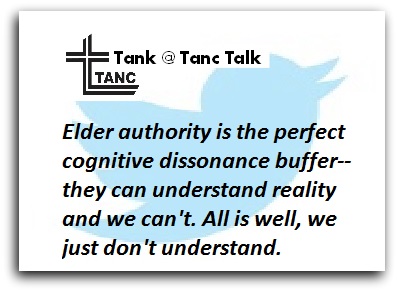 Therefore, when it comes to spiritual matters, trust God’s anointed regardless of the obvious. In cognitive dissonance, the thing used in an attempt to reconcile two contradictions as much as possible is called the “buffer.” In this case, the buffer is the belief that spiritual leaders must be obeyed because they are the ones who can see reality and we can’t. Sure, we can understand worldly things that have no eternal value, but when it comes to eternal matters the leaders must be trusted at all cost. The right problem to address is the buffer, not the symptom of being comfortable with contradictions. Discernment bloggers wrongly identify the real problem and work on the wrong one. They fail completely on Cain’s “W.”
And by the way, if you want to read a sermon by a conservative evangelical that exemplifies this dualist approach to reality, you can read it here, and listen to it here.
In addition, this author can give firsthand evidence of this mentality via correspondence from someone upset by what this ministry publishes.
Deep down you know that it is true. Turning logic on its head, twisting words, pseudo-scholarship, and outright attacking people for things that both you and I know they do not believe does no one any good.
Another misunderstanding is that I somehow knew and stood behind any improper things you may have experienced at Clear Creek.
These statements were made in light of the fact that citations/quotations make-up approximately 30% of what our ministry writes, and improper things “you may have” experienced is set against a website that thoroughly documents what exactly happened. The individual wrote these statements in the face of undeniable documentation. How can he do that? Because only those with authority can properly interpret reality despite the evidence presented to the contrary. That’s why. The individual also accused our ministry of “pseudo-scholarship.” Why is it such according to him? Because it doesn’t have the authority of Reformed institutional scholarship—they are the ones who really know the truth. Discernment bloggers seem to miss the point that institutional tyrants do not interpret reality in the normative sense.
Another point missed by discernment bloggers is: tyrants who interpret reality differently will not always act out in the same way. However, if the same ideology does not produce shameful behavior, it will at least produce tolerance for it. And the right question here is, “why is this so?” Answer: moral equivalence. If everyone is Adolf Hitler at heart, who is anyone to judge anybody for anything? We are ALL just sinners saved by grace after all. “Justice,” you say? What justice? We ALL deserve hell! Again, this is also seen in the aforementioned correspondence:
I truly grieve for the things that you have shared have happened with your family, but all either of us can do from here is look to faithful God and away from the sin that is in our heart and other men who will always ultimately disappoint because none of us are sinless.
Notice that he grieves for the things “that you have shared happened with your family,” i.e., how I interpret their actions, not what they actually did. And notice that the sin these men may have committed against me is also in my heart as well. So, they would say to the young ladies and boys who have been molested in the church, “So what?” The same sin that indwells the pedophile is in the victim as well. Can we not survey the past and present abuse and see this worldview plainly?
So, if there is no moral unequivalence necessitating a need for justice, all that is left is unity and peace for the sake of unity and peace which can only be obtained by blindly following those preordained to lead the great unwashed masses. We must also understand that this logic gave rise to institutions in general and the institutional church in particular.
Let’s work on the right problem: the worldview of the institutional church. Let’s ask the right question: “What should we do about it?” And finally, let’s remove obstacles to what works.
The obstacle that needs to be removed is fellowship with the institutional church. Again, the institution in and of itself is not the problem, but its caste worldview is the problem. Christians en masse must stop giving their money to the institutional church and must warn all people that they involve themselves with the institutional church at their own risk. It looks something like this:
Mark, likewise, I don’t care to debate with you because we see reality differently. I interpret reality grammatically, and you interpret reality redemptively like the Neo-Platonist “Christians” that you follow. Even John Street has bought into this latter-day antinomian nonsense. All I want to hear is that you stay clear of my family, and let’s be clear, it is not a wish—it is a demand, and I will protect my family at all cost—be sure of it.
Keep your family away from the institutional church. What else needs to happen in order to demonstrate that its fundamental worldview is horribly distorted? Husbands need to step up and take over their responsibility before Christ to lead their own families spiritually. You need to join a fellowship and be encouraged by men of God who can think for themselves and fear the Holy Spirit more than puffed-up control freaks. If you cannot find such a fellowship, do so in your own home.
paul
Related articles:
Love Your Local Institutional Church
 One of the advantages of having Calvinist friends on my Facebook friend list is that little gems like this one appear in my news feed from time to time. The article is entitled “Do You Love the Church Like Jesus Does?” It was written by a young man named Mark Perry, Associate Pastor of Westerville Bible Church in Westerville, Ohio, a suburb of Columbus. Mr. Perry could be considered to be of the “young, restless, and reformed” variety.
The opening caption of the article asks the question, is it possible to love Jesus and not love His church? Obviously, a question such as this establishes the premise that such a thing is not possible. We are to assume that these two things are not compatible. If you don’t love the church then you must not love Jesus. The purpose of the article seeks to first define the “church” and then make the argument of why and how we are to love it. Again, you can read the entire article here, but I have reproduced the body of the article in this post so that I can offer a review of Mr. Perry’s arguments (in italics) and insert my comments to relevant sections that I want to point out to you.
Do You Love the Church Like Jesus Does?
What is the church?
We use the word “church” in many different ways. How can we pinpoint what that means? In Ephesians we are told that “Christ loved the church and gave himself up for her” (Eph 5:25). We can identify the church by asking for which “church” Jesus died.
The church is not the building in which believers assemble. We often use the word church to refer to the building: “What a lovely church!” or “The church could use a new coat of paint.” But surely this is not the church for which Jesus died. In fact, New Testament congregations met in members’ homes (e.g., Rom 16:5; 1 Cor 16:19; Col 4:15; Philemon 1:2). In many parts of the world today, our brothers and sisters in Christ meet in homes, parks, or public locations. It is not necessary to own property or have a physical building dedicated to the regular assembling of Jesus’ body.
So far so good. All very well stated. These are all things that Paul and I have both stated on regular occasions. I would agree with Mr. Perry on this point. Notice how he establishes that the church is not a building. In fact, he goes to some length to establish what the church is not, thereby framing his argument to follow. Reading on:
The church is not the meetings or ministry programming. Another way we use the word church is to refer to a worship service or ministry program: “Church was great this morning; I really enjoyed the sermon.” “My church has so many ministry opportunities available.” Many people see the church as the sum of services or ministries offered: children’s ministries, fellowship opportunities, teaching and preaching, or other benefits offered to members or adherents. But did Jesus die to secure singles’ ministries, Vacation Bible School, and youth groups? Did Jesus love a certain style of music or preaching so much that he left heaven to give his life? Every generation of believers since the book of Acts has had to work out how to obey Jesus’ command to make disciples in their culture.
Ok, here he starts to drift a little. First of all, we don’t have to “work out” how to obey Jesus’ commands. His commands are clear. We either do them or we don’t. The way we make disciples or “learners” is by teaching them exactly what Jesus said to do. The message of the Gospel of the Kingdom is not culture-specific. It is the same for all men everywhere. We don’t have to “figure it out.”
The other thing I notice in this statement is the implication that evangelism takes place within the confines of the institutional gathering or its ministries. This is patently false. Evangelism is an individual mandate. We don’t bring the unsaved to the church through the means of some “program” or “ministry” in order to get them saved. We as individuals go out to them and preach the gospel to them. When they hear and believe and become saved, we then invite them to fellowship with the assembly for the purpose of edification.
Moving on…
The church is the regular assembly of believers in Jesus. We often say, “The church is the people”
This is correct. Yay! The reason we often say it is because it’s true.
and we are right—almost.
Wait…Huh? What do you mean “almost?”
On one hand, the universal church includes all believers in Jesus from the Day of Pentecost until the Rapture. At the moment of Jesus’ return in the air, the universal church will be assembled for the first time: “those who have fallen asleep” and “we who are alive, who are left” (1 Thess 4:14, 17). But until that time, the church exists on earth in localized assemblies of believers who meet regularly for prayer, Scripture reading, teaching of apostolic doctrine, and fellowship (Acts 2:42). The Greek word translated “church” (ἐκκλησία) means assembly or gathering and sometimes in the New Testament it even refers to groups of unbelievers (e.g., Acts 19:32, 39, 41).
Ok, while I don’t see the NT making any distinction between “universal church” and “local church”, nevertheless his other points here are spot on. And he would have been better served stopping right there, but he didn’t. Read on…
The church is the church when it is assembled.
WHAT? Read that again. He said, “The church is the church when it is assembled”? The logical inverse of that statement would necessarily follow that the church is not the church when it is not assembled. But he just said the word “church” is the word “ekklesia” which means “assembly.” The reality of his statement indicates that the church does not exist when it is not assembled. That would mean the church only has relevance when it is assembled.
At the beginning this author made points about what a church is not. It is not a building, it is not a program. But please notice his emphasis is still on some group entity over the individual. And this is something that “Argo”, a blogger who frequently comments on Paul’s Passing Thoughts, has written on extensively over the past few weeks. In Reformed and Protestant orthodoxy, there is no relevance or meaning or existence outside of the group! To them, our relevance as believers only matters within the church. So, when we are not assembled, we don’t matter.
It is those believers who regularly gather in Jesus’ name. Therefore, the church that Jesus loves and for whom he died is the gathering of believers. These local assemblies or gatherings of believers are the only church we can know this side of heaven.
I would dare to ask Mr. Perry that if the church is the Body, and we are individual members of that Body, each with our own function, then do we cease to be a part of that Body when we are not assembled? Are we only part of the Body when we meet on Sundays (or Wednesday, or Saturday, or any other required meeting time/place)? I contend that our relevance as believers extends far beyond that which we do when we gather for fellowship. And our not being assembled together in fellowship at any given time does not preclude our identity as a member of the Body of Christ. He continues:
What does it mean to love the church?
We are commanded to “walk in love, as Christ loved us and gave himself up for us” (Eph 5:2). In other words, we are to love the church just as Jesus does. The command to love Jesus’ church is the same as the oft-repeated New Testament command to “love one another” (e.g., Rom 12:10; 13:8; 1 Thess 3:12; 4:9; 2 Thess 1:3; 1 Pet 1:22; 4:8; 1 John 3:11; 4:7, 11, 12; 2 John 1:5). So we love Jesus’ church when we love the brothers and sisters in our local assembly.
What about other brothers and sisters in other assemblies around the world who are not part of our cult group assembly, who don’t necessarily share all the same beliefs in matters of practice? Are they not a part of the body because they don’t assemble with us? Is our church somehow better/superior to their church because we don’t “worship” the same way they do, because we “do church” the “right way”? Are they any less part of the body of Christ? Are they part of the assembly because they are born-again believers in Christ or instead because they regularly assemble at our “church”?
And this is where it gets difficult. We may love our church’s beautiful building, we may be enraptured by our favorite preacher’s sermon series, or we may appreciate the array of ministries and opportunities our church offers, but loving these difficult, obnoxious, unkind, and sinful people is a different matter entirely! Jesus’ love for us is our example to love his church. What about the sinful people in my church? Jesus loved me while I was a sinner (Rom 5:6–8). What about the cantankerous or antagonistic people in my church? Jesus loved me while I was his enemy (Rom 5:10). What about the people who have weak consciences or unreasonable standards in my church? Jesus served others, not himself (Rom 15:3; Mark 10:45).
Mr. Perry must not think very much of the members in his church. Look at what he calls them: “difficult, obnoxious, unkind, and sinful people… cantankerous or antagonistic… people who have weak consciences or unreasonable standards”. Wow, I sure want to be a part of that church now that I know what the pastoral staff thinks of me! The view of the continued total depravity of the saints is clearly evident in this paragraph. The Bible does not call believers “sinners”. That is what we were in the past. Let us not forget the rest of 1 Corinthians 6:11, “…but ye are washed, but ye are sanctified, but ye are justified in the name of the Lord Jesus, and by the Spirit of our God…” Believers are righteous, Mr. Perry, because we have the righteousness of God the Father. We have His seed in us that cannot sin! (1 John 3:9)
As I continue to read these last points, the emphasis of the church as an institution (…our church’s beautiful building…preacher’s sermon series…array of ministries and opportunities…) vs. a body of individuals is apparent. The “church” is referred to in terms that place the emphasis on this “entity” that is something other than the body of Christ. It is very subtle, but the undertones are there.
How can we love the church?
How then can we “walk in love” and serve one another through love (Gal 5:13)? Here are four practical ways.
Meet regularly with Jesus’ church. Don’t turn your back on Jesus’ church because you don’t like the facilities or prefer a different ministry emphasis. Don’t abandon Jesus’ church for something that is not the church. Jesus has promised his presence with his church until the end of the age (Matt 28:20). Jesus meets with his church—do you?
There is a veiled threat in this point regarding abandoning the church. What happens to the one who abandons the church? What is the “something that is not the church”? Do you not see the equivocation here that if you are not part of the church then you are not a part of the Body, ergo, you are not saved? Whether or not it is stated plainly, reformed orthodoxy functions under the belief that salvation is found within the institution.
Pray for Jesus’ church. If you see problems [sic] When you see problems in your church, pray for your church.
Yes, by all means, we ought to pray for each others’ needs as we fellowship together. We ought to pray that our fellowship time is efficacious. We ought to pray that we would be on our guard for wolves who would do violence to the flock, and that we would be discerning regarding false teaching. But that is not what this author has in mind. His concern here is with the actual institution itself. Consider report after report of spiritual abuse and scandals that have rocked the religious word in the last few years. But yet it is these same institutions that must be preserved for the “cause of Christ”, regardless of the problems that exist. Look at this next paragraph:
Are you concerned about your church? Remember Jesus loves his church—he died for her—and he cares for your church more than you ever could (Rev 1:12, 20). We pray with confidence when we pray according to God’s will (1 John 5:14), and we know what God’s will is for the church—that she becomes like Jesus! This is what God is at work doing (Phil 1:6; 2:13). Pray the God-breathed prayers of the New Testament for your church (e.g., Eph 3:14–21; Phil 1:9–11; Rom 15:5–6; 1 Thess 5:23–24). Jesus prayed for his church (John 17:20–26) —do you?
Notice the collectivist emphasis in terms. The individuals are expendable. The “church” must become like Jesus, not individuals. We must pray for God’s will for the “church”, not the individuals. Jesus died for the “church”, not the individuals. Jesus prayed for the “church”, not the individuals. But consider that last reference in John 17 carefully. When Jesus prayed that night in the garden, he wasn’t praying for a church, he was praying for you and me! He was praying for the PEOPLE, the individuals that comprised His Body.
Follow the spiritual leaders Jesus has placed over his church. If you don’t like or don’t “click with” your church leadership, you might be tempted to turn your back on Jesus’ church. In fact, disagreement with the teaching or ministry direction of our leaders is a very spiritual-sounding reason for abandoning the group of brothers and sisters to whom we have committed ourselves
It’s more that just “spiritual-sounding”, it is commanded by Scripture! Come out from among them and be ye separate. Earnestly contend for the faith. Mark and avoid those who cause divisions because of contrary doctrine. But somehow this is abandonment?
But if Jesus was going to show us something new from his Word or to correct a misunderstanding we had about the Bible, how would he do that? Wouldn’t he use the leaders and teachers he has given to his church for that very purpose (Eph 4:11–14)? It seems the Chief Shepherd would use the shepherds he has set up over his church (1 Pet 5:4–5) to “keep watch over your soul” (Heb 13:17). Jesus, the Great Shepherd of the sheep, entrusted the church for which he died to your elders (Heb 13:20–21; Acts 20:28)—do you follow them?
First of all, there is nothing “new” in the Bible. We’ve had it for 2000 years or more. Are leaders and teachers giving us new revelation? Do they have some special dispensation or gifting that enables them to speak for God? Has God divinely appointed them (predetermination) to be in a place of authority, and so we must obey them? No because pastors and teachers are gifts given for the purpose of equipping and edifying the assembly, not for the purpose of authority or speaking for God. There is no mediator between God and man other than Jesus. We don’t need men to interpret God’s word for us. Shepherds guard and protect, they don’t rule. They see to the needs of the flock so that each believer can be effective in his own ministry. They don’t dictate to the flock how to think and act.
Put the spiritual needs of Jesus’ church above your own preferences. Often our opinions about how the building should be decorated or the way in which the meetings or programs should be set up are more important to us than the spiritual needs of our brothers and sisters.
Mr. Perry keeps bringing up these references to the building and ministries after he made it a point early on to emphasize that the church is not either of these. Why do these thoughts constantly permeate our thinking? Because it’s been ingrained into our mindset. This beast has created all of its own problems. Matters of preference or décor or carpet color or music choice or programs or how much to tithe all become moot when we simply get back to a Biblical model of fellowship.
If anyone could have lobbied for his own interests instead of giving himself for his church, it was Jesus (Phil 2:3–8). Jesus gave up his rights and reputation for his church—do you?
This is obviously a reference to Philippians 2:7, “But made himself of no reputation…”, but this same passage also states that Jesus gave up nothing, but instead constantly affirmed His equality with the Father.
Next Lord’s Day, as you gather in Jesus’ name with that group of believers you call your brothers and sisters in Christ, look around and ask yourself this question: “Do I love this church like Jesus does?”
Thankfully, that is the end of the article, because there is much more I could add, but I’d be writing forever. The bottom line here is that consistently the emphasis in the NT regarding the church is the assembly, or the individual members of the Body. We are to love the people, not this thing they call the “church”. Reformed and Protestant orthodoxy equivocate whenever it speaks of “church”, and that is by design. Their double-speak confuses and obfuscates the real matter- their belief of salvation being tied to the institution, and not the finished work of Christ. When you love the people you are loving the church because we are all members of it every moment, not just when we gather for fellowship. We are individual members of a Body, and no man ever hated his own body. We have got to be clear what we are talking about when we use the words we use!
Andy
An Answer to Run of the Mill Calvinist Oligarchy
Romans 9 explains it all but please don’t whitewash it. The “it does not depend on man’s effort….” The “it” IS salvation. Jesus said you did not choose me but… etc. New Testament is heavy on “Calvinism” at least the salvation part of Calvinism.
Esau was not loved by God, period. Conditional love is all there is. Personally I don’t believe unconditional love makes since. God does not love those he throws in hell and he does not allow those he loves to throw themselves in hell, yea I guess I’m kinda Calvinistic. Every time I hear a preacher say God loves everyone there is a little voice from the back of the church where I’m sitting “except Esau.”
I do get weary of the constant rejection of Calvinism. The question is predetermination with or without free choice towards salvation. God allowing a free choice of rejection and not stopping it would still be predetermined if he knows the outcome and allows it. Plain and simple logic.
Chuck Hulsey
Chuck,
What is plain and simple logic, as far as we can understand it, and for certain the most logical paradox if you want to call it one, is the answer to the question “Why would God allow evil in the world?” Answer: freewill is an important pillar of metaphysics. And let’s be clear, predeterminism is not unique. Predeterminism has been the dominate philosophy driving the vast majority of all civilizations since the beginning of time. In the secular realm it is “fate,” “destiny,” etc., in religious realms fate and destiny are personified.
Freewill and predeterminism are the two trees of philosophy, and the fruit of each are historically apparent; predeterminism has brought nothing but slaughter and misery upon the earth. It is the driving force behind slavery, poverty, starvation in third world civilizations, communism, Islam, and geographical oligarchy in general.
Its kissing cousin is authority. Predeterminism began in the garden when the serpent suggested to Eve that she couldn’t really understand God without his superior metaphysical insight. He was the supposed authority on God. In contrast, the linchpin of human wellbeing is the following: God speaks to man directly without human mediators. God seeks reconciliation with all people individually. The only authority is what God says to individuals, not what other men say he is saying.
But in regard to those who want to claim they speak for God, and in most cases rule in God’s stead, what is their proof? God has rarely come to earth and ordained certain individuals. This is where predeterminism comes in. As church historian John Immel well notes, every religious leader who has ever claimed authority over God’s people has done so in accordance with “preordination.” They are “called” of God. Every pastor, pope, and snake oil salesman who has ever lived has his/her own story of how God revealed their “calling.” Verily, God had his hand on them before the foundation of the world.
Others use education, intimidating massive institutions built on the backs of serfs, and the sword to affirm what God has supposedly preordained.
Somewhere in time immediately after man was kicked out of the garden, spiritual caste was devised, and it was predicated on select individuals ruling over the great unwashed masses in God’s stead. These are preordained individuals who ask their own rhetorical question to the masses, “has God really said…?” It is grounded in the grand presupposition of man’s total inability.
This system was articulated by Plato in the 4th century BC via The Republic, but there has scarcely been anything other than his philosopher king/soldier/producer caste system from the beginning. Calvinism is just one more worn-out bloody song and dance of determinism in world history.
That’s what is “logical” my friend if you wish to go there. Pick the tree you like by its fruits.
Moreover, if you want to further explore what is logical, predeterminism requires the redefinition of many, many, many words that have commonly understood, if not intuitive, definitions. I could name many, but the primary one is “hope.” By determinism’s very definition, hope cannot be objective. And if it is not objective, how can it be hope? No one can know for certain whether they have hope or not. The only hope for mankind is that some have hope, but no one will know for certain who has hope until the end. Hence, Protestants can claim until the cows come home that they value life, but their fundamental logic states otherwise, and frankly, their historical fruits bear that out.
 Now, in regard to your orthodox regurgitation of Scripture interpretation flowing from the belief that you are unable to ascertain truth for yourself, your appeal isn’t really to Scripture; it is to what Protestant philosopher kings say that Scripture means. Your problem with me is that I think I can know truth. Per the theme of this year’s “Liberation” conference featuring the who’s who of Neo-Calvinism, going to the Bible for “information” is “evil” and “nasty theology.” Neo-Calvinists are now plainly stating what Calvin stated from the beginning: you must continue to receive ongoing grace to remain saved, and that grace can only be found under the grace-giving Christocentric preaching of Reformed elders. Mainline Calvinists are now saying this publically in no uncertain terms. How can one even take Protestantism seriously, and Calvinism in particular?
Calvinism is a laughable naked emperor. It has survived all of these years by distracting the masses with election Scripture-stacking contests when its fundamental soteriology is clearly grounded in progressive justification. Predeterminism is the root of the poisonous tree of progressive justification bearing the rotten fruit of antinomian behavior.
After all, if justification is finished, what do we need the philosopher kings for? We don’t, and nothing strikes more fear in them than the possibility of people investigating the cause of all the smoke they want to discuss to keep people from their dirty little secret…
…they replace Christ as the one mediator between God and men with their Christocentric progressive justification false gospel.
Often Asked By Those Looking For a Church: How Do I Know If It Is New Calvinist Or Not? Important Addendum
 Originally published February 7, 2012
There has been an important development for the answering of this question. Specifically, how a pastor interprets Romans 8:30 will determine whether he is New Calvinist, or not New Calvinist. This is best explained by using an excerpt from another recent post, and then I will repost the original article afterward.
As many know, especially my wife, I have spent almost five years researching the present-day New Calvinism movement. The movement has its roots in the Progressive Adventist movement fathered by Robert Brinsmead. The magnum opus of that movement was their interpretation of Romans 8:30. I will pause now and quote an individual who witnessed that remarkable movement firsthand:
In 1971, Brinsmead scheduled a flurry of summer institutes to bring us his latest emphasis. There was more excitement than usual; the latest round of tapes had prepared us for something big. Bob had been studying the Reformation doctrine of justification by faith, comparing it to Roman Catholic doctrines. Reading Luther, he saw that justification is not just a means to the end of perfect sanctification. When we are justified by faith, not only does God impute Christ’s righteousness to us but we also possess Christ Himself—all His righteousness and all His perfection. Eternity flows from that fact.
And those whom he predestined he also called, and those whom he called he also justified, and those whom he justified he also glorified’ (Rom. 8:30).
The same ones he justified he also glorified. We began to realize we had inserted extra steps into Paul’s chain of salvation: sanctification and a final atonement brought about by blotting out sins. Those added steps, in fact, were the heart of the Awakening message—but we had ignored the heart of the real gospel: being justified by faith, we ‘rejoice in hope of the glory of God.’ Our righteousness is in heaven, said Brinsmead:
“The righteousness by which we become just in God’s sight, remain just in His sight and will one day be sealed as forever just in His sight, is an outside righteousness. It is not on earth, but only in heaven…only in Jesus Christ” (Martin L. Carey: Judged by the Gospel: The Progression of Brinsmead’s Awakening )
Brinsmead further articulated this magnum opus in the theological journal, Present Truth:
Then in the golden chain of salvation, Romans 8:30, justification spans our Christian life all the way from calling or conversion to glorification: “Whom He called, them He justified; whom He justified, them He also glorified.” Here justification, our standing before God, is coterminous with sanctification, our being conformed to the image of God’s Son, in Romans 8:29. In 1 Corinthians 1:30 the apostle mentions Christ as our righteousness or justification before he names Him as our sanctification. But in 1 Corinthians 6:11 the order is reversed: “You are washed, you are sanctified, you are justified in the name of the Lord Jesus, and by the Spirit of our God.”
Accordingly, Luther taught that to accept justification by faith in Christ is our whole work for the whole Christian life. We never learn this too well. For the forgiveness of sins is a continuous divine work until we die. Christ saves us perpetually (Luther’s Works, American ed. (Philadelphia: Muhlenberg Press; St. Louis: Concordia, 1955- ), Vol.34, pp.164, 167, 190) [Present Truth: volume 25, pages 11,12].
Now, the term, “golden chain of salvation” did not originate with Brinsmead, but when that term was used by theologians of old, it doesn’t seem to be in reference to Romans 8:30. The term seems to have a contemporary meaning when associated with Romans 8:30, and that is how it will be used in this post. Furthermore, Brinsmead attributes the magnum opus of Progressive Adventism to Martin Luther, and Carey attributes it to Brinsmead who again, states that he learned it from the writings of Luther.
But the need for further research aside, this post will focus on the what. And the what is the following:
[1] Brinsmead’s interpretation of Romans 8:30 combines justification and sanctification, and perpetuates the need for a just standing before God until glorification.
[2] And the need for a progressive justification until glorification, ie.,“Christ saves us perpetually.”
[3] And sanctification is missing from Romans 8:30 because it is “coterminous” with Justification. “Conterminous” means, 1. having the same border or covering the same Area 2. being the same in extent; coextensive in range or scope.
[4] This Romans 8:30 golden chain can be definitively traced throughout the New Calvinism community as a single mainframe that holds the doctrine together and determines its modus operandi.
[5] The Romans 8:30 golden chain manifests itself as, Gospel Sanctification, Sonship Theology, New Covenant Theology, and Christian Hedonism which all dwell in the community of New Calvinism.
Hence, New Calvinists can run, but they can’t hide—their interpretation of Romans 8:30 identifies them. And it also identifies what they will teach, and how they will counsel.
The Two Romans 8:30 and Their Gospels
Therefore, one version of Romans 8:30 suggests that sanctification is missing from the verse because justification and sanctification are the same, and justification is perpetual till glorification. The second interpretation of Romans 8:30 suggests that sanctification is missing from the verse because justification and sanctification are completely separate; and justification is a finished work that makes sanctification possible, but does not directly power it. This position would hold that sanctification is powered by regeneration, and not justification. Hence, Romans 8:30 is missing sanctification because justification is a finished work that guarantees glorification.
These are two completely different gospels. One is monergistic substitutionary sanctification, and the other is monergistic justification and synergistic sanctification. How the gospel is presented from each of these different viewpoints must necessarily be radically different. Moreover, counseling is necessarily, and radically different as well.
New Calvinism is not only dangerous to one’s soul, it is very subtle, and its proponents are deliberately covert. A post on what to look for is overdue, and my thanks to the reader who wrote and reminded me of this need. First, know this: in our day, New Calvinist churches will be the rule and not the exception. When you visit a church, assume that it is in the process of being taken over by New Calvinists, or has been in that camp completely for a period of time. Churches that have been solidly New Calvinist for a number of years will have cult-like characteristics.
Now, let me first begin my list by specifically answering the readers question and then I will expand from there: “….and would like to have a few questions to ask a Pastor to be able to know for sure if he is or is not in the NC camp by how the questions are answered. At the top of your head what questions would you recommend be asked that would be very telling?”
1) The biggie: “What hermeneutic do you use when you are preaching? Do you use the grammatical historical hermeneutic, or the redemptive historical hermeneutic?” Whether the pastor is NC or not, a deer in the headlight look will follow because most parishioners of our day do not know any theology. Think about it for a moment. These are two very different ways of approaching the Bible with the results being radically different; but yet, 99% of the parishioners out there have no idea which one their pastor uses.
GHH seeks to be exegetic; all ideas about everything are drawn from the text. RHH has an eisegetic approach; the sole purpose of the Bible is to gain a deeper understanding of Christ. It is sometimes called the “Chrstocentric” hermeneutic.
If the pastor admits that he is RHH, he is a NC. If he becomes aloof, for example; “Well, why don’t you come and see what we are about at one of our services, and then if you still want to talk about theology, we can do that” (by the way, that’s an actual quote from a pastor in response to my question concerning his hermeneutics), he is suspect. If he claims to be both, he is also suspect. If he is NC, he will know the very second you asked that question that he does not want you in his church.
2) Ask him who his favorite teachers are (you may want to word the question in a different way). If aloofness follows, he is suspect. If his favorite teachers are the likes of John Piper et al, he is either undiscerning or NC. In other words, he’s suspect.
3) You can ask him about his view on obedience, but you have to ask it this way in order not to be roper-doped: “Does all legitimate obedience and duty come out of a deeper understanding of our salvation? And when it does, is it a ‘mere natural flow?’”
4) “Do you believe that we are sanctified (set apart) by contemplating the gospel that saved us, or colaboring with the Holy Spirit in applying the word to our life.”
Bottom line: a skilled NC pastor can get around all of these questions except question number one. Even then, he can claim that he uses both hermeneutics.
Things to Look For
5) Is everything going on in the church about the gospel and Jesus? Is all of the music about redemption? Are all the messages about salvation, even though it’s a Christian setting? Is God the Father and the Holy Spirit rarely mentioned?
6) Another biggie: The missing transition communication technique in teaching and conversation. Like number one, this is huge. A message will begin with the subject of our Christian walk, but then will move into the subject of salvation without a transition in subject, as if the two are the same thing. Really, number one and number six are the most significant answers to the reader’s question.
7) The either/or communication technique, or the missing option C communication technique. The classic example is this prayer I heard spoken by a New Calvinist elder: “Lord, forgive us for obeying you in our own efforts.” The prayer insinuates that it’s either all of our effort, or all of something else that we don’t need forgiveness for. New Calvinists use this communication technique over a wide spectrum of teachings.
The Danger Zone
8.) Don’t forget, New Calvinist elders believe they have authority over you if you are a professing Christian and you are in their neck of the woods. Never, never, never, never meet with an elder or a group of elders ALONE. Never. And document everything. If you find yourself trying to ascertain where a church is doctrinally, and things are getting uncomfortable—that’s a New Calvinist church, or a cult, one or the other. Also, in this type of situation in a NC church, they consider these meetings to be steps of Matthew 18. They also consider any type of formal or informal counseling to be part of the discipline process. Regardless of whether you are a member or not, they will formally excommunicate you from the church universal in a Sunday morning service. And by the way, you have no legal grounds for a lawsuit in any state. Please, please, avoid these situations.
9) Watch for signs of exclusiveness; such as, “We preach the scandalous gospel,” ect. Or, “We teach this, as opposed to the ‘vast majority’ of other Christian churches.” “This is what makes us unique.” If you hear verbiage like this, gather your family and run for the nearest exit door. And don’t look back.
10) Watch out for love bombing. An overemphasis on love usually replaces things that are missing—like TRUTH! True loving relationships, even among Christians, are developed over time.
Also, in a NC church, if you are thought to be discerning, you may be approached by an elder with an unsolicited offer to “disciple” you on a weekly basis. This is more than likely for the purpose of neutralizing you as a threat. In many NC churches, this is considered counseling/discipline whether you are aware of it or not. It is known as “redemptive church discipline.” The goal is to bring you to a “redemptive” view of sanctification.
paul
Why Non-Institutional “Church Discipline” is Very Unmessy
 In most states, to tell someone under threat of public humiliation that they can’t do something legal, such as vacating church membership, is a criminal act. This is especially true of the institutional church.
Why? Because the institutional church has its roots in Europe where church states were common. In many cases, church membership was mandatory. Keep in mind; in many Reformed churches the Calvin Institutes are the standard of polity, but it was written under the auspices of and in context of a church state.
Hence, institutional “church disciple” often conflicts with laws in a free society. This is why institutional churches spend millions of dollars each year covering their sanctified rumps in regard to this issue…and it is money spent for no good reason at all.
First of all, the legal problems begin with orthodoxy that calls for a “tell it to the church” for purposes of shunning and declaring the person an unbeliever. The whole declaring people unbelievers thing goes back to the orthodoxy of Calvin’s “Power of the Keys.” This is the belief that whatever Reformed elders proclaim on earth will be true in heaven. Basically, even if you are saved, if an elder wants to unsave you, heaven is bound by his authority. The Reformed can throw their little temper tantrums in denial if they want to, but this is a fact, and many who read here at PPT can bring their own testimonies to bear on that. Besides, the Calvin Institutes stake this claim in no uncertain terms.
Secondly, “tell it to the church” was NEVER meant to be an announcement to the congregation that the elders have decided to “excommunicate” a certain person. It is a call to the whole assembly to get involved in the situation so that EVERBODY is accountable and the true facts of the matter are totally out in the open. In fact, the offended and the first two witnesses may have to stand alone against the whole assembly in some cases:
“Where two or three are gathered in my name, there I am in the midst of them.”
Thirdly, we see “the Lord’s discipline” in the Bible, and we see self-discipline in the Bible, but where is “church discipline”? Answer: NOWHERE. The church does not discipline, assemblies are a matter of voluntary fellowship, period. If the whole assembly cannot convince the offender to make things right, they simply refuse to fellowship with the offender until he/she repents—it’s just that simple.
Fourthly, per the usual, this should all be interpreted through the prism of home fellowships, not the institutional church with all its necessary legal drama. Said offender is no longer welcome in the home of the host where the meetings take place. In extreme cases, restraining orders in regard to an institution are very messy, but not when it comes to private homes.
In addition, if the home fellowship wrongly stands with the offender for various immature reasons, guess what? The three merely go off and start their own home fellowship. Who is with them?
See how simple this all is? It’s the institution that complicates all of this.
Lastly, it’s not a matter of humiliating someone publically via the institution’s public building—that obviously beckons a host of legal issues. It is a simple matter of discontinuing fellowship until the offender makes things right.
Moreover, in regard to a network of home fellowships in a given geography, a wronged person could appeal to other fellowships. Where there can be no agreement, you may have an actual split in networks as well. But the whole thing is based on fellowship—not authority or a public institution where things become legal issues.
paul

 Paul's Passing Thoughts
9 comments