The Magnum Opus of the Reformation: Martin Luther’s Heidelberg Disputation; Part 4
 Listen to Show or download audio file.
Welcome truth lovers to Blog Talk radio .com/False Reformation, this is your host Paul M. Dohse Sr. Tonight, part 4 of “The Magnum Opus of the Reformation: Martin Luther’s Heidelberg Disputation.”
Greetings from the Potter’s House and TANC ministries where we are always eager to serve all of your heterodox needs. Our teaching catalog can be found at tancpublishing.com.
If you would like to add to our lesson or ask a question, call (347) 855-8317. Remember to turn your PC volume down to prevent feedback.
Per the usual, we will check in with Susan towards the end of the show and listen to her perspective.
Remember, you may remain anonymous. When I say, “This is your host; you are on the air, what’s your comment or question”—just start talking.
If you would like to comment on our subject tonight, you can also email me at paul@ttanc.com. That’s Tom, Tony, Alice, Nancy, cat, paul@ttanc.com. I have my email monitor right here and can add your thoughts to the lesson without need for you to call in. You can post a question as well.
Ok, so last week we only covered thesis 7, and as discussed, sometimes these Reformed guys are as clear as mud. Where the confusion comes in regards Luther’s position on mortal versus venial sin. Per Susan’s contribution last week, we know that Luther and Calvin never left the Catholic Church, and Susan assessed the Catholic position on mortal and venial sin. With that said, what was Luther’s position?
Look, here is the same advice I gave Susan in regard to her research on Jonathan Edwards: sometimes, there is just no way of knowing what these guys are trying to say, so you have to look for the places that can be defined and draw conclusions accordingly. The way Luther goes about thesis 7 could be debated until the second coming. So what’s he saying definitively? Well, let’s go to thesis 12:
In the sight of God sins are then truly venial when they are feared by men to be mortal.
This becomes sufficiently clear from what has been said. For as much as we accuse ourselves, so much God pardons us, according to the verse, »Confess your misdeed so that you will be justified« (cf. Isa. 43:26), and according to another (Ps. 141:4), »Incline not my heart to any evil, to busy myself with wicked deeds«.
Bingo. That’s pretty clear. For all practical purposes, according to Luther, the deeds of the saved and unsaved alike are all mortal sins. Even if Luther makes room for sins being authentically venial in the subjective Christian life, it makes no difference because mankind cannot do a good deed or any work that would be meritorious before God. In order to be saved, an individual must disavow the possibility of good works and assume every act is a mortal sin.
Susan is in the midst of some very heavy research, and has been sharing some of it with me. At times she will read excerpts from Edwards and there is no way in hades to know what the guy is saying. But, according to the subject, you can draw from what the guy has said in other places and draw your conclusions. And that’s what we are doing here.
While we are on thesis 12, let’s note this:
For as much as we accuse ourselves, so much God pardons us, according to the verse, »Confess your misdeed so that you will be justified« (cf. Isa. 43:26).
Bingo—that’s the Reformation gospel in a nutshell. You are still a wretched unregenerate sinner, and a perpetual return to the same repentance that saved you keeps you justified. The saving death of Christ is continually reapplied to your life along with His imputed obedience as well. This is what Paul David Trip et al call “A lifestyle of repentance” echo, echo, echo, echo.
And by the way, if you have any complaint at all about the way your church is run, this is what you will probably hear: “Who are you to judge? You should be busy accusing yourself rather than others lest you fall from grace.” And I don’t have a problem with that and nether should you. Why? Well at least they know what Protestantism is about. They are just being good Protestants, it is what it is.
And here’s another thing; I claim a liberty for myself that I think is biblical. I refuse to pass judgement on who is going to hell and who isn’t. Not only is hell a terrible place of eternal torment that I would not literally wish on anybody, but I choose to leave that assessment where it belongs; in the hands of God. Do you know why people want me to draw the hell conclusion from my assessment of true gospel versus false gospel? Here’s why: they want to use that to shut down discussion and subsequent discovery. See, when TANC ministries comes up, they want to say, “Ya, Dohse believes that Martin Luther and John Calvin are burning in hell.” See, that shuts down discussion. But if they tell the truth and say, “Dohse believes the Reformation gospel is progressive justification,” well, now that induces curiosity and discovery.
Listen, who am I to be going around saying that this guy is going to hell and that guy is going to hell? That’s not my place, but the bigger point is that such behavior becomes the topic and not the substantive discussion of true gospel versus false gospel. The former utilizes a jump from presuppositions to conclusion so that the substantive is circumvented. Don’t fall for that garbage.
Let’s now proceed to thesis eight:
Thesis 8: By so much more are the works of man mortal sins when they are done without fear and in unadulterated, evil self-security.
The inevitable deduction from the preceding thesis is clear. For where there is no fear there is no humility. Where there is no humility there is pride, and where there is pride there are the wrath and judgment of God, »for God opposes the haughty. Indeed, if pride would cease there would be no sin anywhere.
This thesis supplies a couple of major hallmarks of the Reformation. But I better pause here to head off a danger at the pass. Don’t be tempted to think that this point by point assessment of the FIRST Reformation doctrinal statement is redundant. It’s not. In all of this, I am becoming more and more appreciative of Luther’s genius. Throughout this document, Luther is not only putting forth a foundational doctrinal statement, he is teaching people how to think and what to think about the finer points of life. Luther isn’t saying the same things in a different way, he is redefining the elements of collective thinking that are possible exits out of the foundational premise. At the end of this study, one could put together a counter disputation, and maybe I will.
Here, he defines “pride.” What is that according to Luther, and frankly every Reformer after him? Pride, according to Luther, is the heart of sin: “Indeed, if pride would cease there would be no sin anywhere.” Here we see two major epistemologies or metaphysical hermeneutics of the Reformation: First, the common man cannot only do anything that would find favor with God, the common man cannot know reality. Second, every truth has a counter truth. Said another way, opposites define each other. In Plato’s theory of forms, reality descends from the immutable objective to the mutable and shadowy subjective. Ascent to the objective begins by finding those things that are immutable in the subjective shadow world.

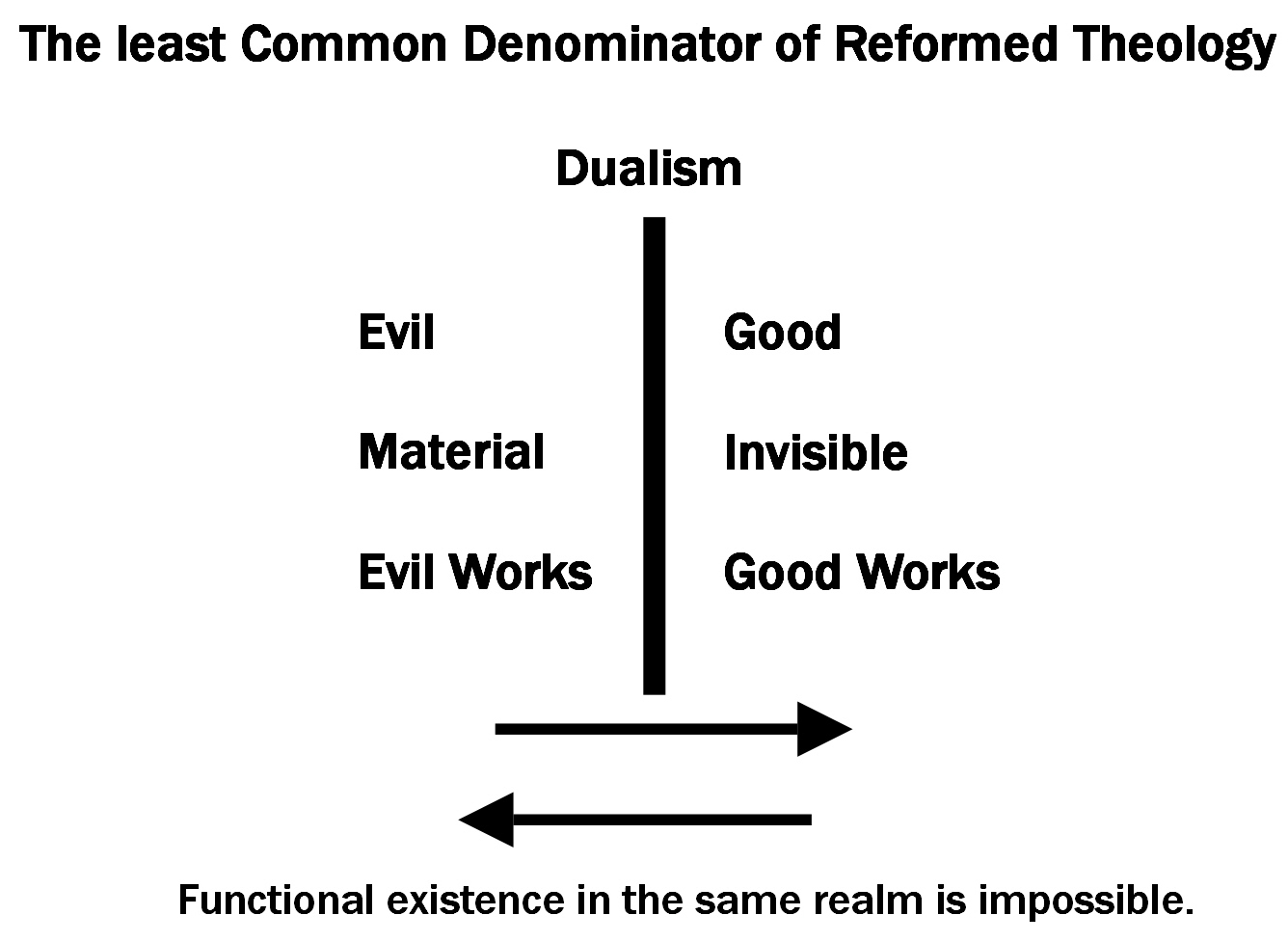
For Plato, that was math among other things, but along this same line of epistemology is dualism, or what’s called “co-eternal binary opposition, a meaning that is preserved in metaphysical and philosophical duality discourse but has been more generalized in other usages to indicate a system which contains two essential parts.” Do you see this in thesis 8? It’s pride and humility. We also refer to this as the either/or hermeneutic. There is no in-between, it’s either/or. There is no taking pride in what you do without being prideful. There is no taking of satisfaction from a job well done; you are either humble or prideful.
And, this is also key, what is humbleness’ key attribute? Right, fear; specifically fear of condemnation…”For where there is no fear there is no humility. Where there is no humility there is pride, and where there is pride there are the wrath and judgment of God.”
Your only chance of getting into heaven in the end is doubts that you will. Luther and Calvin both equated eternal security with damning pride. Tullian Tchividjian once joked that Presbyterians differ from Baptists because Presbyterians don’t call each other “brothers” because no one knows for certain whether that’s the case or not. The joke bought the house down, but as the saying goes, the truth in a joke is what often makes it funny.
Once again, this is also right out of the Calvin Institutes:
Let us, therefore, embrace Christ, who is kindly offered to us, and comes forth to meet us: he will number us among his flock, and keep us within his fold. But anxiety arises as to our future state. For as Paul teaches, that those are called who were previously elected, so our Savior shows that many are called, but few chosen (Mt. 22:14). Nay, even Paul himself dissuades us from security, when he says, “Let him that thinketh he standeth take heed lest he fall,” (1 Cor. 10:12). And again, “Well, because of unbelief they were broken off, and thou standest by faith. Be not high-minded, but fear: for if God spared not the natural branches, take heed lest he also spare not thee,” (Rom. 11:20, 21). In fine, we are sufficiently taught by experience itself, that calling and faith are of little value without perseverance, which, however, is not the gift of all (CI 3.24.6).
As we have discussed before, Calvin’s election construct has three categories: the non-elect, the temporary elect, and those who persevere. No one knows whether they make it or not until they are revealed as such in the final judgement. This is known as “final justification when the sons of God are made manifest.” Apparently, they are made manifest by their “accompanied good works” which were really performed by Jesus and not them. This aversion to eternal security is also demonstrated by the likes of John Piper:
There is danger on the way to salvation in heaven. We need ongoing protection after our conversion. Our security does not mean we are home free. There is a battle to be fought (John Piper: Bethlehem Baptist Church Minneapolis, Minnesota; The Elect Are Kept by the Power of God October 17, 1993).
Of course, the apostle John’s stated purpose for writing the book of 1John directly contradicts this idea. Let’s move on to thesis 9:
Thesis 9: To say that works without Christ are dead, but not mortal, appears to constitute a perilous surrender of the fear of God.
For in this way men become certain and therefore haughty, which is perilous. For in such a way God is constantly deprived of the glory which is due him and which is transferred to other things, since one should strive with all diligence to give him the glory-the sooner the better. For this reason the Bible advises us, »Do not delay being converted to the Lord.« For if that person offends him who withdraws glory from him, how much more does that person offend him who continues to withdraw glory from him and does this boldly! But whoever is not in Christ or who withdraws from him withdraws glory from him, as is well known.
Luther here has a problem with the idea that good works can be performed by the unbelieving or believing and such works do not condemn, but are merely dead works that cannot earn merits for justification. This now brings us to what the Reformers believe is the sole purpose for all existence: God’s glory. Any concession that man can do anything good robs God of glory.
Man can indeed do good works, but in regard to the unsaved, it is true that in the end that only results in less condemnation, but Luther isn’t even willing to conceded that. If people can do good works resulting in less condemnation—that robs God of glory. Furthermore, it removes fear of condemnation from some works which also robs God of glory.
This is why Luther’s disputation is said to be the cross story versus the glory story: any glory not given to God is claimed by man; hence, the glory story, or the story of man. It can’t be a story about God and man, All glory must be granted to God. You are either living in the cross metaphysical narrative or the glory of man metaphysical narrative.
Thesis 10: Indeed, it is very difficult to see how a work can be dead and at the same time not a harmful and mortal sin.
This I prove in the following way: Scripture does not speak of dead things in such a manner, stating that something is not mortal which is nevertheless dead. Indeed, neither does grammar, which says that »dead« is a stronger term than »mortal«. For the grammarians call a mortal work one which kills, a »dead« work not one that has been killed, but one that is not alive. But God despises what is not alive, as is written in Prov. 15:8, »The sacrifice of the wicked is an abomination to the Lord.«
Second, the will must do something with respect to such a dead work, namely, either love or hate it. The will cannot hate a dead work since the will is evil. Consequently the will loves a dead work, and therefore it loves something dead. In that act itself it thus induces an evil work of the will against God whom it should love and honor in this and in every deed.
This thesis makes another argument against the idea that good works can be performed by mankind, but they are dead works in regard to justification. If mankind can perform a good deed, if mankind is competent, if mankind has some sort of ability, then why would that not include the ability to choose? This speaks to the Reformed doctrine of total inability. The Reformed continually claim this doctrine as uniquely Reformed and contrary to all other religions throughout history. This is not true; in fact, the total depravity of mankind coupled with determinism of some sort has been the overwhelming norm from the beginning of time. We delved into this historical fact in our Romans series (lessons 55-64).
What I would like to focus on in this thesis is Luther’s mention of grammar and the “grammarians.” What is a grammarian? A grammarian is someone who studies world linguistics. A grammarian also studies the connections between linguistics and the interpretation of reality. By and large, a grammarian is going to take a literal approach to interpreting reality; ie., things are as they appear. Another way of stating it: reality can be understood empirically. Hence, man can reason and understand reality.
This is going to be my subject at this year’s conference. The Reformers did not hold to a literal interpretation of realty. Obviously, St. Augustine was heavily steeped in allegory. This is what most Christians don’t understand: the Reformation was about the interpretation of reality itself, and how the Bible should be used for that purpose.
The Reformers didn’t reject biblical grammarianism, but made it secondary to the redemptive view of reality, or the idea that all of reality should be interpreted by “the gospel.” If the use of grammar leads to a redemptive outcome, wonderful. If it doesn’t, you use allegory to insure a redemptive outcome. The Reformed therefore often claim to be grammarians which is blatantly disingenuous. And look, the Reformed camp is not the least bit shy about all of this. We can see in this thesis how Luther was willing to use the grammar for the outcome he desired. In essence, he is saying: look, if the simpleton grammarians even think that something dead cannot contribute anything to life, how much more should we believe it as well?
And look, the Reformed camp is not the least bit shy about all of this. In his book, “Uneclipsing The Son,” by John MacArthur confidant and rumored heir apparent Rick Holland, he states that “bad grammar makes good theology” (page 39). The who’s who of American evangelicalism endorsed the book, and John MacArthur wrote the forward. As should be surmised by the title, the book is an in-your-face Gnostic treatise. The whole eclipsing the sun motif is a well-traveled illustration in Neo-Platonist/Gnostic circles. In the forward, MacArthur makes shocking statements that include the following idea: the subordination of God the Father and the Spirit to the Son.
If one does not interpret the Bible as a grammarian, all bets are off. While the Catholics made printing the Bible illegal, the Protestants merely took away individual interpretation and made biblical knowledge “the Gnosis.” Also, here is an aside: why did Christ emphasize the new birth to Nicodemus? The guy was “the” teacher in Israel and had never even heard of the new birth. Why? because Judaism was saturated with Gnostic philosophy and the infusion of divinity into a mortal being was unthinkable. The guy’s very name even reflects the Gnostic politic: nico; victory; demus; people; or, victory over the people. The most prominent Gnostic sect of the day was the Nicolaitans which means “victory over the laity.”
Now, next week, we are going to use theses 11 and 12 as an introduction to thesis 13 and following where Luther gets into the foundational position of free will according to the Reformation. We have heard lots of discussion about freewill for many years; next week, we will define the issue.
The Magnum Opus of the Reformation: Martin Luther’s Heidelberg Disputation; Part 3
 Listen to the audio or download the audio file in separate window.
Welcome truth lovers to Blog Talk radio .com/False Reformation, this is your host Paul M. Dohse Sr. Tonight, part 3 of “The Magnum Opus of the Reformation: Martin Luther’s Heidelberg Disputation.”
Greetings from the Potters House and TANC ministries where we are always eager to serve all of your heterodox needs. Our teaching catalog can be found at tancpublishing.com.
If you would like to add to our lesson or ask a question, call (347) 855-8317. Remember to turn your PC volume down to prevent feedback.
Per the usual, we will check in with Susan towards the end of the show and listen to her perspective.
Remember, you may remain anonymous. When I say, “This is your host; you are on the air, what’s your comment or question”—just start talking.
If you would like to comment on our subject tonight, you can also email me at paul@ttanc.com. That’s Tom, Tony, Alice, Nancy, cat, paul@ttanc.com. I have my email monitor right here and can add your thoughts to the lesson without need for you to call in. You can post a question as well.
Let’s start out with an interpretation prism that just struck me this week. Have you ever thought about this? Think about it: all of Reformed doctrine developed during the Reformation presumed a church state. That means the doctrine itself was tailored for an outcome that required oversight by the state. So, if Luther came back from the dead and visited the church today he would be delighted in regard to the doctrine being taught, but would be absolutely aghast that the church is functioning without the state enforcement of orthodoxy. When Luther is showed the carnage of today’s church in this scenario, he says in the modern vernacular, “Duh, there’s no enforcement of orthodoxy. The patients are running the Psych ward!”
In other words, the doctrine presupposes bad behavior necessarily restrained by the enforcement of orthodoxy, and by the way, that’s exactly how Calvin ran Geneva. So, what we have today is a Protestant doctrine designed for a theocracy functioning in a representative republic. Just a thought, now let’s move on to thesis 7.
Thesis 7: The works of the righteous would be mortal sins if they would not be feared as mortal sins by the righteous themselves out of pious fear of God.
This is clear from Thesis 4. To trust in works, which one ought to do in fear, is equivalent to giving oneself the honor and taking it from God, to whom fear is due in connection with every work. But this is completely wrong, namely to please oneself, to enjoy oneself in one’s works, and to adore oneself as an idol. He who is self-confident and without fear of God, however, acts entirely in this manner. For if he had fear he would not be self-confident, and for this reason he would not be pleased with himself, but he would be pleased with God.
In the second place, it is clear from the words of the Psalmist (Ps. 143:2), »Enter not into judgment with thy servant«, and Ps. 32:5, »I said: I will confess my transgressions to the Lord.« etc. But that these are not venial sins is clear because these passages state that confession and repentance are not necessary for venial sins. If, therefore, they are mortal sins and »all the saints intercede for them«, as it is stated in the same place, then the works of the saints are mortal sins. But the works of the saints are good works, wherefore they are meritorious for them only through the fear of their humble confession.
In the third place, it is clear from the Lord’s Prayer, »Forgive us our trespasses« (Matt. 6:12). This is a prayer of the saints, therefore those trespasses are good works for which they pray. But that these are mortal sins is clear from the following verse, »If you do not forgive men their trespasses, neither will your father forgive your trespasses« (Matt. 6:15). Note that these trespasses are such that, if unforgiven, they would condemn them, unless they pray this prayer sincerely and forgive others.
In the fourth place, it is clear from Rev. 21:27, »Nothing unclean shall enter into it« (the kingdom of heaven). But everything that hinders entrance into the kingdom of heaven is mortal sin (or it would be necessary to interpret the concept of »mortal sin« in another way). Venial sin, however, hinders because it makes the soul unclean and has no place in the kingdom of heaven. Consequently, etc.
Ok, this thesis is about as clear as mud. But in context, this is how I interpret it, and by the way, most Reformed scholars agree: everything a believer does is evil whether it appears good or bad by human standards. Let me get to the crux here: if any person saved or unsaved thinks they can do a good work that God would look upon and say, “That’s a good deed, it won’t save him/her, but the deed in and of itself is a good deed” that’s mortal sin; ie., condemning sin.
Hence, a Christian is in a state of perpetual sin of the mortal type. Believing such, and attending every good work with fear is venial or forgivable sin. Saving faith is the belief that Christians are under condemnation. This is what the Reformed mean by the Christian life being lived out “subjectively.”
Good and bad things happen and we don’t really know what’s really good or bad or who is doing it or what kind of good or bad works they are.
Let me explain: first, as we saw in the other theses, what appears good to man is really evil, and what appears evil is really good. Man can’t even judge good from evil. For example, man sees suffering as bad, but all wisdom is hidden in suffering. Secondly, we have no way of knowing whether God is doing the work or we are doing the work. Remember Luther’s old and rusty hatchet illustration from last week? So, you just kind of live out your life subjectively, and whatever happens is ok just so you realize that anything initiated by you is evil, and what appears to be good might be a manifestation of Christ’s righteousness or one of your evil works by virtue of the fact that you did the work. Either way, you have no way of knowing as you are “living out justification subjectively” or what is known as “subjective justification.” The key is to live your life in fear that you might come to believe that you can do anything that has merit with God.
Do we have examples of this in our day? Sure we do. How often have you heard a professing Christian say, “I didn’t do it! I didn’t do it! It was the Holy Spirit who did it!” Often, you can even see the fear in them that someone will believe they did the work. This also relates to other people. I once had a congregant (a financially poor single mother) tell me that a person who gave them a car didn’t really give them the car (and I am talking a new car by the way), but rather it was the Holy Spirit who gave her the car. You see, if you concede that someone else can do a good work, that is also saying you can do a good work, and that’s mortal sin. Here is another one: “Jesus did it THROUGH me.” What’s that? That’s Luther’s old rusty hatchet, right? Like a hatchet, you are completely passive and God just picks you up and starts whacking away on stuff.
Where do people get this in our day? Right here—you are looking at it. The Heidelberg Disputation 1518 practically applied in 2015.
We are going to look at thesis 7 in a little more detail, but first, let’s get another big picture; let’s address this idea of perpetual condemning sin and the traditional Reformed remedy. We are going to call on our good friend John Calvin to help us with this. Obviously, if Christians swim in the waters of condemnation, there needs to be a remedy, so let’s go to a trusty Reformed commentary:
…by new sins we continually separate ourselves, as far as we can, from the grace of God… Thus it is, that all the saints have need of the daily forgiveness of sins; for this alone keeps us in the family of God (John Calvin: Commentaries on the Catholic Epistles; The Calvin Translation Society 1855. Editor: John Owen, p. 165 ¶4).
So, daily we ask forgiveness for mortal sin (that which removes us from grace), and this “ALONE” keeps us in the family of God. But wait, did you know there is only one place where you can get that ongoing forgiveness? Let’s again consult John Calvin to find out where that place might be:
Nor by remission of sins does the Lord only once for all elect and admit us into the Church, but by the same means he preserves and defends us in it. For what would it avail us to receive a pardon of which we were afterwards to have no use? That the mercy of the Lord would be vain and delusive if only granted once, all the godly can bear witness; for there is none who is not conscious, during his whole life, of many infirmities which stand in need of divine mercy. And truly it is not without cause that the Lord promises this gift specially to his own household, nor in vain that he orders the same message of reconciliation to be daily delivered to them (The Calvin Institutes: 4.1.21).
To impart this blessing to us, the keys have been given to the Church (Mt. 16:19; 18:18). For when Christ gave the command to the apostles, and conferred the power of forgiving sins, he not merely intended that they should loose the sins of those who should be converted from impiety to the faith of Christ; but, moreover, that they should perpetually perform this office among believers (The Calvin Institutes: 4.1.22).
Secondly, This benefit is so peculiar to the Church, that we cannot enjoy it unless we continue in the communion of the Church. Thirdly, It is dispensed to us by the ministers and pastors of the Church, either in the preaching of the Gospel or the administration of the Sacraments, and herein is especially manifested the power of the keys, which the Lord has bestowed on the company of the faithful. Accordingly, let each of us consider it to be his duty to seek forgiveness of sins only where the Lord has placed it. Of the public reconciliation which relates to discipline, we shall speak at the proper place (Ibid).
This is what the crux of the Reformed gospel is: a perpetual justification for perpetual condemnation. Do we have present-day examples of this? Sure we do; specifically, the interpretation of 1John 1:9 by many in Presbyterian and Baptist circles.
If we confess our sins, he is faithful and just to forgive us our sins and to cleanse us from all unrighteousness.
The idea that this verse proffers a continued repentance for “present sin” is fairly common in Protestant circles of all stripes. Of course, this boils down to keeping yourself saved via repentance. How is that not works salvation? But at any rate, it begins with this idea that Christians dwell in constant mortal sin that needs continued forgiveness.
Here is another example from real life: Susan was at the grocery store and ran into an old friend who is a member of a mainstream evangelical Baptist church. Somehow, the subject got onto alter calls, and Susan wondered aloud why churches have alter calls. Here was the lady’s answer: “Well, I guess people have sin in their lives that needs confession.” Why do people need to go to church to get that forgiveness? Again, we may be far away from 1518, but that doesn’t mean the fruit falls far from the tree my friends.
Let’s now look at some of the finer points of thesis 7.
To trust in works, which one ought to do in fear, is equivalent to giving oneself the honor and taking it from God, to whom fear is due in connection with every work. But this is completely wrong, namely to please oneself, to enjoy oneself in one’s works, and to adore oneself as an idol. He who is self-confident and without fear of God, however, acts entirely in this manner. For if he had fear he would not be self-confident, and for this reason he would not be pleased with himself, but he would be pleased with God.
We begin the finer points with misplaced fear. Biblically, there is to be no fear of condemnation; in fact, love and fear of condemnation are mutually exclusive:
1John 4:18 – There is no fear in love, but perfect love casts out fear. For fear has to do with punishment, and whoever fears has not been perfected in love.
Christians do not fear eternal condemnation because there is “NOW no condemnation” for those who believe (Romans 8:1). In contrast, Luther, as well as Calvin, cited fear of condemnation as the primary motivator of the Christian life. Luther has stated it here in thesis 7, but Calvin was a little more to the point:
Certain learned men, who lived long before the present days and were desirous to speak simply and sincerely according to the rule of Scripture, held that repentance consists of two parts, mortification and quickening. By mortification they mean, grief of soul and terror, produced by a conviction of sin and a sense of the divine judgment. For when a man is brought to a true knowledge of sin, he begins truly to hate and abominate sin… By quickening they mean, the comfort which is produced by faith, as when a man prostrated by a consciousness of sin, and smitten with the fear of God, afterwards beholding his goodness, and the mercy, grace, and salvation obtained through Christ, looks up, begins to breathe, takes courage, and passes, as it were, from death unto life. I admit that these terms, when rightly interpreted, aptly enough express the power of repentance; only I cannot assent to their using the term quickening, for the joy which the soul feels after being calmed from perturbation and fear. It more properly means, that desire of pious and holy living which springs from the new birth; as if it were said, that the man dies to himself that he may begin to live unto God (CI 3.3.3).
This quotation by Calvin also revisits the doctrine of mortification and vivification that we discussed in prior lessons. But the main point for citing this text from the Calvin Institutes is to show that THE primary motivator of sanctification according to the Reformers was, and still is condemnation and fear of future eternal judgement.
Just please let that sink in for a while. You can’t chalk this up to a secondary disagreement with the heroes of the Protestant faith, this is the heart and soul of their soteriology. Granted, biblically, Christians are to fear present consequences in this life, and that is one of the motivators for Christian living. This is Moses’ “blessings and cursings’’ that apply to believers and unbelievers alike. However, for unbelievers, while a moral life does lead to blessings in this life, it only results in lesser condemnation in the end. For the Christian, it’s more and more life unto life. Christ came that we may have life, and have it more abundantly. But, also, “judgement begins in the household of God” right? Remember Ananias and Sapphira? That event made the assemblies “fear” which actually spurred growth in the assemblies. But this is not a fear of condemnation. That kind of fear stifles love.
So let that sink in as well. Love cannot thrive in the midst of condemnation and the fear thereof. Why is the institutional church so messed up? Are you beginning to see why? Susan and I were talking about something for our grandchild to do this summer and the idea of VBS came up. I shot the idea down; for better or worse, I have studied all of this long enough to know I do not want my grandson anywhere near an institutional church that considers itself Protestant. What’s the alternative? Well, not a lie because it’s the only game in town. Christians need to get busy building true Christian communities.
But this is completely wrong, namely to please oneself, to enjoy oneself in one’s works, and to adore oneself as an idol. He who is self-confident and without fear of God, however, acts entirely in this manner. For if he had fear he would not be self-confident, and for this reason he would not be pleased with himself, but he would be pleased with God.
We could discuss the fact that the Bible plainly states that it is perfectly ok to take satisfaction in a job well done, but the bigger and finer point is the either/or interpretive prism that is a hard fast rule in Protestant teaching. We sometimes call this the either/or hermeneutic. This concept saturates Protestantism. You can’t please yourself and God, you either totally please yourself or totally please God. You can’t be confident enough to do a job well and take satisfaction in it without being arrogant; you either have NO self-confidence, or you are making yourself God—it’s either/or with no in-between. There is no balance.
Of course, this is the Platonist aspect of Reformed theology and is the natural result of the dualism philosophy that Platonism is based on. Furthermore, I strongly suspect that it all flows from the knowledge of good and evil doctrine first presented to Eve. I think that is a whole wide open frontier of research that hasn’t been explored yet.
So, tonight we only covered thesis 7 and will continue with thesis 8 next week.
Dee Parsons of Wartburg Watch: The Personification of Everything Wrong with Church
 When Paul’s Passing Thoughts .com was started in 2009, the goal was to find out why church turned on me with a vengeance despite my best efforts. Second to that was the question, “What now, where does one go from the point of diagnosing the problem?” You have to properly diagnose the problem before you can fix it.
This article will not wear you out with points leading up to a final conclusion; I will begin by stating what I have found. Church produces the fruit of its ideology. What is wrong with church? Answer: church is what’s wrong with church. Christ’s mandate to his followers was never intended to look anything like church. The solution is to depart from church and pursue Christ’s mandate to His followers. You can’t fix church. There is nothing there that is salvageable.
Let me back up a tad because this post is not the least bit personal, but seeks to sharpen the objectives of TANC Ministries. This is some information that I have not shared before. PPT was primarily a blog for the express purpose of sharing my research. My focus was research. I had to know why—how could dozens of pastors stand by and watch Clearcreek Chapel do to my family what they did?
Clearly, obviously, from a literal interpretive standpoint in regard to the Bible, what they were doing was dead wrong and unbiblical. During the episode, I was even under the counsel of a church that was part of the same fellowship of churches that Clearcreek Chapel belongs to. The pastor, the late Rick Wilson, was a former associate pastor at CCC. The present pastor of the church, Paul Craig, was an elder at the time and according to Wilson found the situation, “unsettling.” Grace Covenant (Beavercreek, Ohio) was obviously stuck in the middle, and was also the recipient of a significant exodus of people from CCC at the time. Though I was clearly under church discipline at CCC, I was allowed to attend Grace Covenant on a regular basis. I even thought about applying for membership which would have forced the Grace Covenant elders into making a judgment regarding the veracity of CCC discipline. I should have; watching that play out would have been priceless.
Eventually, Wilson instructed me to go back and play along in order to get my wife back, but I had already tried that for four months. During that time, I was subjected to cult-like break sessions conducted by CCC elder and Psychiatrist Dr. Devon Berry. The CCC elders knew that I had overcome serious depression in the past, and it was obvious they thought they could use Berry and the circumstances they were bringing to bear in my life to drive me into debilitating despair. It was very apparent to me at the time: that is what they were trying to do.
I want to stop right here and thank God publically for something right now—I want to give Him the glory. At the time, I was working out of town and laid in bed at night before going to work the next day…in perfect peace. My favorite time of the day during that time period was bedtime. Why? I laid there in the quiet darkness, not really thinking about anything except how peaceful it was. I was doing nothing but laying there soaking up the peacefulness. Do I have any theories regarding this experience? One: I had begun a long journey in search for the truth. God is with one on such journeys. That’s my best shot at answering that question. By all reasoning, I should have been a basket case.
Let’s now pause here for some simple clarification. It all boiled down to two things:
AUTHORITY, and how I interpreted reality versus how they interpreted reality.
I have discovered something in my research—research enables you to come to a point more and more where you can explain complex problems in simple terms. In the 2500 + articles I have written on Reformed ideology, you can see the focus move from the what to the why. My first book articulated the what and how it contradicted a grammatical interpretation of reality, though I didn’t understand the latter dynamic. My second book articulated the contemporary history of the Neo-Calvinism movement and added some more data about grammatical contradictions.
My third book and subsequent booklets articulate the grammatical contradictions in regard to soteriology. They also describe the dynamics between the Old Calvinism/New Calvinism question and how the interpretation of reality drives that debate.
Including time spent prior to PPT, eight years later, I can now put all of this in simple terms. It boils down to AUTHORITY vested in the interpretation of reality.
And, the established credential thereof known as “orthodoxy.” What is the premise of orthodoxy? Nothing more or less than the claims of men that people choose to believe. You can put any number of things in place of “naked” in regard to the following question posed by God, “Who told you that you are_____?” Be very, very, very wary of what men say God told you. And that’s orthodoxy. And the place we go to get certified in orthodoxy is called “seminary.” In case you haven’t noticed, God isn’t the dean or an adjunct professor in any of these schools.
 Here is something else that should be evident: you, and only you alone will answer to God. Therefore, pick your orthodoxy well. There are no attorneys in God’s court save Christ, “hear ye Him.” “God has spoken to us in these last days through His Son”, not a horde of academics.
So, what do we have in the recent dust-up between PPT and Wartburg Watch? Be advised, I am not going to rehash all of the gory details. Dee Parsons is right and I am wrong because she has college degrees, and holds to orthodoxy. Paul Dohse does not have college degrees, and does not hold to orthodoxy. Paul Dohse holds to a grammatical interpretation of realty, and therefore asks, “How can those who proclaim themselves ‘wicked’ lay claim to salvation?”
Be sure of this: NOTHING has changed since Christ ministered on earth. The primary pushback against Christ was clearly the orthodoxy of the day. Christ deliberately avoided the lauded academia of that day. I just don’t know what is more obvious. In addition, he had to personally reeducate the apostle Paul who was the only religious academic that He used for foundational purposes.
I am weary of documenting the steroidal cognitive dissonance that takes place over at Wartburg and their e-church hosted by the Barney Fife of pastors, Wade Burleson. Regardless of his credentials, from a standpoint of interpreting reality grammatically, his theological snafus are just plain embarrassing. For example, you can’t make the point that a biblical author was teaching something based on the analysis of a word that didn’t exist in the first century. This all takes place in the face of common sense for the same reason I experienced what I experienced at CCC:
AUTHORITY vested in a particular interpretation of reality.
Because one is credentialed in knowing how to lead those who cannot know reality, one should have authority over you for your own good and the common good of people in general.
In varying degrees, CHURCH, established in the 4th century by St. Augustine et al, is the expression of this primary root, and the fruit doesn’t fall far from the tree. Chaos and drama will continue in the church with no solution in sight because of its foundational presuppositions concerning the interpretation of reality and the authority vested in its epistemology.
This ministry’s series on the Heidelberg Disputation focuses on the following fact: at issue with the Reformation was a debate about the interpretation of reality. Of course that spoke to how the Bible is interpreted, but the issue started with how reality itself is to be interpreted. Let me give you the thumbnail:
Words don’t necessarily mean things.
By and large, there are two kinds of Protestants roaming about, Calvinists and functioning Calvinists. Susan and I often have conversations with people who hate Calvinism, but verbally espouse Calvinism unawares constantly. We don’t even address the particulars anymore because we know a complete reeducation is needed. This is what we are attempting to do with the HD series. This series reexamines the roots of the poisonous tree.
This is why Dee Parsons, in the recent dust-up, insinuated that I am mentally ill. What is the definition of a person who does not properly perceive reality? Hence, the CCC elders involved a Psychiatrist in my situation because they honestly believe I am mentally ill because I interpret reality grammatically. Reformed scholars such as Geerhardus Vos have stated such openly. Pastor Russ Kennedy told me I was “mad” and begged me to allow them to “shepherd” me. I believe the guy honestly meant well and still does. Unfortunately, as the saying goes, the road to hell is paved with good intentions.

By the way, I am not talking about grammatical interpretation that leads to a redemptive outcome. I am talking about the interpretation of reality beginning with exegetical presuppositions in the purest sense. I realize Reformed scholars interpret a verse literally when it can serve a redemptive historical outcome…
…that doesn’t make you a proponent of interpreting reality grammatically.
One of the accusations that flowed from the recent dust-up was that TANC Ministries is merely developing its own orthodoxy. Not so. Orthodoxy fundamentally interprets reality according to Martin Luther’s Heidelberg Disputation which was expanded upon by John Calvin’s Institutes of the Christian Religion. Seminary degrees guarantee that individuals will not do independent research that will reveal the real tenants of orthodoxy:
- It is a metaphysical redemptive narrative that interprets all reality through a dualism of good and evil.
- It demands the fusion of faith and force for the common good of mankind.
- It is predicated on spiritual caste that adds additional mediators between God and man other than Christ.
- All of reality progresses as predetermined by manifestations of good completely outside of man.
Dee Parsons’ response to me that “I don’t believe what you say I believe” is most likely due to her ignorance regarding the true sum and substance of the same Reformed orthodoxy that she promotes. Perhaps. While claiming to be an advocate for the spiritually abused, she picks and chooses from orthodoxy what she wants to acknowledge.
The Westminster Confession is just wonderful, but its call to control the free press and execute those who are heterodox is due to the authors being “men of the time.” Of course, their politics and ethics had nothing to do with their ideology. Perish the thought, and no, American Jurisprudence isn’t the only difference between Calvin’s Geneva and the present-day church. It’s absurd to think Dee Parsons would actually have you committed to a mental institution because she thinks you are mentally ill. It’s absurd to think Mark Driscoll would really put you in a wood chipper just because he said that’s what ought to be done. It’s absurd to think James MacDonald would catapult you into the next county, and to your certain death just because he said he wishes he could.
Church is a place where professional clergy interpret reality in a completely different way than most parishioners. Congregants follow the dictates of church leaders while being clueless in regard to their interpretation of reality. They are given elements to follow while being totally unaware as to what those elements are based on. Hence, chaos and confusion reign. Duggar-like drama is paraded before the world constantly like an out-of-control stampede of rats. Yet, that isn’t the madness; the madness is suggesting that we rethink how church is done. After all, Catholicism and Protestantism have had only 1500 + years to get it right. Not only that, the Neo-Calvinist movement has been in total control of the church for at least ten years. Growing steadily since its conceptual resurgence in 1970, discernment/spiritual abuse blogs exploded in 2009 when the movement shifted into 4th gear. Starting in 2008, a historical phenomenon of mediation organizations to keep churches out of court exploded onto the scene as well.
With all of this considered, I think I have heard the best assessment of Wartburg Watch yet:
Subconsciously or consciously, Dee uses her blog as a means to leverage her desire for a seat at the American church’s authoritarian table. Period. Whether this was an initial objective of her blog or merely a pitfall of unforeseen success, who knows? But the reality is obvious:
Dee creates better soldiers, not better souls. And the irony is thus that the “victims” who frequent her site often become the very image of that which they initially despised: manipulative self-appointed God-proxies who claim that the only legitimate doctrinal discussions are with those whom already concede their reformed hermeneutic (Muff Potter, anyone?).
My point is that the cognitive dissonance, the categorical rejection of reason as a yard stick for measuring reality (the efficacy of existence), makes contending with her an almost perfect waste of time.
So what’s the solution? I believe the solution is an utter rejection of orthodoxy and church as we know it. The immense ramifications of that is not the issue—truth is the issue. The church has had its chance to make a case for hope, and has not measured up.
I believe the task ahead is daunting, but will supply a freedom and joy beyond our wildest imaginations. It is a call for Christians to submit themselves to the one mediator Jesus Christ. It is a call for Christians to stop listening to men, and “hear ye Him.” Orthodoxy has NO authority, ALL authority has been given to Christ and no one else.
Past this, God’s people must gather together for mutual encouragement and edification in the ways prescribed by the Bible and not the traditions of men.
When is the misery and suffering produced by orthodoxy enough to make us question everything?
That time is well past.
paul
Why Home Fellowships Can Help Abused Women and the Institutional Church Cannot

In our vision for a return to the way Judeo-Christian assemblies were done for about the first 300 years, let’s look at why home fellowships can help abused women and the institutional church cannot.
I would like to use this article as a catalyst for argumentation. The article was posted (author is not clearly stated) by Anna Wood who co-authored a book with Jeff Crippen, a Reformed pastor. The book can be found here.
The post is titled, What domestic abuse victims need from the church. My contention is that abused women cannot get what they need from “the church” as demonstrated over and over and over again. In fact, clearly, as also demonstrated over and over and over again as well, the institutional church adds to the abuse and becomes a co-abuser.
Why is this? The article offers a perspective from which to answer. This issue also speaks to the differences between home fellowships and the institutional church, hereafter “the church.” In an institution, it is easy to sign on the dotted line, give at the office, and pretend. Pastors can bark from Calvin’s Geneva pulpit all they want to; all folks have to say is, “Hey, I am a member in good standing, and as often heard, humble and incompetent—it’s not my gift and I am not qualified.” Likewise, in said article, the author’s call to “get involved” is going nowhere in the church in case anyone hasn’t noticed.
To the contrary, home fellowships are comprised of people who are sick of playing church, are weary of being mere spectators, and are not looking to walk into an arena with hungry lions, but know it could lead to that. They are also confident in the Spirit-filled laity and recognize where 500 years of academic popeism has brought us. In addition, they have a literal view of reality versus the functional dualism that drives orthodoxy. What am I saying? I am saying that home fellowships have a radically different worldview than orthodoxy and this will lead to aggressive participation in all kinds of needs.
Let me further this point by using the article at hand:
Statistics say that one out of four women in the United States experience domestic abuse of some form in their lifetime. Men can also be victims of domestic abuse. When those who have suffered are members of the Lord’s church, the faithful among them have an obligation to help them. And, if we know of someone in the community who is being abused, I also believe we have an obligation to help if we can. When, for whatever reason, we shy away from this obligation, either through ignorance or willful refusal to get involved, we lay waste to the Gospel we claim to believe. Christians are called to defend the oppressed yet when it comes to domestic violence, so few do.
What abuse victims need from their fellow Christians is pretty simple and straightforward. We need you to be Jesus to us. Do what He would do, say what He would say, were He the One ministering to us. Isn’t that what we all need from each other, anyway? Christians are called to stand in the place of Christ here on the earth and be His representative and do the works He would do. To fail in this is to fail in serving Christ.
Whoa, what a minute here! This is entirely unrealistic because of the message constantly drilled into the heads of Protestants. We are “all just sinners saved by grace.” We are, according to one prominent evangelical, “enemies of God.” According to yet another, “we hate God.” On the one hand, it is constantly drilled into the heads of those in the church that “when you are dead, you can do nothing,” but on the other hand we really think that parishioners shouldn’t think twice about getting involved in a domestic abuse situation?
First of all, getting involved in domestic violence is not “pretty simple.” Actually, it can get you killed by someone who doesn’t much appreciate your intervention. Moreover, getting the facts and evaluating the situation biblically is far from simple. Now couple that with the constant total depravity of the saints mantra heard in the church and it is little wonder that few will get involved in domestic abuse needs. The completely upside down worldview of the church makes laity involvement in domestic abuse nothing more than a pipe dream.
And, “Christians are called to defend the oppressed yet when it comes to domestic violence, so few do.” This complaint is not only a mere symptom, but is not even a symptom of the real problem. Congregants not only fail to defend the oppressed, they either turn a blind eye or defend the defender of the abusers—the church. Ever heard of SGM? Ever heard of ABWE? Ever heard of the SBC? In case you haven’t noticed, they are not only still in business, but business is booming! Why? Because regardless of what happens in the church, it is the only ticket to heaven. “What? so billions of people should go to hell because some bad things happen in the church that is made up of sinners? Well, get a grip—where there are people, there is sin!” That is in quotations because this is exactly what we hear in response to a “cry for justice.”
So far, if you are keeping notes, we have two reasons the church cannot help abused women: 1. The total depravity of the saints resulting in a few “experts” attempting to minister to a massive throng 2. Salvation is found in the institution, and therefore the institution will be defended at all cost. Better that a few suffer by themselves rather than all of humanity being sent to hell.
Before we move on to the next points, a little more clarification: why does the church defend abusers? It starts with its worldview. Without going into a lot of detail, we must first recognize that Calvin and Luther are the church’s heroes, and then recognize what their “theology of the cross” was all about. This is a philosophy that interprets all reality via the suffering of the cross. As Luther stated, “all wisdom is hidden in suffering.” Luther, as well as Calvin, split reality into two epistemologies: the cross story and the glory story. Only preordained leaders can lead the great unwashed masses in the cross story—only the preordained can save humanity from the story of man, or the glory story. As Al Mohler once said, “pastors are preordained to save God’s people from ignorance.”
 However, theologians of the cross and the spiritual peasantry have something in common: we are all just sinners saved by grace. So, everything going on in the material realm is fairly insignificant—it’s just the same old sin and dance anyway. But by the same token, theologians of the cross are preordained of God and invaluable. And besides, many are icons of the institution that keep the money rolling in. Sure, you can reject this theory and opt for another one, but in the process you will drive yourself nuts trying to figure out why ABWE defended and protected Donn Ketcham until the bitter end.
Need another example among myriads? What about Jack Hyles? The guy was a mafia don dressed in Bible verses and is still a spiritual hero among many Baptists. David Hyles, Jack’s son, was also a well-respected pastor in the church who had affairs with at least 19 women and is a suspect in an unsolved murder. Yet, to the best of my knowledge to date, David Hyles is still invited to speak at Baptist conferences/churches and receives robust ovations. Jack Hyles remained in the pulpit until his death in 2001 and was succeeded by his son in law Jack Schaap who is presently in prison for statutory rape. Jack Hyles is notorious for his quip, “If you didn’t see it, it didn’t happen” and is still revered among many Baptists as the best preacher since the apostle Paul.
The article continues with its list of things abuse victims need from “the church.” But the thesis of this article is that the church is not only unable to supply these things, but becomes a co-abuser. In contrast, the original Christian model for fellowship is well able to help and more likely to do just that.
First on the list is “The Pure Gospel.”
The church long ago got away from the pure gospel. We water it down, mix it up and serve it with a side of fun. No wonder it doesn’t save. It can’t save. It’s poison. We need preachers dedicated to the truth of God’s Word who are willing to stand up and preach that truth without changing it one iota. We need Christians who long after righteousness. When we have that–the pure Gospel preached and lived–we’ll see more Christians helping abuse victims and we’ll see less abusers masquerading as Christians.
Uh, ok, not sure how to add to this. It’s a stunning admission while calling on the same church to do something about the problem it has created. We don’t need “preachers” to do anything. Preachers have been preaching long and hard for thousands of years and the results are evident. We need God’s people to stand up and get back to the first works of home fellowship. The laity waiting on the experts is long traveled and worthless. More of what is beginning to happen needs to happen more and more. Ordinary Spirit-filled Christians are meeting together around the word and fellowship, and seeking God’s face in this whole matter about how church is traditionally practiced. And the fact that the church is grounded in a false gospel is something I addressed in another article posted today and Friday.
Without addressing every single point in the article other than those mentioned already, let me move on to this one:
Someone to care for their needs
Do you know what keeps a lot of abused women and children with their abusers? The lack of money to leave. If a woman is trying to get herself and her children to safety, don’t spend time telling her why she’s wrong, what you think about her decision or trying to talk her out of it. She knows what it’s like to live in abuse and you don’t. Even if she stays, chances are great that she and her children need something or maybe a lot of things. Financial abuse often accompanies other types of abuse. Instead of lecturing, get busy serving and help them.
According to the first-century model, a home fellowship network would be several small groups meeting in several homes in the same geographical area. And because of freedom from massive infrastructure cost and “tithing” versus New Testament giving based on NEED only funds and resources to help the abused would be ample. In fact, I could share an example from our very own home fellowship. We have a young lady living with us, and other people connected to our fellowship contribute financially to her needs. She is fully supported independently from anybody who might be a problem in her life. And when people live with you, trust me, you know the facts and you do a lot of listening. She will be completely self-reliant this month after living with us for about two years.
In regard to a different kind of abuse, a home fellowship network that I know of in Africa operates in the following way: the network assimilates street orphans from Nairobi into their fellowships. There is a leader from the network, equipped with the latest information about funds and availability that goes into Nairobi searching for orphans, and upon finding some, brings them back to the fellowship network where they will have a home, food, protection, and education. Let’s say that our home fellowships are connected with theirs; many of these children could be brought stateside and assimilated into fellowship here as well.
In addition to being freed from the bondage of infrastructure expense, the authority of the church’s clergy is suffocating. Clergy, more times than not, are control freaks obsessed with keeping the herd calm. They are spiritual cowboys constantly concerned with the herd being spooked. This speaks to the rest of the concerns in the post being considered here. More times than not, the laity are kept in the dark concerning the needs of those abused. There is a wall of confidentiality between the church’s “trained” counselors and the parishioners who fund the whole mess. When red flags are raised in regard to how certain situations are handled, we are told that “we should trust the elders who are closest to the situation and know all of the details.” This continually proves to be a recipe for disaster, and elders are granted NO such authority via the Scriptures.
Small groups in private homes offer intimate support and confidentiality from the other home fellowships. It is a perfect balance of intimate care and financial support if needed. All of the different gifts and experiences of Christ’s body are brought to bear on the situation.
Also, we must remember that the home fellowship movement is comprised of people from all walks of life: policemen, mental health professionals, etc., etc. These people or their areas of expertise are not separated from any situation by the professional clergy for inappropriate reasons.
paul

 Paul's Passing Thoughts
1 comment