Helping People with Obsessive-Compulsive Disorder (OCD)
 Obsessive-compulsive behavior (OCD) “is an anxiety disorder characterized by uncontrollable, unwanted thoughts and repetitive, ritualized behaviors you feel compelled to perform.” The common symptom most of us are familiar with is excessive handwashing. However, the experts also associate OCD with hoarding.
That’s interesting. According to the experts, many hoarders smitten with OCD fear that something bad will happen to them if they throw away certain items. I can relate as I will not throw a Bible away. I relate the trash with things that are of no value. When I first became acclimated to the use of computers I was emailing a close friend. I wouldn’t delete his emails because the lingo for the email service I was using was “trash.” I soon learned how to use email folders to store all of his emails. Likewise, I will not throw away cards people send me, especially family. So, I would disagree with the experts that hoarding is completely fear driven. I think other issues are at play in regard to hoarding while not excluding fear altogether from that equation.
Things like excessive handwashing are easier to address because clearly that is fear driven. The Bible is pretty clear on the dynamics of fear. First of all, we know that the works of the law are written on the hearts of all people born into the world. That means valuing life is intuitive. We are wired to love life. And of course, that is one of the many reasons that I have devoted what’s left of my life to exposing the dangers of Protestantism; the doctrine is predicated on the total depravity of man and mankind’s inherent worthlessness. So, what’s up with the anti-abortion movement? Well, with any religion, fewer numbers in the pool of resources is not beneficial, but that is a subject for another time and probably better addressed by Sean over at Oligarchy White Paper.
So, healthy and wise fear defends life; that’s first. Let’s now discuss what gets healthy fear out of whack according to the Bible. This will also explain why Protestantism will be no stranger by any means to OCD. Fear has to do with judgement or CONDEMNATION.
Fear has to do with judgement, or eternal condemnation, and judgement follows death. This is why people fear death: because they know intuitively that judgement follows death. Invariably, death means giving an account to God. The Bible states that the sting of death is the law because the law condemns.
1Corinthians 15:56 – The sting of death is sin, and the power of sin is the law. 57 But thanks be to God, who gives us the victory through our Lord Jesus Christ.
Sin is empowered by condemnation. If you take away sin’s ability to condemn, it has no purpose to exist. Sin is described in the Bible as a “master” that seeks to enslave. It does so through fear of judgement. Therefore, sin is empowered by the law. No law, no condemnation, and death has no sting (fear of the judgement that comes afterward). The crux of unhealthy fear is ignorance in regard to law.
This is an “imputation” that is not discussed nearly enough in Christian circles. ALL sin is against the law. This is the way God set things up. This is reality. As the law was added over the years, sin increased. Nevertheless, this is why Christ died on the cross, to END the law. Christ didn’t go to the cross to die for sins per se, but all sin against the law. When Christ died on the cross, He cancelled the law and all sin against it. He also cancelled any judgement or condemnation; the judge has no law from which to convict.
Keep in mind, there has always been the law of God written on the hearts of every individual that is administered by the conscience, and either accusing or excusing us, but God added the written code for the purpose of imputing sin. All sin is against the law (1John 3:4). The written code was added for the express purpose of holding sin captive (Galatians 3:22).
Let’s take a look at a particular Old Testament passage.
Zechariah 3:1 – Then he showed me Joshua the high priest standing before the angel of the Lord, and Satan standing at his right hand to accuse him. 2 And the Lord said to Satan, “The Lord rebuke you, O Satan! The Lord who has chosen Jerusalem rebuke you! Is not this a brand plucked from the fire?” 3 Now Joshua was standing before the angel, clothed with filthy garments. 4 And the angel said to those who were standing before him, “Remove the filthy garments from him.” And to him he said, “Behold, I have taken your iniquity away from you, and I will clothe you with pure vestments.” 5 And I said, “Let them put a clean turban on his head.” So they put a clean turban on his head and clothed him with garments. And the angel of the Lord was standing by.
6 And the angel of the Lord solemnly assured Joshua, 7 “Thus says the Lord of hosts: If you will walk in my ways and keep my charge, then you shall rule my house and have charge of my courts, and I will give you the right of access among those who are standing here. 8 Hear now, O Joshua the high priest, you and your friends who sit before you, for they are men who are a sign: behold, I will bring my servant the Branch. 9 For behold, on the stone that I have set before Joshua, on a single stone with seven eyes, I will engrave its inscription, declares the Lord of hosts, and I will remove the iniquity of this land in a single day. 10 In that day, declares the Lord of hosts, every one of you will invite his neighbor to come under his vine and under his fig tree.”
The new garments are NOT Christ. The new garments represent the righteousness of the Old Testament saint as a result of believing in the coming branch that would take away the sins of the world, not just cover them. If anything, other than representing righteousness, the new clothing would represent the law before it would represent Christ. The Old Testament saint, along with his/her sins, was held captive by the law of condemnation until Christ died on the cross to end the law and “set the captives free.”
But don’t get lost in all of the theology. Here is the simple point: those who are under grace are able to keep fear in perspective. There are only two people groups in the world: under law, and under grace (Romans 6:14). The Bible is very specific about the difference: those under law face judgment according to the law and certain condemnation. This empowers sin and puts the sting in death leading to all kinds of unhealthy fear in various and sundry forms.
Where confusion comes, in follows the idea that there is no law in grace. The law (the Bible) is the Holy Spirit’s law; He will use it to convict the world of sin and the judgement to come, or He will use it to sanctify believers. This comes about by believers learning about the Bible and using its wisdom for the sole purpose of loving God and others while knowing that the law’s ability to condemn has been cancelled. For the believer, death is still an affront to their love of life, but death doesn’t threaten to condemn them for eternity. Those under threat of judgement may be given to debilitating fear. “The unbelieving flee when no one pursues.”
Let’s pause to examine a particular verse:
1John 4:18 – There is no fear in love, but perfect love casts out fear. For fear has to do with punishment, and whoever fears has not been perfected in love.
Unfortunately, the English doesn’t do well in accurately reflecting the Greek word “mature” in this verse. Mature love casts out fear. Those who are overtaken with fear are not maturing in love. This verse is better thought of in this way:
There is no law in love, but those who are growing in grace experience a casting away of the law’s condemnation because law has to do with judgement. Those who have a hopeless fear of death are not learning the law and applying it to their lives in order to love God and others. This is what casts out fear.
This is why OCD will be just as prevalent among Protestants as it will be among the under law crowd. Protestantism has a singular perspective on the law: it can only condemn. This results in confusion about law among many professing Christians. Because there is only one perspective on the law, i.e., it must be kept perfectly in order to fulfill righteousness, complex soteriologies emerge that seek to fulfill the law via substitutions of all sorts. Think, “various and sundry denominations.”
For the most part, these false constructs replace the pursuit of love via the law with rituals that fulfill the law completely in our stead. In the case of the Galatians, they replaced “faith WORKING through love” with circumcision and the observance of days and dietary laws. They believed this fulfilled the whole law in their place. Whether folks want to face up to it or not, Martin Luther and John Calvin did the exact same thing with the following construct:
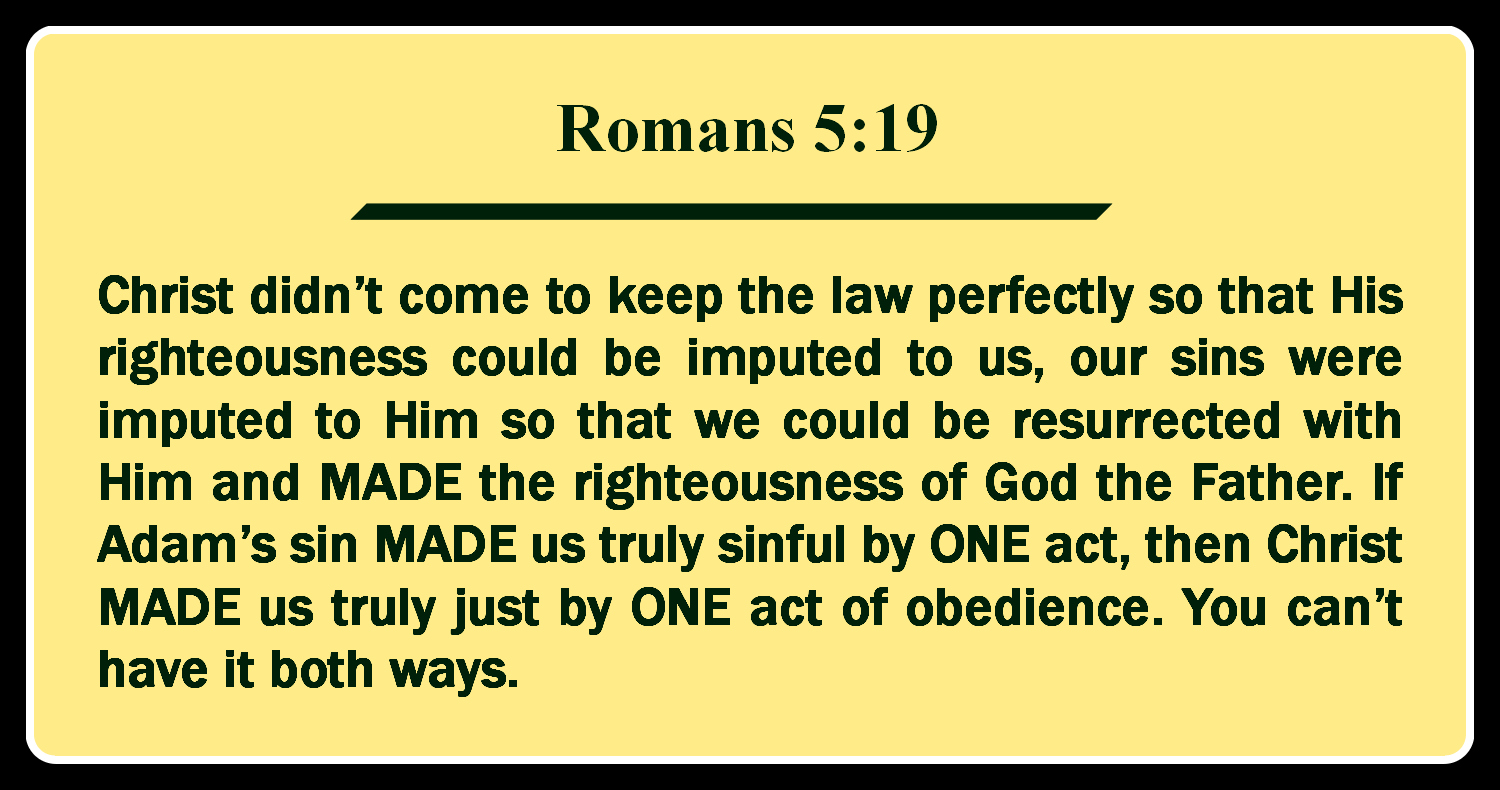
If you obey these certain rituals, the perfect obedience of Christ to the law will be imputed to your life, and this will keep you justified positionally.
But that’s still under law. It matters not who keeps the law—under law is still under law.
The fearful person must know that the law cannot condemn them. They must know that there is NOW…NO condemnation for those who believe in Christ (Romans 8:1). Death is indeed unfortunate and sad, but to the one under grace it does not destroy the present life as well through unhealthy fear.
The motives for obedience by the one under grace should not be questioned because obedience for justification is a metaphysical impossibility. The only reason left for one under grace to obey the law is love. But if you will notice…
…the fearful are crippled in their ability to love others, no?
For example, those who have an unreasonable fear of crowds will fail to support loved ones at special events, etc. When you are spending all of your time washing your hands along with all sorts of other preventative rituals, it is obviously more difficult to serve others. And unfortunately, these fears become habit patterns. The body will be trained over time to react to certain situations and fears in habitual ways.
We are created in the image of God and have many of God’s characteristics…but it is never said that God fears as far as I can tell from the Scriptures. After Adam and Eve disobeyed God, fear indeed was the very first symptom causing Adam and Eve to hide from God. Death brings us face to face with God.
But those under grace have no need to fear judgement or condemnation from God. The Bible states that this particular fear of condemnation is the source of fear run amuck, and it cripples our ability to love. Christ died on the cross so that we can follow Him in death—this is the Spirit’s baptism. One who is dead is not under the law (Romans 7:1ff). Even if your body is exhumed and taken into court, the judge has no law to judge you with for Christ ended it. You only went to one court hearing after you were resurrected to new life: adoption court where the Holy Spirit stood with you and testified that you have been adopted by God the Father. He knows, He resurrected you with the same power that He resurrected Christ with.
The unbelieving must be born again, and the Protestant must come to a proper understanding of the law. The fearful must follow Christ in the baptism of the Holy Spirit through trust in what both have accomplished for us. In both cases, unhealthy fear is robbed of its power. Death is unpleasant, but not a terror. Slowly but surely, fearful believers who keep reminding themselves that they are not under condemnation will replace fear with love more and more.
Christ came that we may have life, and have it more abundantly. It is our duty to call on believers to seize and lay upon the many precious promises secured by Christ on the cross through horrendous suffering. Seize upon the purpose of his death, that is, to give life. Christ died for life, not more death…unless you speak of the former self.
Romans 8:14 – For all who are led by the Spirit of God are sons of God. 15 For you did not receive the spirit of slavery to fall back into fear, but you have received the Spirit of adoption as sons, by whom we cry, “Abba! Father!”
As Christians love more and more, their consciences do not condemn them. The law written on the heart is still operative. If Christians are weak in love, an accusatory conscience can tempt them to believe they are still under condemnation of the law. When Christians violate their conscience whether biblically informed or not, they should seek fatherly forgiveness, but not forgiveness to prevent condemnation. By the way, part of the cure for fearful Christians is to address God as Father in prayer, not just God, especially a god of condemnation. Christ did not come to condemn the world, but to save it. Also, the Bible is clear: Christians should fear present consequences for sin, but NEVER eternal condemnation.
I know that a popular consensus claims that ALL phobias are a medical problem. Nevertheless, the spiritual aspect should always be addressed. In most cases, the need for medication will eventually vanquish, and with the doctor being in agreement. I must point out that I am aware of situations where medical doctors insisted that medication for such things are an ongoing need for life, and such did not end up being the case at all. In most cases, it is a spiritual problem.
And by the way: counseling that teaches the fearful to devalue life is an ill-advised solution. The fear of death may be gone because life deserves death anyway, but that will hardly lead to a life of love. Obviously.
paul
The Scream of the Damned and “How Much?” Christ’s Descent into Paradise
 Yesterday, I wrote a post regarding the Reformed doctrine of double imputation. This Reformed doctrine was developed to deny the idea that God infuses righteousness into believers through the new birth. Supposedly, Christ lived a perfect life so that His righteous can be imputed to believers for purposes of living by faith alone in sanctification. As discussed, this begs the question: “How much?” Is that why Christ lived 30 years? Is that what it took to secure enough righteousness to get the elect into heaven? And of course, PPT continually points out why this is sooooo wrong on many levels.
The other side of double imputation suggests that Christ died for each and every sin of the elect only. So therefore, in the same way another question is begged: how much suffering was necessary?
Now enter Christ’s decent into “hell” while He was on the cross as noted by, 1 Pet. 3:18-20, 1Peter 4:6, Ephesians 4:8-10, Acts 2:31, and Galatians 3:21-27. Here at PPT we think it is pretty obvious what these verses refer to. Old Testament saints were covered, or protected by the law until Christ died on the cross. The law was a “guardian” until “faith came.” This is the imputation that is not talked about nearly enough: the imputation of sin to the law because “all sin is against the law.” Sin is “held captive” by the law until one believes in Christ who ended the law. In this way, OT believers were “captives” as the law was a guardian that protected them until “faith came” (Christ).
By the way, that atonement is ended for believers, but not unbelievers. Presently, every sin an unbeliever commits is imputed to the law because all sin is against the law and where there is no law there is no sin. People will either be judged by the law at the final judgement, or they will believe on Christ and have the law ended along with every violation they committed against it. This law also includes the law of conscience written on the heart of every person born into the world. Apparently, those who have no knowledge of the Bible will only be judged according to conscience while the religious who have biblical knowledge will be judged by both.
So, when OT believers died, they went to “the abode of the dead.” According to Christ’s “parable” in Luke 16, it was divided into “Abraham’s bosom” and a place of torment. Yes, I believe Christ’s illustration in that chapter is to be taken literally, and was Christ’s description of an actual event. Christ never earmarked the illustration as a parable per His custom when he utilized parables. Hence, when Christ went to “paradise” to preach to the captives He took the thief on the cross with Him. I would say the thief got one whale of an education on that day. Christ preached victory to His enemies and led the captives free, and took them to heaven. Then, upon arriving in heaven, He poured gifts out on His assembly.
But…when your doctrine is predicated on the false presuppositions of Reformed double imputation, Christ’s descention must now be used in a lame attempt to answer the “how much?” question. The result is the notion that God actually sent Christ to hell for the purpose of adequately paying the penalty for the elect. This includes the idea that Christ emitted a horrific scream on the cross as He suffered in hell for the sins of the elect.
Yes, you too can pay $80,000 for a seminary education where you will be required to believe such things in order to get a job. Ya, do that. Go for it Bubba.
How much? Christ’s death ended the law. His resurrection infuses life. One death for life everlasting. Two single acts, one by Christ and one by the Spirit. That is enough—that secured our salvation.
paul
The False Protestant Gospel of “How Much?”
“At any moment, any lost person can choose to have their sins ended. It is not a question of whether or not they are elected, it is a question of whether or not they are under the law—and they are.”
The Protestant gospel effectively denies the biblical interpretation of the new birth. Because of its Platonist metaphysical presuppositions, it denies the treasure of God’s seed dwelling in weak vessels. Hence, the new birth is redefined and confined to the ability to perceive realm manifestations apart from any ability to do a good work of any kind. As stated by some, “Sanctification is done TO you, not BY you.”
In the biblical good news schema, Christ does ONE act of obedience as His part in God’s reconciliation plan. There is no question of “how much?” because His death was all that was required.
Now enter the heinous “Reformation” gospel of confusion. A cursory observation of Reformation history reveals that the dust-up between Rome and the “Reformers” was over metaphysics first. The very first and foundational doctrinal statement of the Reformation contained 12 theses of philosophical metaphysics. Luther was miffed that Rome was moving away from its Augustinian/Platonist roots and coming under the spell of Thomism. This shift began in the 13th century via St. Thomas Aquinas and eventually incited the Reformation. The assertion that the Reformation was driven by sola scriptura is absurd.
Martin Luther introduced his metaphysical answer to Thomism and foisted his theses that supported it onto Scripture. The centerpiece eventually came to be known as double imputation. To Luther’s credit, he created a timeless soteriology based on metaphysics that continues to turn the world upside down. John Calvin articulated Luther’s foundation in the Institutes of the Christian Religion. Both were dedicated to returning the church to its Augustinian roots.
What is double imputation? Basically, it’s the idea that Christ’s role in the gospel of first importance (as set apart from God’s full counsel which is also good news) was twofold as opposed to ONE single act. This was necessary as a “biblical” doctrine that keeps the material being of man separate from Plato’s trinity: the good, true, and beautiful, ie., the invisible. The true gospel turned dualism philosophy completely on its head by infusing good into weakness and defining the true definitions of God’s creation and the state of being.
The idea that God infused His righteousness into the being of mankind is repugnant to the Reformed mindset. How repugnant? The colonial Puritans executed Quakers for even asserting an errant view of the idea.
Therefore, distorting Christ’s role in God’s elected plan of reconciliation was necessary. Christ’s redefined soteriological role removes all goodness from mankind proper and “Christians” in particular. Christ not only came to die for the sins of particular persons preselected by God, but He also came to live a perfect life in obedience to the law so that His obedience could be imputed to the “elect.”
Now the questions are begged: “How much suffering was necessary to pay the penalty for sins committed by the preselected, and how much obedience was necessary for righteousness to be imputed to the preselected as well. When a false doctrine is predicated on errant presuppositions, not only do these kinds of questions arise, but the attempted answers give rise to more questions.
And displays of nonsense. An example is the weird and embarrassing ad lib “Scream of the Damned” propagated by John Piper and CJ Mahaney at a conference hosted by John MacArthur Jr.’s Grace Community Church.* The sheer weirdness of it all even raised eyebrows within Reformed circles by the likes of Steve Camp. The premise was an adolescent-like attempt to explain how much? in regard to Christ’s death. Imagining the response from my older than dirt and probably dead father in the faith, Pastor Richard Peacock, put me on the floor rolling around while laughing uncontrollably. Only the thought of thousands of attending pastors supported by the hard work and sweat of the laity watching without a blink shocked me into the horror of reality and put an end to my shameless response.
When are people going to stop and say to themselves, “Wait a minute here; what drives this stuff? This kind of stuff just doesn’t happen for any or no reason.”
Likewise, in regard to how much?, how long did Christ have to live and how much of the law did He have to obey for the elect? Theories abound because the question itself flows from the false presuppositions of Platonism foisted on the Scriptures resulting in the doctrine of double imputation.
Christ did ONE thing to secure reconciliation for mankind: He died. How much? Answer: enough for ALL mankind. How? Answer: by ending the law. How is that possible? Answer: because all sin is against the law and imputed to the law, and Christ died to end it. Sin is not covered by Christ’s law–keeping; no, sin is not covered, it is ENDED. At any moment, any lost person can choose to have their sins ended. It is not a question of whether or not they are elected, it is a question of whether or not they are under the law—and they are.
What else did Christ do to secure our reconciliation? Answer: nothing. But wasn’t He resurrected? Answer: yes, but He didn’t do that, that was the Holy Spirit’s role in God’s plan of reconciliation. The fact that Christ would be resurrected was a promise made TO Christ and Abraham BY God. That surprises many Christians who don’t read their own Bibles for themselves, viz, most.
In other words, this is the gospel: Christ DIED to END sin. The Spirit resurrected Christ as the first fruits of those who would also be resurrected to new life and justification which is NOT merely a legal declaration, but a metaphysical fact. It does of course have a legal aspect, but it is adoption court where the Holy Spirt bears witness with us that we are the children of God. Christ was “resurrected” for our justification” by the Holy Spirit. “Forensic Justification” does have a legal aspect, but not only in the halls of criminal court, but just as much in the court of adoption with the Holy Spirit appearing as a witness.
Obedience to the law by Christ does not justify us, the new birth justifies us because we are in fact righteous. The resurrection justifies us, not law-keeping by anyone including Christ.
True resurrection with Christ is “under grace,” but that by no means states that we are no longer under a law. It means that we are no longer under a law that condemns us. This is what strips sin of its power. This is what strips death of its sting. We must remember that the law is the Spirit’s law. He will use it to convict the world of sin and warn of the judgment to come, or he will use it to sanctify God’s children. The law is a savor of death to those who do not believe, and a savor of life as we walk in it as God’s children.
The time has come to stop dwelling in the Protestant metaphysical narrative of death, and to follow Christ in our duty to write a narrative of life.
How much? That will depend on OUR obedience as children of God. The Spirit gave us life and opportunity to use His law to love God and others. “Do’s and don’ts” are not the issue, LOVE is the issue. We do not stay at the foot of the cross while Christ loves for us; we will be rewarded for the narrative of life that we write by using the gifts granted to us when Christ sat down beside the Father and rested from justifying all who will believe in Him.
We zealously write our narrative of life without fear of condemnation because of Christ’s love for us. And our love will never be enough because of the freedom we feel. The freedom purchased by His blood that freed us from the condemnation of the law and the Master empowered by it, and the freedom to love by obeying the law of the Spirit—the perfect law of liberty. When God looks at us, He sees more than Christ, he sees one that Christ is not ashamed to call a brother—He sees one of His children. Christ doesn’t cover us, He presents us.
He is not ashamed of us. His death was enough for our life.
paul
* “Apparently, they got the concept from RC Sproul, who used to be rock solid, but now it would appear that senility has opened his mind to the nonsensical theological acrobatics of our day. Likewise, the same consideration might apply to John MacArthur who spoke at the conference and also sponsored it; he is getting up in years as well. I offer this as a possible excuse for both of them though the vision of my heart longs to see them as the gray-haired stalwarts of the faith that I thought they were. Here is what Sproul said:
‘Once the sin of man was imputed to Him, He became the virtual incarnation of evil. The load He carried was repugnant to the Father. God is too holy to even look at iniquity. God the Father turned His back upon the Son, cursing Him to the pit of hell while on the cross. Here was the Son’s ‘descent into hell.’ Here the fury of God raged against Him. His scream was the scream of the damned. For us’ (Tabletalk magazine, My God, My God, Why Hast Thou Forsaken Me? April 1990, p. 6).
Steve Camp, on his blog, wrote a tame but thoroughly convincing argument against such a notion. But the fact that Camp thought such a significant expenditure of effort was needed is indicative of our day; surely, only ten years ago, such a thesis would have invoked a horrendous outcry among God’s people” (The New Calvinist License To Kill: And Did God Really Condemn Christ To Hell?, Paul’s Passing Thoughts blog, Paul Dohse, Sr., September 2, 2011).

 Paul's Passing Thoughts
leave a comment