The Nature of God
 I believe incredibly exciting times await God’s people as they break free from the Protestant Orthodoxy Dark Ages. The key will be the realization that God wrote the Bible for the average individual. We have an example of this regarding the nature of God; a subject thought to be too deep for the average disciple.
Our only head is Christ who teaches all, and the idea of being taught assumes the ability to understand. God’s people need to simply let the words in the Bible say what they plainly say, and we are individually responsible for doing so. One must free their minds from the tyranny of orthodoxy and journey into the Bible with their own God-given mind, and they will be responsible to God alone for doing so.
What then does the Bible teach us about God’s nature? The Bible states that God is love:
Beloved, let us love one another, for love is from God, and whoever loves has been born of God and knows God. Anyone who does not love does not know God, because God is love.
So we have come to know and to believe the love that God has for us. God is love, and whoever abides in love abides in God, and God abides in him.
Obtaining God’s Love
Protestant orthodoxy has a peculiar teaching known as the “vital union.” According to Reformed tradition, we maintain this vital union of “Christ in us and us in Christ” by “preaching the gospel to ourselves.” This is done by searching for sin in our lives so that we can return to the cross for forgiveness resulting in increased salvation. The following chart publicized by several Reformed organizations illustrates the process:
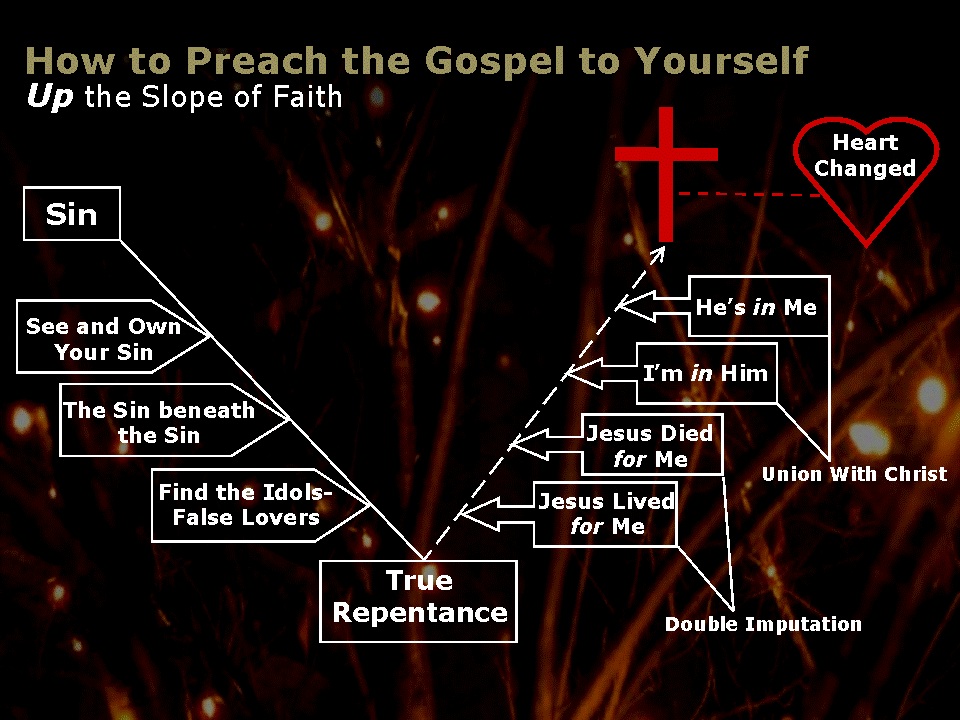
In case you think this is a “biblical” process for best results in growing as a disciple expressed in the illustration by “Heart Changed,” think again as illustrated by another chart published by several Reformed organizations as well:

In this chart, what is growing? Us, or our “salvation”? Many Reformed teachers in our day are fond of telling us how to “keep ourselves in the love of God” by “preaching the gospel to ourselves every day.” In fact, if we change, the following chart from the same camp shows the consequences:

…our salvation gets smaller! In contrast, we obtain God’s love once, and for all time, by believing in His Son, and experience assurance of that love but walking according to our new being.
Little children, let us not love in word or talk but in deed and in truth. By this we shall know that we are of the truth and reassure our heart before him…
But according to Protestant orthodoxy, if we make every effort to love God and others instead making every effort to find more and more sin in our lives, the gospel effect in our lives is diminished.
The Nature of God
How we obtain the love of God as prescribed by Protestant orthodoxy flows from its tenets regarding the nature of God. Primarily, God is defined as sovereign. Rather than sovereignty being an aspect of God’s nature, it is made to be the primary organizing principle—not love. This is an important distinction for those who take part in the exodus from Protestant darkness; will God’s nature be defined by a grammatical and exegetical interpretation of Scripture, or an interpretation based on orthodoxy?
Clearly, the Bible states that God is love. So, how does the Bible define love? Let’s see:
1Corinthians 13:1 – If I speak in the tongues of men and of angels, but have not love, I am a noisy gong or a clanging cymbal. 2 And if I have prophetic powers, and understand all mysteries and all knowledge, and if I have all faith, so as to remove mountains, but have not love, I am nothing. 3 If I give away all I have, and if I deliver up my body to be burned, but have not love, I gain nothing.
4 Love is patient and kind; love does not envy or boast; it is not arrogant 5 or rude. It does not insist on its own way; it is not irritable or resentful; 6 it does not rejoice at wrongdoing, but rejoices with the truth. 7 Love bears all things, believes all things, hopes all things, endures all things.
8 Love never ends. As for prophecies, they will pass away; as for tongues, they will cease; as for knowledge, it will pass away. 9 For we know in part and we prophesy in part, 10 but when the perfect comes, the partial will pass away. 11 When I was a child, I spoke like a child, I thought like a child, I reasoned like a child. When I became a man, I gave up childish ways. 12 For now we see in a mirror dimly, but then face to face. Now I know in part; then I shall know fully, even as I have been fully known.
13 So now faith, hope, and love abide, these three; but the greatest of these is love.
The so-called Reformed gospel of sovereignty calls for the total inability of man to love God even after their definition of conversion. One well known Reformed theologian wrote a book titled One Way Love. This staple Protestant belief is defined in the doctrine of double imputation which calls for the imputation of Christ’s alien righteousness to be imputed to our lives apart from anything we do other than preaching the gospel to ourselves. Much is made of living the Christian life by faith alone in order to maintain our “just standing.”
What it boils down to is God creating evil for His own glory. Whether you consider the teachings of Martin Luther or John Calvin, the founding fathers of Protestantism, this is an irrefutable fact. Luther taught that God created mankind with a passive will; in other words, a will that can only act if acted upon from an outside source. This testifies to God’s nature as defined by sovereignty. Hence, certain people are predetermined to suffer for eternity. In regard to this, John Calvin stated,
[God] arranges all things by his sovereign counsel, in such a way that individuals are born, who are doomed from the womb to certain death, and are to glorify him by their destruction.
~Institutes 3.23.6
I again ask how is it that the fall of Adam involves so many nations with their infant children in eternal death without remedy, unless it so seemed meet to God?…The decree, I admit, is dreadful; and yet it is impossible to deny that God foreknew what the end of man was to be before he made him, and foreknew, because he had so ordained by his decree.
~Institutes 3.23.7
This is contrary to love which is the true nature of God, being “kind,” and “Love does no wrong to a neighbor; therefore love is the fulfilling of the law.” The Reformed even make it a point to say that God did no wrong by creating man in an evil state because the end cause is God’s glory. If God brings good out of something evil, in the final analysis it is good because the end is good. It is also said that God created evil to make good better. However, that still does not dispose of the kindness issue. Love CANNOT be unkind to ANYONE.
Furthermore, it does not seek its own way, and you can insert “its own glory” in that list as well. Moreover, love does not rejoice in evil for any outcome, and always rejoices in truth and not the temporary demise of truth for some kind of better outcome. That notion is absurd.
In the final analysis, one of God’s attributes is sovereignty, but sovereignty is not the organizing principle of his nature because his nature is love.
paul
The Baptism of the Spirit Fulfills All Righteousness—Not Jesus’ Law-keeping
 Then Jesus came from Galilee to the Jordan to John, to be baptized by him. John would have prevented him, saying, “I need to be baptized by you, and do you come to me?” But Jesus answered him, “Let it be so now, for thus it is fitting for us to fulfill all righteousness.” Then he consented. And when Jesus was baptized, immediately he went up from the water, and behold, the heavens were opened to him, and he saw the Spirit of God descending like a dove and coming to rest on him; and behold, a voice from heaven said, “This is my beloved Son, with whom I am well pleased.”
However you want to slice or dice justification (dikaiosynē), it is plainly stated by Jesus that His baptism by John “fulfill[ed] all righteousness (also dikaiosynē).” In what way? I think it is safe to say that the baptism of the Holy Spirit fulfills all righteousness. In other words, it’s the baptism of the Spirit that makes us righteous new creatures and not an imputed righteousness based on perfect law-keeping. The baptism of the Spirit also includes following Christ in death as well; ie, the death of the old self.
The word baptism (baptizō) means “to immerse,” so what actually happened can be paraphrased in this way:
“John immersed Jesus momentarily under the water; when He came up, behold, the heavens were opened to him, and he saw the Spirit of God descending like a dove and coming to rest on him; and behold, a voice from heaven said, “This is my beloved Son, with whom I am well pleased.”
Right then, the Father proclaimed that He was pleased with Christ which kind of shoots down the idea that a perfect obedience to the law was required by Jesus for purposes of making us righteous via imputation. The only imputation that the Bible speaks of is our sin imputed to Christ, not Christ’s righteousness imputed to us, though that mantra is widely accepted as gospel truth.
In contrast, the righteousness of God made us just through the new birth which makes us God’s literal children. We are righteous because we are literally born of God in His likeness. The new birth, or baptism of the Spirit, creates a new state of being, not a mere imputation of perfect law-keeping by Jesus.
I believe this event connects righteousness to the new birth apart from the law as stated in Romans 6:
What shall we say then? Are we to continue in sin that grace may abound? 2 By no means! How can we who died to sin still live in it? 3 Do you not know that all of us who have been baptized into Christ Jesus were baptized into his death? 4 We were buried therefore with him by baptism into death, in order that, just as Christ was raised from the dead by the glory of the Father, we too might walk in newness of life.
5 For if we have been united with him in a death like his, we shall certainly be united with him in a resurrection like his. 6 We know that our old self was crucified with him in order that the body of sin might be brought to nothing, so that we would no longer be enslaved to sin. 7 For one who has died has been set free from sin. 8 Now if we have died with Christ, we believe that we will also live with him. 9 We know that Christ, being raised from the dead, will never die again; death no longer has dominion over him. 10 For the death he died he died to sin, once for all, but the life he lives he lives to God. 11 So you also must consider yourselves dead to sin and alive to God in Christ Jesus.
We know that the promise of the Spirit was made to Abraham and Christ (Galatians 3:16, Psalms 16:10, Acts 2:27, 13:35), and that the same Spirit that raised Christ from the dead also raises us to new life as well (Ephesians 1:19,20, Romans 8:11, 2Corinthians 4:14).
I believe John’s baptism of Jesus and what followed took place to establish this truth: it is the new birth that establishes justification apart from the law.
paul
Bible Prophesy is Directly Linked to Assurance of Salvation: Part One
 One of the many Protestant myths that we hear often is that Bible prophesy, otherwise known as eschatology, is “secondary” truth. Yes, having a definitive understanding of its corpus which is about 25% of Scripture is optional.
Among the many disturbing insinuations in regard to this mentality is the idea that God prophesies about things that we can’t really understand. In other words, God is glorified by telling us things we can’t understand to prove some kind of point whatever that might be.
Not unlike many other Protestant mentalities, this particular one is warned against in Scriptures, and to the contrary promises blessings for those who study prophesy which assumes possible understanding.
One of the blessings of studying Bible prophecy and having a proper understanding of it is assurance of salvation. Much could be discussed on this wise, but the focus of this post will be the number of resurrections and judgments.
A Humble Faith is Confused and Uncertain?
There are many confused Protestants in the land because supposedly, being confused gives glory to God. One of myriad examples is a book written by Puritan wannabe Russ Kennedy of Clearcreek Chapel in Springboro, Ohio titled “Perplexity.” The primary thesis of the book is about how unanswered questions are a form of worship. But this is typical: the Bible states that God is not a god of confusion, but Protestant orthodoxy can always be counted on to set the Bible straight. My point here is that there are many Protestants that believe the Bible teaches about multiple resurrections and judgments, But that’s NOT Protestantism. Most Protestants do not know what a Protestant is…which of course in not commendable.
At any rate, confusion never walks with surety.
Justification by Faith: One Resurrection; One Judgment
What is Protestant orthodoxy on this matter? Answer: one resurrection and one judgment immediately following. And why does this matter? It matters because this view of eschatology is tied directly to the Protestant position on justification; or in other words, the essential doctrine of Protestantism known as justification by faith.
In that doctrine of salvation (soteriology), there is no assurance of salvation until your salvation is confirmed at the one final judgment at the end of the ages. In that one final judgment, God “separates the sheep from the goats.” This is the judgment of the nations and NOT the great white throne judgment, but articulating the differences is not the subject of this particular post; our subject is justification by faith and its necessary eschatology that supports its authentic soteriology.
Orthodoxy: Obedient Faith Not OSAS
Most Protestants also believe that once saved always saved (OSAS) is Protestant orthodoxy, but this is something else you can add to the long (very long) list of things that Protestants think Protestants believe. Protestant orthodoxy holds to salvation as a process. It is the idea that the process has a beginning point, a progression, and a final confirmation. A good snapshot of this is how Protestant orthodoxy interprets Philippians 2:12,13.
Therefore, my beloved, as you have always obeyed, so now, not only as in my presence but much more in my absence, work out your own salvation with fear and trembling, for it is God who works in you, both to will and to work for his good pleasure.
First, “obeyed” is the Protestant “obedient faith” or “obedience of faith.” What’s that? It is the idea that Christians only perform one act of obedience, living by faith…alone. How do you live by faith alone? It’s a good question because our culture defines faith as purely mental. Therefore, how do we “live” actively by faith alone? As homo sapiens, we not only sit around and think—we do things.
The answer is in… “work out your own salvation with fear and trembling.” Here, orthodoxy interprets “salvation” as justification, or the saving of the soul by Divine decree. Therefore, salvation needs to be worked out through faith alone.
“The Imperative Command is Grounded in the Indicative Event”
Also, and this is a BIG also, our working out of our salvation by faith alone, or faith-alone work, should be motivated by the supposed fact that “Christians” remain under the condemnation of the law, and should live in constant fear of condemnation which motivates us to live by faith alone lest we fall into “works righteousness [justification].” Because justification is seen as a process, and its end acquired by faith alone, one must not “jump directly from the command to an act of obedience.” Instead, everything we do must be “grounded in the historical Christ event” via faith alone, or by faith-alone works. This is how orthodoxy categorizes works in the Christian life: works, or a “righteousness of our own,” jumps from the command to obedience which is not of faith while faith-alone works operates on all obedience being grounded in the cross event.
In our Heidelberg Disputation series, mainline Protestant evangelical Phil Johnson is cited in regard to orthodoxy’s very definition of faith: it is returning to the same historical Christ event that saved us over and over again. By doing this, the righteousness of Christ is imputed to our Christian life (sanctification, or a process of increased setting apart for God’s purposes), and the justification process continues to move forward. This is important to note because said imputation continues to satisfy the law, and remember, our primary motivation is fear of condemnation from being under law.
So, to clarify, our primary faith-alone work is to continually return to the same gospel that saved us, otherwise known as “preaching the gospel to ourselves” in order to keep the law satisfied. A perfect law-keeping is imputed to us as we live by faith alone in “what Jesus has done, not anything we do.”
The Preeminence of the Law in Protestant Soteriology
Let’s tally all of this up in regard to the subject: Protestant orthodoxy makes law preeminent in salvation, and there is only one judgment that deals with the law; the great white throne judgment at the end of the ages. Orthodoxy rejects any judgment that excludes the condemnation of the law. Their gospel calls for a judgment that confirms those who “live by the gospel” well enough to be covered by Christ’s fulfillment of the law through His perfect law-keeping.
Judgments for rewards apart from the law and its condemnation are rejected by orthodoxy. The reward for living by faith-alone well enough is salvation. Because we are saved by faith alone, we must begin by faith alone, live by faith alone, and will be judged according to how well we did that. When we stand AT the judgment, if God only sees the works of Christ and not anything we did, we will “stand IN the judgment.”
Though Christ is said to have preeminence among Protestants, that’s only because Christ paid the penalty of sin under the law, and supposedly fulfilled its demands in our stead. The law is what really has preeminence in Protestant orthodoxy.
And this is why only one judgment is accepted; because all other judgments are for reward APART from the law’s condemnation.
What Saves a Protestant at the Judgment?
In the rest of Philippians 2:12,13 we read, “for it is God who works in you, both to will and to work for his good pleasure.” If you have been following our Heidelberg Disputation series, you know that authentic Protestantism interprets this through Martin Luther’s bondage of the will. Luther believed that man was created with a passive will. Like water, it is only active when it is acted upon from outside of itself. Water doesn’t move unless gravity pushes it—it doesn’t change temperature unless the environment acts upon it from the outside. Likewise, the Christian does not work, he/she only has the will to act if acted upon from the outside. God is the only one who has an active will, and He created man with a passive will.
Luther framed this in context of death. According to Luther, death is not a nonexistent state, but merely a passive state. The dead exist, but they are in bondage to passivity unless acted upon. Luther also believed that this is illustrative of the Christian life. Christians are still dead in trespasses and sin, and only perform good works when acted upon from the outside by God. This is in fact central to the Protestant ideology that drives its soteriology.
Conclusion
Assurance of salvation cannot be a reality in authentic Protestantism because surety removes the condemnation of the law regardless of anything we do. The goal is not the obedience of love, but the so-called obedience of faith that satisfies the “righteous demands of the law.” If we live by faith alone, the obedience of Christ will be imputed to us. This belief is what saves the Christian at the final judgement.
In part two, we will examine what Philippians 2:12,13 is really stating, and its relationship to eschatology. Moreover, we will examine why Christians can have doubtless assurance of salvation accordingly.
paul
Sin, Sin, Sin, Sin, Sin, Sin, Sin, Sin
Got sin? You do if you are a Protestant, and a lot of it. The “T” in TULIP doesn’t stand for total depravity for no good reason, no pun intended. The only good thing is focusing on the bad thing: your nasty, wicked self.
Sin is a really big deal in Protestantism because we get ourselves into heaven by dwelling on the fact that we are “sinners.” If we can do any good work, if ALL of our works are NOT filthy rags—that’s not living by “faith alone” for our justification. Supposedly, if we think we can do anything good, that’s not living by faith alone in what Jesus has accomplished for us, but rather living in the “confidence of the flesh.”
The foundation of Protestant soteriology is the idea that “Christians” live under the possibility of condemnation and should fear accordingly. Christians remain under the condemnation of the law and remain covered by professing that they can do no good work. By continually returning to the same gospel that saved us for forgiveness of works, both good and bad, the righteousness of Jesus continues to be imputed to us. Hence, “We have no righteousness of our own in salvation or the Christian life.”
In contrast, the emphasis of our Christian lives should be LOVE. We still sin, but it is not sin unto condemnation, but rather sin against our Father as a family matter. We may receive chastisement, but we are in no danger of condemnation. Not so with the Protestant gospel: the “Christian” remains under eternal condemnation and is only covered through faith alone by returning to the same gospel that saved us. This is why Protestantism has always been weak in the area of discipleship. This is why there is an obsession with making saved people rather than disciples. And by the way, the only place we can find continued forgiveness for “sin that removes us from grace” (Calvin/Luther) is under the “authority” of the local church. Go figure.
Even in Baptist churches, pastors bemoan the fact that “10% of the congregants do 90% of the work.” Well, dah, I am surprised that even 10% are doing anything as the focus is keeping oneself saved by focusing on how inept we are.
More and more in counseling, I am telling people to stop focusing so much on sin. Clearly, especially in the Protestant contemporary biblical counseling movement, the specific instruction is to “find the sin beneath the sin” as a means of growing your salvation as if salvation grows to begin with. If our focus is sin- searching as a means of spiritual wellbeing, and good works tempt us to think we did something good (again, Luther/Calvin), what in the world will be the results? Well, look around for yourself—it’s called “the church.”
A focus on sin will not prevent sin or promote love. If there is something to be gained by finding sin, it will be far from us to fight against it. Why would we cut off our supply of blessings by making the cross smaller? It becomes a supply and demand issue.
The Bible endorses a focus on love, not sin-searching. We are to look for ways to love God and others, not ways to find the “sin beneath the sin” or some endeavor to “peel back the layers of sin.” No doubt, there is a CONTROL conspiracy involved with this supposed method of sanctification as well. Stripping people of an accurate evaluation of self is a very efficient way of controlling them. Being worthy enough to hold others accountable for their own good will not get you into heaven—only returning daily to the same gospel that saved you for a fresh set of downs to get into the salvation end zone.
And what will eventually happen to any marriage if the constant focus is your spouse’s sin? No wonder then that the present-day biblical counseling movement (mostly sponsored by Reformed churches) is overflowing with marriage counseling cases. Week in, and week out, teaching will knock down any notions that either spouse can do any work that is not “filthy rags.” And, the only real sin is not knowing that everything you do is sin; if you don’t know that, you may find yourself in so-called church discipline. We do know this: those who will not accept this premise are deemed “unteachable.”
We have not been given a spirit of fear under the law of sin and death and its condemnation. We, instead, have been given the Holy Spirit and boldness to love God and others without any fear of condemnation.
We are to be enslaved to love—not to a fear of condemnation.
paul
The Heidelberg Disputation Series Part 9: The Truth About Galatians 2:20
 Listen to audio or download audio file.
Welcome truth lovers to Blog Talk radio .com/False Reformation, this is your host Paul M. Dohse Sr. Tonight, part 9 of “The Magnum Opus of the Reformation: Martin Luther’s Heidelberg Disputation, The Truth About Galatians 2:20.”
Greetings from the Potters House and TANC ministries where we are always eager to serve all of your heterodox needs. Our teaching catalog can be found at tancpublishing.com.
If you would like to add to our lesson or ask a question, call (347) 855-8317. Remember to turn your PC volume down to prevent feedback. If you choose to use Skype to listen to the show, my advice is to just dial direct from your Skype account without using any of the Blogtalk links. 347-855-8317.
Per the usual, we will check in with Susan towards the end of the show and listen to her perspective.
Remember, you may remain anonymous. When I say, “This is your host; you are on the air, what’s your comment or question”—just start talking.
If you would like to comment on our subject tonight, you can also email me at paul@ttanc.com. That’s Tom, Tony, Alice, Nancy, cat, paul@ttanc.com. I have my email monitor right here and can add your thoughts to the lesson without need for you to call in. You can post a question as well.
Galatians 2:20 is the go-to verse for all stripes of progressive justification. For those who seek to live an aggressive sanctification and life of fearless love, its constant twisting by proponents of progressive justification is an ongoing nuisance of biblical proportions. This episode attempts to end the argument once and for all.
What is the constant mantra that we here today in regard to Galatians 2:20? “See, it is not I who lives, I am still spiritually dead, and the life I appear to live is really Christ living through me.”
First, what is our specific beef with this notion? Ok, so folks have a passive view of sanctification (Christian living); so what? The so what follows: a passive approach to sanctification assumes that justification is an unfinished process, and therefore, any actions by “saved” people must not circumvent the justification (salvation) process. That’s default works salvation because we are involved in keeping the salvation process going, albeit doing nothing with intentionality.
This is the crux of the Protestant gospel; justification by faith. We are justified by faith alone in the same gospel that saved us because not doing anything but believing is supposedly a faith alone work. But not doing anything with intentionality is doing something—that’s the problem. And as we will see, the biblical definition of faith is contrary to the Reformed definition of faith.
Let me walk you through our process tonight. We will begin by looking at the proper interpretive method that must be used in rightly dividing Galatians 2:20. Then we will look at the proper context, followed by the right definitions of the words used in the verse resulting in correct interpretive conclusions.
Let’s look at the proper interpretive method for rightly dividing Galatians 2:20. We call this hermeneutics. Whenever we read our Bibles, we must ask ourselves if the context is justification or sanctification. What is the difference?
Justification, unlike the Reformed definition, is a state of being brought about by the new birth. It is not merely a legal declaration that changes our status. The Bible uses the words “justification” and “righteousness” interchangeably.
Know the difference between the Biblicist remedy to prevent legal fiction, and the Reformed remedy to prevent legal fiction. The Reformed remedy states that the declaration is not legal fiction because the righteousness of Christ is imputed to the “believer” and substitutes the believer’s righteousness with the righteousness of Christ. This is Martin Luther’s alien righteousness and the Reformed doctrine of Christ for us. Even though the saint remains a sinner, Martin Luther’s Simul iustus et peccator, or simultaneously saint and sinner, covers the believer with the righteousness of Christ. In Reformed thought, the standard of this righteousness is the law.
The Biblicist remedy doesn’t cover sin, it ends it. The standard for righteousness in being justified is the new birth, not the law. We are not only declared righteous, we are righteous because we are born again into the literal family of God. In essence, the Trinity became a family. That’s huge. For eternity the Trinity was only one between the three of them, but their remedy for sin was to make mankind one with them as a family. In the plan of salvation, in the election of the salvific plan, God became a Father, and the Messiah became a Son. This nomenclature denotes the plan of salvation specifically; God not only redeems man, He makes Him His literal family through the agency of the Holy Spirit.
Hence, righteousness is not a declaration made true by a double substitution, it is true because the new birth makes us righteous; it is a state of being, not a mere forensic declaration. The new birth is a onetime event that results in the Spirit living within us forever. Our hearts are truly redeemed, but we are still weak and therefore susceptible to breaking the law. Yet, we are righteous because God’s seed dwells within us, and the law’s ability to judge us has been cancelled. More on that later.
Therefore, Scripture verses must be interpreted by the context of justification or sanctification. Does the verse pertain to the new birth which is a onetime finished event, or the Christian life which is ongoing? What is the difference between the two?
Simply stated, one is a gift, and the other is a reward. Does the context speak of the gift, or what we do to earn our rewards? Does the context speak of the finished work of salvation, or our endeavor to live in fearless and aggressive love followed by its rewards and blessings?
Let’s define the difference by defining the lost versus the saved; the unrighteous versus the righteous. The two have a different master, a different reward, and a different law. The master correlates to the wages received according to their slavery.
We are all born under sin which is defined in the Bible as a master. In this sense, we are/were enslaved to sin. As slaves under the Sin master, though they can do good works, the only wage that can be received is death and condemnation. The law, or the Bible, condemns those who are “under law.”
In contrast, Christ purchased all men with His blood by paying the penalty for sin. He has effectively purchased all slaves from the other slave master. You were “bought with a price.” If you believe this, you are now a slave to the new Master through the new birth. You can only receive wages for life, and there is no condemnation. As Christians, our goal is not to stop doing sinful things; our goal is to gain things pertaining to life. Christians focus on sin way too much—our focus should be love. Peter said that “above all” focus on love because love covers a multitude of sins. The Bible is now our guide for loving God and others, and does not condemn us.
Moreover, salvation is not a mere assent to the facts of the death, burial, and resurrection of Christ, it is a decision to follow Christ in death and resurrection through the baptism of the Holy Spirit that results in the new birth and the permanent receiving of the Holy Spirit. The old you literally dies and you are resurrected a new person.
Amazingly, lost people know this intuitively; the most common reason that the unregenerate don’t want to become saved is because they know it means giving up their present life, and being resurrected to the uncertainty of being a totally new person sold out to the kingdom. I believe that to be the focus of Christ’s exchange with Nicodemus in John 3.
And this is also the focal point of Galatians 2:20. Proponents of progressive justification use this verse to refute Biblicism which proffers a radical dichotomy between justification and sanctification. But in truth, Paul is attacking the Galatian error of progressive justification which substitutes the believer’s love in sanctification for a ritual that keeps justification moving forward. It’s the exact same error propagated by the Reformation.
The context is Paul’s rebuttal regarding how the Galatians were attempting to be justified. Justification is clearly the context. The fact that Paul is addressing the subject of justification in the body of text where Galatians 2:20 resides, is clearly evident (three times alone in Galatians 2:16, Galatians 2:17, 2:21, 3:8, 3:11, 3:24, 5:4). The Galatians were being led away into error via a justification which has law as its standard. It’s the same old song and dance with progressive justification; some sort of ritual or tradition fulfills the whole law which is not the standard of justification to begin with.
Since people cannot keep the law perfectly, the law is dumbed down into some sort of ritual or ceremony. Paul therefore warns them that if they want to be justified by the law, they are responsible for all of the law, not just the recognition of a few rituals:
Galatians 5:2 – Look: I, Paul, say to you that if you accept circumcision, Christ will be of no advantage to you. 3 I testify again to every man who accepts circumcision that he is obligated to keep the whole law. 4 You are severed from Christ, you who would be justified by the law; you have fallen away from grace.
Obviously, they believed that circumcision satisfied what many call today the “righteous demands of the law,” or a satisfaction “under the eyes of the law.” It is clear that a salvation by circumcision (ordinance) is in the mix here: 2:3, 2:12, 5:2, 5:3, 5:6, and 5:11. Perhaps circumcision saved you, and then the ongoing observance of other rituals maintained ones “just standing” (Gal 4:10, 11). At any rate, this results in the “relaxing of the law” for purposes of love in sanctification. Or in other words, antinomianism:
Galatians 2:15 – We ourselves are Jews by birth and not Gentile sinners; 16 yet we know that a person is not justified[b] by works of the law but through faith in Jesus Christ, so we also have believed in Christ Jesus, in order to be justified by faith in Christ and not by works of the law, because by works of the law no one will be justified.
17 But if, in our endeavor to be justified in Christ, we too were found to be sinners, is Christ then a servant of sin? Certainly not! 18 For if I rebuild what I tore down, I prove myself to be a transgressor.
Galatians 5:7 – You were running well. Who hindered you from obeying the truth? 8 This persuasion is not from him who calls you. 9 A little leaven leavens the whole lump.
Galatians 5:13 – For you were called to freedom, brothers. Only do not use your freedom as an opportunity for the flesh, but through love serve one another. 14 For the whole law is fulfilled in one word: “You shall love your neighbor as yourself.”
Of particular interest to further the point is Paul’s assertion as to what actually fulfills the law; LOVE, not ritual or tradition, especially since we are not justified by the law to begin with.
Now, as we move into the focal point of Galatians 2:20, it is important to define the words used in the verse.
I am crucified with Christ: nevertheless I live; yet not I, but Christ liveth in me: and the life which I now live in the flesh I live by the faith of the Son of God, who loved me, and gave himself for me (KJV [nevertheless I live excluded by ESV]).
Look, this verse is nothing more or less than run of the mill Pauline soteriology. It speaks of the Spirit’s baptism and the new birth. It is arguing against progressive justification by reiterating the new birth. “I am crucified with Christ” speaks of the old us that was crucified with Christ:
Romans 6:1 – What shall we say then? Are we to continue in sin that grace may abound? 2 By no means! How can we who died to sin still live in it? 3 Do you not know that all of us who have been baptized into Christ Jesus were baptized into his death? 4 We were buried therefore with him by baptism into death, in order that, just as Christ was raised from the dead by the glory of the Father, we too might walk in newness of life.
5 For if we have been united with him in a death like his, we shall certainly be united with him in a resurrection like his. 6 We know that our old self[a] was crucified with him in order that the body of sin might be brought to nothing, so that we would no longer be enslaved to sin. 7 For one who has died has been set free[b] from sin. 8 Now if we have died with Christ, we believe that we will also live with him. 9 We know that Christ, being raised from the dead, will never die again; death no longer has dominion over him. 10 For the death he died he died to sin, once for all, but the life he lives he lives to God. 11 So you also must consider yourselves dead to sin and alive to God in Christ Jesus.
12 Let not sin therefore reign in your mortal body, to make you obey its passions. 13 Do not present your members to sin as instruments for unrighteousness, but present yourselves to God as those who have been brought from death to life, and your members to God as instruments for righteousness. 14 For sin will have no dominion over you, since you are not under law but under grace.
In light of Romans 6 and 7, here is what I think this verse is saying:
The old I was crucified with Christ, but nevertheless the new I lives, not the old I, but the new I that is indwelt by Christ. The new I lives by faith in Christ who loved me and died for me.
In light of other Scripture, this is the only conceivable interpretation. And we must also consider the biblical definition of “by faith.” Galatians 5:6 makes the definition absolutely certain:
For in Christ Jesus neither circumcision nor uncircumcision counts for anything, but only faith working through love.
Also note what James said about faith:
James 2:14 – What good is it, my brothers, if someone says he has faith but does not have works? Can that faith save him? 15 If a brother or sister is poorly clothed and lacking in daily food, 16 and one of you says to them, “Go in peace, be warmed and filled,” without giving them the things needed for the body, what good is that? 17 So also faith by itself, if it does not have works, is dead.
18 But someone will say, “You have faith and I have works.” Show me your faith apart from your works, and I will show you my faith by my works. 19 You believe that God is one; you do well. Even the demons believe—and shudder! 20 Do you want to be shown, you foolish person, that faith apart from works is useless? 21 Was not Abraham our father justified by works when he offered up his son Isaac on the altar? 22 You see that faith was active along with his works, and faith was completed by his works; 23 and the Scripture was fulfilled that says, “Abraham believed God, and it was counted to him as righteousness”—and he was called a friend of God. 24 You see that a person is justified by works and not by faith alone. 25 And in the same way was not also Rahab the prostitute justified by works when she received the messengers and sent them out by another way? 26 For as the body apart from the spirit is dead, so also faith apart from works is dead.
This is the EXACT same faith that is advocated by progressive justification soteriology in general, and Reformation soteriology in particular; a faith without works that invokes some kind of substitution for our works in sanctification. And they love to use Galatians 2:20 to promote it. Last week, we looked at this in-depth through the ministry of one of the more mainline evangelical churches; John MacArthur’s Grace to You ministries. We deconstructed a sermon on Galatians 2:20 by one of the ministry’s most prominent leaders, Phil Johnson, [also see Part 2 here].
In his Reformed run of the mill evaluation of the verse, he advocated the idea that it is a paradox; Paul was speaking of one man that is both dead and alive. Because of Christ, we are dead to the law because Christ fulfilled the law for us. We are alive when Christ’s fulfillment of the law is imputed to us in sanctification. Justification does not change the person in any way, shape, or form, but because of Christ, we are dead to the law for justification and alive to the law in sanctification because Christ fulfills the law in our place. There is no real exchange of masters because justification does not change us; the other Master, Christ, is a servant for us while we remain a slave sold under sin.
As John Piper once stated it, Christ is a school teacher that does our homework for us, and takes the test for us as well. He is also, for all practical purposes, a Master who purchased us with His blood, and then does our work for us. Again, it’s a matter of several single perspectives that unites what God separates. And in fact, the Reformed state constantly that Christians are still enslaved to sin.
This also unites gift and reward making salivation the reward for living by their definition of faith alone. This makes faith alone a work for purposes of earning our salvation. It is doing nothing with intentionality because love in sanctification is deemed works salvation. The servant is not free to love. The servant is not free to serve the other Master because he/she is still under the law that cannot be kept perfectly. But, it is love that fulfills the law, not law-keeping.
Note the following text:
Hebrews 6:9 – Though we speak in this way, yet in your case, beloved, we feel sure of better things—things that belong to salvation. 10 For God is not unjust so as to overlook your work and the love that you have shown for his name in serving the saints, as you still do. 11 And we desire each one of you to show the same earnestness to have the full assurance of hope until the end, 12 so that you may not be sluggish, but imitators of those who through faith and patience inherit the promises.
Note that God would be “unjust” in not rewarding their love and servitude. Why? Because sanctification is about the earning of reward while justification is a gift. Scripture must be interpreted according to the context of justification or sanctification accordingly.
Faith works in love. Faith works—this is not mere contemplationism or faith in Christocentric facts, it’s a working faith that we will be rewarded for. Let’s now define how faith works by, or through love. It’s the freedom to obey the law of the Spirit of life as opposed to the law of sin and death that the new man was under (Romans 6:14 and 8:2). This is what fulfills the law, not a dumbed down tradition. This is why Christ said that our righteousness must surpass that of the Pharisees; it must be a righteousness that works through love and fulfills the law accordingly. Not that the law is a standard for justification to begin with, but this is set against the idea that it is. The new birth frees the saint to aggressively love through obedience without any fear of condemnation.
Because the Pharisees sought to fulfill the law with their traditions, they relaxed the law and ignored its weightier tenets of mercy and love. As a result, they were rank antinomians on the inside and the outside (Matthew 23:28, Luke 11:39), and just another example of those who hold to progressive justification.
Moreover in closing, if justification does not change us through the baptism of the Spirit and Galatians 2:20 pertains to mere death and life experiences imputed to us by Christ as proponents of progressive justification assert, that leaves us with the raw reality of what the institutional church will look like. As ones still under the law of sin and death, the reading and teaching of God’s law will actually provoke people to sin:
Romans 7:7 – What then shall we say? That the law is sin? By no means! Yet if it had not been for the law, I would not have known sin. For I would not have known what it is to covet if the law had not said, “You shall not covet.” 8 But sin, seizing an opportunity through the commandment, produced in me all kinds of covetousness. For apart from the law, sin lies dead. 9 I was once alive apart from the law, but when the commandment came, sin came alive and I died. 10 The very commandment that promised life proved to be death to me. 11 For sin, seizing an opportunity through the commandment, deceived me and through it killed me. 12 So the law is holy, and the commandment is holy and righteous and good.
13 Did that which is good, then, bring death to me? By no means! It was sin, producing death in me through what is good, in order that sin might be shown to be sin, and through the commandment might become sinful beyond measure.
Sin is empowered by its ability to condemn through the law (1Cor 15:56). Sin is empowered and alive via condemnation. The person who is not reborn is under the law and its condemnation. Sin is still empowered by its ability to condemn through the law. This is why Christ came to end the law (Romans 10:4). Regardless of what kind of front the institutional church is able to erect, progressive justification keeps people under the law, under the Sin master, and the law itself will only provoke and promote sin.
In fact, in regard to youth groups, they will turn your children into antinomian rebels. This is irrefutable and a foregone conclusion regarding any doctrine that keeps people under the law. The law will only provoke them to sin because of its ability to condemn those who are still under it. In contrast consider the following:
Romans 7:1 – Or do you not know, brothers—for I am speaking to those who know the law—that the law is binding on a person only as long as he lives? 2 For a married woman is bound by law to her husband while he lives, but if her husband dies she is released from the law of marriage. 3 Accordingly, she will be called an adulteress if she lives with another man while her husband is alive. But if her husband dies, she is free from that law, and if she marries another man she is not an adulteress.
4 Likewise, my brothers, you also have died to the law through the body of Christ, so that you may belong to another, to him who has been raised from the dead, in order that we may bear fruit for God. 5 For while we were living in the flesh, our sinful passions, aroused by the law, were at work in our members to bear fruit for death. 6 But now we are released from the law, having died to that which held us captive, so that we serve in the new way of the Spirit and not in the old way of the written code.
See what is really going on in Galatians 2:20? Take the “yet not I, but Christ liveth in me” and interpret it with, “you also have died to the law through the body of Christ.” Because the verse is strictly about how we are truly justified, it must be interpreted with the law in mind. And you can see that context in the venue of Galatians 2:20 with a capital C. Consider another interpretive paraphrase:
I am crucified with Christ and no longer under the law that enslaved me to sin, nevertheless I live according to the new way of the Spirit; yet not the I that was under the law, but the I with Christ living in me because I died to the law through His body: and the life which I now live in the flesh I live by faith working through love according to the Spirit’s law of life.
This is a fair paraphrase unless you want to totally disregard Romans 6, 7, and 8, or worse yet, contradict those chapters. So why in the world is Galatians 2:20 worded this way? First, remember, it is ONE verse, and unlike any other verse about justification. Is this some sort of thumbnail statement that represents the corpus of Paul’s teachings on justification? I think that is very likely. Paul bemoans throughout his letter to the Galatians that he had invested all kinds of time in teaching them about law and gospel. It is very likely that this is a bumper sticker statement that represents the corpus of that teaching. If this verse says what purveyors of progressive justification say that it says, the rest of Pauline soteriology is clearly and completely upside down.
But be certain of this: this teaching of Galatians 2:20 is exactly why the institutional church looks like it does today. It is a return to Pharisee-like antinomianism traditions. It was in fact the Judaizers that were troubling the saints at Galatia.
With that, let’s go to the phones.

 Paul's Passing Thoughts
8 comments