Rick Holland’s “Uneclipsing The Son” Part 4: Mr. Holland Was For Obedience Before He was Against It, And The Sonship / AF Connection
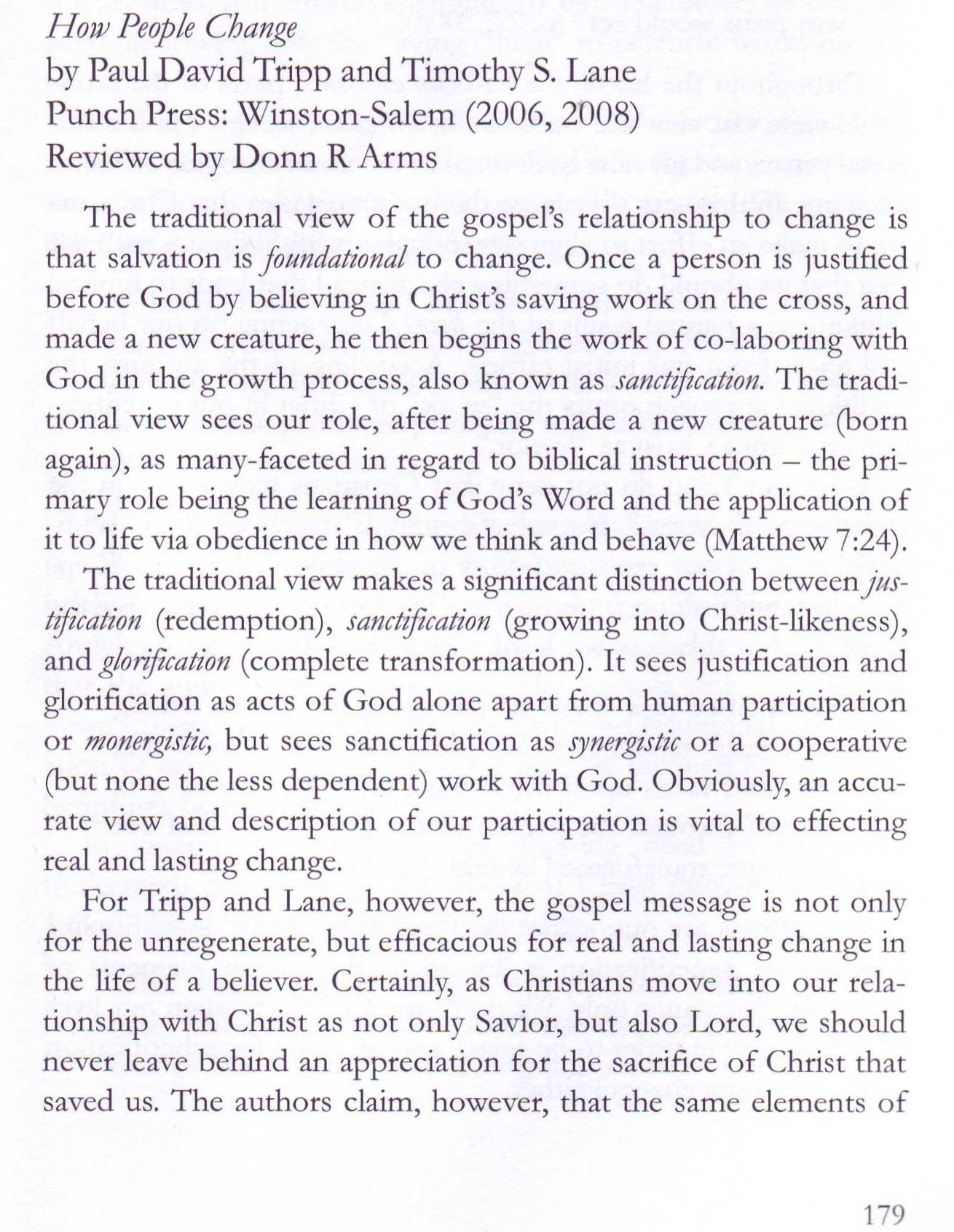
 On pages 46 through 56 (most of chapter 4), Holland makes a case that the book of Job is all about Christ. Of course, New Calvinist believe every verse in the Bible is about Christ so that’s no surprise. Though I believe his exegesis is a stretch to come to that conclusion, these pages are by far the less ghastly so far and have some merit. In addition to making this point, he seems to slightly redefine the word transcendence as primarily the difference between two things, rather than something that is superior or not confined by immanence. I know, this seems like nitpicking, but Holland seems to use his primary definition to make some sort of strict dichotomy between the Son and the Father that effects how we perceive the Trinity, and such dichotomies tend to make me suspicious. Not only that, it’s eerily similar to the “objective” part of COG (the centrality of the objective gospel) which teaches that gospel reality is completely outside of us. This can subtly set up a prism that requires all realities about the Father to be seen through the Son, rendering the Father as true, but insignificant when compared to Christ; and in fact, our biggest problem—with Christ coming to the rescue. Of course, there is some truth to that, but that approach also makes me uncomfortable with what seems like an unbalanced view of the Trinity that can lead to bad places.
Nevertheless, what follows is much easier to expound on. On page 59, Holland reiterates what makes GS what it is: contemplative spirituality. Holland states on page 59: “In other words, we see Christ now, and the more we know Him and the more we study Him, the more we become like the clear image we see of Him. Looking for [emphasis mine. This is supposedly what job one is for Christians when reading their Bible] and seeing and gazing [my emphasis] at the excellencies, the glories of Jesus leads to greater vision, sharper focus, deeper awareness of Jesus and His permanent abiding presence. It elevates the soul to a higher vantage point of worship. We must learn to stare at the Son of God such that we are blinded to all the allurements of the world! All encumbrances aside, all slack hardeness aside, everything aside but…Him.”
Along with this statement being a superb specimen of how GS instructs followers to read the Bible, looking for Jesus only; and specifically, his “excellencies” and “glories,” the statement shows the kinship between GS and Sonship Theology. In a book Jay Adams’ wrote to warn the church about Sonship, he wrote the following:
“The problem with Sonship is that it misidentifies the source of sanctification (or the fruitful life of the children of God) as justification. Justification, though a wonderful fact, a ground of assurance, and something never to forget, cannot produce a holy life through strong motive for it.”
And,
“Certainly, all of us may frequently look back to the time when we became sons and rejoice in the fact, but there is no directive to do so for growth, or even an example of this practice, in the New Testament….The true reminder of the good news about Jesus’ death for our sins is the one that he left for us to observe-the Lord’s supper (‘Do this in remembrance of Me’).”
Holland follows this up on page 60 and 61 with the usual GS slight of hand. On page 60, using John 14:21 as a point of reference, he makes several orthodox statements concerning obedience. He seems to be clearly saying that obedience is the gateway to a deeper love for Christ. He seems to be saying the same thing Christ is clearly saying in that text: obedience to Christ is synonymous with loving Him. In other words, obedience is a loving act (John 3:16).
I used to become perplexed by these sudden bursts of orthodoxy after reading page after page of “truth” seasoned with nuance because God’s people are not yet ready to accept that we have been supposedly living under a false gospel for the past 100 years. I calmly read pages 60-61 while enjoying a nice lunch Susan fixed for me. Two all beef patties smothered in pepper-jack cheese and jalapeños. No buns because I’m on a low-carb diet that is working fabulously (email me at pmd@inbox.com if you want the details). She also brought me a glass of tea sweetened with something other than sugar, but it was really good. Before I finished the last bite, Holland began to explain exactly what he means by “obedience” on page 61. He was for it on page 60, but on page 61, well, you see, what Jesus meant in John 14:21 is love and obedience are the same thing.
But you say: “Paul, that agrees with what you just said was orthodox!” Not exactly. I said that obedience is an act among many that is a demonstration of love. On page 61, Holland makes the point that they are the same thing, but obedience must be defined by love, and now we must ask ourselves what “love” is. Hmmmmm—get you hand on your wallet:
“So what does it mean to love Jesus? Yes, we’ve already seen obedience. That’s a given [I’m sure]. But [just like the “But”Light commercial: “Here we go!”] true Christians are distinguished from unbelievers not only by their obedience, but by their love for Christ. Let this question echo in your soul: Do you love Christ? Is He precious to you, as He was to Peter? Is He the hub of your faith and your life, [and here is the crux:] or have you made Christianity something of a way to live instead of a person to love?”
NOTE, after saying obedience and love are intrinsically connected, he makes a dichotomy that is impossible to distinguish in real life. How can one possibly distinguish Godly obedience from making “Christianity something of a way to live instead of a person to love?” It’s a false dichotomy that forces the reader to decide whether true love is a way of life or a “person to love.” And again, and again, regardless of a calling to live in a new way throughout Holy Writ, Holland does not qualify the statement.
HOWEVER, Holland then defines what this true love is on pages 61-67 after the pesky subject of obedience is relegated to its proper place in the back of the bus. He then breaks down a “biblical” definition of love into three categories: Love And Faith (p.61), Love And Understanding (p.64), and Love And Affections (p.66).
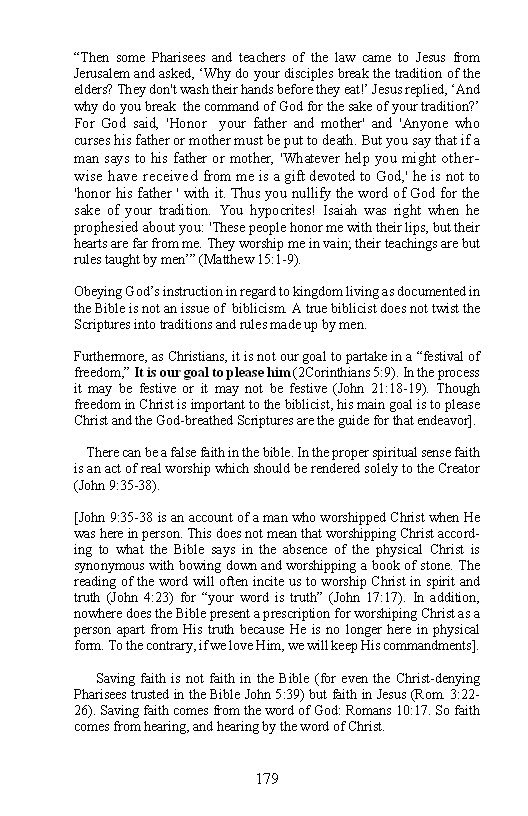
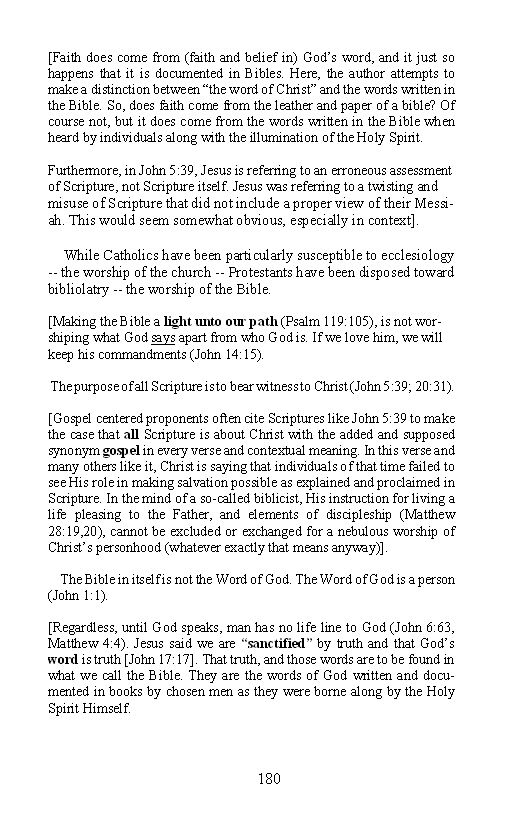
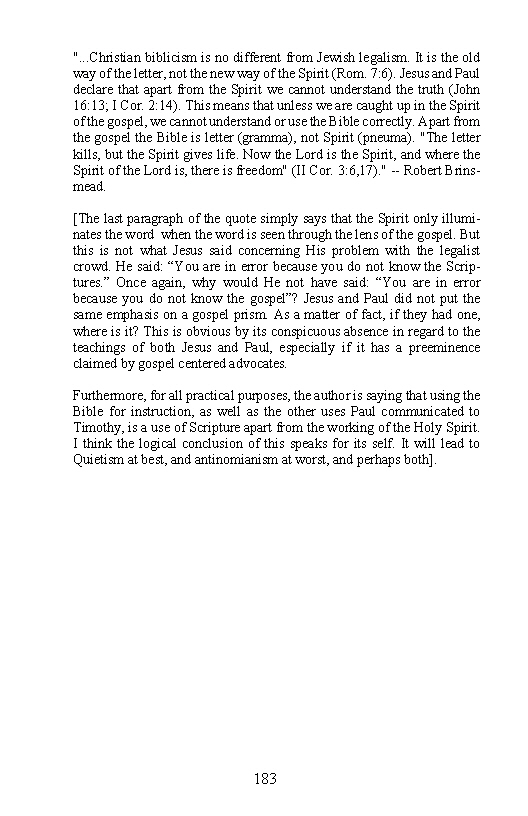
In the first segment, “Love And Faith,” Holland clearly shows this book’s kinship with the Australian Forum. I devote a whole chapter in my book, “Another Gospel” to Robert Brinsmead’s interpretive prism as taught by him and Paxton / Goldsworthy. Following this post, a full copy of that chapter can be viewed. On page 62, Holland describes faith as the “eye of the soul.” He then writes that Scripture is the lens used by faith and the Holy Spirit illuminates Scripture for one purpose and one purpose only: “Suddenly the Bible comes alive and we see Christ’s excellence, His splendor!” Hence, this is the EXACT position of the AF: the Bible’s only purpose is to obtain a deeper knowledge of the gospel, and the Holy Spirit will not illuminate anything else but that. Holland writes on page 63: “There must be a faith that engages with God’s Word on Jesus and estimates it to be the most important information in the world” [which then becomes the interpretive mode of operation].
Therefore, the Bible is for the purpose of plunging the depths of seeing the glory of Christ and nothing else. Any other information in the Bible that seems to be contrary to that thesis is descriptions of what Christ has done and should teach us more about Him instead of being an instruction book for a different “way to live.” All of the commands in the Bible are meant to show us what Christ has done for us already, and to humble us because we can’t keep all of them perfectly anyway. As I heard one pastor say from a pulpit about three months ago: “You can’t keep all of God’s law anyway, so don’t even try.” Pondering the volume of commands should also drive us to the foot of the cross and more dependence on Christ. Supposedly.
Therefore, the only logical conclusion is that obedience is a natural result of “Staring At The Son” (the actual title of chapter 5). But how do we know when we are committing the horrible sin of “obeying Jesus in our own efforts?” Well, because it will FEEL like it—that’s how you supposedly know, and Holland emphasizes that point throughout the rest of chapter 5. Throughout the book, Holland reiterates the same worn-out GS points made by Francis Chan (“When it’s love, it feels like love”), John Piper (“Beholding as a way of becoming” and joy is synonymous with faith), Paul David Trip (Christians are still spiritually dead), and Michael Horton (we only grow spiritually when we “revisit the gospel afresh”). The following is the chapter of my future book where the AF view of interpretation is dealt with—which is the same approach propagated by Holland:




By Request: A Summary Of The New Calvinist Genealogy Chart; Part 1 / Introduction
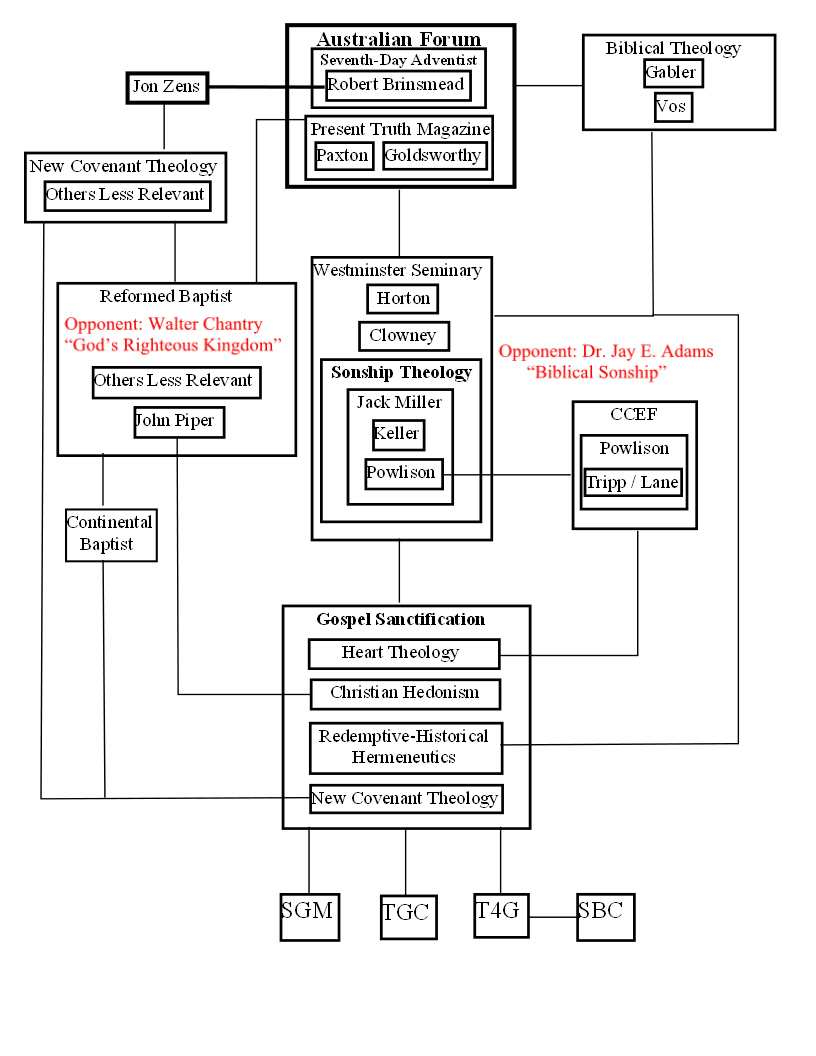 The contemporary history of New Calvinism begins with Robert Brinsmead and Jon Zens. They are the fathers of New Calvinism. Between my interview with Brinsmead and an informal document written by Zens I found on the internet—this is apparent. Brinsmead started a project called the Australian Forum (he wanted me to note that it was one of many projects that focused on certain subjects) that sought to articulate a gospel-centered sanctification into a unified, consistent systematic theology. One of the major considerations was a focus on covenant theology in relationship to this endeavor. Jon Zens is the father of New Covenant Theology, but it is clear that Brinsmead had a major influence in the formulation of that doctrine. All of this took place in the 70’s. So, New Calvinism has been around for about 35 years in various forms. It is primarily based on the Forum’s centrality of the objective gospel (COG). COG is the very heart of New Calvinism. Though NC has many different expressions, this doctrine is the heartbeat that drives it.
The Forum was having a significant impact on two spheres of Christianity in the 70’s and early 80’s; namely, Reformed Baptist and Westminster Seminary. Zens was a Reformed Baptist and also a student at Westminster. Zens taught a Sunday School class where his ideas on New Testament ethics were being presented, and Westminster students attended those studies. Michael Horton was infatuated with the Forum’s teachings, and COG can be seen in many of his teachings throughout his career. Keep in mind, the Forum’s magazine, Present Truth, and later, Verdict, according to Zens, had the largest readership among all Evangelical publications at that time. Apparently, Zens was initially introduced to the Forum by receiving Present Truth while he was a student at Westminster, and eventually formed a close relationship with Brinsmead. Also, G. Goldsworthy’s involvement in the Forum as one the AF three is one of the interesting the top is the same as the bottom in the genealogy chart. Till this day, the Goldsworthy Trilogy is a mainstay of New Calvinism’s Gospel Theology. Again, at the very heart of Goldsworthy’s Trilogy is COG. Goldsworthy was close to Brinsmead, and Brinsmead learned his Hebrew skills from Goldsworthy.
Zens, with the help of several men who are now the who’s who of New Covenant Theology while Zens is in the background (probably because of his connections with Brinsmead), attempted to propagate the doctrine, yet unnamed, via the Baptist Reformation Review . Zens received a very zealous contention from other Reformed Baptist such as Walter Chantry. At that time, Brinsmead wrote several articles defending Zens’ doctrine in the BRR. According to Zens:
“A sort of (unintended) [I doubt that] culmination occurred in the Spring, 1981, BRR. There were lengthy review articles of Walt Chantry’s God’s Righteous Kingdom [a book Chantry wrote to contend against COG, though he saw it as neo-antinomianism, which is also a correct assertion] and Robert Brinsmead’s Judged by the Gospel: A Review of Adventism. The dynamic N.T. approach to law and gospel [“NT approach to law and gospel” is a present-day NC mantra] was stated forcefully by RDB:
‘[Paul’s] appeals on how to live are made on the basis of what God has done for us in Christ. It is in view of God’s gospel mercies that we are to present our lives as a living sacrifice to God (Rom.12:1-3) . . . . Paul virtually never appeals to the law – ‘Thou shalt not.’ When he demands certain behavior of the church, he appeals instead to the holy history of Christ . . . and from that stand point then makes his ethical appeal.’”
Note here, and this is very important: the Forum’s the imperative command is grounded in the indicative event can be seen in Brinsmead’s statement cited by Zens above, which is a pillar of Gospel Sanctification till this day, and originated in COG doctrine by the AF. Chantry and others effectively beat COG within an inch of its life, and the doctrine, coined by Zens one year later as “New Covenant Theology” (in 1981), continued on in a meager existence among Continental Baptist. Most likely, John Piper was introduced to COG among Reformed Baptist and was probably well aware of the controversy. The wherewithal of his injection of Christian Hedonism into the movement is sketchy at this time and needs extensive investigation which I will do Lord willing.
Meanwhile, COG was finding new life at Westminster Seminary. In fact, Brinsmead and the Forum met with the Westminster faculty in the I think early 80’s, I will add references to this summary later. Brinsmead remembers little about the meeting other than he noted that the faculty served pork to him and the other forum members which he suspected was deliberate due to the Forum’s connection with Adventism. I informed him that it was deliberate because they were incited to do so by Jay Adams (a faculty member at the time) who was not a happy camper that the meeting took place. Brinsmead stated that one individual present at the meeting seemed to be an “elder statesman” of Westminster. I’m guessing it was Edmund Clowney.
At this point, COG, as the face of the AF disappears, leaving behind its remnants with Continental Baptist because Robert Brinsmead departed from orthodox Christianity all together. But the heart of COG incited a new movement begun by Westminster professor John “Jack” Miller called “Sonship Theology.” Again, COG met stiff resistance in Presbyterian circles under the new name of Sonship. Leading the charge was Dr. Jay Adams who also knew Jack Miller personally. His contention against Sonship is well documented in his book, “Biblical Sonship: An Evaluation Of The Sonship Discipleship Course.” Unfortunately, the book is out of print. One may well note: Some big dogs of the present-day New Calvinists movement; specifically, Tim Keller and David Powlison, were disciples of Jack Miller and his Sonship program. Tim Keller’s propagation of Sonship is well known and documented. At a conference conducted at John Piper’s church while Piper was on sabbatical, Powlison specifically cited Miller as his “mentor” and ridiculed Adams for criticizing Miller while failing to mention that the “criticism” was in the form of a book—which I am sure slipped his mind. Miller is the one who coined the phrase often aped by Jerry Bridges: “We must preach the gospel to ourselves everyday.” Funny, while an elder at a reformed church in the mid-nineties, I heard Jerry Bridges say that without realizing what a profound effect that little phrase would have on my life ten years later.
But with COG again under heavy fire and the Sonship coat of arms being shot full of holes, “Sonship” was replaced with “gospel,” ie., “gospel-driven” this, and “gospel-centered” that. The movement was now underground, but steadily growing while avoiding labels like the plague. Take note: for almost ten years between 2000 and 2009, the movement was nameless. The name “New Calvinism” is very recent and was attached because movements that become massive cannot avoid a label. Meanwhile, David Powlison had been busy for a number of years integrating Jack Miller’s form of COG into “biblical counseling” through his Dynamics of Biblical Change which became the basis for biblical counseling at Westminser Seminary. Hence, different players were at work making COG relevant to different areas of Christian theology and life that were important to them in making COG work. Brinsmead conceived the primary foundation (with other Reformed elements not unique with him—what he called “jewels” that contributed to what was important to him) and helped Zens formulate the covenant theology. Goldsworthy integrated COG into hermeneutics and eschatology with a little bit of Gabler and Vos mixed in for good measure. Piper contributed to the experience / emotional aspect, and Powlison was paramount in his contribution to the life application part; otherwise, COG would be more vulnerable to its unbiblical passivity in the sanctification process.
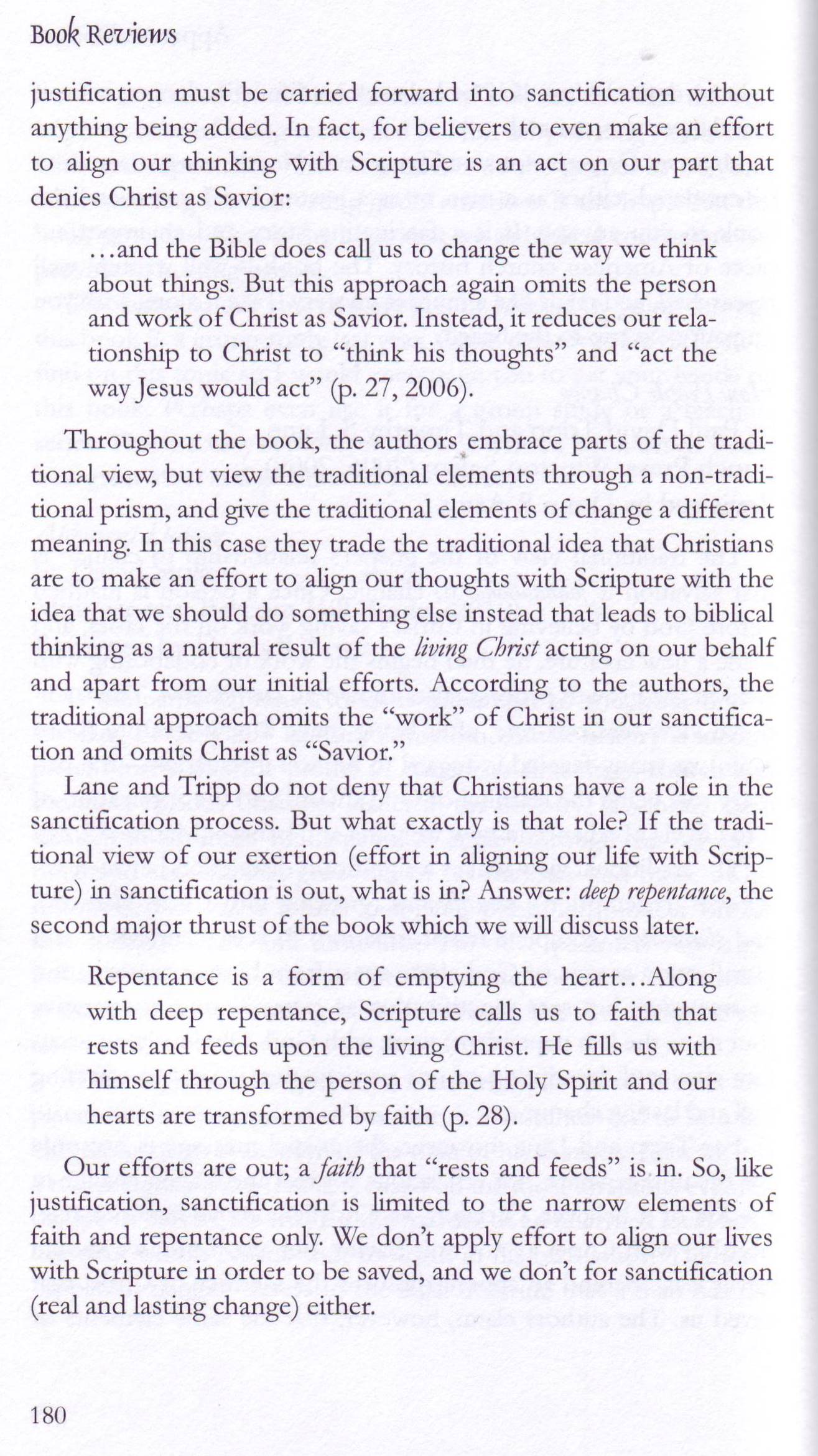
Unbeknown to many in the biblical counseling movement, the integration of COG into biblical counseling, primarily in David Powlison’s Theology of the Heart that came out of Westminster’s DBC, was at the core of tensions between NANC and CCEF, the counseling wing of Westminster Seminary (other than the integration of Psychology as well, but COG deserves infamous merit there as well). Eventually, CCEF’s influence totally infected NANC with the disease, and NANC advocates act as if the cupbearer, upon realizing he has tested a deadly cup, should use his last words to compliment the superb taste of the drink. Eventually, disciples of David Powlison; Paul David Trip and Timothy Lane, wrote a book that articulated COG’s supposed life application in the book, How People Change. The centrality of the objective gospel (COG) and all of its elements are glaringly obvious in the book—almost as if it was written by Robert Brinsmead himself.
Starting in, or about 2004, Christians began to realize something was wrong, but because the movement had no label, other than, “gospel” (and who is going to diss the “gospel”?), many simply just remained confused as to what this was all about. However, I was in a unique situation at the time. I was in a church that was on the cutting edge of the movement for many reasons. In NANC’s glory days, this church was a training center for biblical counselors. The church was eventually infected by COG via CCEF’s influence over NANC, and Reformed Baptists who joined the same afoermentioned church who were of the Jon Zens persuasion. Once I knew something didn’t smell right, I spent several months researching and interacting with the elders of that church. Their story, which of course I didn’t buy, was that COG has been historically true all along, and a Reformation was afoot. Eventually, after hundreds of hours of conversation / debate with these elders and my own research, I named the movement “Gospel Sanctification” and started a blog called the “Berean Call” which later became PPT. Initially, I thought the movement was confined to those group of elders (who are all men drunk with visions of grandeur), and they were trying to formulate a system that made Heart Theology, Christian Hedonism, NCT, and redemptive-historical hermeneutics work together as a unified theology. Four years later, I came to realize that they were a mere reflection of a total package.
About a year ago, I received a book from an individual whom I suspect knew that there was a connection between Gospel Sanctification and Sonship Theology, but wanted me to see it for myself. The connection was immediately seen in the first 100 words of Adams’ book. After much more research, it looked like Jack Miller was the father of Gospel Sanctification, but I was haunted by a few things. GS seemed to need NCT’s view of the law to function without contradiction. Also, all elements of Sonship and the historical connections were easy to match with GS, but NCT theology seemed to be dropped in out of nowhere. Of course, it didn’t surprise me that the elders of the church I was a member of or CCEF never uttered the name, “Sonship” because that would supply Christians with an interpretive prism that could expose them. Then, several months later, by accident, I stumbled upon an article that mentioned the Australian Forum and how it had a profound effect on the theological mindset of Michael Horton. That prompted me to say to myself, “Oh really?” “What is the Australian Forum?” Well, the rest is history.
Future parts will put veneer on the framework posted here, but any clarifying questions are welcome.
paul
New Calvinism’s Dirty Little Secret: How They Practice “Redemptive” Church Discipline
Don’t misunderstand, I’m not crazy about how most churches practice church discipline to begin with; for example, I don’t think Matthew 18:15-35 is a grid for church discipline—I think it’s a grid for resolving conflict among Christians. I also think the term is unbiblical as well; there is self discipline in the Bible, and there is God’s discipline, but there is no discipline practiced by the church. The church is to put certain procedures into motion that will pave the way for God to discipline, but the church does not perform the discipline. It’s an important distinction.
Nevertheless, churches need to be proactive in a biblical way in regard to resolving conflict and confronting sin. But the best kept secret of the New Calvinist movement (Gospel Sanctification / Sonship Theology, hereafter NCGSS) is its creepy, cultish way of practicing what they call “redemptive church discipline” (hereafter RCD). RCD is mostly practiced by Reformed elders in Baptist circles where local churches are not accountable to higher authorities. However, that will change as church hierarchies continue to show a lack of intestinal fortitude in regard to standing up against the big names of New Calvinism (hereafter NC).
It all begins with what is becoming clearer to me as I understand more, and more about this movement—everything is about an extreme form of justification, ie., being justified by Christ and His works alone. You would think that it would be impossible to take that belief to an extreme, but NC certainly does. Whether they will admit it or not, among other extremes, they teach that our present obedience was imputed to us by Christ in His atonement and presently performed by Him, and not us. They call this “the imputed active obedience of Christ.” They often speak of the necessity that Christ lived a perfect life while here in the flesh so that His perfect obedience could be imputed to us along with a legal declaration of righteousness. So, other than His death on the cross (what they call His “passive” obedience) and His resurrection being efficacious for the atonement—His perfect life (“active” obedience) is not assumed by virtue of the fact that He is Christ, and was also needed so that obedience could be imputed to us as well.
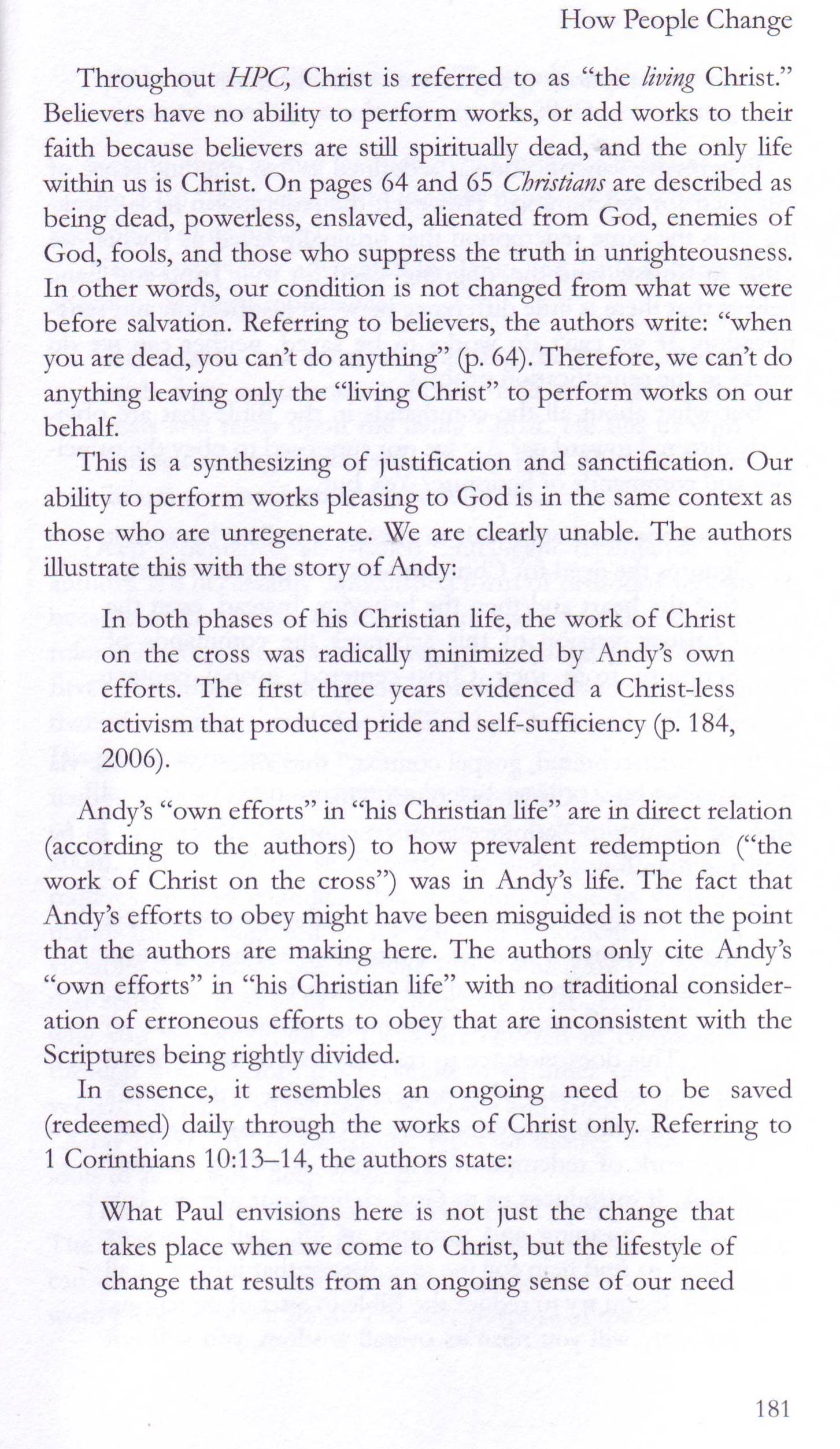
However, while pounding that point home, when you ask them if Christ’s obedience is still active, you get the deer in the headlight look. Why? Because if they say “yes” (and trust me, according to their doctrine, the answer is “yes”), that can only mean that He is presently obeying in our place. If you pay attention, you can see hints of this in their unguarded statements. In an informal document written by Jon Zens that recounts his conversations with Robert Brinsmead, the subject at hand was “the centrality of Christ in obedience.” A reader coined a phrase yesterday that may be apt: “imputed sanctification.”
This extreme view of justification also leads NC to deny the centrality of the Father and the new birth. Logical conclusions also point to unorthodox teachings such as daily justification, or the need to be resaved on a continual bases. This blog is replete with quotes that affirm these accusations.
It therfore stands to reason that church discipline must concern justification as well. The problem this poses for NC is the fact that orthodox church discipline calls for obedience on the part of the believer—which shifts the “emphasis to the believer and away from Christ” (what they call an erroneous subjective justification rather than an objective justification). Therefore, they had to come up with a church discipline that focuses away from demands upon the Christian and implements the works of Christ instead. Hence, “redemptive” church discipline.
How does it work? First, the sin really isn’t the issue per se. Elders may announce to any parishioner at any time that they have been placed into the process of RCD. In RCD, the “steps” are not the Matthew 18 steps that could lead to disfellowship, rather, the steps are part of the process of which you are either in or out of—via elder announcement. If the elders perceive that you have a cooperation or colaboring view of sanctification, you can be placed into the process to correct your view of redemption—that’s why they call it RDC. Therefore, a member could find him/herself in the process because of a theological discussion with an elder, and in fact, this has happened. Once in the process the parishioner is not free to vacate his membership until the elders determine “fruit meet for repentance.” The process can move from step to step (supposedly per Matthew 18) within the process if the individual in the process shows no acclimation to the “proper” view of redemption. Eventually, no movement in the desired direction (months, or even years later) can lead to the fourth and final step—disfellowship.
Those who try to leave that particular church in the midst of the process are also disfellowshipped—the congregation naturally assumes this happened because the member attempted to vacate membership before an offended party, or those confronting sin could confront him in a second or third step with witnesses in a traditional church discipline. In other words, parishioners in NC churches usually don’t know that their elders are practicing this kind of discipline, but rather assume the more traditional practice. Worse yet, the congregation also assumes sin of the baser sort as the reason for the excommunication.
Secondly, any kind of sin can be cause for RCD because sin really isn’t the issue; the sin is merely the result of the person’s view of redemption—fix his/her’s view of redemption, and Jesus will start obeying for them—problem solved. Furthermore, since redemption is the goal, elders who practice RCD can also (so they think) bring non-members into the process because the church has a mandate from Christ to make disciples of all nations. Therefore, a parishioner who pretends to be converted to NCGSS in order to escape a church without being disfellowshipped can still be excommunicated if they tattle on the elders to existing members after they leave. In fact, this has happened.
Lastly, this puts counselees in a very precarious situation. Many churches who are NANC certified practice RCD. Basically, counselees can find themselves held hostage at a church via threat of public humiliation. This ministry is aware of many testimonies accordingly: people being placed in RDC for tithing issues, priority issues—you name it, while discussion of this form of discipline is nowhere to found. A more vile consideration is marriage counseling where one spouse accepts Gospel Sanctification and the other spouse doesn’t—resulting in the conclusion that it is a mixed marriage (believer/unbeliever). This of course, puts the marriage in a very dangerous circumstance.
Would proponents of NC like to deny this? Well then, simply answer this question: “Why do you call it “redemptive” church discipline? Isn’t the word, “redemption” a little strong when we are talking about reconciliation? Please explain, and for once without hiding behind the word, “gospel.”
paul


Wed. Night Bible Study Makes Jay Adams Look Less Radical
“That’s his words, not ours. Therefore, our group concluded that even with our limited knowledge of biblical counseling, we could, in fact, help this Christian—and more than the ‘experts’ that he cited in the article.”
An extraordinary article was published in Christianity Today and published online yesterday ( http://www.christianitytoday.com/ct/2011/april/schizophrenic.html ). It is the testimony of a Christian struggling with Schizophrenia. The article, printed out, is six pages. I took the article with me to our church’s Wed. night Bible study and used it for open discussion.
After passing out copies to each parishioner, I informed them that we would be reading through the article together and stopping for discussion when warranted. As facilitator, I opened with the following question: “Is God’s word sufficient for just the ‘normal’ problems of life, or is it useful for deeper problems?” I then began reading as the others followed along.
The author writing his testimony opened with the following statement:
“I used my cane to hit the handicapped door opener. My hands shook and shadows danced on the wall. In the back of my mind, I saw train tracks. My head lay on the rail. A whistle blew, and I closed my eyes. It blew again and again. My eyes were shut tight. I was anxious and scared. Do suicides go to heaven?”
The parishioners seemed to be catching-up a little bit on this unorthodox Bible study I sprang on them, so I offered another interpretive / discussion question:
“If you were waiting for your car to be serviced at the auto repair center, and the person sitting next to you saw you reading your Bible, and asked that question, would you have an answer?” One member said “yes” and offered a pretty good theologically sound answer, which prompted my next question: “That’s good, but I’m wondering, should we see this as a divine appointment? Should we ask him, ‘what is going on in your life that would prompt such a question?’ I’m wondering, is this how a lot of people get saved? Is this how churches grow? Isn’t the gospel, if you think about it, problem centered?” The group agreed and suggested that such opportunities should be used to gain involvement in people’s lives. After all, this guy needs hope, right? And what does the Bible say about that? “But in your hearts set apart Christ as Lord. Always be prepared to give an answer to everyone who asks you to give the reason for the hope that you have. But do this with gentleness and respect” (1Peter 3:15).
While waiting for his doctor, the author shared what he was thinking:
“I sat in a comfortable leather chair. I thought of the life I could have lived. The life I lost.”
Here was my next question to the group: “If this Christian expressed this thought to the apostle Paul, what do you think Paul would say to him?” A deacon in our church immediately suggested some thoughts on Philippians 3:8 where Paul said he considered his past life rubbish when compared to the gospel—so, “what’s so special about this guy’s past life?” Hmmm, interesting thought, no? The deacon’s wife then pointed to Philippians 3:13,14: “But one thing I do: Forgetting what is behind and straining toward what is ahead, I press on toward the goal to win the prize for which God has called me heavenward in Christ Jesus.” At this point the group was very engaged and insightful observations from the Scriptures started coming in rapid fire. The group agreed as a whole that this line of thinking was not a helpful focus for our not so hypothetical counselee. We continued to read:
“A small, balding man in penny loafers came to greet me. He wore a Harris Tweed jacket with no tie—a failed attempt to set his patients at ease.”
We did not park long here, but I suggested that our counselee doesn’t know what the intentions of this doctor was in how he dressed. But, let’s say that it was his intentions; how does the counselee know it didn’t work for others? And would that be necessarily wrong? Could this indicate more unbiblical thinking? Probably. I then brought back to mind the author’s opening statement and directed the group to Philippians 4:8,9:
“Finally, brothers, whatever is true, whatever is noble, whatever is right, whatever is pure, whatever is lovely, whatever is admirable—if anything is excellent or praiseworthy—think about such things. Whatever you have learned or received or heard from me, or seen in me—put it into practice. And the God of peace will be with you.”
In light of this passage, should the counselee be thinking (the word is actually more along the lines of “dwelling”) about his head being on a railroad track with a train approaching? In fact, was that “true”? Are those thoughts “lovely”? The group’s response: “Obviously not.” Then came my next question regarding what Paul said the results of right thinking and right doing would be (“And the God of peace will be with you.”):
“We would all agree that this Christian needs “peace,” but does this promise pertain to our counselee even though he’s schizophrenic?” Their answer: “Absolutely!” Hmmmm, interesting.
Then came a very light moment, and a lightbulb moment when we discussed the first question the therapist asked our counselee:
“Well, David, how do you feel?”
My facilitating question was: “In light of what we have discussed, shouldn’t the doctor’s question be ‘How are you thinking—rather than ‘How are you feeling?’ If one knows how this Christian is thinking—wouldn’t his feelings be a given?’”
The group wholeheartedly agreed via laughter. Their smiling faces also seemed to say, as they rechecked the manuscript: “Doctors get paid for this?”
We then continued to read:
“It took me a moment to collect my thoughts. “I still see shadows everywhere. They seem to watch me. Whenever I close my eyes I see myself without a head. Sometimes it feels like invisible knives are swirling around me. The medicine is making it hard for me to walk, and often I feel like I am falling when I am just standing still. The suicidal thoughts are getting better. Just ideas, no actual plans.”
This statement evoked some questions in our minds: Does wrong thinking lead to bad feelings, and do those bad feelings then start to produce further negative thinking, with further negative feelings? The counselee is now using “[it] seems” and “it feels” as if we can almost see the downward spiral right here in this manuscript. Also, can the drugs really do the counselee any good while he is thinking this way?
We continued to read:
“Dr. Stanley nodded and scribbled something on my chart.
‘I see. I think you are doing better than the last time we met. How are you spending your time?’
‘I sleep most of the time. When I’m awake I play my Xbox. Sometimes I read and listen to music.’
‘Do you get out of the house much?’
‘No.’
I directed the group back to Philippians 4:8,9. Is this “doing” (sleeping and Xbox “most” of the time) advisable for this counselee right now? Again, regardless of his condition, does the promise of these verses and James 1:25 still stand? We think it does.
I then directed them to page two and read the following from what the author wrote:
“A little knowledge can be a frightening thing. I soon realized, for instance, that psychiatrists often go to school for 24 years so they can prescribe drugs that, according to some research, are only marginally better than a placebo. Almost all antidepressants increase the recipient’s risk for suicide. Why did I trust these people? Why did I pay $160 an hour to see them?”
That’s his words, not ours. Therefore, our group concluded that even with our limited knowledge of biblical counseling, we could, in fact, help this Christian—and more than the “experts” that he cited in the article.
Others who were reading ahead brought up another important issue from the following excerpt:
“While some members of our conservative church were supportive, it was amazing how often our questions were met with skepticism and hostility: ‘Are you secretly gay?’ ‘Do you have some unconfessed sin?’ ‘Are you possessed by a demon?’ ‘How dare you question God!’ The range of suspicions was staggering.”
Regarding this excerpt—our group’s conclusion: 1. Counseling /discipleship must be done the right way. 2. This is indicative of Job’s three friends: “C’mon job, confess your sins—you will be healed and we can all go back home.” 3. Christians must resist laziness in regard to helping other Christians (i.e., quick fixes and pat answers). 4. Christians must be gentle, humble, willing to sacrifice self, and willing to invest in others.
In, or around 1972, Jay Adams published a book entitled “Competent to Counsel.” The book introduced a radical concept to contemporary Christianity; namely, that the average Christian has what he needs in the Holy Spirit and the Scriptures to help others with the deep problems of life. Today, Dr. Adams and Donn Arms offer training that equips Christians to do just that through the Institute of Nouthetic Studies ( www.nouthetic.org ). Our church’s men’s ministry is implementing this training into our curriculum. We trust that it will make us better husbands, better fathers, better ministers of the word, and better evangelist. In Adams’ introduction to the program, he suggests that Christians have more in their discipleship bag than what they think—after Wednesday night, we would have to agree. Also, Dr. Jay’s contention is not looking so radical after all.
What We Don’t Need
We don’t need counseling that taints the “pure milk of the word” ( 1Peter 2:2) with those who ask the wrong questions (“How do you feel” verses “What do you think”). Though feelings in the Christian life are very important, the primary purpose of medication is telling in regard to other counseling disciplines. Neither should God’s word be tainted with those who make feelings the primary discipline through which all other spiritual disciples flow (i.e., John Piper). Nor do we need to solicit ancient philosophers and look for God’s truth in everything that crawls upon the Earth (i.e., CCEF). Furthermore, we do not need to integrate mysticism with the pure milk (i.e., NANC). Moreover, those who cry “Christ-centered counseling, NOT problem centered counseling” miss the point: the gospel itself is problem-centered. The good news addresses two major problems: sin, and separation from God. We are ambassadors on an alien planet, and those in the kingdom of darkness look for relief from their pain, and the happiness Christ talked about in the Sermon on the Mount—but they often do not understand the source of that pain.
Lastly, this excerpt, “Doctor, it has been three years. Will I ever get better?….’you need to accept that you will always be this way’ (the statement by his doctor was never refuted by the Author),” gives us pause because Romans 8:37 says, “No, in all these things we are more than conquerors through him who loved us.” Certainly, Jay Adams is right; we have to believe that Christians have more hope in our bags than that!
paul

 Paul's Passing Thoughts
2 comments