Religious Tyranny: A Case Study; Introduction and Chapter One
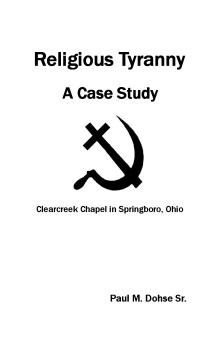
Cover: Religious Tyranny; A Case Study
Preamble
I need another project right now like I need a hole in the head; nevertheless, recent events have impressed upon me the immediate need for this work. As I accomplish each part I will be posting it here on PPT and making all readers part of an editing committee. So, comment here, email me here mail@ttanc.com, and pass judgment on content, grammar, style or whatever else editors do. The compilation will be available in a free ebook or hardcopy book form that can be purchased.
Thank you for your input.
paul
Introduction
“…I have sworn upon the altar of god eternal hostility against every form of tyranny over the mind of man.” – Thomas Jefferson to Dr. Benjamin Rush, September 23, 1801
This book flows not from the winepress of sour grapes, but rather from thankfulness. Whether secular or religious tyranny, these endeavors always yield freedom. Tyranny was a usurper into God’s creation and challenges man’s innate need to be free. Therefore, sin finds itself in a quandary; it is utterly driven by a lust to enslave, but this will eventually drive men to a fight or flight. Tyranny is affliction, but it will always awaken man to his freedom duty. For this, we can be thankful.
This book is an in-depth look into religious tyranny using Clearcreek Chapel in Springboro, Ohio as a case study. However, this case study is a story that reads like most church experiences in our day, and the personal testimonies read the same as well. The information written within will come from the author’s firsthand experience and the testimonies of others, but there is no need to focus on a few people when this is the like testimony of many. Hence, the study will focus on common experiences and not particular individuals.
Most people are saved according to the experience described by the apostle Paul in 1Thessalonians 1:5,
For our gospel came not to you in word only, but also in power, and in the Holy Ghost, and in much assurance; as you know what manner of men we were among you for your sake (KJV).
Yet, most professing Christians doubt their salvation, and furthermore, most professing Christians know there is something fundamentally missing in church; something isn’t right, but they can’t put their finger on it. The present mass exodus from the institutional church is well documented while most people leaving the church don’t know specifically why they are leaving. They are leaving because something is missing, but they are not sure what that something is. The salvation that came with much power and assurance has faded into doubt and indifference.
On the other hand, the church, whether Catholic or Protestant, seems to be supported by many others who are unwavering despite tyranny, illogical contradictions, hypocrisy, and evils not even spoken of in the secular world. How can this be? How can a church like Clearcreek Chapel now embrace beliefs that would have been rejected out of hand with extreme prejudice by the same Chapel parishioners twenty years prior? How can the present leadership behave in a way that would not have been tolerated for a moment twenty years prior by the same people who now embrace it wholeheartedly?
This study proposes to answer all of these questions in no uncertain way, but one final question needs to be answered to complete the study; once the indictment is clarified, what should our response be? What is the solution?
So then, how can we have full assurance of salvation? What is wrong with church? Why is tyranny acceptable? And what should we do about it?
Because only truth sanctifies (John 17:17),
Paul M. Dohse Sr.
Chapter One: The Chapel’s Unique Place in Church History
Clearcreek Chapel in Springboro, Ohio played an important and telling role in contemporary church history. Founded by a young Dr. John D. Street in the latter 1980’s, it sought to be relevant in contemporary culture. Dr. Street often described the church at that time as “ministering to the present culture while wearing bellbottom pants.” Street also patterned the Chapel ministry after his mentor, Pastor John MacArthur Jr.
Dr. Street also made an emerging movement at that time a hallmark of the Chapel ministry; the biblical counseling movement founded by Dr. Jay Adams. The advent of said movement began with Adams’ controversial book, “Competent to Counsel” (1970). The Chapel became a training center for the biblical counseling movement founded by Adams, and in large part a face of the biblical counseling movement.
Adams, a Presbyterian minister, was provoked by his own confession that he was unable to help people with serious problems, and indicted the church as a whole in the same way. What made this indictment painfully obvious was the integration of secular Psychology into religious thought during the 1980s. This integration was a movement that peaked in the 80’s. Help could not be found in the church so people looked for help outside of the church. The biblical counseling movement peaked in the 1990’s and this is when it experienced a true biblical revival, and Clearcreek Chapel was one of the epicenters of that spiritual awakening.
It is now very important to explain what that revival looked like because the implications are profound. This is the first point in beginning to answer the questions presented in the introduction: what’s wrong with church? Why do so many Christians doubt their salvation? Why do so many embrace churches that practice open tyranny? And lastly, what should we do about it?
If most Christians are honest, they see very little progressive change in the people they attend church with. If most Christians are honest, they admit people who are saved from the outside secular world into an enduring life testimony are very few and far in-between. Yet, this was not what was going on at the Chapel during the 90s. In one year (1995) as a result of the biblical counseling focus, twelve people were saved in 1Thessalonians 1:5 fashion and stayed the course. During this time other churches influenced by the Chapel shared the same testimony.
But let’s back up for a moment; Jay Adams’ testimony is startling. As one who came from the elitist hallowed halls of Protestant brain trust, he openly admitted himself that he was clueless in regard to helping people with real life problems. Furthermore, this was his indictment against the church at large as well. We must pause and ponder this fact soberly; after more than 500 years and oceans of Protestant scholarly ink, it was commonly accepted that most ministers were unable to take the word of God and help people with serious problems. There is a very simple answer in regard to why that was the reality and still is, and we will arrive there in due process. But before we move on, it is interesting to note that while the Protestant brain trust openly confessed its inability to help people with deep personal problems, it wailed and screamed in sackcloth and ashes that the void was filled with secular Psychology.
The brainchild of Adams’ biblical counseling construct is even more startling. In beginning his quest for helping people with real problems, he sought out none other than O. Hobart Mowrer, a notable secular Psychiatrist who fathered a kind of responsibility therapy movement championed by the likes of Dr. Phil McGraw and Dr. Laura Schlessinger. Adams wrote in the introduction of Competent To Counsel,
Reading Mowrer’s book The Crisis in Psychiatry and Religion, as I said, was an earth-shaking experience. In this book Mowrer, a noted research psychologist who had been honored with the Presidency of the American Psychological Association for his breakthrough in learning theory, challenged the entire field of psychiatry, declaring it a failure, and sought to refute its fundamental Freudian presuppositions. Boldly he threw down the gauntlet to conservative Christians as well. He asked: “Has Evangelical religion sold its birthright for a mess of psychological pottage?”
In Crisis, Mowrer particularly opposed the Medical Model from which the concept of mental illness was derived. He showed how this model removed responsibility from the counselee. Since one is not considered blameworthy for catching Asian Flu, his family treats him with sympathetic understanding, and others make allowances for him. This is because they know he can’t help his sickness. He was invaded from without. Moreover, he must helplessly rely on experts to help him get well. Mowrer rightly maintained that the Medical Model took away the sense of personal responsibility. As a result, psychotherapy became a search into the past to find others (parents, the church, society, grandmother) on whom to place the blame. Therapy consists of siding against the too-strict Super-ego (conscience) which these culprits have socialized into the poor sick victim.
In contrast, Mowrer antithetically proposed a Moral Model of responsibility. He said that the “patient’s” problems are moral, not medical. He suffers from real guilt, not guilt feelings (false guilt). The basic irregularity is not emotional, but behavioral. He is not a victim of his conscience, but a violator of it. He must stop blaming others and accept responsibility for his own poor behavior. Problems may be solved, not by ventilation of feelings, but rather by confession of sin.
From my protracted involvement with the inmates of the mental institutions at Kankakee and Galesburg, I was convinced that most of them were there, as I said, not because they were sick, but because they were sinful. In counseling sessions, we discovered with astonishing consistency that the main problems people were having were of their own making. Others (grandmother, et al.) were not their problem; they themselves were their own worst enemies. Some had written bad checks, some had become entangled in the consequences of immorality, others had cheated on income tax, and so on. Many had fled to the institution to escape the consequences of their wrongdoing. A number had sought to avoid the responsibility of difficult decisions. We also saw evidence of dramatic recovery when people straightened out these matters. Humanistic as his methods were, Mowrer clearly demonstrated that even his approach could achieve in a few weeks what in many cases psychotherapy had been unable to do in years.
I came home deeply indebted to Mowrer for indirectly driving me to a conclusion that I as a Christian minister should have known all along, namely, that many of the “mentally ill” are people who can be helped by the ministry of God’s Word. I have been trying to do so ever since.
This experience was the breakthrough that launched the biblical counseling movement and its subsequent success. Without Mowrer’s observations, the biblical counseling movement never happens. Nevertheless, Adams then states the following in the same introduction:
Let me append one final word about Mowrer. I want to say clearly, once and for all, that I am not a disciple of Mowrer or William Glasser (a writer in the Mowrer tradition who has become popular recently through the publication of Reality Therapy,a book that has confirmed Mowrer’s contentions in a different context). I stand far off from them. Their systems begin and end with man. Mowrer and Glasser fail to take into consideration man’s basic relationship to God through Christ, neglect God’s law, and know nothing of the power of the Holy Spirit in regeneration and sanctification. Their presuppositional stance must be rejected totally. Christians may thank God that in his providence he has used Mowrer and others to awaken us to the fact that the “mentally ill” can be helped. But Christians must turn to the Scriptures to discover how God (not Mowrer) says to do it.
All concepts, terms and methods used in counseling need to be re-examined biblically. Not one thing can be accepted from the past (or the present) without biblical warrant. Biblical counseling cannot be an imposition of Mowrer’s or Glasser’s views (or mine) upon Scripture. Mowrer and Glasser have shown us that many of the old views were wrong. They have exposed Freud’s opposition to responsibility and have challenged us (if we read their message with Christian eyes) to return to the Bible for our answers. But neither Mowrer nor Glasser has solved the problem of responsibility. The responsibility they advocate is a relative, changing human responsibility; it is a non-Christian responsibility which must be rejected as fully as the irresponsibility of Freud and Rogers. At best, Mowrer’s idea of responsibility is doing what is best for the most. But social mores change; and when pressed as to who is to say what is best, Mowrer falls into a subjectivism which in the end amounts to saying that each individual is his own standard. In other words, there is no standard apart from God’s divinely imposed objective Standard, the Bible. Tweedie is correct, therefore, when he rejects Mowrer’s “projected solution” to the problem of sin as an “acute” disappointment.
During the years that followed, I have been engrossed in the project of developing biblical counseling and have uncovered what I consider to be a number of important scriptural principles. It is amazing to discover how much the Bible has to say about counseling, and how fresh the biblical approach is. The complete trustworthiness of Scripture in dealing with people has been demonstrated. There have been dramatic results, results far more dramatic than those I saw in Illinois.
In light of the entire context stated here, Adams’ paradoxical twist on Mowrer is both stunning and perplexing, but don’t miss the much larger point; Adams’ perspective as documented here is profoundly indicative of what is fundamentally wrong with church. Yes, it is the something that is wrong that few are able to put their finger on. However, we are still in the history stage of our study. In regard to why Clearcreek Chapel is a paramount case study for religious tyranny, we are still laying the historical groundwork.
Chapter Two: The Insurgency
Moving On As a Contemporary Child of God; All Those Who Do So Have Their Own Blessed Broken Road
 “The Protestant teachers proudly proclaim themselves as bad people and even laugh about it, but yet the simplicity of cause and effect somehow escapes us.”
“In all cases, orthodoxy is the knowledge handed down to the spiritual peasants to inform them on how to be progressively saved by the institution.”
“…in the final judgment followers will stand alone before God.”
Recently, the host and domain address for eldersresolution.org came up for renewal. With everything I have going on with TANC Ministries the due date slipped between the cracks and the site is temporarily down although there are other extensions of the site online (clearcreekchapel.com).
Looking through the information that the site documents was a defining moment and one of deep reflection. I decided to renew the domain address and move it to another site that I will develop sometime in the near future. Perhaps this very post will be the centerpiece.
Before I move on to the primary ideas of this post, let me say that eldersresolution.org, which can now be found in pdf format at http://clearcreekchapeleldersresolution.weebly.com/ was the work of my son-in-law, Pastor David Ingram, and pioneered the concept of using websites to hold the institutional church accountable in a public way. He came up with the idea as a way to take a stand in my situation (circa 2008), and to my knowledge there were no such sites on the internet at that time. It would seem that the Bangladesh missionary kids (https://bangladeshmksspeak.wordpress.com/) were also innovators in regard to the concept early on. In 2009, the concept went viral in response to the heavy-handed leadership mode of the New Calvinist movement which had finally come of age after 39 years of covert growth; what many called the “Quite Revolution” (http://founders.org/library/quiet/).
Reviewing the information made me cringe as it revisited what a weak and confused person I was at the time. With that said, it was also a major turning point in my life that I find impossible to regret. How many times did I dismiss the numerous and serious problems I saw in the church with, “What else is there?” For 27 years I struggled to find relevance in the church.
The turning point was the New Calvinist movement, and specifically the New Calvinists that covertly obtained control of Clearcreek Chapel (Springboro, Ohio). I had been a member there for 20-years-plus and a former elder. As these leaders began transforming Clearcreek from Reformation Light to Reformation Lager, I wondered if I had finally stumbled upon the answers to why Protestant sanctification is so anemic, illogical, and irrelevant.
Like the Protestant leaders I had rubbed shoulders with in the past, they couldn’t answer the hard questions, but this time I really pressed the issue because they were just adding more confusion to the confusion I had found a way to live with. That was troubling to me. Then, when they started responding to my persistence with passive forms of aggression, and later not so passive, I figured I was on to something.
Funny, one question I kept asking publically in Sunday school seemed to be the lightning rod: “How do we know when we are trying to please God ‘in our own efforts’ and what exactly does that mean to begin with? How should we do effort?” It was very obvious to the congregation that they didn’t want to answer the question, but I kept pushing the issue and that’s when all of the trouble started. It would seem that in my search for Protestant relevance, I had finally found the right question. If Christians are to rightly partake in a right effort versus a wrong effort, how is that determined?*
And of course, now I know why they didn’t want to answer the question. Protestantism teaches that sanctification is a “Sabbath rest” in which we “rest in what Jesus has done—not anything we do.” This is what Protestant Light formally criticized as let go and let God theology. But of course in the scheme of things, the folly of this construct is fully realized: not doing things is a metaphysical impossibility; so, what we are talking about is two different types of works. That would be, not working work and working work. Or if you may, faith alone works and work work.
This boils down to Protestant orthodoxy classifying works according to the traditions of men. They determine what faith alone works are as opposed to works that are “self-justifying.” It boils down to the following: obedience to their definitions determine your salvation. Non-self-justifying works pertain to Protestant ritual that keeps you saved. And of course, the sacrament of tithing keeps the money pouring in for infrastructure that bolsters the aurora of authority. What will people pay for their eternal salvation? Observe the splendor of Protestant temples and institutions that pollute the landscape everywhere.
Eldersresolution.org is merely a documenting of the symptoms. The domain will always be there, but I am not really sure why it is a good idea. It was originally constructed to warn others about the Clearcreek Chapel elders who had supposedly distorted Protestant orthodoxy and done really bad things to other people. What I know now is that Protestantism itself is the bad thing. Bad things happen in church because church is bad. In fact, one of the premier leaders of the present-day Protestant church, Dr. John Piper, brags about being bad (https://youtu.be/6-GxkAJ1OBU). The Protestant teachers proudly proclaim themselves as bad people and even laugh about it, but yet the simplicity of cause and effect somehow escapes us.**
Other mediators other than Christ necessarily demand institutional salvation based on what is supposedly God’s authority by proxy. This is why the body of Christ is a literal family and NOT an institution in any way, shape, or form. It is a literal family that one is literally born into by the baptism of the Spirit otherwise known as being “born again.” It is the literal “household of God” and the family of God the Father—not an institution any more than any family is an institution. Christ’s mandate to His assemblies is to be carried out through a family format—the literal family of God. Any vestige of institutionalism will cripple the cause of Christ to the degree that it exists within the assemblies of Christ expressed where families dwell: in homes, not institutional purpose buildings.
ALL institutional churches and religions have these things in common: mediators other than Christ or mediators in addition to Christ. There is a claim of authority other than Christ or a shared authority with Christ, and finally, there is always a gnosis caste system; the haves and have-nots in regard to the ability to know truth owned by the institution. In all cases, orthodoxy is the knowledge handed down to the spiritual peasants to inform them on how to be progressively saved by the institution.
False religion is always a broken road, but unfortunately, the pain of that road will rarely lead people to other places. But when it does, the pain of that road becomes an irrelevant and distant concern. It is a pain that is finished and its purpose completed. It is swallowed up by the experience of where the road has taken you. The story of your broken road will rarely warn others of danger or save anyone; people will forgive or look the other way in many, many things in order to gain eternal life. In the minds of the “good Germans” during WWII Germany was not perfect, but what else was there? In their minds; nothing.
In the mind of a good Protestant or Catholic what else is there? Nothing. It may be a nasty bus, but it’s the only bus going to heaven because the authority of men says so. But in the final judgment followers will stand alone before God.
And so it is. The broken road has led me to a place that makes its potholes and highway robbers a distant and irrelevant memory. Their work is finished. When experience teaches you a new way, and you begin to live in that new way, that’s healing.
Staying on the broken road and revisiting its experiences will never heal. Never. When pain is a finished work…you are healed. It is little different than Christ’s obedience to the cross which He despised and bore for the joy that was set ahead.
It is finished.
paul
*Chad Bresson, an elder at Clearcreek Chapel once prayed before the congregation: “Lord, we know that we have tried to please you in our own efforts this week, please forgive us.”
**The father of the Reformation, Martin Luther, stated in a letter to Philip Melanchthon: “If you are a preacher of mercy, do not preach an imaginary but the true mercy. If the mercy is true, you must therefore bear the true, not an imaginary sin. God does not save those who are only imaginary sinners. Be a sinner, and let your sins be strong, but let your trust in Christ be stronger, and rejoice in Christ who is the victor over sin, death, and the world. We will commit sins while we are here, for this life is not a place where justice resides.”
This Week’s Sinner Saved by Grace Sinning and in the News: RC Sproul Jr.
 This week’s Reformed leader who got caught is RC Sproul Jr. The scandals are now commonplace and beginning to lose their news worthiness. Commonness doesn’t excite; it’s uncommonness that gets people’s attention. This is why the Super Bowl only takes place once a year; it’s an uncommon event.
Sproul will be suspended for eleven months (without pay?) for…well…being who he is…a “sinner.” And if the Protestant leaders are dropping like flies, what’s going on among those they are leading? I can answer that. Lots of totally depraved stuff. Don’t let the resurgence of church discipline fool you. Church discipline, a concept NOT found in the Bible, is only for those who ask questions and do things that could involve the outside world in “family matters.”
You might want to understand the following: making RW Glenn, Mark Driscoll, Doug Phillips, Josh Duggar, Tullian Tchividjian, Bill Gothard, etc., resign from ministry for being who they are and being scandalous while preaching the “scandalous gospel” is not inconsistent if you really understand Protestant doctrine more than Protestants do. Their fall is merely a manifestation of God’s will. The Lord is “sovereign,” and the Lord giveth, and the Lord taketh away.
Let me just boil everything down and make it real simple. Protestantism was founded on the idea that all of reality is a salvific metaphysical narrative written by God who created the narrative and all of the characters to complete himself. For the sake of his own glory and self-love which apparently was lacking, God wrote history as a metaphysical redemptive narrative. Stop right where you are now and consider: what you are presently experiencing is part of the prewritten narrative which is all about redemption. The story, and everything about it, brings glory to God.
Consequently, yes, God is supposedly the creator of evil, predetermines who goes to heaven and who goes to hell, and well-being comes from rejoicing in what gives God glory for the sake of his self-love; whatever is in the narrative that he pre-wrote might even include your own damnation. Of course, this makes the most excellent piety an expression of hyper altruism. It is the practical application of John Calvin’s Worm theology.
So, since everything is predetermined for God’s glory, and God is glorified by damnation and salvation alike which are eternal, every verse in the Bible is about salvation, or what we call “justification.” In the final analysis, in accordance with the least common denominator, you MIGHT be saved in the end by living by faith alone in the gospel of sovereignty. To at least have a chance, you must enter the “race of faith” in which the reward is salvation. When you hear folks talk about “sovereign grace,” and the “sovereign gospel,” and the “gospel of sovereignty,” this is what it boils down to. When good Protestants say, “God is in control,” they are not kidding—God is in TOTAL control.
This is why institutional Christians have always lacked wisdom in regard to everyday wisdom and solving the more difficult questions of life (what we call sanctification), because every verse in the Bible is about justification, ie., “what Jesus has done, not anything we do.” As one pastor told me, “I am not going to be distracted from the gospel by counseling people.” Good Protestant pastors farm out counseling to the ACBC where the counseling is “gospel-centered.” And this counseling will give people peace; after all, there is nothing you can do about anything, so stop fighting what God has predetermined. Relax, be happy, everything is predetermined for God’s glory. Got tragedy? Praise the Lord for his glory. Rejoice and be happy for this is the day he has made.
Let’s apply this to what we see on the Christian hillsides littered with dead bodies. According to what I was told by Clearcreek Chapel elder Greg Cook some time ago, counseling guru Stuart Scott is no longer an elder at John MacArthur’s church because Scott’s children were sinners saved by grace acting like sinners. This is the crux: obedience, like every other reality, is determined and delivered by God, not us. So yes, we are in fact sinners, but anything that we do that is good is performed by God, not us. Couple this with what I have heard MacArthur say on the radio: (paraphrase) “Saved obedient children are God’s mark on a man confirming his calling to the ministry.” See how this works?
Now let’s apply this to Sproul et al. Their punishment is not inconsistent with the idea that they are punished for being what they preach because their fallenness or unfallenness is determined by God. What they did is who they are, and God did not prevent what they did, but regardless, they deserve the punishment. Why? Because God is the potter and we are the clay, and all clay pots are made for his glory whether pots of wrath or pots of glory. Look, read Sproul’s statement about what he did and his suspension, this is written all over it if you know what to look for.
Yes, yes, yes, I know, I can hear the screaming Protestant denials like alley cats in the night while in heat. But what they say reveals the foundations of their Protestant mindset: “It’s God’s will,” or “Lord willing,“ “I didn’t do it, it was the Holy Spirit,” “God is in control,” etc., etc., etc. These statements are NEVER qualified. What’s God’s will? Everything, or just certain categories? If we didn’t do it and the Holy Spirit did it, what do we do, if anything as opposed to what the Spirit does? If we drive somewhere to do a good work, does the Spirit drive the car, or do we drive the car? And if we drive the car, does that qualify as participation in the good work? To what extent is God in control? Not only that, an orientation towards solutions is hardly ever observed, but rather, “we will pray for you.” This is because solutions are irreverent in regard to what God has supposedly predetermined. Our prayers serve to display our “perplexity” as set against God’s omniscience which also gives him glory. Regardless of the circumstance, we don’t pray for a good ending, but for God’s glory, ie., whatever happens.
The hard determinism of Protestantism’s gospel of sovereignty is deluded over the years leaving behind anemic sanctification which causes people to look for a solution. This results in, “Eureka! Here is the problem: we have strayed away from our original gospel!” Hence, enter the New Calvinist movement.
Common sense tells us that this doctrine will lead to, at least, a relaxation of the law, or better stated, a relaxation of love (“If you love me, keep my commandments”), but there is no contradiction in these leaders paying consequences for living out the gospel that they preach…
…whether they obey/love or not is God’s doing which confirms God’s mantle upon them. If anyone loves, it is really God loving himself through the individual. As the Christian song states, “We are empty vessels waiting to be filled.” Wellbeing is defined as seeing yourself as a mere character in God’s prewritten metaphysical narrative and plying whatever predetermined role that gives him glory. If you believe that anything you do is your own choice, you are playing god and writing your own reality.
Now, apply this construct to Sproul’s post and see if it makes any sense. Will any of these guys return to ministry? Only the future reading of God’s narrative will tell…the Lord giveth and the Lord taketh away.
paul
Bible Prophesy is Directly Linked to Assurance of Salvation: Part One
One of the many Protestant myths that we hear often is that Bible prophesy, otherwise known as eschatology, is “secondary” truth. Yes, having a definitive understanding of its corpus which is about 25% of Scripture is optional.
Among the many disturbing insinuations in regard to this mentality is the idea that God prophesies about things that we can’t really understand. In other words, God is glorified by telling us things we can’t understand to prove some kind of point whatever that might be.
Not unlike many other Protestant mentalities, this particular one is warned against in Scriptures, and to the contrary promises blessings for those who study prophesy which assumes possible understanding.
One of the blessings of studying Bible prophecy and having a proper understanding of it is assurance of salvation. Much could be discussed on this wise, but the focus of this post will be the number of resurrections and judgments.
A Humble Faith is Confused and Uncertain?
There are many confused Protestants in the land because supposedly, being confused gives glory to God. One of myriad examples is a book written by Puritan wannabe Russ Kennedy of Clearcreek Chapel in Springboro, Ohio titled “Perplexity.” The primary thesis of the book is about how unanswered questions are a form of worship. But this is typical: the Bible states that God is not a god of confusion, but Protestant orthodoxy can always be counted on to set the Bible straight. My point here is that there are many Protestants that believe the Bible teaches about multiple resurrections and judgments, But that’s NOT Protestantism. Most Protestants do not know what a Protestant is…which of course in not commendable.
At any rate, confusion never walks with surety.
Justification by Faith: One Resurrection; One Judgment
What is Protestant orthodoxy on this matter? Answer: one resurrection and one judgment immediately following. And why does this matter? It matters because this view of eschatology is tied directly to the Protestant position on justification; or in other words, the essential doctrine of Protestantism known as justification by faith.
In that doctrine of salvation (soteriology), there is no assurance of salvation until your salvation is confirmed at the one final judgment at the end of the ages. In that one final judgment, God “separates the sheep from the goats.” This is the judgment of the nations and NOT the great white throne judgment, but articulating the differences is not the subject of this particular post; our subject is justification by faith and its necessary eschatology that supports its authentic soteriology.
Orthodoxy: Obedient Faith Not OSAS
Most Protestants also believe that once saved always saved (OSAS) is Protestant orthodoxy, but this is something else you can add to the long (very long) list of things that Protestants think Protestants believe. Protestant orthodoxy holds to salvation as a process. It is the idea that the process has a beginning point, a progression, and a final confirmation. A good snapshot of this is how Protestant orthodoxy interprets Philippians 2:12,13.
Therefore, my beloved, as you have always obeyed, so now, not only as in my presence but much more in my absence, work out your own salvation with fear and trembling, for it is God who works in you, both to will and to work for his good pleasure.
First, “obeyed” is the Protestant “obedient faith” or “obedience of faith.” What’s that? It is the idea that Christians only perform one act of obedience, living by faith…alone. How do you live by faith alone? It’s a good question because our culture defines faith as purely mental. Therefore, how do we “live” actively by faith alone? As homo sapiens, we not only sit around and think—we do things.
The answer is in… “work out your own salvation with fear and trembling.” Here, orthodoxy interprets “salvation” as justification, or the saving of the soul by Divine decree. Therefore, salvation needs to be worked out through faith alone.
“The Imperative Command is Grounded in the Indicative Event”
Also, and this is a BIG also, our working out of our salvation by faith alone, or faith-alone work, should be motivated by the supposed fact that “Christians” remain under the condemnation of the law, and should live in constant fear of condemnation which motivates us to live by faith alone lest we fall into “works righteousness [justification].” Because justification is seen as a process, and its end acquired by faith alone, one must not “jump directly from the command to an act of obedience.” Instead, everything we do must be “grounded in the historical Christ event” via faith alone, or by faith-alone works. This is how orthodoxy categorizes works in the Christian life: works, or a “righteousness of our own,” jumps from the command to obedience which is not of faith while faith-alone works operates on all obedience being grounded in the cross event.
In our Heidelberg Disputation series, mainline Protestant evangelical Phil Johnson is cited in regard to orthodoxy’s very definition of faith: it is returning to the same historical Christ event that saved us over and over again. By doing this, the righteousness of Christ is imputed to our Christian life (sanctification, or a process of increased setting apart for God’s purposes), and the justification process continues to move forward. This is important to note because said imputation continues to satisfy the law, and remember, our primary motivation is fear of condemnation from being under law.
So, to clarify, our primary faith-alone work is to continually return to the same gospel that saved us, otherwise known as “preaching the gospel to ourselves” in order to keep the law satisfied. A perfect law-keeping is imputed to us as we live by faith alone in “what Jesus has done, not anything we do.”
The Preeminence of the Law in Protestant Soteriology
Let’s tally all of this up in regard to the subject: Protestant orthodoxy makes law preeminent in salvation, and there is only one judgment that deals with the law; the great white throne judgment at the end of the ages. Orthodoxy rejects any judgment that excludes the condemnation of the law. Their gospel calls for a judgment that confirms those who “live by the gospel” well enough to be covered by Christ’s fulfillment of the law through His perfect law-keeping.
Judgments for rewards apart from the law and its condemnation are rejected by orthodoxy. The reward for living by faith-alone well enough is salvation. Because we are saved by faith alone, we must begin by faith alone, live by faith alone, and will be judged according to how well we did that. When we stand AT the judgment, if God only sees the works of Christ and not anything we did, we will “stand IN the judgment.”
Though Christ is said to have preeminence among Protestants, that’s only because Christ paid the penalty of sin under the law, and supposedly fulfilled its demands in our stead. The law is what really has preeminence in Protestant orthodoxy.
And this is why only one judgment is accepted; because all other judgments are for reward APART from the law’s condemnation.
What Saves a Protestant at the Judgment?
In the rest of Philippians 2:12,13 we read, “for it is God who works in you, both to will and to work for his good pleasure.” If you have been following our Heidelberg Disputation series, you know that authentic Protestantism interprets this through Martin Luther’s bondage of the will. Luther believed that man was created with a passive will. Like water, it is only active when it is acted upon from outside of itself. Water doesn’t move unless gravity pushes it—it doesn’t change temperature unless the environment acts upon it from the outside. Likewise, the Christian does not work, he/she only has the will to act if acted upon from the outside. God is the only one who has an active will, and He created man with a passive will.
Luther framed this in context of death. According to Luther, death is not a nonexistent state, but merely a passive state. The dead exist, but they are in bondage to passivity unless acted upon. Luther also believed that this is illustrative of the Christian life. Christians are still dead in trespasses and sin, and only perform good works when acted upon from the outside by God. This is in fact central to the Protestant ideology that drives its soteriology.
Conclusion
Assurance of salvation cannot be a reality in authentic Protestantism because surety removes the condemnation of the law regardless of anything we do. The goal is not the obedience of love, but the so-called obedience of faith that satisfies the “righteous demands of the law.” If we live by faith alone, the obedience of Christ will be imputed to us. This belief is what saves the Christian at the final judgement.
In part two, we will examine what Philippians 2:12,13 is really stating, and its relationship to eschatology. Moreover, we will examine why Christians can have doubtless assurance of salvation accordingly.
paul
Dee Parsons of Wartburg Watch: The Personification of Everything Wrong with Church
 When Paul’s Passing Thoughts .com was started in 2009, the goal was to find out why church turned on me with a vengeance despite my best efforts. Second to that was the question, “What now, where does one go from the point of diagnosing the problem?” You have to properly diagnose the problem before you can fix it.
This article will not wear you out with points leading up to a final conclusion; I will begin by stating what I have found. Church produces the fruit of its ideology. What is wrong with church? Answer: church is what’s wrong with church. Christ’s mandate to his followers was never intended to look anything like church. The solution is to depart from church and pursue Christ’s mandate to His followers. You can’t fix church. There is nothing there that is salvageable.
Let me back up a tad because this post is not the least bit personal, but seeks to sharpen the objectives of TANC Ministries. This is some information that I have not shared before. PPT was primarily a blog for the express purpose of sharing my research. My focus was research. I had to know why—how could dozens of pastors stand by and watch Clearcreek Chapel do to my family what they did?
Clearly, obviously, from a literal interpretive standpoint in regard to the Bible, what they were doing was dead wrong and unbiblical. During the episode, I was even under the counsel of a church that was part of the same fellowship of churches that Clearcreek Chapel belongs to. The pastor, the late Rick Wilson, was a former associate pastor at CCC. The present pastor of the church, Paul Craig, was an elder at the time and according to Wilson found the situation, “unsettling.” Grace Covenant (Beavercreek, Ohio) was obviously stuck in the middle, and was also the recipient of a significant exodus of people from CCC at the time. Though I was clearly under church discipline at CCC, I was allowed to attend Grace Covenant on a regular basis. I even thought about applying for membership which would have forced the Grace Covenant elders into making a judgment regarding the veracity of CCC discipline. I should have; watching that play out would have been priceless.
Eventually, Wilson instructed me to go back and play along in order to get my wife back, but I had already tried that for four months. During that time, I was subjected to cult-like break sessions conducted by CCC elder and Psychiatrist Dr. Devon Berry. The CCC elders knew that I had overcome serious depression in the past, and it was obvious they thought they could use Berry and the circumstances they were bringing to bear in my life to drive me into debilitating despair. It was very apparent to me at the time: that is what they were trying to do.
I want to stop right here and thank God publically for something right now—I want to give Him the glory. At the time, I was working out of town and laid in bed at night before going to work the next day…in perfect peace. My favorite time of the day during that time period was bedtime. Why? I laid there in the quiet darkness, not really thinking about anything except how peaceful it was. I was doing nothing but laying there soaking up the peacefulness. Do I have any theories regarding this experience? One: I had begun a long journey in search for the truth. God is with one on such journeys. That’s my best shot at answering that question. By all reasoning, I should have been a basket case.
Let’s now pause here for some simple clarification. It all boiled down to two things:
AUTHORITY, and how I interpreted reality versus how they interpreted reality.
I have discovered something in my research—research enables you to come to a point more and more where you can explain complex problems in simple terms. In the 2500 + articles I have written on Reformed ideology, you can see the focus move from the what to the why. My first book articulated the what and how it contradicted a grammatical interpretation of reality, though I didn’t understand the latter dynamic. My second book articulated the contemporary history of the Neo-Calvinism movement and added some more data about grammatical contradictions.
My third book and subsequent booklets articulate the grammatical contradictions in regard to soteriology. They also describe the dynamics between the Old Calvinism/New Calvinism question and how the interpretation of reality drives that debate.
Including time spent prior to PPT, eight years later, I can now put all of this in simple terms. It boils down to AUTHORITY vested in the interpretation of reality.
And, the established credential thereof known as “orthodoxy.” What is the premise of orthodoxy? Nothing more or less than the claims of men that people choose to believe. You can put any number of things in place of “naked” in regard to the following question posed by God, “Who told you that you are_____?” Be very, very, very wary of what men say God told you. And that’s orthodoxy. And the place we go to get certified in orthodoxy is called “seminary.” In case you haven’t noticed, God isn’t the dean or an adjunct professor in any of these schools.
 Here is something else that should be evident: you, and only you alone will answer to God. Therefore, pick your orthodoxy well. There are no attorneys in God’s court save Christ, “hear ye Him.” “God has spoken to us in these last days through His Son”, not a horde of academics.
So, what do we have in the recent dust-up between PPT and Wartburg Watch? Be advised, I am not going to rehash all of the gory details. Dee Parsons is right and I am wrong because she has college degrees, and holds to orthodoxy. Paul Dohse does not have college degrees, and does not hold to orthodoxy. Paul Dohse holds to a grammatical interpretation of realty, and therefore asks, “How can those who proclaim themselves ‘wicked’ lay claim to salvation?”
Be sure of this: NOTHING has changed since Christ ministered on earth. The primary pushback against Christ was clearly the orthodoxy of the day. Christ deliberately avoided the lauded academia of that day. I just don’t know what is more obvious. In addition, he had to personally reeducate the apostle Paul who was the only religious academic that He used for foundational purposes.
I am weary of documenting the steroidal cognitive dissonance that takes place over at Wartburg and their e-church hosted by the Barney Fife of pastors, Wade Burleson. Regardless of his credentials, from a standpoint of interpreting reality grammatically, his theological snafus are just plain embarrassing. For example, you can’t make the point that a biblical author was teaching something based on the analysis of a word that didn’t exist in the first century. This all takes place in the face of common sense for the same reason I experienced what I experienced at CCC:
AUTHORITY vested in a particular interpretation of reality.
Because one is credentialed in knowing how to lead those who cannot know reality, one should have authority over you for your own good and the common good of people in general.
In varying degrees, CHURCH, established in the 4th century by St. Augustine et al, is the expression of this primary root, and the fruit doesn’t fall far from the tree. Chaos and drama will continue in the church with no solution in sight because of its foundational presuppositions concerning the interpretation of reality and the authority vested in its epistemology.
This ministry’s series on the Heidelberg Disputation focuses on the following fact: at issue with the Reformation was a debate about the interpretation of reality. Of course that spoke to how the Bible is interpreted, but the issue started with how reality itself is to be interpreted. Let me give you the thumbnail:
Words don’t necessarily mean things.
By and large, there are two kinds of Protestants roaming about, Calvinists and functioning Calvinists. Susan and I often have conversations with people who hate Calvinism, but verbally espouse Calvinism unawares constantly. We don’t even address the particulars anymore because we know a complete reeducation is needed. This is what we are attempting to do with the HD series. This series reexamines the roots of the poisonous tree.
This is why Dee Parsons, in the recent dust-up, insinuated that I am mentally ill. What is the definition of a person who does not properly perceive reality? Hence, the CCC elders involved a Psychiatrist in my situation because they honestly believe I am mentally ill because I interpret reality grammatically. Reformed scholars such as Geerhardus Vos have stated such openly. Pastor Russ Kennedy told me I was “mad” and begged me to allow them to “shepherd” me. I believe the guy honestly meant well and still does. Unfortunately, as the saying goes, the road to hell is paved with good intentions.

By the way, I am not talking about grammatical interpretation that leads to a redemptive outcome. I am talking about the interpretation of reality beginning with exegetical presuppositions in the purest sense. I realize Reformed scholars interpret a verse literally when it can serve a redemptive historical outcome…
…that doesn’t make you a proponent of interpreting reality grammatically.
One of the accusations that flowed from the recent dust-up was that TANC Ministries is merely developing its own orthodoxy. Not so. Orthodoxy fundamentally interprets reality according to Martin Luther’s Heidelberg Disputation which was expanded upon by John Calvin’s Institutes of the Christian Religion. Seminary degrees guarantee that individuals will not do independent research that will reveal the real tenants of orthodoxy:
- It is a metaphysical redemptive narrative that interprets all reality through a dualism of good and evil.
- It demands the fusion of faith and force for the common good of mankind.
- It is predicated on spiritual caste that adds additional mediators between God and man other than Christ.
- All of reality progresses as predetermined by manifestations of good completely outside of man.
Dee Parsons’ response to me that “I don’t believe what you say I believe” is most likely due to her ignorance regarding the true sum and substance of the same Reformed orthodoxy that she promotes. Perhaps. While claiming to be an advocate for the spiritually abused, she picks and chooses from orthodoxy what she wants to acknowledge.
The Westminster Confession is just wonderful, but its call to control the free press and execute those who are heterodox is due to the authors being “men of the time.” Of course, their politics and ethics had nothing to do with their ideology. Perish the thought, and no, American Jurisprudence isn’t the only difference between Calvin’s Geneva and the present-day church. It’s absurd to think Dee Parsons would actually have you committed to a mental institution because she thinks you are mentally ill. It’s absurd to think Mark Driscoll would really put you in a wood chipper just because he said that’s what ought to be done. It’s absurd to think James MacDonald would catapult you into the next county, and to your certain death just because he said he wishes he could.
Church is a place where professional clergy interpret reality in a completely different way than most parishioners. Congregants follow the dictates of church leaders while being clueless in regard to their interpretation of reality. They are given elements to follow while being totally unaware as to what those elements are based on. Hence, chaos and confusion reign. Duggar-like drama is paraded before the world constantly like an out-of-control stampede of rats. Yet, that isn’t the madness; the madness is suggesting that we rethink how church is done. After all, Catholicism and Protestantism have had only 1500 + years to get it right. Not only that, the Neo-Calvinist movement has been in total control of the church for at least ten years. Growing steadily since its conceptual resurgence in 1970, discernment/spiritual abuse blogs exploded in 2009 when the movement shifted into 4th gear. Starting in 2008, a historical phenomenon of mediation organizations to keep churches out of court exploded onto the scene as well.
With all of this considered, I think I have heard the best assessment of Wartburg Watch yet:
Subconsciously or consciously, Dee uses her blog as a means to leverage her desire for a seat at the American church’s authoritarian table. Period. Whether this was an initial objective of her blog or merely a pitfall of unforeseen success, who knows? But the reality is obvious:
Dee creates better soldiers, not better souls. And the irony is thus that the “victims” who frequent her site often become the very image of that which they initially despised: manipulative self-appointed God-proxies who claim that the only legitimate doctrinal discussions are with those whom already concede their reformed hermeneutic (Muff Potter, anyone?).
My point is that the cognitive dissonance, the categorical rejection of reason as a yard stick for measuring reality (the efficacy of existence), makes contending with her an almost perfect waste of time.
So what’s the solution? I believe the solution is an utter rejection of orthodoxy and church as we know it. The immense ramifications of that is not the issue—truth is the issue. The church has had its chance to make a case for hope, and has not measured up.
I believe the task ahead is daunting, but will supply a freedom and joy beyond our wildest imaginations. It is a call for Christians to submit themselves to the one mediator Jesus Christ. It is a call for Christians to stop listening to men, and “hear ye Him.” Orthodoxy has NO authority, ALL authority has been given to Christ and no one else.
Past this, God’s people must gather together for mutual encouragement and edification in the ways prescribed by the Bible and not the traditions of men.
When is the misery and suffering produced by orthodoxy enough to make us question everything?
That time is well past.
paul

 Paul's Passing Thoughts
leave a comment