Religious Tyranny: A Case Study; Chapter Three, The Calvinist Civil War Named “Sonship”

Front Cover
Thank you! I am receiving a lot of help through comments and email. Adjustments will be applied later as I am focused on getting the big picture of the book written out.
Protestantism is perhaps the most uncommendable religion on earth because few Protestants really know what a Protestant is. The same can’t be said about Catholics and Muslims; you may disagree with them, but at least they know what they believe and can defend their position with consistent logic. You may disagree with the logic, but the fundamentals are logically consistent. For the most part simply stated; man cannot know reality, so God appoints mediators to rule over the great unwashed to prevent the self-destruction of humanity. This is the basic prism that drives most religion. Once one wades through all of the window dressings blocking the window and looks out, this is the least common denominator that has plagued mankind from the beginning of civilization.
Protestant scholars are very fond of claiming historical precedent, but a contemporary event that took place in the 1990’s proved the following: the contemporary brain trust of the Protestant Reformation had no idea what the Protestant Reformation represented. Obviously, if the scholars of Protestantism don’t even know what it is, neither do the parishioners. So, why does that concern us in regard to this study? Because the tenets of true Protestantism explain all of the interpretive questions presented thus far. Authentic Protestant orthodoxy is founded on tyranny, lack of assurance, a rejection of the new birth, an utter rejection of individualism, and is the propagator of one of the most aggressive caste systems ever developed for religious purposes. Regardless of any outcry against this seemingly outrageous accusation, the evidence will be presented in this chapter.
Tyranny at Clearcreek Chapel came about, and in fact, is still thriving at this writing, because of the resurgence movement previously introduced. This study represents a like narrative that has taken place worldwide in regard to the tenets of authentic Protestantism and how they drive events in the local churches. The Chapel was a forerunner and on the cutting edge of the resurgence movement and is also the same story retold by thousands of other lives and churches. That’s why this study is important for those who really want to know the truth and what to do moving forward.
Until the American Revolution, Protestantism was little different from other caste religions, but for whatever reason, integrated Americanism into its doctrine more than any other religion. However, the authentic tenets (traditions) have always been running in the background. Its tradition predicates its functioning, but the integration of Americanism formed much of its intellect. This is why Protestant scholars are so fond of the word, “paradox.” Authentic Protestantism and Americanism are contradictions made consistent by the magic concept of paradox.
An example, perhaps the best one, is the traditional order of worship in Protestant churches versus their statements of faith. The order of worship typically found in any given Protestant church on Sunday represents the church-state that it was prior to the American Revolution and its institutional salvation—not personal salvation. Protestant intellect says, “Once saved always saved,” but the order of worship represents a continued need for salvation found only in the Protestant institution. Cry out against this accusation if you must, but this assertion represents stated Protestant orthodoxy in no uncertain terms.
This reality is no better demonstrated by examining the Calvinist civil war fought in the 1990’s over the Sonship movement that invaded Presbyterian circles. At the head of the charge against Sonship was Dr. Jay Adams while also presiding over the escalation of the biblical counseling movement during the same time. How relevant was the Sonship debate? It incited several formal public debates, and several books defending positions for and against Sonship. In fact, Adams wrote one such book himself titled, “Biblical Sonship: An Evaluation of the Sonship Discipleship Course.” In that book, he refuted the idea that Sonship was of the Reformed tradition.
Nothing could be more polar opposite from the truth; Sonship was, and still is an accurate representation of the Reformation gospel. This debate brought the following fact into the light: contemporary Protestant scholars were clueless in regard to the true tenets of Protestantism. Those who claim historical precedent didn’t even understand the precedent to begin with—a longstanding historical precedent is irrelevant if you don’t even know what it is, and even more irrelevant if it’s a false precedent from its conception.
Where did the Sonship doctrine come from? It came from the Australian Forum which, as previously mentioned, was the think tank that truly rediscovered the authentic Protestant gospel. Its theological journal, Present Truth, was the most widely published theological journal in the English-speaking world during the 1970’s. Key is the fact that this journal was widely distributed at Westminster Theological Seminary, a foremost bastion of Reformed theology in Western culture. Three key figures in the historical scheme being presented here were professors at Westminster; Jay Adams, Dr. John “Jack” Miller, and Dr. David Powlison.
Adams was recruited by Westminster to formulate a biblical counseling curriculum in the 1970’s which eventually became the Christian Counseling & Educational Foundation (CCEF). Some time later the National Association of Nouthetic Counselors was initiated (NANC, now ACBC; Association of Certified Biblical Counselors) as an accreditation institution for biblical counseling. Adams is often referred to as the founder of this organization which isn’t true. To his credit, Adams wanted the biblical counseling movement to be a laity affair and resisted professional accreditation.
Adams was a professor at Westminster at the same time that Dr. John Miller was. Dr. John Miller was the father of Sonship theology. Even though folklore claims that Miller devised Sonship during a sabbatical in Spain, it shares the exact same tenets prorogated by the Australian Forum; ie., the idea that one must return to the same gospel that saved them perpetually to maintain salvation. Miller merely put a different twist on it and was the one who coined the mantra, “We must preach the gospel to ourselves every day.”
Adams rejected the notion of spiritual growth in the Christian life through returning to the same gospel that saved us perpetually, but Adams also seemed to be oblivious to the much larger point of Sonship; the Christian life is the progression of salvation which means it must be lived out by faith alone in order for salvation to progress towards a final salvation. This is a pillar of the authentic Protestant gospel that Adams rejected with prejudice. Much to the consternation of Adams, the Australian Forum was actually invited to Westminster to meet with the faculty, a meeting that Adams skipped in protest. However, he made sure that someone served pork at the gathering to mock the Adventist connections to the Forum. Also, note that Adams never recognized a connection between Sonship theology and the Forum.
A mentor of Dr. Miller who also taught at Westminster was Dr. David Powlison who became the executive director of CCEF. As a result, another civil war developed in the Reformed community; specifically, within the biblical counseling community. Surprisingly, Adams missed the connection between Sonship theology and the growing contentions over methods of counseling within the biblical counseling movement. Adams missed the fact that Powlison brought Miller’s Sonship with him to CCEF and integrated it into biblical counseling via a program named, “Dynamics of Biblical Change.” This counseling model later became “Theology of the Heart.”
Adams missed the connection because he was the face of a severe pushback against Sonship that seemed to have destroyed it, but this was not the case at all. The Sonship movement merely changed its nomenclature to “Gospel Transformation.” This was a calculated move by Powlison and others mentored by Dr. Jack Miller. Adams thought the movement had been effectively put down, but it really went underground and reinvented itself in the biblical counseling movement. Adams did not recognize the connection and went on to see the biblical counseling civil war as a separate and new issue. The two sides of this conflict have been distinguished by the terms, “first generation biblical counseling” and “second generation biblical counseling.” Of course, most believe this is an argument about counseling method which is a lie. The conflict has always been about two different gospels; the confused evangelical gospel of our day, and the authentic Protestant gospel that proffers a progressive salvation through faithfulness to the church institution.
Eventually, Adams was all but completely driven out from the biblical counseling movement. The reworked version of Sonship theology by Powlison et al was so masterfully nuanced that Adams couldn’t figure out why he was being persecuted by his own counseling community for the better part of seven years. Sonship went underground in 2000, and the biblical counseling civil war raged from the year 2000 to 2007. During that time and to the extent that it was even noted by the secular world, the evangelical community was being transformed against its own will by what seemed to be a phantom force. The best anyone could make of it was the idea that it was some kind of Calvinist resurgence. Shortly before the movement was named “New Calvinism” in 2008, some called it “Gospel Sanctification.”
Ironically, even though this movement has completely taken over the Protestant church in our day, many within the church testify that they have never even heard of “New Calvinism.” This follows the movement’s MO of avoiding interpretive labels. Nevertheless, the vast majority of all evangelical teachers in our day connect themselves to Dr. Jack Miller by vigorously promoting his, “We must preach the gospel to ourselves every day.”
Meanwhile, back to Clearcreek Chapel circa 1995. Dr. John Street, before he was a doctor, attended CCEF in order to obtain his Doctorate degree in “Theology of the Heart.” As a sitting elder at the time, this author actually approved of the church paying for his degree. Around the same time, another man mentored by Dr. Miller, Jerry Bridges, was a guest speaker at the Chapel. When I heard him say, “We must preach the gospel to ourselves every day,” like everyone else I thought, “Well yes, I agree, we don’t ever want to forget the gospel that saved us.” Behold the use of assumptions to slowly indoctrinate people who are already dumbed down by design. The fix was in, and no one had a clue what was going on.
With that said, Street was more of an unwitting participant in the gradual indoctrination. While his close friend Jay Adams was contending against Sonship, no one made the connection between CCEF, Theology of the Heart, and Sonship. And certainly, the connection between the Australian Forum and Sonship was not even on the radar screen.
Then, during this time of unwitting participation, the Chapel was visited upon by a resurgent purist, an early foot soldier of the movement that fancied itself as the very rebirth of the Protestant Reformation. This man was the effective reincarnation of medieval Protestant tyranny. To know him and the leaders he developed was a unique opportunity to interact with a tyranny of old.
When one believes they are ordained by God to save the church and bring it back to its true gospel, by the way, 200 years later, unfathomable arrogance lingers close by.
Chapter Four: The Arrival of “Ravenous Wolves”
Religious Tyranny: A Case Study; Chapter Two, The Insurgency
Front Cover
As shared in Chapter one, Clearcreek Chapel was a church endowed with changing people because its ministry in general, including the pulpit ministry, was driven by Dr. Jay Adams’ biblical counseling construct. The framework focused on in-depth application of scriptural wisdom to life as opposed to merely living by “biblical generalities.” It rejected a medical model of sin and insisted on people “owning their sin” and taking responsibility for their failures. As we will see as this study progresses, the powerful living displayed at the Chapel during the 90’s was due to this model being partially correct in a biblical sense while maintaining too much fatal orthodoxy.
Said another way, until this time in church history, the church had a confused and tepid relationship with the concept of obedience, but the biblical counseling movement merely emphasized it more than it had ever been emphasized before. Of course, this is because Adams witnessed the cause and effect results demonstrated by Mowrer and applied it to biblical counseling while at the same time summarily dismissing Mowrer’s model as humanistic. As stated in the first chapter, we will be revisiting this major point with all zeal.
Protestantism has always had an uneasy and confused relationship with obedience because its most monstrous and evil nemesis, salvation by works, has its own application for obedience. As a result, obedience has always been seen as a possible Trojan horse whenever it presents itself in the church. The biblically intelligent obedience of Adams’ construct that was yielding change in the church was the elephant in the room. Everyone loved what was going on, but were privately uneasy when they heard, “The power is in the doing.” Adams, nor anyone else in the movement ever clarified why it was alright to believe that obedience is curative. How is obedience to the law for salvation not obedience to the law for salvation in Christian living? What’s the difference? How is obedience sanctified for Christian living? These questions were never answered because in reality most Protestants don’t even know enough to ask the question to begin with. One thing had not changed with the advent of the biblical counseling movement; the traditional Protestant confusion over the Holy Spirit’s role in the Christian’s life.
At this point in the study, we will unveil one of its major theses that begins to answer our stated interpretive questions: after the American Revolution, authentic Protestant orthodoxy became very confused. The fact is, the doctrine of the Protestant Reformation, at least according to the philosophy it was founded on, was extremely consistent and all ideological dots connected with a logical premise and conclusion. Yes, Reformation soteriology was a masterpiece of intellectual consistency. But moving forward post-Revolution, it became a mixture of original tenets and other ideas; hence, Protestantism became a morass of functionality that contradicted its intellectual proclamations. For example, many Protestants would become indignant in regard to the idea that people are saved by church membership, but the way “Christians” function in regard to that idea is altogether a different story.
In essence, freedom happened. In the same way that the Protestant Reformation made chaos of Catholic orthodoxy, the American Revolution made chaos of Protestant orthodoxy overseen by the Puritan theocracy that had ruled over the colonies. Post-Revolution and moving forward, Protestant orthodoxy became a paradoxical nightmare held together with specific talking points. These talking points sounded intelligent and pious, but if thought out to their logical conclusions—utterly mindless. The Adams biblical counseling revolution only fixed part of this problem with a stronger nod towards intelligent obedience. But as stated earlier, it was an uneasy coexistence. It was a revival with doubt running in the background.
Now we come to one of the more significant events in all of contemporary church history. In the exact same year that Jay Adams unleashed the biblical counseling movement, another movement was born and the significance of this other movement is historically profound. Though the history of how this movement came about will not be addressed in this study, its proposition and advent will be. The theological think tank that spawned this other movement was dubbed “The Australian Forum” and its primary thinkers were comprised of two Anglican theologians, a Seventh-day Adventist theologian, and a Reformed Baptist.
What was their proposition? Namely, that the true Protestant Reformation gospel had been lost. Furthermore, contemporary Calvinists were deemed guilty of swaying away from the true Reformed tradition, and evangelicalism wasn’t even in the gospel ballpark. This movement led to a worldwide insurgence known as the New Calvinist movement. It boasted, and still does, a return to the true Protestant gospel more than 500 years after the fact, and labeled all church as lost in a “sea of subjectivism” and falsehood.
And, in regard to what the Protestant Reformation was really about, they were, and are, exactly correct in that assertion.
This unequivocal fact stands as a monument for all time: the who’s who of contemporary church scholarship has all but admitted that it was wrong for more than 200 years, and the church was saved by a Seventh-day Adventist in 1970 although they like to leave out the Seventh-day Adventist part. This led to a massive covert insurgency movement within the church from 1970 to the present. In Sothern Baptist circles it has been decried as “aggressive Calvinism” and “high controlling churches.” But what is it really?
The Clearcreek Chapel story is a perfect microcosm of this worldwide church event because the insurgents of this movement who came to the Chapel were early foot soldiers of the movement. The Chapel study therefore gives us insight into the real Protestant gospel and its fallout when practiced in the milieu of life. It is the face of religious tyranny and cultism, and the Clearcreek Chapel story is the story of innumerable people and church events. It is the prototype of the New Calvinist meta-narrative. It is also instructive regarding the way home to true freedom in our beloved Christ.
But before we delve into the Chapel narrative further, what is the proof for this outrageous proposition? Contemporary church history is the proof; specifically, the Calvinist civil war.
Chapter Three: The Calvinist Civil War Named “Sonship”
Chapter Four: The Arrival of “Ravenous Wolves”
Religious Tyranny: A Case Study; Introduction and Chapter One
Cover: Religious Tyranny; A Case Study
Preamble
I need another project right now like I need a hole in the head; nevertheless, recent events have impressed upon me the immediate need for this work. As I accomplish each part I will be posting it here on PPT and making all readers part of an editing committee. So, comment here, email me here mail@ttanc.com, and pass judgment on content, grammar, style or whatever else editors do. The compilation will be available in a free ebook or hardcopy book form that can be purchased.
Thank you for your input.
paul
Introduction
“…I have sworn upon the altar of god eternal hostility against every form of tyranny over the mind of man.” – Thomas Jefferson to Dr. Benjamin Rush, September 23, 1801
This book flows not from the winepress of sour grapes, but rather from thankfulness. Whether secular or religious tyranny, these endeavors always yield freedom. Tyranny was a usurper into God’s creation and challenges man’s innate need to be free. Therefore, sin finds itself in a quandary; it is utterly driven by a lust to enslave, but this will eventually drive men to a fight or flight. Tyranny is affliction, but it will always awaken man to his freedom duty. For this, we can be thankful.
This book is an in-depth look into religious tyranny using Clearcreek Chapel in Springboro, Ohio as a case study. However, this case study is a story that reads like most church experiences in our day, and the personal testimonies read the same as well. The information written within will come from the author’s firsthand experience and the testimonies of others, but there is no need to focus on a few people when this is the like testimony of many. Hence, the study will focus on common experiences and not particular individuals.
Most people are saved according to the experience described by the apostle Paul in 1Thessalonians 1:5,
For our gospel came not to you in word only, but also in power, and in the Holy Ghost, and in much assurance; as you know what manner of men we were among you for your sake (KJV).
Yet, most professing Christians doubt their salvation, and furthermore, most professing Christians know there is something fundamentally missing in church; something isn’t right, but they can’t put their finger on it. The present mass exodus from the institutional church is well documented while most people leaving the church don’t know specifically why they are leaving. They are leaving because something is missing, but they are not sure what that something is. The salvation that came with much power and assurance has faded into doubt and indifference.
On the other hand, the church, whether Catholic or Protestant, seems to be supported by many others who are unwavering despite tyranny, illogical contradictions, hypocrisy, and evils not even spoken of in the secular world. How can this be? How can a church like Clearcreek Chapel now embrace beliefs that would have been rejected out of hand with extreme prejudice by the same Chapel parishioners twenty years prior? How can the present leadership behave in a way that would not have been tolerated for a moment twenty years prior by the same people who now embrace it wholeheartedly?
This study proposes to answer all of these questions in no uncertain way, but one final question needs to be answered to complete the study; once the indictment is clarified, what should our response be? What is the solution?
So then, how can we have full assurance of salvation? What is wrong with church? Why is tyranny acceptable? And what should we do about it?
Because only truth sanctifies (John 17:17),
Paul M. Dohse Sr.
Chapter One: The Chapel’s Unique Place in Church History
Clearcreek Chapel in Springboro, Ohio played an important and telling role in contemporary church history. Founded by a young Dr. John D. Street in the latter 1980’s, it sought to be relevant in contemporary culture. Dr. Street often described the church at that time as “ministering to the present culture while wearing bellbottom pants.” Street also patterned the Chapel ministry after his mentor, Pastor John MacArthur Jr.
Dr. Street also made an emerging movement at that time a hallmark of the Chapel ministry; the biblical counseling movement founded by Dr. Jay Adams. The advent of said movement began with Adams’ controversial book, “Competent to Counsel” (1970). The Chapel became a training center for the biblical counseling movement founded by Adams, and in large part a face of the biblical counseling movement.
Adams, a Presbyterian minister, was provoked by his own confession that he was unable to help people with serious problems, and indicted the church as a whole in the same way. What made this indictment painfully obvious was the integration of secular Psychology into religious thought during the 1980s. This integration was a movement that peaked in the 80’s. Help could not be found in the church so people looked for help outside of the church. The biblical counseling movement peaked in the 1990’s and this is when it experienced a true biblical revival, and Clearcreek Chapel was one of the epicenters of that spiritual awakening.
It is now very important to explain what that revival looked like because the implications are profound. This is the first point in beginning to answer the questions presented in the introduction: what’s wrong with church? Why do so many Christians doubt their salvation? Why do so many embrace churches that practice open tyranny? And lastly, what should we do about it?
If most Christians are honest, they see very little progressive change in the people they attend church with. If most Christians are honest, they admit people who are saved from the outside secular world into an enduring life testimony are very few and far in-between. Yet, this was not what was going on at the Chapel during the 90s. In one year (1995) as a result of the biblical counseling focus, twelve people were saved in 1Thessalonians 1:5 fashion and stayed the course. During this time other churches influenced by the Chapel shared the same testimony.
But let’s back up for a moment; Jay Adams’ testimony is startling. As one who came from the elitist hallowed halls of Protestant brain trust, he openly admitted himself that he was clueless in regard to helping people with real life problems. Furthermore, this was his indictment against the church at large as well. We must pause and ponder this fact soberly; after more than 500 years and oceans of Protestant scholarly ink, it was commonly accepted that most ministers were unable to take the word of God and help people with serious problems. There is a very simple answer in regard to why that was the reality and still is, and we will arrive there in due process. But before we move on, it is interesting to note that while the Protestant brain trust openly confessed its inability to help people with deep personal problems, it wailed and screamed in sackcloth and ashes that the void was filled with secular Psychology.
The brainchild of Adams’ biblical counseling construct is even more startling. In beginning his quest for helping people with real problems, he sought out none other than O. Hobart Mowrer, a notable secular Psychiatrist who fathered a kind of responsibility therapy movement championed by the likes of Dr. Phil McGraw and Dr. Laura Schlessinger. Adams wrote in the introduction of Competent To Counsel,
Reading Mowrer’s book The Crisis in Psychiatry and Religion, as I said, was an earth-shaking experience. In this book Mowrer, a noted research psychologist who had been honored with the Presidency of the American Psychological Association for his breakthrough in learning theory, challenged the entire field of psychiatry, declaring it a failure, and sought to refute its fundamental Freudian presuppositions. Boldly he threw down the gauntlet to conservative Christians as well. He asked: “Has Evangelical religion sold its birthright for a mess of psychological pottage?”
In Crisis, Mowrer particularly opposed the Medical Model from which the concept of mental illness was derived. He showed how this model removed responsibility from the counselee. Since one is not considered blameworthy for catching Asian Flu, his family treats him with sympathetic understanding, and others make allowances for him. This is because they know he can’t help his sickness. He was invaded from without. Moreover, he must helplessly rely on experts to help him get well. Mowrer rightly maintained that the Medical Model took away the sense of personal responsibility. As a result, psychotherapy became a search into the past to find others (parents, the church, society, grandmother) on whom to place the blame. Therapy consists of siding against the too-strict Super-ego (conscience) which these culprits have socialized into the poor sick victim.
In contrast, Mowrer antithetically proposed a Moral Model of responsibility. He said that the “patient’s” problems are moral, not medical. He suffers from real guilt, not guilt feelings (false guilt). The basic irregularity is not emotional, but behavioral. He is not a victim of his conscience, but a violator of it. He must stop blaming others and accept responsibility for his own poor behavior. Problems may be solved, not by ventilation of feelings, but rather by confession of sin.
From my protracted involvement with the inmates of the mental institutions at Kankakee and Galesburg, I was convinced that most of them were there, as I said, not because they were sick, but because they were sinful. In counseling sessions, we discovered with astonishing consistency that the main problems people were having were of their own making. Others (grandmother, et al.) were not their problem; they themselves were their own worst enemies. Some had written bad checks, some had become entangled in the consequences of immorality, others had cheated on income tax, and so on. Many had fled to the institution to escape the consequences of their wrongdoing. A number had sought to avoid the responsibility of difficult decisions. We also saw evidence of dramatic recovery when people straightened out these matters. Humanistic as his methods were, Mowrer clearly demonstrated that even his approach could achieve in a few weeks what in many cases psychotherapy had been unable to do in years.
I came home deeply indebted to Mowrer for indirectly driving me to a conclusion that I as a Christian minister should have known all along, namely, that many of the “mentally ill” are people who can be helped by the ministry of God’s Word. I have been trying to do so ever since.
This experience was the breakthrough that launched the biblical counseling movement and its subsequent success. Without Mowrer’s observations, the biblical counseling movement never happens. Nevertheless, Adams then states the following in the same introduction:
Let me append one final word about Mowrer. I want to say clearly, once and for all, that I am not a disciple of Mowrer or William Glasser (a writer in the Mowrer tradition who has become popular recently through the publication of Reality Therapy,a book that has confirmed Mowrer’s contentions in a different context). I stand far off from them. Their systems begin and end with man. Mowrer and Glasser fail to take into consideration man’s basic relationship to God through Christ, neglect God’s law, and know nothing of the power of the Holy Spirit in regeneration and sanctification. Their presuppositional stance must be rejected totally. Christians may thank God that in his providence he has used Mowrer and others to awaken us to the fact that the “mentally ill” can be helped. But Christians must turn to the Scriptures to discover how God (not Mowrer) says to do it.
All concepts, terms and methods used in counseling need to be re-examined biblically. Not one thing can be accepted from the past (or the present) without biblical warrant. Biblical counseling cannot be an imposition of Mowrer’s or Glasser’s views (or mine) upon Scripture. Mowrer and Glasser have shown us that many of the old views were wrong. They have exposed Freud’s opposition to responsibility and have challenged us (if we read their message with Christian eyes) to return to the Bible for our answers. But neither Mowrer nor Glasser has solved the problem of responsibility. The responsibility they advocate is a relative, changing human responsibility; it is a non-Christian responsibility which must be rejected as fully as the irresponsibility of Freud and Rogers. At best, Mowrer’s idea of responsibility is doing what is best for the most. But social mores change; and when pressed as to who is to say what is best, Mowrer falls into a subjectivism which in the end amounts to saying that each individual is his own standard. In other words, there is no standard apart from God’s divinely imposed objective Standard, the Bible. Tweedie is correct, therefore, when he rejects Mowrer’s “projected solution” to the problem of sin as an “acute” disappointment.
During the years that followed, I have been engrossed in the project of developing biblical counseling and have uncovered what I consider to be a number of important scriptural principles. It is amazing to discover how much the Bible has to say about counseling, and how fresh the biblical approach is. The complete trustworthiness of Scripture in dealing with people has been demonstrated. There have been dramatic results, results far more dramatic than those I saw in Illinois.
In light of the entire context stated here, Adams’ paradoxical twist on Mowrer is both stunning and perplexing, but don’t miss the much larger point; Adams’ perspective as documented here is profoundly indicative of what is fundamentally wrong with church. Yes, it is the something that is wrong that few are able to put their finger on. However, we are still in the history stage of our study. In regard to why Clearcreek Chapel is a paramount case study for religious tyranny, we are still laying the historical groundwork.
Chapter Two: The Insurgency
Why The Slandering of My Character Gives Me So Much Joy
 Really, I have much to do this morning but another correspondence came in, one of many this week (and the week is yet young), that goes something like this: “I was talking to someone who is warning me about you. What really happened at Clearcreek Chapel? Why did they bring you up on church discipline? Did you commit adultery or something like that? It’s alright if you did, just tell me so I will be ready when people discuss you.”
This is the game played by the Protestant Resurgent Church. Many of the congregants are not fully boiled yet so they can’t be told the elders have God’s very authority and can excommunicate someone for anything deemed sin by them—the cardinal one being; questioning their authority. So, they just excommunicate someone publically for say, not loving his wife like Christ loves the church, whisper: the standard is the perfection of the law, not love.
Therefore, EVERYONE under the condemnation of the law (see, “Protestant”) is guilty of everything under the law all of the time. This is why Mark Dever et al say that you are technically in the discipline batter’s box the day you join the church. You are fodder for discipline at all times, so keep your mouth shut and put your temple tax in the plate. Verily, ahhhhmen.
Hence, this actually makes the elders look gracious as the parishioners are left to their assumptions that the husband did something not even named among the Gentiles. Pretty slick: they look above the fray of gossip while avoiding the truth about the authority they claim and leaving the congregation to their own imaginations resulting in the ultimate character assassination. That’s a lot of heavy work accomplished in one sitting. Perhaps we should complement their efficiency.
But this is all good news for me, and I write this post full of joy. Please, if you have heard something bad about me, do share. I know that it goes on a lot behind closed doors, but how is one to be encouraged if you only talk of him secretly? Look, I know that your bundle of encouragement probably pales to what is out there, viz, I tried to murder the Clearcreek elders, I committed adultery, I moved to Indiana to hide from the IRS (this accusation was presented by an elder that owed the IRS over $100,000 and had his assets frozen), I am a drunkard, I abandoned my family, presumably with my mistress and left no forwarding address or money to live on, etc., etc., etc., but do tell anyway. Just ask the guy who shared last week by telephone how hard I was laughing.
The Bible states plainly that laughter is good for the bones. Why deprive me of such joy? When I began this ministry, it was founded on my first morsel of truth obtained as a recovering Protestant: the Spirit only uses truth, and eventually, the hammer of truth will start making a dent. Seek truth, truth, truth, and leave the results to the Spirit. This is what kept me going when only 20 people were coming to my blog per day. The standard was one, so 20 was pretty good to me. Since then, views range from 150 to 800, and we have hit 2000 on at least one day. We still haven’t figured out what the trends are, but the higher numbers used to be event-driven, but that is no longer the case. BUT…NOTHING spells e-f-f-e-c-t-i-v-e-n-e-s-s like slander. I will take the slander over numbers any day.
Nevertheless, let me make the vetting of these various and sundry accusations very simple. Several formidable evangelicals who know the Clearcreek Chapel elders personally not only fellowshipped with me after the fact, but invited me to participate in their ministries. Why? They know the discipline was totally bogus. One of these men, a former associate pastor at Clearcreek Chapel, even tried to get Peacemaker Ministries involved in the situation. In addition, and again, after the fact, some of these ministries shared very sensitive inside information with me concerning ACBC (Association of Certified Biblical Counselors) that would be gut-wrenching if made public. That clearly speaks to trust.
So obviously, it doesn’t add up. But, I can go public with this stuff at any given time. However, again, this wouldn’t be nearly as satisfying as the slander.
Slander is confirmation that truth is a big problem for them. Nothing is more satisfying than to see the wild animals of falsehood cornered with the truth and lashing out in desperation.
paul
The “Cross Story” and Sanctified Rape in the Church
Originally published January 31, 2013
 “Be sure of it: this is how Calvinists think; this is their worldview.”
“Don’t misunderstand: the problem of ‘victim mentality’ is not even on the radar screen—they have removed the word “victim” from their metaphysical dictionary.”
“Justice necessarily implies victim. Victim necessarily implies worth. All three are conspirators with the glory story.”
Martin Luther had more on his mind than silly Popes when he nailed his 95 Theses to the front door of All Saints’ Church in Wittenberg, Germany. That protest launched the Reformation, but six months later Luther presented the systematic theology of the Reformation to the Augustinian Order in Heidelberg. Luther’s Heidelberg Disputation laid the foundation, and John Calvin later articulated and applied its basic principles to the full spectrum of life in his Institutes of the Christian Religion.
The Cross Story and the Glory Story
Luther’s cross story, or theology of the cross is the crux of the Heidelberg Disputation and introduced in the first sentence of the Calvin Institutes:
Our wisdom, insofar as it ought to be deemed true and solid wisdom, consists almost entirely of two parts: the knowledge of God and of ourselves.
That’s Luther’s theology of the cross: a deeper and deeper knowledge of our putrid humanity as set against God’s holiness. And NOTHING in-between. All of creation, all events, and all reality contribute to deeper knowledge of one of these two, and then both as a deeper knowledge of each gives more understanding to the other; knowledge of both, and the experience of both. Hence, every blessing, including our good works which are done by the Holy Spirit to begin with, lends more understanding of God’s glory. Every evil event, sin, and tragedy lends deeper understanding in regard to our total depravity and worthlessness. But of course your mother is dying of cancer; I am amazed that God would give anyone as many years as He has given her. Who are we to think we deserve even one year of life? And what a wonderful opportunity for her to suffer the way Jesus suffered for us!
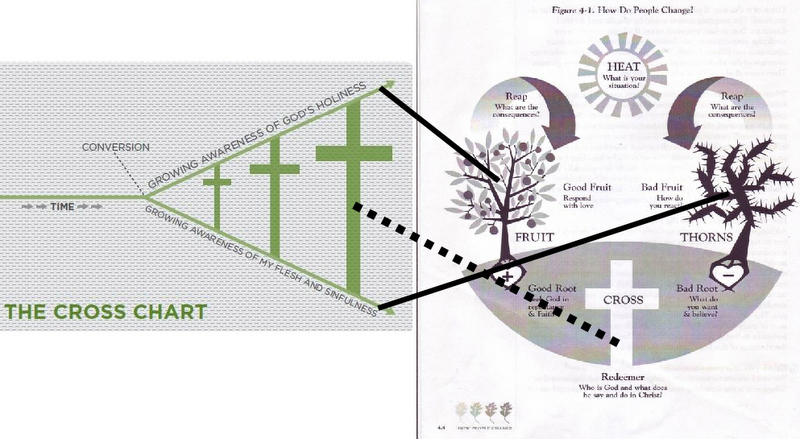
This is the cross story. See the illustration below. This is a contemporary depiction from that camp—this is their assessment:

Anything else at all that gives any credit to humanity—Christian or non-Christian is the “glory story.” That would be our glory specifically, and not Christ’s. To the degree that humanity is considered, the glory of Christ is “ECLIPSED.” This is the theses of a book written by John MacArthur associate Rick Holland: Uneclipsing The Son. Everything is perceived as speaking through one of these two perspectives. ANYTHING coming from what is perceived as the “glory story” is summarily dismissed. Be sure of it: this is how Calvinists think. This is their worldview.
In one of the former Resolved Conferences sponsored by John MacArthur and Holland, in one of his messages, Holland extols a letter written to Puritan Christopher Love by his wife as he awaited execution. Holland forgot to mention to those listening that Love was executed for espionage against the English government while letting the audience assume he was executed for loftier spiritual-like reasons. The following is excerpts from the letter:
O that the Lord would keep thee from having one troubled thought for thy relations. I desire freely to give thee up into thy Father’s hands, and not only look upon it as a crown of glory for thee to die for Christ, but as an honor to me that I should have a husband to leave for Christ…. I dare not speak to thee, nor have a thought within my own heart of my own unspeakable loss, but wholly keep my eye fixed upon thy inexpressible and inconceivable gain. Thou leavest but a sinful, mortal wife to be everlastingly married to the Lord of glory…. Thou dost but leave earth for heaven and changest a prison for a palace. And if natural affections should begin to arise, I hope that the spirit of grace that is within thee will quell them, knowing that all things here below are but dung and dross in comparison of those things that are above. I know thou keepest thine eye fixed on the hope of glory, which makes thy feet trample on the loss of earth.
Justice? That implies that humanity has some sort of value. That implies that life itself has some sort of value. That implies that humanity should be protected through threat of punishment. That’s the glory story. Therefore, Calvin stated the following:
Those who, as in the presence of God, inquire seriously into the true standard of righteousness, will certainly find that all the works of men, if estimated by their own worth, are nothing but vileness and pollution, that what is commonly deemed justice is with God mere iniquity; what is deemed integrity is pollution; what is deemed glory is ignominy (CI 3.12.4).
Death by Biblical Counseling
The church must face up to a sobering reality in our day. The vast majority of biblical counseling that goes on in our day is based on this construct—you will be counseled from the perspective of the cross story, and anything that smacks of the glory story will be snubbed. You are not a victim. There is no such thing as a victim. Christ was the only true victim in all of history. Don’t misunderstand: the problem of “victim mentality” is not even on the radar screen—they have removed the word “victim” from their metaphysical dictionary. “Victim” is part of the glory story; Christ as the only victim is the cross story. I am not a victim. That’s impossible because my sin nailed Christ to the cross. Thank you oh Lord that I was raped. Thank you for this opportunity to suffer for you. Thank you for the strength to forgive the one who raped me in the same way you forgave me. What a wonderful opportunity to show forth your gospel!
Hence, when the leaders of a Reformed church came to inform parents that a young man in that church had molested their toddler, this was the opening statement:
Today, we have before us an opportunity to forgive.
The parents were then counseled to not contact the authorities. Those who do are often brought up on church discipline. Justice necessarily implies victim. Victim necessarily implies worth. All three are conspirators with the glory story. And be not deceived: this is the logic that drives Reformed organizations that are supposed to be mediators in the church; specifically, Peacemaker Ministries and G.R.A.C.E. A major player in the Biblical Counseling Movement is Paul David Tripp. In 2006, he wrote a book that articulates the horizontal application of Luther’s theology of the cross: “How people Change.” Of course, the title is a lie; if he really believed people change, that would be the glory story. Notice also that it is, “How People Change” and not, “How Christians Change.” That’s because this bunch see no difference in the transforming power of the new birth and ordinary Christ-rejecting people.
In the book, Tripp, like all who propagate Luther’s theology of the cross, posits the Bible as a “big picture” narrative of our redemptive life. The Bible is a mere tool for one thing only: leading us more and more into the cross story and away from the glory story. This is accomplished by using the Bible to enter into the cross narrative and thereby seeing our preordained part in the “big picture” narrative of redemptive history. Though Tripp is not forthright about it in the book, this is known as the Redemptive Historical Hermeneutic. By seeing our life through the cross story, we are empowered to live life for God’s glory. This is done by seeing ALL circumstances in life (Heat) as preordained in order to show our sinfulness (Thorns) and God’s goodness (Fruit) for the purposes of having a deeper understanding of both resulting in spiritual wellbeing. In other words, all of life’s circumstances are designed to give us a deeper understanding of the cross story: God’s holiness, and our sinfulness. I have taken his primary visual illustration from the book and drawn lines to the cross story illustration to demonstrate the relationship (click on image to enlarge):
Understanding this lends insight to Tripp citations on the Peacekeepers Ministries website:
Paul Trip wrote a great post over at The Gospel Coalition blog all about the need for pastors to pursue a culture of forgiveness in their ministry. Pastors (and anyone serving Christ) have a choice:
“You can choose for disappointment to become distance, for affection to become dislike, and for a ministry partnership to morph into a search for an escape. You can taste the sad harvest of relational détente that so many church staffs live in, or you can plant better seeds and celebrate a much better harvest. The harvest of forgiveness, rooted in God’s forgiveness of you, is the kind of ministry relationship everyone wants.”
Then he describes three ways forgiveness can shape your ministry. I’ve listed them, but you can read how he explains them in detail.
“1. Forgiveness stimulates appreciation and affection.
2. Forgiveness produces patience.
3. Forgiveness is the fertile soil in which unity in relationships grows.”
He closes with this exhortation:
“So we learn to make war, but no longer with one another. Together we battle the one Enemy who is after us and our ministries. As we do this, we all become thankful that grace has freed us from the war with one another that we used to be so good at making.”
And concerning another author, they also stated:
Last week, Steve Cornell at The Gospel Coalition blog posted some really great insight into the difference between forgiveness and reconciliation. They also offered up some excellent and biblically sound steps in dealing with a situation where an offending party is hesitant to reconcile.
Here he summarizes a key distinction:
“It’s possible to forgive someone without offering immediate reconciliation. It’s possible for forgiveness to occur in the context of one’s relationship with God apart from contact with her offender. But reconciliation is focused on restoring broken relationships. And where trust is deeply broken, restoration is a process—sometimes, a lengthy one”…. His ten guidelines for those hesitant to reconcile are rooted in scripture and, I think, incredibly helpful.
1. Be honest about your motives.
2. Be humble in your attitude.
3. Be prayerful about the one who hurt you.
4. Be willing to admit ways you might have contributed to the problem.
5. Be honest with the offender.
6. Be objective about your hesitancy.
7. Be clear about the guidelines for restoration.
8. Be alert to Satan’s schemes.
9. Be mindful of God’s control.
10. Be realistic about the process.
Notice the overall blurring of distinction between the offended and offender with the subject of forgiveness.
The Cross-centered Anti-justice Pandemic is No longer Exclusively a Reformed Thing
Apart from Calvinism, the redemptive historical cross-centered approach is crossing denominational lines en masse. We at TANC see doctrines that were born of Luther’s theology of the cross in non-Reformed circles constantly; specifically, heart theology (deep repentance), exclusive interpretation of the Scriptures through a redemptive prism, Gospel Sanctification, and John Piper’s Christian hedonism. And we also see the same results. It is not beyond the pale for a pastor who has raped a parishioner to be the one counseling the victim sinner. You know, the “sinner saved by grace.”
God is a God of justice, and throughout the Scriptures He demands that we be people of justice. He demands that we come to the defense of the victim. I close with fitting words from church historian John Immel:
And this is the challenge. This is the challenge that I have as a man who is passionate about thinking: to inspire people to engage in complex ideas that drive tyranny. So here’s my challenge to those who are listening.
Do not be seduced into believing that righteousness is retreat from the world.
Do not be seduced into believing that spirituality is defined by weakness and that timid caution for fear of committing potential error is a reason to be quiet.
Do not be intimidated by vague, hazy threats of failure.
Do not let yourself believe that faith is a license to irrationality. I’m going to say that again to you. This is good. Do not let yourself believe that faith is a license to irrationality.
Do not mistake the simple nature of God’s love for a justification for simple-mindedness.
Do not deceive yourself with the polite notion that you are above the fray, that your right to believe is sufficient to the cause of righteousness. There is no more stunning conceit.
Do not pretend that your unwillingness to argue is the validation of truth.
Know this: Virtue in a vacuum is like the proverbial sound in the forest–irrelevant without a witness. Character is no private deed. To retreat is nothing more than a man closing his eyes and shutting his mouth to injustice.
Virtues are not estimates to be lofted gently against evil.
Virtues are not to be withheld from view in the name of grace.
Virtues are not to be politely swallowed in humble realization that we are all just sinners anyway.
Love is not a moral blank check against the endless tide of indulgent action.
Love is not blind to the cause and effect of reality.
Love is not indifference to plunder and injustice and servitude.
The time is now, you men of private virtue, to emerge from your fortress of solitude and demonstrate that you are worthy of a life that bears your name. The time is now, you men of private virtue, to answer Mick Jagger and all the nihilists that insist we are living on the edge and we cannot help but fall. It is time for you men of private virtue to take up the cause of human existence and think.
~TANC 2012 Conference on Gospel Discernment and Spiritual Tyranny: John Immel; session 1, “Assumptions + Logic = Action.”
paul

 Paul's Passing Thoughts
leave a comment