By Request: A Summary Of The New Calvinist Genealogy Chart; Part 1 / Introduction
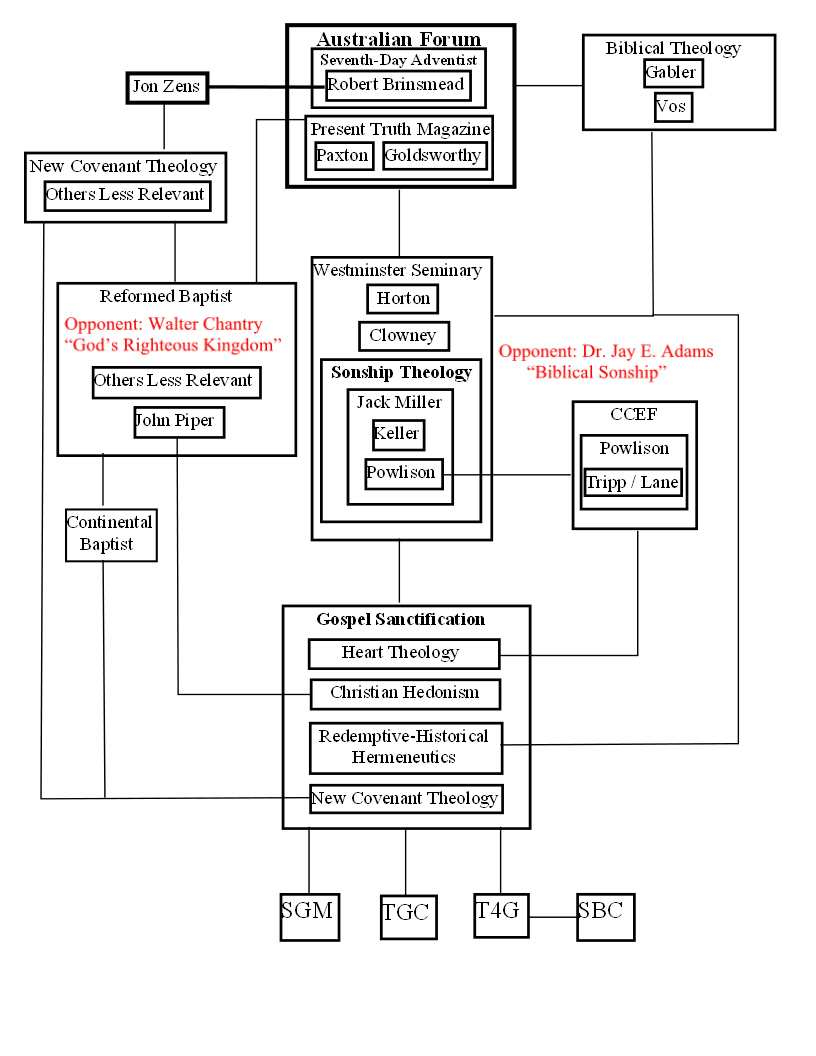 The contemporary history of New Calvinism begins with Robert Brinsmead and Jon Zens. They are the fathers of New Calvinism. Between my interview with Brinsmead and an informal document written by Zens I found on the internet—this is apparent. Brinsmead started a project called the Australian Forum (he wanted me to note that it was one of many projects that focused on certain subjects) that sought to articulate a gospel-centered sanctification into a unified, consistent systematic theology. One of the major considerations was a focus on covenant theology in relationship to this endeavor. Jon Zens is the father of New Covenant Theology, but it is clear that Brinsmead had a major influence in the formulation of that doctrine. All of this took place in the 70’s. So, New Calvinism has been around for about 35 years in various forms. It is primarily based on the Forum’s centrality of the objective gospel (COG). COG is the very heart of New Calvinism. Though NC has many different expressions, this doctrine is the heartbeat that drives it.
The Forum was having a significant impact on two spheres of Christianity in the 70’s and early 80’s; namely, Reformed Baptist and Westminster Seminary. Zens was a Reformed Baptist and also a student at Westminster. Zens taught a Sunday School class where his ideas on New Testament ethics were being presented, and Westminster students attended those studies. Michael Horton was infatuated with the Forum’s teachings, and COG can be seen in many of his teachings throughout his career. Keep in mind, the Forum’s magazine, Present Truth, and later, Verdict, according to Zens, had the largest readership among all Evangelical publications at that time. Apparently, Zens was initially introduced to the Forum by receiving Present Truth while he was a student at Westminster, and eventually formed a close relationship with Brinsmead. Also, G. Goldsworthy’s involvement in the Forum as one the AF three is one of the interesting the top is the same as the bottom in the genealogy chart. Till this day, the Goldsworthy Trilogy is a mainstay of New Calvinism’s Gospel Theology. Again, at the very heart of Goldsworthy’s Trilogy is COG. Goldsworthy was close to Brinsmead, and Brinsmead learned his Hebrew skills from Goldsworthy.
Zens, with the help of several men who are now the who’s who of New Covenant Theology while Zens is in the background (probably because of his connections with Brinsmead), attempted to propagate the doctrine, yet unnamed, via the Baptist Reformation Review . Zens received a very zealous contention from other Reformed Baptist such as Walter Chantry. At that time, Brinsmead wrote several articles defending Zens’ doctrine in the BRR. According to Zens:
“A sort of (unintended) [I doubt that] culmination occurred in the Spring, 1981, BRR. There were lengthy review articles of Walt Chantry’s God’s Righteous Kingdom [a book Chantry wrote to contend against COG, though he saw it as neo-antinomianism, which is also a correct assertion] and Robert Brinsmead’s Judged by the Gospel: A Review of Adventism. The dynamic N.T. approach to law and gospel [“NT approach to law and gospel” is a present-day NC mantra] was stated forcefully by RDB:
‘[Paul’s] appeals on how to live are made on the basis of what God has done for us in Christ. It is in view of God’s gospel mercies that we are to present our lives as a living sacrifice to God (Rom.12:1-3) . . . . Paul virtually never appeals to the law – ‘Thou shalt not.’ When he demands certain behavior of the church, he appeals instead to the holy history of Christ . . . and from that stand point then makes his ethical appeal.’”
Note here, and this is very important: the Forum’s the imperative command is grounded in the indicative event can be seen in Brinsmead’s statement cited by Zens above, which is a pillar of Gospel Sanctification till this day, and originated in COG doctrine by the AF. Chantry and others effectively beat COG within an inch of its life, and the doctrine, coined by Zens one year later as “New Covenant Theology” (in 1981), continued on in a meager existence among Continental Baptist. Most likely, John Piper was introduced to COG among Reformed Baptist and was probably well aware of the controversy. The wherewithal of his injection of Christian Hedonism into the movement is sketchy at this time and needs extensive investigation which I will do Lord willing.
Meanwhile, COG was finding new life at Westminster Seminary. In fact, Brinsmead and the Forum met with the Westminster faculty in the I think early 80’s, I will add references to this summary later. Brinsmead remembers little about the meeting other than he noted that the faculty served pork to him and the other forum members which he suspected was deliberate due to the Forum’s connection with Adventism. I informed him that it was deliberate because they were incited to do so by Jay Adams (a faculty member at the time) who was not a happy camper that the meeting took place. Brinsmead stated that one individual present at the meeting seemed to be an “elder statesman” of Westminster. I’m guessing it was Edmund Clowney.
At this point, COG, as the face of the AF disappears, leaving behind its remnants with Continental Baptist because Robert Brinsmead departed from orthodox Christianity all together. But the heart of COG incited a new movement begun by Westminster professor John “Jack” Miller called “Sonship Theology.” Again, COG met stiff resistance in Presbyterian circles under the new name of Sonship. Leading the charge was Dr. Jay Adams who also knew Jack Miller personally. His contention against Sonship is well documented in his book, “Biblical Sonship: An Evaluation Of The Sonship Discipleship Course.” Unfortunately, the book is out of print. One may well note: Some big dogs of the present-day New Calvinists movement; specifically, Tim Keller and David Powlison, were disciples of Jack Miller and his Sonship program. Tim Keller’s propagation of Sonship is well known and documented. At a conference conducted at John Piper’s church while Piper was on sabbatical, Powlison specifically cited Miller as his “mentor” and ridiculed Adams for criticizing Miller while failing to mention that the “criticism” was in the form of a book—which I am sure slipped his mind. Miller is the one who coined the phrase often aped by Jerry Bridges: “We must preach the gospel to ourselves everyday.” Funny, while an elder at a reformed church in the mid-nineties, I heard Jerry Bridges say that without realizing what a profound effect that little phrase would have on my life ten years later.
But with COG again under heavy fire and the Sonship coat of arms being shot full of holes, “Sonship” was replaced with “gospel,” ie., “gospel-driven” this, and “gospel-centered” that. The movement was now underground, but steadily growing while avoiding labels like the plague. Take note: for almost ten years between 2000 and 2009, the movement was nameless. The name “New Calvinism” is very recent and was attached because movements that become massive cannot avoid a label. Meanwhile, David Powlison had been busy for a number of years integrating Jack Miller’s form of COG into “biblical counseling” through his Dynamics of Biblical Change which became the basis for biblical counseling at Westminser Seminary. Hence, different players were at work making COG relevant to different areas of Christian theology and life that were important to them in making COG work. Brinsmead conceived the primary foundation (with other Reformed elements not unique with him—what he called “jewels” that contributed to what was important to him) and helped Zens formulate the covenant theology. Goldsworthy integrated COG into hermeneutics and eschatology with a little bit of Gabler and Vos mixed in for good measure. Piper contributed to the experience / emotional aspect, and Powlison was paramount in his contribution to the life application part; otherwise, COG would be more vulnerable to its unbiblical passivity in the sanctification process.
Unbeknown to many in the biblical counseling movement, the integration of COG into biblical counseling, primarily in David Powlison’s Theology of the Heart that came out of Westminster’s DBC, was at the core of tensions between NANC and CCEF, the counseling wing of Westminster Seminary (other than the integration of Psychology as well, but COG deserves infamous merit there as well). Eventually, CCEF’s influence totally infected NANC with the disease, and NANC advocates act as if the cupbearer, upon realizing he has tested a deadly cup, should use his last words to compliment the superb taste of the drink. Eventually, disciples of David Powlison; Paul David Trip and Timothy Lane, wrote a book that articulated COG’s supposed life application in the book, How People Change. The centrality of the objective gospel (COG) and all of its elements are glaringly obvious in the book—almost as if it was written by Robert Brinsmead himself.
Starting in, or about 2004, Christians began to realize something was wrong, but because the movement had no label, other than, “gospel” (and who is going to diss the “gospel”?), many simply just remained confused as to what this was all about. However, I was in a unique situation at the time. I was in a church that was on the cutting edge of the movement for many reasons. In NANC’s glory days, this church was a training center for biblical counselors. The church was eventually infected by COG via CCEF’s influence over NANC, and Reformed Baptists who joined the same afoermentioned church who were of the Jon Zens persuasion. Once I knew something didn’t smell right, I spent several months researching and interacting with the elders of that church. Their story, which of course I didn’t buy, was that COG has been historically true all along, and a Reformation was afoot. Eventually, after hundreds of hours of conversation / debate with these elders and my own research, I named the movement “Gospel Sanctification” and started a blog called the “Berean Call” which later became PPT. Initially, I thought the movement was confined to those group of elders (who are all men drunk with visions of grandeur), and they were trying to formulate a system that made Heart Theology, Christian Hedonism, NCT, and redemptive-historical hermeneutics work together as a unified theology. Four years later, I came to realize that they were a mere reflection of a total package.
About a year ago, I received a book from an individual whom I suspect knew that there was a connection between Gospel Sanctification and Sonship Theology, but wanted me to see it for myself. The connection was immediately seen in the first 100 words of Adams’ book. After much more research, it looked like Jack Miller was the father of Gospel Sanctification, but I was haunted by a few things. GS seemed to need NCT’s view of the law to function without contradiction. Also, all elements of Sonship and the historical connections were easy to match with GS, but NCT theology seemed to be dropped in out of nowhere. Of course, it didn’t surprise me that the elders of the church I was a member of or CCEF never uttered the name, “Sonship” because that would supply Christians with an interpretive prism that could expose them. Then, several months later, by accident, I stumbled upon an article that mentioned the Australian Forum and how it had a profound effect on the theological mindset of Michael Horton. That prompted me to say to myself, “Oh really?” “What is the Australian Forum?” Well, the rest is history.
Future parts will put veneer on the framework posted here, but any clarifying questions are welcome.
paul
Clearcreek Chapel’s “All in the Family”
 “I gathered up jewels that others here and there had mined, and just put it together in a way that seemed clear and important to me. If I could, it would be easier to reply that I had copied the package from somewhere in particular, but I am not able to do that. What I was on about impacted others and sharpened others up – like Paxton and Goldsworthy – and Jons [as confirmed later: Jon Zens] and a guy called Edward Fudge and others along the way.” ~ Robert Brinsmead
Clearcreek Chapel in Springboro, Ohio is a good representation of the kinship between all of the elements in our genealogy chart ( http://wp.me/pmd7S-K7 ). One of the joys of this ministry is reconnecting family members with long-lost relatives. It is intriguing to see how remnants of the genealogy chart are all gathered at the bottom—thirty-something years later, but with family members like Robert Brinsmead and Jon Zens (the original patriarchs) missing. Heartbreaking.
Not only that, credit is not being given where credit is due; for example, Jack Miller’s Sonship Theology, which pumped new life into the centrality of the objective gospel (aka Gospel Sanctification and New Covenant Theology) after it received a brutal beating from Walter Chantry and others on the left side of the chart, is never mentioned at T4G, TGC, and SGM gatherings, even though the primary disciples of Jack Miller (Tim Keller and David Powlison) are major players in those movements. Could it be because the Sonship label was shot full of holes by Jay Adams and Chad Van Dixhoorn on the right side of the chart? It would really do my heart good to see the Sonship label proudly displayed at the 2012 T4G. I mean, we’re talking family here.
Though I will be writing about many of these bottom-of-the chart family reunions, Clearcreek Chapel is an excellent specimen. The “elder” in charge of their “adult education” is Christian radio personality Chad Bresson, who authors a blog dedicated to Geerhardus Vos. Bresson is a member of the Earth Stove Society which promotes New Covenant Theology. Bresson has recently posted a lengthy article on eighty elements of New Covenant Theology followed by four articles on the writings of Graeme Goldsworthy. Also, a post by Bresson that articulates how New Calvinists interpret the Bible using a lengthy excerpt from the writings of Robert Brinsmead drew a lot of heat from some readers: http://goo.gl/qbeS4 .
Bresson was a recent speaker at the John Bunyan Convention which is a yearly conference that fictitiously uses the name of Bunyan to promote New Covenant Theology (NCT). This year’s conference included two primary figures of NCT, Fred Zaspel and John Reisinger. The conference was held at Reformed Baptist Church in Lewisburg, PA and I have not ascertained whether or not it is a Continental Baptist church which are a small fellowship of NCT churches that split from Reformed Baptist circles over the NCT issue. The debate that fueled the split was primarily between the father of NCT, Jon Zens, and Walter Chantry. Reformed Baptist protestants staunchly proclaimed NCT to be Antinomianism and were not the least bit apologetic about the accusation. Jon Zens is now in the background, probably because of his close association with the likable, but controversial Robert Brinsmead.
While Bresson shows Clearcreek’s kinship with Jon Zens, Brinsmead, and Goldsworthy, the Chapel leadership as a group focuses heavily on David Powlison’s Theology of the Heart ( http://goo.gl/8UnBe ) and John Piper’s Christian Hedonism. In fact, the pastor of Clearcreek is a well known rabid follower of John Piper. It is my understanding that Piper’s Christian Hedonism is presented yearly in the adult Sunday school class. Paul David Tripp is a frequent speaker there and the Chapel was one of the pilot churches that “tested” Tripp’s book How People Change, which is based on Powlison’s Dynamics of Biblical Change.
The common thread that ties all of the family members together is the Australian Forum’s centrality of the objective gospel (COG). This core thread (COG) was primarily developed by Brinsmead and Zens. Though it includes what Brinsmead describes (in our interview) as a collection of jewels, there is no doubt that Brinsmead and Zens formulated the basic systematic theology that makes its present-day life possible. In regard to any such system prior to the Forum, Brinsmead stated: “I gathered up jewels that others here and there had mined, and just put it together in a way that seemed clear and important to me. If I could, it would be easier to reply that I had copied the package from somewhere in particular, but I am not able to do that. What I was on about impacted others and sharpened others up – like Paxton and Goldsworthy – and Jons [as confirmed later: Jon Zens] and a guy called Edward Fudge and others along the way.”
COG states that all spiritual growth comes from contemplating the gospel outside of us. Any truth that is placed in the same priority at any given time is said to eclipse Christ. Inside considerations (the inner us [subjective]) would be included, which relegates the new birth to a position of insignificance—paving the way for the total depravity of the saints, “The same gospel that saved you also sanctifies you,” and “we must preach the gospel to ourselves everyday” (coined by Jack Miller and aped excessively by Jerry Bridges). As this foundational thread (system) has weaved through contemporary church history, it has been endowed with an explanation of how it is experienced (Christian Hedonism); how it applies to life (Heart Theology); its view of covenants (New Covenant Theology); and an interpretive model that enables outcomes that fit together logically (The Goldsworthy Trilogy [research on how the Dutch Reformed movement and Vos may have influenced Goldsworty is still pending]).
In an introduction to a Christian Hedonism class at Clearcreek Chapel, Chad Bresson said, “This is what makes us unique.” While one wonders why the goal is to be unique, we all can agree that it’s family that makes it all so special.
paul
Gospel Sanctification and Sonship’s Gospel-Driven Genealogy, Part 10: A Strong Finish For “Dr.” John MacArthur Not Looking Good
“Where did this ‘eclipsing Christ’ standard of truth come from? And does it add anything to the genealogy hypothesis?”
When I saw the advertisement, my heart sank. In my wrestling with proponents of Gospel Sanctification over the years, one of their mantranized mottos has been whether or not something “eclipses Christ” as a primary standard for determining truth. As others will attest who witnessed the hostile takeover of Clearcreek Chapel by the Chad Bresson cartel, “I have a problem with that view because it eclipses Christ” was a phrase that was constantly heard.
Back to the advertisement: MacArthur has written the forward to a new book written by one of his close ministry associates, Rick Holland. The title of the book is, “Uneclipsing The Son” by “Dr.” (a title that more and more is becoming a sign of danger more than respect) Rick Holland. Even from the standpoint of this (me) Evangelical peasant, “Dr.” MacArthur’s forward to the book raises troubling questions:
“This book is an insightful, convicting reminder that no one and nothing other than Christ deserves to be the central theme of the tidings we as Christians proclaim—not only to one another and to the world, but also in the private meditations of our heart.”
I asked the Sultana of Optimism, my wife Susan, to evaluate the statement. She immediately pointed out that the second part of the statement concerning private meditation was biblically untrue for many reasons. As far as Christ ALWAYS being the CENTRAL theme of the gospel, I will address that in future parts. Granted, Christ must always be part of a gospel presentation, it’s not the gospel without Him, but is He always the one and only central theme of the presentation as MacArthur suggests? Is Christ the only one who “deserves” to be a central figure of the gospel? Phil Johnson’s (the Executive Director of MacArthur’s ministry) endorsement of the book is even more disturbing as his statement mirrors John Piper contemplative spirituality:
“We become like whatever we worship (Psalm 135:15-18). So the key to sanctification and spiritual maturity is a simple principle: As we set our affections on Christ and keep Him at the center of all our thoughts, activities, desires, and ambitions, we are transformed into His likeness (2 Corinthians 3:18).”
Barry E. Horner also echo’s concern on page 192 of Future Israel when he writes: ‘This is not an insignificant point since it is common today, especially within Reformed Christianity as Thomas Smail pointed out in The Forgotten Father, for an incorrect prominence to be given to Jesus Christ (as though impossible to challenge) that results in biblical distortion.’”
As far as meditation on Christ alone being the one “simple” principle for sanctification as stated by Phil Johnson above, Dr. Jay E. Adams states:
“The problem with Sonship is that it misidentifies the source of sanctification (or the fruitful life of the children of God) as justification. Justification, though a wonderful fact, a ground of assurance, and something never to forget, cannot produce a holy life through strong motive for it.”
“Certainly, all of us may frequently look back to the time when we became sons and rejoice in the fact, but there is no directive to do so for growth, or even an example of this practice, in the New Testament….The true reminder of the good news about Jesus’ death for our sins is the one that he left for us to observe-the Lord’s supper (‘Do this in remembrance of Me’).”
Where did this eclipsing Christ standard of truth come from? And does it add to the genealogy hypothesis? (http://wp.me/pmd7S-Gm ) (Revised: http://wp.me/pmd7S-K7 ). You be the judge. The following are excerpts from the Australian Forum archives, one excerpt per article:
When the law is emphasized so as to eclipse the glory of the gospel, the church falls under the bondage of legalism.
…faith and never want to lose it, and may even fear that if any other truth is emphasized, it will eclipse the wonderful message of salvation. …
From “The Centrality of the Gospel”: evangelical preaching has contributed more to the eclipse of the Bible than we would ever dare to imagine.
They are used to eclipse or displace Christ’s imputed righteousness! “That glory cannot be taken away from Christ and transferred to either our renewal or …[same statement used in at least three other articles].
They are used to eclipse or displace Christ’s imputed righteousness!
When the law is emphasized so as to eclipse the glory of the gospel, the church … and rapturous experience) of having Christ come into the heart—and then …
When the law is emphasized so as to eclipse the glory of the gospel, … grace alone, on account of Christ’s obedience alone, and received by faith alone …
truth is emphasized, it will eclipse the wonderful message of salvation. …. And from Jesus Christ, who is the faithful witness, the firstborn from the …
Church history may be seen as a struggle to keep law and gospel in proper tension. When the law is emphasized so as to eclipse the glory of the gospel, …
Because they are put in the very room of the gospel! They are used to eclipse or displace Christ’s imputed righteousness! “That glory cannot be taken away …
… any other truth is emphasized, it will eclipse the wonderful message of salvation. …. Similarly, non-believers may reject the gospel because of their …
Tavard explains that when Luther began his work as a Reformer, the gospel was in “partial eclipse.” The Council of Trent, however, “reformulated” the gospel …
These sample statements were gleaned from the AF archives by a cursory search. Uneclipsing the Son (or his works) is a dominate theme that saturates AF doctrine.
Legacies are usually determined by how we end. This brings to mind something that we may want to meditate on often: the call to persevere. Christ didn’t say meditating on Him makes perseverance easy or guarantees that He will do it for us. MacArthur may not believe that, but he certainly lends credibility to those who do. Will the last leg of his ministry be remembered as lending creditability to Antinomians and even embracing their doctrines? I think it’s very likely.
If I had to bet, would I bet that I will find uncanny parallels between Holland’s new book and the AF archives? Absolutely. I am working on several side-by-side quotation charts, I trust that “Dr.” Holland will have a significant contribution to the comparisons.
paul
Gospel Sanctification and Sonship’s Gospel-Driven Genealogy, Part 7: The Birth of New Covenant Theology
“Apparently, this will be the legacy of New Covenant Theology—it was concocted by a Seventh-Day Adventist turned Reformed before he became apostate.”
As things become clearer, it seems the crux of New Calvinism is sanctification by objective justification. What’s that? Simply stated: all things relevant focus on Christ and His works outside of us (what they call the gospel). Any consideration of ourselves (subjective) in the mix, and anything else other than Christ and His works amounts to Existentialism. All reality must be interpreted through the gospel. In fact, truth can be truth until it is taught without being seen through the interpretive lens of Christ—then it becomes error. So, we aren’t really born again—that’s a subjective interpretation and insinuates that we can have a part in the sanctification process. The new birth must be seen “in its gospel context.” Hence, the Australian Forum said the following about the new birth, and even election: “Those who preach ‘Ye must be born again’ as the gospel are preaching a false gospel.” And, “A doctrine of election which takes as its starting point a philosophical concept instead of the gospel makes the Father the center and not Christ. A doctrine of election apart from Christ is inimical to sanctification and not its powerful source” (Present Truth Magazine Archives Vol. 24 #2).
This interpretive prism can be seen clearly in what is taught by contemporary New Calvinist. A predominant mantra among them is the idea that we are unable to approach the Scriptures without personal presuppositions (subjective). Therefore, ideas must not be drawn from the text (exegesis) because that’s subjective—the text must be interpreted through the gospel (eisegesis). This is why contemporary New Calvinist, as with the Australian Form, deny the new birth from our perspective: “But to whom are we introducing people, to Christ or to ourselves? Is the ‘Good News’ no longer Christ’s doing and dying, but our own ‘Spirit-filled’ life?” (Michael Horton, In The Face Of God).
Compare Horton’s quote with one of the Australian Three, G. Paxton:
“It robs Christ of His glory by putting the Spirit’s work in the believer above
and therefore against what Christ has done for the believer in His doing and dying” (Present Truth Archives Vol. 37 #4)
The fruit doesn’t fall far from the tree, but let me now use this quote by Chad Bresson to further this point and lead us into our subject:
“New Covenant Theology presumes a Christocentricity to the understanding and meaning of all reality” (Vossed World, “What is New Covenant Theology?”).
Jon Zens, the father of New Covenant Theology, was totally onboard with sanctification by objective justification. He wrote an article for the Australian Forum entitled “Why Existential Theology Is Bankrupt” (Id Vol. 37 #4). Though sanctification by objective justification was probably not original with the Australian Forum (but the jury is still out on that), they definitely called for a systematic theology that would reconcile that doctrine to Scripture in all areas, and they specifically called for a “framework” in the areas of history, covenants, and eschatology (Ibid Volume XLVI). G. Goldsworthy, one of the AF3, would have been priceless in regard to a historical and eschatological framework, but it is my contention that Jon Zens answered the call for a covenantal framework.
Dennis M. Swanson of Master’s Seminary stated in his “Introduction to New Covenant Theology” that though Zens is not a focal person in the movement at this time—“he really started the movement” (p.152). Swanson further states that he believes Zens coined the phrase “New Covenant Theology” in 1981 (p.153).
In an unusual document by Zens entitled Law And Ministry In The Church: An Informal Essay On Some Historical Developments (1972-1984), by Jon Zens, 1984”—Zens writes the following:
“I started receiving Present Truth (now Verdict) at Westminster Seminary (1972). I didn’t read it much, however, until 1975. The emphasis on justification was helpful to me at this time [that would be sanctification by objective justification alone].
In August, 1979 — through a series of fluke circumstances — I heard about some unadvertised meetings at a Ramada Inn in Nashville. For three days the editor of Verdict, Robert D. Brinsmead [the editor of Present Truth and the primary leader of the Australian Forum, and one of the AF3], was addressing about 150 Adventist-oriented people. I came Friday night and spoke with RDB and Jack Zwemer in their motel room for about two hours. We also talked for another two hours on Sunday night.
I was impressed by Brinsmead’s teachable, open spirit. He obviously did not feel threatened by my pointed and probing questions. One area that I asked him about was the idea that the law had to do a “work” before the gospel could come to folks. His magazine had been permeated with this concept. I suggested that if all things are to be approached through Christ, why do we put the law ahead of Him in evangelism? Where in Acts were the Ten Commandments preached before the gospel? He said he thought I had some good points and that he would reflect upon them. On Sunday night I gave him Richard Gaffin’s The Centrality of the Resurrection, Meredith Kline’s The Structure of Biblical Authority, and all of the back issues of BRR.
In January, 1980, Brinsmead called from California, just before he was to leave for Australia. He said that he had read the back issues, that he thought we [note: “WE”—] were on to something important [emphasis mine], and that he would study these matters closely in Australia. In 1981 some brilliant essays appeared in Verdict. “Sabbatarianism Re-examined,” “Jesus and the Law,” And “The Heart of N.T. Ethics” presented a Christ-centered approach to ethics. It was certainly heartening to see this shift by the largest English-speaking theological journal in the world at that time (sadly, since mid-1984 RDB went markedly downhill [right, not only was he a Seventh-Day Adventist, but he is now openly apostate by all standards]).”
Zens elaborated on his interaction with Brinsmead and discussed several Australian Forum articles published in Present Truth (later, Verdict), in This is My Beloved Son, Hear Him (Searching Together. Summer-Winter 1997, Vol. 25:1,2,3. Pages 67-71) Zens attached the following footnote to the article: “I met Mr. Brinsmead in August 1979, asked him to consider the centrality of Christ in Christian obedience, and gave him some materials to read. In January 1980, Brinsmead called me and indicated that these redemptive-historical points were worthy of consideration and further study.”
Here, we perceive the very cradle of New Covenant Theology. While working through the issues himself, Zens confronted Brinsmead in regard to the AF’s view on the law’s relationship to justification—which Zens had been “helped” by (their view on justification) while at Westminster. Brinsmead then called Zens in 1980 to say, “We [are] onto something important.” Then Brinsmead, according to Zens, published a string of “brilliant” articles as a result in 1981—the same year Swanson says Zens coined the phrase “New Covenant Theology.” Apparently, this will be the legacy of New Covenant Theology—it was concocted by a Seventh-Day Adventist turned Reformed before he became apostate.
Zens was a Reformed Baptist pastor at the time, so it is easy to see how the doctrine has spread in that camp. Present Truth also had a significant readership in Reformed Baptist circles. Zens’ leanings toward antinomian type doctrines had already caused trouble among Reformed Baptist which resulted in William J Chantry writing the book, God’s Righteous Kingdom. As far as the Johnny-come-lately names of NCT, one website is quoted as saying the following: “Since 1980 there has been a great resurgence of Reformed theology in Baptist circles. As a result, some have sought to develop a new, non-covenantal approach to theology distinct from the Second London Confession position. Leaders of this movement include such theologians as John Reisinger, Jon Zens, Fred Zaspel, Tom Wells, Gary Long, Geoff Volker, and Michael W. Adams.”
According to Richard C Barcellos in Defense Of The Decalogue, the doctrine was still in transition as late as 2001 when he wrote his book. Its proponents will have to let us know when they get it nailed down, or perhaps they can solicit some help from Robert Brinsmead. Robert–phone home.
paul
Gospel Sanctification and Sonship’s Gospel-Driven Genealogy, Part 3: New Calvinism’s Bad Seed
In one of the more contemporary blogs dedicated to Christocentric hermeneutics, it happened—Robert Brinsmead appeared, and started a lot of trouble. The blog is Vossed World, authored by Chad Bresson, an elder at Clearcreek Chapel in Springboro, Ohio. According to a message preached there recently by another Clearcreek elder, the leadership considers Clearcreek to be a “New Covenant Theology” church. They are also very strong on Christian Hedonism (John Piper), Heart Theology (CCEF), and Redemptive-Historical hermeneutics which is the theme of Bresson’s blog. Bresson is also a member of the Earth Stove Society (dedicated to NCT).
Bresson posted an excerpt from the writings of Brinsmead that represented the beliefs of the Australian Forum (see chart in part 2) concerning the use and interpretation of the Scriptures. The Australian Forum (hereafter “AF”) included Brinsmead, Geoffrey Paxton, and Graeme Goldsworthy. The post was brought to my attention by a reader. Though one person who commented on the post was totally unaware of it—Bresson responded to him by launching a defense regarding the relevance of Brinsmead’s apostasy:
“There are two reasons your analogy doesn’t wash: 1. Brinsmead wrote this ditty during a time of his life (as SDA, no less) when he affirmed reformed theology. That this guy is now an atheist is irrelevant. 2. What Brinsmead says here isn’t anything different than what has been posted on this blog for the past three years. In fact, given the recent articles written by the guys at Southern [see bottom of chart in part 2], what Brinsmead writes here could have just as easily have been written by one of them.”
The reader responded this way:
“I didn’t toss an ad hominem attack. I am criticizing the doctrine you are pursuing; I am not attacking you personally at all. I didn’t know this guy is now an atheist. I don’t know anything about him.”
The post and all the comments can be viewed here:
http://breusswane.blogspot.com/2008_07_17_archive.html
July of 2008 is a long way from what the AF wrote in the 1970’s. Bresson and the Chapel are respected as being on the cutting edge of New Calvinism (hereafter “NC”), and notice that he said, “What Brinsmead says here isn’t anything different than what has been posted on this blog for the past three years.” When I read the Brinsmead excerpt, I immediately recognized the fact that NC, ie., Gospel Sanctification and Sonship Theology (hereafter “NCGSS) needs such a hermeneutic to appear (consistent) and function consistently. My point by point rebuttal of the Brinsmead excerpt posted by Bresson can be read here: http://wp.me/pmd7S-lq
Or here: Brinsmead
This post is the first that demonstrates that the top of the proposed genealogy chart looks the same as the bottom. Bresson and the Chapel are an excellent specimen representing the NCGSS movement—yet, Bresson states that what Brinsmead wrote some thirty years ago is representative of what has been written on his blog for the past three years. Furthermore, Bresson’s blog is also replete with Graeme Goldsworthy writings, who was one of the original three that made up the AF.
So what? Well, the original doctrine of the AF was a mixture of sanctification by faith alone, Seventh-Day Adventist doctrine, and “Redemptive” Historicism. Also, all facts so far strongly indicate that Brinsmead was the primary visionary and inventor of the doctrine—and he is now an apostate—not good. Most Christians don’t buy into the idea that God used an unsaved person to reveal something “new” to God’s people, especially someone who became apostate after leaving a cult! Moreover, nobody can deny that Goldsworthy is the darling of present-day NCGSS hermeneutics, and that he was also one of the original three that made up the AF.
paul

 Paul's Passing Thoughts
leave a comment