How Church Ruins Your Life
 Meme Post #1
“Church” was never meant to be an institution, but rather a family meeting in private homes because that’s what families do. During the soon approaching Thanksgiving Day, extended families will meet together locally. In others words, for example, the Dohse family is a large family with descendants living all over the world, but more than likely, only the descendants living in the Dayton, OH area will gather together in one place. Few families maintain a purpose-built facility for meeting together. In fact, that would be deemed rather strange.
The 1st century assembly of Christ had a family mindset that is hard for us to comprehend. “They had all things in common” is not a socialist statement, it is a statement regarding their family mindset at that time. The “Church” concept did not really get a foothold in Christianity until the 4th century. The word “church” is a replacement word added to Bible translations and goes hand in glove with the institutionalization of Christianity.
One reason this is important is because families operate differently than institutions. In families, order and unity is achieved through what families are supposed to be about – love and respect. Thanksgiving dinner will go well this year because of family cooperation. Yes, there will be organization, but it will be based on many considerations other than authority. Mom and grandma will tell the men to stay out of the kitchen, and they will obey. When mom says its time to eat, everyone will come to the table. Everyone recognizes that the food part is mom’s gift. If some of the men tarry in front of the football game, aunt Beth will enter the room with a pair of scissors and threaten to cut the power cord on the big screen TV, and so it goes.
Much could be discussed here (this is a many-faceted dynamic), but the family concept circumvents cultism. Cults are predicated on authority—always. No authority, no cult; they must have authority. The integration of authority and religion always results in cultism. It starts with an authoritative presupposition resulting in a mind-control mandate. The institutional church was clearly founded on authority supposedly mandated by Christ through what we call apostolic succession. Immediately after the demise of the most prominent apostles, the so-called church fathers began clamoring for a centralized religious authority based in Rome. The home fellowships led by elders vigorously resisted this attempted transition. After a messy power struggle that lasted for more than 200 years, for the most part, home fellowships succumbed to the Roman church’s claim of apostolic succession and divine authority.
This was the beginning of the Roman Catholic Church from which Protestantism came, but the latter claimed no less authority whatsoever. The Reformation created many splinter groups that attempted to revive home fellowships, but were met with equal persecution from both Rome and Geneva. Catholics and Protestants never ceased fighting accept for the purpose of working together unofficially to persecute the various home fellowship movements that emerged. The Catholics nor Protestants had any tolerance for those who would not come under the auspices of their authority. And, if you think the vast majority of wars fought throughout history are the result of differences regarding religious authority—you rightly assess.
The claim of authority has always been, and always will be, twofold: God ordained governments to enforce religious orthodoxy, and the church’s oversight of salvation. One gets saved in the church, and through “faithfulness to the church,” the church, in turn, doles out more and more salvation until the day of judgment.
Let’s look at this in regard to meme #1. Where does God get “full custody” of his children? Look at the picture—it’s the church building. The implication follows: if you are a casual church attender, you only do business with God on the weekends or a mere one hour during Sunday service. The other implication is that you only do business with God at the temple. On the one hand, we are His “children,” but on the other hand, apparently, we only fellowship with Dad at an institution.
The idea is flawed, unnatural in regard to truly being born again into God’s family, but also has unfortunate cause and effect ramifications. If you go to a purpose-building twice on Sunday, once on Wednesday, and for whatever else is going on during the week (e.g., choir practice, visitation, revivals, men’s Bible study, women’s Bible study, youth activities, church softball league, etc., etc., etc.), when does one have any time with their own families? They don’t.
But the following is the kicker, especially in Reformed churches: on the one hand, families have little private time together, but on the other hand, they are spending what little free time they have hearing about how everyone in their family is a “sinner” or totally depraved. Then, when certain family members begin to display an aversion to the results of this construct, the church recommends separation or shunning. This is resulting in the division of families within the institutional church that is even unprecedented in the secular realm.
The institutional church is bad for your family and will destroy your marriage at worst, and will result in mere coexistence at best. Don’t sacrifice your family at the alter of showing faithfulness to God by being present at the purpose-building “every time the doors are opened.”
There should be NO disconnect between your family life and your life with God, that’s why the family of God should fellowship together right where we live, in the home.
paul
Home Fellowships Offer Alternatives to Seminarians and Pastors Looking for True Revival: 1Corinthians 9
 Home fellowships, the church as it is meant to be, is not a bureaucratic political institution, but it is an organization. There is organization in regard to roles and spiritual gifts though fairly simplistic. Home fellowships combine informality and freedom to pursue gifts along with good organization. This is a powerful concept, but not very Western. Some prefer to call this “organic.” In other words, the endeavor of God’s people takes on a life of its own within truthful confines.
The home fellowship movement must resist authoritarianism as well as a loosey-goosey form of fellowship—things must be done, “decently and in order.” Good organization maximizes the use of money and gifts that usually are expended for institutional infrastructure. Instead of Joe volunteering to paint the church building, he volunteers to help the home fellowship paint the house of an elderly widow living on a fixed income.
If Joe wants to start another fellowship network in a different city, he merely moves there and starts an extension of the fellowship in his new home or the home of someone already living in that city. If a group of Christians in a city want to start their own home fellowship network, but lack gifted teachers, they can appeal to another network that may have elders willing to relocate. Or, they can merely obtain the teaching manuscripts from another network, and have a reading followed by open discussion. Or, they can approach an institutional pastor who is looking to go in a different direction.
In a few home fellowships that I know of, strong organization through elders, deacons, and deaconesses works very well, but those fellowships were started by pastors with a significant following who left the institutional church. Just being free of the institution itself shifts the focus from the institution to individual gifts, but organization is still needed.
Fellowship replaces authority, gifts replace programs, and leadership leads without dictating. If what is happening violates your conscience, vote with your feet, but by all means be sure to join another fellowship or start your own. However, fulfilling Christ’s mandate to make disciples is not a part-time venture, it is worship. Worship is walking in the Spirit in the whole of our lives. For most, that means working with our hands in order to supply the need of God’s people, but for others, it means the “ministry of the word.” If you look around, the attitude that this ministry is a part-time endeavor is evident. Who will deny that Christians by and large are illiterate in regard to sanctification accordingly?
What I am saying is this; in regard to the laity, leadership is seen as a part-time venture because they are not formally accredited by the institutional church. They aren’t worth much investment because they are a mere help to the expert pastors, or the best a small church can afford. Even the “expert” pastors spend little time in the “ministry of the word” because they are also the CEO of the institution. This has always led to weak sanctification and overall ignorance in regard to Christian living. My wife Susan and I makeup 80 years of Christian experience and both agree that we have learned more about God in the past two years since leaving the institutional church than all of the former years combined—this is no accident. Moreover, the institutional church creates all kinds of drama that distracts Christian’s from the great commission mandated by Christ and their own gifts. You would think that commenting on the latest blogosphere controversy was indeed a gift of the Spirit. If it is, we are in the biggest revival since Pentecost.
The “ministry of the word” is not a part-time job. Nor is it administrative. Home fellowship movements must combine freedom with sound organization. Home fellowship movements must rediscover sanctification on their own. They must undo 500 years of Protestant darkness. They must redevelop the true called out assembly model from the ground up. This is not a part-time venture. The days are evil; we must make the best of our time.
In the early church, lay elders were supported full time. 1Corintians 9 makes this clear. There were obviously no seminaries or institutional accreditation, yet this was the case nevertheless. This was according to need, and seeing the ministry of the word as vital. Of course, situations vary along with the freedom for an elder to work, but home fellowships need to be open to fully supporting the needs of a gifted teacher.
The apostles were accused of being in the ministry for money, and this is why the apostle Paul worked though he was a huge advocate for elders being supplied for in full time ministry of the word:
“1Corinthians 9:11 – If we have sown spiritual things among you, is it too much if we reap material things from you? 12 If others share this rightful claim on you, do not we even more? Nevertheless, we have not made use of this right, but we endure anything rather than put an obstacle in the way of the gospel of Christ.”
Frankly, a great way to start a home fellowship is to find a pastor who has been totally beaten down by the institutional church and is looking for hope and answers. Home fellowships need to realize that they have something they have always had: the power of the purse. The institutional church has preconditioned Christians to believe that money is only validated within the institution. This is astounding to me because church hierarchy has effectively vanquished the reality among the laity that the institutional church is nothing without laity greenback. I liken it to what happened on some plantations during the Colonial era:
“Hey guys, it just occurred to me; there is one slave master and five enforcers, but seventy of us. And it takes fifteen seconds to reload a musket.”
Orthodoxy has convinced the Christian masses that their money belongs first to the institutional church. Let me repeat that:
“Orthodoxy has convinced the Christian masses that their money belongs first to the institutional church.”
This isn’t true at all, and is part and parcel with the idea that the institutional church owns the truth, and agreement with an institution is all that is required for the laity. In other words, “humbleness,” “submission,” etc., replaces a personal responsibility to be discerning in all matters of life. Discernment has no relevance apart from the institution, and neither does your money. Many Christians would vehemently deny the truth of this, but the institutional church has always mastered the art of getting people to function in certain ways while denying it verbally. Case in point: “The church isn’t the building, it’s the people.” Right. A comparison of investment regarding infrastructure versus people in the institutional church is a stunning discrepancy. Few Christians know the basics of theology, are proud of that, and have total gift unawareness. And “family” is like the Olive Garden; you are only family when you are there—at the building. Ever left a church? When was the last time you heard from anybody there? That’s what I thought.
Christians no longer have to beg the institution to do certain things or not to do certain things while paying good money for the privilege. We are responsible for our own stewardship. There are gifted lay people in the church who should be getting our support—not cronies of institutional orthodoxy.
Christians must start thinking outside of the box in this regard and start putting their money to work for God’s business rather than the business of the institutional church. Home fellowships are where the people really are the assembly. But that does not exclude good organization and expenditure of resources that show the value of the ministry of the word.
paul
A Letter to a Friend
Dear John Doe,
The problems you have had in “church” over the years are not a problem with you; the problem is in the Protestant lie. Protestantism is clearly founded on the false gospel of progressive justification, and the Reformation was primarily a political affair. The primary objective has always been the building up of its institution and not people building. Your “church” problems over the years are directly related to your desire to build people and not an institution. “The church is not the building, but the people” is a bunch of lip service with the evident results following. True history reveals that the “church” didn’t become an institution until the 4th century.
This brings me to the subject of you. You are obviously a gifted teacher who has been muzzled over the years because you are intelligent and can think for yourself. You are a threat to authority because you can think. Stop waiting for the permission of men to practice the gifts that Christ has given you. They have no authority—ALL authority has been given to Christ and He is the one who died to give you those gifts.
Come out from among them and be free John. You have the gift of elder, start a fellowship of likeminded believers in your home or someone else’s home. The men who hinder you will not be your judge, nor will they stand in your stead before Christ to give an account of your talents.
Your friend always,
Paul Dohse
PS, many men like you need to hear this as well, so I am going to change your name and make it a post. Give my best regards to your family.
Justice, and Why Christians Leave Church
“It’s not about injustice, It’s about Jesus.”
~ Producer of “Unearthed”
Justice: One Reason People Don’t Go to Church: Romans 13:1-7
1. Romans 13:1-7
A. What does this have to do with people not going to church?
b. Everything.
2. “Unearthed” video clip.
A. Seems to be EVERYTHING Christians would agree on as well as all moral people.
a. “You can’t legislate morality; you have to change people’s hearts.”
b. It calls men to stand up and be moral, and therefore circumventing the demand for porn.
c. Tim Keller
- A man’s “sense of justice.”
- The men are victims too; they are slaves.
- The gospel is the key. (the collective soul will be explained).
d. Mark Driscoll
- It hurts EVRYBODY, not just the man enslaved to porn.
† Voice of reason; man is an island is a misnomer hurtful to society.
†† The collective good.
e. It’s the “portal”; soft porn ultimately leads to sex trafficking.”
f. You can’t keep picking the fruit (ie, stop the behavior), you have to cut off the root.
g. If we do this, it is hard telling what society will “look like” versus BE like.
h. We want move beyond the problem and make a film about the solution.
- Title: The Hearts of Men.
- Christ moves beyond symptoms and deal with the HEARTS of men.
† Interpretive question: what is the “heart.”
i. Action.
- Primarily pray for the victimizers as well as the victims.
- Share
- Give Money
3. What is really going on here?
A. Their definition of the gospel is the societal collective Psyche.
B. Their definition of the heart is the soul of man.
4. The construct defined.
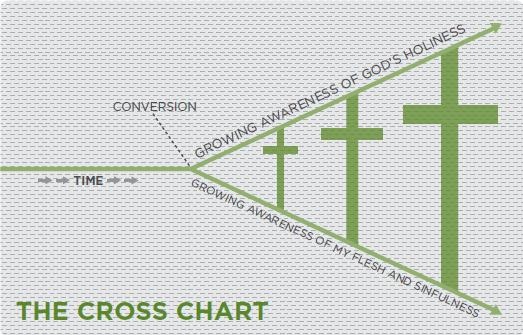
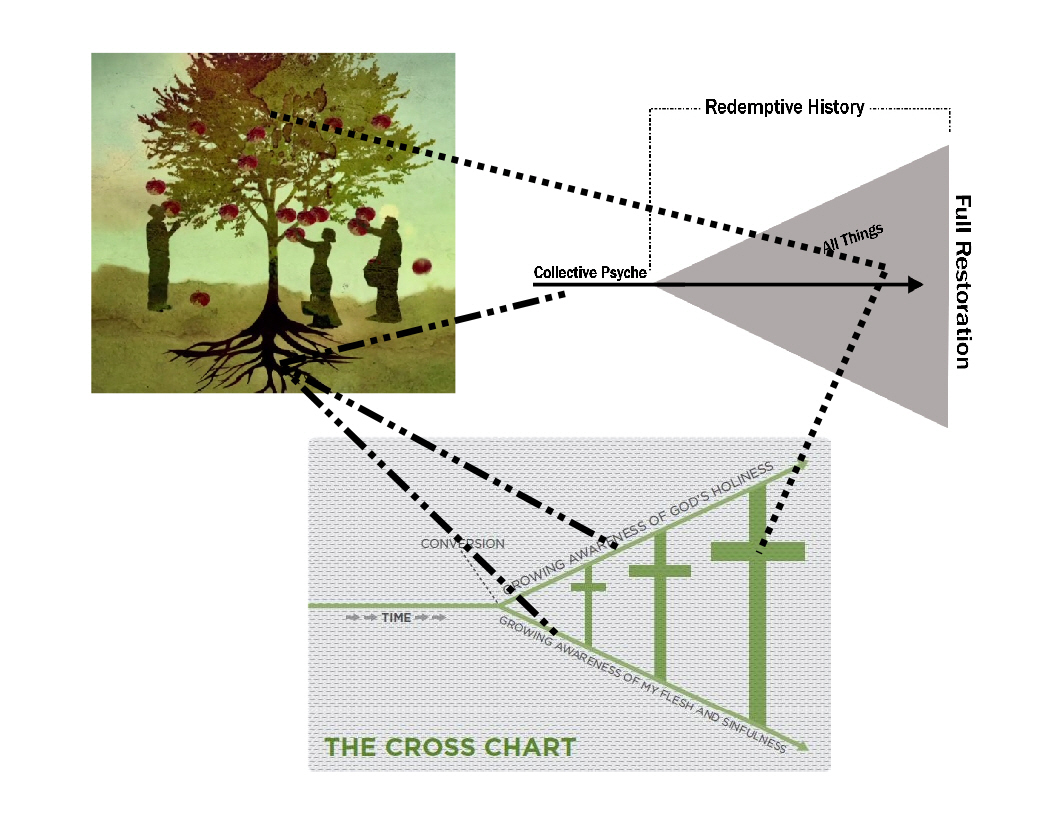
A. Image #1
a. The collective psyche is the root.
b. All things progressing toward restoration is the fruit.
c. Image #2—the tree in the video.
d. Church historian and author John Immel
- Image #1
- The root is IDEAS.
- The fruit is what society “looks like” as a result of the ideas.
B. The soul.
a. Like a tree, the “heart” has a root and fruit.
b. This is the Heart Theology of Neo-Calvinism.
- Pastor rant: “I am sick of the “root and fruit gospel”
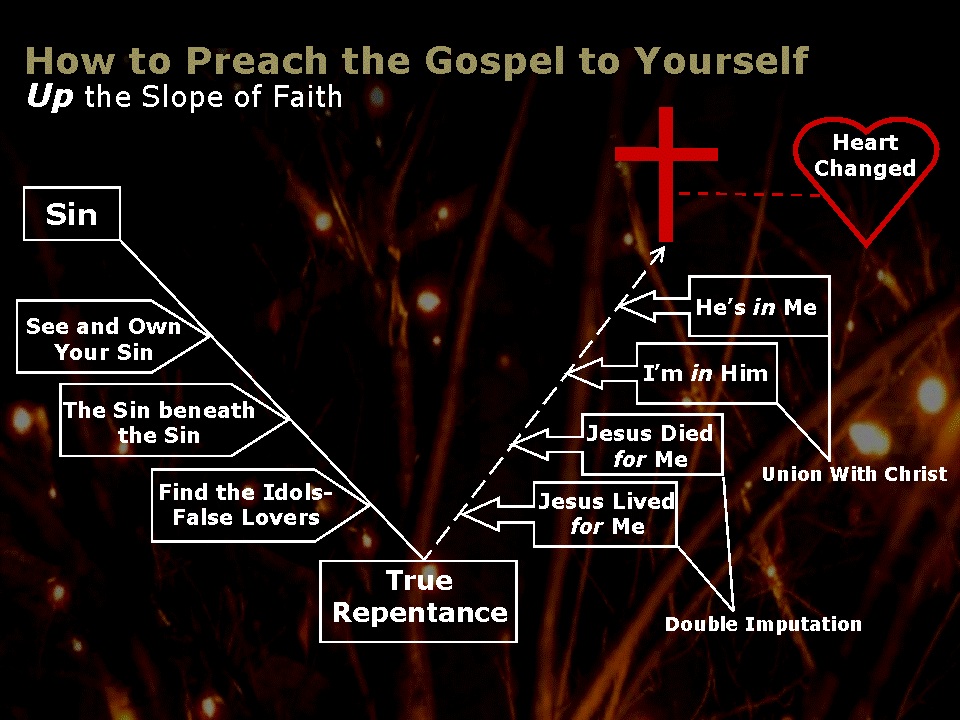
- What is it? Image #3
- Man is totally depraved/incompetent, therefore, his root ideas must be supplied for the collective good of society.
- Moreover, his ideas should be compelled by force for the betterment of society.
- What man thinks is what society is.
† This is the collective soul making the collective psyche resuting in the ideal society.
- This is Plato: man’s soul is a mirror image of society; society is a tree of fruit and root, and man’s soul is a tree of fruit and root.
- Image #4
- Compare to Image #1
- Image #5
c. The video NEVER states that man changes; it states, like communism, that society is the manifestation of man’s thinking, and that man does not know what to think, and must be compelled to think the right things through being educated by the enlightened, and for the betterment of society, by force if necessary.
d. Man is too incompetent to be a problem, bad ideas are the problem. The Neo-Calvinist therefore deems him as someone who should be prayed for, and at times agrees with the state that he/she should be executed if they refuse to repent of their own ideas—for the collective good of society. It’s nothing personal, it just so happens that your body is the bearer of bad ideas that are hurtful to society. No man is a bad person per se, ideas are the problem.
5. Justice: the story of two realities.
A. The justice of Romans 13:1-7 versus the justice of Plato’s Republic.
a. Government is a gift to man by God and is His servant for the good of man.
b. God exhorts man to have a sense of justice and to follow Him, and man is capable of doing so, and has a free will to do so.
c. However, when injustice takes place via the choices of men, God warns Christians and the unregenerate alike (throughout the New Testament) that the government is His servant to enforce justice and punish injustice. Hence, God is pleased with the natural flow of justice, but warns that He will enforce justice sooner or later; presently by government, or in the future via His White Throne Judgment.
d. Man is without excuse because he is created with a conscience—Paul exhorts Christians to live by their consciences.
B. Plato’s Republic insists that ALL justice comes from the root because man is incapable of knowing good and reality. Therefore, it does NO good to enforce behavior, what man believes is what must be enforced, and this root will result in societies fruit.
Conclusion
History tells us that Plato’s construct does not work. And because it has become the premise of the church’s Heart Theology, church doesn’t work. Hence, people stop going to church for the same reason that people do not move from America to Russia.
“It’s not about injustice, It’s about Jesus.”
~ Producer of “Unearthed”



From New Testament Synagogue to Home Assembly
 It can be confusing. After the birth of the assembly of Christ; seemingly, Christians just start meeting without any planning or protocol. They just start “doing church.” Unfortunately, the fact that the New Testament assembly was essentially Jewish for a number of years was a shocking revelation to me. Folks can say all they want about Baptists correcting Reformation anti-Semitism—it just isn’t so. Baptists have done nothing to preserve the Jewish roots of the church, and more than likely, the overall ignorance concerning our Jewish roots is foundational to most of the problems we see today within the Evangelical church. A proper understanding of the New Testament assembly model is critical to our philosophy of ministry.
Acts 10 and 11will give you a good perspective on how Jewish the church was—the Gentiles were recognized as part of the same body with much controversy and ado. Once you understand this, it is assumed that New Testament believers simply followed the form of worship that they were already accustomed to. Let’s not forget; for many Jews, the birth of Christ’s assembly was a major event, but not a conversion for them. Many were already born again before the cross (see John 3). So, what you see in New Testament assemblies was pretty much what was going on in the Jewish synagogues prior to Pentecost.
Therefore, it is no surprise to see the apostolic church ministering at the temple, in synagogues, and in homes. It was a natural transition, and a reflection of what had been happening at Jewish synagogues.
The synagogue is a concept that began sometime prior to the exodus. An Old Testament word search of “elder” makes it abundantly clear that elders led groups of people within Israel. During the exodus, the tabernacle was the primary focus for ritual, and God’s people were divided into small groups of learning overseen by elders. Again, a simple word search and observance of how the word is used in the Old Testament makes this abundantly clear. Though these small groups served many critical functions, the primary focus was that of learning. Traditionally, the synagogue is known as Bet Midrash (house of study), Bet Tefillah (house of prayer), and Bet Knesset (house of assembly).* Today, many synagogues have floor plans that accommodate these major ideas; a room for assembly, a room for prayer, and a room for study.
This is a longstanding tradition, and consequently, we see the same pattern in the book of Acts. Certainly, the concept of synagogue was institutionalized, and the first century was no exception. The first century synagogue, numbering around 400 in Jerusalem alone, was a combination of politically well-connected and highly structured centers and less formal home assemblies that were strictly that of the laity.** Along with being well connected with state politics, many of the institutionalized synagogues integrated Greek and Roman paganism into Judaism. † Due to the traditional Jewish mentality in regard to synagogues; i.e., the term “small sanctuary” was used interchangeably between the assembly and the family, ** the assemblies were unaffected by these unfortunate integrations if they chose to be, and many were.
Note: Christ’s assembly grows from 120 to 3000 in one day according to Acts 2:41, and in the following verse we read, “And they devoted themselves to the apostles’ teaching and the fellowship, to the breaking of bread and the prayers.” Where to put all of these people and what to do with them was of no issue, they merely returned to their existing assemblies, primarily in homes, and continued in the synagogue tradition. Acts 2:46 makes it clear that they met at the temple and had fellowship meals in their homes which would have also included teaching, prayer, the remembrance, and a departure with the singing of a hymn. The so-called last supper would have been very indicative of what went on during these assembly/synagogue meetings.
But also remember, the Jews that made up the apostolic assembly were VERY aware that the temple was temporary. In fact, after the destruction of the temple in 70 AD,
Following the destruction of the Temple in Jerusalem in the year 70 C.E., the rabbis decided the home would be the mikdash m’at—”small sanctuary”—a holy place responsible for fostering the family’s spiritual life.††
In addition, Christ’s ministry probably produced many solid synagogues prior to Pentecost.
This model continued predominately for the next 200 years, and there is no reason to think that Christ prescribed any alternatives.
Paul
Notes:
*George Robinson: Essential Judaism; Pocket Books 2000, p. 46.
**Louis H. Feldman and Meyer Reinhold: Jewish Life and Thought Among Greeks and Romans; Augsburg Fortress 1996, p. 68.
†Louis H. Feldman and Meyer Reinhold: Jewish Life and Thought Among Greeks and Romans; Augsburg Fortress 1996, p. 73.
†† Jewish Home & Community: My Jewish Learning.com; Online source | http://goo.gl/N6Udu6

 Paul's Passing Thoughts
5 comments