2015 TANC Conference Speaker:
 Susan Dohse M.Ed.

Jonathan Edwards: The Man, the Myth, the Message
Session 1: Friday, August 28, 1:00 PM
Session 2: Friday, August 28, 4:45 PM
Session 3: Saturday, August 29, 2:15 PM
2015 TANC Conference Speaker:
 John Immel

Examining the Historical Perspectives and Evolution of Determinism
Session 1: Friday, August 28, 10:45 AM
Session 2: Saturday, August 29, 1:00 PM
Session 3: Saturday, August 29, 2:15 PM
Session 4: Sunday, August 30, 3:30 PM
Session 5: Sunday, August 30, 4:45 PM
A World Philosophy and Church History for Home School
 For some time, I have received requests from homeschool moms for something substantive on world philosophy and church history. Well, I put something together from our TANC conferences. It is my opinion that this is information you would pay thousands of dollars to receive at a seminary or Bible college if they offered it, and they don’t. If I was homeschooling, this is what I would use hands down. You may download it for free here.
Hope this helps,
paul
From Christ’s Assembly to the Institutional Church: The History and Philosophical Progression
 Assembly
The fact that the 1st century church was made up of home fellowships is not obscure history. Not only that, the home fellowship model continued for at least 200 years after the Pentecost that marked the birth of the church. Was this the intended model designed for the Great Commission? And how did the institutional church become the predominate model? Is a particular model efficacious to the success of the Great Commission? This paper seeks to answer those questions.
The institutional church as we know it today is predicated by particular elements. Those elements are public structures, orthodoxy, polity, and horizontal authority. The home fellowship model is predicated by the smaller group meeting in private homes, vertical authority, horizontal fellowship, gifts, and leadership. These are important distinctions in context of the discussion.
Furthermore, even though the terms are used interchangeably in the Bible, deacon and elder should be associated with the home fellowship model while pastor and bishop should be associated with the institutional church. At the very least, that will be the case with this paper, but “bishop” is the term that goes part and parcel with the birth of the institutional church. “Pastor” is the term that replaced bishop over time in Evangelical circles. So, for purposes of this paper elder will be associated with leadership/home fellowships, and pastor/bishop will be associated with the horizontal authority of the institutional church.
Another important distinction will be between “assembly” and “church.” Like “bishop,” church is part and parcel with the institutional church. The etymological use of the word church coincides with the birth of the institutional church. “Assembly” will be associated with the home fellowship model. The reasons for these distinctions will become evident as we progress.
In considering the gravity of the issue, an honest discussion will entail philosophy. The philosophical presuppositions in regard to mankind drove the tension early in church history, and it drives it now. This involves an honest discussion of individualism versus collectivism. Attitudes concerning the assembly (home fellowship model) versus the church (institution) reveal misconceptions that run deep in the Western psyche. Yes, for the most part, the thought of home fellowships immediately raises the ire of “cult.” As we will see, cults are the natural outflow of the institutional church and her very elements. For instance, cults are void of leadership, but heavily predicated by authority. Authority is the heart of the cult, not leadership.
Individualism is based on the competence of the individual. Collectivism is based on the incompetence of the individual and calls for authority over the gifted. In addition, because man is incompetent and inherently selfish, every individual’s life purpose is what they can contribute to the group, or society. The individual’s worth is the sum total of what he/she can contribute to the group. Though God has wired us to enjoy life, joy is reduced to an experience only that flows from the complete eradication of self. Self-esteem becomes the root of all evil, and the only truthful evaluation of self must be utter worthlessness. Collectivism is joyful wormhood.
This redefines gift as an attribute primarily owned by those who have the ability to orchestrate collectivism. The concept of gift is given tacit acknowledgment in regard to the unenlightened masses, but emphasized strongly in regard to those who can prevent societal chaos resulting from an unfettered populous. Though most are unaware of it, presidential elections are already predetermined by the philosophy of the populous. The philosophy sold will determine the outcome. This boils down to what people believe about the competence of mankind. If the people believe that individualism will lead to chaos, they will clamor about to be taken care of by a police state. Likewise, in the church, the result of gift being primarily defined as that possessed by those who prevent chaos will yield the same result. Hence, as we shall see, a strong emphasis on individual gifts is antithetical to the institutional church. The primary goal of the institutional church becomes the prevention of chaos.
What was the mindset of the 1st century assembly model? First, smaller groups meeting in homes necessarily keeps the individual in focus. It is clear that the assembly model had confidence in the individual. If every believer is truly indwelt by the Holy Spirit, such confidence should not surprise us. There was no horizontal authority, only the vertical authority of Christ who said ALL authority had been given to Him (Matthew 28:18).
This defines a mainstay of the assembly: leadership sets the example and persuades in regard to an authority above themselves while at the same status level as the group. The apostle Paul appealed to the group and said, “Be imitators of me, just as I also am of Christ” (1Cor 11:1NET). This calls for the individual to judge the apostle according to his/her own interpretation of Scripture, and assumes the motive is to follow Christ correctly. In fact, the Bereans were called “honorable” for doing just that when they judged Paul’s teachings according to their own searching of the Scriptures (Acts 17:17).
In regard to horizontal authority, we have a very interesting event recorded in Scripture:
Mark 9:38 – John said to him, “Teacher, we saw someone casting out demons in your name, and we tried to stop him, because he was not following us.” 39 But Jesus said, “Do not stop him, for no one who does a mighty work in my name will be able soon afterward to speak evil of me. 40 For the one who is not against us is for us. 41 For truly, I say to you, whoever gives you a cup of water to drink because you belong to Christ will by no means lose his reward.
The assembly model calls for submission to the Chief Shepherd only. Agreement or disagreement on what that is to varying degrees is a matter of fellowship. If the disagreement is too strong, break fellowship: “Can two walk together, except they be agreed?” (Amos 3:3 KJV). This is just one more strength of the assembly model: depending on the nature of the disagreement, separations can contribute to the spread of the gospel. We have an example of this regarding the relationship between Barnabas and Paul. In Acts 15 we find that they separated because of a contention between them that was too great. Paul didn’t pull apostolic rank on Barnabas, they separated, and undoubtedly, their efforts were doubled.
Also, home assemblies do not limit growth in numbers. In the New Testament, we find that there were many home assemblies in a given geography. When a letter was written to, for example, “the church * of God that is in Corinth,” that was a letter written to all of the assemblies in that city. The letters were distributed in many different ways including designated messengers. The fact that the letters were sent to designated geographies suggests a cooperation and network between the assemblies. Obviously, the issues were the same as the letters addressed all of the assemblies in that geography; usually a city.
Apparently, the assembly of Corinth had expanded its influence by the time Paul wrote his second letter to them:
Paul, an apostle of Christ Jesus by the will of God, and Timothy our brother,To the church of God that is at Corinth, with all the saints who are in the whole of Achaia:
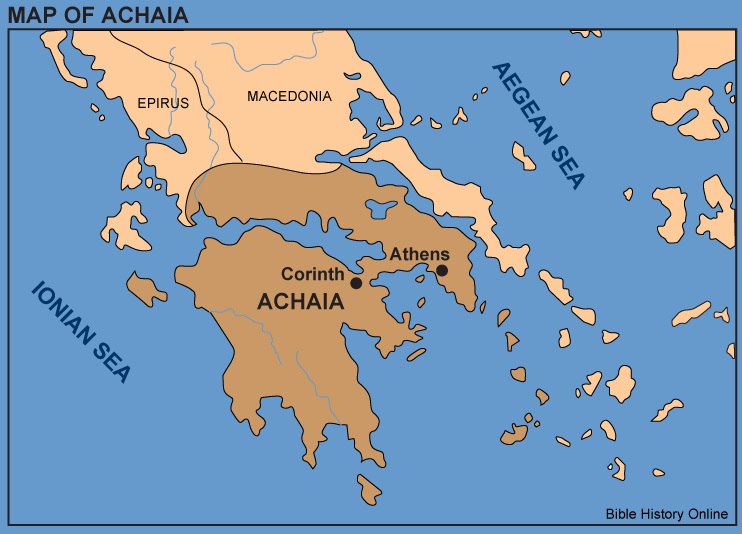
The broader geographical area of Achaia is included in the second letter. The “whole of” in regard to Achaia assumes multiple assembles and this assumption should be foisted upon the city of Corinth as well. The assembly of Christ expressed in several different assemblies and hopefully expressing the one mind of Christ that is key to unity.
1 Corinthians 1:10 – I appeal to you, brothers, by the name of our Lord Jesus Christ, that all of you agree, and that there be no divisions among you, but that you be united in the same mind and the same judgment.
1 Corinthians 2:16 – For who hath known the mind of the Lord, that he may instruct him? But we have the mind of Christ.
Philippians 2:2 – complete my joy by being of the same mind, having the same love, being in full accord and of one mind.
Philippians 2:5 – Let this mind be in you, which was also in Christ Jesus:
Assembly leadership appeals to the one mind in Christ as the only authority. Assembly leaders have no authority. Fellowship is determined by whether or not leadership has persuaded the assembly. This determines unity as well. Those who can agree on what Christ has commanded can walk together and minister together in single mindedness. This brings us back to a consideration of the following: can large groups of individuals agree based on the idea of individual competence? In general, is the individual capable of being reasonable? Does unity have to be dictated, or can individuals be unified? The New Testament assembly model answers this question with a resounding, “yes”:
Acts 6:1 – Now in these days when the disciples were increasing in number, a complaint by the Hellenists arose against the Hebrews because their widows were being neglected in the daily distribution. 2 And the twelve summoned the full number of the disciples and said, “It is not right that we should give up preaching the word of God to serve tables. 3 Therefore, brothers, pick out from among you seven men of good repute, full of the Spirit and of wisdom, whom we will appoint to this duty. 4 But we will devote ourselves to prayer and to the ministry of the word.” 5 And what they said pleased the whole gathering, and they chose Stephen, a man full of faith and of the Holy Spirit, and Philip, and Prochorus, and Nicanor, and Timon, and Parmenas, and Nicolaus, a proselyte of Antioch. 6 These they set before the apostles, and they prayed and laid their hands on them. 7 And the word of God continued to increase, and the number of the disciples multiplied greatly in Jerusalem, and a great many of the priests became obedient to the faith.
Notice that it is the word of God that increased, and the “obedience to the faith” and not men. There is only one verse in the New Testament that seems to call for an obedience to church leaders:
Hebrews 13:17 – Obey your leaders and submit to them, for they are keeping watch over your souls, as those who will have to give an account. Let them do this with joy and not with groaning, for that would be of no advantage to you.
The word “obey” in this verse is defined as follows:
g3982. πείθω peithō; a primary verb; to convince (by argument, true or false);
The idea is to be persuaded. That is how the same Greek word is translated by the same version (ESV) in Matt 27:20.
Now the chief priests and the elders persuaded the crowd to ask for Barabbas and destroy Jesus.
A similar form of the word can mean “refuse to be persuaded” as in 1Peter 3:1, but on no wise does Heb 13:17 teach that we are to submit to an authority when it contradicts our understanding of Christ’s authority. This again goes hand in hand with the idea that the individual lacks competence in understanding truth.
The assembly model also lends understanding in regard to many passages like Mathew 18:15-20.** This passage contains instructions for being reconciled to an individual who has offended you; it is for conflict resolution within the assembly. Trying to apply these instructions within an institutional construct creates many, many problems. However, the passage makes perfect sense when seen from the assembly prism. This holds true for much of the New Testament. Fitting the institutional church into New Testament instruction is often like fitting a square peg in a round hole.
The institutional church does not nurture the Great Commission or discipleship. Invariably, a collectivist environment will not emphasize individual gifts which are the body parts of Christ’s assembly. Read 1Corithians 12:14-26.
Paul’s context in 1Cor 12:14-26 is spiritual gifts (see 12:1). To say that the institutional church underemphasizes individual gifts is an understatement, and the results speak for themselves; it is a body that does not work well. Many who do not have the gift of teaching merely buy an authoritative position in the church through institutional academics. This is where they learn orthodoxy and polity, and regurgitate these traditions of men in the local church. Orthodoxy and polity will be addressed later in this paper, but this you can be sure of: the perpetuation of orthodoxy requires little giftedness.
From Assembly to Institution: A History
As stated initially, the intentional assembly model was the norm for at least 200 years and probably closer to 300 years. It works the same way regardless of geographical socioeconomic conditions or political situations: ie., persecution. It would be no surprise that God designed a model that will work well and efficiently under any circumstance. And obviously, an assembly model saves a vast amount of money on infrastructure. Even though the assembly does not seem to be the norm in Western culture, the intended model never ceased to exist. Christ said he would build His assembly and the gates of hell would not prevail against it, and this is of course true. The assembly model flourishes in China and Africa, and is making a huge comeback in the West where the institutional church has taken its toll. Some say that home fellowships in America have increased from roughly 2,500 to 30,000 in less than ten years while 1,600 people a day leave the institutional church. The word “movement” is being used more and more.
But how did we get from the assembly to the church? This can be tracked historically and begins with the passing of Peter and Paul who were the most formidable of the apostles. Peter was the “rock” of the church, and Paul wrote 13 of the 27 books that makeup the New Testament canon. The passing of these two apostles created a leadership vacuum.
Also left behind was no shortage of theologians, many of them products of the apostles and their disciples. The most prominent ones are known as the Church Fathers. For example, one church father, Polycarp, was a disciple of the apostle John. These men were very influential leaders of that day, and had different ideas in regard to apostolic succession. Some believed that the apostles laid the foundation of Christ’s assembly and set it in motion without the need for further apostolic oversight. Others believed that the church was doomed to chaos without doctrinal oversight. However, though the apostles certainly possessed some categories of authority, they made themselves accountable to the general populous of Christians according to Scripture as we have previously noted.
A movement developed that was strongly supported by some of the church fathers; specifically, that the church at Rome should have oversight of all of the assemblies, and the church at Rome should be overseen by a single bishop. The first bishop to be named was Linus. It was taught that Linus represented the succession of the apostles. According to one of the church fathers, Irenaeus:
The blessed apostles, then, having founded and built up the Church, committed into the hands of Linus the office of the episcopate (Irenaeus: Against Heresies 3:3.3).
Irenaeus also identified Linus as the same who was an associate of Paul mentioned in 2Tim 4:21. Irenaeus is considered to be one of the earliest church fathers known as the Apostolic Church Fathers and was an associate of Polycarp. And yes, Linus represents the beginning of the Catholic Church and its succession of first, authoritative bishops, and then followed by the popes. Irenaeus is indicative of many of the church fathers who ascribed to apostolic succession,† but the focus is on him because he is the earliest and most vocal about it:
Wherefore we must obey the priests of the Church who have succession from the Apostles, as we have shown, who, together with succession in the episcopate, have received the certain mark of truth according to the will of the Father; all others, however, are to be suspected, who separated themselves from the principal succession (Irenaeus: Adversus Haereses; Book IV, Chapter 26).
Since, however, it would be very tedious, in such a volume as this, to reckon up the successions of all the Churches, we do put to confusion all those who, in whatever manner, whether by an evil self-pleasing, by vainglory, or by blindness and perverse opinion, assemble in unauthorized meetings; [we do this, I say,] by indicating that tradition derived from the apostles, of the very great, the very ancient, and universally known Church founded and organized at Rome by the two most glorious apostles, Peter and Paul; as also [by pointing out] the faith preached to men, which comes down to our time by means of the successions of the bishops. For it is a matter of necessity that every Church should agree with this Church, on account of its pre-eminent authority, that is, the faithful everywhere, inasmuch as the apostolical tradition has been preserved continuously by those [faithful men] who exist everywhere (Irenaeus: Adversus Haereses; Book III, Chapter 3).
The primary nemesis of the apostolic church was Gnosticism, and the Gnostics claimed secret oral knowledge that came directly from Christ. The debate concerning authentic canonicity during that time made an argument for the most reliable oral tradition valid. This fed the movement for the church at Rome, and its presiding bishop, to have authority over all of the assemblies. The church fathers argued that it was obvious that the likes of Linus and Polycarp possessed the most reliable oral tradition (The Horizon History of Christianity: American Heritage Publishing 1964; p. 73).
However, for the most part in regard to realty, it was a more “reliable” form of Gnosticism as the church fathers themselves were heavily influenced by Gnostic principles (Ibid pp. 70, 71). ††
Scripturally, we have the clear mentality of the two primary apostles who knew their departure was near. For Paul, it was a final exhortation to the Ephesian elders, warning them that after his departure wolves would come in among the eldership and attempt to ravage the flock (Acts 20:17-32). From this passage, it can be argued that Paul is commending the assembly elders to the care of God’s flock through the word and not any kind of authority. Indeed, the apostles were already working side by side with the elders on matters of doctrine (Acts 15:1-4). For Peter, it was a final exhortation to the saints as a whole to remind them of important sanctification principles that would give them assurance of salvation (2Peter 1:1-15). This is followed by instruction, to all of the saints, in regard to false teachers. If there is any succession, it is to the congregation of the saints and their elders.
Nevertheless, at this juncture in church history, the tension begins between elder leadership and bishop authority. The church at Rome may have been chosen for this authority because it was the epicenter of the world at that time. In the beginning, its “authority” had to be sold through the intimidation of the church fathers. Gnostic influence fueled the collectivist mentally and the need for orthodoxy. Orthodoxy is the parental explanation to the child. It is the gnosis repackaged in a form that can be followed, albeit not necessarily understood by the great unwashed masses. It is the creeds, confessions, and catechisms. These place the bishop between the parishioner and the word of God. These make the bishop the authority. These make the understandable word of God the gnosis. The first example of such creeds is the Didache dating back to early post apostolic times.
As the intimidation grew, many assemblies and their elders capitulated to bishop authority. Instead of a plurality of elders among the assemblies fulfilling their leadership gift, it became one bishop, one church, one city. These bishops usurped the positions of the assembly elders and were subservient to the bishop of Rome.‡ However, many of these assemblies under bishop authority still retained deep convictions in regard to the apostles doctrine and Scripture. Under the bishopric, Clement of Rome, a church father himself, this tension came to a head. Apparently, the church at Corinth which by then comprised a huge network of assemblies had responded well to Paul’s rebukes and instruction. It is also apparent that Clement was taking it upon himself to appoint bishops to the assemblies based on assumed authority propagated by most of the church fathers. Corinth responded by expelling the bishops from their assemblies. This is the subject Clement addresses in the letter of 1Clement:
1Clem 44:1 – And our Apostles knew through our Lord Jesus Christ that there would be strife over the name of the bishop’s office.
1Clem 44:2 – For this cause therefore, having received complete foreknowledge, they appointed the aforesaid persons, and afterwards they provided a continuance, that if these should fall asleep, other approved men should succeed to their ministration. Those therefore who were appointed by them, or afterward by other men of repute with the consent of the whole Church, and have ministered unblamably to the flock of Christ in lowliness of mind, peacefully and with all modesty, and for long time have borne a good report with all these men we consider to be unjustly thrust out from their ministration.
The suggestion that these bishops ministered “peacefully” while they were in Corinth couldn’t be exactly right for in other places Clement addresses doctrinal issues (40:2-41:1). 40:2 in particular suggests that the bishops might have been hindering the informality of their meetings:
Now the offerings and ministrations He commanded to be performed with care, and not to be done rashly or in disorder, but at fixed times and seasons.
The bishops were expelled via the suggestion of a few in Corinth. Undoubtedly, these were men highly respected by the assemblies before the bishops arrived—probably assembly elders:
1Clem 47:6 – It is shameful, dearly beloved, yes, utterly shameful and unworthy of your conduct in Christ, that it should be reported that the very steadfast and ancient Church of the Corinthians, for the sake of one or two persons, maketh sedition against its presbyters.
It is also possible that these elders didn’t take Rome’s authority seriously:
1Clem 39:1 – Senseless and stupid and foolish and ignorant men jeer and mock at us, desiring that they themselves should be exalted in their imaginations.
Clement accuses these men, again, probably elders, of being jealous of bishop authority:
1Clem 57:2 – Learn to submit yourselves, laying aside the arrogant and proud stubbornness of your tongue. For it is better for you to be found little in the flock of Christ and to have your name on God’s roll, than to be had in exceeding honor and yet be cast out from the hope of Him.
Clement also threatens them with excommunication:
1Clem 57:1 – Ye therefore that laid the foundation of the sedition, submit yourselves unto the presbyters and receive chastisement unto repentance, bending the knees of your heart.
Ibid 57:2 – Learn to submit yourselves, laying aside the arrogant and proud stubbornness of your tongue. For it is better for you to be found little in the flock of Christ and to have your name on God’s roll, than to be had in exceeding honor and yet be cast out from the hope of Him.
Clement sent a delegation to Corinth to present the letter and wait on a reply. 63:3 could imply the second step of “church discipline”:
1Clem 63:2 – For ye will give us great joy and gladness, if ye render obedience unto the things written by us through the Holy Spirit, and root out the unrighteous anger of your jealousy, according to the entreaty which we have made for peace and concord in this letter.
1Clem 63:3 – And we have also sent faithful and prudent men that have walked among us from youth unto old age unblamably, who shall also be witnesses between you and us.
1Clem 63:4 – And this we have done that ye might know that we have had, and still have, every solicitude that ye should be speedily at peace.
1Clem 65:1 – Now send ye back speedily unto us our messengers Claudius Ephebus and Valerius Bito, together with Fortunatus also, in peace and with joy, to the end that they may the more quickly report the peace and concord which is prayed for and earnestly desired by us, that we also may the more speedily rejoice over your good order.

The Day the Church Excommunicated Christ’s Assembly
As stated earlier, even though many assemblies were half pregnant with bishop authority, they would draw the line on certain convictions. This held true for more than 100 years after Clement’s letter to the Corinthians. In 193 AD, there is another major standoff between the assembly of Christ and the church. This time, it involves Victor of Rome and the Asian assemblies. One is astounded to learn through the history of this controversy that the assemblies observed the Passover for what could have been 300 years after Pentecost.
Rome’s polity could only be enforced through academic and social caste intimidation. As they sought to appease the Roman government (which was already a state religion) more and more, this meant more and more integration of Rome’s paganism into Christian nomenclature. Therefore, Victor insisted that the Asian assemblies replace Passover with Easter:
Internal dissensions during this era affected the Church at Rome. The dispute over the celebration of Easter grew more acute. The Christians at Rome, who had come from the province of Asia, were accustomed to observe Easter on the 14th day of Nisan, whatever day of the week that date might happen to fall on, just as they had done at home. This difference inevitably led to trouble when it appeared in the Christian community of Rome. Pope Victor decided, therefore, to bring about unity in the observance of the Easter festival and to persuade the Quartodecimans to join in the general practice of the Church.
He wrote, therefore, to Bishop Polycrates of Ephesus and induced the latter to call together the bishops of the province of Asia in order to discuss the matter with them. This was done; but in the letter sent by Polycrates to Pope Victor he declared that he firmly held to the Quartodeciman custom observed by so many celebrated and holy bishops of that region. Victor called a meeting of Italian bishops at Rome, which is the earliest Roman synod known. He also wrote to the leading bishops of the various districts, urging them to call together the bishops of their sections of the country and to take counsel with them on the question of the Easter festival.
Letters came from all sides: from the synod in Palestine, at which Theophilus of Caesarea and Narcissus of Jerusalem presided; from the synod of Pontus over which Palmas as the oldest presided; from the communities in Gaul whose bishop of Irenaeus of Lyons; from the bishops of the Kingdom of Osrhoene; also from individual bishops, as Bakchylus of Corinth. These letters all unanimously reported that Easter was observed on Sunday… Victor, who acted throughout the entire matter as the head of Catholic Christendom, now called upon the bishops of the province of Asia to abandon their custom and to accept the universally prevailing practice of always celebrating Easter on Sunday. In case they would not do this he declared they would be excluded from the fellowship of the Church (The Catholic Encyclopedia).
It can be assumed that there were many assemblies that separated themselves from all of the drama and lived separately from Rome and the church fathers. Perhaps they had already been excommunicated at some point. But the following is clear: all assemblies ruled by bishops who refused to exchange the observance of Passover with Easter (a pagan festival) were excommunicated:
Further, Irenaeus states that St. Polycarp, who like the other Asiatics, kept Easter on the fourteenth day of the moon, whatever day of the week that might be, following therein the tradition which he claimed to have derived from St. John the Apostle, came to Rome c. 150 about this very question, but could not be persuaded by Pope Anicetus to relinquish his Quartodeciman observance. Nevertheless he was not debarred from communion with the Roman Church, and St. Irenæus, while condemning the Quartodeciman practice, nevertheless reproaches Pope Victor (c. 189-99) with having excommunicated the Asiatics too precipitately and with not having followed the moderation of his predecessors (The Catholic Encyclopedia).
Eventually, the church at Rome succeeded in being fused with the state during the reign of Constantine. At that point, orthodoxy was enforced by the point of a sword. This is how the institutional church came about, and the Protestantism that came from it is no less institutional.
Like its Roman mother, it came forth from the womb seeking authority in its polity and orthodoxy. ‡‡ This is the difference between the assembly and church: the priesthood of believers versus bishops; gifts versus authority. To which Christ stated:
Mark 10:35 – And James and John, the sons of Zebedee, came up to him and said to him, “Teacher, we want you to do for us whatever we ask of you.” 36 And he said to them, “What do you want me to do for you?” 37 And they said to him, “Grant us to sit, one at your right hand and one at your left, in your glory.” 38 Jesus said to them, “You do not know what you are asking. Are you able to drink the cup that I drink, or to be baptized with the baptism with which I am baptized?” 39 And they said to him, “We are able.” And Jesus said to them, “The cup that I drink you will drink, and with the baptism with which I am baptized, you will be baptized, 40 but to sit at my right hand or at my left is not mine to grant, but it is for those for whom it has been prepared.” 41 And when the ten heard it, they began to be indignant at James and John. 42 And Jesus called them to him and said to them, “You know that those who are considered rulers of the Gentiles lord it over them, and their great ones exercise authority over them. 43 But it shall not be so among you. But whoever would be great among you must be your servant, 44 and whoever would be first among you must be slave of all. 45 For even the Son of Man came not to be served but to serve, and to give his life as a ransom for many.”
Notes
* The word throughout the New Testament is ekklesia: “called out assembly.” Church has an etymology that coincides with the coronation of the institutional church circa 300 AD. The very definition of church includes the category of “institution” according to some dictionaries. Church is a word that is incorrectly associated with the early assemblies.
** The space will not be taken here to make the point, but Matthew 18:15-20 coincides operationally with the assembly model on all points. This is especially true when you consider that the institutional model spawns the mega church.
† Polycarp was a bishop and not an assembly elder. A maxim of another church father, Ignatius was, “Do nothing without the bishop” (The Horizon History of Christianity: American Heritage Publishing 1964; p. 74). Tertullian (c. 155 – c. 255) “Though he fought against Gnosticism, he also exalted the authority of the church beyond that allowed by Scripture. He taught that the church’s authority comes through apostolic succession” (Pastor David Cloud: The Church Fathers, A Door to Rome; Way of Life .org, Nov/14/12).
†† Clement of Alexandria (c. 150 – c. 230) “From 190 to 202, Clement headed the heretical school of Alexandria, Egypt, founded by Pantaenus, which intermingled the Greek philosophy of Plato with Christianity” (Pastor David Cloud: The Church Fathers, A Door to Rome; Way of Life .org, Nov/14/12).
‡ Charles M. Jacobs: The Story of the Church; The Muhlenberg Press 1947, pp. 19, 20. | The Horizon History of Christianity: American Heritage Publishing 1964; p. 74.
‡‡ William Marshall D. D.: The Principles of the Westminster Confession of Faith Standards Persecuting; William Oliphant & Co. Edinburgh 1873. “The Protestant Reformers in leaving Rome did not leave all Romanism behind them. In particular, they brought with them the prosecuting principles of Rome, and worked them freely and vigorously in support of the Reformed faith. They changed the Pope but not the popedom… Rightfully and nobly did the Protestant Reformers claim religious liberty for themselves; but they resolutely refused to concede it to others.”
paul
A Visual Eschatological Theory
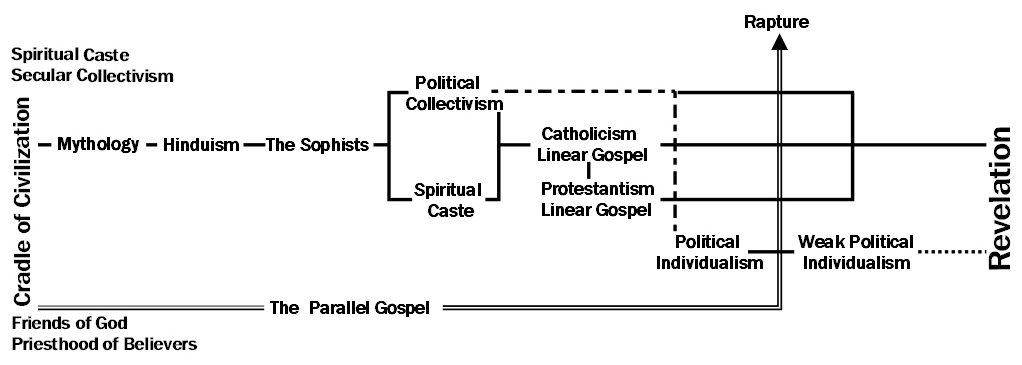
Spiritual Caste Hinduism: https://paulspassingthoughts.com/wp-content/uploads/2012/10/caste.jpg
Spiritual Caste: Protestantism: https://paulspassingthoughts.com/wp-content/uploads/2012/10/caste1.jpg
Catholicism/Protestantism: https://paulspassingthoughts.com/2013/08/13/susan-dohse-on-plato-augustine-calvin-and-the-reformation/
Collectivism/Sophists: https://paulspassingthoughts.com/2013/06/27/tanc-2013-john-immel-the-history-of-western-philosophy-and-its-societal-impact/
Political Individualism: Part 1; http://youtu.be/RcNwi1kMlNs Part 2; http://youtu.be/-aAvSTlbx3c Part 3; http://youtu.be/mzS7KOnyo9E
The Linear Gospel: https://paulspassingthoughts.com/wp-content/uploads/2013/06/linear-gospel-1.jpg
The Parallel Gospel: https://paulspassingthoughts.com/wp-content/uploads/2013/06/parallel-gospel-1.jpg
Protestant Gospel Metaphysics and Epistemology: https://paulspassingthoughts.com/wp-content/uploads/2013/06/pictures-of-calvinism.pdf

 Paul's Passing Thoughts


leave a comment