Get Over It: Calvin and Luther Propagated a Blatant False View of Justification
FACT is, Luther and Calvin propagated a false view of justification and the theological math is very simple. It’s a religious empire built on a big fat lie. Luther and Calvin belong in the infamous Hall of False Gospels, not Christian folklore.
Why is this? Justification is not a legal covering that God “sees.” It is not a legal declaration of covering, it is a legal declaration of fact concerning the true being of the individual who is now a family member. He now deals with us as sons. When God looks at the new family member, He sees a righteousness that is like Christ’s because Christ is the brother, but it is also the righteousness of the individual. When God “sees” one of His children, He sees the righteousness of one born of Him. “A righteousness of our own” argument is intellectually dishonest; it attempts to make us the originators of righteousness because we received it as a gift.
“But Christians still sin.”
This very contention is a false gospel smoking gun. This simple four-word contention (one of Calvin and Luther’s primary arguments for progressive justification) is all one needs to completely discredit the Reformation from the plain sense of Scripture. This perspective obviously sees Christians as still under the law and needing a COVERING to satisfy the law.
But here is the good news of the true gospel: sin is not merely covered, it is ended, and where there is no law, there is no sin.
But that doesn’t mean “under grace” equals not being under any law. It’s just a different use of the law: for love, NOT condemnation. Authentic Protestantism clearly keeps Christians under the law of condemnation, and therefore needing a covering of righteousness not their own. Supposedly, Christ came to not only die for our sins, but to obey the law perfectly so that His perfect obedience can be imputed to our Christian life by faith alone.
There are many problems with this view of justification known as “double imputation.”
First, it makes the law of condemnation a co-life-giver. That’s Paul’s whole point in Galatians chapter 3. Also, the law now sits on a third throne with God the Father and Christ. In fact, Reformed tradition often pontificates about “An offering given to satisfy the law from the empty hands of faith which only bring the righteousness of Christ as an offering.”
Whoa! Really?
Secondly, it denies that the old person died with Christ via the baptism of the Spirit. Why in the world would believers need a covering to protect them from a law that they are no longer under? A dead person cannot be found guilty under the law—they are dead. This is Paul’s whole point in Romans chapter 7.
Thirdly, because of the Reformation’s single use of the law, that of condemnation only, the ability of the Christian to love is circumvented. The Christian is not free to “serve another.” The law of sin and death, the ministry of death, is made the same as the law of liberty, the law of Christ, and the law of the Spirit of life that He uses to sanctify us (John 17:17).
Fourthly, because the believer is still under the law of sin and death confirmed by the fact that he/she still needs a covering of righteousness that is not their own imputed by the new birth, he/she is still enslaved to sin.
Fifthly, the principles of GIFT and REWARD in the Bible now have to be the same. Therefore, salvation is the reward for living by faith alone in the same gospel that saved us. This, according to Calvin, “keeps us in the family of God.”
Hence, salvation is a reward for living by faith alone rather than a gift. This problem speaks for itself and is the crux of “already not yet.”
Is it any wonder that the Protestant church is a train wreck? It’s that way because of its false gospel.
paul
The Protestant Twisting of 1John: A Clarification, Part 5 – Law, Gospel, and Love
Listen to show audio or download audio file.
Welcome to Blogtalk Radio False Reformation this is your host Paul M. Dohse Sr. Tonight, part 5 of “The Protestant Twisting of 1John: A Clarification.” If you would like to add to our lesson or ask a question, call (347) 855-8317. Remember to turn your PC volume down to prevent feedback. Per the usual, we will check in with Susan towards the end of the show and listen to her perspective.
If you would like to comment on our subject tonight, you can also email me at paul@ttanc.com. That’s Tom, Tony, Alice, Nancy, cat, paul@ttanc.com. I have my email monitor right here and can add your thoughts to the lesson without need for you to call in.
This is our final segment on 1John, and next week we will be doing a book review on “How People Change” by Paul David Tripp. I will be doing an overview of each of the 16 chapters in the book according to the theses of each chapter, and then will explain how the different points of each chapter fit together to form a particular doctrine. All in all, the book represents a pretty impressive application of Reformed mysticism.
Then, the following week, starting on May 8th, I think the time has come to do an in-depth evaluation of the Heidelberg Disputation. Martin Luther’s 95 Theses launched the Reformation, but all Reformed doctrines flow from the Heidelberg Disputation. Though very subtle, our present church culture is saturated with a collectivist doctrine of death, and I want to show exactly where this culture of death came from. We will be evaluating the Heidelberg Disputation theses by theses. How many Baptists know anything about the Heidelberg Disputation? Few, if any, yet the foundation of evangelicalism flows from this document.
Last week, I got away from our Gnostic theme and showed a correlation between John’s theology and that of the apostle Paul. The focus was the new birth, which Gnosticism denies. The historical backdrop is John’s pushback against Gnosticism which denies that people change. The Gnostics of that day believed that the material realm is evil and the spiritual realm is pure.
The goal is wellbeing that comes from getting beyond the five senses in order to gain knowledge. The particular vein of Gnosticism that John was contending against believed that sin only occurs in the body, and man’s spirit has never sinned per se. As a result, God’s people were being taught that what they did in the body was insignificant, and man didn’t need to deal with sin. Gaining spiritual knowledge for their own wellbeing was the key to having a happy life.
They denied that Christ really came as a man and was God’s Son. They taught that there were two Christ’s; one born of men and a Christ that was a spiritual avatar of sorts.
At any rate, the doctrine denied Christ’s deity, that He came to die for sin, and that mankind needed forgiveness for sin. Consequently, it also denied the new birth. In the same way Protestantism obviously denies that people change, redefine the new birth as an ability to perceive realm manifestation, and have their own unique distortion of the Trinity. When it gets right down to it, authentic Protestantism posits the Father and the Spirit as shadows of Christ.
Therefore, in chapter 3, John focuses on the new birth and why it changes us. But the dominate theme of the book, especially chapters 4 and 5, concentrates on love. Why is that? Because love in action should be the primary focus of Christians. Instead, what is the primary focus of Protestantism? Right; sin, sin, sin, sin, sin. Yes, our focus must be keeping our sins covered by the perfect righteousness of Jesus. Every song you sing, every sermon you hear is about how glorious Jesus is as set against our wretched vile selves. It boils down to praising our ability to see how rotten we are in the name of Jesus.
Look, 1Corinthians 13:6 defines love as something that doesn’t rejoice in evil, but clearly, Protestants rejoice in “grace,” that is, seeing our evil as set against the holiness of God. Like the Gnosticism that John was dealing with, Protestantism turns love completely upside down. That’s the problem we want to solve tonight.
In the first parts of this series, we focused on the Gnostic backdrop, but last week, we brought in the teachings of Paul to better understand what John was writing, and that’s what we are going to do tonight.
Why does Protestantism, like Gnosticism, circumvent love, and what can we do about it? Let’s first consider what 1John states about love:
1John 4:7 – Beloved, let us love one another, for love is from God, and whoever loves has been born of God and knows God. 8 Anyone who does not love does not know God, because God is love.
1John 5:1 – Everyone who believes that Jesus is the Christ has been born of God, and everyone who loves the Father loves whoever has been born of him. 2 By this we know that we love the children of God, when we love God and obey his commandments. 3 For this is the love of God, that we keep his commandments.
Do you see the huge problem with focusing on sin and not love? And I don’t mean God’s love for us because we are such vile sinners, I mean our love towards God and others. Note what somebody sent the blog this week which is indicative of what we hear constantly in the church. They heard this on K-Love Christian radio:
Who am I, that the Lord of all the earth
Would care to know my name,
Would care to feel my hurt?
Who am I, that the Bright and Morning Star
Would choose to light the way
For my ever wandering heart?
Not because of who I am
But because of what You’ve done.
Not because of what I’ve done
But because of who You are.
I am a flower quickly fading,
Here today and gone tomorrow.
A wave tossed in the ocean.
A vapor in the wind.
Still You hear me when I’m calling.
Lord, You catch me when I’m falling.
And You’ve told me who I am.
I am Yours, I am Yours.
This is what we hear incessantly in the church. Where is the focus on our love towards others and God? In order to return to the right focus on love, we need the right theology, so let’s get to it.
Whatever form of Protestantism you are talking about, and Calvinism in particular, its Achilles’ heel is the law. Protestantism cannot pass the true gospel test because of its position on law, and this is not hard to understand.
Andy Young, an associate of TANC ministries, said something in last year’s 2014 conference that is probably true for the most part: “The law is for sanctification.” Right, because the law is in no wise for justification. We are justified apart from the law (Romans 3:21) and “apart” means exactly that. The fact that the law will judge people in the end is a separate issue altogether.
The apostle Paul makes all of this easy to understand in Galatians chapter 3. But first, let’s use that same chapter to establish what we mean by the word, “law.” The word is used interchangeably with many other words, including, “gospel” to refer to the Bible. So, Andy was merely saying that the Bible is for sanctification, or in other words, Christian living. Andy was talking in context of sanctification for the Bible has no stake in justification, and again, the fact that the Bible will judge people in the end is another issue. Yes, the Bible defines justification (Rom 3:21, Gal 4:21); yes, the Bible testifies to the truths regarding justification, but the law does not justify.
Note the following from Galatians 3:
21 Is the law then contrary to the promises of God? Certainly not! For if a law had been given that could give life, then righteousness would indeed be by the law. 22 But the Scripture imprisoned everything under sin, so that the promise by faith in Jesus Christ might be given to those who believe.
Notice that Paul uses the word “law” and “Scripture” interchangeably. The law, “holy writ,” “the word,” “the gospel,” “the Scriptures,” “the law and the prophets,” etc. are all terms that refer to the Bible which is a full orbed statement by God regarding Himself, mankind, and reality. Statements like this: “We are not bound by the law, or else we’d have to live under every aspect of the law including not wearing blended fabrics and not eating shrimp and bacon” reveal a fundamental ignorance in regard to what the law is.
Protestantism falls on this one basic principle: law is the standard for righteousness. This makes the salvific work of Christ two-fold: He died to pay the penalty for our sins, and came to fulfill the law for us in order to make us righteous. That’s gross heresy. That’s an egregious false gospel. Hence, you have two kinds of Protestants: one camp that understands the position and professes it, and the other camp who also confesses it, but has not thought out the ramifications. This includes Baptists, Methodists, and many others. Baptists parted ways with the Reformers on baptism, but have never repented of making the law justification’s standard.
Yes, Jesus said that He came to fulfill the law and to not end it, but then we have the apostle Paul writing that Christ in fact did come to end the law, so does the Bible contradict itself? By no means.
Here is the problem: by design, Protestants don’t interpret the Bible in context of sanctification and justification, and again, that is by design. Why? Because Protestantism is founded on the idea that sanctification is merely the progression of justification. This also goes hand in glove with the idea that the law is justification’s standard. Hence, the law must continue to be fulfilled perfectly to keep the saints justified. This results in the confused theological train wreck we call Protestantism.
When the law must be continually fulfilled perfectly as a standard for justification, the law cannot be used for love because now you have fused love and justification together. This is why churches lack love; the maintaining of justification and love are confused. In the Bible, love is absolutely synonymous with obedience. Unfortunately, Protestantism makes obedience a justification issue. Obedience is not a justification issue—it’s a love issue. That’s why there is so much love-bombing in churches; true love is stifled because it is confused with justification. The vacuum is then filled with empty words and programs. People are in bondage to the law in Jesus’ name and their pain is medicated by praise bands, personality cults, and the splendor of institutional temples.
The fulfillment of the law in Jesus’ name is a huge problem—there is no law in justification regardless of who keeps it. Who keeps it is not the issue, the law is the issue. Here is the theses of Paul’s argument in Galatians 3: Only God can give life through faith alone in the promise. What is the promise? It was a promise made to Abraham and Christ that Israel and the Gentiles would be blessed with eternal life, and that Christ would be resurrected by the power of the Holy Spirit in order to make that possible:
Galatians 3:15 – To give a human example, brothers: even with a man-made covenant, no one annuls it or adds to it once it has been ratified. 16 Now the promises were made to Abraham and to his offspring. It does not say, “And to offsprings,” referring to many, but referring to one, “And to your offspring,” who is Christ. 17 This is what I mean: the law, which came 430 years afterward, does not annul a covenant previously ratified by God, so as to make the promise void. 18 For if the inheritance comes by the law, it no longer comes by promise; but God gave it to Abraham by a promise.
So in other words, if Christ came to also fulfill the law, the Promise is fulfilled by law, and not God’s promise made to Abraham. By the way, this term, “the promise” is a major biblical term referring to the gospel. In regard to justification, Christ came for one reason: to end the curse of the law:
Galatians 3:10 – For all who rely on works of the law are under a curse; for it is written, “Cursed be everyone who does not abide by all things written in the Book of the Law, and do them.” 11 Now it is evident that no one is justified before God by the law, for “The righteous shall live by faith.” 12 But the law is not of faith, rather “The one who does them shall live by them.” 13 Christ redeemed us from the curse of the law by becoming a curse for us—for it is written, “Cursed is everyone who is hanged on a tree”— 14 so that in Christ Jesus the blessing of Abraham might come to the Gentiles, so that we might receive the promised Spirit through faith.
If we still rely on the works of the law, we are under a curse; again, it doesn’t matter who keeps it. Paul spent most of his ministry trying to hammer this point home. Here, he makes it clear that the law was not part of the original promise, and once a covenant has been ratified, nothing can change it. If Christ fulfilled the law in our stead, that is clearly an addition to the original covenant of promise—that’s Paul’s specific point.
But now Protestants once again protest that the key is a perfect fulfillment of the law which only curses those who cannot keep it perfectly. Christ’s perfect obedience to the law is then imputed to us. In light of this chapter in Galatians, this position is fraught with problems. Clearly, it’s still an addition to the original covenant. Also, key is who the promise is made to; ie., the descendants of Abraham which include the Gentiles, and Christ Himself. Paul emphasizes that there is only ONE seed (verse 16). Why?
“Seed” is key. The Greek word refers to offspring. Christ was part of Abraham’s lineage, and is only ONE seed—there is not more than one seed. Christ died to end the curse of the law by dying to pay the penalty of sin, and then waited (in a manner of speaking) in the grave for the promise that was also made to Him: “the promised Spirit.” The Spirit raised Christ from the grave:
Romans 8:11 – If the Spirit of him who raised Jesus from the dead dwells in you, he who raised Christ Jesus from the dead will also give life to your mortal bodies through his Spirit who dwells in you.
Ephesians 1:19 – and what is the immeasurable greatness of his power toward us who believe, according to the working of his great might 20 that he worked in Christ when he raised him from the dead and seated him at his right hand in the heavenly places,
The promised Spirit is major here. This is the new birth. This promise of the Spirit accomplished three universe-shaking objectives: it enabled mankind to follow Christ in literal death and resurrection, baptized Jews and Gentiles into one body, or family of God, cancelled judgement and condemnation, and set God’s children free to aggressively love.
The idea that Christ fulfilled the law in order to satisfy justification usurps the Spirit’s role in the promise. God elected the means of salvation, Christ died, and the Spirit baptizes. God initiated salvation, Christ paid the penalty for sin, and the Spirit regenerates. We are not justified by the law, we are justified by the new birth:
Romans 4:20 – No distrust made him waver concerning the promise of God, but he grew strong in his faith as he gave glory to God, 21 fully convinced that God was able to do what he had promised. 22 That is why his faith was “counted to him as righteousness.” 23 But the words “it was counted to him” were not written for his sake alone, 24 but for ours also. It will be counted to us who believe in him who raised from the dead Jesus our Lord, 25 who was delivered up for our trespasses and raised for our justification. (ESV 2001).
Galatians 3:1 – O thoughtless Galatians, who did bewitch you, not to obey the truth — before whose eyes Jesus Christ was described before among you crucified? 2 this only do I wish to learn from you — by works of law the Spirit did ye receive, or by the hearing of faith? 3 so thoughtless are ye! having begun in the Spirit, now in the flesh do ye end? (YLT).
Notice the idea of completion reflected by the Greek and properly translated by the YLT. We don’t receive the Spirit and His work on the installment plan when we believe; the new birth is a complete work. Hence, the new birth, or the Spirit’s baptism is what makes us righteous or justified, not the law.
Again, God set forth the plan of salvation, Christ died to end the law, and the Spirit regenerates us and helps us in our progression of holiness. We are born of the Spirit and resurrected as holy babies born of God, and grow up in holiness (1Peter 2:2). The baptism of the Spirit is therefore twofold:
Romans 6:1 – What shall we say then? Are we to continue in sin that grace may abound? 2 By no means! How can we who died to sin still live in it? 3 Do you not know that all of us who have been baptized into Christ Jesus were baptized into his death? 4 We were buried therefore with him by baptism into death, in order that, just as Christ was raised from the dead by the glory of the Father, we too might walk in newness of life.
5 For if we have been united with him in a death like his, we shall certainly be united with him in a resurrection like his. 6 We know that our old self was crucified with him in order that the body of sin might be brought to nothing, so that we would no longer be enslaved to sin. 7 For one who has died has been set free from sin. 8 Now if we have died with Christ, we believe that we will also live with him. 9 We know that Christ, being raised from the dead, will never die again; death no longer has dominion over him. 10 For the death he died he died to sin, once for all, but the life he lives he lives to God. 11 So you also must consider yourselves dead to sin and alive to God in Christ Jesus.
Romans 7:1 – Or do you not know, brothers—for I am speaking to those who know the law—that the law is binding on a person only as long as he lives? 2 For a married woman is bound by law to her husband while he lives, but if her husband dies she is released from the law of marriage. 3 Accordingly, she will be called an adulteress if she lives with another man while her husband is alive. But if her husband dies, she is free from that law, and if she marries another man she is not an adulteress.
4 Likewise, my brothers, you also have died to the law through the body of Christ, so that you may belong to another, to him who has been raised from the dead, in order that we may bear fruit for God. 5 For while we were living in the flesh, our sinful passions, aroused by the law, were at work in our members to bear fruit for death. 6 But now we are released from the law, having died to that which held us captive, so that we serve in the new way of the Spirit and not in the old way of the written code.
Colossians 2:8 – See to it that no one takes you captive by philosophy and empty deceit, according to human tradition, according to the elemental spirits of the world, and not according to Christ. 9 For in him the whole fullness of deity dwells bodily, 10 and you have been filled in him, who is the head of all rule and authority. 11 In him also you were circumcised with a circumcision made without hands, by putting off the body of the flesh, by the circumcision of Christ, 12 having been buried with him in baptism, in which you were also raised with him through faith in the powerful working of God, who raised him from the dead. 13 And you, who were dead in your trespasses and the uncircumcision of your flesh, God made alive together with him, having forgiven us all our trespasses, 14 by canceling the record of debt that stood against us with its legal demands. This he set aside, nailing it to the cross. 15 He disarmed the rulers and authorities and put them to open shame, by triumphing over them in him.
Why would Christ fulfil the law and then die to end it? Why would Christ’s perfect obedience to law be imputed to us when it is no longer valid? Why would Christ fulfil the law for those who die with Him and are no longer under that law? Why would Christ fulfil a law that has nothing to say to us? (Romans 3:19). When Paul states, “For all who rely on works of the law are under a curse” (verse 10), that means any works of the law period, not just what we perform, but any works of the law period. The covenant of promise WAS NOT RATIFIED BY THE LAW THAT CAME 430 YEARS LATER. What could possibly be more evident? If Jesus kept the law perfectly as part of the gospel, that still ratifies the original covenant of promise.
But all of this is not even Paul’s primary argument. His primary argument is that only the Spirit can give life. His argument is that only the resurrection of the new birth gives life. If the law has any part in justification; the law can give life and there is more than one seed. Consequently, only God can give life and now there is a co-life-giver. That’s Paul’s argument exactly.
11 Now it is evident that no one is justified before God by the law, for “The righteous shall live by faith.” 12 But the law is not of faith, rather “The one who does them shall live by them.”
Life, justification, faith alone in the promise, and the new birth are all mutually inclusive while the law and justification are mutually exclusive—that’s exactly what the apostle Paul is saying.
Also, if law has anything to do with justification at all, we inherit eternal life by being born again into God’s family by the fulfillment of the law and NOT promise:
18 For if the inheritance comes by the law, it no longer comes by promise; but God gave it to Abraham by a promise.
Someone may argue, “But Jesus keeps the law perfectly!” So what of it? It’s still inheritance by the law and not promise. Again, and again; the original covenant was not ratified by Jesus’ perfect law-keeping. Here is what we must come to grips with: Protestantism is predicated on a juvenile perception of law and gospel.
16 Now the promises were made to Abraham and to his offspring. It does not say, “And to offsprings,” referring to many, but referring to one, “And to your offspring,” who is Christ.
20 Now an intermediary implies more than one, but God is one.
21 Is the law then contrary to the promises of God? Certainly not! For if a law had been given that could give life, then righteousness would indeed be by the law.
As an aside while on the subject of covenants: this whole idea of Jesus fulfilling the law plugs into the ever popular Covenant theology. This is the idea that Christ came to obey the law perfectly in order to restore the original and supposed covenant of works with Adam. But the Covenant of Promise was not made with Adam, it was made with Abraham. Compounding this glaring error is the citation of Genesis 3:15 to make a connection between Adam’s disobedience and Christ’s obedience to the law. But in that verse, it is the serpent that is being addressed and not Adam. Usually, when you make a covenant with someone, as with Abraham, it’s made with the person you are talking to. In essence, it claims that God made a covenant with the serpent.
Regardless of all of the splendor and glory affiliated with religious academia, it is found wanting in embarrassing proportions. The laity must stop listening to these people and start reading the Bible for themselves.
But with all of this said, “Why then the law?”(verse 19). However, which law is Paul referring to when he presents this anticipated question in verse 19? There are two laws: one known as, “the written code” (Colossians 2:14), “the law of sin and death” (Romans 8:2), “the law of sin” (Romans 7:23), simply “the law” in many places, “the letter” (2Cor 3:6), “ministry of death” (2Cor 3:7), “ministry of condemnation” (2Cor 3:9), “the record of debt” (Col 2:14), and “the first covenant” (Hebrews 8:13).
The second is known as: “the law of the Spirit of life” (Romans 8:2), “the law of my mind” (Romans 7:23), “the law of liberty” (James 1:25), “the law of Christ” (Galatians 6:2), and because love fulfills the whole law (Romans 13:8-10), it can be rightly called “the law of love.”
In verse 19, Paul is referring to the first law. It only condemns and judges, but that’s not its only function by far.
19 Why then the law? It was added because of transgressions, until the offspring should come to whom the promise had been made, and it was put in place through angels by an intermediary. 20 Now an intermediary implies more than one, but God is one.
21 Is the law then contrary to the promises of God? Certainly not! For if a law had been given that could give life, then righteousness would indeed be by the law. 22 But the Scripture imprisoned everything under sin, so that the promise by faith in Jesus Christ might be given to those who believe.
23 Now before faith came, we were held captive under the law, imprisoned until the coming faith would be revealed. 24 So then, the law was our guardian until Christ came, in order that we might be justified by faith. 25 But now that faith has come, we are no longer under a guardian, 26 for in Christ Jesus you are all sons of God, through faith. 27 For as many of you as were baptized into Christ have put on Christ. 28 There is neither Jew nor Greek, there is neither slave nor free, there is no male and female, for you are all one in Christ Jesus. 29 And if you are Christ’s, then you are Abraham’s offspring, heirs according to promise.
What’s this saying? First, it’s saying that the first law has no function for believers after Christ died on the cross to END the law. And Christ did come to end the law of sin and death. Christ didn’t come to merely cover sin with His own righteousness, He came to end sin by ending the law (Romans 3:19,20, 4:15, 5:13, 7:6,8, 10:4, 1Tim 1:9, Gal 2:19).
Secondly, the first law covered believers until Christ died on the cross. The first law was an atonement for sin; all of the sins of Old Testament believers were imputed to that law, and then it was ended by Christ. The person who believes on Christ dies in baptism, and is no longer under the law that he/she sinned against (Romans 7:1ff). This would also include believers who were deceased at the time.
In regard to Old Testament believers that were dead during the time of Christ’s ministry on earth, Old Testament believers were captive under the law until Christ died to end the law. Therefore, they were in Sheol/Abraham’s bosom/Paradise/Hades. When Christ died, He went there and preached to the captives and took the thief on the cross with Him. When the Spirit resurrected Him, He also resurrected those in Sheol and set the captives free. They and their sins were held captive by the law until Christ died to end it. Remember, King David said, “For you will not abandon my soul to Sheol, or let your holy one see corruption” (Psalm 16:10). As a testimony, Christ sent many of them to walk around Jerusalem. Texts that help sum up all of these points are Ephesians 4:7-10 which also references Psalm 68:18, Luke 16:22, Matthew 27:51-53, and Colossians 2:13-15.
Thirdly, the first law still has a function in the scheme of things. The old covenant of the law is passing away, but is not ended for the unbelieving. “Under grace” did not end “under law” (Romans 6:14). The first law still holds sin captive because all sin is against the law (1John 3:4). Yes, for those who don’t repent, the law will judge them in the end. To the degree that they violate the law, they will be punished eternally.
But there is a sense in which the first law also serves a purpose of covering as it formally did for those under grace. When a person is saved and born again, they die and are no longer culpable to the law—the law is also ended for them at that time. Their sins are taken away and cast as far as the east is from the west. Again, Christ did not come to cover sin, he came to take sin away. The first law is grace in waiting. All sin is imputed to it, and it stands ready to be ended for each and every person who chooses to follow Christ in death and resurrection.
Now, what about the other law—the law of the Spirit of life? Let there be no doubt, there is a law that is under grace. It is the law of love. We have been released from the condemnation of the first law, and are now free to aggressively serve the law of Christ:
Romans 7:4 – Likewise, my brothers, you also have died to the law through the body of Christ, so that you may belong to another, to him who has been raised from the dead, in order that we may bear fruit for God.
In the same way that one sin formally violated the whole law (James 2:10), one act of love fulfills the law of Christ (Gal 5:14, Rom 13:10). Love covers a multitude of sin (1Peter 4:8). We are sanctified with the word of truth (John 17:17). The Christian life is faith WORKING through the obedience of love (Gal 5:6), and love is synonymous with obedience (John 14:15).
If a professing Christian is not truly bearing fruit for God as an expression of true love for truth, God, and others, he/she has a flawed view of the law’s relationship to the gospel.
What is sapping the power of Christianity in our day is misguided fear. When the ending of sin is confused with the idea of covering, excessive introspection ensues for fear that we are not living by a convoluted Protestant system of faith-alone works so that the perfect obedience of Christ will continue to be imputed to our Christian life.
In contrast, there is no longer any condemnation for those in Christ and fear has to do with judgement (Rom 8:30, 1Jn 4:16-19). Those mature in love cast away fear. They are free from the condemnation of the law and free to serve Christ in aggressive love.
Who will deny that the overwhelming preoccupation of Protestants is sin and not love while any appearance of good works are held suspect? Where there is not freedom to love without fearful introspection, love will not thrive.
Let’s go to the phones.
All You Need to Debunk Calvinism is the Lord’s Prayer
 In what is commonly referred to as the “Lord’s Prayer,” we are instructed by Christ to ask for forgiveness from the Father. Who the prayer is addressed to has profound soteriological implications.
Calvinism, and really Protestantism in general, promotes the idea that sin is sin; there is no other perspective on sin other than it condemns. Clearly, Christ is telling us to seek forgiveness from the Father, but on the other hand, the apostle Paul wrote that where there is no law, there is no sin (Romans 3:19, 4;15, 5;13, 7:8, 10:4), so as children of the Father, what are we asking for?
The prayer addresses the Father from whom there is no condemnation for His children (Romans 8:1,34). For those who are not His children, sin does condemn. For those who are in God’s family and born of Him, there can be chastisement for family sin (Hebrews 12:5ff). But for those not in God’s family, sin condemns and our Father is potentially a God of wrath to them.
You are either God’s child or a child of wrath (Ephesians 2:3-5). Obviously, repentance from the sin that condemns can only be a one-time event that cancels out the law’s ability to condemn. You cannot be in God’s family while under condemnation.
These two perspectives on sin are efficacious to a true gospel. One is wrath and condemnation, and the other is love through obedience and possible chastisement for disobedience.
Calvinism clearly teaches a single perspective on the law; the single perspective of condemnation (The Calvin Institutes 3.14.9-11). Therefore, supposedly, Christ came to obey the law perfectly so that the law is continually satisfied. Christians are still under the condemnation of the law, but Jesus’ perfect obedience fulfills the law every time we seek forgiveness for “present sin.”
So, do we ask the Father to forgive us for failing Him, or do we ask forgiveness in order to keep our salvation? How we answer that question determines the validity of our gospel.
paul
Are Calvinists Saved?
 Originally published October 6, 2012
The begging of the question has a sound Scriptural argument.
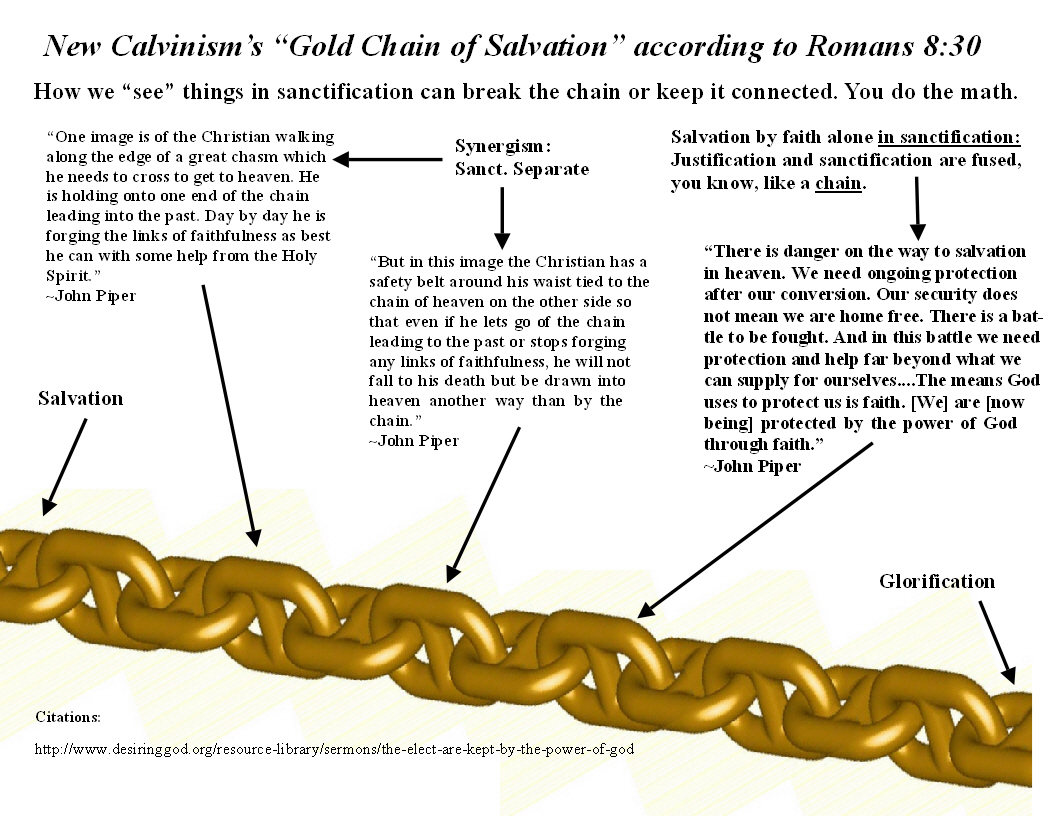
This ministry has made much of the critical importance of separating justification (salvation) and sanctification (growth in holiness, or kingdom living). The Reformed (Calvin/Luther Reformation doctrine/gospel) “never separate, but distinct” doublespeak doesn’t cut it in the arena of truth, and we will see why. “Never separate” =’s false gospel. If you get a little lost in the first part of my argument which gives the lay of the land, don’t worry, when I get into the specific Scriptural argument, it will clear things up and make it all come together for you. It must delight the ghosts of the Reformation that the argument has always been in the arena of freewill verses predestination. It’s the primary thrust of this ministry to change that argument. This isn’t a quibbling about semantics in the mainstream—this is about the truth of the gospel. As New Calvinist Russ Kennedy once thundered from the pulpit in his mousy voice: “Any separation of justification and sanctification is an abomination!” I have often argued from the standpoint of this issue. If sanctification is the middle of the Reformed “golden chain of salvation” then sanctification is part of finishing justification. This means that what happens in sanctification determines whether or not justification is properly finished. What’s a chain? John Piper even preached a message about the eternal importance of our contribution to the “links” in just the right way. In essence, sanctification becomes a spiritual minefield. This is exactly the same thing that the Reformed crowd has always accused Rome of: the fusing together of justification and sanctification. However, as we shall see, they are both guilty of the exact same heresy/false gospel. As we shall see, both teach that sanctification finishes justification. This is a linear gospel (one unified chain from salvation to resurrection (glorification) versus a parallel gospel with salvation on one plane as a finished work before the foundation of the world, and kingdom living that runs parallel with the finished work and reflects the reality of our salvation until glorification. Typical in the linear gospel is the idea that Christ died for all of our past sins, but we must now finish the work (with the Holy Spirit’s help [sanctified works salvation]) until glorification when we are completely transformed into complete holiness. This is the often-heard bemoaning of “Christ PLUS something.” 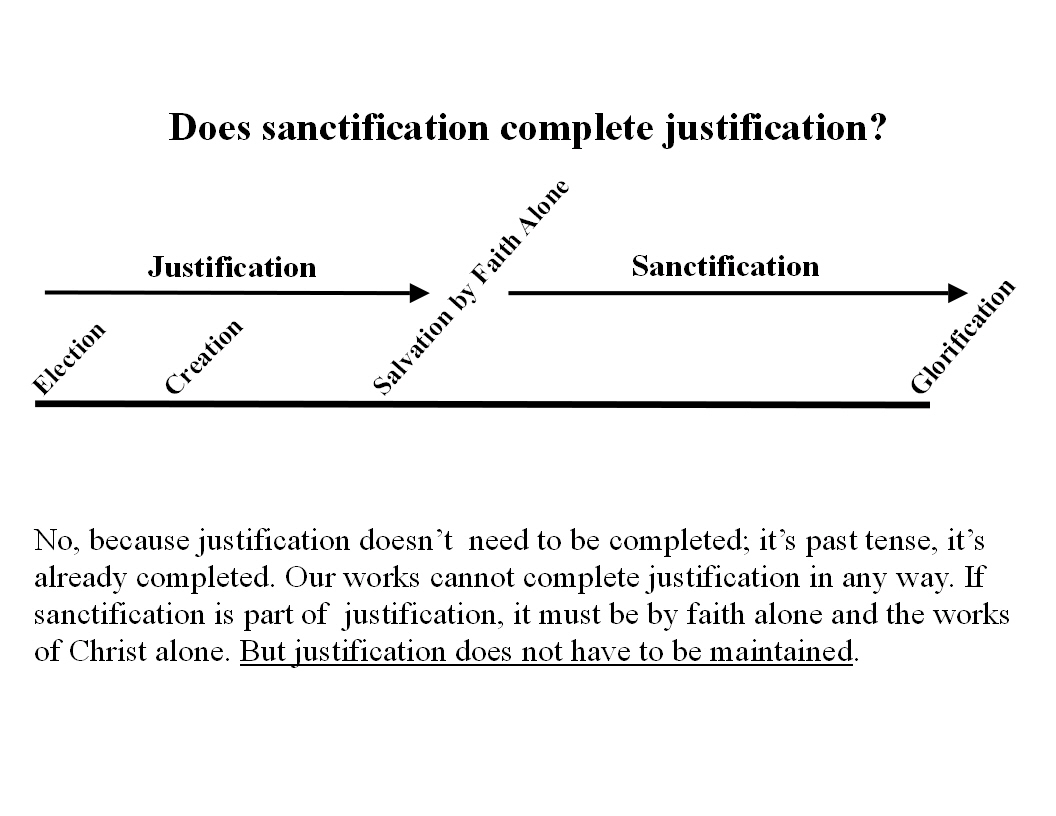 An excellent example is some strains of Freewill Baptists who teach that Christ died for all of our past sins, but with the help of the Holy Spirit, we must confess and repent of every sin we commit until the resurrection, e.g., Christ plus salvation by repentant prayer for sins committed after we are “saved.” My grandparents were saved out of this tradition. When my grandfather asked my grandmother if she thought that God could ever forgive him of all the sins he committed, she answered: “Yes, but you are going to have to pray awful hard!” Praise God that through the ministry of several individuals my grandparents eventually abandoned that gospel for the true one of salvation by faith alone as a finished work. Likewise, Rome teaches that you must let the Catholic Church finish your justification through ritual, e.g., Christ plus Catholic ritual. The Reformation gospel is also Christ plus something else, but the something else is ever-so-subtle. In both cases, sin must be dealt with in sanctification in order for the saint to remain justified until the final judgment. In other words, the righteous standard of justification must be maintained on our behalf. Like all other proponents of a linear gospel, the Reformed crowd contends that anything less than the perfection demanded of the law (“all sin is transgression of the law”) is “legal fiction.” So both Rome and the Reformers agree: justification must be maintained by sanctification, and in the case of the Reformers specifically, they believe that the perfect standard of the law must be maintained until glorification; otherwise, our justification is “legal fiction.” Here is where Reformed subtlety is uncanny: Christ keeps the law for us in sanctification. He maintains the perfect standard. All the fruit of sanctification (obedience/good works) flows from the life He lived on Earth and His death on the cross. Christ plus the works of Christ to finish salvation. “But Paul, what in the world is wrong with that?!” Here is what is wrong with it: works are still required to maintain justification. That is a huge problem, even if it is Christ doing the work. What did the Hebrew writer say about Christ’s work for justification not being complete? And even more subtle is the following Reformed idea: believing that the law is no longer a standard for maintaining justification is antinomianism. Antinomianism =’s legal fiction. Their definition of antinomianism is the removal of the law from justification as the standard for maintaining it. Traditionally, among Biblicists, antinomianism is the removal of the law from sanctification, and herein lays even further steroidal subtlety: the Reformed theologians would refute a removal of the law from sanctification as well, not only because they think justification and sanctification are the same thing, but because its perfect keeping is required to maintain a true declaration of the just that is not “legal fiction.”
  However, the Biblicist believes that the law is a standard for kingdom living and is no longer a standard for justification. Therefore, if we attempt to obey it with the Holy Spirit’s help, and to please/serve the Lord, it can have no bearing on our just state. While the Biblicists think they are therefore joint contenders with the Reformers against antinomianism, such is far from the truth. The Reformed mind believes the Biblicist is either a legalist or an antinomian, or both. The Biblicist is supposedly an antinomian because he/she has removed the law from justification as a just standard, or is a legalist because they think they should strive to keep the law in sanctification. Since sanctification finishes justification’s perfect standard of law keeping, our “own” attempts to keep the law in sanctification is an attempt to finish justification. Hence, what the Biblicist fails to understand is the Reformers belief that Christ must maintain the law for us in sanctification because justification and sanctification are not separate. Anything more or less is supposedly works salvation. On the other hand, because it is vital that Christ obeys the law for us in sanctification, the likes of John Piper and Tullian Tchividjian contend that those who are really preaching the Reformed gospel will indeed be accused of antinomianism. All in all, their position is easy to see if you pay attention. John Piper and many other Calvinists often state that, “Good works are the fruit of justification.” And, “Justification is the root, and sanctification is the fruit.” Well, the average Biblicist then thinks, “Yes, but of course, our salvation makes good works in sanctification possible.” But that’s not what they are saying. If you pay closer attention, they are saying that justification is a tree that produces its own fruit. Justification is the root, and whatever happens in true sanctification is the fruit of the root of the justification tree. Problem is, justification doesn’t grow. Justification is a finished work. What Calvinists refer to as “progressive sanctification” is really the fruit of the root: progressive justification. Another name for this that they throw around is “definitive sanctification.” The word “definitive” refers back to the definite completion of justification.
  Revision: this ministry now rejects the idea that orthodoxy is truth; orthodoxy is the traditions of men. Never in Scripture do we find premise for a body of teaching that explains the teaching. The above illustration is valuable for demonstrating that the fruit of justification is glorification, NOT sanctification. This brings us to the Scriptural argument which begins with a question I asked myself just this morning: “Paul, you are always harping about the crucial importance of the separation of justification and sanctification—a parallel gospel versus a linear one. But where does the Bible say specifically that this is critical?” First, the very definition of a lost person in the Bible is one who is “under the law”:
Romans 3:19 Now we know that whatever the law says it speaks to those who are under the law, so that every mouth may be stopped, and the whole world may be held accountable to God. Romans 6:14 For sin will have no dominion over you, since you are not under law but under grace. Romans 6:15 What then? Are we to sin because we are not under law but under grace? By no means! 1 Corinthians 9:20 To the Jews I became as a Jew, in order to win Jews. To those under the law I became as one under the law (though not being myself under the law) that I might win those under the law. Romans 7:1 Or do you not know, brothers —for I am speaking to those who know the law—that the law is binding on a person only as long as he lives? Romans 7:2 For a married woman is bound by law to her husband while he lives, but if her husband dies she is released from the law of marriage. Romans 7:3 Accordingly, she will be called an adulteress if she lives with another man while her husband is alive. But if her husband dies, she is free from that law, and if she marries another man she is not an adulteress.
The unsaved are “under the law” and will be judged by it in the end. This is the very definition of the unsaved. Calvinists define Christians the same way—we are supposedly still under the law and will be judged by it in the end. That’s why Christ must keep the law for us—because we are still under it. If not this position, why do many in the Reformed tradition hold to the idea that Christ’s perfect obedience is imputed to our sanctification? His death justifies us, and His perfect life sanctifies us. Hence, His death pays the penalty for past sins, and then His perfect life imputed to our sanctification keeps us justified. Why would an imputation to our sanctification be necessary if we are no longer under the law? This is known as the Reformed view of “double imputation” and has been called out as heresy by many respected theologians for this very reason: it implies that Christians are still under the law. In regard to sustaining the law in our stead, why? It has been totally abolished in regard to our just standing:
Romans 3:20 For by works of the law no human being will be justified in his sight, since through the law comes knowledge of sin. Romans 3:21 But now the righteousness of God has been manifested apart from the law, although the Law and the Prophets bear witness to it— Romans 4:15 For the law brings wrath, but where there is no law there is no transgression.
The keeping of the law by anybody DOES NOT do anything to justify mankind:
Romans 3:28 For we hold that one is justified by faith apart from works of the law.
Here is where the separation of justification and sanctification is vital on this first point: we ARE NOT under the law for justification, but rather UPHOLD THE LAW in sanctification. The two must be separate because of the differing relationships to the law:
Romans 3:31 Do we then overthrow the law by this faith? By no means! On the contrary, we uphold the law. Romans 6:15 What then? Are we to sin because we are not under law but under grace? By no means!
Furthermore, if we are still under the law (whether or not Christ obeys it for us to keep us in a just standing), this means we are still under the power of sin. Being under the law and also under its spell to provoke sin in the unregenerate is spoken of as being synonymous in the Bible. Those who are “under the law” are also under the power of sin and enslaved to it:
Romans 7:4 Likewise, my brothers, you also have died to the law through the body of Christ, so that you may belong to another, to him who has been raised from the dead, in order that we may bear fruit for God. Romans 7:5 For while we were living in the flesh, our sinful passions, aroused by the law, were at work in our members to bear fruit for death. Romans 7:6 But now we are released from the law, having died to that which held us captive, so that we serve in the new way of the Spirit and not in the old way of the written code. Romans 7:8 But sin, seizing an opportunity through the commandment, produced in me all kinds of covetousness. For apart from the law, sin lies dead.
If we are still under the law, and will be judged by it, whether or not Christ stands in the judgment for us with His own works, we are still enslaved to sin by virtue of being under the law…. for justification. And Calvinists know this to be true, that’s why they say we are still…. what? Right, even as Christians, “totally depraved.” And, “enemies of God.” Of course, throughout the Bible, Christians are spoken of as being friends of God and no longer His enemies. Our status as enemies of God is stated in the past tense. But the Reformed crew continually state that Christians are vile enemies of God and are enslaved to sin. They realize that this goes hand in hand with being under the law. To the contrary, dying to the law in the death of Christ….for justification—sets us free to be enslaved to the righteousness that is defined by the law. We are dead to the law for justification and alive to obey truth….for sanctification:
Romans 8:2 For the law of the Spirit of life has set you free in Christ Jesus from the law of sin and death. Romans 8:3,4 [emphasis by author] For God has done what the law, weakened by the flesh, could not do. By sending his own Son in the likeness of sinful flesh and for sin, he condemned sin in the flesh,….in order that the righteous requirement of the law might be fulfilled in us, who walk not according to the flesh but according to the Spirit. Romans 8:7 For the mind that is set on the flesh is hostile to God, for it does not submit to God’s law; indeed, it cannot. Romans 9:31 but that Israel who pursued a law that would lead to righteousness did not succeed in reaching that law. John 17:17 Sanctify them in the truth; your word is truth. James 1:25 But the one who looks into the perfect law, the law of liberty, and perseveres, being no hearer who forgets but a doer who acts, he will be blessed in his doing.
So, that is the separation that must be for the true Christian: Justification has no law for which we are judged, and we live by the law of blessings in sanctification. This brings us to another important separation in the two: the judgments. Those under the law and sin will stand in a final judgment which will be according to the law. Again, because Calvinists believe that we are still under the law, albeit that Christ obeyed/obeys it for us, Christians will supposedly stand in the same judgment as the damned who are under the law and enslaved to it. At that time, the children of God, according to Calvinists, will be “made manifest.” But because Christians are not under the law and cannot be judged by it, they will stand in a judgment for rewards and not a judgment that determines a perfect keeping of the law by Christ in our stead. Hence, there will be two different resurrections: one for those under the law and another for those under grace, and two different judgments for the same two groups. One for rewards, and one to determine if those under the law kept it perfectly. The latter judgment doesn’t go well for any standing in it.
Luke 14:12-14 He said also to the man who had invited him, “When you give a dinner or a banquet, do not invite your friends or your brothers or your relatives or rich neighbors, lest they also invite you in return and you be repaid. 13 But when you give a feast, invite the poor, the crippled, the lame, the blind, 14 and you will be blessed, because they cannot repay you. For you will be repaid at the resurrection of the just.” [Notice that this is a resurrection for the “just.” They are already determined to be just before they are resurrected]. 2Corinthians 5:9,10 So whether we are at home or away, we make it our aim to please him. 10 For we must all appear before the judgment seat of Christ, so that each one may receive what is due for what he has done in the body, whether good or evil. 1Corintians 3:11-15 For no one can lay a foundation other than that which is laid, which is Jesus Christ. 12 Now if anyone builds on the foundation with gold, silver, precious stones, wood, hay, straw— 13 each one’s work will become manifest, for the Day will disclose it, because it will be revealed by fire, and the fire will test what sort of work each one has done. 14 If the work that anyone has built on the foundation survives, he will receive a reward. 15 If anyone’s work is burned up, he will suffer loss, though he himself will be saved, but only as through fire. Hebrews 6:10 For God is not unjust so as to overlook your work and the love that you have shown for his name in serving the saints, as you still do. Revelation 20:6 Blessed and holy is the one who shares in the first resurrection! Over such the second death has no power, but they will be priests of God and of Christ, and they will reign with him for a thousand years. Revelation 20:11-15 Then I saw a great white throne and him who was seated on it. From his presence earth and sky fled away, and no place was found for them. 12 And I saw the dead, great and small, standing before the throne, and books were opened. Then another book was opened, which is the book of life. And the dead were judged by what was written in the books, according to what they had done. 13 And the sea gave up the dead who were in it, Death and Hades gave up the dead who were in them, and they were judged, each one of them, according to what they had done. 14 Then Death and Hades were thrown into the lake of fire. This is the second death, the lake of fire. 15 And if anyone’s name was not found written in the book of life, he was thrown into the lake of fire.
Don’t let anyone tell you that eschatology is a “secondary” or “nonessential” consideration. Your eschatology is your gospel. It will state your position regarding whether or not you fuse justification and sanctification together; ie, likening Christians to those under the law.
Yet another vital difference in sanctification and justification is repentance. Repentance for salvation (when you are justified) is different from our repentance in sanctification. Among many in the Reformed tradition where the “same gospel that saved you also sanctifies you,” the repentance is the same. Repentance unto salvation is not a onetime “washing,” but rather a means to continue “in the gospel” through what they call “deep repentance.” Biblicism holds to repentance in sanctification that restores his/her fellowship and communion with God as His children. They would see repentance unto salvation as differing, and only necessary for salvation—a onetime decision to take one’s life in a new direction by following Christ, and believing in his death, burial, and resurrection. Reformed repentance, according to the likes of Paul David Tripp and others is a “daily rescue.” Our original repentance was for rescue, and we need rescue today as much as we needed rescue when we were saved. Again, this indicates their belief that we are still under the curse of the law and need to be continually rescued from it while remaining under the bondage of sin. However, Christ made it clear to Peter (John 13:6-11) that those who have been washed (1Corinthians 6:11, Romans 8:30) do not need another washing. Those who drink of the living water do not thirst again (John 4:13,14). Lastly, though many other separations could be discussed, why saints can be considered just while they still sin at times is of paramount importance. There is no sin in our justification because there is no law, and where there is no law, there is no sin. Though unfortunate, there can be sin in our sanctification because it is totally separate from justification and can’t affect our just standing with God. Basically, all of the aforementioned makes it of necessity to deny the new birth. If we have God’s seed in us, and we do (1John 3:9), that dispels total depravity, and without total depravity, justification and sanctification cannot be fused together. The new birth is a huge problem for Reformed theology. If the old man that was under the law is dead (Romans 7:1ff), and the seed of God is in the saved person, and the sin due to our weakness in the flesh cannot be laid to our account for justification, then our justification is not “legal fiction” because we do not exhibit perfect obedience to the law. This is another grave consideration because Christ said, “You must be born again.” Obviously, despite their denials that they deny the new birth—you can’t be both totally depraved and born again. Reformation doctrine is clearly a false gospel. Its version of justification does not void the law, and denies the new birth while distorting everything in-between. Freewill verses predestination is hardly the issue, the very gospel itself is the issue.
paul
Curing the Protestant Disease of Noanswerosis
As one crawling out of the present Protestant Dark Age, a focus on sanctification rather than keeping myself saved by not working has revealed a disease that infects all Protestants: Noanswerosis (pronounced no-anser-osis).
This is a word that joins, no—answer—osis. When a Protestant is “saved,” their brain is immediately infected with this disease. In fact, contemporary terms that refer to the Protestant gospel state such explicitly.
The subjective power of an objective gospel.
Or…
The objective gospel.
Or…
The centrality of the objective gospel outside of us.
Or…
Definitive justification experienced subjectively.
What are these terms saying? Well, these are contemporary terms that define the foundational document of the Protestant Reformation: Martin Luther’s Heidelberg Disputation to the Augustinian Order (1518). Luther’s 95 Theses was a moral disputation, his Heidelberg Disputation defined the worldview of the Reformation and was penned about 6 months after the 95 Theses. John Calvin’s Institutes of the Christian Religion further defines Luther’s foundational premise.
What’s the gist of it all? First, God is completely sovereign over everything. Reality is a movie produced and scripted by God. History is a meta-narrative, or metaphysical narrative prewritten by God. Also, this movie (reality) is a 3D movie and requires special glasses in order to see it.
In other words, without the 3D glasses the movie (reality) will be blurred and distorted. And, the 3D glasses are…the gospel. All of reality, according to authentic Reformed ideology, is a gospel story. Seeing yourself in the role of how it all plays out as a mere character in a prewritten play is a matter of faith. If you see yourself as in control of anything, you are making yourself God and attempting to write your own reality.
Therefore, the gospel is the only reality that is…objective. EVERYTHING in life that happens is part of the gospel narrative, or… “his-story” (history).
So, how in the world does this supposedly work in real life? Before we get to that, let’s discuss the immense benefits from seeing reality in this way. Basically, there is no use in getting stressed out about anything because it is just all a prewritten narrative by God that you have no control over. In some sense, more accurately, in a big way, you can step back and separate yourself from what is going on in the world. Don’t worry—be happy. There is no need to get upset about an event, it’s all part of God’s gospel narrative that helps us in seeing reality more clearly.
Stop right there. That’s key. The goal is more seeing. There is a reason for this madness; what else but the primary goal of all philosophies? Happiness or joy or wellbeing or peace or however else you want to frame it. “Faith” is defined as SEEING ONLY. In Luther’s construct, ALL doing is part of the material world and inherently evil. If you can see it, hear it, smell it, taste it, feel it, or DO it—it’s evil, period.
Seeing life more and more as a prewritten narrative that glorifies the gospel that you have no role in leads to more and more wellbeing. Hey, no matter what happens, to God be the glory. Every life event says something about the gospel. Actually, there is a specific interpretive paradigm, or if you will, the 3D glasses: “The holiness of God as set against the sinfulness of man.” Every life event lends more understanding to the depths of our own depravity versus the holiness of God. When something good happens to us “worms crawling upon the earth” (Calvin), that’s grace, that’s astounding mercy. When something bad happens, we are merely getting what we deserve.
That’s life, but what about the Bible? The Bible is an aid in seeing our depravity more and more and God’s holiness more and more. The Bible is the script of the gospel narrative. According to the Reformed academics that really understand Reformed ideology, the Bible is a gospel narrative that displays the fundamental narratives that play out in life. When you read the Bible, it is therefore your story also as seen in narrative archetypes.
So, a life of faith is really about seeing only, all of the doing has been predetermined by God. This is how we live our lives by faith alone; life is seeing and not doing. The doing is ONLY EXPERIENCED.
Now we are getting into how this philosophy actually functions in real life, supposedly that is. Pretty much, go ahead and live out your life… and here it comes… “subjectively.” This is an affirmation that everything you do is evil, even your good works, and you really have no way of knowing whether it is you doing the work or God. Take note: in understanding this philosophy, it is important to distinguish between personal works and what happens in reality. Everything that happens is predetermined by God as part of His prewritten historical narrative. But, how we see or perceive life events determines whether we are living by faith or not. There must be a distinction between actual events and perception.
Bible study, or teaching in general is focused on perception, and then we go about living our lives subjectively. Yes, we make an effort to live life, but in our effort to live life we confess that it is a subjective experience. What does that mean? Luther split subjective life into two categories: venial sin and mortal sin. If we believe that we can do a good work, that’s mortal sin. If we confess that even our good works are evil, that’s venial sin. Life is subjective because when we see our works in the world, we have no way of knowing whether it is God doing the work through us or ourselves doing a work…and you hear this often… “in our own efforts.” All of the incessant moaning you hear in church over “works done in our own efforts” is right out of the Heidelberg Disputation.
The Reformed have three schools of thought in regard to how the subjective life works. Theory one states that the subjective life of faith is a combination of manifestation and our actual works. Manifestation is realm manifestation. This is when the invisible realm births an event in the material realm. It is like the rain. You feel the rain, you experience the rain, but you have no control over the rain. The rain comes from heaven—you didn’t make it rain, you only experience the rain. This school holds to the idea that it is impossible to distinguish between our actual efforts and realm birthing, or realm manifestation. As long as the person believes that everything that he/she does is evil, and anything good that happened came from God—that’s venial sin and will be forgiven IF we confess that our good works are evil. It is a subjective life because we have no way of knowing what our works are and what the Spirit’s works are. We only confess that if anything we experience is actually a good work, we didn’t do it.
The second school is John Calvin’s Sabbath Rest Sanctification paradigm. If all of our works are sanctified by contemplation on the gospel, ie., our sinfulness as set against God’s holiness, we will be less tempted by our “good” works. In other words, we will be less tempted towards mortal sin—the belief that we actually did a good work. This is closely related to the imperative command is grounded in the indicative event. The more we contemplate the gospel, the more we are able to see that anything in our life that appears to be a good work is a work that flows from the gospel event. This is also connected to the Reformed doctrine of double imputation. Christ came to fulfil the law so that His obedience to the law during the time He lived on earth can be imputed to our lives by faith alone. So, if we experience any good work in our life and believe it is a manifestation of Christ’s obedience imputed to us—we are under venial sin and not mortal sin.
Venial sin is forgivable, but we must be faithful to the institutional church and return to the same gospel that saved us in order to receive a reapplication of Christ’s penal substitution and righteous obedience. They use 1John 1:9 and other Scriptures as a proof text for this doctrine. A perpetual return to the same gospel that saved us keeps us in the “vital union” with Christ which is yet another Reformed soteriological doctrine.
The third school emphasizes the Reformed doctrine of mortification and vivification. This doctrine encompasses the other two schools as well. Its contemporary expression is John Piper’s Christian Hedonism. This is also the official Reformed definition of the new birth. The new birth is mortification and vivification. Mortification entails a focus on our sinfulness and wormism. This is the death part of our baptism. This results in resurrection, or vivification. This is the resurrection part of our baptism. As we see the gospel narrative more deeply, we experience the joy of vivification in a deeper and deeper way. Seeing the depths of our sinfulness as set against God’s holiness (mortification) leads to a deeper and deeper experience of joy in our Christian lives (vivification). Hence, the new birth is not a onetime event in the Christians life, the Christian must continually return to the new birth process that leads to the ultimate goal of a joyful Christian life. Question. In the final analysis, is this not a rejoicing in evil that Paul stated as an antithesis of love?
Therefore, believing that the new birth is a onetime event assumes Christians move on to something else other than the gospel which also assumes Christians can do good works. That’s mortal sin. Also, a literal interpretation of the Bible assumes that biblical commands can be obeyed by the believer, that is also mortal sin according to Reformed ideology. This means that a grammatical historical view of the Bible is conducive to mortal sin while the historical redemptive view of Scripture keeps the “believer” under the auspices of forgivable venial sin.
This all translates into a dramatic devaluing of wisdom for living life in an effective way. This is what has been going on for hundreds of years. Obviously, answers are not the point or anywhere in the ballpark of life. Answers are not merely in the back seat—they aren’t even in the car. The only answer for an unfixable life is to be “joyful no matter what your circumstances are.”
This is where Noanswerosis comes from. What are the symptoms? When you counsel someone and give them solid answers from the Scriptures, they just sit there and look at you dumfounded. They will actually depart without acknowledging that the conversation actually happened. As Protestants, we are so accustomed to not having answers that the answers are now paralyzing us. It’s Noanswerosis.
Noanswerosis is caused by believing that having answers is mortal sin and applying the answers will condemn you to hell. Now you better understand where the Bible is coming from. Faith is not just seeing—it’s doing (see James). Happiness does not come from mere seeing—the blessing is IN the doing (James 1:25). Seeing only is a life built upon sand, a life of having answers and applying them is a life built upon a rock.
We have the answers, let’s keep learning and putting what we learn into practice while it is still daylight for the darkness is coming when no man can work.
paul

 Paul's Passing Thoughts
leave a comment