The Imputation of Christ’s Righteousness Denies God as Father
 Originally published March 10, 2015
One of the most popular truisms in our day is the often-heard “righteousness of Christ” mantra. “We have the righteousness of Christ,” “The imputation of Christ’s righteousness,” etc. The mantra is indicative of the rampant last-day’s false gospel propagated by the institutional church.
The Bible never states that the righteousness of Christ is imputed to us or covers us, but rather states that we have the righteousness of God. Why is this seemingly technical difference all-important? Because the notion distorts the identity of the Trinity. God is no longer a father, and Christ is no longer our brother.
Have you ever wondered why God is called the Father? Because a father is able to give life—the same kind of life that makes up his own essence; in this case, righteousness. Because we are fathered by God through the Holy Spirit via the new birth, we are not merely declared righteous, we are MADE righteous. Therefore, the Reformation’s forensic justification gospel denies the Trinity and the new birth.
The idea that we can’t really be righteous and are only declared righteous further denies that God is a true father. How? It denies that we are truly born of God because we fall short of keeping the law perfectly. In his letter to the Galatians, Paul argues that this replaces the seed of God with the law and actually makes the law a life-giving seed. Paul states that only one seed was promised to Abraham and his offspring (Christ), not two, and “God is one.”
The primary point of Galatians 3:10-20 is that God the Father is the only one who gives life, He is the one seed. “The promise” spoken of is the promise of the new birth through the one seed. If you note the passage carefully, “the promise” was made to Abraham and Christ. No law can give life, nor can an “intermediary” (verse 20) which probably speaks to Moses or the angels or both.
Christ’s role was/is that of Brother.
“Both the one who makes people holy and those who are made holy are of the same family. So Jesus is not ashamed to call them brothers and sisters” (NIV).
“For he who sanctifies and those who are sanctified all have one source. That is why he is not ashamed to call them brothers” (ESV).
The “one source” is God the Father, and because of Him, Christ is not ashamed to call us brothers and sisters. Christ died for us, and God’s promise to Abraham and Christ was that many would be raised to glory with Christ. The impartation of righteousness was not Christ’s role in salvation—His role was to pay the penalty for our sins.
Notice in the aforementioned citations from Hebrews 2:11 that we are “made” holy and “are” holy. If that is negated by an inability to keep the law perfectly, that makes the law a co-life-giver with God the Father. But there is only one God and only one seed.
What makes a believer holy is the regeneration of the heart through the new birth. The saved person is literally born of God’s seed (1John 3:9). Because of our mortal state, this results in a change of direction, not perfection. The Bible describes it as a reversal of slavery and freedom (Romans 6:20). But at any rate, Christ came to end the law for judging our holiness (Romans 10:4). If it wasn’t for the weakness of our mortal bodies, we would not sin and therefore we long for resurrection (Romans 7:23-25).
The idea that Christ kept the law perfectly so His righteousness can be imputed to us makes the law a co-life-giver with God, makes Christ both father and brother, denies that the Holy Spirit raised Christ from the dead per “the promise,” and makes the law part of the Trinity.
It’s a really, really bad idea and an egregious false gospel. God is one, not many. There is only one life-giver, and that’s why we call Him “Father.”
paul
Can Christians Really Be “Self-Righteous”?
 There are many, many Protestant misnomers that are assumed to be truth. In the past I have written about so-called “legalism” and “church discipline.” Neither concepts are found anywhere in the Bible. In this short post, we will mention another one: “self-righteousness,” specifically, the idea that a Christian can be “self-righteous.” If you get my point here, you may reconsider your incredulity regarding the aforementioned misnomers.
Actually, there is a reason that we hear the constant literary and verbal drumbeat regarding the dangers of so-called Christian self-righteousness; the root cause is found in Martin Luther’s alien righteousness soteriology. Many have added the self-righteousness mantra to their vocabulary without thinking the idea through to its logical and historical conclusions.
First of all, the problem is presenting Christian self-righteousness as something to be avoided lest we shipwreck our faith. In other words, answering the biblical call to become who we are will supposedly shipwreck our faith. God made us righteous through the new birth; how would we then make ourselves “self-righteous”? If we have a proper understanding of salvation, why would we attempt to do something that we know is already completed? Because of weak understanding, believers have been led to believe that we are in danger of justifying ourselves. Obviously, this makes good works a spiritual minefield for the Christian. A cursory observation of the institutional church makes this point.
This was Paul’s exact point to the Galatians (3:1-3); why are you trying to complete a work that was finished when you received the Spirit? We are made righteous via the new birth, not the satisfaction of…”the righteous demands of the law.” Understand; when Paul speaks of righteousness by the law in Galatians, he is speaking of manmade traditions that fulfill the law for justification. In other words, the law is the standard for justification—not the receiving of the Spirit.
This is a HUGE problem because if the law is the standard for justification, the believer cannot be free to love, ie., the law cannot be the Christian standard for love AND the standard for justification at the same time. Using the law lawfully for love can show that we are justified/righteous, but the law cannot justify in any way, shape, or form.
Hypothetically, if the law could justify, we would have to keep it perfectly:
Galatians 5:2 – Look: I, Paul, say to you that if you accept circumcision, Christ will be of no advantage to you. 3 I testify again to every man who accepts circumcision that he is obligated to keep the whole law.
What’s going on here? The Galatians were buying into the most common false soteriology of the ages; the idea that the law is the standard for righteousness instead of the new birth. This does not set the Christian free to use the law lawfully, or in other words, as a standard for love:
Galatians 4:21 – Tell me, you who desire to be under the law, do you not listen to the law? 5:1 – For freedom Christ has set us free; stand firm therefore, and do not submit again to a yoke of slavery. 5:6 – For in Christ Jesus neither circumcision nor uncircumcision counts for anything, but only faith working through love. 7 You were running well. Who hindered you from obeying the truth?
So, for those who see the law as the standard for justification, and knowing that we cannot keep the law perfectly, some ritual or tradition is put into place, and if that is practiced, the law is fulfilled. For those falling into this error at Galatia, that meant the observance of days and circumcision. Paul, in essence was saying, “No, no, no—if you are going that route you cannot bypass a perfect keeping of the law; circumcision does NOT fulfill the law.”
No, LOVE is what fulfills the law.
The Galatian problem was a carryover from former error before Christ came to die on the cross to end the law, but later in history Christ was integrated in this way:
Christ fulfills the law for us.
If we do certain things, Christ fulfills the “righteous demands of the law” and a fulfillment of the law is imputed to us. But here is the huge problem with that: law is still the standard for justification, NOT faith working through love. Hence, love is circumvented resulting in dead orthodoxy at best and sinful calamity at worst.
This was the crux of Martin Luther’s alien righteousness. ALL righteousness is outside of the believer, and this is testified to by the fact that Christians cannot obey the law perfectly. If we play by the rules, Christ’s perfect law-keeping will be imputed to us and we can remain saved. Again, the problem is law as justification’s standard.
This keeps the “Christian” under law and COVERED by under grace. In this ancient construct, you have under law and under grace going on at the same time. The “Christian” remains under law, but is “covered” by the righteousness of Christ via under grace.
In contrast, the old us that was under law died with Christ, and we were resurrected with Christ and set free to love according to the law without any fear of condemnation via being under the law. Christ came to end the law of condemnation for those who love him. He loved us first by ending the law on the cross and thereby setting us free to love Him and others according to the law.
The law is NOT the standard for justification—the new birth is, and thus freeing us to love God and others without fear of condemnation.
BUT, this whole idea that Christians can be “self-righteous” confounds under law and under grace. Any righteousness that we have must be, supposedly, our own righteousness that didn’t come from the new birth. This is the true implication of the saying. ALL righteousness remains outside of the believer because he/she cannot keep the law perfectly.
Therefore, the “Christian” is not free to love without fear of condemnation. And again, the church looks like that is indeed the case.
paul
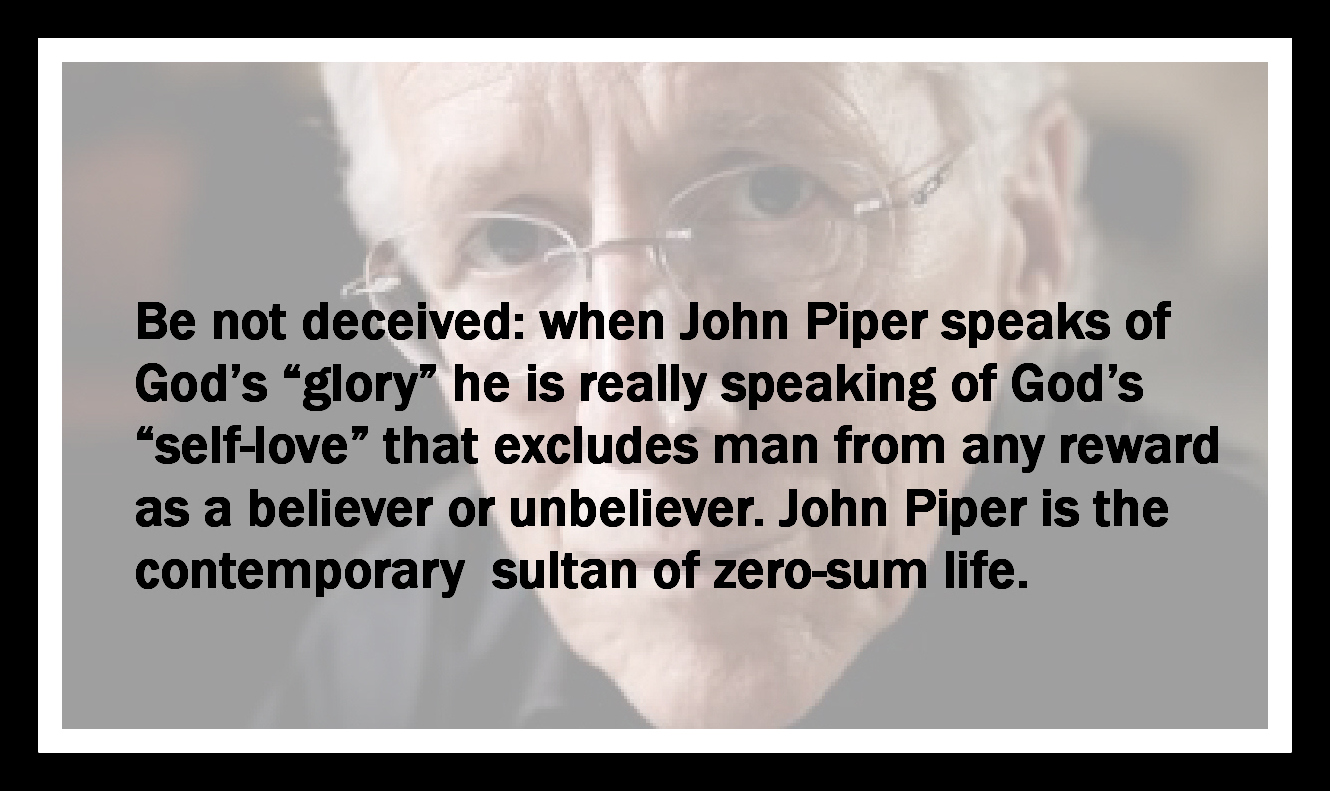
The Scream of the Damned and “How Much?” Christ’s Descent into Paradise
 Yesterday, I wrote a post regarding the Reformed doctrine of double imputation. This Reformed doctrine was developed to deny the idea that God infuses righteousness into believers through the new birth. Supposedly, Christ lived a perfect life so that His righteous can be imputed to believers for purposes of living by faith alone in sanctification. As discussed, this begs the question: “How much?” Is that why Christ lived 30 years? Is that what it took to secure enough righteousness to get the elect into heaven? And of course, PPT continually points out why this is sooooo wrong on many levels.
The other side of double imputation suggests that Christ died for each and every sin of the elect only. So therefore, in the same way another question is begged: how much suffering was necessary?
Now enter Christ’s decent into “hell” while He was on the cross as noted by, 1 Pet. 3:18-20, 1Peter 4:6, Ephesians 4:8-10, Acts 2:31, and Galatians 3:21-27. Here at PPT we think it is pretty obvious what these verses refer to. Old Testament saints were covered, or protected by the law until Christ died on the cross. The law was a “guardian” until “faith came.” This is the imputation that is not talked about nearly enough: the imputation of sin to the law because “all sin is against the law.” Sin is “held captive” by the law until one believes in Christ who ended the law. In this way, OT believers were “captives” as the law was a guardian that protected them until “faith came” (Christ).
By the way, that atonement is ended for believers, but not unbelievers. Presently, every sin an unbeliever commits is imputed to the law because all sin is against the law and where there is no law there is no sin. People will either be judged by the law at the final judgement, or they will believe on Christ and have the law ended along with every violation they committed against it. This law also includes the law of conscience written on the heart of every person born into the world. Apparently, those who have no knowledge of the Bible will only be judged according to conscience while the religious who have biblical knowledge will be judged by both.
So, when OT believers died, they went to “the abode of the dead.” According to Christ’s “parable” in Luke 16, it was divided into “Abraham’s bosom” and a place of torment. Yes, I believe Christ’s illustration in that chapter is to be taken literally, and was Christ’s description of an actual event. Christ never earmarked the illustration as a parable per His custom when he utilized parables. Hence, when Christ went to “paradise” to preach to the captives He took the thief on the cross with Him. I would say the thief got one whale of an education on that day. Christ preached victory to His enemies and led the captives free, and took them to heaven. Then, upon arriving in heaven, He poured gifts out on His assembly.
But…when your doctrine is predicated on the false presuppositions of Reformed double imputation, Christ’s descention must now be used in a lame attempt to answer the “how much?” question. The result is the notion that God actually sent Christ to hell for the purpose of adequately paying the penalty for the elect. This includes the idea that Christ emitted a horrific scream on the cross as He suffered in hell for the sins of the elect.
Yes, you too can pay $80,000 for a seminary education where you will be required to believe such things in order to get a job. Ya, do that. Go for it Bubba.
How much? Christ’s death ended the law. His resurrection infuses life. One death for life everlasting. Two single acts, one by Christ and one by the Spirit. That is enough—that secured our salvation.
paul

 Paul's Passing Thoughts
leave a comment