Absolutely Critical to Effective Ministry: Knowing the Two Realities of Protestantism
 If we are to accomplish anything in contemporary Christianity, we must begin to live by a basic hard-fast rule: our actions must be guided by the knowledge that there are two realities in contemporary Christianity; grammatical-historical and redemptive-historical.
These are usually discussed as methods of Bible interpretation, but they are really much more than that according to Protestant tradition. These are two different ways of interpreting reality itself.
We will begin by defining the redemptive-historical interpretation of reality along with this caution: one of the most powerful influences that this view of reality has is the dismissal of its basic premise as mere mysticism held by fringe elements of Protestantism. Those who dismiss it out-of-hand then proceed to function by its tenets unawares. The who’s who of Protestantism care little that the masses understand this ideology, just so they function by it.
In fact, Protestant leaders assume most parishioners are unable to grasp its tenets. Therefore, redemptive-historical reality must be explained in a way that will enable congregants to apply it to their lives and function a certain way within church culture. Redemptive-historical reality is primarily the crux of Protestant orthodoxy and its spiritual caste system.
In mythology, we often link the bizarre narratives to the philosophy itself, but that’s a mistake. Roman, Greek, and Babylonian culture was not developed by superstitious idiots. What we fail to understand is the narratives are stories that convey principles to the spiritual underlings so they can apply principles of higher knowledge to their lives. They cannot understand the higher knowledge, but those who can need to tell the underlings how to live in order to obtain the best possible society.
“Orthodoxy” can be likened to mythological narratives that teach those of lesser spiritual understanding how they should live, but they are based on well thought out metaphysical (state of being) systems of knowledge. We shouldn’t be surprised that what seems to be superstition has ruled the greatest empires on earth. This is because the core ideology is always a succinct system of thought that is greatly underestimated. The ancient philosophers were not idiots. Democritus (circa 400 BC) was the originator of atomic theory. The sophist class of philosophers were the first to apply philosophy to sociology in an in-depth way (circa 500 BC). ALL present-day psychologies are founded on the basic theories of that day. For example, the basic ideology that drives the theory of rehabilitation in our modern-day prison systems came from Socrates.
Let’s now define redemptive-historical reality. I will be using a quote from Graeme Goldsworthy who is considered to be the contemporary father of redemptive-historical hermeneutics:
If the story is true, Jesus Christ is the interpretative key to every fact in the universe and, of course, the Bible is one such fact. He is thus the hermeneutic principle that applies first to the Bible as the ground for understanding, and also to the whole of reality (Graeme Goldsworthy: Gospel-centered Hermeneutics; p.48).
This is a pretty straight forward statement and accurately depicts what Protestantism is really founded on; not a theology per se, but a way to interpret reality itself. How in the world does one interpret all of reality through the one person Jesus Christ? You MUST understand: Martin Luther articulated the answer in the foundational treatise of Protestantism, the Heidelberg Disputation.
The Heidelberg Disputation is a concise systematic ideology that explains how all of reality is to be interpreted through redemption, or if you will, the man of redemption, Jesus Christ. Again, the power of this ideology is a dismissal of it out-of-hand by those who proceed to sit under its “theology.” The theology of the metaphysics redefines biblical terms, and uses them to lead the masses into a functioning Christocentric view of reality.
We will not plunge the depths of the Heidelberg Disputation in this writing, but the principles will be outlined and their inevitable functionality among Christians. Before we move forward, let’s examine additional statements that confirm this approach among Christians. This testimony was given in a recent email to me:
An old acquaintance of ours (Presbyterian as they get) has said more times than I can remember something like this: “Every verse in the Bible, from Genesis 1 through Revelation, is talking about Jesus.” Years ago that sounded so intellectual, holy; today it sounds like hogwash. I mean, are we really expected to believe that the passages talking about incestuous rape are talking about Jesus? Come on, really?
Well, as ridiculous as it sounds, the answer is, “yes.” Many function according to the theology that is predicated on this foundational interpretive method for not only the Bible, but reality itself.
Pause: keep in mind that those who function according to this interpretation of reality without understanding its premise will reflect back the resulting interpretation of Scripture. They repeat pulpit talking points without ever investigating the source of them, or the logical conclusions of the talking points. Sometimes, such people are referred to as “useful idiots.” But again we need to be cautious: people who blindly follow others do not do so for the sake of following blindly—they are functioning according to some sort of ideology that leads to the blind following.

Let’s look at some more examples from proponents of New Covenant Theology:
New Covenant Theology insists on the priority of Jesus Christ over all things, including history, revelation, and redemption. New Covenant Theology presumes a Christocentricity to the understanding and meaning of all reality (1st tenet of NCT according to the Earth Stove Society, a NCT think tank).
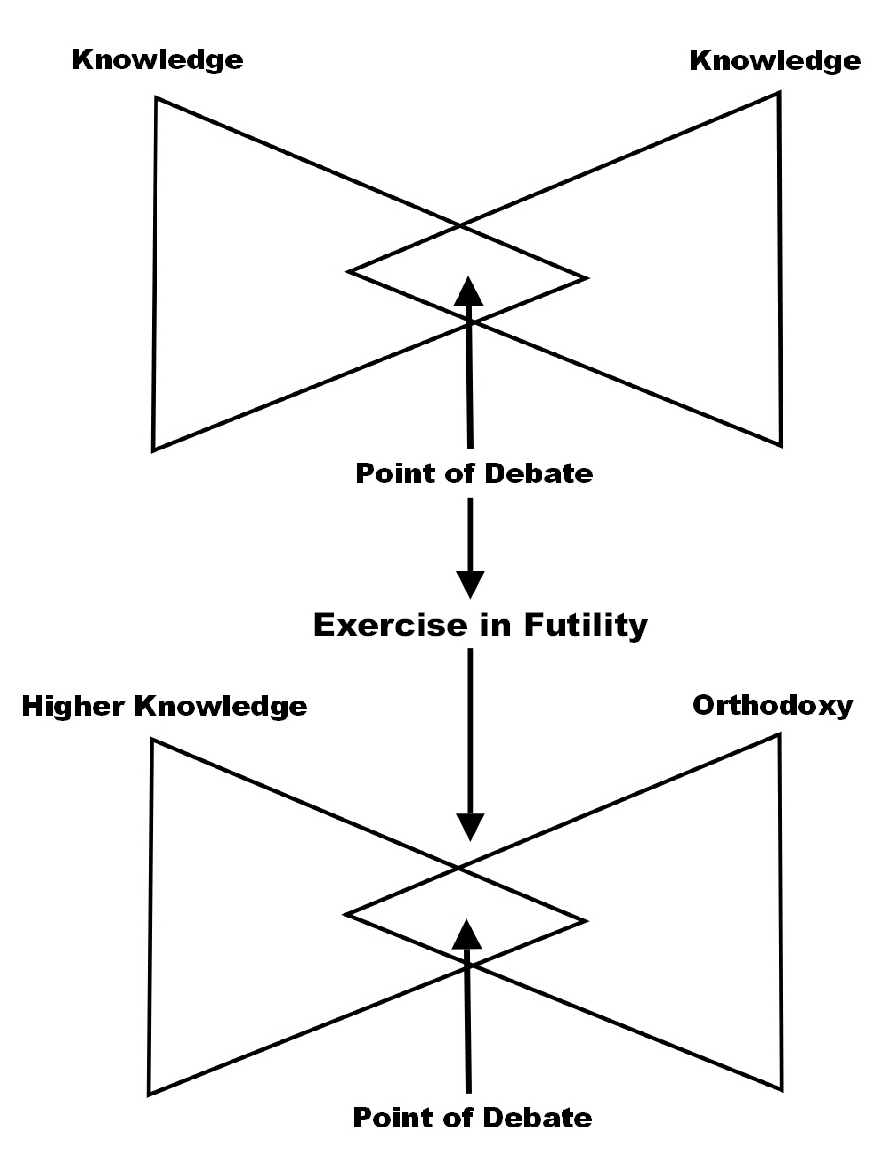
Not much ambiguity in that statement. Pretty clear on its face except for how one would apply it to real life. Again, many might scratch their head in regard to that statement, but proceed to let the theological orthodoxy that flows from it shape their life and thinking. At the point of debate with such people, their orthodoxed talking points will reflect the metaphysical premise. They will absolutely not be swayed in their thinking because they concede that they cannot understand the higher knowledge, and the authority of the higher knowledge is part of the orthodoxy.
Pause: I used to be involved in a ministry that evangelized Jehovah Witnesses. Debating the Bible with them led nowhere because their orthodoxy reinterprets all biblical terms and phraseology. When Christ is referred to, it is assumed that their presuppositions regarding Christ are the same, and they are not. Instead, we challenged their orthodoxy, i.e., the Watchtower publication. Likewise, let me reveal a concluding theme of this study: never debate the Bible with a Protestant; instead, bring their authority into question. Refuse to discuss anything else for it will be futile for reasons yet to be examined.
Let’s look at another statement from the New Covenant Theology camp:
At this time, resist the temptation to utilize subsequent passages to validate the meaning or to move out from the immediate context. Remembering that all exegesis must finally be a Christocentric exegesis.
Look for Christ even if He isn’t there directly. It is better to see Christ in a text even if He isn’t, than to miss Him where He is (The Biblical Theological Study Center: A Christo-Presuppositional Approach to the Entire Scriptures; Max Strange. Online source: http://goo.gl/5sGjP).
The question quickly becomes, “How can you see Jesus in every verse in the Bible?” This is where the Bible becomes a “meta-narrative.” That can mean, “grand narrative,” but in this case it means “metaphysical narrative.” The Bible is a narrative, or story that depicts redemptive reality. You will get confused unless you understand that the theory also posits the inclusion of multi-purpose perspectives into the metaphysical story (a story that depicts true reality). The text grammar doesn’t determine the perspective resulting in a particular objective outcome, but the assumed outcome determines the perspective. So, can “passages talking about incestuous rape” say something about redemption? Of course. In this example, the passage is not talking about Jesus specifically, but denotes why His redemptive works are needed. In some way, according to the prism, the verse always speaks of Jesus and His redemptive works.
This approach to interpreting reality (state of being, or metaphysics), what we call epistemology, plugs into the basic ancient philosophy of total inability. This proffers the idea that man cannot know or comprehend reality. The metaphysic follows: man dwells in a realm apart from true reality that he cannot comprehend. Secondly, somehow, usually via a theory of predeterminism, there are a select few that can ascertain truths from the other realm. Usually, the delineation of the realms is the material versus invisible with mankind residing in the material realm.
The Reformers recognized a reality that man functions in, but deemed it “subjective,” or shadowy. Focusing on this shadowy realm leads to despair. In the aforementioned foundational document of Protestantism, Luther contended that man’s material realm only feeds “the glory story,” or the story of man.
In Luther’s construct, ALL reality is interpreted through two stories: the glory story (the story of man), and the cross story (the story of redemption). Giving any credence to the material world or the belief that man can know the material world empirically only contributes to the story of man and his glory. Yes, man functions in this world, but it does not possess any objective wisdom that can bring true wellbeing. Only an ever-clearer understanding of the cross story can bring wellbeing.
What then is the cross story specifically? It is twofold: it is the holiness of God as set against the sinfulness of man. This is the only objective truth and reality that can bring wellbeing. The goal is a deeper and deeper understanding of how inept we are in every category of life as set against the glory and holiness of God.
Pause for main point: according to this philosophy, the sole purpose of the Bible is to lead us in seeing the cross story with more and more clarity. To the extent that we do that, we will have wellbeing. AND, to the extent that each individual lives according to the cross story, the wellbeing of society as a whole will increase. When Reformed folks talk about “transforming society with the gospel,” this is exactly what they are talking about. To the extent that the populous embraces the doctrine of inability, society will be transformed.
One reason for lauding this epistemology is unified agreement on interpretation. If every verse is about Jesus, there is no division in opinions. Secondly on this point, it gives Christianity a pass on defending inerrancy; e.g., narratives are not meant to be technical systems of theology that require consistency in logic. Thirdly on this point, if some sort of Christocentric conclusion is drawn from the text—it can’t be wrong. If the interpretation of the text somehow demeans man and exalts God, error is impossible.
Before we address the grammatical-historical approach to interpreting reality, let me add some thoughts to the redemptive-historical perspective. This perspective now dominates the institutional church. Just yesterday, I participated in a conversation on a social media site in which the following statement was made about Proverbs chapter 8:
The Old Testament reveals shadows of what Jesus Christ will be in the New Covenant. I can easily say that wisdom personified in Proverbs 8 is Jesus Christ.
If one reads Proverbs 8, the assertion that it is about Christ is beyond presumptuous at best. It is a complete rejection of the plain sense of the grammar; even in lieu of the personification being in the female gender.
Also, these two perspectives on reality are a salvific issue with the Reformed. A denial of total inability equates with the grammatical-historical view of reality which is supposedly an attempt by man to glorify himself by writing his own story. By believing that you can understand reality, you are in essence making yourself God.
The most common question is the issue of biblical imperatives that are clearly directed at mankind. This assumes that man is able to obey because grammatically, the commands are directed at him with a demand for obedience. But again, addressing these commands with the presupposition of total inability that equates with the redemptive-historical prism, the commands are supposedly meant to deliberately frustrate man and “drive him to despair of self-righteousness.”
The Reformed continually concede that the Bible states things in grammatical form, but that is always followed with the proper “gospel context” according to the redemptive-historical interpretation of reality. The classic example is this quotation from Neo-Calvinist Paul David Tripp:
….and the Bible does call us to change the way we think about things. But this approach again omits the person and work of Christ as Savior. Instead, it reduces our relationship to Christ to “think his thoughts” and “act the way Jesus would act.” (How People Change 2006, p.27).
Notice that Tripp concedes that the Bible calls us to do things according to the grammatical context, but goes on to say that is a denial of the gospel (omits the work of Christ as savior). On page 26 of the same book, Tripp calls obedience to the word of God a “behavioral approach” that “separates the commands of Scripture from their Christ-centered gospel context.”
Lastly before we move on, when one is able to wrap their minds around the redemptive-historical approach to interpreting reality, it will be recognized that this approach now saturates the Protestant institutional church.
What is the grammatical-historical approach to interpreting reality? As with the other prism, I am not going to elaborate on the “historical” part except to say that the redemptive-historical hermeneutic makes history part of the prewritten gospel narrative. History is simply the redemptive story playing out as scripted by God.
The political commentator Rush Limbaugh often notes that “words mean things.” This is a good working definition of grammatical-historical interpretation; it draws conclusions from a technical evaluation of the words in a sentence whether spoken or written. The many categories of language that give meaning are considered also, which speaks to the “historical” part of the term. Does the sentence mean the same thing today that it meant then? For instance a sentence written in 1940 might say, “Bob is gay.” History informs us of the meaning in that day: Bob is happy. Today that means Bob is a homosexual. The etymology of words and many other factors weigh-in, but all have this in common: they are empirical tools.
This interpretive method also assumes mankind is able to comprehend the realty he dwells in according to empirical observation and can draw conclusions on his own. Man has ability.
Pause: how did Luther get away with denying that mankind had any kind of ability at all? He chalked-it-up to man’s self-perceived ability that can accomplish things in the material world. These accomplishments are of no worth and only accomplish one thing and one thing only: they serve man’s lust to glorify himself. Luther believed that satisfaction from accomplishment was nothing more than sinful pride. To Luther, the only redeeming thing about the world was that heaven manifested its works on earth according to God’s sovereign will. If man lives life subjectively and professes that his evil “good” works cannot be distinguished from heavenly manifestations “experienced subjectively,” that is venial sin that can be forgiven. In accordance with authentic Reformed tradition, Luther believed the following: the belief that any man, including Christians, can perform a good work is mortal sin.
Therefore, the Reformed often define wisdom/knowledge according to two categories: “worldly knowledge” and “wisdom from above.” Sure, man can obtain worldly knowledge that improves his circumstances, but it is all prideful according to Luther. Wouldn’t this approach propagate a lot of death and misery due to a lack of science? Yes, but that was exactly Luther’s point. Many are perplexed by the embracing of ideologies that result in third world cultures, but those who are perplexed make the point for those in the other camp: what is the perplexity of the detractors? Answer: they are perplexed that other people do not lust after materialism as they do. Hence, third world cultures are often seen as being virtuous by the Reformed.
This is why Luther introduced suffering as a hermeneutic that interprets reality. There is true wisdom in the cross story because according to Luther, “all wisdom is hidden in suffering.” According to Luther, many reject this interpretation of reality and dub it the “foolishness of the cross.” Luther also stated that men call the good evil (suffering), and evil good (anything that prevents suffering). This is why Luther called reason an “ugly whore who should have dung rubbed in her face.”
The grammatical-historical perspective of reality assumes man can interpret his own reality, and the material world is not inherently evil. Believers and unbelievers share common realities that are simply practical and not evil.
Here is the challenge: to bring biblical knowledge to bear on grammatical-historical reality when the prevailing view of Protestantism has been the redemptive prism for hundreds of years.
But there is good news as well: the grammatical prism is what man utilizes intuitively. People assume they can interpret their own reality. Of course, the Reformed see this as the very problem.
Does this mean that grammatical-historical Christians should evangelize the lost world and forgo debate with Protestants? Yes it does, because it is a futile endeavor. You are trying to reach people who define reality itself differently. Protestants are redemptive-historical religionists.

Predestination and Fatalism: “How Much?” is the Question that Only Leaves Two Choices

Originally published May 30, 2014
“This speaks to conditional and unconditional promises by God, cause and effect, and hope. What is at stake is our very understanding of reality itself.”
“What am I saying? A am saying that predeterminism is not a paradox in and of itself, I am suggesting that we consider the idea in our study that predeterminism is a slippery slope to making all of life a paradox. In other words, it makes objective truth unknowable.”
This is part 6 of our series on predestination. We are in the process of evaluating predestination from the viewpoint of love, promises, judgment, cause and effect, hope, commandments, obedience, fear, foreknowledge, freewill, choice, ability, total depravity, evangelism, the gospel, Bible doctrine, paradox, and salvation. In most cases, determinism creates a strained understanding of what some of these words mean to us in real life.
For instance, if God loves the world and man does not have the ability to choose, why does God choose some and not others? He is impartial, no? Why will God judge those who never had a chance to escape judgment? Would God really command us to do things that He knows we are not able to do? How is God’s love really defined? Paradox is a reality, but to what extent do we except paradox as a replacement for the common understanding of life concepts and the words that describe them? Are the simple concepts of commands, love, and choice really a paradox in spiritual matters but necessarily taken literally in the milieu of life? Does whosoever will really mean whosoever has been chosen? And if it does, why doesn’t God simply state that accordingly?
In part one, we established an important starting point: the doctrine of predestination has always been primarily framed and assimilated by Reformed theologians. That’s a problem because they had/have the gospel wrong. This is a matter of simple theological math; they were on the wrong side of the law and gospel. Therefore, the doctrine must be reexamined.
In part 2, we examined God’s will in regard to the lost and the relationship of evangelism and paradox. Evangelism is another word that becomes paradoxical in light of predestination. Obedience is a paradox, love is a paradox, judgment is a paradox, and evangelism as well because the legitimacy of the offer of salvation is called into question. Whosoever will becomes whosoever has been elected. If election is a paradox, all of the concepts connected to it are paradoxical as well.
In part 2, we established that God does not desire that any person perish. He does not take pleasure in the death of the wicked. Which brings up another paradox: does God plead and exhort man to be saved while knowing that he is unable to respond? When God states, “come, let us reason together,” is he saying that while knowing that man is unable to reason?
At any rate, we concluded in part 2 that God does not desire the death of the wicked—He desires that all would be saved.
In part 3, we established that predestination was not unique with the Reformers. In fact, determinism is an ancient concept that has dominated human history. We also examined the historical bad fruit produced by its ideology, and biblical contradictions as well.
In part 4, we looked at the means by which God seeks man. Man is created with intuitive knowledge of God, man begins life in the book of life and must be blotted out if he/she perishes, and Christ died for all men, not just the elect. Though not in the study, the fact that all sins are imputed to the Old Covenant, and belief in Christ eradicates the Old Covenant and all of the sin imputed to it, it implies a readiness and desire of God to vanquish one’s sin. The imputation of all sin to a covenant is sort of the opposite of starting life in the Book of Life; God wants to keep you in the one book and get rid of the other one.
Moreover, God sent the Holy Spirit to convict the world of sin and the judgment to come while the works of God’s law are already written on the heart of every person. On the one hand, God has set up a gargantuan infrastructural reality to facilitate the salvation of man, but in all of this, who enters in is ultimately predetermined by Him. Why all the drama? Why all of the paradox? Why all of the confusion? Yet, another paradox that could be added is the Holy Spirit’s warning in regard to judgment along with all of God’s prophets; why offer this incentive to escape judgment to those who are unable to respond? This speaks to conditional and unconditional promises by God, cause and effect, and hope. What is at stake is our very understanding of reality itself.
In part 5, we begin to answer the question, “How much?” Let’s say that man is unable to choose God initially, but what about post new birth? Is man then able to make choices? Curiously, the Reformers say, “no.” We looked at the Reformed redemptive-historical hermeneutic that interprets all reality as a gospel metaphysical narrative. We simply put ourselves in the narrative by believing everything in life points to a truth about Christ and is predetermined. We called this plenary determinism. Also, while discussing this, we introduced the possibility that certain things are predetermined by God, while other things are not. We used the following chart to illustrate this:

Granted, we want some things to be predetermined by God. We want a happy ending. We want justice. We want the good guys to win. We want everyone to live happily ever after. In times of danger, we want our fears tempered by knowing that God is control. In the book of Revelation, for certain, the opening of the six seals will make it seem like the earth is in complete chaos and spinning out of control, but the fact will be that God is in control of every bit of that. Will that temper the fear of those who know that at the time? Sure it will.
But is everything predetermined? Does man have any role in reality at all? The main source for predestination doctrine has always been the Reformers, at least in Western culture, and they disavow choice in both the saved and unsaved state. Consequently, from an eschatological view, there is only one judgment in which both believers and unbelievers stand in to determine one’s eternal fate. Opposing eschatological views posit a separate judgment for believers and unbelievers, one for reward (believers), and one that condemns (unbelievers).
Obviously, the idea of reward strongly suggests that the reward is for something earned by making a right choice. In Reformed circles, rewards spoken of in the Bible are attributed to salvation (the reward[s] is salvation), but now we have yet another paradox because it is not really a reward that we get for something that we did! What am I saying? I am saying that predeterminism is not a paradox in and of itself, I am suggesting that we consider the idea in our study that predeterminism is a slippery slope to making all of life a paradox. In other words, it makes objective truth unknowable.
However, the Reformers state that truth can be known, and that there is no paradox at all: Man and history were created to glorify God. Everything that happens is predetermined by God (cause), and everything that happens is for God’s glory, and in fact, does glorify Him (effect). Hence, man has no ability to choose in being the cause for anything that happens. Judgment reflects God’s glory alone in simply revealing what God has preordained via good or evil. If this is not true, then how much choice does man have? That must be determined. If true, then how much choice does man not have? This must be determined as well.
At the T4G 2008 conference, John MacArthur stated the following:
The sum is that man is evil and selfish, unwilling and unable because he is dead. He loves his sin. He loves the darkness. He thrives on selfish lust. He’s happy to make a god of his own, manufacturing and convinced himself that he is good enough to satisfy that god. He may see his sin in his sin, but he does not see his sin in his goodness, and he does not see his sin in his religion, and it is his sin in his goodness that is most despicable for there is the deception and it is his sin in his religion that is most blasphemous because there it is that he worships a false god…
The contemporary idea today is that there’s some residual good left in the sinner. As this progression came from Pelagianism to Semipelagianism and then came down to sort of contemporary Arminianism and maybe got defined a little more carefully by Wesley who was a sort of a messed up Calvinist because Wesley wanted to give all the glory to God, as you well know, but he wanted to find in men some place where men could initiate salvation on his own will. That system has literally taken over and been the dominant system in evangelical Christianity. It is behind most revivalism. It is behind most evangelism. That there’s something in the sinner that can respond.
Notice how MacArthur combines ability with goodness. Ability is made to be a moral issue. Why does an ability to choose something, or make a wise choice, or desire to have something that is rooted in anthropology, have to be an issue of inherent goodness? If unregenerate man can make wise choices, or at least correct choices, and certainly he can, why couldn’t one of those wise choices be that of salvation? Yes, certainly the Bible teaches that man’s inclination is away from God, but once God seeks him out and confronts him, does he have the ability to be persuaded? Why is man able to choose to stop at a red light (cause) to prevent an accident (effect), but unable to choose God?
Throughout the same message, MacArthur asserts the following like points:
Wesley wanted to give all the glory to God, as you well know, but he wanted to find in men some place where men could initiate salvation on his own will.
Here, MacArthur makes an ability to choose equal with initiating the means of salvation and initially seeking God. Our previous lessons assert that man doesn’t initially seek God, but once God seeks him by various means, man has the ability to choose. Man has many abilities that are morally neutral, even in his weakness, why can’t the ability to choose be one of them when he/she is aided by God and convicted by the Holy Spirit? In Scripture, we have instances of men being nearly persuaded (Mark 12;34, Acts 26:25-32); what are we to surmise from this, that man has the ability to be partially persuaded, but not the ability to be fully persuaded? James suggested that some men can believe in God, but fall short of believing in a saving way (2:19). This means man has an ability to believe in God intellectually, but is unable to understand saving truth about God and make his own choice? Why would man then have the ability to believe in God at all?
According to MacArthur,
A new wave followed as people struggled to hang on to human freedom which said that Adam’s sin had “in some measure” affected and disabled all men, but sinners were left with just enough freedom of the will to make the first move of faith toward God. And then God’s grace kicked in. But sinners made the first move, and that’s what became known as semi-Pelagianism. Some would call it prevenient grace. There’s a component of grace in all human beings that gives them in the freedom of their own will the ability to initiate salvation. The idea is that depravity is real, but it is not total. Saving grace from God then becomes a divine response rather than the efficient cause of our salvation. This view is denounced, as you know, by several councils starting around 529.
How does an ability to choose equal the initiation of salvation? How does an ability to choose, or the freedom of the will to choose equal us making the first move? We by no means made the first move! Clearly, God made the first move by supplying the means of salvation, and the second move by calling all men unto salvation. After this, how does our abilty to choose constitute the “first move”? It’s not the first move, it’s a response to God’s love. And in regard to the point of our first lesson, throughout his message, MacArthur validates his points by citing St. Augustine; that is very problematic in and of itself. MacArthur then moves on in the same message to make the new birth synonymous with our ability to choose. If we have an ability to be persuaded, that is supposedly like giving birth to ourselves:
When the Bible speaks about the condition of the sinner, with what words does it speak? Well, when the Bible speaks of the sinner’s condition, it is usually in the language of death, sometimes darkness, sometimes blindness, hardness, slavery, incurable sickness, alienation, and the Bible is clear that this is a condition that affects the body, the mind, the emotion, the desire, the motive, the will, the behavior. And it is a condition that is so powerful no sinner unaided by God can ever overcome it… John 3, you are very familiar with it, Nicodemus, and no one is going to be able to see the kingdom of God unless he’s born again, Jesus said in verse 3, very interesting. Nicodemus said to him, “How can a man be born when he is old? He cannot enter a second time into his mother’s womb and be born, can he?” He is not stupid. He’s a teacher in Israel. He’s speaking metaphorically. He’s picking up on Jesus’ born again metaphor and asking the question, how does that happen? How does it happen? You can’t do it on your own. You can’t birth yourself. That’s his point. He gets it. He understands that man has no capability to bring birth to himself. Jesus follows up by saying, “Truly, truly, I say to you, unless one is born of water and the spirit,”
First, MacArthur’s concession, perhaps unwittingly, that “it is a condition that is so powerful no sinner unaided by God can ever overcome it” is exactly what we are saying, and not by any means that man can choose God solo. God supplies the means of salvation and seeks after man with the conviction of the Holy Spirit and the word of God. But in the end, man is able to neglect this great salvation, and to his own eternal detriment. Also, the new birth is part of the means of salvation totally out of man’s control; the new birth is a promise to those who believe, and obviously not man giving birth to himself.
When you start thinking about these things apart from Reformed orthodoxy, some observations become interesting. MacArthur used the following proof texts to make one of his points:
But let me just work you through John for a minute, John 1:12-13. “But as many as received him, to them he gave the right to become the children of God even to those who believed in his name who were born, not of blood nor of the will of the flesh nor of the will of men, but of God.” That is unmistakable. Unmistakable. Salvation being the work of God.
First, notice that man’s role is simply to receive, and then man is “given” the “right” to become the children of God. Then MacArthur bemoans the following:
It is behind most revivalism. It is behind most evangelism. That there’s something in the sinner that can respond. And this is sort of like the right in a free country. You have to have this right. This wouldn’t be fair if God didn’t give the sinner the right to make his own decision so that the sinner unaided by the Holy Spirit must make the first move. That’s essentially Arminian theology. The sinner unaided must make the first move. And God then will respond when the sinner makes the first move.
This is exactly what the proof text that MacArthur stated says, that those who receive Christ do in fact have the “right” to become part of God’s kingdom. Also, in stating his Reformed logic in another way, he suggested that hearing the gospel message and receiving it was the same thing as preaching ourselves:
What can remedy that? We do not preach ourselves, verse 5, we preach Christ Jesus as Lord and ourselves as your slaves for Jesus’ sake. We preach the gospel of Christ as lord and ourselves as slaves. And what happens? Verse 6, God who said light shall shine out of darkness, that’s taking you back to creation, God who created, who spoke light into existence is the one who has shown in our hearts to give the light of the knowledge of the glory of God in the face of Christ.
Aside from the fact that having the ability to be persuaded is not preaching ourselves rather than Christ, note that MacArthur equates creation with the gospel which insinuates that the fall was built into creation itself. This is part and parcel with the supralapsarianism that we discussed in previous lessons.
But the thrust of this lesson centers on the “how much” when it comes to any role at all for man in salvation and the logical end of it, and in the final analysis how God’s love is defined. This is a sobering consideration. In both the 2013 Shepherds’ Conference and T4G 2008, MacArthur presents the idea that John 3, regarding the new birth, is something that is done to the individual without any participation on the part of the believer. The clear message in both cases was that any decision or belief on the part of the believer was excluded also. It was very much like the following rendition of the same text:
When we consider the great teachings of Scripture, they are not there just to give us information and they are not to teach us what we can do in our own strength. In Musings 34 (http://www.godloveshimself.org/?p=2018) we looked at how believing that the doctrine of justification is true is not the same thing as being justified. The new birth was also mentioned at the end. In the passage above (John 3:3-5) Jesus speaks pointedly and with power in a way that reflects on the issue being mused on here. Jesus did not tell Nicodemus that he must know the truth about the new birth in order to enter the kingdom. Jesus also did not tell Nicodemus that he must believe the truth about the new birth in order to enter the kingdom. Instead of that, Jesus told Nicodemus that he must actually be born again in order to enter the kingdom. There is a huge difference between believing what is true and what is true actually happening to you.
If we take this as a picture or even as an example of the teachings of Scripture, we can view what it means to believe something with different eyes or with a different perspective. Neither Jesus or Paul declared that a person must believe the facts about justification in order to be justified, but simply that a person must be justified (God Loves Himself .wordpress .com: Musing 35; February 10, 2014).
So, if reality is a prewritten metaphysical narrative for the sole purpose of glorifying God in all that happens in the narrative, it only stands to reason that God is motivated by self-glorification and self-love as the highest purpose for all that he does:
Perhaps this concept that Edwards gives just above cannot be stated too strongly or emphasized too much since all true Christianity depends on the truth of it. If God is not centered upon Himself and He does not do all for His own glory, then God Himself is not holy and acts against the perfection of His own nature, wisdom, holiness, and perfect rectitude. If God Himself does not love Himself and do all He does out of love for Himself (as triune), then He does not keep the same standard that He commands all others to do. If God does not love Himself and do all He does out of love for Himself, then the both the great Commandments and the Ten Commandments are not a transcript of the character of God. If God Himself does not love Himself and do all He does out of love for Himself (as triune), then He does not do what He requires of others in the first three petitions in the Lord’s Prayer. If God Himself does not love Himself and do all He does out of love for Himself (as triune), then He does not do all in His own name as He requires others to do so. If God Himself does not love Himself and do all He does out of love for Himself (as triune), then He does not do all for His own glory which He requires others to do (God Loves Himself .wordpress .com: Edwards on the God Centeredness of God; 11 December 7, 2013).
Add yet another paradox in regard to love. God didn’t send His Son to the cross because he loves mankind, he sent His Son to the cross because He loves Himself. The list of commonly understood words in a grammatical reality that have been redefined by the doctrine of determinism is now very lengthy. Why indeed did God even bother to write the Bible in a grammatical format? No wonder that Rick Holland, a former associate of John MacArthur has stated that good grammar makes bad theology. No kidding? Add yet another paradox: the idea that God is not a God of confusion. Of course, the Reformed would say that there is no confusion at all—ALL things are predetermined for God’s glory and completely out of our control—end of story.
Let’s pad this point a little more with some quotes from John Piper:
I would like to try to persuade you that the chief end of God is to glorify God and enjoy himself forever. Or to put it another way: the chief end of God is to enjoy glorifying himself.
The reason this may sound strange is that we tend to be more familiar with our duties than with God’s designs. We know why we exist – to glorify God and enjoy him forever. But why does God exist? What should he love with all his heart and soul and mind and strength? Whom should he worship? Or will we deny him that highest of pleasures? It matters a lot what God’s ultimate allegiance is to! (Desiring God .org: Is God for Us or for Himself?; October 23, 1984).
Actually, the Bible states that the chief end of man is to obey God, and that God takes more pleasure in obedience than sacrifice (Ecc 12:13,14 1Sam 15:22). I am not sure that the Bible ever states any “chief end” of God. Really? God’s life has a primary purpose that we can understand? And its narcissism?
Though there seems to be many Scriptures that bolster determinism, it requires the redefining of many commonly understood word meanings, and inevitably leads to an unavoidable illogical outcome. If the doctrine of predetermination in and of itself was the only paradox, that would be different, but the problem we see here is that it makes all of reality a paradox unless you accept the mythological Reformed metaphysical narrative.

Advice to Clearcreek Chapel Members Being Held Against Their Will: Don’t Slip John Street a Note
 Regardless of unresolved conflict with many Christians and documented outrageous behavior by the leadership of Clearcreek Chapel in Springboro, Ohio, the Professor and Chair of the graduate program in biblical counseling at The Master’s College and Seminary, John Street, will conduct the Chapel’s annual “Family Enrichment Weekend” (1/23, 24/2015).
I would equate that to chickens having a celebration of life conference at a KFC processing plant. The Clearcreek Chapel leadership has devastated many families, and the idea of a “family enrichment conference” hosted by them is an absurd mockery. Regardless, the biblical counseling community insists on sending troubled people to their counseling center and endorsing them overall.
Clearcreek Chapel, referred to by many in the area as “Cloudy Creek Chapel” and “Clearcreek Cult,” has a storied past of bazaar teachings from the pulpit and outright creepy behavior by the elders. They also hold a suffocating control over parishioners and their instances of church discipline matches that of churches several times their size. The Chapel has brought people up on discipline for insufficient tithing, nonattendance, and asking too many questions. Congregants have also been disciplined for vacating membership without the approval of Chapel elders. Members can also be disciplined for visiting websites that are unapproved by the elders; e.g., it was announced that visiting any website authored by moi is “sin.”
Devon Berry, one of the present elders, preached a sermon that propagated the following idea: spiritual growth can only come from the word of God if heard coming from an elder. In another sermon, Berry promised the congregation that Jesus would keep the Chapel by-laws for them. He also stated that the Chapel membership covenant has equal authority to the Bible.
A former elder who recently left the Chapel for undisclosed reasons used to lead a yearly pilgrimage to the gravesite of Geerhardus Vos, a Reformed mystic who died in 1949. In the last known Pilgrimage, said elder read from one of Vos’ books graveside while weeping. You can’t make this stuff up.
However, the hallmark of Chapel leadership is holding people hostage there under some kind of threat; usually, loss of reputation through church discipline. In fact, counseling, formal or informal, is considered the first step of church discipline by default. The counselees are rarely aware of this. The Chapel then uses information gathered in counseling to control people. Though Street is clearly aware of all of this along with the counseling organizations that support the Chapel, they continue to robustly endorse the Chapel with no hesitation. Basically, they are referring hurting people to a classic cult.
I am not sure when these types of endorsements became closure for me, but they are. The topic Street will be delivering is an example of this: The Gospel-Centered Marriage. So, John Street is going to the Chapel with New Calvinism’s Christocentric calling card. He is officially New Calvinist. In regard to no one in the Reformed camp that I was a part of for 20 years holding the Chapel accountable, I am totally ok with it because none of them were ever my friends. I was never a New Calvinist, but apparently, all of my “friends” were.
Nevertheless, I can give some advice to those being held hostage there by some means. I know what you are thinking: when Congressman Leo Ryan visited Jonestown, some of the members slipped him a note asking for help. I strongly advise against that when Street arrives. He is one of them, and he won’t help you.
In addition, neither can his Christocentric progressive justification help you. Gee, sorry you have to go, but I am sure it is required since you are under “heavy counseling.”
paul
Ted Black: “Covenantal Historical” is a Much Better Argument Than Redemptive Historical
As previously discussed on this blog, New Covenant Theology, Heart Theology, Redemptive Historical Hermeneutics, and Christian Hedonism are the four pillars of the antinomian doctrine sometimes referred to as Gospel Sanctification. This doctrine is gaining rapid, widespread acceptance among evangelicals, and is so subtle that many teachers propagate its elements unawares.
New Covenant Theology argues that the new covenant replaced the Law with a new “higher Law of love” (or other such references like “higher law of Christ”). Heart Theology is the practical application of Gospel Sanctification’s narrow role in regard to our participation in the sanctification process. Christian Hedonism attempts to explain how Gospel Sanctification is experienced. But Redemptive Historical Hermeneutics is an interpretive prism that makes Gospel Sanctification plausible.
Gospel Sanctification, in a nutshell, synthesizes justification with sanctification and extrapolates the same means of monergistic justification into sanctification, reducing the role of the believer in sanctification to almost nothing, except for the same role we would have in justification. Heart Theology then attempts to answer the question: “So what are believers supposed to do in the sanctification process?” But all in all, the four pillars work together to eliminate an upholding of the Law *by believers* in the sanctification process.
Redemptive Historical Hermeneutics was developed by Geerhardus Vos and coined “Biblical Theology” sometime between 1894 and 1932 while he was a professor at Princeton. Most of what I have learned about this hermeneutic is from Ted Black’s “The Biblical Hermeneutics of Geerhardus Vos: an Analysis, Critique, and Reconstruction.” Black wrote the paper as a requirement for a project while at Covenant College located in Georgia. Two things should bring Vos’s approach into immediate suspicion: First, the complexity of it. Blacks Critique, though a masterpiece, is 150 pages of mind-numbing theology. Certainly, especially when one considers the Sermon on the Mount, the expectation of such a complex prerequisite to understanding God’s word does not seem likely. Secondly, it’s new, with similar theories nowhere to be found before the eighteenth century.
As I said, this theory of interpretation is extremely complex, but it primarily teaches that the Bible is a historical account of redemption. Hence, the name: “Redemptive Historical.” It goes without saying that not many Christians would argue with that, but what they don’t understand is that this theory of interpretation teaches that the Bible is exclusively a redemptive narrative concerning the works of Christ and nothing else. Therefore, as one example, what seems to be commands directed towards us in the Bible can now become commands that God knows we cannot obey with the intention of driving us to the one who fulfilled the Law on our behalf: Christ. In other words, when you look at Scripture through a Christocentric prism, the purpose of commands are to drive us to the knowledge that we are unable to uphold the Law, as apposed to the idea that obedience is our part in a covenant between us and God (but as a way of loving God and submitting to the Lordship of Christ, not as works for salvation) So then, when Paul the apostle referred to the Law as a schoolmaster that leads us to Christ, this can also apply to sanctification as well (supposedly).
This now sets the table for Black’s contention. He proposes on pages 53-62 of the above cited paper that covenants are a much more pronounced theme in the Scriptures than the works of Christ. He does this in a string of brilliant arguments, but I will only enunciate the ones I can best get my mind around. On page 59, he says the following: “As I argued above, the particular purpose of Gen. 1-2 is not redemptive, but covenantal—its purpose is the presentation of the covenant.” This brings to my mind (and I will use it to make my first point) the assertion by John Piper in his message at the the 2010 T4G conference that the theme of the gospels is redemptive because of how each gospel ends. This is also a continuing mantra heard among proponents of GS, that the end determines the theme. No wonder, because at the beginning of the Bible you have God as creator, and the God who makes a covenant with man, not redemption. Also, let me add that in a grand display of weak discernment in our time, nobody at the T4G blinked at what Piper said, regardless of the fact that the gospels do not even end with redemption as well, but rather Christ announcing that He had been given all authority by the Father and His mandate for the church. In fact, the Bible as a whole doesn’t even end with redemption, but rather the establishment of God’s kingdom on earth and the apparent restoration of God’s covenant with man.
Secondly, Black makes the point that the Old and New Testaments are structured / organized around the covenants. Each phase of Biblical history begins or encompasses a covenant. Also, he mentions the progressive nature of the Abrahamic covenant from Genesis 12 to the end of the Bible. When you follow Blacks reasoning as he unfolds his thesis in detail, you begin to see the dominant theme of God’s covenants with man throughout Scripture.
Thirdly, Black makes the point on page 57 that viewing covenants as a major theme in the Bible presents the Trinity in a more balanced, and biblical light: “Further, it appears that Scripture is not centered around Christ but rather around the Triune God, including Christ.” The propensity to present unbalanced views of the Trinity by GS proponents is an ongoing concern of great import. Obviously, if the Bible is primarily about the redemptive works of Christ, rather than His part in effecting the covenants between God and man, this is bound to happen, and for the worse. Black says the following on page 60: “The clear implication of this is that redemption, although a key theme of Scripture, and the distinguishing characteristic of any and all covenants of grace, is not the primary element of our present covenant in either its historical or inscripturated presentation, and neither was it primary in the past.”
But more importantly, Black, unlike proponents of GS, is suggesting covenants as a primary theme, not a single prism in which to interpret all of Scripture. I think he says the following on page 61 in sarcasm: “As such, and in different terms, we should understand that Scripture is not first and foremost based on the ‘history of redemption,’ but on the ‘history of the covenant’ I propose therefore, that we do not refer to our method of interpreting Scripture as ‘Redemptive Historical,’ but rather ‘Covenantal Historical.’”
By any measure, GS has a weak argument in regard to redemption being the *only* major theme of Scripture, and a far lesser argument for it being a single prism in which to interpret all of Scripture. Not only that, its unreasonably complex, and like its illegitimate child, NCT, which is thought by some to be only thirty years old, its way too new, implying that God’s children have been without a sufficient hermeneutic for 1900 years.
paul
Is Elder Infallibility a Tenet of Christocentric Theology?
I am presently working on a lengthy, in-depth article regarding a particular elder that teaches at a church that propagates the doctrine of Gospel Sanctification, an extreme form of Christocentric theology. As part of my research, I decided to read one of his sermons entitled “How to Listen to a Sermon.” I know, bizarre, but welcome to my world as I research the wacky world of the “gospel-driven life.” It is a world that is like a bottomless Cracker Jack box, where the surprises never end, and the reading of this sermon produced yet another one.
In the sermon, the elder strays away from the main point to strongly emphasis the idea that spiritual growth comes primarily from *preaching and teaching,* and is an absolute, paramount necessity accordingly:
“You think, perhaps, that [you] can fill up the other half of the plate with personal study, devotions, or quiet times, or a radio program. Beloved, you cannot. Scripture is relatively quiet on such practices. But on preaching, the case is clear and strong. Neglect preaching and neglect your soul. I know that some are kept from services for legitimate reasons which are out of their control, but I doubt that is the case for most. I beseech you, change your ways for the good of this people and for the good of your own selves. Give the Word its rightful place. As I have often said, there is no better place you could be than here, under the preaching of the Word.”
Actually, I believe “devotions,” quiet times,” and “radio programs” are added-in to mask the disturbing part of this statement, “personal study.” Nowhere , but nowhere, does the Scriptures ever say that personal study is expendable when compared to preaching or teaching. In fact, if I wanted to make the case that preaching and teaching could be done without, I would cite the following:
1 John 2:27
As for you, the anointing you received from him remains in you, and you do not need anyone to teach you. But as his anointing teaches you about all things and as that anointing is real, not counterfeit—just as it has taught you, remain in him.
This verse clearly teaches that when it gets right down to it, the indwelling Holy Spirit is our teacher, and that human teachers are not an absolute necessity as this elder is clearly saying. At the very least, he is in grave error concerning the level of importance between the two.
But even more disturbing is the logical conclusion that must be drawn from this assertion. If personal study is expendable (please note; in his list of examples, he names devotions, quiet times, and radio programs in the same list. One can only assume that if they are in the same list to make his point, they share the same level of importance. Surely then, no one would deny that Christians could not do without radio programs or devotionals), then how could it (personal study) be sufficiently empowered to discern the truthfulness of the sermon? The conclusion must necessarily be that personal interpretation is always at the mercy of preaching. Do you think my statement is a subjective conclusion in regard to what he is saying? Think again. He actually uses Acts 17:10,11 (a text that clearly states the importance of personal study to confirm truthfulness) to imply that preaching is a critical link in the learning process, with personal study being secondary:
“In addition to coming with anticipation, we must come to a sermon prepared. Coming to the hearing of the Word prepared is both a matter of our hearts and our behaviors. I think the example of the Bereans in Acts 17 is helpful. Verse 11 says, “Now these Jews were more noble than those in Thessalonica; they received the word with all eagerness, examining the Scriptures daily to see if these things were so.” We can note from earlier in the chapter what exactly it was the Bereans were responding to – verses 2-3 tell us that Paul’s pattern was to reason with his hearers from the Scriptures, explaining and proving that Jesus was the Christ. What made the Jews in Berea more noble than the Jews in Thessalonica? Well for one, they did not run Paul out of town, and secondly, they took Paul’s preaching seriously enough to go to the Word to test it [he is not talking about a test in regard to the truth, but rather, a nebulous concept of testing the Christocentric interpretation in everyday life. He covers this idea in another part of the same sermon. Note that “it” in his statement refers to God’s word, not Paul’s preaching]. The text here implies that there was an interactive nature between three entities: The preacher, the hearers, and the Word. Note this cycle: Paul, from the Word, delivers words. The Bereans, from Paul’s words, go to the Word. The Word cycles from God, through the preacher, to the people, back to the Word, and this, verse 12 tells us, produced belief in the God of the Word. An important thing to note is that this happened daily – suggesting a regular interaction between preaching, personal study, and the Word. The Bereans eagerly prepared by paralleling their own Bible reading and study with Paul’s preaching. So a good preparation for the public preaching of the Word is the private consumption of the Word. It will be the seasoning that brings out the flavor – salt on your French fries, if you will.”
Where to begin in the unraveling of this hideous twisting of God’s word! First of all, I had to actually draw a diagram to unravel what he is saying in regard to this part of the quote:
“Note this cycle: Paul, from the Word, delivers words. The Bereans, from Paul’s words, go to the Word. The Word cycles from God, through the preacher, to the people, back to the Word, and this, verse 12 tells us, produced belief in the God of the Word.”
Read the quote carefully. Think about it. God’s word goes *through* the “preacher” first, before getting *to* the “people,” making the preacher’s words synonymous with God’s words. Also note that he cites 17:1,2:
“We can note from earlier in the chapter what exactly it was the Bereans were responding to – verses 2-3 tell us that Paul’s pattern was to reason with his hearers from the Scriptures, explaining and proving that Jesus was the Christ.”
Let me cut to the chase here: what he is saying is that all Christocentric and gospel-centered preaching is infallible. Hence, any preacher teaching from a Christocentric perspective is also infallible. He also emphasizes this in his conclusion:
“On to our last point, then. It is simple. The lens set forth by Christ himself on the road to Emmaus, in Luke 24, is the lens through which we should hear very sermon. Here it is from the text: …everything written about me in the Law of Moses and the Prophets and the Psalms must be fulfilled… You should always listen to a sermon looking for Christ and the redemptive plan that God has set out in history to accomplish through his Son. We must be Christ-centered listeners.”
In other words, when the Scriptures are being taught from the Christ / gospel perspective, error is impossible, and likewise, neither can the preacher teaching from that perspective be in error as well. If the mere intention is to present Christ from the text, the Holy Spirit then becomes involved, making error impossible. Another elder at the same church projected this same idea in an article entitled “The Word of God is a Person.” He quotes Robert Brinsmead to make his point:
“That which makes the Bible the Bible is the gospel. That which makes the Bible the Word of God is its witness to Christ. When the Spirit bears witness to our hearts of the truth of the Bible, this is an internal witness concerning the truth of the gospel. We need to be apprehended by the Spirit, who lives in the gospel, and then judge all things by that Spirit even the letter of Scripture.”
Said another way, the Holy Spirit “lives in the gospel,” so when your doin’ gospel, your doin’ truth, end of discussion.
Going back now to the elder’s use of Acts 17 and the original sermon of interests here, he completely ignores any sort of basic grammatical rules at all to draw his conclusions. He gives the following reasons for the nobility of the Bereans:
“What made the Jews in Berea more noble than the Jews in Thessalonica? Well for one, they did not run Paul out of town, and secondly, they took Paul’s preaching seriously enough to go to the Word to test it.”
But the excerpt he speaks of is a compound sentence:
“Now these Jews were more noble than those in Thessalonica; they received the word with all eagerness, examining the Scriptures daily to see if these things were so.”
In a compound sentence the ideas must be related, this is a hard-fast rule. Therefore, the specific reason for their nobility is obviously in the second independent clause, which does not include anything mentioned by the elder. Furthermore, in the second clause, the proving of what Paul taught is obviously the (purpose) object of both verb phrases, both directly and indirectly. Clearly, the reason for their nobility was the fact that they proved what Paul was teaching to be true through personal study. Not only that, the elder also says the following:
“An important thing to note is that this happened daily – suggesting a regular interaction between preaching, personal study, and the Word.”
But this is clearly an improper correlation. “Daily” in this sentence refers to “examining the Scriptures” and not Paul’s preaching (which is not even in the compound sentence which begins with “now“ -introducing a separate idea). The elder is suggesting an inseparable correlation between preaching and personal study that cannot be separated from the word. Instead of personal study proving the truthfulness of preaching or teaching, he is making preaching an absolute necessity to understanding truth, with personal study supplying a mere “seasoning” to the preaching, instead of testing its truthfulness. Besides this, he also assumes that the Bereans knew what Paul was going to teach before he came:
“The Bereans eagerly prepared by paralleling their own Bible reading and study with Paul’s preaching.”
Not only is this an assumption, given the technology of the time, it is also highly unlikely. What tense in the text even remotely suggests that the Bereans “examined” the Scriptures before Paul preached? Clearly, the intent of this elder is to discourage a proving of truthfulness in regard to Chrisocentric preaching after the fact, but rather a prior, personal study that merely “flavors” the preaching instead of proving its truthfulness. At any rate, it is a complete bastardization of the biblical text.
I might also mention that another elder in this same church, and previously mentioned, preached a sermon entitled “Adam’s Insurrection, Man Jettisons God from the Educational Process, “ in which he argues that the essence of Adam’s fall was a rejection of Christocentric teaching that was outside of himself (Adam). The theme of that sermon seems to be similar to the sermon that is the subject of this post; namely, and at the very least, it strongly discouraged a mentality that elevates personal discernment to the same level of teaching outside of ourselves.
So, it now begs the question that is the subject of this post; in regard to elders teaching from the Christocentric perspective, does Christocentric theology teach that they are infallible? Or, is this just unique in regard to this particular church? Yet, another question could be asked: how many parishioners who heard either of the above mentioned sermons ran for the exit doors? But to answer the first question, I suspect that this belief is more than likely to be prominent among churches that hold to Christocentric theology.
paul

 Paul's Passing Thoughts

leave a comment