The Doctrine of Centralism and the “Cult” Misnomer
 “Hence, there are only two types of churches in our day: those that promote bondage to pastor kings, and those that promote the priesthood of believers—with the latter being an anomaly in our day. ”
“This Reformation myth—the epic battle for truth between Rome and a lowly monk, is the greatest hoax ever perpetrated on mankind.”
Like “legalism,” “gospel,” “grace,” and “Christian,” “cult” is a loosely used term thrown around in our day. Like “legalism” in particular, I don’t think there is any such thing as a “cult.”
The word is very unhelpful, inaccurate, and enables spiritual abuse and tyranny of the worst sort. And, bibliology, or doctrine, has absolutely nothing to do with whether or not an organization is something that doesn’t exist; namely, a cult.
Have you noticed? People still attend and vigorously support what some call the big C. Why is that? Why do they also cover up big C behavior? Why the blind faith? Why do upright law abiding citizens support certain organizations in the face of damning evidence? Why are the victims blamed for the actions of their abusers? What’s going on?
Same Behavior
Observation begins to supply clues. Some years ago, I had a ministry to Jehovah Witnesses. JW’s are commonly accepted as being a cult. But in case you haven’t noticed, they aren’t going away anytime soon. Why is that? I will answer that question later, but for now, let me state a procedure that JW’s use to neutralize those who contend against them: they set out to end your marriage. I was called into a situation where an individual was meeting with a group of JW elders from a kingdom hall that his wife was a member of. They had been recently married. He wanted to follow God, and considered the Bible to be the authority, and wanted me to attend the meeting to present another perspective on Scripture for him to consider.
But I did something surprising. I wouldn’t discuss doctrine with them. Instead, I brought copies of old Watch Tower theological journals (some dating back to the 1920’s) that clearly showed how JW’s have changed their positions on major theological issues over the years. Until the 70’s (if I remember correctly), JW’s disallowed blood transfusions (based on obscure Old Testament law) which led to the untimely deaths of many of their followers—especially children. Some of the younger elders present were unaware of this fact and didn’t buy the idea suggested at the meeting that I had photo-shopped the copies.
The next morning, three ladies from the same kingdom hall came to visit my wife after I left for work. They offered to come to our home during the day and have Bible studies with her. Despite my outrage, they were so persistent that I had to consider the obtaining of a restraining order from the local police.
Now enter Calvinist churches that are in contention with individuals. They do the EXACT same thing. The first thing that is going to happen when, and if you are in a contention with Calvinist elders in a local church—they are going to set the wheels in motion to drive a wedge between you and your spouse. I don’t condone it, but in cases that have been brought to our attention, the stalking of wives was only halted when Reformed elders were threatened with physical violence, or confrontation in the middle of Sunday morning services. The latter we do indorse, and many Reformed churches have security teams in place to thwart such confrontation which by the way is biblical. In other articles, I have outlined fourteen cult elements that are aped by Reformed churches. According to “cult” experts, the primary motivating factor is CONTROL. The process aimed at getting control and keeping it is known as centralism.
Now, try to solve the Reformed bully problem by labeling them a cult. Ya, good luck with that one. So, herein is now the problem: by labeling some “cults” and others not cults, the others get a free ticket to act like a cult without being one when the fact of the matter is that they are all CONTROLISTS.
Controlism
Labeling them all “control freaks” (centralism, or controlism) is much better, and more accurate than “cult,” but still way short of being solution oriented. Why would so many people be concerned with controlling others? People do what they do for a reason. They do what they do because of what they believe or want. “Oh, you mean ‘doctrine,” right?” Wrong. Doctrine is the tool that makes control possible. Something comes before the doctrine. We are going to discuss the primary crux of this issue and lay all of the residual issues aside. This is the big picture.
Philosophy
Philosophy is the theory of being or existence, how we know what we know, ramifications of knowledge, and how we communicate it to others. Western culture is predicated on the idea that philosophers are an elite class that should rule the world. And depending on the philosophy’s doctrine, they are mediators between the masses and the cosmos, nature, various invisible forces, gods, or thee God.
Prior to the sixth century, Western culture primarily functioned on mythology. The fifth century saw a movement towards science, but the study of human existence and how truth related to life (philosophy) did not emerge till circa 400 BC. The epicenter was the Academy in Athens Greece. This is where the philosophical wheel of Western culture was invented. The primary premise mentioned above, Plato’s philosopher kings, moved out from Athens into history by two roads: secular, and religious. In the religious realm, doctrines and church polity were geared for the ultimate goal necessary to implement the core philosophy: CONTROL. Though religious wars have raged throughout Europe till this day under the auspices of doctrinal disagreements (going to war over doctrine is not doctrinally sound to begin with), what the issue has always been is that of control.
Even in regard to the doctrinal contentions between the Reformers and Rome, both doctrines were designed to control the saintly masses. That is why the results have always been the same whether Reformed or Catholic: heavy-handed leadership, abuse, and cover-ups. Why are there so many different denominations, doctrines, and beliefs? Really there isn’t; these are just different theological systems that approach control in different ways. The doctrine assimilated into the minds of both groups lead to the behavior. Why do pastors feel entitled to abuse? Philosophical indoctrination via biblical proof texting. Why do pastors cover for each other and refuse to confront other pastors? Same reason. Why are victims told that it is their fault? Same reason. Why do parishioners look the other way and pretend it didn’t happen? Same reason. Want to see this in action? Watch the following video:
And this article: http://martybraemer.wordpress.com/2012/08/07/jack-schaap-my-friend/
The primary crux of Centralism in both Reformed doctrine and Catholicism is the emphasis on saintly ineptness. The Reformers relegated the saints to total depravity and a total inability to please God in any way. If you can convince people that they are worthless, it goes without saying that they become docile followers who are hesitant to question anything. Likewise, on the Catholic side, if you can’t interpret the Scriptures on your own and absolution can only be found through the Catholic Church—few are willing to rock the boat. Today’s Baptists of all strips are either one or the other, or a combination of both. While supposedly rejecting both, determinism and weekly absolution can be found at the altar weekly. After all, we are “all just sinners living by the same grace that saved us.” Sermons are about “forgiving the way we have been forgiven,” and how “complaining is always sin.”
As obedience to the local pastor king is slowly assimilated into the minds of parishioners through various doctrines, followers will ultimately drink the Kool-Aid if they are told to. The infamous Jack Hyles (Independent Fundamental Baptist) demonstrated this to a fellow pastor by saying to one of his deacons: “stand up”; and he did. “Sit down”; and he did, and much to the astonishment of the other pastor. Hyles’ daughter once stated that she was certain that her father’s 50,000 followers would drink the Kool-Aid if he told them to and prefaced the statement with, “I’m not kidding!” Therefore, in her estimation, when it got right down to it, the (at one time) largest Baptist church in the world was no different from Jonestown, and I concur. Hyles and Jim Jones simply had different flavors of doctrine that were geared to obtain the same results.
When Christ came upon the scene proclaiming His good news of the kingdom of God, His message was a head-on collision with Greco-Roman philosophy that had been integrated into Judaism. Christ proclaimed the Scriptures, for all practical purposes, to be the comprehensive metaphysical, epistemological, ethical, political, philosophical statement directly from God, and placed it in the hands of the saints to interpret it for themselves, and supplied everything necessary to do so. The priesthood of believers is the extreme antithesis to philosopher kings. And Christ looked to none of the theologians of that day for credibility—He didn’t cite any of them. He picked twelve uneducated blue-collar workers to build the greatest kingdom of the ages, and made every citizen a priest unto God. He purchased us with His own blood, and we are owned by no other man.
Hence, there are only two types of churches in our day: those that promote bondage to pastor kings, and those that promote the priesthood of believers—with the latter being an anomaly in our day. Susan and I are visiting churches right now, and we know this: any given church will be geared to control the members through doctrine, polity, and ministry, or will be geared to equip priestly saints full of goodness and competence in spiritual matters—able to minister to each other and the world with all knowledge. There is no in-between; every church will fit into one of these two criteria.
Where Truth Still Matters
Christians are under the illusion that truth matters, and doctrinal disagreements in our day are driven by such. Hardly. Truth is irrelevant; the real crux of the matter is what doctrine best suits to effectively control the masses. Truth is not the epicenter of God’s comprehensive philosophical statement on life and godliness in our day. The prior question (which doctrine best controls) has always led to the marriage of church and state throughout history. The state has always sought to unite with a “unifying belief system,” ie., religion; the state has a vested interest in a docile populous, while religion has an interest in using the state to control the totally depraved zombie sheep from destroying themselves. Rome and the Reformers were in agreement on the marriage of church and state; their disagreement concerned the gospel of centralism under the guise that gospel truth really matters. This Reformation myth, the epic battle for truth between Rome and a lowly monk, is the greatest hoax ever perpetrated on mankind. And, read the book of Revelation and the book of Daniel for yourselves, the marriage of the anti-Christ statesman with the one world religion of the latter days is hardly a mere preface in the scheme of things. The anti-Christ is Plato’s magnum opus of philosopher kings.
1. Exhort with sound doctrine and truth.
But there are still plenty of saints around that care about real truth, and they must be convinced with sound doctrine and sound doctrinal apologetics. This is the first piece of the puzzle that answers the ministry riddle of our day.
2. Save the honestly deceived.
There are saints who love the truth, and have no agenda, but have unwittingly resigned their priesthood to pastor kings, and are owned by them instead of Jesus Christ. They must be convinced with the truth they love, and thereby rescued from throwing away their high calling and casting their pearls before swine.
3. Do not invest in “saints” with itching ears.
Don’t waste time with those who value what they receive from pastor kings more than truth. Pastor kings offer easy believeism, and ease is a universal temptation. Whether, this is easy because to do anything in sanctification is works, and not grace; or, obedience is optional—at least we are saved; or, we are totally depraved pieces of crap that couldn’t please God even if we tried, so what could be easier?; or, any effort in sanctification is works salvation because the two are the same; or, the same gospel that saved us also sanctifies us—no need to move on to anything else that might be harder than that; or, no need to delve deep into the Scriptures and study hard because the Bible is a gospel narrative only; or, whatever else is the reason—something that people want that they are receiving from the pastor kings is more important than truth. Truth is often hard.
This is why they are willing to compromise and lay almost everything at the altar of the pastor kings. It’s easy. And, victims are a big-time inconvenience. Hence, ignorance is bliss and cover-ups are the first order of the day. Doctrine will condone this in various and sundry ways. Occasionally, these saints with itching ears will contend against truth bearers that threaten their comfort. Be careful to not invest time in them—invest in the honest doubters.
4. Prevention
Saints must be educated and warned not to squander their priesthood under the auspices of the pastor kings, whether of the Reformed stripe, the Arminian stripe, or the misnomer of cultism.
paul
Paul and paul Phone Interview on Muzzling Thinking Saints: If They Can’t Take Your Life—They Will At Least Get Your Wife; Part 3
Part 3
Part 2
Part 1
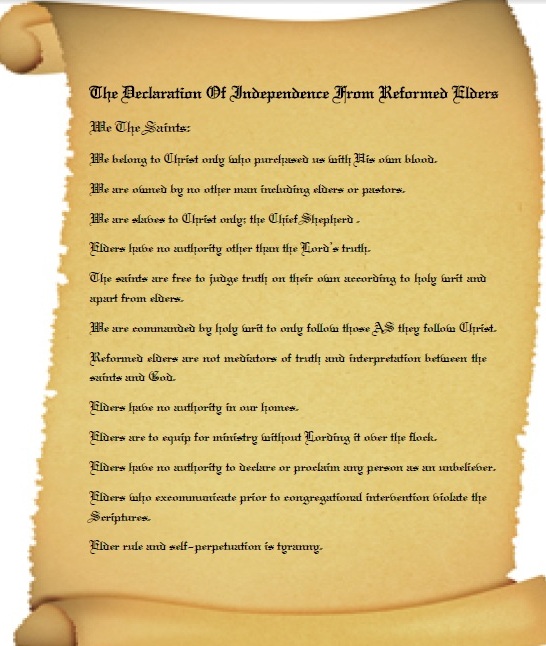
Destroying Eve-il is a Reformed Family Tradition: Today Danvers, Tomorrow the Gallows
Great pizza party last night with an author who is writing a sci-fi novel. As I sat and listened to him share his shocking plot designed to invoke terror in his future readers, my recent research for “Reformation Myth” (due to be published in January 2013) made the chilling plot seem mundane in comparison to sexy witches being hung, burned, and impaled with images of Mary fitted with large spikes.
On the one hand, the Reformers were supposedly brilliant for recognizing Plato’s theory that pure truth and beauty is immutable, while on the other hand, their brutality was merely the “mentality of the age.” It is also understandable why Reformed folks are so big on, “all truth is God’s truth” because the Catholic church had a lot of ideas that the Reformers thought were pretty cool; specifically, that because of Eve, women in general are predisposed to evil, or Eveil.
Between sips of mocha that could barely be executed because of my fixated attachment to the narrative, the little angel on my right shoulder kept saying, “Excuse me, this is history, and it really happened.”
Indeed it did happen, and the war declared on witches by the Catholic Church and the Reformers resulted in casualties that surpass many, many wars waged throughout history. And, to say the least, the due process of law that determined who was a witch was, well, shall we say, a little lean. Since it was thought that 90% of all witches were women, if you were a woman, and dragged into court, your gender was a bad start to the process. In at least one case, a particularly pious woman didn’t even take her arrest seriously and was sarcastic towards her accusers—who later executed her. I guess there is only one thing worse than a witch—a sarcastic woman. Then, there was this also:
The climate of fear created by churchmen of the Reformation led to countless deaths of accused witches quite independently of inquisitional courts or procedure. For example, in England where there were no inquisitional courts and where witch-hunting offered little or no financial reward, many women were killed for witchcraft by mobs. Instead of following any judicial procedure, these mobs used methods to ascertain guilt of witchcraft such as “swimming a witch,” where a woman would be bound and thrown into water to see if she floated. The water, as the medium of baptism, would either reject her and prove her guilty of witchcraft, or the woman would sink and be proven innocent, albeit also dead from drowning (Helen Ellerbe: The Dark Side of Christian History,Chapter Eight: 1450 – 1750 C.E.).
It all started with the Catholics first, and the Reformers later joined the campaign that supplemented the inquisition:
Pope John XXII formalized the persecution of witchcraft in 1320 when he authorized the Inquisition to prosecute sorcery. .” Thereafter papal bulls and declarations grew increasingly vehement in their condemnation of witchcraft and of all those who “made a pact with hell.” In 1484 Pope Innocent VIII issued the bull Summis desiderantes authorizing two inquisitors, Kramer and Sprenger, to systematize the persecution of witches. Two years later their manual, Malleus Maleficarum, was published with 14 editions following between 1487-1520 and at least 16 editions between 1574-1669. A papal bull in 1488 called upon the nations of Europe to rescue the Church of Christ which was “imperiled by the arts of Satan.” The papacy and the Inquisition had successfully transformed the witch from a phenomenon whose existence the Church had previously rigorously denied into a phenomenon that was deemed very real, very frightening, the antithesis of Christianity, and absolutely deserving of persecution.
It was now heresy not to believe in the existence of witches. As the authors of the Malleus Maleficarum noted, “A belief that there are such things as witches is so essential a part of Catholic faith that obstinately to maintain the opposite opinion savors of heresy.” Passages in the Bible such as “Thou shalt not suffer a witch to live” were cited to justify the persecution of witches (Ibid.).
The following gives us an idea as to the extent that this was going on:
Contemporary accounts hint at the extent of the holocaust. Barbara Walker writes that “the chronicler of Treves reported that in the year 1586, the entire female population of two villages was wiped out by the inquisitors, except for only two women left alive.” Around 1600 a man wrote:
Germany is almost entirely occupied with building fires for the witches… Switzerland has been compelled to wipe out many of her villages on their account. Travelers in Lorraine may see thousands and thousands of the stakes to which witches are bound (Ibid.).
The general mentality of the Eveil motif was part and parcel with the war on witches:
The witch hunts were an eruption of orthodox Christianity’s vilification of women, “the weaker vessel,” in St. Peter’s words. The second century St. Clement of Alexandria wrote: “Every woman should be filled with shame by the thought that she is a woman.” The Church father Tertullian explained why women deserve their status as despised and inferior human beings:
“And do you not know that you are an Eve? The sentence of God on this sex of yours lives in this age: the guilt must of necessity live too. You are the devil’s gateway: you are the unsealer of that tree: you are the first deserter of the divine law: you are she who persuaded him whom the devil was not valiant enough to attack. You destroyed so easily God’s image, man. On account of your desert that is, death even the Son of God had to die.”
Others expressed the view more bluntly. The sixth century Christian philosopher, Boethius, wrote in The Consolation of Philosophy, “Woman is a temple built upon a sewer.” Bishops at the sixth century Council of Macon voted as to whether or not women had souls. In the tenth century Odo of Cluny declared, “To embrace a woman is to embrace a sack of manure…” The thirteenth century St. Thomas Aquinas suggested that God had made a mistake in creating woman: “nothing [deficient] or defective should have been produced in the first establishment of things; so woman ought not to have been produced then.” And Lutherans at Wittenberg debated whether women were really human beings at all. Orthodox Christians held women responsible for all sin. As the Bible’s Apocrypha states, “Of woman came the beginning of sin/ And thanks to her, we all must die”(Ibid.).
And the Reformers were completely onboard with the Eveil rage of that Day:
St. Augustine of Hippo (354 to 430 CE). He wrote to a friend:
“What is the difference whether it is in a wife or a mother, it is still Eve the temptress that we must beware of in any woman……I fail to see what use woman can be to man, if one excludes the function of bearing children.”
Martin Luther (1483 to 1546):
“If they [women] become tired or even die, that does not matter. Let them die in childbirth, that’s why they are there.”
St. Thomas Aquinas (1225 to 1274 CE):
“As regards the individual nature, woman is defective and misbegotten, for the active force in the male seed tends to the production of a perfect likeness in the masculine sex; while the production of woman comes from a defect in the active force or from some material indisposition, or even from some external influence.”
But the Reformers did way more than stand on the sidelines and cheer. When doing a pdf document search on Witch Hunts In Europe And America, An Encyclopedia by William Burns, “Calvin” got 32 hits including the following:
There are about five hundred recorded witch trials in the 150 years after Calvin’s arrival in Geneva. Given the high rate of survival of Genevan records, this probably represents the majority of cases that occurred. The witch-hunt in Geneva peaked relatively early, in the 1560s and early 1570s. The records show that, outside the witch-hunt of 1571, Geneva had one of the lowest rates of execution in Europe, about 20%. Geneva magistrates seem to have used banishment as an alternative to execution in cases where the guilt or innocence of the subject was in doubt, rather than following the practice of other areas which simply tortured until a confession was obtained. The relatively mild torture practiced by the Genevans kept individual witch cases from developing into large hunts, and in some cases the magistrates were uninterested in following up accusations even when an accused witch named others…
The comparatively small kingdom of Scotland, whose legal system blended English and Continental elements, had from the mid-sixteenth century on a zealous Calvinist clergy intent on creating a godly society. It executed the most witches of any British region. The other British area of high witch-hunting activity was the legally anomalous Channel islands….
William Perkins was Elizabethan England’s leading Calvinist theologian, and his posthumously published A Discourse on the Damned Art of Witchcraft (1608) had an unrivalled influence on subsequent Puritan demonologists in old and New England. Perkins’s approach was intellectually austere. He shunned reference to previous demonologists or actual cases of witchcraft, and based his argument almost entirely on the Bible, particularly Exodus 22.18, “Thou shalt not suffer a witch to live.” Perkins saw the essential nature of witchcraft as the making of the satanic pact, or “covenant,” which inverted the covenant relation between God and his elect that was basic to Puritan Calvinist theology. So closely does Perkins relate the witch’s contact with the Devil to the good Christian’s contact with God that he claims that to deny the possibility of physical contact with devils would be to deny the possibility of covenant with God. Perkins describes the making of the covenant as a simple agreement, without the necessity for the witch to sign in blood or kiss or have sex with the Devil. Other central aspects to the witch stereotype as the sabbat or the Devil’s mark he also ignored. Even maleficia played a minor role. Perkins’s principal target was not the maleficent witch, but the “good witch,” whom he described over and over as even more worthy of death than the evil witch. Perkins believed that all power to perform “magic” could only come from Satan.
William Perkins was the elder statesman of the very same Calvinist Puritans that boarded the Mayflower and landed on Plymouth Rock. John Robinson, their pastor and follower of Perkins, gave an impassioned speech to them before they boarded the ship. The Pilgrims, who were really political refugees, set up a Geneva style Calvinistic theocracy known as the American Colonies and was the spawning grounds for colonial Calvinism.
Go figure, not long after, in Salem Town and Salem Village, the infamous Salem witch trials occurred. The Puritan Cotton Mather was heavily involved and attended the execution of Salem Town’s pastor, George Burroughs, who was accused of aiding and abetting a covenant of witches. An actual account of the sad proceedings follow:
George Burroughs was executed on Witches Hill, Salem, on the 19th of August, the only minister who suffered this extreme fate.
Though the jury found no witches’ marks on his body he was convicted of witchcraft and conspiracy with the Devil. While standing on a ladder before the crowd, waiting to be hanged, he successfully recited the Lord’s Prayer, something that was generally considered by the Court of Oyer and Terminer to be impossible for a witch to do. After he was hung, Cotton Mather, a minister from Boston, reminded the crowd from atop his horse that Burroughs had been convicted in a court of law, and spoke convincingly enough that four more were executed after Burroughs. Below is the original account as first compiled and published in 1700 by Robert Calef in More Wonders of The Invisible World pages 103-104, and later reprinted or relied upon by others including Charles Wentworth Upham and George Lincoln Burr,
Mr. Burroughs was carried in a Cart with others, through the streets of Salem, to Execution. When he was upon the Ladder, he made a speech for the clearing of his Innocency, with such Solemn and Serious Expressions as were to the Admiration of all present; his Prayer (which he concluded by repeating the Lord’s Prayer) was so well worded, and uttered with such composedness as such fervency of spirit, as was very Affecting, and drew Tears from many, so that if seemed to some that the spectators would hinder the execution. The accusers said the black Man [Devil] stood and dictated to him. As soon as he was turned off [hung], Mr. Cotton Mather, being mounted upon a Horse, addressed himself to the People, partly to declare that he [Mr. Burroughs] was no ordained Minister, partly to possess the People of his guilt, saying that the devil often had been transformed into the Angel of Light. And this did somewhat appease the People, and the Executions went on; when he [Mr. Burroughs] was cut down, he was dragged by a Halter to a Hole, or Grave, between the Rocks, about two feet deep; his Shirt and Breeches being pulled off, and an old pair of Trousers of one Executed put on his lower parts: he was so put in, together with Willard and Carrier, that one of his Hands, and his Chin, and a Foot of one of them, was left uncovered.
—Robert Calef
Now, in our day, and unbelievably, the proud children of this Calvinist legacy pronounce themselves the experts on “biblical manhood and womanhood.” Specifically, an organization was formed in 1987 called “The Council on Biblical Manhood and Womanhood.” It is funded, organized, maintained, and directed by the who’s who of the American Neo-Calvinist movement including, Ligon Duncan, Wayne Grudem, John Piper, and Al Mohler. They formed a statement/declaration on this subject that was so well attended by their forefathers called the “Danvers Statement.” It is called the Danvers Statement because their declaration was finalized in—get this— Danvers, Massachusetts.
So, what’s relevant about that? Well, Danvers is the modern day location of Salem Town, the location of the Salem witch trials. In fact, these guys made it a point to have the meetings there that finalized the document. Ok, I mean, really, if you are a bunch neo-Nazis who want to start a forum on Judaism, would you make it a point to finalize your declaration at Auschwitz?
Furthermore, the Reformers didn’t get up one morning and decide to start burning witches—it all began with their Eveil doctrine. And the proponents of this movement not only swear by the theological genius of Calvin, but what they teach about the fall and Eve’s participation is word for word. Also, in regard to what is actually going on as far as treatment of women, all that is missing is the gallows. Whether it be women locked in basements as punishment, being spanked by their husbands, deprived of education, or their children being held hostage through manipulation of relatives by church elders—it is at least Witch Hunt Light.
Have I read the Danvers Statement? No, why would I? Christ said that false teachers are known by their fruit. The root of the fruit is the doctrine. Good trees don’t bear bad fruit, and Reformed leaders are little more than Adolf Hitler and Joseph Stalin in priestly garb.
paul
The True Gospel Verses Calvinism: Part 2
“The whole idea that Christians are unable to obey the law in a way that is acceptable to God is an absurd contradiction of a massive body of Scripture. But yet, this is widely accepted in Reformed circles and key to understanding their doctrine.”
“And moreover, according to Reformed theology, the law is still a standard that must be maintained to get justification home to glorification by driving on a road named Sanctification.”
“However, If you will stay your mind on the reality of the above illustration, and dogmatically assert that all Reformed theology in some way relates to this illustration, you will be given insight into the soul of Reformed theology. Do not let the Reformed academics move you away from this reality with rhetoric.”
“So, in Reformed theology, because the law remains a standard for progressive justification, perfect obedience to the law in sanctification must also be imputed to us.”
Let’s begin by revisiting the original question that prompted this two part post:
Paul, please explain in layman’s terms how Calvinism views justification and sanctification. I am trying to understand this. Does this have anything to do with the saint’s persevering?
What most people don’t understand is the fact that Reformed theology is all but a complete demolition of the truth. The election/free will debate is hardly the issue; this theology barely falls short of contradicting every basic theological point of Scripture.
This starts with the fusion of justification and sanctification….
….this fusion is the leaven that leavens the whole lump. Reformed theology thinks that sanctification links justification to glorification. It believes that sanctification is the growing part of salvation. But, salvation doesn’t grow, it’s a finished work. The chart below from a Calvinist organization should make my point (click to enlarge if necessary).
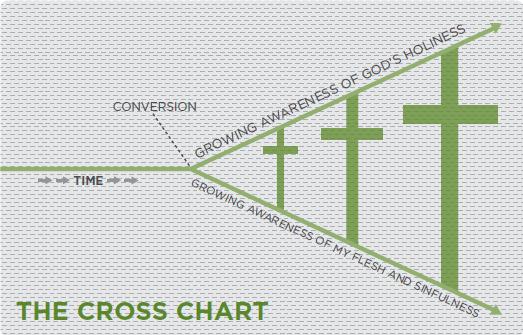
Also note: the believer doesn’t grow, the cross does. In fact, the believer gets worse! Or at least endeavors to increasingly realize how rotten he/she is. But what about the new birth? Reformed theology denies it regardless of the fact that Christ said, “You must be born again.” I can already hear the cat cries, but I will make my case. There isn’t a theology on earth that is more wrong than Reformed theology for many reasons including the denial of the new birth.
First of all, while denying that they fuse justification and sanctification together, the core element of Reformed theology is based on such. If justification and sanctification are fused together, we abide in the milieu that is between the two. That can make sanctification very tricky, unlike my biblical thesis in part one—we don’t abide in that realm that is a finished work. If we reside in a place where justification progresses to glorification, can we mess it up? According to Calvinists, “yes.” More on that later. But again, they clearly recognize this problem and base their core doctrine on it.
So, what doctrine is that? Well, there is only one way to prevent us from short circuiting justification on the way to glorification: cut us out of sanctification all together and make it a 100% work of God. And I agree, if our sanctification is the link between justification and glorification, we would need to be cut out of the equation all together. This is greatly magnified in Reformed theology by the idea that justification must be maintained by the keeping of the law. So, justification begins, but needs to be maintained until it arrives to glorification via the road of sanctification. This can be seen in a personal conversation I had with the well-known Calvinist Voddie Baucham:
paul: “Do you believe in this Gospel Sanctification stuff?”
Baucham: “I’m not sure what you mean.”
paul: “The same gospel that saved us also sanctifies us.”
Baucham: “Yes, absolutely!”
paul: “But Dr. Baucham, justification is a finished work, how can it sanctify us?”
Baucham: Nodding toward the window where we were standing; “That road out there is a finished work, but we still use it.”
Is that true? Are we sanctified by justification? Do we still “use” justification to get to glorification? At least in the Reformed view, the answer to all three of those questions is “yes,” and the perfect maintaining of the law to get justification home to glorification is the key. Justification must be maintained by the perfect keeping of the law, or else the legal declaration that we are justified is, “legal fiction” according to Reformed academics. This is the exact term they use to explain why sanctification must maintain justification by a perfect maintaining of a true legal declaration by perfect law-keeping. And moreover, according to Reformed theology, the law is still a standard that must be maintained to get justification home to glorification by driving on a road named Sanctification. As we discussed in part one, the law has been voided in regard to justification. Paving a road from justification to glorification, and naming it Sanctification, and using the law for the asphalt is a gargantuan theological misstep.
Well, that certainly excludes us! No? But don’t worry, Calvinists have a solution to this problem—it’s the doctrine of The Objective Gospel Outside of Us. The gospel gets justification home to glorification on the road named Sanctification, and we don’t have anything to do with it because the road is maintained by the perfect keeping of the law. How in the world does all of this work? I will explain, stay tuned. But first, let me establish that Calvinists believe that the law must be obeyed perfectly to maintain justification. This can be seen clearly in the writings of John Calvin himself. In context of sanctification, Calvin wrote that any attempt by a Christian to keep the law in sanctification was akin to an effort to keep the law….for justification. So, in Reformed theology, whatever is….for sanctification, IS ALSO….for justification because the two are the same. Calvinists use James 2:10, which is a statement….for justification, and apply it….for sanctification as one example, but they also routinely speak as if justification, and sanctification are the same thing with the same standard for keeping the law. Here is what Calvin said on this wise in his Institutes (Book 3; ch. 14, sec. 9,10):
Let the holy servant of God, I say, select from the whole course of his life the action which he deems most excellent, and let him ponder it in all its parts; he will doubtless find In it something that savors of the rottenness of the flesh, since our alacrity in well-doing is never what it ought to be, but our course is always retarded by much weakness. Although we see that the stains by which the works of the righteous are blemished, are by no means unapparent, still, granting that they are the minutest possible, will they give no offense to the eye of God, before which even the stars are not clean? We thus see, that even saints cannot perform one work which, if judged on its own merits, is not deserving of condemnation.
Even were it possible for us to perform works absolutely pure, yet one sin is sufficient to efface and extinguish all remembrance of former righteousness, as the prophet says (Ezek, 18:24). With this James agrees, “Whosoever shall keep the whole law, and yet offend in one point, is guilty of all” (Jam 2:10).
Notice that there is nothing a Christian does that is considered good or righteous by God. The same is echoed by Calvinists in our day like Tullian Tchividjian (click to enlarge if necessary):

And also notice what the standard for that is: the law….for justification in sanctification. The whole idea that Christians are unable to obey the law in a way that is acceptable to God is an absurd contradiction of a massive body of Scripture. But yet, this is widely accepted in Reformed circles and key to understanding their doctrine. Obviously, the law is still the standard, which is a problem in and of itself if you read part 1. The road named Sanctification that links justification and glorification together is paved with the law, and the asphalt is kept in perfect condition by a perfect keeping of the law. As discussed in part one, the law is not available to progress justification forward. For purposes of progressing justification—the law is void—we are no longer UNDER it….for justification. Therefore, justification can’t progress. It doesn’t get bigger, and it doesn’t grow. But obviously, if we are still on that road, things get tricky.
Therefore, Reformed theology holds to the idea that salvation grows to perfection until glorification, but we must remain OUTSIDE of this process lest the growing process is messed up by our mortal imperfection. This is where the Centrality of the Objective Gospel Outside of Us comes into play. Reformed academics get a covert pass on this because listeners assume they are talking about justification only—BUT THEY ARE NOT—THEY ARE TALKING ABOUT BOTH JUSTIIFICATION AND SANCTIIFCATION. So, we must be cut out of the growing process of salvation because of our imperfection while being able to lay claim to it. But how? Here is how: THE GOSPEL GROWS, BUT WE DON’T. Remember the cross illustration above?
Ok, so, in Reformed theology, justification and sanctification are the same thing. Sanctification is the growing of justification until it reaches glorification, and in the process, justification must not be “legal fiction.” Therefore, sanctification maintains justification by the perfect keeping of the law until the day of glorification . We can lay claim to it, but because of our mortal imperfection, we can’t be part of justification progressing to glorification. So how does this work in Reformed theology? We will get to that, but first, let me further substantiate my claims thus far. Let me begin by quoting Calvin on the idea that justification is progressive. Really, our first clue should be the title of chapter 14 from the Calvin Institutes: “The Beginning of Justification. In What Sense Progressive.” Calvin states the following in that chapter:
Therefore, we must have this blessedness not once only, but must hold it fast during our whole lives. Moreover, the message of free reconciliation with God is not promulgated for one or two days, but is declared to be perpetual in the church (2 Cor 5:18, 19). Hence believers have not even to the end of life any other righteousness that that which is there described. Christ ever remains a Mediator to reconcile the Father to us, and there is a perpetual efficacy in his death, i.e., ablution, satisfaction, expiation; in short, perfect obedience, by which all our iniquities are covered. In the Epistle to the Ephesians, Paul says not that the beginning of salvation is of grace, but “by grace are ye saved,” “not of works, lest any man should boast” (Eph 2:8, 9).
Furthermore, a Reformed think tank that was highly regarded in the early seventies, the Australian Forum, published the following illustration that captures the general idea of the doctrine (click to enlarge):
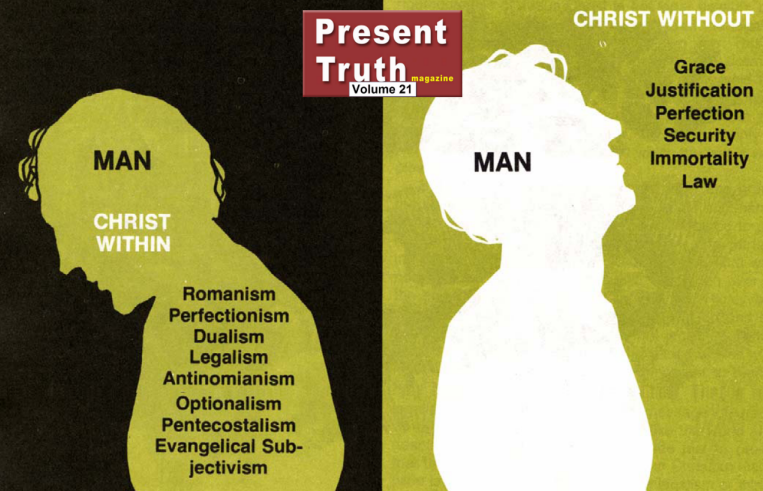
Let me add an additional note:

Obviously, this illustration provokes multiple questions in regard to practical application which will be discussed later (how this supposedly works in sanctification). But the key reality must not leave your mind: Christians cannot really participate in sanctification according to Reformed theology with the exception of one concept, and unfortunately, as we shall see, that one concept can only be works salvation. Not only is our role limited and narrow, the specific role is efficacious to maintaining our own salvation. However, If you will stay your mind on the reality of the above illustration, and dogmatically assert that all Reformed theology in some way relates to this illustration, you will be given insight into the soul of Reformed theology. Do not let the Reformed academics move you away from this reality with rhetoric.
Let’s also illustrate that proponents of Reformed theology fuse justification and sanctification together and speak of the two as being the same thing. In their sermons and teachings, they do this by virtue of the missing transition of subject matter—that being the difference between sanctification and justification. In their messages, they transition between the two without noting any difference as if the two are the same thing—because that is what they believe. Furthermore, this is an excellent communication method for assimilating this idea into the minds of their parishioners victims without them realizing what is happening. Examples of this are strewn about everywhere, but I will cite the following example from The Truth About new Calvinism, page 18:
Regarding the same message in context of who the audience was, in the sermon notes, the top of the page had statements like, “Things Jesus wants us (“us” would presumably be Christians) to know about the law.” The top parts of the notes were also replete with “we” in regard to the law, but the bottom part had statements like: “We live in the Age of Grace; salvation is not of works,” but yet, the whole message clearly regarded the role of the law in the lives of Christians. Therefore, whether unawares or otherwise, the pastor extended the relationship of the law in regard to justification (salvation) into the realm of sanctification (our life as already saved Christians), by virtue of a missing transition in subject matter. Hence, the subject of the law’s relationship to the lost was spoken of as being the same thing as its relationship to those who are saved. Theologians call this a collapsing of sanctification into justification or the synthesizing of the law’s relationship to justification and sanctification. This is most definitely a hallmark of New Calvinist doctrine to keep in mind for later discussion. The communication technique of the missing transition is also a technique used often by New Calvinists.
Next, let’s establish the fact that in Reformed theology, the law must still be the standard for sanctification because sanctification is the growing process of justification; in other words, progressive justification. Again, if law is not the standard for sanctification which is supposedly the progression of justification, then justification (according to Reformed theology) is mere “legal fiction.” Well, justification does not grow, it is based on God’s declaration—not law (as discussed in part one), and there is a reason why sanctification need not be perfect as a kingdom life totally separate from the finished work of justification which will be addressed later. But without further ado, the aforementioned Reformed view can be seen in Calvin’s diatribe in which he thinks it of abundant importance for Christians to know that they cannot obey the law in order to please God:
For since perfection is altogether unattainable by us, so long as we are clothed with flesh, and the Law denounces death and judgment against all who have not yielded a perfect righteousness, there will always be ground to accuse and convict us unless the mercy of God interpose, and ever and anon absolve us the constant remission of sins. Wherefore the statement which we set out is always true. If we are estimated by our own worthiness, in everything that we think or devise, with all our studies and endeavors we deserve death and destruction.
We must strongly insist on these two things: that no believer ever performed one work which, if tested by the strict judgment of God, could escape condemnation (Calvin Institutes: book 3; ch.14, sec. 10,11).
So, though the apostle Paul states that the paramount goal of Christians is to please God (2Cor. 5:10); obviously, Reformed theologians state unequivocally that the law is not the standard for that. Again, it can’t be, because sanctification is growing justification which demands a perfect adherence to the law in order not to be “legal fiction.” Therefore, if not the law, what? This interpretive question is the juggernaut of the subject at hand. The answer: more salvation. According to Reformation theology, our only possible participation in progressive justification is the same thing that justified us to begin with: faith alone. But wait a minute, in Reformed theology, we are not justified per se. Remember the illustration that is the soul of Reformed theology that we cannot be removed from, and the reality thereof. All righteousness , Christ, grace, ect., must remain outside of us. Nothing of grace can be within. So, we have no righteousness that is our own….for sanctification. Like….for justification, it must remain outside of us. In fact, Reformed theologians believe that if grace, Christ, or any kind of valid righteousness is inside of us, that is infusing grace into us while in sanctification. And if we do that, we are making sanctification the ground of our justification. Get it? If sanctification is a road that takes justification to glorification, and it must be paved with perfection, and we are on that road, and grace is infused into us, then we are made part of the progressive justification process. Game over.
We must (according to Reformed theology) walk side by side with justification on the road named Sanctification that takes us to glorification without being a part of the process. Otherwise, our participation is legal fiction because we obviously still sin. An “aberration” that believes that we have righteousness inside of us is called “infused grace” by Reformed academics and is the primary offence to the soul of Reformed theology: The Objective Gospel Outside of Us. Again, reobserve the two-man Christ within/Christ without Reformed illustration that is the soul of this doctrine. All Righteousness must remain outside of us and we must walk the road named Sanctification the same way we were initially permitted to be on the road, by faith only. If we work, or obey the law, we are believing that there is a righteousness inside of us that can participate with progressive justification in arriving at glorification at the end of the road. This is infusing grace into us and making our ability to travel with justification the ground of our justification. At least partially, which is a horseshoe and hand grenade issue in regard to justification anyway. Now, let’s observe the “elder statesman” of New Calvinism reiterating what I have just written. Take note that John Piper’s comments following were in regard to a lecture by Graeme Goldsworthy at Southern Seminary. Goldsworthy was one of the key members of the aforementioned Reformed think tank, the Australian Forum. The following excerpts were taken from The Truth About new Calvinism, pages 41-43:
In the aforementioned article concerning Goldsworthy’s lecture at Southern, Piper agrees that the original Reformation sought to correct the reversal of sanctification and justification:
“This meant the reversal of the relationship of sanctification to justification. Infused grace, beginning with baptismal regeneration, internalized the Gospel and made sanctification the basis of justification. This is an upside down Gospel.”
In case one would think that Piper excludes evangelicals from this concern because of his mention of baptismal regeneration, consider what he said in the same article: “I would add that this ‘upside down’ gospel has not gone away— neither from Catholicism nor from Protestants….”
….Piper concurs with Goldsworthy that “infused grace” is the problem. The like complaint is that the completely outside of us gospel empowers us inwardly, subjects us to subjective distractions from the power of the historic Christ event, and makes the natural result of the gospel our power source (the fruit), instead of the outward power of the gospel, the real root. To infuse grace is to suggest that we are enabled to participate in being justified by our own efforts in bringing about the natural results of the gospel.
Nothing shows this kinship between the Forum and New Calvinism more than a Piper quote from this same article and a visual aid used by Robert Brinsmead to demonstrate how “infused grace” supposedly puts our souls in peril. First Piper’s quote:
“When the ground of justification moves from Christ outside of us to the work of Christ inside of us, the gospel (and the human soul) is imperiled. It is an upside down gospel [emphasis Piper’s—not this author].”
Now observe Brinsmead’s illustration on the next page: [the two-man Christ within/Christ without chart which was published by the Australian Forum].
This necessarily leads to the Reformed denial of the new birth. Obviously, the idea that Christ lives within us and works within us is part and parcel to the new birth—and a big problem for The Objective Gospel Outside of Us. Reformed theologians know that they cannot blatantly deny the new birth and retain credibility, so they have many cute ways of relegating it to insignificance in order to bolster their staple doctrine. I have addressed how they do this in many other articles including chapter 11 of The Truth About New Calvinism, and will not continue to do so here, but will at least note some interesting quotes that speak to my assertion:
It robs Christ of His glory by putting the Spirit’s work in the believer above and therefore against what Christ has done for the believer in His doing and dying.
~ Geoffrey Paxton (Australian Forum)
But to whom are we introducing people to, Christ or to ourselves? Is the “Good News” no longer Christ’s doing and dying, but our own “Spirit-filled” life?
~ Michael Horton
And the new-birth-oriented “Jesus-in-my-heart” gospel of evangelicals has destroyed the Old Testament just as effectively as has nineteenth-century liberalism. (footnoted to Paxton’s article with above quote).
~ Graeme Goldsworthy (Australian Forum)
One would therefore think that this theology would lead to a view that believers are no different from the unregenerate save belief in the gospel only. Practically, Christians remain totally depraved like the unregenerate. And you would be correct about that. Reformed theology holds to the idea that justification initially recons us righteous in Christ, and without Christ in us, and then continues to recon us clothed with Christ’s righteousness (and none of our own in sanctification) as long as we “live by faith” ALONE….for sanctification. Moreover, only the POSITION of a person is changed in salvation, not the character, personhood, or creaturehood. There is no better illustration of this than the following citation from Michael Horton’s Christless Christianity, p.62:
Where we land on these issues is perhaps the most significant factor in how we approach our own faith and practice and communicate it to the world. If not only the unregenerate but the regenerate are always dependent at every moment on the free grace of God disclosed in the gospel, then nothing can raise those who are spiritually dead or continually give life to Christ’s flock but the Spirit working through the gospel. When this happens (not just once, but every time we encounter the gospel afresh), the Spirit progressively transforms us into Christ’s image. Start with Christ (that is, the gospel) and you get sanctification in the bargain; begin with Christ and move on to something else, and you lose both.
The tail end of Horton’s quote brings me to the next point. Notice that Horton states that “we” can “lose,” as in l-o-s-e “both.” Both what? Obviously, justification and sanctification. Which equals = no salvation. “Paul, is he really saying that we can lose our salvation?” Sure he is—IF—we “move on to something else.” Which equals = moving on to something else but faith alone…for sanctification which is the same thing as moving on to something else….for justification. Progressive justification is not the only theological anomaly that Reformed theologians are content with, they must also add sanctification by faith alone. But all of this is necessary in order to stay consistent with their core doctrine: The Centrality of the Objective Gospel Outside of Us. Yes, let them squeal all night long; nevertheless, they teach that you can lose you salvation.
I will illustrate this further by revisiting the idea that Reformed theology fuses justification and sanctification together. Reformed theologians are big on the “Golden Chain of Salvation” concept based on Romans 8:30. We discussed Romans 8:30 in part one along with its ramifications for salvation. The Reformed take on this verse is the idea that sanctification is excluded because it is one and the same with justification. The opposite position was presented in part one to some extent. Note the following quotation by John Piper:
This is probably why in the golden chain of Romans 8:30 the term sanctification is missing: “And those whom he predestined he also called, and those whom he called He also justified, and those whom he justified he also glorified.” When Paul jumps directly from justification to glorification he is not passing over sanctification, because in his mind that process is synonymous with the first phase of glorification and begins at conversion. (God is the Gospel, footnote, p. 93).
Ok, notice that Piper calls justification (“conversion”) “the first phase of glorification.” So, again, we see that justification grows in glory and culminates at complete glorification and sanctification is part of that “process.” Not so. In regard to the fusion of justification and sanctification, what is a “chain”? Reformed theologians clearly refer to the justification “process” as a chain with justification on one end and glorification on the other end, and sanctification in the middle. Moreover, John Piper preached a sermon in which he warns that if we do not participate in the salvation “links” in the proper way, that we put ourselves in great danger—presumably in regard of losing our salvation. The following illustration with a golden chain and Piper’s quotes from the sermon should clearly make my point here (click to enlarge):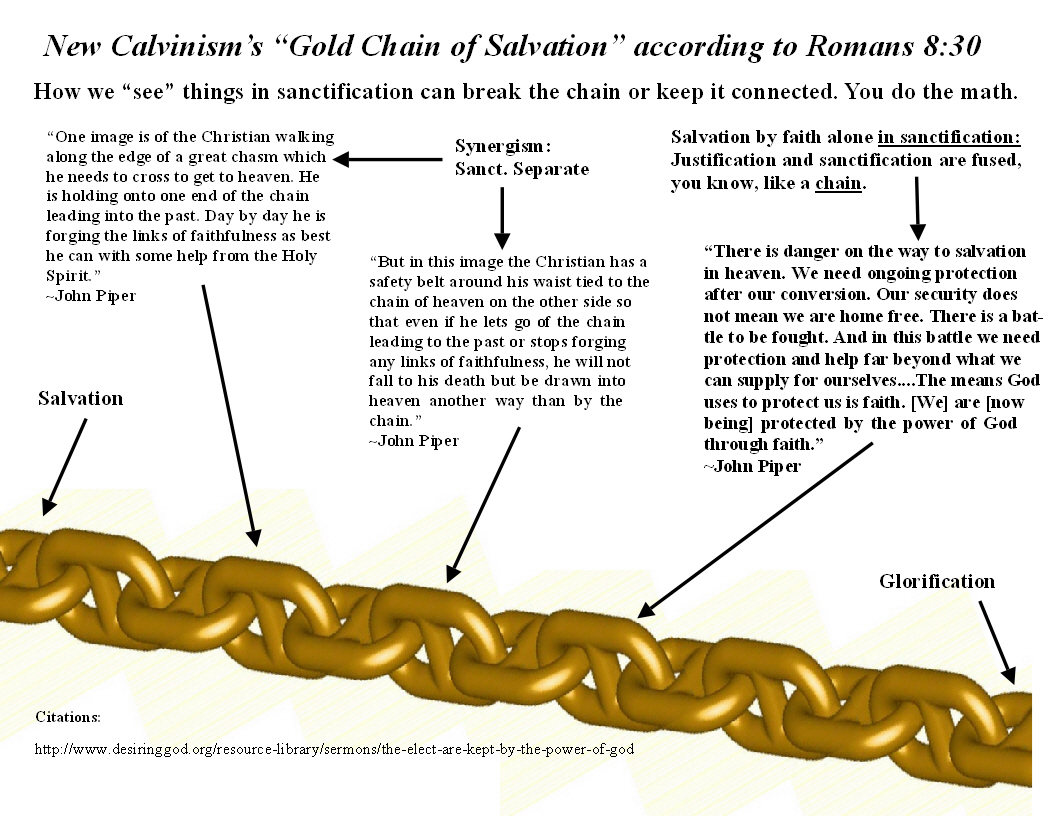
Which brings me to yet another point. If we can lose our salvation, what do we have to do to keep it? Whatever that is, it’s a work to maintain justification. And that is works salvation. In the case of Reformed theology, we have to keep our salvation by sanctification by faith alone. Hence: salvation by Christ + faith alone in sanctification. Think about that. To the Reformed, moving on to anything else but sanctification by faith alone will cause us to lose our salvation. Historically, the relaxing of the law in sanctification has always been deemed antinomianism. Is Reformed theology salvation by antinomianism? Yes, I think it is—the fusion of justification and sanctification can hardly end up anywhere else.
This entails the belief that Christ not only came to die for our sins, but He also came to live a perfect life of obedience to the law so that His perfect obedience in the life he lived on earth could be imputed to us in sanctification. So, in Reformed theology, because the law remains a standard for progressive justification, perfect obedience to the law in sanctification must also be imputed to us. In other words, Jesus obeys for us. How our justification must be maintained in our sanctification (according to Reformed theology) is well articulated by the Australian Forum Reformed think tank (The Truth About new Calvinism: p. 101, 102):
After a man hears the conditions of acceptance with God and eternal life, and is made sensible of his inability to meet those conditions, the Word of God comes to him in the gospel. He hears that Christ stood in his place and kept the law of God for him. By dying on the cross, Christ satisfied all the law’s demands. The Holy Spirit gives the sinner faith to accept the righteousness of Jesus. Standing now before the law which says, “I demand a life of perfect conformity to the commandments,” the believing sinner cries in triumph, “Mine are Christ’s living, doing, and speaking, His suffering and dying; mine as much as if I had lived, done, spoken, and suffered, and died as He did . . . ” (Luther). The law is well pleased with Jesus’ doing and dying, which the sinner brings in the hand of faith. Justice is fully satisfied, and God can truly say: “This man has fulfilled the law. He is justified.”
We say again, only those are justified who bring to God a life of perfect obedience to the law of God. This is what faith does—it brings to God the obedience of Jesus Christ. By faith the law is fulfilled and the sinner is justified.
On the other hand, the law is dishonored by the man who presumes to bring to it his own life of obedience. The fact that he thinks the law will be satisfied with his “rotten stubble and straw” (Luther) shows what a low estimate he has of the holiness of God and what a high estimate he has of his own righteousness. Only in Jesus Christ is there an obedience with which the law is well pleased. Because faith brings only what Jesus has done, it is the highest honor that can be paid to the law (Rom. 3:31).
A more contemporary example from the Journal of Biblical Counseling (David Powlison’s CCEF) can be observed in the following citation:
It is by virtue of Christ’s perfect life, death on the cross and resurrection-plus nothing-that we are justified (made and declared right with God) and sanctified (set apart, kept, and viewed as right with God) and sanctified (set apart, kept, and viewed as right in the Lord’s eyes by virtue of His obedience). Christ is our holiness. Christ is our sanctification.
Therefore, our walk with Christ must be a continual reoffering of the works of Christ to maintain our just standing. When we come to the last resurrection, we will be judged accordingly. If we lived sanctification in this way, the righteousness of Christ will be the ground of our justification and we will be glorified. See the following illustration from a John Piper video clip (click to enlarge):
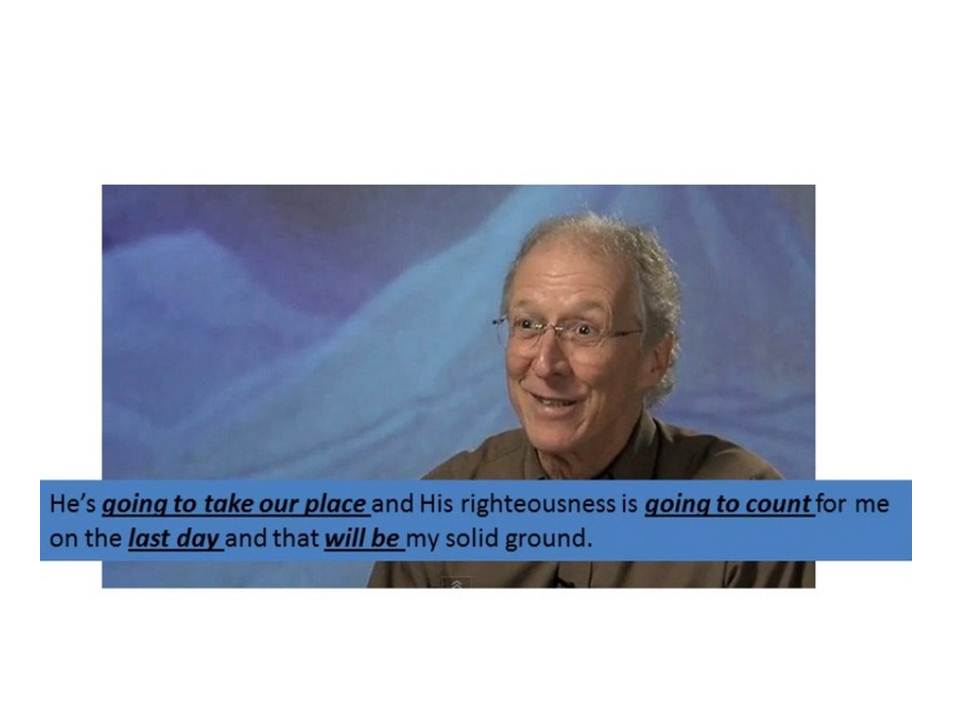 Christians will stand in no such judgment. And via the new birth, we are new creatures that in fact are righteous. Our lack of imperfection, though displeasing to the Lord, has no bearing….for justification. We are new creatures that deplore the weakness of our mortality, but are indwelt and enabled to obey God through our new life in the Holy Spirit. We are declared righteous, and in fact are righteous. We are not colaboring with our flesh like the world, but we rather colabor with God (1Cor. 3:9, 1Thess. 3:2, 2Cor. 6:1). Therefore, Paul could say, “Now if I do what I do not want, it is no longer I who do it, but sin that dwells within me (Romans 7:20). We will look at the supposed practical application of Reformed theology in part three, and compare it to the truth in light of assurance, spiritual growth, perseverance of the saints, and other sanctification issues.
paul

 Paul's Passing Thoughts
leave a comment