Robert Jones Will Return to Clearcreek Chapel to Teach a Refresher Course on Controlling Parishioners
 The New Calvinist movement is much attuned to its European Reformed roots. Though the New Calvinists deny a mentality of equal footing between orthodoxy and Scripture, their endearment to Reformed authority is evident. Though documents like the Westminster Confession and the Calvin Institutes are said to be “subordinate truth,” we must remember that these documents are, “orthodoxy,” and orthodoxy is synonymous with “truth” in Western culture. “Heterodox” is the opposite, and commonly refers to those who oppose the commonly accepted creeds and confessions of the Reformed church.[1]
The fact that these documents were drafted under the auspices of church states is a major consideration. For example, The Westminster Confession of Faith includes specific standards for the enforcement of orthodoxy by the state.[2] The most formidable result of the Enlightenment era, the United States of America, changed all of that. What we clearly have now is a desire to follow the dictates of 17th century Reformed orthodoxy in a post Christian era ruled by the separation of church and state. As an aside, it would be wrong to say the Enlightenment era was anti-Christian; in contrast, it championed freedom of Religion by insisting on the separation of faith and force.
The desire to follow in the footsteps of those who believed in the civil enforcement of orthodoxy poses unique problems for the Neo-Calvinist movement. This created a niche consulting market that specializes in teaching churches how to improvise in an open society. One of the first organizations to exploit this need was Peacemaker Ministries. Founded in 1982, the organization equips church leaders to control parishioners under the pretense of “peace making.”
The present-day New Calvinist movement was born in 1970, and from its beginning spawned massive church splits and conflict. By 1982, an emphasis on damage control would have been in high demand, especially in regard to lawsuits provoked by the heavy-handed leadership style of New Calvinists.
The organization strives to help churches “build a culture of peace.” One way of doing that is through “peacemaking teams.” Keep in mind, organizations like Peacemakers are supported by the institutional church and have no vested interest in obtaining a peaceful solution for individual concerns. Peacemaker Ministries routinely turns a blind eye to the out of control misuse of church discipline in Neo-Calvinist church culture. The excuse PM employs for not getting involved would be funny if not so dastardly: they cite the bogus church discipline itself as a reason to not get involved because they only get involved in controversies between Christians. And since the bogus church discipline has declared the offended party an unbeliever—all bets are off. Again, keep in mind who is paying PM.
On their website, it is stated that the purpose of peacemaking teams is to “serve their leaders and to advance their vision to build his church.” So, it is not true reconciliation that is in mind, or gaining brothers between brothers, but rather a team that diffuses controversy that hinders the leaders’ “vision.” This is just another tool in the repertoire of control infrastructures common in Neo-Calvinist churches. What these control structures look like is discussed here.
Once again, Robert Jones of Peacemaker Ministries will teach at the annual “Family Enrichment Conference” held at Clearcreek Chapel in Springboro, Ohio. Jones is scheduled to teach at the 2014 conference. Clearcreek Chapel has a long history of unresolved conflict with many Christians, and is well known for its cult-like heavy-handed leadership style. Since the departure of the founding pastor, Clearcreek has consistently drifted from one conflict to another. The latest controversy involved complaints by parishioners that the Clearcreek elders were teaching “some kind of Christian mysticism.” The Chapel elders recently changed their titles to less controversial words like “overseer” as opposed to “pastor of spiritual formation” etc. In addition, the radical Christian mystic Chad Bresson is no longer on the board of elders, and is seemingly no longer a member there as well.
A Robert Jones tune-up may be well overdue.
paul
1. Webster’s New World Dictionary of the American Language: World Publishers 1959.
2. William Marshall: The Principles of the Westminster Standards Persecuting ; D.D., Coupar – Angus. Edinburgh: William Oliphant & Co. 1873. Specific citations: Paul’s Passing Thoughts .com; Inseparable: The Reformation’s Principles of Persecution and its Gospel; Part One – August 31, 2013.
Clearcreek Chapel Gone Wild: Jesus Keeps the Clearcreek Covenant for You
 My, my, how different Clearcreek Chapel of Springboro, Ohio is since a pack of New Calvinist wolves took it over shortly after the departure of the founding pastor. The victorious pack, led by Chad Bresson (who for some reason recently left the KoolAid paradise that he built at his former chapel with a creepy adoration for his supposed theological prowess), began infiltrating the flock a couple of weeks before Dr. John Street’s departure.
The undomesticated canine delegation he brought with him from a Baptist church in Dayton, Ohio seemed to be frustrated with their inability to devour at that location. Really old sheep produce a mutton that is tough to chew, and invariably leaves a bad aftertaste.
As far as the “friends” I knew back in that day, and their susceptibility to believe Bresson’s outrageous mythology, I never saw it coming.
Apparently, just about any place a thinking person pokes the Chapel these days produces something utterly bizarre. I say this because of what I accidently stumbled onto today. In a recent sermon by Chapel elder Devon Berry, who is a mental healthcare professional (yikes!), he stated that Jesus keeps the Chapel covenant for the “beloved” members. Let me share an excerpt:
Is the Chapel covenant a call to a certain kind of living in the Church? Yes, it is. But beloved, it is a call to much, much, much more than that and it can never be only that. It is a call to the living Christ, our righteousness, our sin-bearer, our life. When you read the Chapel Covenant, reflect on Christ first for it is meant to point us to him – not to ourselves and our own efforts. Then rejoice. He has obeyed for us. He has suffered and died for us. And, he has also enabled us by grace – something we’ve talked around this morning but not mentioned directly.
Let me close by contradicting myself. Earlier I said that you could not keep the Chapel Covenant. I will end by saying that you can keep the Chapel Covenant. Grace, the enabling power given by God because we are at peace with him through the work of the cross, provides all that we need to obey and overcome sin. Hence, the Chapel Covenant is a call to live in the reality of who we are as believers. There is no better place you could live, no more joyful place you could abide, no more beautiful place you could dwell than in the life-transforming reality of the gospel. Believer, be who you are for Christ has given you all that you need.
Clearly, Berry is putting the Chapel covenant on par with the Scriptures. He states that it is more than a standard; it is a “call to the living Christ.” And, the ability to keep the covenant requires the enabling grace of Christ? This is beyond creepy. Moreover, if 2+2=4, Berry makes living by the Chapel covenant via the grace of Christ synonymous with dwelling in the “life-transforming reality of the gospel.” And according to Berry, there is not a place in the world where they could have more joy.
Sorry I am missing all the fun.
paul
Calvinism’s Platonist Rejection of the Trinity
 How do Calvinists reject the Trinity? Basically, they make God the Father and the Holy Spirit lesser forms of Jesus Christ. Their rejection of the Trinity is based on Plato’s theory of forms. This shouldn’t be any big surprise as one of the forefathers of the Reformation, St. Augustine, was a Plato groupie. My wife Susan will address the Plato/Augustine love affair in significant detail at this year’s TANC conference.
Plato’s basic idea of forms led to the Reformed Emphasis Hermeneutic, also known as the Redemptive Historical Hermeneutic. Plato’s trinity was the good, the true, and the beautiful, and all other forms, or solid matter if you will, are lesser forms of the true form. In one sense, Calvin believed that Jesus Christ brought the two together, but that is a philosophical angle we will not pursue here because other manifestations of this heresy are more plainly and easily seen. Calvinists merely make Jesus Christ the full expression of the good, true, and beautiful while representing the other members of the Trinity as lesser forms.
Hence, Jesus Christ, and His works become the stargate to all understanding of reality. The “gospel” is a term that encompasses the personhood of Christ and His works—this is the gateway to understanding ALL reality. The saving act (singular) of Jesus Christ is not something done in history as part of the Trinity’s plan to reconcile them to mankind, but is the key to understanding all reality. Therefore, many Calvinists refer to the “saving acts” (plural) of Christ and His personhood as keys to understanding. The Bible is therefore 100% about the gospel i.e., the personhood and works of Christ. More on this further along.
This is abundantly evident via the everything Jesus mentality of today’s churchianity. The books, the sermons, and the music are everything Jesus. This is why; it is a Protestant family tradition set on fire by the Neo-Calvinist movement. And it all begins in a galaxy far, far away known as Western philosophy. Calvin notes the following in his Institutes of the Christian Religion:
For this reason Augustine [who he quotes on average every 2.5 pages in the Institutes], treating of the object of faith (De civitate Dei lib. 11 c. 2), elegantly says, “The thing to be known is, whither we are to go, and by what way”; and immediately after infers, that “the surest way to avoid all errors is to know him who is both God and man, It is God we tend, and it is by man we go, and both of these are found only in Christ.
Therefore, supposedly, the “only” sure way to avoid error is to focus on Jesus Christ only, the idea that spiritual reality and physical reality are only seen in Christ notwithstanding. A clearer way to see how this all fleshes out is in the first tenet of New Covenant Theology which is a spinoff of Neo-Calvinism:
New Covenant Theology insists on the priority of Jesus Christ over all things, including history, revelation, and redemption. New Covenant Theology presumes a Christocentricity to the understanding and meaning of all reality.
Considered to be the foremost authority on Reformed hermeneutics in our day, Graeme Goldsworthy stated the following on page 48 of Gospel-Centered Hermeneutics (InterVarsity Press 2006):
If the story is true, Jesus Christ is the interpretative key to every fact in the universe and, of course, the Bible is one such fact. He is thus the hermeneutic principle that applies first to the Bible as the ground for understanding, and also to the whole of reality.
Calvinism concurs. ALL reality is Chrsitocentricity. The gospel is a stargate to the pure form of the good. Geoffrey Paxton, an Anglican theologian and authority on the Reformation, stated the following on page 41 of The Shaking of Adventism (Baker Book House 1978):
Christ alone means literally Christ alone, and not the believer. And for that matter, it does not even mean any other member of the Trinity!
This statement is both shocking and representative of Reformed trinitarian thinking. Paxton is absolutely right, Solus Christus means just that. Another way of understanding this is via the solar eclipse. This is the most popular example of how Christ must be the gateway to pure understanding. Christ is the Sun, the life-giving rays of light. To let anything obscure that light, no matter what it is—is to deprive ourselves of wisdom and life to that degree. When we let objects, even objects that are factual and true obscure Christ, we are “living in the shadows.” This is the theses of longtime John MacArthur confidant Rick Holland’s book, Uneclipsing The Son. The book is a Platonist/Gnostic treatise that is not even ambiguous. On page 11, Holland writes that the book of James presents Christ as the “rule and standard of all spiritual instruction.” On the same page, Holland asserts that Christ is the “one true God” and then cites five Scripture references that say no such thing.
John MacArthur wrote the Forward to Holland’s book being presently considered, and made these statements:
Rick Holland understands that truth. This book is an insightful, convicting reminder that no one and nothing other than Christ deserves to be the central theme of the tidings we as Christians proclaim—not only to one another and to the world, but also in the private meditations of our own hearts.
The pastor who makes anything or anyone other than Christ the focus of his message is actually hindering the sanctification of the flock.
No greater subject exists than Jesus Christ–no greater gift can be given than uplifting His glory for another soul to see it and be changed by it. This book will be a wonderful help to anyone who senses the need to orient one’s life and message properly with a Christ centered focus. It is full of fresh, practical, and memorable spiritual insight that will show you how to remove whatever obstacle is blocking your vision of the Son and allow His light to blind you with joy.
Christ, while praying to the Father, referred to the Bible as “your word” and “your word is truth” (John 17:17). We pray to God the Father, not Christ, and we baptize in the name of all three Trinity members. The Bible is not Chrsitocentric. The Bible has many major themes. The father of our faith looked for “a city built by God.” This contradicts the plain sense of Scripture, which brings me to my next point.
The Redemptive Historical Hermeneutic calls for a contemplation on Christ and His works only, or the gospel, and a logical conclusion drawn from the formation of verbs, nouns, adjectives, prepositions, etc., must be disregarded for a Chrsitocentric conclusion or a “truth” that “shows forth the gospel.” In the aforementioned book, on page 39, Holland has the audacity to make the following statement under the heading “When Bad Grammar Makes Good Theology”: “The rules of grammar are intended to be guardrails for communication. But sometimes they prevent it.” Insinuated is the idea that Christ’s greatness transcends mere grammatical rules, and therefore, one must break those rules to communicate how consumed our life must be with Christ.
A good example of this is a statement by Paul David Tripp on page 27 of How People Change (Punch Press 2006). Tripp acknowledges that the Bible in-fact does state that we should apply biblical commands to our life, but to take that literally, and not in its “Christ-centered gospel context” (p. 26) is to “omit” Christ in our life as “Savior.” Therefore, a literal approach to the Bible harkens to works salvation. The results of this can be seen in this approach to preparing Bible lessons:
At this time, resist the temptation to utilize subsequent passages to validate the meaning or to move out from the immediate context. Remembering that all exegesis must finally be a Christocentric exegesis.
Look for Christ even if He isn’t there directly. It is better to see Christ in a text even if He isn’t, than to miss Him where He is (Biblical Theological Study Center: A Christo-Presuppositional Approach to the Entire Scriptures; Max Strange. Online source: http://goo.gl/5sGjP).
Another authority on the Reformation, Robert Brinsmead, states this perspective concisely:
That which makes the Bible the Bible is the gospel. That which makes the Bible the Word of God is its witness to Christ. When the Spirit bears witness to our hearts of the truth of the Bible, this is an internal witness concerning the truth of the gospel. We need to be apprehended by the Spirit, who lives in the gospel, and then judge all things by that Spirit even the letter of Scripture (Brinsmead, Robert D. ”A Freedom from Biblicism” in The Christian Verdict, Essay 14, 1984. Fallbrook: Verdict Publications. Pgs. 9-14).
In other words, the meaning of Scripture according to the letter [i.e., logical interpretations from the grammatical construction] must be judged by “that Spirit” which “lives in the gospel.” All bets are off concerning any interpretation that seems to be the plain sense of the text.
Moreover, New Calvinists take this concept dangerously close to disparaging God the Father. In the book here cited by Holland, he suggests that Christ saved the world from God. In fact, the heading on page 23 reads, “Saved—From God.” So, apparently, hell is a God the Father sort of thing. On page 43 and following, Holland presents God as “our most pressing problem.” And, “man’s greatest problem is God, God Himself.” And of course, it’s Christ to the rescue, right?
Though few would reject the idea that Christ saved us from God’s wrath, it’s hardly the whole story and promotes the subtle New Calvinist goal of making Christ more significant than God the Father. Holland gives no Scripture references for this concept of Christ saving us from God because there isn’t any. God was just as involved in the salvation solution as Christ was, and Christ is also a God of wrath just as much as the Father is (Rev. 6:16,17 and 19:11-16). This whole concept is a subtle, but dangerous distortion. At the very least, making a strict dichotomy that associates wrath with God and salvation with Christ is ill advised and smacks of Marcionism.
Holland is hardly alone in this approach among New Calvinists. Paul Washer suggested to an audience of European college students that the goodness of God is man’s biggest problem (Online source: http://wp.me/pmd7S-1A3). At any rate, a standalone dichotomy of wrath versus love associated with Christ and the Father that is unqualified, is a concept that should make Christians very uncomfortable.
Calvinism promotes a Platonist-like distortion of the Trinity. It shouldn’t surprise us as the Plato/Reformed love affair is well documented. New Calvinists in our day even sport ministry subtitles with Platonist themes: “Between Two Worlds,” “Between Two Spheres,” and in regard to Plato believing that pure truth is static, “Truth Unchanging.”
Like all cultic false religions throughout history, they distort and therefore reject the Trinity.
paul
ADDENDUM
Calvin presented the priority of Christ over the other two Trinity members in the following way as explained by Mark Driscoll associate Justin Holcomb:
According to Calvin, the object of faith’s knowledge is Jesus Christ. He defines faith by proceeding to the center of a series of concentric circles: God’s existence, God’s power, God’s truthfulness, God’s will “toward us” as revealed in Scripture, and finally Christ. All these circles are implied in faith, but only the last is properly understood as the object of faith. Calvin goes so far as to say that those who say that God is the proper object of faith “rather mislead miserable souls by vain speculation, than direct them to the proper mark” (Institutes III.2.i). Christ as mediator is necessary if humans are to know God. Christ is not set over against God. Rather, Calvin asserts, Christ is the means—the only means—by which we can believe in God (Online source: http://theresurgence.com/2009/07/10/calvin-on-faith-christ-and-his-gospel).
ADDENDUM
One might consider the ruckus that was created over my suggestion that salvation involves all members of the Trinity and not Christ alone. I think this is telling. The following is a reprint of the controversy on Pastor Joel Taylor’s blog that resulted from some comments I had made on that subject:
5 pt salt .com
JUSTIFICATION IS NOT OF CHRIST ALONE
POSTED BY JOEL TAYLOR ON DECEMBER 15, 2011 IN GENERAL | 24 COMMENTS
I’m not even sure I like the title of this post. Not because it’s not true, but because it’s confusing.
Let me explain.
A few days ago I posted this piece promoting the book by Paul Dohse entitled The Truth About New Calvinism: It’s History, Doctrine, and Character. It’s worth reading. In fact, I think his book is an important one, and yes, I highly recommend you get it.
But, of course, not everyone feels that way.
Yesterday, after reading that post of mine, one 5ptsalt reader left this comment to me regarding Dohse and his book:
I’m pretty shocked you are promoting this book. Taking a peak inside reveals some pretty far out stuff. Just one example:
“First, justification is not by Christ ALONE. If God didn’t elect Christ, elect the elect, and draw them to Christ, along with sacrificing His only Son, what Christ did would have been for naught. So, justification is not by Christ alone.”
Buyer beware. This is dangerous stuff.
Well brethren, don’t be shocked that I promote this book. Be glad. And for you buyers, no need to beware.
Dohse is Right
Fact is, Paul Dohse is spot on, and even though he doesn’t need me to defend his statements, this reader’s comment gives us the opportunity to look at Scripture and, hopefully, instruct all of us. As Martha Stuart is apt to say, “That’s a good thing.”
See, it’s always important to look at statements in their proper context, a practice often overlooked and disregarded in the heat of defending what one is doctrinally comfortable with. But we need more importantly to examine all things in light of Scripture, it being – yes, I’m saying it again – the final authority in all things.
This comment by Dohse can be found from this post [link] of his which itself is a response to a series of questions by one of his readers. Here’s the question of the reader, followed by Dohse’s response:
Q: You have raised many issues in the last post that would take a book to answer. If I may, I would like to ask a few questions that might help us to clarify the issues on which we disagree. First, I want to state a couple of points on which I think we agree. Incidentally, I am convinced Piper and others would also agree.
…….
2. Justification is based on the work of Christ alone and our works do not contribute to it at all.
…..
Dohse responds to the second point:
2. First, justification is not by Christ ALONE. If God didn’t elect Christ, elect the elect, and draw them to Christ, along with sacrificing His only Son, what Christ did would have been for naught. So, justification is not by Christ alone.
Now, as I said earlier, Dohse is right. In fact, spot on. Here’s why: In a nutshell, it took all three persons of the Trinity to accomplish our justification. Father, Son and the Holy Spirit. If one dogmatically asserts that the Son alone is responsible for our salvation, including our justification, such a statement is clearly, from the Biblical testimony, an error.
Yes, the basis of our justification is the finished work of Christ alone, apart from our own works. That is true. Yet Dohse is merely pointing out the fact that unless the Father had predestined some to salvation, there would be none. The Father sent the Son to redeem us. The Holy Spirit works in us to make us holy. So Dohse is pointing out the involvement of the Trinity in our complete salvation. Although the basis for justification is Christ alone, there would be no justification without the involvement of all three persons of the Trinity in our redemption.
First, let’s give a simple definition of what justification is. Be sure and learn this, I implore you. When this is learned, hopefully, much confusion will be dismissed altogether.
Justification Defined
Justification is a declaration from the throne of God the Father concerning our legal status before His law. It is a single act, occurs one time, is never again repeated and is definitely not a process.
God the Father is the Author and Origin of Our Justification:
since indeed God who will justify the circumcised by faith and the uncircumcised through faith is one. – Romans 3:30
But to the one who does not work, but believes in Him who justifies the ungodly, his faith is credited as righteousness, – Romans 4:5
and these whom He predestined, He also called; and these whom He called, He also justified; and these whom He justified, He also glorified. – Romans 8:30
By the way, who predestination the elect unto salvation? Jesus Christ the Son? No! God the Father predestination us, according to Scripture. You see, it is God the Father who makes the declaration of justification, so to think justification is of Christ alone, well, that is simply not a biblical position.
Blessed be the God and Father of our Lord Jesus Christ, who has blessed us with every spiritual blessing in the heavenly places in Christ, just as He chose us in Him before the foundation of the world, that we would be holy and blameless before Him – Ephesians 1:3-4
Who will bring a charge against God’s elect? God is the one who justifies; – Romans 8:33
When anyone objects to statements like “Justification is not by Christ alone”, I would suggest one needs to pull back, calm down, and search the Scriptures and strive towards of a biblical understanding of precisely what justification is, a declaration from God the Father.
Brethren, I hear far, far, far too much praying for the Holy Spirit to “come down” and manifest Himself. I strongly object to such, and I would encourage pastors, and elders who are allowing such to continue to rethink what they are encouraging.
Listen. The Holy Spirit, third person of the Trinity, points us to Christ, not to Himself, and does not anywhere in Scripture ask us to ask more of Him! (John 16:13, 14).
Listen again, please. Christ Jesus points us to the Father! He is the way to the Father, not just to Himself! John 14:6.
Look at Ephesians 2:18, 19 brethren, and for all you New Calvinists, contemplate this:
for through Him we both have our access in one Spirit to the Father. So then you are no longer strangers and aliens, but you are fellow citizens with the saints, and are of God’s household
Now, why do so many focus only on the Son? For you to be redeemed, it took the entire Trinity, the triune Godhead, in perfect agreement together regarding a predestined, glorious plan of redemption of those given by the Father to the Son by the work of the Holy Spirit.
Sonship theology, indeed. Paul Dohse is right, because Paul Dohse is listening to God’s written Word, not the latest guru of truth.
Brethren, in love, I ask you not to ignore two members of the Trinity. Christianity is not wearing a Calvinistic t-shirt, boasting of your reformed views, and getting people to contemplate on the Gospel more.
That is utterly absurd. It is ignoring the whole counsel of God. This business of “Gospel sanctification” and Sonship theology is a dangerous – and exceedingly popular movement. And it is a movement that endangers souls.
So get that book, read it, be alert, and learn and be aware of anything and anyone who, in your heart, trumps the Word of God. May we all strive to better acknowledge the final authority of God’s Word, and rest our beliefs on its veracity alone.
24 COMMENTS
JOSHUA
DECEMBER 15, 2011
Did you believe this before Dohse made his statements or did he lead you to this understanding?
REPLY
ELLEN
DECEMBER 15, 2011
What then are we to think about the following scripture, relating to the reasoning in this post? In the beginning was the Word and the Word was with God and the Word
was God. John 1:1
REPLY
JOEL TAYLOR, PASTOR-TEACHER POST AUTHOR
DECEMBER 15, 2011
You should think that Jesus was in the beginning, eternal, and was with God, with God the Father, God the Holy Spirit, and was/is God Himself, and created all things, and all things are upheld by Him, for Him and through Him.
REPLY
JOE
DECEMBER 15, 2011
I like John 3:16
REPLY
JOHNDUNNINGUK
DECEMBER 15, 2011
I believe that if we are to truly accept the doctrines of grace as being true, we cannot do so sincerely, and yet fail to understand the crucial role that all three Persons of the Godhead play in our salvation.
In covenant theology, there is a sense whereby that which we know as the covenant of grace, flows directly out of an agreement within the Godhead made before creation, known as the counsel of peace, and sometimes as the covenant of redemption.
It was in this coming together of the Godhead to form a plan of creation, redemption and salvation, that each Person of the Godhead took upon their role. (I realise this is a pretty poor description on my part, so please excuse me). Each Person of the Godhead being indispensible to the other, and the faithful work of each Person, utterly vital for the plan of salvation to succeed.
Although I can sort of understand peoples reaction to this post generally, I have to agree that I think it more emotional than intellectual. It is undoubtedly true to say that there is absolutely no sacrifice for sin that is acceptable to God, other than Christ. However it would also be true that without the sovereign election of the Father, giving a people to His Son to redeem through His own blood, His sacrifice would be for nought. And were it not for the Holy Spirit, sealing those who have been chosen and redeemed, acting as the deposit that guaranteed their inheritance in Christ, then none would be brought to glory anyway.
REPLY
MAY
DECEMBER 15, 2011
However it would also be true that without the sovereign election of the Father, giving a people to His Son to redeem through His own blood, His sacrifice would be for nought.
Why would His sacrifice be for nought? The Father knows that some will and some will not believe.
REPLY
JOHNDUNNINGUK
DECEMBER 16, 2011
Why would His sacrifice be for nought? The Father knows that some will and some will not believe.
If you read through John 6:37-44 you will see what I meant more clearly. Christ did not come to the earth to do His own will, but the will of the One who sent Him. Namely the Father.
It is the Father who elects those who are to be saved and gives them to His Son to raise up on the Last Day, and we are told that ALL those who are given by the Father shall come to the Son.
The willingness of Christ to lay down His life to save us as the redeeming price, can only redeem those the Father has given Him to redeem. Therefore without being given a people by His Father, His sacrifice would purchase nothing.
REPLY
TIM SCOTT
DECEMBER 15, 2011
I’m a little confused. I want to ask a clarifying question, just to make sure I have read your article correctly. Aren’t you denying a central tenet of the Reformation? I mean, yes, salvation involves all persons of the Godhead but how was that salvation accomplished? Through Christ right?
REPLY
JOEL TAYLOR, PASTOR-TEACHER POST AUTHOR
DECEMBER 15, 2011
What ‘central tenet’ of the reformation would I be denying? The Father is the one who justifies, according to Scripture.
REPLY
Pingback: God Making His Appeal Through Us. « Kevin Nunez
TIM SCOTT
DECEMBER 15, 2011
Solus Christus
REPLY
JOEL TAYLOR, PASTOR-TEACHER POST AUTHOR
DECEMBER 15, 2011
Tim, the Father elected those who would be saved, and gave them to the Son to be redeemed, which He did at the cross. That is the testimony of Holy Scripture. We must be careful not to make being ‘reformed’ more important than being biblical. Solus Christus is not about the doctrine of justification brother.
REPLY
TIM SCOTT
DECEMBER 15, 2011
Thanks. That is why I was making sure I understood what you were saying. Appreciate your answer bro.
JOHNDUNNINGUK
DECEMBER 16, 2011
It seems to me that this is the result of a sloppy question/statement followed by a precise answer. I’m not saying that to lay blame on anyone, but merely to say that where matters of doctrine are concerned, precision in our language is essential. All the JW’s do is add one little letter “a” to John 1:1 and it turns the whole Gospel on its head!
The statement made was: “2. Justification is based on the work of Christ alone and our works do not contribute to it at all.” To which the response made was bang on. The intent of the statement maybe obvious enough to some, but it is far from being accurate, and may well lead to wrong doctrine developing if left unchallenged.
REPLY
VINCEPLANETTA@GMAIL.COM
DECEMBER 16, 2011
It doesn’t seem to me the statement should be shocking at all (Jam 2:24). I think reformers have placed too much emphasis on “alone” and is so often misleading. Not that it is incorrect but can potentially detract from man’s response and action.
REPLY
GRACEWRITERRANDY
DECEMBER 16, 2011
The real issue is not whether all three persons of the Trinity are involved in the work of salvation, That should go without saying for anyone who has read the Scriptures. The question that I originally asked to Paul Douche concerned the basis of the sinner’s justification before God. Is it the work of Christ alone or is it the work of Christ’s work or Christ’s work plus our obedience. Whether you like it or not, the Father’s work in electing believers was not the basis of our justification; the Spirit’s work in regeneration was not the basis of our justification. Were those works necessary in order to justify us? Of course they were! Were they the basis of our justification? No way! The basis of our justification was the obedience of Christ alone.
REPLY
JOEL TAYLOR, PASTOR-TEACHER POST AUTHOR
DECEMBER 19, 2011
The basis of our justification is the finished work of Christ, absolutely. However, this post never mentions you, nor is it about you. it concerns a comment left on 5ptsalt in regards to PD.
REPLY
GRACEWRITERRANDY
DECEMBER 16, 2011
“Solus Christus is not about the doctrine of justification brother.”
If it is not about justification. what is it about?
REPLY
JOEL TAYLOR, PASTOR-TEACHER POST AUTHOR
DECEMBER 17, 2011
Salvation.
Acts 4:12 – and there is salvation in no other One, for neither is there any other name under Heaven having been given among men by which we must be saved.
1Ti 2:5 For there is one God, and there is one mediator between God and men, the man Christ Jesus,
1Ti 2:6 who gave himself as a ransom for all, which is the testimony given at the proper time.
REPLY
GRACEWRITERRANDY
DECEMBER 17, 2011
johndunninguk,
You stated that there is something inaccurate about the statement I made. I would be interested in knowing what part of that statement you find sloppy. Do you think it is inaccurate to say that God’s declaration is based on [not by] Christ’s finished work alone or do you think it is inaccurate to state that our works do not contribute to justification at all? If it is not based on Christ’s finished work, on what basis do you think an absolutely holy God could declare sinners righteous and remain righteous himself?
REPLY
JOHNDUNNINGUK
DECEMBER 17, 2011
Hello Andy,
Firstly I do fully believe that our justification is based upon the finished work of Christ on our behalf. I also believe that the very reason that God is willing to justify sinners, can only be because by faith we have accepted and put our trust in the only acceptable sacrifice that can be made for our sins, and that is the One who God sent as that sacrifice. Our own works have nothing to do with it, apart from maybe fighting against the process.
The thing I disagree with is your initial statement “Justification is based on the work of Christ alone”, which is not fully true. Our justification can only come through repentance and faith, both of which I would consider the works of Father and Holy Spirit, as opposed to Christ Himself.
I only object because unless we are elected by the Father, given the gift of faith and drawn by Him, and regenerated and convicted of our sin by the Holy Spirit; then the completed works of Christ alone do not justify us at all. To believe otherwise leaves pitfalls such as universalism wide open for us to fall into.
God bless you, and please excuse me if I have come across harsh in any way. John.
REPLY
GRACEWRITERRANDY
DECEMBER 17, 2011
John,
Thanks for your reply. I don’t think we disagree re: the statement I made. It seems our only areas of disagreement have to do with the difference between the basis of justification and how justification is received. Justification is clearly THROUGH faith which includes repentance, but we are never told that justification is BASED ON, that is on account of or because of the sinner’s faith.
It is important that we distinguish between redemption planned, redemption accomplished and redemption applied. Although the Father and the Spirit were both involved in the offering up of Christ’s obedience unto death, it was his obedience that formed the basis upon which the Father declares us righteous in his sight. It is his righteousness that is put to our account and forms the basis for the Father’s declaration that we are righteous before him. The Father’s primary work in the process of redemption occurred in the area of redemption purposed or planned. He is also involved in the application phase, i.e., effectual calling. The Spirit’s primary work occurs in the application phase. As essential as these works of the Father and the Spirit are, none of those activities on their part form the judicial basis upon which God justifies sinners.
Randy
GRACEWRITERRANDY
DECEMBER 17, 2011
John,
One additional thought. Part of Christ’s redemptive work is reconciliation that not only effects the putting away of the Father’s holy wrath toward the elect, but also guarantees the putting away of our unholy hostility toward God. It is this redemptive accomplishment that the Spirit applies to the elect in regeneration. If we are believers, we have now received the reconciliation (Rom. 5:11) that Jesus accomplished objectively on the cross. That is, Jesus’ accomplishment has now been applied.
Randy
A Reply to a Former Member and Present Members at Clearcreek Chapel in Springboro, Ohio: You Don’t Define Me
I love you Paul, but have been saddened for some time regarding the dearth of gentleness and truth in your blog,etc. Deep down you know that it is true. Turning logic on its head, twisting words, pseudo-scholarship, and outright attacking people for things that both you and I know they do not believe does no one any good. Please, this is not an invitation to debate. To reason together would be good, but I fear that is not your true motive. Praying for you and remembering our service together.
Mark,
Sorry, I no longer allow others to dictate the language and thereby frame the context of debate for a desired outcome. The arrogance of your presuppositions concerning me and anyone else who disagrees with those you follow is astounding. Telling me what “I know” deep down is indicative of this. You know what I know deep down? Really?
You, as well as others at Clearcreek Chapel misunderstand me totally. I am thankful for what happened. I thought I served with people who could think for themselves. I also thought I was among those who would stand up for me at all cost. I could still be there under such an illusion. Frankly, that’s pretty scary.
You, as well as them, claim to know and love truth, but you stood by and watched them ravage my family because I questioned their doctrine. The Clearcreek parishioners are the ones that know this; for anyone who was there, it is more than obvious that the trouble started when I asked questions in that disastrous Sunday School series that should have stripped the Clearcreek elders of all credibility.
First, per Terri Engle, and others, the Clearcreek elders handed core members manuscripts of said doctrine that they (core members) didn’t understand and had them dictate it in Sunday School classes to lend creditably to their doctrine. If you are dealing with truth, you don’t need to do that. Secondly on that point, it’s deceptive because the class assumes the teacher understands the material. Other than the fact that it was obvious what was going on, Terri Engle is a liar if he denies that he personally informed me of this. This alone speaks to the spiritual integrity of the Clearcreek elders.
When this ploy crashed and burned, core members were replaced with elders. When that crashed and burned because they could not answer the hard questions (not only from me), all the Sunday School classes were combined and the big gun was brought in, Russ Kennedy. That lasted for 2 classes. It was a disaster. That is when the Clearcreek elders started coming to my house unannounced, in groups, for shock and awe effect. Prior to that, I was called into a meeting with Mark Schindler and Devon Berry in which nothing about my personal life was of any concern. They requested that I not ask Greg Simmons questions in Sunday School classes. He was dissing Dispensationalism and didn’t even know what the word meant as he was dictating the manuscript handed him by the elders.
I will not much rehearse the fact that I left the Chapel rightfully, and according to Scripture. That is well documented. I will not rehearse the fact that Shirley denied all of the accusations against me by the elders under sworn testimony to PJ’s guardian ad litem. That is well documented. I will not rehearse the fact the elders coerced me into coming back to the Chapel by threatening to ruin my name, and held me hostage there for four months. I will not rehearse the FACT that while I was under discipline Chapel members were living in open sin and the elders knew. I have the documentation. Would you like to see the email from one who represented those who felt guilty about it?
Moreover, the Chapel was recently embroiled in another controversy concerning accusations that they were teaching, according to Dale Evans from the Chapel pulpit, “some kind of mysticism.” Go figure. Another series to answer for their questionable doctrine colliding with those left at the Chapel who still have a conscience for the truth. I assume the detractors were disposed of in the usual way.
Let me inform you, Mark, and the Clearcreek crowd about who I really am. I am a man who was seeking truth and found it in Jesus Christ. I came as a man who remembers the divorce of my parents when I was 9 years old like it was yesterday. When they told my brother and me, I remember what time it was. I remember the furniture we were sitting on. I remember what we had for dinner. I remember crying myself to sleep. That and the pain/sin of my former life altogether set my heart on fire in regard to being set free by Jesus Christ and His truth. I love that truth, and I will sit with it alone in the wilderness if I have to.
Now let me tell you who you are as well as anyone I ever knew at the Chapel. None of you are my friends and none of you love me. That’s a bunch of baloney. Please don’t insult my sensibilities. You are ones that Satan used to drive a spear through my heart in a way that could most wound me. You are all cowardly, mindless followers of men. You stand with the Clearcreek elders though they are guilty as hell in what they have done. They have devastated many families over a false doctrine and their judgment from God slumbers not. And if those who support them in ANY WAY think they do not share in their sin—they, and you, are sadly mistaken.
The Clearcreek elders sought to do evil to me by what they did, but God meant it for good. My new wife is a woman of astounding integrity with a mind of her own. She holds a Masters degree in education, and her faith has been severely tested and has emerged from the fire intact. Though she thinks my approach is harsh at times and I have greatly improved there by her counsel, she has deeply investigated my ministry theses and is of one mind with me.
Therefore, your accusation is against both of us and you owe us both a request for forgiveness accordingly. And by the way, you couldn’t even begin to carry water for her. She can think for herself, and you can bet that I didn’t marry someone who can’t after what I have been through.
This is who I am: before Russ Kennedy came back to the Chapel and assumed eldership under false pretense, I publically rebuked the congregation for falsely accusing him after his first departure. And I would have stood with him on that wise at any cost. That’s who I am. Don’t confuse that with who you are and what you call, “love,” and for that matter, “friendship.”
Anybody who stands against the tyranny of the Chapel elders is expendable. The Clearcreek definition of love is the following: those who follow them without question are worthy of it.
You don’t define me. If only there were words for how little I value your venquilitrist wisdom.
Paul Dohse
Stuart Scott’s Joyful Fellowship With Spiritual Despots is a Microcosm of New Calvinist Reasoning
 “Hence, and don’t miss this, justice is not the point. The concept of justice and fairness digresses from Reformed Calvinistic dualism.”
“….six months after Luther’s 95 Theses launched the Reformation, the true magnum opus of the Reformation was written by Martin Luther; his Heidelberg Disputation to the Augustinian Order. The document reflects Luther’s utter Platonist disdain for humanity.”
“Now, let’s take this information and evaluate why Scott et al are completely indifferent to suffering and injustice.”
Once again, Stuart Scott will break bread with the elders at Clearcreek Chapel (Springboro, Ohio) as he is the featured speaker at this year’s “Family Enrichment” Conference. Clearcreek Chapel having a family enrichment conference is like the Nazis sponsoring an endowment for Judaism. It’s a mockery; the Chapel has ravaged innumerable families and Christian lives since its orchestrated takeover by Russ Kennedy and aided by former Clearcreek elder Greg Cook. Cook brought in a group from another Baptist church which included present Clearcreek elders Chad Bresson and Dr. Dale Evans.
Their attempted takeover of the church they left failed, but their endeavor at the Chapel succeeded—the spiritual carnage notwithstanding. Cook, as the former (?) director of Clearcreek’s counseling program, was giving wives the green light to divorce husbands who had “ruined the family finances” while he himself was just under $200,000.00 in due and owing debt. It is unclear as to whether this revelation led to his stepping down as an elder, or not. Probably not since hypocrisy is a requirement for eldership in our day.
Other present Clearcreek elders have been forced to step down in the past, but have been reinstated; specifically, Mark Schindler who was re-baptized after his prior eldership. Apparently, not being sanctified by justification was the prior cause of his disgrace. Whatever it was specifically, his wife gave testimony that she never considered divorce and was determined to make the marriage work. It’s a pity that such wifely resolve that saved Schindler’s marriage is not encouraged among wives in the counseling rooms of the Chapel in this day. But one must remember that such resolve is only honorable in regard to saving the marriages of New Calvinist philosopher kings.
It all seems insane, until you realize that people act from their logic. Why would Scott give credence to such a camp? Why would he ignore the pleadings of the oppressed? Why is he, like all New Calvinists, utterly indifferent to justice? We get a clue from his book, The Exemplary Husband on page 72. He states the following:
God uses everything in our lives for His perfecting (growing) purposes (Romans 8:28-29; James 1:2-4). As we learned earlier, our growth as Christians toward Christ-likeness is a life-long process, often referred to as sanctification. Because God is so intent on sanctifying us, we know that He will certainly use our most important human relationships to do this.
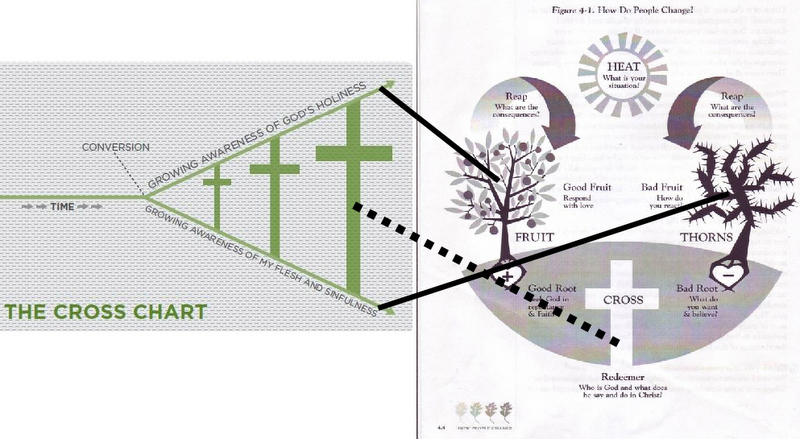
Right. As I have worn out multiple keyboards emphasizing here on PPT, New Calvinism is a dualist philosophy. Let’s go over this again. Below is THEIR illustration, NOT mine:

Note first that regardless of their verbiage, they don’t believe we really grow, it’s the cross (what it represents) that grows. That’s obviously job one. The endeavor thereof requires a primary focus on two goals and two goals only: a deeper and deeper UNDERSTANDING of our sinfulness, and absolutely nothing else, as set against God’s holiness. Part and parcel with this is also the idea of worthlessness on our part.
The cross represents bigger and bigger salvation which must be manifested more and more until the day when our “final justification” is “revealed.” This occurs as we are sanctified the same way we are saved, by partaking in the realizing of our sinful worthlessness before God and His holiness. The more we understand the difference between the two, the more our salvation is manifested. We don’t change, only the greatness of our salvation changes in order to glorify God. Of course, this obviously redefines the new birth and denies it.
As prorogated in the satanic treatise, “How People Change” by Paul David Tripp, ALL tragic and sinful events in life serve the bottom of the cross chart, and ALL good that occurs in our lives serves the top of the chart. As we contemplate the gospel narrative, the goodness of God is manifested which contributes to more understanding at the top of the chart. Goodness is not our fruit, its God’s fruit only for the purpose of aiding us in understanding His goodness—not ours. Hence, and don’t miss this, justice is not the point. The concept of justice and fairness digresses from Reformed Calvinistic dualism.
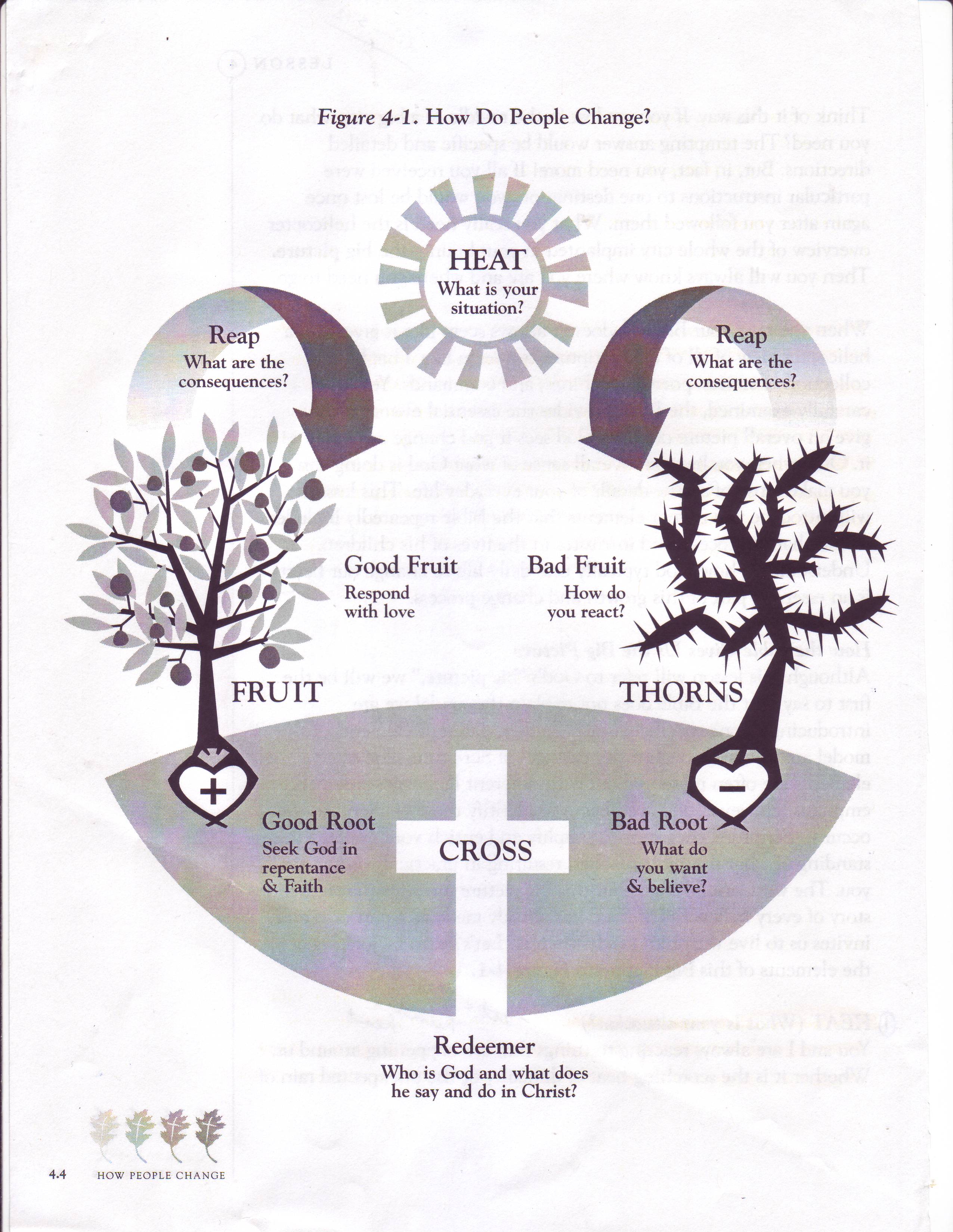
The next point is that in the neo-Calvinist gospel schema, the Scriptures serve as a Cross narrative to help us see this dualism in a clearer way. In the mind of the neo-Calvinist, the Scriptures do not define what is right and fair; the Scriptures define Luther’s “cross story.” Here is what the vast majority of Christians do not understand: six months after Luther’s 95 Theses launched the Reformation, the true magnum opus of the Reformation was written by Martin Luther; his Heidelberg Disputation to the Augustinian Order. The document reflects Luther’s utter Platonist disdain for humanity.
In Luther’s Disputation, all reality must be seen through the cross story; i.e., the cross illustration at hand here, and ALL else is the “glory story” or anything at all to do with us—our glory, not the cross story that makes God bigger and mankind smaller. To any degree that we are in the equation, the cross story is diminished.
Now, let’s take this information and evaluate why Scott et al are completely indifferent to suffering and injustice. What did the Clearcreek elders do that is wrong? Nothing because the purpose of the Bible is not to judge the authority of Reformed elders, it is to show forth the cross story, not our story, and injustice is an Us Story kind of thing. Have former parishioners at Clearcreek suffered unjustly at the hands of the elders? Well, that’s a good thing! That suffering shows us the bottom of the chart. And besides, “justice”? If we got what we all deserved, there wouldn’t be any grace! Is this like Paul’s protest in Romans against propagating more evil that grace may abound? Yes, I think so. To the contrary in the minds of neo-Calvinists, we should bow down and thank God for bringing such abuse into our lives.
This is the gospel construct that rules the majority of biblical counseling in our day and is taking over the church in this country. It is a Platonist world view that set Europe on fire for hundreds of years with unspeakable horrors. And it is a story that is playing at a local church near you.
And this weekend, Stuart Scott brings his version of the show to Springboro, Ohio. A celebration of suffering in the name of Christ. But I have news for Scott: the sins of the Clearcreek elders does not cause grace to abound. And his appearance there has nothing to do with grace or love.
If there are any parishioners at Clearcreek (who may be reading this) who are presently there against their will for fear of public humiliation or things revealed in counseling —in your desperation, don’t slip Scott a note—he’s one of them.
paul

 Paul's Passing Thoughts
1 comment