Identity
 TANC Ministries is presently working on a book project leading up to our 2016 conference in August. I guess my name will be on the book as the author, but the book is really a group project. Maybe the author should be “TANC Ministries.”
Why this project? I will cite some excerpts from the project objective:
“Those who are disillusioned with Christianity, but haven’t given up on God and are looking for answers, often ask, ‘Where do I start?’ Such people who come to PPT, and are overwhelmed by the mass of information often ask, ‘Where is the best place to start?’ Andy Young recently remarked about the multiple layers of misinformation and the question of where this ministry should start with people on our end of the question…The target audience are those looking for real and truthful answers amongst the confusion; they are those trying to make sense out of life in the confusion of Christianity as we know it in our day. The book will have a theological and philosophical bent. Protestants and Catholics alike are dumbed-down by design, think that the Reformation was a theological debate, are confused about basic elements of metaphysics and being, and need a place to start on their truth journey. Those who buy the book will have this in common: they assume reason is a necessary pathway to finding truth.”
At first, it looked like the project was off to a fast start, but what seemed like great ideas were shot down by the group, so it was suggested that I start submitting free-writing articles to the group based on the usual ministry themes, and this will result in an articulation of objectives that the group agrees with. This article is one such submission to the group.
I am not crazy about Facebook, but on the other hand, it is valuable to our ministry, and yesterday was no exception. I am not going to copy and paste the whole debate here between myself and a couple of Catholics, but I am very tempted to think that it will be the crux of our project. The excerpt that encapsulates the main point follows:
“You act as if the Pope speaking ex cathedra or the council of Bishops as an authority of truth is so absurd. I understand that you disagree with it, and you are entitled to the right to disagree. But the concept in and of itself is certainly not absurd. I have to say, if it comes down to which is less absurd, a church authority instituted by Christ is much more plausible than Jesus giving us a Bible and telling everyone they can discern truth completely (error free) by themselves. (Not saying we are completely void of discerning truth, but we will never be perfect at it). Look around you: if everyone could perfectly discern truth for themselves, then why do non-catholic churches continue to split up each and every day? I think there are like over 30,000 denominations now? We are not trying to attack you, Paul M. Dohse Sr. We are just trying to get to the truth. And I have felt misrepresented by your points, so I have to ask the tough questions.”
To me, this absolutely says it all; perhaps the project group will agree. It boils down to man’s (mankind) identity and his ability to interpret reality. Universally, the goal is man’s well-being. Is the key to well-being a proper identity? What does man’s identity have to do with evaluating truth? EVERYTHING. Suppose you identify man as a being that cannot know truth? I think that makes the point.
Now, this necessarily involves a discussion about philosophy and its four major tenets: metaphysics (state of being), epistemology (how we know), ethics (the moral application of how we perceive reality), and politics (how the ethics are communicated). But what about the Bible? From my own perspective, I see the Bible as God’s philosophical statement to mankind. If you are able to defend God’s truth, or the Gospel, you must know what the Bible states about these four tenets of philosophy. No? Really? Consider the following fact: this stream of conversation on Facebook was extremely long, and complete with Scripture stacking and citation wars, but to no avail. Why? Because truth is interpreted through the philosophical prism. A Chinese person might as well be attempting to convince an English person that Chinese is better (anything Chinese) while arguing in their perspective languages. The example that astounds me the most follows: people who seek counsel and assume the counselor shares their view of reality. No wonder so few people are helped by counseling accordingly. Another example makes its own point because few Christians will even know what I am talking about. Pastors in our day view reality from two different perspectives, redemptive or grammatical, and most parishioners are clueless in regard to where their pastors stand on that issue. They assume they know what the pastor is teaching from the pulpit, but really they are clueless.
What is the philosophy of the person that I was having the discussion with? Metaphysics: man cannot know truth PERFECTLY. Epistemology: “ex cathedra or the council of Bishops as an authority of truth.” Ethics: prevention of chaos. Politics: expected obedience to authority. Words mean things, so lets examine his words carefully. The issue with man, according to this person, is he cannot know truth “perfectly.” That’s key. So then, what is the ethic? Christ has appointed an authority on earth to prevent chaos because no man can know the truth perfectly.
But wait a minute, neither can the men whom Christ appointed as an authority; likewise, they cannot know the truth perfectly because they are also men, so what gives? This is what gives: authority for the sake of UNITY is the goal, not truth per se. In fact, UNITY defines truth itself. And where does that come from? Yep, P-l-a-t-o. Among most of the classic sophists, unity itself was truth. At least in Plato’s case, this was the definition of social justice as well. Does that ring any bells in regard to churchianity, or Western society in general? Let me further the point. What was this person’s primary argument for the authority of the Catholic Church? Right, to prevent the chaos of “30,000 denominations” the inevitable result of men being free to discern truth for themselves.
But it gets better when one considers biblical metaphysics. Again, via this person’s own words, the issue is INDIVIDUAL interpretation. But wait a minute, I thought a believer is a totally new creature indwelled by the Holy Spirit? What a minute, I thought the Bible said that the Spirit will lead us in ALL truth. So, why would members of one body with one mind in Christ, and striving for that one mind in Christ be lacking in unity? Why is such a notion “absurd.” Answer: because Catholics and Protestants both fundamentally deny the new birth, that’s why. And consequently, we also hear things from Protestant pastors such as Mark Driscoll saying, “Just keep your damn mouth shut and obey.” As Pastor Chad Bresson is fond of saying, Whether an elder is right or wrong is irrelevant to unity. For those who have the audacity to question an elder, Pastor James MacDonald suggests that they be tied to a catapult and “launched into the next county.” Why are they so passionate about being agreed with? Because obedience to authority is what unifies, not truth—authority is truth.
Moreover, with Believers, “perfection” is not the issue, but LOVE is the issue. Law as condemnation versus law as love is also the difference the new birth makes, but enough said for now. I will see if any of this gets some traction with the project group.
paul
Clearcreek Chapel Gone Wild: Jesus Keeps the Clearcreek Covenant for You
 Originally posted November 18, 2013
My, my, how different Clearcreek Chapel of Springboro, Ohio is since a pack of New Calvinist wolves took it over shortly after the departure of the founding pastor. The victorious pack, led by Chad Bresson (who for some reason recently left the KoolAid paradise that he built at his former chapel with a creepy adoration for his supposed theological prowess) began infiltrating the flock a couple of weeks before Dr. John Street’s departure.
The undomesticated canine delegation he brought with him from a Baptist church in Dayton, Ohio seemed to be frustrated with their inability to devour at that location. Really old sheep produce a mutton that is tough to chew, and invariably leaves a bad aftertaste.
As far as the “friends” I knew back in that day and their susceptibility to believe Bresson’s outrageous mythology, I never saw it coming.
Apparently, just about any place a thinking person pokes the Chapel these days produces something utterly bizarre. I say this because of what I accidently stumbled onto today. In a recent sermon by Chapel elder Devon Berry, who is a mental healthcare professional (yikes!), he stated that Jesus keeps the Chapel covenant for the “beloved” members. Let me share an excerpt:
Is the Chapel covenant a call to a certain kind of living in the Church? Yes, it is. But beloved, it is a call to much, much, much more than that and it can never be only that. It is a call to the living Christ, our righteousness, our sin-bearer, our life. When you read the Chapel Covenant, reflect on Christ first for it is meant to point us to him – not to ourselves and our own efforts. Then rejoice. He has obeyed for us. He has suffered and died for us. And, he has also enabled us by grace – something we’ve talked around this morning but not mentioned directly.
Let me close by contradicting myself. Earlier I said that you could not keep the Chapel Covenant. I will end by saying that you can keep the Chapel Covenant. Grace, the enabling power given by God because we are at peace with him through the work of the cross, provides all that we need to obey and overcome sin. Hence, the Chapel Covenant is a call to live in the reality of who we are as believers. There is no better place you could live, no more joyful place you could abide, no more beautiful place you could dwell than in the life-transforming reality of the gospel. Believer, be who you are for Christ has given you all that you need.
Clearly, Berry is putting the Chapel covenant on par with the Scriptures. He states that it is more than a standard, it is a “call to the living Christ.” And, the ability to keep the covenant requires the enabling grace of Christ? This is beyond creepy. Moreover, if 2+2=4, Berry makes living by the Chapel covenant via the grace of Christ synonymous with dwelling in the “life-transforming reality of the gospel.” And according to Berry, there is not a place in the world where they could have more joy.
Sorry I am missing all the fun.
paul
An Open Letter to the President of the National Association of Nouthetic Counselors
Originally posted February 21, 2012
“This is the apostle Paul’s disparaged 3-verse system to fix a lack of peace. It is the wonderful hope that obedience to God’s word seizes upon His promises. And that’s why many NANC counselors strip their victims of hope.”
“The cited letter reflects the same things often taught by many board members of NANC and BCC. Because this doctrine combines justification and sanctification, it makes sanctification like a minefield because what we do in sanctification can affect the justification that supposedly powers it. This does not lay a healthy foundation for counseling”
Dr. Street,
The National Association of Nouthetic Counselors website states the following about your organization:
NANC exists to help pastors and those who would be ministers of the Word of God by providing help and encouragement. NANC is first and foremost a certifying organization. The certifying process is rigorous but attainable by even the busiest pastor. The process consists of the completion of an approved training course, the completion of a theological and a practical counseling test, several references, and a minimum of 50 hours of supervised counseling experience.
Furthermore, your organization refers hundreds of “counselors” certified by your organization. The purpose of this letter is to publically confront you in regard to the fact that NANC has board members, Fellows, and hoards of certified counselors who openly promote a blatant false gospel. I will first establish this fact, in case you are not aware of it, and then beseech you to tell me why this is acceptable.
Much data could be provided as I have been sent several articles written by NANC Fellows that contain outrageous teachings; and apparently, NANC thinks nothing of sending troubled people to antinomian mystics. But I only need to quote one of your present board members, David Powlison. Powlison performed a lecture at John Piper’s church while Piper was on a sabbatical to eradicate “several species of heart idols” that he saw in his heart (apparently, they were of the 8-month type because he was able to return to ministry at the pre-appointed time). Powlison stated the following at Piper’s church:
This might be quite a controversy, but I think it’s worth putting in. Adams had a tendency to make the cross be for conversion. And the Holy Spirit was for sanctification. And actually even came out and attacked my mentor, Jack Miller, my pastor that I’ve been speaking of through the day, for saying that Christians should preach the gospel to themselves. I think Jay was wrong on that.
Jack Miller was the father of Sonship Theology, a false gospel that is presently wreaking havoc on Presbyterian churches. It has also been known as Gospel Sanctification and is the primary catalyst for the present-day New Calvinist movement which has turned orthodoxy completely upside down. The doctrine is best explained by a theological journal that was its source:
Unless sanctification is rooted in justification and constantly returns to justification, it cannot escape the poisonous miasma of subjectivism, moralism or Pharisaism…. Since the life of holiness is fueled and fired by justification by faith, sanctification must constantly return to justification. Otherwise, the Christian cannot possibly escape arriving at a new self-righteousness. We cannot reach a point in sanctification where our fellowship with God does not rest completely on forgiveness of sins…. Christian existence is gospel existence. Sanctification is justification in action.
Miller adopted the theology and coined the phrase, “We must preach the gospel to ourselves every day.” “The same gospel that saved us also sanctifies us” is the New Calvinist mantra of our day. I receive many links to articles written by NANC Fellows who clearly hold to this doctrine. In fact, How People Change, written by Timothy Lane and Paul David Tripp (and based on Powlison’s Dynamics of Biblical Change) is a Sonship/Gospel Sanctification treatise. Tripp and Lane are also on the board of the upstart Biblical Counseling Coalition. That board is the who’s who of Sonship/GS/ NC, including hyper-antinomian Elyse Fitzpatrick.
On a church level, here is the fruit of this doctrine:
To the Ruling Elders of Southwood:
On September 4, 2011, our daughter and her family from Atlanta were here and we attended the Sunday worship at Southwood. After the service, our 13 year old granddaughter, who is well grounded in scripture, stated that she was very confused by the message. She had come away hearing that every good thing she does is wrong. Why would she believe that? We have gone back and listened again to that message, entitled “Duh,” and here is what we found:
The message is from Galatians 3:1-6. Paul is chastening the church for falling prey to the persuasion of the Judaizers, exhorting them again that God’s love for them was not by any of their own works but through the miraculous work of Christ and the Holy Spirit. Jean seems to take the written word beyond its intent. He subtly changes ‘God’s love’ to ‘God’s favor.’ He changes legalism to performance. He takes Jewish law and extends it to almost any action one does. Here are some paraphrased quotes from the sermon. “To keep God’s favor, the Galatians were believing they needed Christ and a dash of obedience which looks like those things called Christian disciplines. Christian walk Christianity is from the Devil. Faithfulness is feeling condemned for work you haven’t finished (as contrasted with faith: resting completely in Christ). Faith is a litmus test for teachers and leaders; the difference between faith in Christ alone and faithfulness is like the difference between truth and falsehood, between Heaven and Hell. Faith alone is all we will teach.” (Here Jean says this is what Paul is teaching but he gives no supporting scriptures to support his interpretation.) “Discern as false any book, sermon, or Bible study where you hear a dash of self justifying obedience. Self justifying obedience is from Satan.
Jean’s statements, combined with the tone and inflections in his delivery, imply that he is scornful of Christian disciplines, preachers, Christian writers, the Christian walk, obedience, faithfulness, good works, and an individual’s efforts. This message can lead to the conclusion that everything we do is evil and, by extension, that God and the Holy Spirit can do nothing through us. The message lacks balance and leaves sanctification out of the equation. A new believer under this teaching would be moribund after accepting Christ, hidebound in fear that he can do nothing right. While it is true none of us have all pure motives, it is also true that God commands us to go forward and that the Holy Spirit will be with us. God says we are His instruments for spreading the Truth. We cannot do this if we are strapped by guilt; we can do this if we seek partnership with the Holy Spirit.
From here Jean goes back to Paul saying “…since you were 100% depraved when you were brought into the Kingdom by the Holy spirit and by no works of your own, why are you trying to be perfected by your own human efforts? You are being deceived by the Devil.” I believe Jean is paralleling Paul in this. Jean then goes on to “We are like alcoholics ; we use Bible study, prayers, small groups, etc. as a crutch and the church rewards our ‘addiction’ with its approval. How would you know if you were addicted? Stop everything. If you feel anxiety, then you are afraid of leaving your ‘fix.’” So we ask: what does God have us do? Jean’s answer is “rest totally in Jesus.” So in turn we ask, what does Scripture say about resting totally in Jesus? But we hear no clear answer from the pulpit.
The cited letter reflects the same things often taught by many board members of NANC and BCC. Because this doctrine combines justification and sanctification, it makes sanctification like a minefield because what we do in sanctification can affect the justification that supposedly powers it. This does not lay a healthy foundation for counseling, and as Timothy F. Kauffman recently stated in the Trinity Review, when justification and sanctification are combined, anything we do in sanctification is works salvation—even doing nothing. It’s eerily reminiscent of Christ’s parable concerning the slothful servant. When such a parable is considered and compared to statements by Elyse Fitzpatrick and her spiritual big brother Tullian Tchividjian, it should make the hair stand up on a deceased person.
Moreover, the unfortunate results of counseling that comes from this doctrine can be seen in the following statement by a pastor who oversees a NANC counseling center:
We read this quote from Paul Tripp in last week’s Biblical Theology Study Center. Amazingly, part of the quote was used again the following evening during testimony time from someone not in our class…someone who resonated with the quote in the midst of personal crisis. For those who are involved in biblical counseling, it can be really easy (and tempting) for the Bible to become little more than a 12-verse system designed to fix a life. Tripp reminds us that the Bible isn’t a how-to manual, but a place where we find hope in a Person.
Compare that statement with what the apostle Paul said:
Do not be anxious about anything, but in every situation, by prayer and petition, with thanksgiving, present your requests to God. And the peace of God, which transcends all understanding, will guard your hearts and your minds in Christ Jesus.
Finally, brothers and sisters, whatever is true, whatever is noble, whatever is right, whatever is pure, whatever is lovely, whatever is admirable—if anything is excellent or praiseworthy—think about such things. Whatever you have learned or received or heard from me, or seen in me—put it into practice. And the God of peace will be with you.
This is the apostle Paul’s disparaged 3-verse system to fix a lack of peace. It is the wonderful hope that obedience to God’s word seizes upon His promises. And that’s why many NANC counselors strip their victims of hope. That, and confusing children who love the Lord.
So tell me Dr. Street, why is this acceptable? Why not come out from among them? Besides, the evidence that this doctrine was concocted by a Seventh-Day Adventist who is now an atheist is overwhelming. The truth will come out, and will eventually be accepted as truth. Why stick around and look stupid? Or, you could fix the problem. I beseech you Dr. Street, stop sending troubled people to false teachers. This is something that none of us want on our resume.
Paul Dohse
Like John Street, Like Stuart Scott: A Celebration of Mystic Despotism

Will Speak at Clearcreek Chapel’s 2015 “Family Enrichment” weekend.
 “Hence, and don’t miss this, justice is not the point. The concept of justice and fairness digresses from Reformed Calvinistic dualism.”
“….six months after Luther’s 95 Theses launched the Reformation, the true magnum opus of the Reformation was written, his Heidelberg Disputation to the Augustinian Order. The document reflects Luther’s utter Platonist disdain for humanity.”
“Now, let’s take this information and evaluate why Scott et al are completely indifferent to suffering and injustice.”
Once again, Stuart Scott will break bread with the elders at Clearcreek Chapel (Springboro, Ohio) as he is the featured speaker at this year’s “Family Enrichment” Conference. Clearcreek Chapel having a family enrichment conference is like the Nazis sponsoring an endowment for Judaism. It’s a mockery; the Chapel has ravaged innumerable families and Christian lives since its orchestrated takeover by Russ Kennedy and aided by former Clearcreek elder Greg Cook. Cook brought in a group from another Baptist church which included present Clearcreek elders Chad Bresson and Dr. Dale Evans.
Their attempted takeover of the church they left failed, but their endeavor at the Chapel succeeded—the spiritual carnage notwithstanding. Cook, as director of Clearcreek’s counseling program, was giving wives the green light to divorce husbands who had “ruined the family finances” while he himself was just under $200,000.00 in due and owing debt. It is unclear as to whether this revelation led to his stepping down as an elder, or not. Probably not since hypocrisy is a requirement for eldership in our day.
Other present Clearcreek elders have been forced to step down in the past, but have been reinstated; specifically, Mark Schindler who was re-baptized after his prior eldership. Apparently, not being sanctified by justification was the prior cause of his disgrace. Whatever it was specifically, his wife gave testimony that she never considered divorce and was determined to make the marriage work. It’s a pity that such wifely resolve that saved Schindler’s marriage is not encouraged among wives in the counseling rooms of the Chapel in this day. But one must remember that such resolve is only honorable in regard to saving the marriages of New Calvinist philosopher kings.
It all seems insane until you realize that people act from their logic. Why would Scott give credence to such a camp? Why would he ignore the pleadings of the oppressed? Why is he, like all New Calvinists, utterly indifferent to justice? We get a clue from his book The Exemplary Husband on page 72. He states the following:
God uses everything in our lives for His perfecting (growing) purposes (Romans 8:28-29; James 1:2-4). As we learned earlier, our growth as Christians toward Christ-likeness is a life-long process, often referred to as sanctification. Because God is so intent on sanctifying us, we know that He will certainly use our most important human relationships to do this.
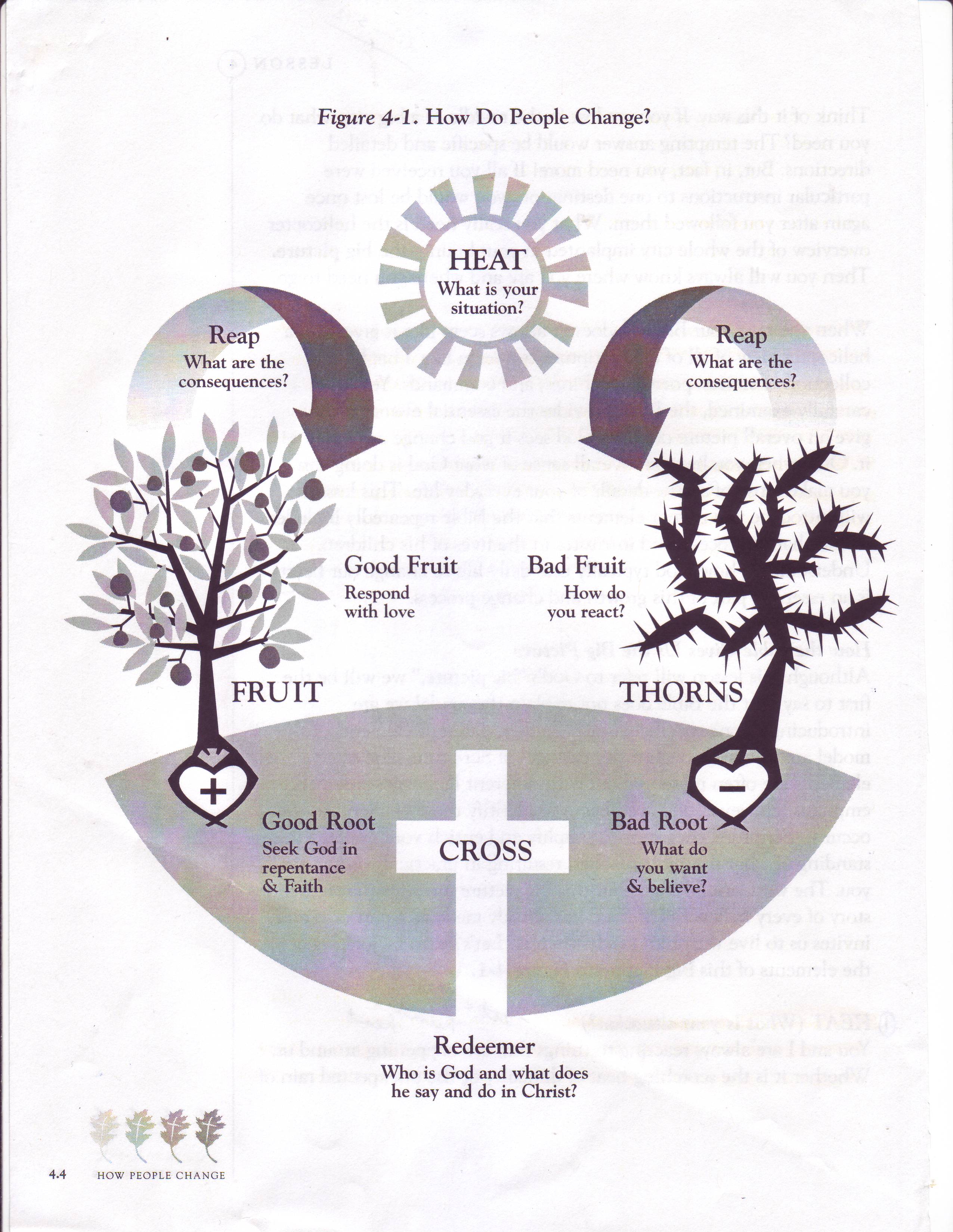
Right. As I have worn out multiple keyboards emphasizing here on PPT, New Calvinism is a dualist philosophy. Let’s go over this again. Below is THEIR illustration, NOT mine:

Note first that regardless of their verbiage, they don’t believe we really grow, it’s the cross (what it represents) that grows. That’s obviously job one. The endeavor thereof requires a primary focus on two goals and two goals only: a deeper and deeper UNDERSTANDING of our sinfulness, and absolutely nothing else, as set against God’s holiness. Part and parcel with this is also the idea of worthlessness on our part.
The cross represents bigger and bigger salvation which must be manifested more and more until the day when our “final justification” is “revealed.” This occurs as we are sanctified the same way we are saved, by partaking in the realizing of our sinful worthlessness before God and His holiness. The more we understand the difference between the two, the more our salvation is manifested. We don’t change, only the greatness of our salvation changes in order to glorify God. Of course, this obviously redefines the new birth and denies it.
As propagated in the satanic treatise “How People Change” by Paul David Tripp, ALL tragic and sinful events in life serve the bottom of the cross chart, and ALL good that occurs in our lives serves the top of the chart. As we contemplate the gospel narrative, the goodness of God is manifested which contributes to more understanding at the top of the chart. Goodness is not our fruit, its God’s fruit only for the purpose of aiding us in understanding His goodness—not ours. Hence, and don’t miss this, justice is not the point. The concept of justice and fairness digresses from Reformed Calvinistic dualism.
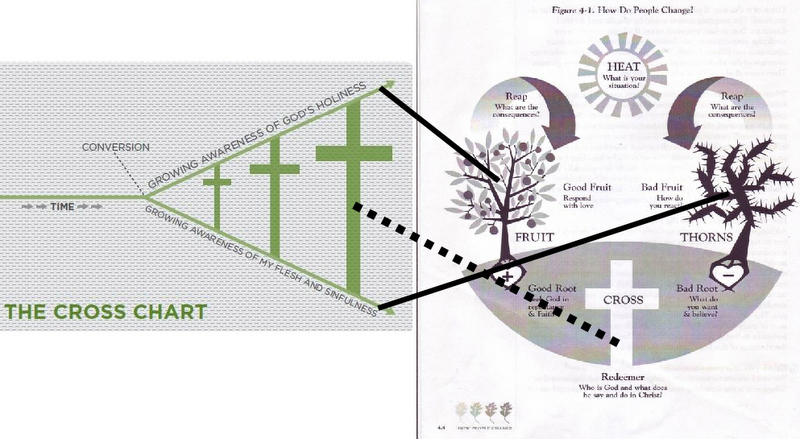
The next point is that in the neo-Calvinist gospel schema, the Scriptures serve as a Cross narrative to help us see this dualism in a clearer way. In the mind of the neo-Calvinist, the Scriptures do not define what is right and fair; the Scriptures define Luther’s “cross story.” Here is what the vast majority of Christians do not understand: six months after Luther’s 95 Theses launched the Reformation, the true magnum opus of the Reformation was written, his Heidelberg Disputation to the Augustinian Order. The document reflects Luther’s utter Platonist disdain for humanity.
In Luther’s Disputation, all reality must be seen through the cross story; i.e., the cross illustration at hand here, and ALL else is the “glory story” or anything at all to do with us—our glory, not the cross story that makes God bigger and mankind smaller. To any degree that we are in the equation, the cross story is diminished.
Now, let’s take this information and evaluate why Scott et al are completely indifferent to suffering and injustice. What did the Clearcreek elders do that is wrong? Nothing because the purpose of the Bible is not to judge the authority of Reformed elders, it is to show forth the cross story, not our story, and injustice is an Us Story kind of thing. Have former parishioners at Clearcreek suffered unjustly at the hands of the elders? Well, that’s a good thing! That suffering shows us the bottom of the chart. And besides, “justice”? If we got what we all deserved, there wouldn’t be any grace! Is this like Paul’s protest in Romans against propagating more evil that grace may abound? Yes, I think so. To the contrary in the minds of neo-Calvinists, we should bow down and thank God for bringing such abuse into our lives.
This is the gospel construct that rules the majority of biblical counseling in our day and is taking over the church in this country. It is a Platonist world view that set Europe on fire for hundreds of years with unspeakable horrors. And it is a story that is playing at a local church near you.
And this weekend, Stuart Scott brings his version of the show to Springboro, Ohio. A celebration of suffering in the name of Christ. But I have news for Scott: the sins of the Clearcreek elders does not cause grace to abound. And his appearance there has nothing to do with grace or love.
If there are any parishioners at Clearcreek (who may be reading this) who are presently there against their will for fear of public humiliation or things revealed in counseling —in your desperation, don’t slip Scott a note—he’s one of them.
paul
Destroying Eve-il is a Reformed Family Tradition: Today Danvers, Tomorrow the Gallows
Originally published August 1, 2012
Great pizza party last night with an author who is writing a sci-fi novel. As I sat and listened to him share his shocking plot designed to invoke terror in his future readers, my recent research for “Reformation Myth” made the chilling plot seem mundane in comparison to sexy witches being hung, burned, and impaled with images of Mary fitted with large spikes.
On the one hand, the Reformers were supposedly brilliant for recognizing Plato’s theory that pure truth and beauty is immutable, while on the other hand, their brutality was merely the “mentality of the age.” It is also understandable why Reformed folks are so big on, “all truth is God’s truth” because the Catholic church had a lot of ideas that the Reformers thought were pretty cool; specifically, that because of Eve, women in general are predisposed to evil, or Eveil.
Between sips of mocha that could barely be executed because of my fixated attachment to the narrative, the little angel on my right shoulder kept saying, “Excuse me, this is history, and it really happened.”
Indeed it did happen, and the war declared on witches by the Catholic Church and the Reformers resulted in casualties that surpass many, many wars waged throughout history. And, to say the least, the due process of law that determined who was a witch was, well, shall we say, a little lean. Since it was thought that 90% of all witches were women, if you were a woman, and dragged into court, your gender was a bad start to the process. In at least one case, a particularly pious woman didn’t even take her arrest seriously and was sarcastic towards her accusers—who later executed her. I guess there is only one thing worse than a witch—a sarcastic woman. Then, there was this also:
The climate of fear created by churchmen of the Reformation led to countless deaths of accused witches quite independently of inquisitional courts or procedure. For example, in England where there were no inquisitional courts and where witch-hunting offered little or no financial reward, many women were killed for witchcraft by mobs. Instead of following any judicial procedure, these mobs used methods to ascertain guilt of witchcraft such as “swimming a witch,” where a woman would be bound and thrown into water to see if she floated. The water, as the medium of baptism, would either reject her and prove her guilty of witchcraft, or the woman would sink and be proven innocent, albeit also dead from drowning (Helen Ellerbe: The Dark Side of Christian History,Chapter Eight: 1450 – 1750 C.E.).
It all started with the Catholics first, and the Reformers later joined the campaign that supplemented the inquisition:
Pope John XXII formalized the persecution of witchcraft in 1320 when he authorized the Inquisition to prosecute sorcery. .” Thereafter papal bulls and declarations grew increasingly vehement in their condemnation of witchcraft and of all those who “made a pact with hell.” In 1484 Pope Innocent VIII issued the bull Summis desiderantes authorizing two inquisitors, Kramer and Sprenger, to systematize the persecution of witches. Two years later their manual, Malleus Maleficarum, was published with 14 editions following between 1487-1520 and at least 16 editions between 1574-1669. A papal bull in 1488 called upon the nations of Europe to rescue the Church of Christ which was “imperiled by the arts of Satan.” The papacy and the Inquisition had successfully transformed the witch from a phenomenon whose existence the Church had previously rigorously denied into a phenomenon that was deemed very real, very frightening, the antithesis of Christianity, and absolutely deserving of persecution.
It was now heresy not to believe in the existence of witches. As the authors of the Malleus Maleficarum noted, “A belief that there are such things as witches is so essential a part of Catholic faith that obstinately to maintain the opposite opinion savors of heresy.” Passages in the Bible such as “Thou shalt not suffer a witch to live” were cited to justify the persecution of witches (Ibid.).
The following gives us an idea as to the extent that this was going on:
Contemporary accounts hint at the extent of the holocaust. Barbara Walker writes that “the chronicler of Treves reported that in the year 1586, the entire female population of two villages was wiped out by the inquisitors, except for only two women left alive.” Around 1600 a man wrote:
Germany is almost entirely occupied with building fires for the witches… Switzerland has been compelled to wipe out many of her villages on their account. Travelers in Lorraine may see thousands and thousands of the stakes to which witches are bound (Ibid.).
The general mentality of the Eveil motif was part and parcel with the war on witches:
The witch hunts were an eruption of orthodox Christianity’s vilification of women, “the weaker vessel,” in St. Peter’s words. The second century St. Clement of Alexandria wrote: “Every woman should be filled with shame by the thought that she is a woman.” The Church father Tertullian explained why women deserve their status as despised and inferior human beings:
“And do you not know that you are an Eve? The sentence of God on this sex of yours lives in this age: the guilt must of necessity live too. You are the devil’s gateway: you are the unsealer of that tree: you are the first deserter of the divine law: you are she who persuaded him whom the devil was not valiant enough to attack. You destroyed so easily God’s image, man. On account of your desert that is, death even the Son of God had to die.”
Others expressed the view more bluntly. The sixth century Christian philosopher, Boethius, wrote in The Consolation of Philosophy, “Woman is a temple built upon a sewer.” Bishops at the sixth century Council of Macon voted as to whether or not women had souls. In the tenth century Odo of Cluny declared, “To embrace a woman is to embrace a sack of manure…” The thirteenth century St. Thomas Aquinas suggested that God had made a mistake in creating woman: “nothing [deficient] or defective should have been produced in the first establishment of things; so woman ought not to have been produced then.” And Lutherans at Wittenberg debated whether women were really human beings at all. Orthodox Christians held women responsible for all sin. As the Bible’s Apocrypha states, “Of woman came the beginning of sin/ And thanks to her, we all must die”(Ibid.).
And the Reformers were completely onboard with the Eveil rage of that Day:
St. Augustine of Hippo (354 to 430 CE). He wrote to a friend:
“What is the difference whether it is in a wife or a mother, it is still Eve the temptress that we must beware of in any woman……I fail to see what use woman can be to man, if one excludes the function of bearing children.”
Martin Luther (1483 to 1546):
“If they [women] become tired or even die, that does not matter. Let them die in childbirth, that’s why they are there.”
St. Thomas Aquinas (1225 to 1274 CE):
“As regards the individual nature, woman is defective and misbegotten, for the active force in the male seed tends to the production of a perfect likeness in the masculine sex; while the production of woman comes from a defect in the active force or from some material indisposition, or even from some external influence.”
But the Reformers did way more than stand on the sidelines and cheer. When doing a pdf document search on Witch Hunts In Europe And America, An Encyclopedia by William Burns, “Calvin” got 32 hits including the following:
There are about five hundred recorded witch trials in the 150 years after Calvin’s arrival in Geneva. Given the high rate of survival of Genevan records, this probably represents the majority of cases that occurred. The witch-hunt in Geneva peaked relatively early, in the 1560s and early 1570s. The records show that, outside the witch-hunt of 1571, Geneva had one of the lowest rates of execution in Europe, about 20%. Geneva magistrates seem to have used banishment as an alternative to execution in cases where the guilt or innocence of the subject was in doubt, rather than following the practice of other areas which simply tortured until a confession was obtained. The relatively mild torture practiced by the Genevans kept individual witch cases from developing into large hunts, and in some cases the magistrates were uninterested in following up accusations even when an accused witch named others…
The comparatively small kingdom of Scotland, whose legal system blended English and Continental elements, had from the mid-sixteenth century on a zealous Calvinist clergy intent on creating a godly society. It executed the most witches of any British region. The other British area of high witch-hunting activity was the legally anomalous Channel islands….
William Perkins was Elizabethan England’s leading Calvinist theologian, and his posthumously published A Discourse on the Damned Art of Witchcraft (1608) had an unrivalled influence on subsequent Puritan demonologists in old and New England. Perkins’s approach was intellectually austere. He shunned reference to previous demonologists or actual cases of witchcraft, and based his argument almost entirely on the Bible, particularly Exodus 22.18, “Thou shalt not suffer a witch to live.” Perkins saw the essential nature of witchcraft as the making of the satanic pact, or “covenant,” which inverted the covenant relation between God and his elect that was basic to Puritan Calvinist theology. So closely does Perkins relate the witch’s contact with the Devil to the good Christian’s contact with God that he claims that to deny the possibility of physical contact with devils would be to deny the possibility of covenant with God. Perkins describes the making of the covenant as a simple agreement, without the necessity for the witch to sign in blood or kiss or have sex with the Devil. Other central aspects to the witch stereotype as the sabbat or the Devil’s mark he also ignored. Even maleficia played a minor role. Perkins’s principal target was not the maleficent witch, but the “good witch,” whom he described over and over as even more worthy of death than the evil witch. Perkins believed that all power to perform “magic” could only come from Satan.
William Perkins was the elder statesman of the very same Calvinist Puritans that boarded the Mayflower and landed on Plymouth Rock. John Robinson, their pastor and follower of Perkins, gave an impassioned speech to them before they boarded the ship. The Pilgrims, who were really political refugees, set up a Geneva style Calvinistic theocracy known as the American Colonies and was the spawning grounds for colonial Calvinism.
Go figure, not long after, in Salem Town and Salem Village, the infamous Salem witch trials occurred. The Puritan Cotton Mather was heavily involved and attended the execution of Salem Town’s pastor, George Burroughs, who was accused of aiding and abetting a covenant of witches. An actual account of the sad proceedings follow:
George Burroughs was executed on Witches Hill, Salem, on the 19th of August, the only minister who suffered this extreme fate.
Though the jury found no witches’ marks on his body he was convicted of witchcraft and conspiracy with the Devil. While standing on a ladder before the crowd, waiting to be hanged, he successfully recited the Lord’s Prayer, something that was generally considered by the Court of Oyer and Terminer to be impossible for a witch to do. After he was hung, Cotton Mather, a minister from Boston, reminded the crowd from atop his horse that Burroughs had been convicted in a court of law, and spoke convincingly enough that four more were executed after Burroughs. Below is the original account as first compiled and published in 1700 by Robert Calef in More Wonders of The Invisible World pages 103-104, and later reprinted or relied upon by others including Charles Wentworth Upham and George Lincoln Burr,
Mr. Burroughs was carried in a Cart with others, through the streets of Salem, to Execution. When he was upon the Ladder, he made a speech for the clearing of his Innocency, with such Solemn and Serious Expressions as were to the Admiration of all present; his Prayer (which he concluded by repeating the Lord’s Prayer) was so well worded, and uttered with such composedness as such fervency of spirit, as was very Affecting, and drew Tears from many, so that if seemed to some that the spectators would hinder the execution. The accusers said the black Man [Devil] stood and dictated to him. As soon as he was turned off [hung], Mr. Cotton Mather, being mounted upon a Horse, addressed himself to the People, partly to declare that he [Mr. Burroughs] was no ordained Minister, partly to possess the People of his guilt, saying that the devil often had been transformed into the Angel of Light. And this did somewhat appease the People, and the Executions went on; when he [Mr. Burroughs] was cut down, he was dragged by a Halter to a Hole, or Grave, between the Rocks, about two feet deep; his Shirt and Breeches being pulled off, and an old pair of Trousers of one Executed put on his lower parts: he was so put in, together with Willard and Carrier, that one of his Hands, and his Chin, and a Foot of one of them, was left uncovered.
—Robert Calef
Now, in our day, and unbelievably, the proud children of this Calvinist legacy pronounce themselves the experts on “biblical manhood and womanhood.” Specifically, an organization was formed in 1987 called “The Council on Biblical Manhood and Womanhood.” It is funded, organized, maintained, and directed by the who’s who of the American Neo-Calvinist movement including, Ligon Duncan, Wayne Grudem, John Piper, and Al Mohler. They formed a statement/declaration on this subject that was so well attended by their forefathers called the “Danvers Statement.” It is called the Danvers Statement because their declaration was finalized in—get this— Danvers, Massachusetts.
So, what’s relevant about that? Well, Danvers is the modern day location of Salem Town, the location of the Salem witch trials. In fact, these guys made it a point to have the meetings there that finalized the document. Ok, I mean, really, if you are a bunch neo-Nazis who want to start a forum on Judaism, would you make it a point to finalize your declaration at Auschwitz?
Furthermore, the Reformers didn’t get up one morning and decide to start burning witches—it all began with their Eveil doctrine. And the proponents of this movement not only swear by the theological genius of Calvin, but what they teach about the fall and Eve’s participation is word for word. Also, in regard to what is actually going on as far as treatment of women, all that is missing is the gallows. Whether it be women locked in basements as punishment, being spanked by their husbands, deprived of education, or their children being held hostage through manipulation of relatives by church elders—it is at least Witch Hunt Light.
Have I read the Danvers Statement? No, why would I? Christ said that false teachers are known by their fruit. The root of the fruit is the doctrine. Good trees don’t bear bad fruit, and Reformed leaders are little more than Adolf Hitler and Joseph Stalin in priestly garb.
paul

 Paul's Passing Thoughts
1 comment