Why Bloggers Must Stand Against Spiritual Despots
 It’s time to get a grip. Susan and I have been visiting many churches and reading a mass of recommended sermons on, “forgiveness,” “judging others,” “humbleness,” and “pursuing peace” that are saturating the internet. These sermons, like the ones we are hearing Sunday, after Sunday, are geared to control people via the following principles; albeit ever so subtle, and of course, by proof texting:
1. In comparison to Christ, everything on Earth, including life in general, is a pile of dung. So, all the bad things that happen are irrelevant. I mean, what do you expect? God allows these things to happen to draw us closer to Him and wean us from our desires for things on Earth. Oh that we would have no desires whatsoever other than “Christ and Him crucified!” That is our goal. No desires at all other than Christ is the ideal.
2. “Justice?” [add sarcastic smirk that begs the question: are you really that clueless?]. “You want justice? If we all got what we deserved, we would all be in hell!” “In regard to everything in life, remember the Puritan who looked upon a marcel of meat that was his only meal for that day and said, ‘What? Christ?? And this also???!’” Being interpreted: any dissatisfaction with life at all directly relates to your unthankfullness for being one of the chosen ones. Yes, I had a sinful thought the other day: I was thinking about how nice it would be to take Susan on a cruise. Just the two of us out on some boat in the middle of God’s vast ocean. How dare me! Those thoughts could have been better expended on the excellency of Christ!
3. The saints are incapable of righteous indignation because of our total depravity. Righteous indignation is arrogance. All anger is sin. We are always angry because we didn’t get our own way.
4. A sense of accomplishment is pride. Jesus does it all for us. We are totally depraved and every good work we do was preordained by God for His glory, and the rest of our life is left to us to muddle through to teach us not to depend on any of our fleshly “strengths” or “abilities.” It’s all good—both what God has predetermined and our own sins point us back to Christ and His works only, “not anything we would do.” “It’s not our doing—it’s Christ’s doing and dying.”
5. The preordained elders of the church must use the law to control the totally depraved zombie sheep. However, remember, every verse must be seen in the context of the historical Christ event, and this takes a special anointing given to those who have been preordained to lead the zombie sheep to heavenly safety despite themselves. “I’m sorry, you who question the elders, it just so happens that your marriage doesn’t ‘look like the gospel’ so we must tell your wife to divorce you. Yes, I know it seems like a contradiction to the plain sense of Scripture, but you don’t have the special anointing that enables you to see the ‘higher law of Christ’ that we can see.”
6. And remember, even though they are God’s chosen and specially anointed, they are still totally depraved like us. See, this is a huge problem—this whole problem with evangelicals wanting Reformed elders to “be the gospel, rather than preaching the gospel.” In other words, trying to manifest our own behavior, rather than manifesting the gospel; ie., Christ’s “active obedience” that is continually imputed to us in sanctification.
7. Conclusion: Keep your stinking mouth shut, buy the books that translate the Bible into “Chrsitocentric gospel truth,” tithe 10% or else, sit under elder preaching as the only way to manifest the historic Christ event, rejoice that all evil in the church makes the cross bigger, and report people who ask questions.
Certainly, the wholesale brainwashing of the saints in this country, and in our day, may be unprecedented. I see it daily in this ministry through correspondence from battered sheep: “Are my elders wrong in their wrongdoing?” How would we know? They supposedly can see things we can’t see. The rest of the congregation is told to “trust the elders who are close to the situation and know all the facts.” Saints stand perplexed and ask, “How can they do that when it is plainly against the Bible?” The answer is simple: they don’t read their Bibles the same way we do. The “gospel” is an objective truth (by the one word only) that is an unknowable eternal truth that the “knowers” can only know.
The Reformers bought into all this stuff, and it is nothing more than a Gnostic perspective that despises life. The statements that vouch for this are everywhere in the Calvin Institutes and Luther’s commentaries, as well as things spoken by contemporary Neo-Calvinists, but we simply don’t want to believe that they are saying what they are saying. Could they be wrong in their wrong? Could they be erroneous in their error? Is their hatred really hatred? Is their law-breaking really a violation of the law? Where do I even begin here? I had a Reformed elder call and tell me that another elder told him that God will bind in heaven whatever elders bind on earth—even if they are wrong. He then added that he didn’t really believe the guy said it. He was standing there, did he say it or not? And if he did, do they really believe that? Hhhheeeellllooo, yes they do!
This is just all a repeat of history. It all boils down to whether men own men by proxy, or whether God owns man. And if God owns man, to what point does He want us to be responsible for ourselves? To what point does our participation in life matter? How are we to think about the full philosophical spectrum of life? Bottom line: we are letting spiritual despots determine these questions and not our Creator. And yes, what God wants to be accomplished in His kingdom is being affected. The world is watching, and they are not impressed, and the answer is not “keeping it all in the family.” And, “What happens in the church, stays in the church because the world doesn’t understand the ‘historic Christ event.’”
“Deb,” or “Dee,” I forget which, over at, I forget, “The Whatburg blog”? or something like that, got it right: the internet is the modern-day Gutenberg press. Yes, there is a lot of pain out there, but there will be a lot more if what is done in darkness is not exposed to the light. This is exactly what God’s word instructs us to do when professing Christians refuse to repent of serious offences against each other: “TELL IT TO THE CHURCH.” Then what? Those who are aware of it are to “stay aloof” from them. It is a fellowship issue. And the willingness of MacArthur et al to fellowship with serial sheep abusers shows what their true love for biblical truth is: not much, if any.
Do you think I am being extreme? Then explain the following to me:
1. The rampant cover-ups by “respected” church leaders.
2. The utter indifference to abuse by the leaders of our day.
3. The blanket acceptance of ridiculous ideas by the who’s who of national religious leaders; such as, John Piper’s “Scream of the Damned.”
4. The wholesale fellowship of leaders with blatant mystics like Tim Keller.
5. Rape and pedophilia swept under the rug and ignored—an atrocity that was once identified primarily with the Catholic Church.
Whether Rome or Reformed, the behavior is the same because the underlying presupposition is the same: the totally depraved must be enslaved to “enlightened” leaders; supposedly, by God’s approved proxy. And there are a hundred different doctrines that seek to reach that goal—we argue over the correctness of each doctrinal nuance, but the goal of all of them is the same: CONTROL. As author John Immel aptly states, these men speak for God, but the problem is….God is not standing there to personally object. Immel states this as a manner of speaking—God is standing there to object, if the mental sluggards of our day would open the Bible and listen for themselves.
But nevertheless, this is way Reformed theologians want to make the Bible a mystical gospel narrative rather than a full philosophical statement on metaphysics, epistemology, ethics, and interpersonal application to be understood and interpreted by the individual born again believer with the help of elders—not the dictation thereof. The latter is for purposes of control—job one for most churches in this country.
The state’s worst fear is an uncontrolled populous, and religions have always come knocking on their doors offering a belief system that will produce a docile mass, and by the way, “if they won’t believe what we tell them to, you can kill them for us.” Do some historical googling on your own—Rome nor the Reformers have ever been any different on this wise. Oh, and you can add the Puritans to that list as well. They called their place of landing “New England.” New location—same England, complete with witch hunts and persecution of those who disagreed with them. Uh, do you think it is coincidence that their only Bible was the Geneva Bible? Now research the city council archives from Geneva during the time Calvin ruled there. Yes, it really happened. And yes, Rome would do what they have always done if the Enlightenment had not put them in their place. Historically, whether Reformed, or Romish, their tyranny has gone underground when they are contended against. A good illustration of this is the book. “House Of Death and Gate Of Hell” by Pastor L.J. King. Pushed back by the Enlightenment, the Catholic Church merely went underground with the Inquisition. Therefore, all of the whining about the evils of the Enlightenment among the Reformed is no accident. The freedom of ideas has always been the tyrants worst enemy.
“Oh now Paul, you can’t just paint the whole movement with one big brush.” Why not? That’s how Jesus painted the Pharisees. When did Jesus ever say, “Beware of the leaven of the Pharisees, but they aren’t all bad. I can’t just paint the whole movement with a big brush. Some of those guys are ok. We have to take from the shelf what is good and leave the rest where we found it.” See my point on how the Bible is a comprehensive statement on how to live and think for the individual? We can’t use it for that if it is a mystical gospel narrative. And that’s the point: control, by removing our ability to think for ourselves. When we read that Luther despised reason, we don’t think he really meant it just because he wrote it. Oh really?
So, in case you aren’t keeping track, that’s reason number three why discernment bloggers need to keep up the blogging: it’s a call to come out from among them. That’s the biblical model: ducks swim with the ducks and birds fly with the birds. Congregations that support abusive ministries need to be confronted about it, and most certainly, others need to be warned that they shouldn’t support those ministries either. Statistics show that 80% of all parishioners who visit a church will google it—exactly, why should the other side of the story not be told? Because abusive churches are masters of deceit, and centralist doctrine is slowly assimilated into the minds of people like the proverbial frog in boiling water, many people are simply in too deep before they realize what is going on. I deal with people who are simply too spiritually weak (through indoctrination designed to do just that) to do what they have to do to leave a given church. Let me state something in regard to what John Immel calls “private virtue.” If warning a sleeping family that their house is on fire is not a private virtue, which Immel rightly fingers as an oxymoron, neither is blogging about abusive churches. Far from it. There is no place for private virtue in our duty to stand against spiritually abusive leaders.
Another reason that the bogosphere must continue to take a hard stand is because the Bible specifically states that we are to do just that. Consider 2 Corinthians 10:4,5;
The weapons we fight with are not the weapons of the world. On the contrary, they have divine power to demolish strongholds. We demolish arguments and every pretension that sets itself up against the knowledge of God, and we take captive every thought to make it obedient to Christ.
Christians have a duty to contend against EVERY “thought” that is contrary to God’s truth, and they are to use truth to do that. I don’t think much needs to be added to this point.
Like our belief that the Popes of our day wouldn’t repeat the horrors of the inquisition, even though they clearly did up until the early 50’s after being forced underground by the Enlightenment, we imagine that the Neo-Calvinists of our day would never repeat the behavior of the Reformers and Puritans. We are sadly mistaken. The spiritual abuse tsunami that we are seeing in our day is Reformation light. The gallows and the stake stoked with green wood has been replaced by bogus church discipline with excommunication following, character assignation, commanding people to divorce their spouses, ruining people’s careers, and false incrimination. It is now protocol for many New Calvinist church leaders to make a concerted effort to get in tight with local law enforcement in case they would need a “favor.” In my contention with Clearcreek Chapel in Springboro, Ohio, I received a very inappropriate phone call from a police detective who ordered me to do certain things that were clearly outside of his authority. I immediately contacted an attorney and started compiling data because I didn’t know what was coming next. My life was also threatened via email. Whatever the present abuse might escalate to, I think it prudent to do all we can to end it where it is at.
The present-day Neo-Calvinists are absolutely correct: they have “rediscovered” the true Reformation gospel. Ministry themes like “Resurgence,” “Modern Reformation,” and “Resolved” are absolutely correct in their assertion that the true Reformation gospel has been recently rediscovered (circa 1970). But where did it go? “The Enlightenment and Existentialism suppressed It.” Hardly. The Enlightenment and Existentialist movements were a pushback against the tyranny that is part and parcel with the Reformation gospel. The Reformation gospel dies a social death every 100-150 years because of the following:
1. The idea of the plenary inability of man leads to a significant decrease in quality of life.
2. The saints eventually discover that said philosophy imposed an interpretation on the Bible regarding the gospel, instead of a gospel understood from exegesis. Another way of stating it: The Reformation gospel is false, fuses justification and sanctification together so that all works are of God only, denies the new birth, is Gnostic, and is accompanied by bad fruit accordingly.
3. The tranny that cannot help but be a part of this doctrine eventually peaks; ie., the saints finally get fed-up.
4. The Gnostic concept of continually recycling a narrow concept that is supposedly the gateway to higher knowledge eventually gets boring. In this case; gospel this, gospel that, gospel the other, gospel driven marriage, gospel driven music, gospel driven child rearing, gospel driven drivers education, gospel driven weight loss programs, and 52 different versions of the gospel a year parsed out on each Sunday. People also get tired of 7/11 music: seven verses about Jesus repeated 11 times.
5. A narrow sanctification dynamic begins to wreak havoc on the saints; ie., ruined lives become the norm.
6. An air of indifference becomes evident. Everybody starts acting like Dr. Spock.
7. Like its kissing cousin, Communism, it just eventually sucks the life out of people, and they start looking for something else. The doctrine simply does not deliver in the long run.
8. The light bulb finally turns on: when the doctor says: “there is nothing we can do,” that =’s no hope. The saints begin to wonder why the Christian life is any different.
And that’s what we are seeing right now. Big time. And regardless of the various stripes of those who are in the fight—we are united on the following: the tyranny and abuse must stop. And what will stop it is the same thing that has always stopped it: the truth proclaimed from the housetops. An incessant, relentless, tenacious proclaiming of the truth hastens the rightful death of tyranny.
It is true, “the keyboard is mightier than the sword.”
paul
Destroying Eve-il is a Reformed Family Tradition: Today Danvers, Tomorrow the Gallows
 Great pizza party last night with an author who is writing a sci-fi novel. As I sat and listened to him share his shocking plot designed to invoke terror in his future readers, my recent research for “Reformation Myth” (due to be published in January 2013) made the chilling plot seem mundane in comparison to sexy witches being hung, burned, and impaled with images of Mary fitted with large spikes.
On the one hand, the Reformers were supposedly brilliant for recognizing Plato’s theory that pure truth and beauty is immutable, while on the other hand, their brutality was merely the “mentality of the age.” It is also understandable why Reformed folks are so big on, “all truth is God’s truth” because the Catholic church had a lot of ideas that the Reformers thought were pretty cool; specifically, that because of Eve, women in general are predisposed to evil, or Eveil.
Between sips of mocha that could barely be executed because of my fixated attachment to the narrative, the little angel on my right shoulder kept saying, “Excuse me, this is history, and it really happened.”
Indeed it did happen, and the war declared on witches by the Catholic Church and the Reformers resulted in casualties that surpass many, many wars waged throughout history. And, to say the least, the due process of law that determined who was a witch was, well, shall we say, a little lean. Since it was thought that 90% of all witches were women, if you were a woman, and dragged into court, your gender was a bad start to the process. In at least one case, a particularly pious woman didn’t even take her arrest seriously and was sarcastic towards her accusers—who later executed her. I guess there is only one thing worse than a witch—a sarcastic woman. Then, there was this also:
The climate of fear created by churchmen of the Reformation led to countless deaths of accused witches quite independently of inquisitional courts or procedure. For example, in England where there were no inquisitional courts and where witch-hunting offered little or no financial reward, many women were killed for witchcraft by mobs. Instead of following any judicial procedure, these mobs used methods to ascertain guilt of witchcraft such as “swimming a witch,” where a woman would be bound and thrown into water to see if she floated. The water, as the medium of baptism, would either reject her and prove her guilty of witchcraft, or the woman would sink and be proven innocent, albeit also dead from drowning (Helen Ellerbe: The Dark Side of Christian History,Chapter Eight: 1450 – 1750 C.E.).
It all started with the Catholics first, and the Reformers later joined the campaign that supplemented the inquisition:
Pope John XXII formalized the persecution of witchcraft in 1320 when he authorized the Inquisition to prosecute sorcery. .” Thereafter papal bulls and declarations grew increasingly vehement in their condemnation of witchcraft and of all those who “made a pact with hell.” In 1484 Pope Innocent VIII issued the bull Summis desiderantes authorizing two inquisitors, Kramer and Sprenger, to systematize the persecution of witches. Two years later their manual, Malleus Maleficarum, was published with 14 editions following between 1487-1520 and at least 16 editions between 1574-1669. A papal bull in 1488 called upon the nations of Europe to rescue the Church of Christ which was “imperiled by the arts of Satan.” The papacy and the Inquisition had successfully transformed the witch from a phenomenon whose existence the Church had previously rigorously denied into a phenomenon that was deemed very real, very frightening, the antithesis of Christianity, and absolutely deserving of persecution.
It was now heresy not to believe in the existence of witches. As the authors of the Malleus Maleficarum noted, “A belief that there are such things as witches is so essential a part of Catholic faith that obstinately to maintain the opposite opinion savors of heresy.” Passages in the Bible such as “Thou shalt not suffer a witch to live” were cited to justify the persecution of witches (Ibid.).
The following gives us an idea as to the extent that this was going on:
Contemporary accounts hint at the extent of the holocaust. Barbara Walker writes that “the chronicler of Treves reported that in the year 1586, the entire female population of two villages was wiped out by the inquisitors, except for only two women left alive.” Around 1600 a man wrote:
Germany is almost entirely occupied with building fires for the witches… Switzerland has been compelled to wipe out many of her villages on their account. Travelers in Lorraine may see thousands and thousands of the stakes to which witches are bound (Ibid.).
The general mentality of the Eveil motif was part and parcel with the war on witches:
The witch hunts were an eruption of orthodox Christianity’s vilification of women, “the weaker vessel,” in St. Peter’s words. The second century St. Clement of Alexandria wrote: “Every woman should be filled with shame by the thought that she is a woman.” The Church father Tertullian explained why women deserve their status as despised and inferior human beings:
“And do you not know that you are an Eve? The sentence of God on this sex of yours lives in this age: the guilt must of necessity live too. You are the devil’s gateway: you are the unsealer of that tree: you are the first deserter of the divine law: you are she who persuaded him whom the devil was not valiant enough to attack. You destroyed so easily God’s image, man. On account of your desert that is, death even the Son of God had to die.”
Others expressed the view more bluntly. The sixth century Christian philosopher, Boethius, wrote in The Consolation of Philosophy, “Woman is a temple built upon a sewer.” Bishops at the sixth century Council of Macon voted as to whether or not women had souls. In the tenth century Odo of Cluny declared, “To embrace a woman is to embrace a sack of manure…” The thirteenth century St. Thomas Aquinas suggested that God had made a mistake in creating woman: “nothing [deficient] or defective should have been produced in the first establishment of things; so woman ought not to have been produced then.” And Lutherans at Wittenberg debated whether women were really human beings at all. Orthodox Christians held women responsible for all sin. As the Bible’s Apocrypha states, “Of woman came the beginning of sin/ And thanks to her, we all must die”(Ibid.).
And the Reformers were completely onboard with the Eveil rage of that Day:
St. Augustine of Hippo (354 to 430 CE). He wrote to a friend:
“What is the difference whether it is in a wife or a mother, it is still Eve the temptress that we must beware of in any woman……I fail to see what use woman can be to man, if one excludes the function of bearing children.”
Martin Luther (1483 to 1546):
“If they [women] become tired or even die, that does not matter. Let them die in childbirth, that’s why they are there.”
St. Thomas Aquinas (1225 to 1274 CE):
“As regards the individual nature, woman is defective and misbegotten, for the active force in the male seed tends to the production of a perfect likeness in the masculine sex; while the production of woman comes from a defect in the active force or from some material indisposition, or even from some external influence.”
But the Reformers did way more than stand on the sidelines and cheer. When doing a pdf document search on Witch Hunts In Europe And America, An Encyclopedia by William Burns, “Calvin” got 32 hits including the following:
There are about five hundred recorded witch trials in the 150 years after Calvin’s arrival in Geneva. Given the high rate of survival of Genevan records, this probably represents the majority of cases that occurred. The witch-hunt in Geneva peaked relatively early, in the 1560s and early 1570s. The records show that, outside the witch-hunt of 1571, Geneva had one of the lowest rates of execution in Europe, about 20%. Geneva magistrates seem to have used banishment as an alternative to execution in cases where the guilt or innocence of the subject was in doubt, rather than following the practice of other areas which simply tortured until a confession was obtained. The relatively mild torture practiced by the Genevans kept individual witch cases from developing into large hunts, and in some cases the magistrates were uninterested in following up accusations even when an accused witch named others…
The comparatively small kingdom of Scotland, whose legal system blended English and Continental elements, had from the mid-sixteenth century on a zealous Calvinist clergy intent on creating a godly society. It executed the most witches of any British region. The other British area of high witch-hunting activity was the legally anomalous Channel islands….
William Perkins was Elizabethan England’s leading Calvinist theologian, and his posthumously published A Discourse on the Damned Art of Witchcraft (1608) had an unrivalled influence on subsequent Puritan demonologists in old and New England. Perkins’s approach was intellectually austere. He shunned reference to previous demonologists or actual cases of witchcraft, and based his argument almost entirely on the Bible, particularly Exodus 22.18, “Thou shalt not suffer a witch to live.” Perkins saw the essential nature of witchcraft as the making of the satanic pact, or “covenant,” which inverted the covenant relation between God and his elect that was basic to Puritan Calvinist theology. So closely does Perkins relate the witch’s contact with the Devil to the good Christian’s contact with God that he claims that to deny the possibility of physical contact with devils would be to deny the possibility of covenant with God. Perkins describes the making of the covenant as a simple agreement, without the necessity for the witch to sign in blood or kiss or have sex with the Devil. Other central aspects to the witch stereotype as the sabbat or the Devil’s mark he also ignored. Even maleficia played a minor role. Perkins’s principal target was not the maleficent witch, but the “good witch,” whom he described over and over as even more worthy of death than the evil witch. Perkins believed that all power to perform “magic” could only come from Satan.
William Perkins was the elder statesman of the very same Calvinist Puritans that boarded the Mayflower and landed on Plymouth Rock. John Robinson, their pastor and follower of Perkins, gave an impassioned speech to them before they boarded the ship. The Pilgrims, who were really political refugees, set up a Geneva style Calvinistic theocracy known as the American Colonies and was the spawning grounds for colonial Calvinism.
Go figure, not long after, in Salem Town and Salem Village, the infamous Salem witch trials occurred. The Puritan Cotton Mather was heavily involved and attended the execution of Salem Town’s pastor, George Burroughs, who was accused of aiding and abetting a covenant of witches. An actual account of the sad proceedings follow:
George Burroughs was executed on Witches Hill, Salem, on the 19th of August, the only minister who suffered this extreme fate.
Though the jury found no witches’ marks on his body he was convicted of witchcraft and conspiracy with the Devil. While standing on a ladder before the crowd, waiting to be hanged, he successfully recited the Lord’s Prayer, something that was generally considered by the Court of Oyer and Terminer to be impossible for a witch to do. After he was hung, Cotton Mather, a minister from Boston, reminded the crowd from atop his horse that Burroughs had been convicted in a court of law, and spoke convincingly enough that four more were executed after Burroughs. Below is the original account as first compiled and published in 1700 by Robert Calef in More Wonders of The Invisible World pages 103-104, and later reprinted or relied upon by others including Charles Wentworth Upham and George Lincoln Burr,
Mr. Burroughs was carried in a Cart with others, through the streets of Salem, to Execution. When he was upon the Ladder, he made a speech for the clearing of his Innocency, with such Solemn and Serious Expressions as were to the Admiration of all present; his Prayer (which he concluded by repeating the Lord’s Prayer) was so well worded, and uttered with such composedness as such fervency of spirit, as was very Affecting, and drew Tears from many, so that if seemed to some that the spectators would hinder the execution. The accusers said the black Man [Devil] stood and dictated to him. As soon as he was turned off [hung], Mr. Cotton Mather, being mounted upon a Horse, addressed himself to the People, partly to declare that he [Mr. Burroughs] was no ordained Minister, partly to possess the People of his guilt, saying that the devil often had been transformed into the Angel of Light. And this did somewhat appease the People, and the Executions went on; when he [Mr. Burroughs] was cut down, he was dragged by a Halter to a Hole, or Grave, between the Rocks, about two feet deep; his Shirt and Breeches being pulled off, and an old pair of Trousers of one Executed put on his lower parts: he was so put in, together with Willard and Carrier, that one of his Hands, and his Chin, and a Foot of one of them, was left uncovered.
—Robert Calef
Now, in our day, and unbelievably, the proud children of this Calvinist legacy pronounce themselves the experts on “biblical manhood and womanhood.” Specifically, an organization was formed in 1987 called “The Council on Biblical Manhood and Womanhood.” It is funded, organized, maintained, and directed by the who’s who of the American Neo-Calvinist movement including, Ligon Duncan, Wayne Grudem, John Piper, and Al Mohler. They formed a statement/declaration on this subject that was so well attended by their forefathers called the “Danvers Statement.” It is called the Danvers Statement because their declaration was finalized in—get this— Danvers, Massachusetts.
So, what’s relevant about that? Well, Danvers is the modern day location of Salem Town, the location of the Salem witch trials. In fact, these guys made it a point to have the meetings there that finalized the document. Ok, I mean, really, if you are a bunch neo-Nazis who want to start a forum on Judaism, would you make it a point to finalize your declaration at Auschwitz?
Furthermore, the Reformers didn’t get up one morning and decide to start burning witches—it all began with their Eveil doctrine. And the proponents of this movement not only swear by the theological genius of Calvin, but what they teach about the fall and Eve’s participation is word for word. Also, in regard to what is actually going on as far as treatment of women, all that is missing is the gallows. Whether it be women locked in basements as punishment, being spanked by their husbands, deprived of education, or their children being held hostage through manipulation of relatives by church elders—it is at least Witch Hunt Light.
Have I read the Danvers Statement? No, why would I? Christ said that false teachers are known by their fruit. The root of the fruit is the doctrine. Good trees don’t bear bad fruit, and Reformed leaders are little more than Adolf Hitler and Joseph Stalin in priestly garb.
paul
Why Christians Can’t See the Total Absurdity of Total Depravity
“One can clearly see here where Powlison wants to take the plain sense of Scripture and apply the Socratic dialectic; ie, start asking questions about the obvious because truth couldn’t be that easy, and if it is, any Spirit indwelled Christian can do truth at home which is a huge problem for the philosopher kings. Empirical Objectivism puts the power of understanding in the hands of the common people. It is enemy number one for the Platonic New Calvinists.”
1. Background: No New Arrogance Under the Sun
This whole philosopher king idea is really getting traction in my mind and begs for a discussion on Calvin’s total depravity. As I read more and more Socrates and Plato, I keep looking at the cover of the book to make sure it wasn’t really written by some New Calvinist: “Er, did I pick up the wrong book from the stack?” Socrates didn’t like to be questioned with challenging questions. Most of his dialogue was through questions because he believed that was how truth was rediscovered in the mind—through interpretive questions. Socrates didn’t mind inquisitive questions, they were efficacious to the process, but challenging questions in regard to his positions offended him. He had a specific response when he was challenged accordingly: he would sarcastically reverse the roles of teacher and student, and ask questions as the student while making the student the teacher. Sometimes he was very subtle about it to the point that the student was not aware it was going on; apparently, to amuse the gods.
2. Background: No New Interpretation Methods Under The Sun
Before we get to our subject of total depravity, I might mention that this exact same interpretive dialogue schema to determine truth is used by such New Calvinists like Paul David Tripp to discover what our heart idols are. He got the idea from mystic heretic David Powlison who dubs the method, “x-ray questions.” Much of “How People Change” is devoted to this Socratic method. It is also an important part of Neuro Linguistic Programming (used by motivational speaker Tony Robbins) which is a practical modeling application of Neuropsychology (Ed Welch of Powlison’s CCEF holds a Ph.D. in Neuropsychology). Socratism is also the bases of many schools of thought in psychotherapy—especially that of Carl Rogers. As an unbeliever, I was counseled by a Rogerian psychologist and the dialogue was very much like what it would have been with Socrates and one of his students 2500 years ago. This is known as the Socratic dialectic.
3. Background: No New Need For CONTROL Under The Sun
Socrates, and his understudy Plato, taught the governing/aristocratic philosophical class of Athens Greece which was only 10% of the population. Some historians estimate the slave class in that culture as being around 90% of the population. So, the last thing you want is 90% of the population thinking for themselves and coming up with their own ideas. Ideas have a lot of power, and people are inclined to act on them if they think their ideas are really good, or true. Unfortunately, this is the effect that the rulers of Athens were afraid Socrates would have on their society, so they executed him when he refused to go into exile. In case you are curious, executions during that time were boring—they merely brought a cup of Kool-Aid to your jail cell and you drank it.
Later, when Plato founded the first institution of learning in western culture, the Academy in Athens, he made it clear that the philosopher kings were the only ones who had knowledge, and that they should rule over the masses. This was much more acceptable than what Socrates claimed—that the ruling class didn’t know anything because they thought they did. Leveling the playing field to those who simply admit that truth is not definitive, while dissing the ruling class for not knowing anything, was just really a bad idea. There was no middle class to buffer the tipping of the scales.
3A: The Doctrine of Incompetence Necessary for Control
And like the true God, truth was a trinity: beautiful; good; true. However, to claim to know everything about truth would be the same as knowing everything about God. Both Plato and Socrates taught that truth was subjective at best and unknowable in the worst case:
I know not how I may seem to others, but to myself I am but a small child wandering upon the vast shores of knowledge, every now and then finding a small bright pebble to content myself with.
I’m trying to think, don’t confuse me with facts [thinking leads to truth apart from observable criteria].
How can you prove whether at this moment we are sleeping, and all our thoughts are a dream; or whether we are awake, and talking to one another in the waking state?
What truth that the philosopher kings can muster up is societies best shot. Overall, Plato believed that man was inept and should be ruled by philosopher kings who are a little better off because they at least know that truth can’t be known, and if we can ascertain truth at all—it’s not through what can be experienced through the five senses. That leaves the subjective intuition of the mind that is helped in the process (as much as it is one) through the Socratic dialectic. Later, Augustine took these concepts and integrated them with theology. One result of this integration was the idea that man is totally depraved. And that includes saved men as well. Now, by contrast, Plato and Socrates believed man, given a crystal ball, would always choose what’s best, and that his downfall was IGNORANCE (Plato: “Ignorance, the root and stem of every evil.”). Whether a man was good or evil was irrelevant to their school of thought. BUT, the crux of the issue was transferred: the inability/incompetence of man.
3B: Intuitive Subjectivism Verses Empirical Objectivism
Why do the saints of our day buy into such doctrines as total depravity when Scripture plainly teaches otherwise? Because a literal interpretation of Scripture is the same as trying to obtain truth through what can be observed—that’s why. To the Platonist, the idea that objective truth can be obtained at all, much less by evaluating the verbs, nouns, subjects, direct objects, etc. in a sentence, is absurd, and will incite sneers every time. And, this same idea can be found throughout New Calvinist teachings in this present day. In the book, How People Change, Paul David Tripp decries a literal interpretation of biblical imperatives that should rather be seen in their “gospel context.” Even in regard to following the biblical imperative to change our thinking (in the same book), Tripp objects by complaining that Jesus comes to us as a person, not a “cognitive concept” that we apply to our lives as a “formula.” Today’s Reformed philosopher kings have access to the higher knowledge of seeing the gospel and the personhood of Jesus in every verse.
Obviously, this can’t be done empirically if the subject of the verse is not the gospel; unless of course, you are gifted with the correct Reformed metaphysics. Coming to conclusions by Interpreting verbs, nouns etc. are merely Platonist shadows of the real form and not the true reality. New Calvinist Paul Washer has complained that evangelicals propagate a reductionist gospel when the truth is supposedly that the gospel is eternal and unknowable. It’s all the same basic philosophy dressed up in biblical terminology.
Incredibly, this very same contention can be seen in David Powlison’s complaints about Jay Adams in our very day. While lecturing at the church of Reformed heretic John Piper, Powlison stated the following:
I think there’s been a huge growth in the movement in the understanding of the human heart, which is really a way of saying of the vertical dimension. And I had an interesting conversation with Jay Adams, probably 20 years ago when I said, why don’t you deal with the inner man? Where’s the conscience? Where’s the desires? Where’s the fears? Where’s the hopes? Why don’t you talk about those organizing, motivating patterns?
And his answer was actually quite interesting. He said, “when I started biblical counseling, I read every book I could from psychologists, liberals, liberal mainline pastoral theologians. There weren’t any conservatives to speak of who talked about counseling. And they all seemed so speculative about the area of motivation. I didn’t want to speculate, and so I didn’t want to say what I wasn’t sure was so.
One thing I knew, obviously there’s things going on inside people. What’s going on inside and what comes out are clearly connected cause it’s a whole person, so I focused on what I could see.”
In other words, Adams was asserting that since behavior is connected to the heart and motivations anyway, why not focus on what can be objectively observed and apply empirical biblical solutions? The invisible interworking’s of the heart is subjective at best, and risky in regard to being used to help people. Adams wanted to be sure of what he was telling people in regard to solutions for their life problems. But if you believe that objective truth is unknowable anyway, and man’s best hope is the new experimental drug that may or may not help because truth is so far above our knowing (but Plato’s “bright pebble[s]” can be found now and then) then you must find truth beyond observing how the nouns and verbs of Scripture work together empirically to an objective conclusion with solutions following.
So, Powlison answers the Adams’ approach by asserting that the verbs of Scripture have a deeper meaning than what appears objectively. Pretty clever: don’t discount verbs, but add the idea that verbs are also intuitive for the purposes of deeper knowledge:
And that notion that the active verbs with respect to God can do multiple duty for us, they not only call us to faith and love and refuge and hope, but they can turn on their heads and they become questions, what am I hoping in, where am I taking refuge, what am I loving that is not God, that that’s actually a hugely significant component, both of self-knowledge and then of repentance as well.
Emphasis on the positive side of the heart is the whole relationship with God. And I do think that’s a way where, in the first generation, it looks pretty behavioral, and the whole vividness of relationship with God.
One can clearly see here where Powlison wants to take the plain sense of Scripture and apply the Socratic dialectic; ie, start asking questions about the obvious because truth couldn’t be that easy, and if it is, any Spirit indwelled Christian can do truth at home which is a huge problem for the philosopher kings. Empirical Objectivism puts the power of understanding in the hands of the common people. It is enemy number one for the Platonic New Calvinists.
The proof is in the pudding. I have written extensively on the long, long, long list of New Calvinist ideas that blatantly contradict the plain sense of Scripture. How can they get away with this? And why do they do it? Well, first, because what can be plainly observed are shadows of real truth which must be obtained by loftier methods beyond empirical observation. Secondly, the philosopher kings are the supposed experts on that. It harkens back to the famous Jack Hyles quote: “Now shut your Bibles and listen to me.” Rather than to immediately drag this man from the pulpit and toss him into the street, why did the 10,000 plus in attendance that morning obey him without a whimper or batting of the eye?
Because he was a philosopher king—that’s why.
Interpreting “Total Depravity” at Home
But if one does interpret the Bible literally, and if God does speak to us individually through his word, the folly of total depravity is plainly seen. In fact, if Christians do have the freedom to interpret the Bible for themselves, a child can even see the foolishness of this concept. First, we only need to observe 2 Peter 2:7,8;
and if he rescued Lot, a righteous man, who was distressed by the filthy lives of lawless men (for that righteous man, living among them day after day, was tormented in his righteous soul by the lawless deeds he saw and heard)—if this is so, then the Lord knows how to rescue godly men from trials and to hold the unrighteous for the day of judgment, while continuing their punishment.
Peter calls Lot (not exactly the brightest bulb in the Christian bunch ) “righteous.” Not, “totally depraved.” If God wants to put forth the idea that Christians are totally depraved, many passages like this would only cause confusion. “But Paul, that’s talking about positional righteousness, not the actual righteousness of the person.” Oh really? The passage states that it was Lot’s righteous “soul” that was “vexed.” And how do you vex something that is already totally vexed? Nevertheless, we can also add the Apostle Paul’s commentary on the Christian’s righteousness and ability:
I myself am convinced, my brothers, that you yourselves are full of goodness, complete in knowledge and competent to instruct one another (Romans 15:14).
In case there is any question that Paul is not talking about us specifically and not just an attribute that we have in Christ alone, he doubles the personal pronoun for emphasis: “you yourselves.” In a further attempt to show that Christians are totally depraved and no different than unbelievers, Calvinists make the law the standard for justification. A New Calvinist recently challenged my contention that Christians do not sin as a lifestyle, and therefore shouldn’t be referred to as “sinners.” He challenged my contention with their classic rhetorical question that supposedly ends the argument: “Did you sin today?” Hence, if we sinned once, we are guilty of breaking the whole law (James 2:20 [a justification verse not applicable to sanctification]) which supposedly =’s total depravity.
But the law is no longer a standard by which Christians are judged; so therefore, the repentance is even different—it is a washing of the feet rather than a washing of the whole body (see John, chapter 13). Because we have the seed of God within us and this treasure in earthen vessels, we do sin, but not habitually because we are born again and the power of habitual sin is broken. The law is a standard for our kingdom living, but not our just standing—the whole book of 1John is about this and Romans references the same tenets throughout. Because Reformed theology starts with Platonist assumptions about truth and man’s relationship to it—they must rewrite Scripture in totality to make it work which necessarily dismisses a literal interpretation of the grammatical sort.
And I contend that the unregenerate are not even totally depraved. Romans, chapter 2 makes it clear that all people born into the world have the law of God written on their hearts and a conscience that mediates between their actions/thinking and the natural law of God. This, in my mind, thoroughly explains why unsaved people do good things, and pass judgment on what is “natural/good” and “unnatural/evil.” In most cases, extreme behavior (especially unnatural) is attributed to the mind being “ill.” “But Paul, Isaiah said that all of the righteous works of man are as filthy rags to him.” Right, when they are for the purpose of earning favor with God for salvation, or in other cases, hypocritical. I once knew a serial adulterer who volunteered at the community soup kitchen that fed the poor. Does God see that good work as filthy? Of course. But does He look upon the work of a person, who without thinking (because of the law written upon his/her heart), throws themself in front of a car that is about to run over a mother and her baby in the same way? I doubt it. Will that act earn heaven? No. But is the act filthy in God’s eyes? Hardly.
Furthermore, throughout the Scriptures, we learn that there are different degrees of punishment in hell. For the Reformed mind, that’s gotta hurt. That means that the unregenerate, in the negative sense, are given some merit for not being as depraved as they could be. Therefore, the life of an unbeliever does contain merit—not for salvation, but for responding positively to God’s natural law. In fact, at times, the unsaved put Christians to shame in regard to this because as a man thinks in his heart—so is he, and many Christians have been taught that they are totally depraved. This is one of the very reasons that the world is often not endeared to Christianity: it’s a contradiction to the natural law within unbelievers.
Moreover, we see further contradictions in Christ’s account of Lazarus and the rich man in Luke, chapter 16. What did the condemned man have to gain by exhorting Abraham to warn his living brethren about his eternal demise lest they end up the same way? I’m sorry, but how can this not be seen as a selfless exhortation for the benefit of others? Total depravity? How?
But there is a warning in this for the Reformed as well. Abraham told the rich man that if they would not listen to the Scriptures, neither would they listen to one who had been raised from the dead. So, does that mean to merely “listen” to a gospel story? Or, other biblical truth as well? Does the Bible use a myriad of other truths about God to lead others to the gospel, or just the gospel story itself? And who are the approved narrators? Is the true gospel a gospel story about a call to believe and contemplate the gospel only? Is that a true gospel? The Reformed philosopher kings of our day assure us that they know the answers to these questions, and to just trust them as God’s anointed.
No thanks, Christ told me to “consider carefully what you hear.” And sorry, I think “you” means, “me” as in, Paul Dohse. Plato said, “Those who tell the stories rule society.” And in our day, those who make the whole Bible a gospel story are ruling the church. Well, not in my house.
As for me and my house, we will heed our Lord’s advice and consider carefully what we hear. No matter who is telling the story, and we will pay closer attention in alarm to those looking for deeper meaning in simple verbs.
paul
Authentic Calvinism has Always Been Anti-Thinking
 Of course, sanctified Calvinists like Jay Adams have always been pioneers in teaching Christians to think biblically. Adams was also the pioneer in advocating the competence of believers to counsel themselves and others from the Scriptures. Adams’ revolution began in 1970 and included themes that embraced the church’s greatest needs at that time and yet today, such as, “Competent to Counsel,” and “More Than Redemption.”
However, in that same year, Robert Brinsmead and the Australian Forum were systematizing the newly rediscovered Authentic Calvinism that dies a social death every hundred years or so. It dies a social death because it is vehemently opposed to major themes that are critical for the Christian life; namely, among many, competence, and the idea that the Christian life is more than “the gospel.”
Let there be no doubt: these two emerging movements clashed continually, and continue to do so today. The Forum doctrine, Authentic Calvinism, found life at Westminster Seminary in the form of Sonship theology. The father of it was Dr. John “Jack” Miller, and he had two understudies named Tim Keller and David Powlison. Powlison formulated the doctrine into a counseling construct known as “The Dynamics of Biblical Change” which is the foundation for Westminster’s counseling curriculum—otherwise known as CCEF.
Powlison himself, while lecturing at New Calvinist heretic John Piper’s church, stated precisely what the contention is between these two schools of thought:
This might be quite a controversy, but I think it’s worth putting in. Adams had a tendency to make the cross be for conversion. And the Holy Spirit was for sanctification. And actually even came out and attacked my mentor, Jack Miller, my pastor that I’ve been speaking of through the day, for saying that Christians should preach the gospel to themselves. I think Jay was wrong on that. I – it’s one of those places where I read Ephesians. I read Galatians. I read Romans. I read the gospels themselves. I read the Psalms. And the grace of God is just at every turn, and these are written for Christians. I think it’s a place where Jay’s fear of pietism, like his fear of speculation, psychologically actually kept him from tapping into just a rich sense of the vertical dimension. And I think Biblical Counseling as a movement, capital B, capital C, has been on a trajectory where the filling in of some of these neglected parts of the puzzle has led to an approach to counseling that is more mature, more balanced. It’s wiser. It has more continuity with the church historically in its wisest pastoral exemplars.
After the Forum got the ball rolling, Authentic Calvinism, dubbed, “The Centrality of the Objective Gospel Outside of Us,” became Sonship theology, and eventually exploded into the present-day New Calvinist movement. Interestingly enough, in the same lecture, Powlison also articulated further upon another difference in the two schools of thought:
I had an interesting conversation with Jay Adams, probably 20 years ago when I said, why don’t you deal with the inner man? Where’s the conscience? Where’s the desires? Where’s the fears? Where’s the hopes? Why don’t you talk about those organizing, motivating patterns?
And his answer was actually quite interesting. He said, “When I started biblical counseling, I read every book I could from psychologists, liberals, liberal mainline pastoral theologians. There weren’t any conservatives to speak of who talked about counseling. And they all seemed so speculative about the area of motivation. I didn’t want to speculate, and so I didn’t want to say what I wasn’t sure was so.
One thing I knew, obviously there’s things going on inside people. What’s going on inside and what comes out are clearly connected cause it’s a whole person, so I focused on what I could see.”
In other words, Adams insisted on drawing conclusions from what could be observed objectively and is uncomfortable with “helping” people with subjective truth/facts. And Powlison has a problem with that. Why? Because authentic Reformed doctrine contains two ideas that are the mega anti-thesis: the average Christian is not competent, and the Christian life is not more than the gospel. THINKING, and worse yet, objective thinking, is a dangerous stunt that shouldn’t be tried at home by the average parishioner. The parishioner has but two duties: See more Jesus and our own depravity, and follow the spiritually enlightened gospel experts. They are responsible for saving as many totally depraved numbskulls as possible—despite themselves. Their “knowledge” is the latest “breakthroughs” regarding the eternal depths of the “unknowable” gospel because it is the only “objective” source of reality. And reality is deep.
And this is messy business where there is no time to fiddle with totally depraved sheep who think they can know things, and worse yet, figure something out on their own. And of course, the unpardonable sin: critiquing the teachings of the spiritually enlightened with critical thinking. Calvin dealt with such by the sword and burning stake. His New Calvinist children are deprived of such tools, but substitute with character assassination (because what the totally depraved are really guilty of is much worse anyway), bogus church discipline, and the supposed power to bind someone eternally condemned by heavenly authority granted to the spiritually enlightened on earth. Luther himself said of Calvin’s Geneva, “All arguments are settled by sentence of death.”
This brings me to a comment that was posted here on PPT by a reader who uses the handle, “Lydia Seller of Purple.” It was in response to a Calvinist that had the audacity to suggest that Calvinism is an intellectual endeavor meant for the masses. Her superb observations:
Submitted on 2012/07/20 at 3:21 am
“Calvinism appeals to the intellect because the Word of God appeals to the intellect. ”
LOL!!! This is hysterical. Right. Jesus was really impressed with those learned intellectual Pharisees. That sermon on the mount was meant for the intellectual elite of Israel. Kinda embarrassing, Christianity appealed to so many ignorant peasants, too. But you Reformed guys took care of that for us by going along with the state church because they were so much smarter than the ignorant peasants. Yep, they understood the Word better which is why Reformed comes out of the state church tradition. .
“The proper order is intellect, then emotions, then will. Much of so called Christianity appeals to emotions first, then will and never intellect. God made us rational beings for a reason. He wants us to think. When we think properly about God’s truth, our emotions will invariably be affected if we have a heart for God. Such an emotional response will move us to make right choices. Paul put it this way working backwards from the will to the intellect, “You obeyed (the will), from the heart (emotions), that form of doctrine (intellect) unto which you have been handed over.””
But you are totally depraved and unable. That is not rational, Randy. 😮 )
The last paragraph is in quotations, so I assume Lydia uses her last statement to comment on that as being from the same guy, but I have some observations on it either way. The only thing that authentic Calvinists want us to think on is the gospel, and with “redemptive” outcomes only, and “redemptive” applications only. And, the emotions always preceding the will, and controlling it, is right out of John Piper’s Christian Hedonism; ie, gospel intellect (gospel contemplationism), then gospel treasure (delight), resulting in joyful obedience which is really a gospel manifestation or “Christ formation” that doesn’t really come from our actions directly. It is also Michael Horton’s Reformed paradigm of doctrine=gratitude=doxology=obedience. I believe my friend, and church historian John Immel has it right: Christian Hedonism was devised to soften the despair and hopelessness that always follows Authentic Reformed theology (leading to its social death) while maintaining Reformed fatalistic determinism.
Such is an insult on the most loving act of all cosmic history. Christ drew deep from truth to overcome his human emotions in obedience to the cross. He endured for the “joy that was set ahead.” His agony preceded obedience in depths that are incomprehensible. Christian Hedonism mocks the very passion of Christ prior to the cross. Hence, the insistence that the totally depraved sheep ignore common sense in exchange for the “gospel context” is the demand of today’s mystical despot abusers. It is also the major ministry theme of Powlison minion Paul David Tripp; this theme can be seen throughout his Gnostic masterpiece, “How People Change.”
I conclude with another apt observation by Lydia regarding the “Reformation”’s tyranny throughout history:
One has to wonder about the Dutch Reformed tradition that made them think making a fortune in the slave trade was Christian. Same with the Presbyterian trained pro slavery Calvinists who were part of the founding of the SBC. Then you have the Calvinist Boers in South Africa and Apartheid. Of course there were no Calvinist slave owners but history seems to show Calvinists have always thought themselves superior to others.
However, I somewhat disagree with the last sentence about Calvinistic slave owners. “The Reformation Myth” will examine the happy Presbyterian slave advocates of the Confederacy, and how their doctrine was an important part of the Confederate machine. And not to mention the roots of Patriarchy that came from the same era as well.
paul
The True Gospel Verses Calvinism: Part 2
“The whole idea that Christians are unable to obey the law in a way that is acceptable to God is an absurd contradiction of a massive body of Scripture. But yet, this is widely accepted in Reformed circles and key to understanding their doctrine.”
“And moreover, according to Reformed theology, the law is still a standard that must be maintained to get justification home to glorification by driving on a road named Sanctification.”
“However, If you will stay your mind on the reality of the above illustration, and dogmatically assert that all Reformed theology in some way relates to this illustration, you will be given insight into the soul of Reformed theology. Do not let the Reformed academics move you away from this reality with rhetoric.”
“So, in Reformed theology, because the law remains a standard for progressive justification, perfect obedience to the law in sanctification must also be imputed to us.”
Let’s begin by revisiting the original question that prompted this two part post:
Paul, please explain in layman’s terms how Calvinism views justification and sanctification. I am trying to understand this. Does this have anything to do with the saint’s persevering?
What most people don’t understand is the fact that Reformed theology is all but a complete demolition of the truth. The election/free will debate is hardly the issue; this theology barely falls short of contradicting every basic theological point of Scripture.
This starts with the fusion of justification and sanctification….
….this fusion is the leaven that leavens the whole lump. Reformed theology thinks that sanctification links justification to glorification. It believes that sanctification is the growing part of salvation. But, salvation doesn’t grow, it’s a finished work. The chart below from a Calvinist organization should make my point (click to enlarge if necessary).
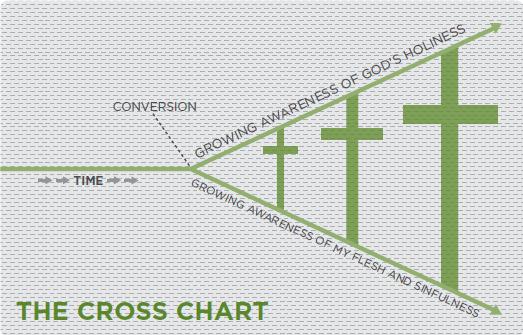
Also note: the believer doesn’t grow, the cross does. In fact, the believer gets worse! Or at least endeavors to increasingly realize how rotten he/she is. But what about the new birth? Reformed theology denies it regardless of the fact that Christ said, “You must be born again.” I can already hear the cat cries, but I will make my case. There isn’t a theology on earth that is more wrong than Reformed theology for many reasons including the denial of the new birth.
First of all, while denying that they fuse justification and sanctification together, the core element of Reformed theology is based on such. If justification and sanctification are fused together, we abide in the milieu that is between the two. That can make sanctification very tricky, unlike my biblical thesis in part one—we don’t abide in that realm that is a finished work. If we reside in a place where justification progresses to glorification, can we mess it up? According to Calvinists, “yes.” More on that later. But again, they clearly recognize this problem and base their core doctrine on it.
So, what doctrine is that? Well, there is only one way to prevent us from short circuiting justification on the way to glorification: cut us out of sanctification all together and make it a 100% work of God. And I agree, if our sanctification is the link between justification and glorification, we would need to be cut out of the equation all together. This is greatly magnified in Reformed theology by the idea that justification must be maintained by the keeping of the law. So, justification begins, but needs to be maintained until it arrives to glorification via the road of sanctification. This can be seen in a personal conversation I had with the well-known Calvinist Voddie Baucham:
paul: “Do you believe in this Gospel Sanctification stuff?”
Baucham: “I’m not sure what you mean.”
paul: “The same gospel that saved us also sanctifies us.”
Baucham: “Yes, absolutely!”
paul: “But Dr. Baucham, justification is a finished work, how can it sanctify us?”
Baucham: Nodding toward the window where we were standing; “That road out there is a finished work, but we still use it.”
Is that true? Are we sanctified by justification? Do we still “use” justification to get to glorification? At least in the Reformed view, the answer to all three of those questions is “yes,” and the perfect maintaining of the law to get justification home to glorification is the key. Justification must be maintained by the perfect keeping of the law, or else the legal declaration that we are justified is, “legal fiction” according to Reformed academics. This is the exact term they use to explain why sanctification must maintain justification by a perfect maintaining of a true legal declaration by perfect law-keeping. And moreover, according to Reformed theology, the law is still a standard that must be maintained to get justification home to glorification by driving on a road named Sanctification. As we discussed in part one, the law has been voided in regard to justification. Paving a road from justification to glorification, and naming it Sanctification, and using the law for the asphalt is a gargantuan theological misstep.
Well, that certainly excludes us! No? But don’t worry, Calvinists have a solution to this problem—it’s the doctrine of The Objective Gospel Outside of Us. The gospel gets justification home to glorification on the road named Sanctification, and we don’t have anything to do with it because the road is maintained by the perfect keeping of the law. How in the world does all of this work? I will explain, stay tuned. But first, let me establish that Calvinists believe that the law must be obeyed perfectly to maintain justification. This can be seen clearly in the writings of John Calvin himself. In context of sanctification, Calvin wrote that any attempt by a Christian to keep the law in sanctification was akin to an effort to keep the law….for justification. So, in Reformed theology, whatever is….for sanctification, IS ALSO….for justification because the two are the same. Calvinists use James 2:10, which is a statement….for justification, and apply it….for sanctification as one example, but they also routinely speak as if justification, and sanctification are the same thing with the same standard for keeping the law. Here is what Calvin said on this wise in his Institutes (Book 3; ch. 14, sec. 9,10):
Let the holy servant of God, I say, select from the whole course of his life the action which he deems most excellent, and let him ponder it in all its parts; he will doubtless find In it something that savors of the rottenness of the flesh, since our alacrity in well-doing is never what it ought to be, but our course is always retarded by much weakness. Although we see that the stains by which the works of the righteous are blemished, are by no means unapparent, still, granting that they are the minutest possible, will they give no offense to the eye of God, before which even the stars are not clean? We thus see, that even saints cannot perform one work which, if judged on its own merits, is not deserving of condemnation.
Even were it possible for us to perform works absolutely pure, yet one sin is sufficient to efface and extinguish all remembrance of former righteousness, as the prophet says (Ezek, 18:24). With this James agrees, “Whosoever shall keep the whole law, and yet offend in one point, is guilty of all” (Jam 2:10).
Notice that there is nothing a Christian does that is considered good or righteous by God. The same is echoed by Calvinists in our day like Tullian Tchividjian (click to enlarge if necessary):

And also notice what the standard for that is: the law….for justification in sanctification. The whole idea that Christians are unable to obey the law in a way that is acceptable to God is an absurd contradiction of a massive body of Scripture. But yet, this is widely accepted in Reformed circles and key to understanding their doctrine. Obviously, the law is still the standard, which is a problem in and of itself if you read part 1. The road named Sanctification that links justification and glorification together is paved with the law, and the asphalt is kept in perfect condition by a perfect keeping of the law. As discussed in part one, the law is not available to progress justification forward. For purposes of progressing justification—the law is void—we are no longer UNDER it….for justification. Therefore, justification can’t progress. It doesn’t get bigger, and it doesn’t grow. But obviously, if we are still on that road, things get tricky.
Therefore, Reformed theology holds to the idea that salvation grows to perfection until glorification, but we must remain OUTSIDE of this process lest the growing process is messed up by our mortal imperfection. This is where the Centrality of the Objective Gospel Outside of Us comes into play. Reformed academics get a covert pass on this because listeners assume they are talking about justification only—BUT THEY ARE NOT—THEY ARE TALKING ABOUT BOTH JUSTIIFICATION AND SANCTIIFCATION. So, we must be cut out of the growing process of salvation because of our imperfection while being able to lay claim to it. But how? Here is how: THE GOSPEL GROWS, BUT WE DON’T. Remember the cross illustration above?
Ok, so, in Reformed theology, justification and sanctification are the same thing. Sanctification is the growing of justification until it reaches glorification, and in the process, justification must not be “legal fiction.” Therefore, sanctification maintains justification by the perfect keeping of the law until the day of glorification . We can lay claim to it, but because of our mortal imperfection, we can’t be part of justification progressing to glorification. So how does this work in Reformed theology? We will get to that, but first, let me further substantiate my claims thus far. Let me begin by quoting Calvin on the idea that justification is progressive. Really, our first clue should be the title of chapter 14 from the Calvin Institutes: “The Beginning of Justification. In What Sense Progressive.” Calvin states the following in that chapter:
Therefore, we must have this blessedness not once only, but must hold it fast during our whole lives. Moreover, the message of free reconciliation with God is not promulgated for one or two days, but is declared to be perpetual in the church (2 Cor 5:18, 19). Hence believers have not even to the end of life any other righteousness that that which is there described. Christ ever remains a Mediator to reconcile the Father to us, and there is a perpetual efficacy in his death, i.e., ablution, satisfaction, expiation; in short, perfect obedience, by which all our iniquities are covered. In the Epistle to the Ephesians, Paul says not that the beginning of salvation is of grace, but “by grace are ye saved,” “not of works, lest any man should boast” (Eph 2:8, 9).
Furthermore, a Reformed think tank that was highly regarded in the early seventies, the Australian Forum, published the following illustration that captures the general idea of the doctrine (click to enlarge):
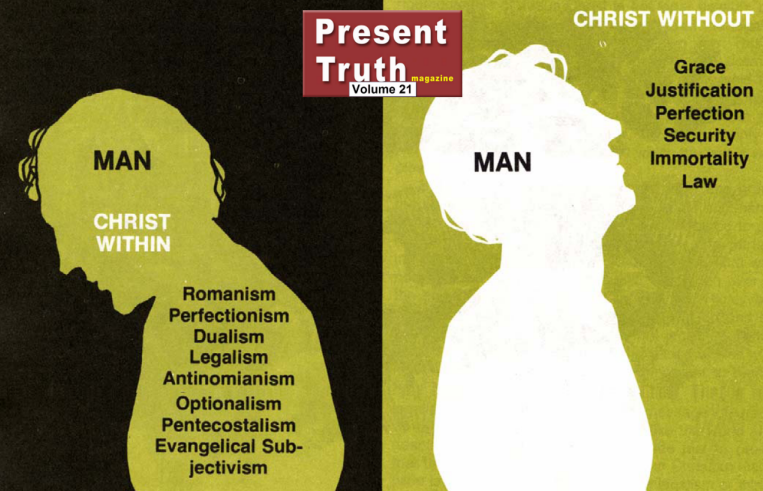
Let me add an additional note:

Obviously, this illustration provokes multiple questions in regard to practical application which will be discussed later (how this supposedly works in sanctification). But the key reality must not leave your mind: Christians cannot really participate in sanctification according to Reformed theology with the exception of one concept, and unfortunately, as we shall see, that one concept can only be works salvation. Not only is our role limited and narrow, the specific role is efficacious to maintaining our own salvation. However, If you will stay your mind on the reality of the above illustration, and dogmatically assert that all Reformed theology in some way relates to this illustration, you will be given insight into the soul of Reformed theology. Do not let the Reformed academics move you away from this reality with rhetoric.
Let’s also illustrate that proponents of Reformed theology fuse justification and sanctification together and speak of the two as being the same thing. In their sermons and teachings, they do this by virtue of the missing transition of subject matter—that being the difference between sanctification and justification. In their messages, they transition between the two without noting any difference as if the two are the same thing—because that is what they believe. Furthermore, this is an excellent communication method for assimilating this idea into the minds of their parishioners victims without them realizing what is happening. Examples of this are strewn about everywhere, but I will cite the following example from The Truth About new Calvinism, page 18:
Regarding the same message in context of who the audience was, in the sermon notes, the top of the page had statements like, “Things Jesus wants us (“us” would presumably be Christians) to know about the law.” The top parts of the notes were also replete with “we” in regard to the law, but the bottom part had statements like: “We live in the Age of Grace; salvation is not of works,” but yet, the whole message clearly regarded the role of the law in the lives of Christians. Therefore, whether unawares or otherwise, the pastor extended the relationship of the law in regard to justification (salvation) into the realm of sanctification (our life as already saved Christians), by virtue of a missing transition in subject matter. Hence, the subject of the law’s relationship to the lost was spoken of as being the same thing as its relationship to those who are saved. Theologians call this a collapsing of sanctification into justification or the synthesizing of the law’s relationship to justification and sanctification. This is most definitely a hallmark of New Calvinist doctrine to keep in mind for later discussion. The communication technique of the missing transition is also a technique used often by New Calvinists.
Next, let’s establish the fact that in Reformed theology, the law must still be the standard for sanctification because sanctification is the growing process of justification; in other words, progressive justification. Again, if law is not the standard for sanctification which is supposedly the progression of justification, then justification (according to Reformed theology) is mere “legal fiction.” Well, justification does not grow, it is based on God’s declaration—not law (as discussed in part one), and there is a reason why sanctification need not be perfect as a kingdom life totally separate from the finished work of justification which will be addressed later. But without further ado, the aforementioned Reformed view can be seen in Calvin’s diatribe in which he thinks it of abundant importance for Christians to know that they cannot obey the law in order to please God:
For since perfection is altogether unattainable by us, so long as we are clothed with flesh, and the Law denounces death and judgment against all who have not yielded a perfect righteousness, there will always be ground to accuse and convict us unless the mercy of God interpose, and ever and anon absolve us the constant remission of sins. Wherefore the statement which we set out is always true. If we are estimated by our own worthiness, in everything that we think or devise, with all our studies and endeavors we deserve death and destruction.
We must strongly insist on these two things: that no believer ever performed one work which, if tested by the strict judgment of God, could escape condemnation (Calvin Institutes: book 3; ch.14, sec. 10,11).
So, though the apostle Paul states that the paramount goal of Christians is to please God (2Cor. 5:10); obviously, Reformed theologians state unequivocally that the law is not the standard for that. Again, it can’t be, because sanctification is growing justification which demands a perfect adherence to the law in order not to be “legal fiction.” Therefore, if not the law, what? This interpretive question is the juggernaut of the subject at hand. The answer: more salvation. According to Reformation theology, our only possible participation in progressive justification is the same thing that justified us to begin with: faith alone. But wait a minute, in Reformed theology, we are not justified per se. Remember the illustration that is the soul of Reformed theology that we cannot be removed from, and the reality thereof. All righteousness , Christ, grace, ect., must remain outside of us. Nothing of grace can be within. So, we have no righteousness that is our own….for sanctification. Like….for justification, it must remain outside of us. In fact, Reformed theologians believe that if grace, Christ, or any kind of valid righteousness is inside of us, that is infusing grace into us while in sanctification. And if we do that, we are making sanctification the ground of our justification. Get it? If sanctification is a road that takes justification to glorification, and it must be paved with perfection, and we are on that road, and grace is infused into us, then we are made part of the progressive justification process. Game over.
We must (according to Reformed theology) walk side by side with justification on the road named Sanctification that takes us to glorification without being a part of the process. Otherwise, our participation is legal fiction because we obviously still sin. An “aberration” that believes that we have righteousness inside of us is called “infused grace” by Reformed academics and is the primary offence to the soul of Reformed theology: The Objective Gospel Outside of Us. Again, reobserve the two-man Christ within/Christ without Reformed illustration that is the soul of this doctrine. All Righteousness must remain outside of us and we must walk the road named Sanctification the same way we were initially permitted to be on the road, by faith only. If we work, or obey the law, we are believing that there is a righteousness inside of us that can participate with progressive justification in arriving at glorification at the end of the road. This is infusing grace into us and making our ability to travel with justification the ground of our justification. At least partially, which is a horseshoe and hand grenade issue in regard to justification anyway. Now, let’s observe the “elder statesman” of New Calvinism reiterating what I have just written. Take note that John Piper’s comments following were in regard to a lecture by Graeme Goldsworthy at Southern Seminary. Goldsworthy was one of the key members of the aforementioned Reformed think tank, the Australian Forum. The following excerpts were taken from The Truth About new Calvinism, pages 41-43:
In the aforementioned article concerning Goldsworthy’s lecture at Southern, Piper agrees that the original Reformation sought to correct the reversal of sanctification and justification:
“This meant the reversal of the relationship of sanctification to justification. Infused grace, beginning with baptismal regeneration, internalized the Gospel and made sanctification the basis of justification. This is an upside down Gospel.”
In case one would think that Piper excludes evangelicals from this concern because of his mention of baptismal regeneration, consider what he said in the same article: “I would add that this ‘upside down’ gospel has not gone away— neither from Catholicism nor from Protestants….”
….Piper concurs with Goldsworthy that “infused grace” is the problem. The like complaint is that the completely outside of us gospel empowers us inwardly, subjects us to subjective distractions from the power of the historic Christ event, and makes the natural result of the gospel our power source (the fruit), instead of the outward power of the gospel, the real root. To infuse grace is to suggest that we are enabled to participate in being justified by our own efforts in bringing about the natural results of the gospel.
Nothing shows this kinship between the Forum and New Calvinism more than a Piper quote from this same article and a visual aid used by Robert Brinsmead to demonstrate how “infused grace” supposedly puts our souls in peril. First Piper’s quote:
“When the ground of justification moves from Christ outside of us to the work of Christ inside of us, the gospel (and the human soul) is imperiled. It is an upside down gospel [emphasis Piper’s—not this author].”
Now observe Brinsmead’s illustration on the next page: [the two-man Christ within/Christ without chart which was published by the Australian Forum].
This necessarily leads to the Reformed denial of the new birth. Obviously, the idea that Christ lives within us and works within us is part and parcel to the new birth—and a big problem for The Objective Gospel Outside of Us. Reformed theologians know that they cannot blatantly deny the new birth and retain credibility, so they have many cute ways of relegating it to insignificance in order to bolster their staple doctrine. I have addressed how they do this in many other articles including chapter 11 of The Truth About New Calvinism, and will not continue to do so here, but will at least note some interesting quotes that speak to my assertion:
It robs Christ of His glory by putting the Spirit’s work in the believer above and therefore against what Christ has done for the believer in His doing and dying.
~ Geoffrey Paxton (Australian Forum)
But to whom are we introducing people to, Christ or to ourselves? Is the “Good News” no longer Christ’s doing and dying, but our own “Spirit-filled” life?
~ Michael Horton
And the new-birth-oriented “Jesus-in-my-heart” gospel of evangelicals has destroyed the Old Testament just as effectively as has nineteenth-century liberalism. (footnoted to Paxton’s article with above quote).
~ Graeme Goldsworthy (Australian Forum)
One would therefore think that this theology would lead to a view that believers are no different from the unregenerate save belief in the gospel only. Practically, Christians remain totally depraved like the unregenerate. And you would be correct about that. Reformed theology holds to the idea that justification initially recons us righteous in Christ, and without Christ in us, and then continues to recon us clothed with Christ’s righteousness (and none of our own in sanctification) as long as we “live by faith” ALONE….for sanctification. Moreover, only the POSITION of a person is changed in salvation, not the character, personhood, or creaturehood. There is no better illustration of this than the following citation from Michael Horton’s Christless Christianity, p.62:
Where we land on these issues is perhaps the most significant factor in how we approach our own faith and practice and communicate it to the world. If not only the unregenerate but the regenerate are always dependent at every moment on the free grace of God disclosed in the gospel, then nothing can raise those who are spiritually dead or continually give life to Christ’s flock but the Spirit working through the gospel. When this happens (not just once, but every time we encounter the gospel afresh), the Spirit progressively transforms us into Christ’s image. Start with Christ (that is, the gospel) and you get sanctification in the bargain; begin with Christ and move on to something else, and you lose both.
The tail end of Horton’s quote brings me to the next point. Notice that Horton states that “we” can “lose,” as in l-o-s-e “both.” Both what? Obviously, justification and sanctification. Which equals = no salvation. “Paul, is he really saying that we can lose our salvation?” Sure he is—IF—we “move on to something else.” Which equals = moving on to something else but faith alone…for sanctification which is the same thing as moving on to something else….for justification. Progressive justification is not the only theological anomaly that Reformed theologians are content with, they must also add sanctification by faith alone. But all of this is necessary in order to stay consistent with their core doctrine: The Centrality of the Objective Gospel Outside of Us. Yes, let them squeal all night long; nevertheless, they teach that you can lose you salvation.
I will illustrate this further by revisiting the idea that Reformed theology fuses justification and sanctification together. Reformed theologians are big on the “Golden Chain of Salvation” concept based on Romans 8:30. We discussed Romans 8:30 in part one along with its ramifications for salvation. The Reformed take on this verse is the idea that sanctification is excluded because it is one and the same with justification. The opposite position was presented in part one to some extent. Note the following quotation by John Piper:
This is probably why in the golden chain of Romans 8:30 the term sanctification is missing: “And those whom he predestined he also called, and those whom he called He also justified, and those whom he justified he also glorified.” When Paul jumps directly from justification to glorification he is not passing over sanctification, because in his mind that process is synonymous with the first phase of glorification and begins at conversion. (God is the Gospel, footnote, p. 93).
Ok, notice that Piper calls justification (“conversion”) “the first phase of glorification.” So, again, we see that justification grows in glory and culminates at complete glorification and sanctification is part of that “process.” Not so. In regard to the fusion of justification and sanctification, what is a “chain”? Reformed theologians clearly refer to the justification “process” as a chain with justification on one end and glorification on the other end, and sanctification in the middle. Moreover, John Piper preached a sermon in which he warns that if we do not participate in the salvation “links” in the proper way, that we put ourselves in great danger—presumably in regard of losing our salvation. The following illustration with a golden chain and Piper’s quotes from the sermon should clearly make my point here (click to enlarge):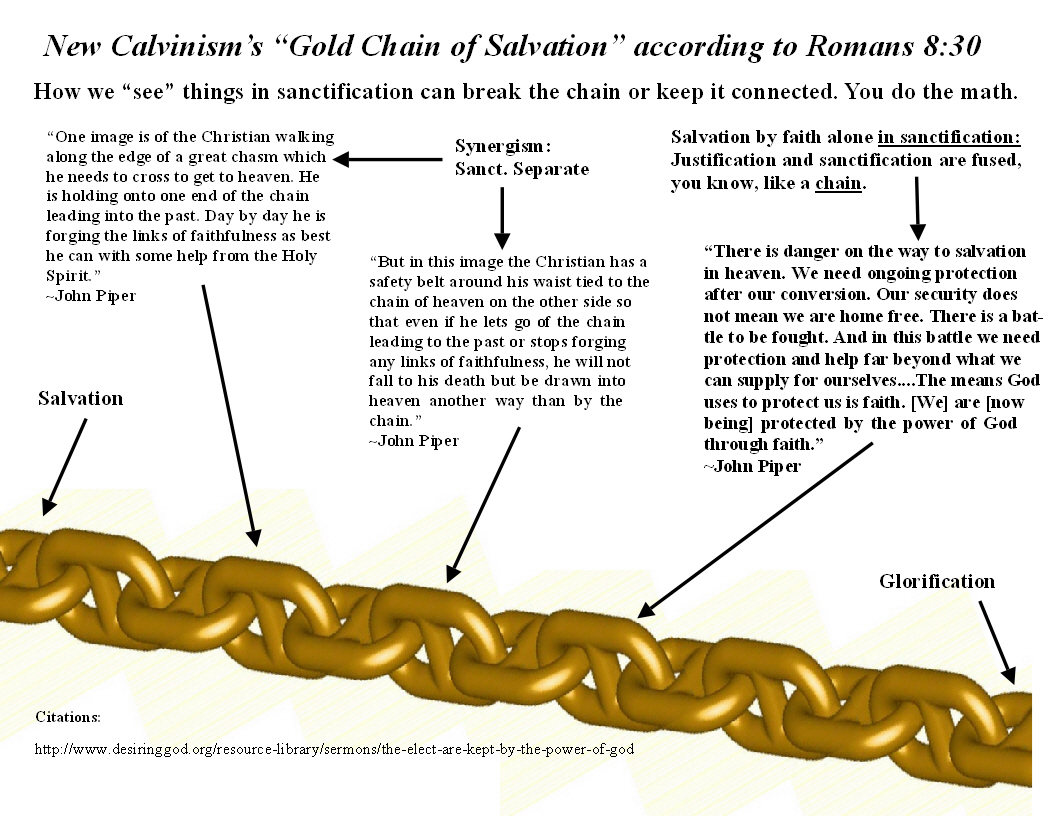
Which brings me to yet another point. If we can lose our salvation, what do we have to do to keep it? Whatever that is, it’s a work to maintain justification. And that is works salvation. In the case of Reformed theology, we have to keep our salvation by sanctification by faith alone. Hence: salvation by Christ + faith alone in sanctification. Think about that. To the Reformed, moving on to anything else but sanctification by faith alone will cause us to lose our salvation. Historically, the relaxing of the law in sanctification has always been deemed antinomianism. Is Reformed theology salvation by antinomianism? Yes, I think it is—the fusion of justification and sanctification can hardly end up anywhere else.
This entails the belief that Christ not only came to die for our sins, but He also came to live a perfect life of obedience to the law so that His perfect obedience in the life he lived on earth could be imputed to us in sanctification. So, in Reformed theology, because the law remains a standard for progressive justification, perfect obedience to the law in sanctification must also be imputed to us. In other words, Jesus obeys for us. How our justification must be maintained in our sanctification (according to Reformed theology) is well articulated by the Australian Forum Reformed think tank (The Truth About new Calvinism: p. 101, 102):
After a man hears the conditions of acceptance with God and eternal life, and is made sensible of his inability to meet those conditions, the Word of God comes to him in the gospel. He hears that Christ stood in his place and kept the law of God for him. By dying on the cross, Christ satisfied all the law’s demands. The Holy Spirit gives the sinner faith to accept the righteousness of Jesus. Standing now before the law which says, “I demand a life of perfect conformity to the commandments,” the believing sinner cries in triumph, “Mine are Christ’s living, doing, and speaking, His suffering and dying; mine as much as if I had lived, done, spoken, and suffered, and died as He did . . . ” (Luther). The law is well pleased with Jesus’ doing and dying, which the sinner brings in the hand of faith. Justice is fully satisfied, and God can truly say: “This man has fulfilled the law. He is justified.”
We say again, only those are justified who bring to God a life of perfect obedience to the law of God. This is what faith does—it brings to God the obedience of Jesus Christ. By faith the law is fulfilled and the sinner is justified.
On the other hand, the law is dishonored by the man who presumes to bring to it his own life of obedience. The fact that he thinks the law will be satisfied with his “rotten stubble and straw” (Luther) shows what a low estimate he has of the holiness of God and what a high estimate he has of his own righteousness. Only in Jesus Christ is there an obedience with which the law is well pleased. Because faith brings only what Jesus has done, it is the highest honor that can be paid to the law (Rom. 3:31).
A more contemporary example from the Journal of Biblical Counseling (David Powlison’s CCEF) can be observed in the following citation:
It is by virtue of Christ’s perfect life, death on the cross and resurrection-plus nothing-that we are justified (made and declared right with God) and sanctified (set apart, kept, and viewed as right with God) and sanctified (set apart, kept, and viewed as right in the Lord’s eyes by virtue of His obedience). Christ is our holiness. Christ is our sanctification.
Therefore, our walk with Christ must be a continual reoffering of the works of Christ to maintain our just standing. When we come to the last resurrection, we will be judged accordingly. If we lived sanctification in this way, the righteousness of Christ will be the ground of our justification and we will be glorified. See the following illustration from a John Piper video clip (click to enlarge):
 Christians will stand in no such judgment. And via the new birth, we are new creatures that in fact are righteous. Our lack of imperfection, though displeasing to the Lord, has no bearing….for justification. We are new creatures that deplore the weakness of our mortality, but are indwelt and enabled to obey God through our new life in the Holy Spirit. We are declared righteous, and in fact are righteous. We are not colaboring with our flesh like the world, but we rather colabor with God (1Cor. 3:9, 1Thess. 3:2, 2Cor. 6:1). Therefore, Paul could say, “Now if I do what I do not want, it is no longer I who do it, but sin that dwells within me (Romans 7:20). We will look at the supposed practical application of Reformed theology in part three, and compare it to the truth in light of assurance, spiritual growth, perseverance of the saints, and other sanctification issues.
paul

 Paul's Passing Thoughts
5 comments