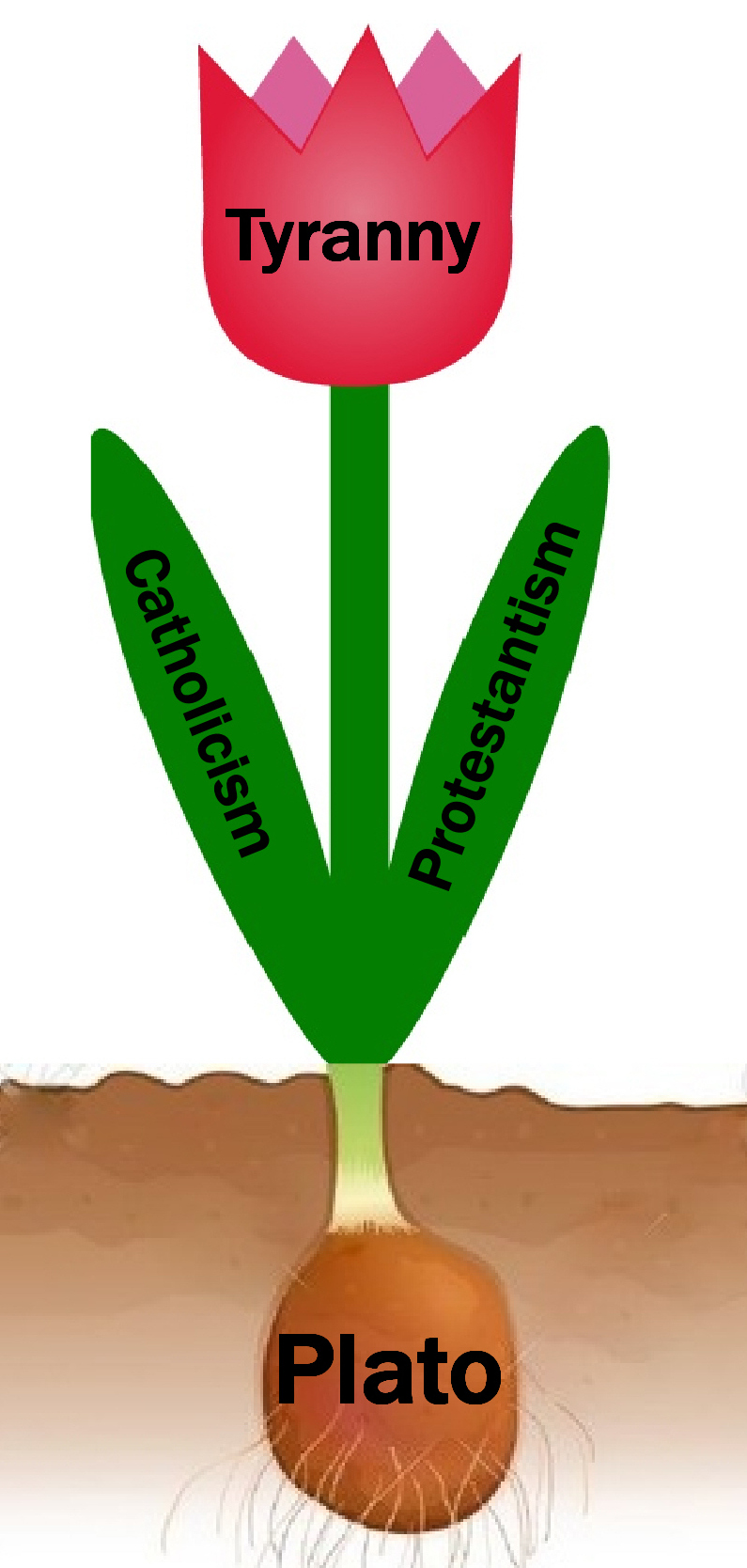
The Heavenly B-52s Can Save American Christianity from Its Present Dark Age
 Originally published February 11, 2013
We must remember that the Dark Ages were a European thing. And we must remember that Greco-Roman philosophy was the source and then it was turbocharged with the integration of European style religiosity. European religion has always been grounded in Plato’s disdain for humanity. Hence, one philosopher stated well that faith and force together are the destroyers of the modern world. One of the most notable historians of our time, K.R. Popper, fingered Plato specifically in regard to the logic that has wreaked havoc on Western culture through Communism, Islam, Catholicism, and Reformed theology. Augustine, one of the fathers of the Reformation, called Plato a pre-Christian Christian, and the juggernaut of faith and force was thus born.
And primarily, American religion was imported from Europe via the Puritans who were a European style religious political sect. They wanted to create a theocracy of their own in the new world. That’s the “religious freedom” they sought in America—a political one. Ironically, this importation of a European pandemic is romanticized by the Thanksgiving holiday. Somehow, deep in our evangelical American psyche, we think the Puritans could have led us to the religious utopia that we all lust for. And in fact, deep in our evangelical psyches, we think the war still rages between our Puritan foundations and the evils of Enlightenment philosophy. And if Enlightenment philosophy would surrender, all would be well and the heavenly Jerusalem would finally come down to Earth.
Nothing could be further from the truth. Enlightenment thought, even with its many abhorrent shortcomings, launched America to unprecedented greatness as a nation because of three basic principles that God agrees with: man is free; man is capable; and man is responsible for the sum and substance of his own life before God. Men “small and great” will all stand before God. Plato’s philosopher kings do not stand before God in our stead regardless of the priestly garb that the Reformers have adorned them with.
In the movie Moneyball, based on a true story, the General Manager of the Oakland A’s baseball team set all time league records with a meager budget and has-been players by breaking tradition with the ways big league teams have always been built. The player’s manager of the team was against the plan, and was a constant hindrance to its implementation. But when the Oakland A’s became the talk of the sports world because of the plan, the player’s manager got all of the credit. In the same way, the manager of American Christianity, the one of 95 Theses fame, Martin Luther, is given credit for America’s greatness. God has blessed America because of the Puritan missionary children that he spawned. Their roots are the lifeblood of America. We were “founded on their Christian principles.” This is a significant departure from reality.
Luther despised reason. He believed that reasoning was a dangerous stunt that the unenlightened masses shouldn’t try at home. And because they are not capable, they have to be protected from themselves; hence, neither are they free. To the degree that we are free the world is in a spree. Man must be saved from himself; by force if necessary, and for the good of the world. Martin Luther to the rescue. Stalin to the rescue. Muhammad to the rescue. The Moral Majority to the rescue. And on every Thanksgiving Day, deep, deep in our American psyche, a small still voice cries out: “Oh but for the Puritans! What could we be?” It’s all the same logic. You can dress it up in different doctrines, but it’s all the same. Logic comes in many doctrinal forms—both secular and religious.
The founding fathers of this country were children of the Enlightenment era. Until America popped up on the history radar screen, force and faith was the big league tradition. Our founding fathers proposed something different: government as the protector of man’s right to be free, capable, and responsible. And a government that served at the pleasure of the people to do so. It is a testimony to the power that is displayed when merely three ideas from God are implemented in our realty. Three ideas from God made America the envy of all world history. In the end, the motif that any child can perceive in the book of Revelation will fill the world with blood up to the horse’s bridles: force and faith. To what is said here, the proffers of force and faith, the Reformed of our day, answer in all of their Puritan glory, “I beg your pardon! Jesus Christ should be the envy of the world!” But which Jesus Christ? The Puritan Jesus Christ? And enlightened minds want to know: “Are we free to decide that for ourselves?” And: “Are we capable of even knowing that?” We fear that the answer to both of these questions is, “No.” And that is why giving you power in our lives at any level is a really bad idea.
Hence, To the degree that the Reformed Dark Age feigns, darkness in the American church does rein. And we are in that Dark Age. It came in essence as logic stowed away in the Mayflower’s diseased European rats bringing the same plague with it. I could drag out all of the apocalyptic data and its many faceted manifestations, but a recent televised top of the hour newscast introduction will suffice:
Here we go again, another sex scandal in the Evangelical church.
You notice they said, “Evangelical” and not “Catholic.” Anybody who knows the facts knows that sexual abuse and the subsequent cover-ups are just as prevalent in the Protestant Evangelical Church as it is in the Catholic Church. The scandals are the same, and the silence among clergy is the same, along with the same disregard for victims. Different doctrines—same logic—same results. Logic always has an endgame; there are many different doctrines that can get you there.
But the American Dark Age takes on a different appearance than the open fires of European religious wars and unspeakable terrors for it is tempered with freedom, capability, and responsibility. In the same way that God’s spies found refuge with a harlot, the American church has been saved from itself by Enlightenment thought. The result has been Reformed Light, and the carnage has been greatly limited. The European Reformers believed that children should be seen and not heard; American Reformed Light allows their children to play in a sandbox. Children are happier when they have a sandbox to play in, and they can form all kinds of ideas in what they make in the sand. But when it is time for dinner, it’s also time to put our little buckets and shovels away, run to the dinner bell, and obey mommy and daddy. They protect us from truth that can cause division because we are unable to handle truth, and they make truth a storybook that we can understand. They read it to us at night, and we are much comforted. We can pretend in the backyard, and we feel safe because mommy is watching from the kitchen window.
But the children of Reformed Light do not grow up. For certain, the American church is every bit like grown adults playing in a sandbox. The real Reformers now come forward and scoff at the pathetic sight, and say they are the answer. Yes, not playing with ideas at all must be the answer. Adults in a sandbox is not the problem, the sandbox is the problem. Sandboxes tempt people to play with truth. The Reformers to the rescue—those half breed Semi-Pelagian parents be damned.
Children in adult bodies will always rape, hate, pillage and steal. It is what it is: spiritually, they were born slaves, born incapable, and born irresponsible. Reformed theology is a bus of misfits, but all believe that it is the only bus going to heaven—the bus of faith alone in Puritan sanctification. All kinds are on the bus, but the tie that binds is womb to the tomb total depravity.
Some do not persevere in accepting their total depravity and the total depravity of others. Some do not trust God’s anointed to get the bus of misfits to heaven, so an Inquisition is needed. The European Reformers used the gallows and the burning stake (if the victim was lucky), brainwashing, and orthodoxy. The American Reformers can use brainwashing and orthodoxy, but because of the founding fathers, the American Reformers must replace the gallows and burning stake with character assassination, authority to condemn eternally, and false criminality. And all of the aforementioned paints the portrait of the present-day American Dark Age in the church. There is a little metal plate on the bottom of the spectacular painting hanging in the gallery of human history, and it reads:
Here we go again.
The Bible is written for mass consumption. All Bible books, save a few, were written to assemblies and not leadership. God has also written his word on the hearts of every person ever born into the world (Romans 2:14). We are all responsible before God, free to obey Him or not Obey Him, and obviously, must exercise our minds for understanding. We also live in the information age; so, if man was without excuse in the days of the apostolic church (Romans 2:1) we are certainly without excuse today.
Nations, particularly the USA, have used heavy bombers to drop propaganda leaflets on cities before an invasion or in an attempt to turn the population at large against the enemy leadership. Each bomb usually weighs about 250 lbs. and rains about 60,000 leaflets on a given area. During the Iraq/US war, leaflet bombings resulted in the mass surrender of Iraqi soldiers. In the same way, regardless of what’s going on in the world, God has a message of truth for every person. Invariably, it is man’s responsibility to do what God wants him to do in any given situation.
God has given the truth to all men, and only the truth will set us free. We need to pick up and read the leaflet and surrender to the Chief Shepherd. The Reformation is responsible for this present Dark Age in the American church. It is a doctrine that must be rejected with prejudice, and we must disdain anything that has touched its filthy garments.
A little leaven leavens the whole lump.
paul
Does Protestantism Require Church Membership for Salvation?
It most certainly does, but the reason church membership is required by the Protestant faith is far more scandalous than that one symptom. We will start with the core gospel of the Protestant religion, and then see how required membership in the local church is efficacious to its gospel.
How “Christians” that are far removed from the original Protestant tradition function is no defense for its official Reformed gospel. Protestants can’t have it both ways though they try. They excuse what Luther and Calvin taught because not all Protestants function by every jot and tittle. But on the other hand, they deem other religions as false based on their original statement of faith. Obviously, no Protestant will give a Buddhist a pass for one second because, “Not all Buddhists believe the exact same things that Buddha believed.”
By and large, the problem is that most Protestants really don’t know what the Protestant gospel is, and when they are confronted, they choose to defend their investment in it for whatever reason. At least one reason follows: investing in the truth is hard work. Protestantism, like many other religions, propagates the farming-out of their faith to the experts. Of course, that is very ill advised.
First, we will look at a summary of the Protestant gospel, and then establish the summary with specific citations. The core principle is progressive justification. This is the idea that salvation is a process and not a onetime passing from death to life. This fact about Protestantism surprises many Protestants. Many tout “once saved always saved,” but that’s not what the Reformers taught at all. They taught that the justified state was a progression from definitive justification to final justification, and the process in the middle is subjective justification. The process in the middle is really progressive justification, but many Reformed scholars deny that in the face of insurmountable evidence. In fact, the title of chapter 14 in book 3 of the Calvin Institutes is, “The Beginning of Justification. In What Sense Progressive.” In other words, justification is present continuance; it’s not a onetime finished event.
As we will see, the institutional church established by the church at Rome circa 4th century is deemed as God’s institution that oversees the progression of justification for God’s people. Unless you are a member of a local church, your salvation cannot progress from point A to point B. Remember, the Reformation did not really seek to replace the “Mother Church,” but rather sought to reform it. Luther, Calvin, nor their mentor St. Augustine ever officially left the Catholic Church. Luther and Calvin had a dying devotion to Augustine until the end who is an official Doctor of Grace in the Catholic Church until this day.
Foundational to Protestantism is the idea that Christ’s death served two purposes for sin: an unconditional forgiveness of past sin, and a conditional forgiveness for “present sin” and future sin. The condition for receiving forgiveness for “present” and future sin was membership in the local church signified and confirmed by water baptism. They didn’t teach baptismal regeneration directly, but taught that forgiveness of present and future sin can only be received in the church, and only water baptism made someone a true member of the church:
“Wherefore, our initiation into the fellowship of the church is, by the symbol of ablution, to teach us that we have no admission into the family of God, unless by his goodness our impurities are previously washed away” (The Calvin Institutes: 4.1.20).
“Nor by remission of sins does the Lord only once for all elect and admit us into the Church, but by the same means he preserves and defends us in it. For what would it avail us to receive a pardon of which we were afterwards to have no use? That the mercy of the Lord would be vain and delusive if only granted once, all the godly can bear witness; for there is none who is not conscious, during his whole life, of many infirmities which stand in need of divine mercy. And truly it is not without cause that the Lord promises this gift specially to his own household, nor in vain that he orders the same message of reconciliation to be daily delivered to them” (The Calvin Institutes: 4.1.21).
“To impart this blessing to us, the keys have been given to the Church (Mt. 16:19; 18:18). For when Christ gave the command to the apostles, and conferred the power of forgiving sins, he not merely intended that they should loose the sins of those who should be converted from impiety to the faith of Christ; but, moreover, that they should perpetually perform this office among believers” (The Calvin Institutes: 4.1.22).
“Secondly, This benefit is so peculiar to the Church, that we cannot enjoy it unless we continue in the communion of the Church. Thirdly, It is dispensed to us by the ministers and pastors of the Church, either in the preaching of the Gospel or the administration of the Sacraments, and herein is especially manifested the power of the keys, which the Lord has bestowed on the company of the faithful. Accordingly, let each of us consider it to be his duty to seek forgiveness of sins only where the Lord has placed it. Of the public reconciliation which relates to discipline, we shall speak at the proper place” (Ibid).
“…by new sins we continually separate ourselves, as far as we can, from the grace of God… Thus it is, that all the saints have need of the daily forgiveness of sins; for this alone keeps us in the family of God” (John Calvin: Commentaries on the Catholic Epistles; The Calvin Translation Society 1855. Editor: John Owen, p. 165 ¶4).
“. . . forgiveness of sins is not a matter of a passing work or action, but comes from baptism which is of perpetual duration, until we arise from the dead” (Luther’s Works: American ed.; Philadelphia: Muhlenberg Press; St. Louis: Concordia, 1955, vol. 34, p. 163).
“. . . Forgiveness of sins is not a matter of a passing work or action, but of perpetual duration. For the forgiveness of sins begins in baptism and remains with us all the way to death, until we arise from the dead, and leads us into life eternal. So we live continually under the remission of sins. Christ. is truly and constantly the liberator from our sins, is called our Savior, and saves us by taking away our sins. If, however, he saves us always and continually, then we are constantly sinners” (Ibid, p.164).
“For the forgiveness of sins is a continuing divine work, until we die. Sin does not cease. Accordingly, Christ saves us perpetually” (Ibid., p.190).
“Daily we sin, daily we are continually justified, just as a doctor is forced to heal sickness day by day until it is cured” (Ibid., p.191).
Hence, notice that there is no distinction made between sins committed as unbelievers and sins committed as believers. Sin is sin and needs a perpetual forgiveness in order for the “believer” to remain justified. The only difference is unconditional forgiveness (sin committed as an unbeliever) and conditional forgiveness, i.e., you can only receive forgiveness as a member of the local church.
Also note the shocking assertion, usually attributed to Catholic priests, that pastors/elders have the authority to grant forgiveness for present and future sin.
paul
Pope Francis’ Culture of Death is Looking a Lot Like Protestantism

“Dear Christian parents, will you save your children from this philosophical culture of death?”
The real difference between Catholicism and Protestantism is philosophical, and by no means a biblically based theological argument. If you want to discuss the difference in regard to orthodoxy for the serfs, there is no difference—both are progressive justification. Both propagate a need for the church to get people from salvation point A to salvation point B.
The functions of both camps are really determined by spiritual elitists who think they are above logic and all things material. Catholic philosopher kings tend to think knowledge beyond the material realm is within every being while Protestant philosopher kings believe all true knowledge is outside of the person.
Both appeal to Christ consciousness as the only immutable true form of goodness and truth. When it gets right down to it, you can barely slip a playing card between their definitions of faith.
Catholics seem to believe that the inner light gives everyone some potentiality for being good, while Protestants believe Christians can only see good and experience goodness that remains completely outside of them. They can experience it, but it is not a part of them. Man cannot be partially good enough to participate in his own salvation; it is a total work by God alone from beginning to end. Catholics believe that people can have enough goodness in them to participate in the finishing of their salvation.
In both cases, salvation is a process that needs the church to finish it. Catholics believe people can be made good enough to participate in the finishing while Protestants reject the idea that man can possess any goodness.
The point here is that they share a common belief that salvation is a process overseen by the church, and that affiliation with the church is efficacious to being saved.
Of late, and more and more, they also share a belief in Martin Luther’s doctrine of death. Both interpret all reality from the standpoint of the cross; i.e., “all wisdom is hidden in suffering.” Both see true discipleship as a complete emptying of self. Both see material as evil and only the invisible as good. Catholics believe inner goodness enables us to see ourselves as worthless, while Protestants believe faith enables us to see ourselves as worthless because we are worthless. Catholics believe good people will want to die to self and this material world, while Protestants believe we ought to die because we deserve nothing but death. But either way, it’s a culture of death.
Also, both believe that self-sacrifice shows forth the glory of the cross because all choices to sacrifice self are “living by the cross” or “walking according to the cross.” Self-denial and self-death demonstrate God’s cross-love and this is when the gospel is presented to people with power from on high. We hear this rhetoric in Protestant circles constantly.
So, what in the world inspired this post? Keep in mind that the following video is a Catholic production, and prepare yourself to be dumbfounded.
The same mentality can also be seen in Pope Francis’ collectivist views on economics and financial equality. Francis, who is loco popular with the Millennials, is leading a whole generation of our youth into socialist ideas. On the other side of the fence, the same. Collectivism gauges the total worth of people based on their ability to contribute to “the group” which is Platonic lingo for society at large.
Another aspect of death culture is the rising popularity of environmentalism among Catholic and Protestant youth. If you are a good Catholic, you know that your evil material body exhales carbon dioxide which pollutes the air, but the good trees absorb the carbon. If you are Protestant, you assume trees are better than humans because humans are totally depraved. In this video, it is suggested that we errantly worry more about ISIS killing people than saving trees.
The video was posted on my FaceBook page by a young Christian, and this was my response:
Well, wouldn’t worry about it too much. Apparently, shortly before the return of Christ there is plenty of earth left to destroy because God destroys it. I also find the notion that trees compensate for human pollution via breathing somewhat disturbing. It’s the idea that trees are important because they filter out the product of human living: trees good–humans bad. Fact is, what we exhale is only about 4% carbon. Also note the unqualified moral equivalency between those who kill people (ISIS) and those who cut down trees. lastly, if those who propagate this message really cared about the environment rather than their ulterior political motives, they would point to the science and example of Israel who have turned that desert terrain into a rich agriculture.
Dear Christian parents, will you save your children from this philosophical culture of death? This May, I will be teaching a series on Martin Luther’s Heidelberg Disputation on Blog Talk Radio. We will exegete this foundational document theses by theses. Let me also recommend our 2015 TANC conference where we delve into these issues as well.
paul
Why Are You “Dissing” the Church?
 Leaving the institutional church has been one of the best decisions our family has made. Granted, there are the social aspects that we miss (my wife especially, she’s a people person), but it doesn’t take much searching to admit that real friendships have to be based on more than just a weekly formal gathering. Want to know who your real friends are? Just try leaving your church for whatever reason. See how many of them still keep in contact with you. In fact, it was a comment very similar to that which I posted on Facebook a few weeks ago, which prompted quite a debate.
There is a young man with whom I am friends, let’s call him “Trevor”. I have personally known Trevor for many years. Trevor has come to me with many questions about some of the things I post on Facebook, and we have had some very edifying discussions. We’ve talked at length about the differences between Justification and Sanctification. He is genuinely seeking answers, and I am grateful for the opportunities to help disciple him.
But a few weeks ago, Trevor sent me the following private message on Facebook:
“Hey Andy I keep seeing you dissing on churches and even though you are probably right why not use your intelligence and abilities on helping teach people about God. There are a lot of people who need God that I’m sure are reading that and when people see hostility amongst Christians towards other Christians it turns them off to it completely and isn’t that contradictory to what we want for people”
I understand the motivation behind his response, and I don’t hold it against him. It is typical from anyone who sits under the orthodoxy of the institutional church. Trevor has probably even spoken with his pastor about some of these issues I’ve brought up, and maybe this response comes after the result of one of those conversations. Either way, his tone of concern is well noted and appreciated. So below you will find my response to Trevor. I apologize that it is rather lengthy, but I hope that it will be edifying.
Dear Trevor,
I’m sure you will agree that it is hard to give a full-orbed treatise within the confines of a simple Facebook status message. It doesn’t lend itself well for going into details. So the goal is to try and make your point in the most direct and concise manner possible. For that reason, a simple matter-of-fact statement may come across as curt and abrasive. That is unavoidable. Nevertheless, statements such as these should prompt people to think. But often times, rather than think, people respond defensively because they automatically assume I am attacking them. I am not attacking people, I am challenging ideas. But most people are too lazy to differentiate the two because they have too much ego invested in their ideas, and therefore take any attack on an idea as a personal attack. This is true of both Christians and non-Christians alike. And actually I have found that those who call themselves “Christian” have an even greater tendency toward ego investment, and there is a very good explanation for that, which leads me to the next point.
When you challenge what a “Christian” has traditionally been taught, you are indeed challenging their very salvation. And this is a frightening prospect for them. But it is for this very reason that these notions need to be challenged, because what it boils down to is that their faith is in a “belief system” rather than belief in the name of the Lord Jesus Christ. That which passes for “the church” is the very embodiment of this belief system. Is it any wonder then that people have such a knee jerk reaction? For someone to even raise the question that what they have been taught might be wrong scares the crap out of them!
This is why I criticize the institutional church, because it embodies this system that has kept people in the spiritual dark ages for centuries! The institutional church is based on “authority”, and the system is needed to maintain the authority. But this is so contrary to scripture. There is to be no authority among the brethren of Christ. Christ is the authority! And he is the only mediator between God and man. Now that is not to say that there is not leadership, but leadership is not the same as authority. Authority implies “power”, while leadership implies “example”. But the emphasis within the traditional “church” model is predicated on power and authority, and everything that happens within the confines of these institutions is designed to maintain that power structure. It has been that way since the very early beginnings of the Roman Catholic church in the 4th century. And Protestantism is no different.
I see many good genuine Christian people languishing away within the walls of the institutional church, and it grieves me deeply, for there are eternal consequences at stake. Not as far as salvation goes, but with regard to eternal rewards. You have spiritually illiterate Christians looking to some authority to tell them what to believe, who have never been equipped to carry out the task that was given to them from the first day they were born again- to go out and make disciples. They are not exercising their gifts. Instead they hide their talent in the ground, waiting for the Master to return and say, “here Lord, here’s what you gave me.” And there will be no eternal reward for them. And the church is purposefully keeping them in this state of immaturity. How I long for believers to realize their full potential as Children of God! But that will never happen in the “church”. The church serves itself.
So, even having said all of that, I still haven’t fully been able to explain the depth of this all. But your concern is how this arguing among believers will turn off others. I contend that what turns of the unsaved is not the fact that they see Christians argue, but rather that Christians don’t even know what they believe. Furthermore, what they do claim to believe is not even rational. Christianity for the past 1500 years has simply failed to produce a fully rational explanation for why someone should believe in Jesus. There must be more to it that just, “well you just have to have faith.” Faith must be grounded in reality. So we don’t simply lay aside arguments regarding contending for truth just for the sake of presenting the illusion of a unified front to the world.
In addition, the traditional excuse for evangelism is simply nothing more than who has the better sales pitch for getting someone to attend their church versus another. This ties in directly with the notion of salvation being in the church. Christians are more interested in getting people into their church than they are with teaching people about the gospel of the Kingdom. By definition, the church cannot be comprised of unbelievers. The body of Christ, the “assembly”, is only made up of believers. The purpose of believers assembling is for edification, and that happens by four functions: instruction in the word, fellowship, sharing meals (including the Lord’s table), and praying together. (Acts 2:42). How can an unbeliever possibly be any part of that? He shares nothing in common. He is not a part of the Body. 2 Corinthians 6:14-15 says, “Be ye not unequally yoked together with unbelievers: for what fellowship hath righteousness with unrighteousness? and what communion hath light with darkness? And what concord hath Christ with Belial? or what part hath he that believeth with an infidel?” Unbelievers have no part in the fellowship of God’s people.
Now the excuse has been that we need to bring unsaved to church so that they can get saved. But that is simply a lazy excuse for evangelism. It is not what Christ’s instructions were. Believers gather in fellowship to be edified. Having then been properly equipped, WE can go OUT into the world to take the gospel TO the lost so that they can HEAR it from US. Faith cometh by hearing, and hearing by the word of God. How then shall they believe in whom they have not heard? And how shall they hear without a preacher? And how shall they preach unless they be SENT? (Romans 10:14-15, 17) Every believer is a preacher- and ambassador from God’s heavenly Kingdom – sent forth with the message of reconciliation to the world. It is our mandate as individuals, NOT the function of an institution!
And so seeing how the “church” has utterly failed in every way in all of these areas, I hope you can better understand now why I have such disdain for it and am so critical of it. But the answer is not reform. It doesn’t need to be reformed, it needs to be defeated because it is not what God intended for His people. The answer is, to come out from among them and be separate. And that is what I have done, and that is what I want to encourage all believers to do. Come out from this institution and join in genuine fellowship with other like-minded believers and start exercising your gifts. There is no horizontal authority between men among believers. All authority is in Christ.
Andy

 Paul's Passing Thoughts
1 comment