“Four Groups” Proposition Simplistic? Consider….
 ….the following transcript of a sermon delivered at a conservative Baptist church that is in the process of being taken over by New Calvinists. Read the “Four Groups” post first, and then read the following manuscript from the aforementioned sermon. This sermon is also predicated on the philosophical (Gnostic/Marxist) ideas that drive camp #2. It is also interesting to note the following fact regarding a Gnostic group that plagued the first century church: “Nico means ‘conquer’ in Greek, and laitan refers to lay people, or laity; hence, the word may be taken to mean ‘lay conquerors’ or ‘conquerors of the lay people'” (On line source: http://en.wikipedia.org/wiki/Nicolaism).
BEGIN TRANSCRIPT:
Hi. Good morning. Let me just add my welcome to those of you who are coming back here for the first time. For those who are coming back, welcome back. For those of you who are leaving, goodbye. No. We’ll be praying for you as you kind of move in new transitions in life.
We are in a transition here at Shawnee Hills. I mean, it’s fairly obvious because I’m up here. And if you’ve been coming the last several weeks/months, we’ve had a lot of other people who have come here and challenged us. And I don’t know about you, but we’ve heard some really great messages over the last several months. And I’ve really appreciated the people who have come from the outside to kind of challenge us and encourage us in this kind of time of transition. But I’m coming to you as one of us. I am a member of this group. And so when I was asked to share this morning, it’s like okay, what can I say to my brothers and sisters in this local body that would be an encouragement to them and how can I do that in a kind of a one-shot type of deal? Which is always sort of difficult ’cause I really like teaching Sunday school because if I’m working through a book, I know exactly what I’m supposed to do. It kind of goes in line. But if I have to pick something one shot, I mean, here I am.
So that’s what I’m gonna try to do this morning, is we’re gonna talk about the concept of worldly wisdom versus godly wisdom. You know, we got this report from the pulpit committee. They have sixty resumes. Wow. Now I’m glad I’m not on the pulpit committee because, you know, I have trouble – when I go to like Olive Garden or Cheesecake Factory and there’s so many good things on the menus, like I don’t know how to choose. How many of you have this kind of same issue here? Okay. So I’m glad it’s you guys and not me that’s doing that.
But this morning as we kind of talk about this issue of godly wisdom, worldly wisdom, in the end the pulpit committee is gonna go through these resumes. They’re going to sort people out. They’re gonna do that, and then they’re gonna present someone to us. Ultimately, we make the decision. Ultimately, we call a pastor. It’s not the pulpit committee that calls the pastor. And so as we kind of go into this decision-making process about thinking who will be the next senior pastor of Shawnee Hills, it kind of gives us a chance to reflect on how are we going to choose somebody. And not just as we think about issues of choosing a pastor, how do we choose anything? What is the decision-making process? What is the kind of standard or goal that we sort of use to know whether we’re making wise decisions or not? And so this is really what I kind of wanna address today.
And I also want you to know that in a sense, even though when we’re looking at James chapter 3 in quite a bit of detail this morning, in essence I’m preaching him as well to you. I’m gonna sing that hymn at the end of the service and hopefully, the words of the message, and we’re kind of going through this concept of earthly versus – or worldly versus godly wisdom will kind of resonate when we sing the hymn at the end. Hopefully, you can see the connections between the two.
All right. Now if you think about going to a restaurant, making a big decision, or making a decision off the menu, going to a restaurant I hope is not a big decision for you, but oftentimes we tend to choose things that make us comfortable. If you’ve been to, you know, if we go out to eat, oftentimes depending on where we go, I can predict what Therese is gonna order off the menu. Because there’s certain things she likes, she feels comfortable with, and so she’s gonna choose those things. And so if we go to Los Mariachis, it’s gonna be the Mariachi chicken. It’s like that’s just the way it’s going to be even though there’s a lot of good things on the menu.
So we tend to choose things or we tend to kind of go with things that we’re comfortable with. Now that’s okay when you’re dealing with the Mariachi chicken, I guess, at Los Mariachis. But in a time of transition, it really gives us a chance to kind of think about what are the standards that we’re going to use to choose a pastor or anything else. And a couple of weeks ago, we were kind of given the results of a survey that we took to kind of see what we were looking for in a pastor. And, I don’t know, it’s always good to kind of quantify, I guess, what the attitude of the group is, and it’s good to see whether your intuitions of things kind of match everybody else’s, but I don’t know that there was anything particularly really surprising here. When I looked at this, this is what I thought. We would pretty much pick as – it was good to have that quantified for me, but it kind of begs the question. If that’s what we are saying that we want, is it maybe something that we’re comfortable with? And if we’re comfortable with that, may it also cause us to sometimes miss certain other things that we should be looking for?
And so what I want to do today is look at what are God’s standards for how we should be making decisions of any type, whether it’s a pastor or anything else. And to use the pastor issue just as kind of an example, if you think about what a pastor is for a congregation, oftentimes the pastor is our representative. He embodies what we think we should be as believers. So on our list we wanted someone who preaches well, and we wanted someone who has been to seminary and can discern the Word. And we wanted somebody who is married because we think that’s a good thing, or most of us thought that was a pretty good thing. And so the pastor sort of becomes the embodiment of who we think he should be. He embodies our values. So pastors are representatives.
But pastors are also shepherd. It’s another kind of way of looking at this. And when we think about a pastor as a shepherd, he is to be who Christ wants him to be, and he is help mold us into what Christ wants us to be. And so when we need chastening, the pastor needs to chasten us. And when we need encouraging, he needs to encourage us. And hopefully, those two things are the same. Our values, pastor as our representative, God’s values, pastor as our shepherd. If those things are together, that’s great. Now I’m not suggesting to us that in our case that those are necessarily far apart. But they can have a tendency because our values versus God values, they can have a tendency to separate. And I think many a person has been pushed from the ministry because they could not be all things to all people, because they had to try to embrace everyone’s different image of who they were supposed to be. So as we kind of get into this – we’re in this time of transition, I think it’s a good time for us to kind of examine how do we go about making decisions. And so that’s what I’d like to do here today. Because if you don’t, the result can be a lot of division and a lot of quarreling and a lot of fighting. And churches end up splitting over issues like this. And I’m not suggesting that this is gonna happen to us at all, but I think it’s a good time for us to kind of step back and look at the whole issue.
So we’re gonna deal with this issue of wisdom here today. And normally when we think about wisdom, where do we normally start? The book of Proverbs, don’t we? So turn up to Proverbs chapter 9 because that’s usually where people wanna go when we think about wisdom. And Proverbs is a good place, because in Proverbs there’s the contrast between Lady Wisdom and Lady Folly. And as the first several chapters of Proverbs go, the writer keeps contrasting these two views for us. But note, we have this kind of encapsulating statement in Proverbs 9:10. And many of you can quote it, or at least you can quote the first part of the verse. “The fear of the Lord is the beginning of wisdom.” And knowledge – I lost it. “And knowledge of the Holy One is understanding.”
So when we think about this idea of wisdom, wisdom starts with what? It starts with reverence. It starts with awe. It’s the fear of the Lord. Now if you think – and then look at what the writer says here. “And knowledge of the Holy One is understanding.” In essence, knowledge is preceded by what? Wisdom. Normally, when we – and this is kind of counterintuitive for most of us. Most of us, when we think about wisdom, wisdom is knowledgeable people taking what they know and applying it well. But know what the author of Proverbs is telling us, that wisdom is really – precedes knowledge. Because if you have wisdom, if you have the fear of the Lord, it is going to guide even what you think is worth knowing. It guides the process of what you choose to learn. If I think that learning to be a triathlete is a good thing, it’s gonna drive my understanding. It’s gonna drive me to look at certain types of magazines and certain television shows and things like that. So my standard of what is good precedes even my understanding of what is good knowledge.
And that really is counterintuitive to us because most of the time we think that wisdom is knowledge applied. Well, what I really wanna suggest that what wisdom really is is knowledge well applied. Well, what does that mean? It means that whenever we approach this idea of wisdom, wisdom must have a target. Wisdom must have a goal. You’re choosing to learn something so that you can progress toward a certain goal or vision of that which is good. So we send people to school, for example, to become more knowledgeable. But what we choose to teach them, or we could teach them anything. But we choose to teach them certain subjects. Why do we teach them those subjects? Because we think that those are the types of subjects that will allow them to get along well in the world. So we have a vision of what is good that drives what we even choose to learn or teach people.
So when we think about this idea of wisdom, we have to start with this idea of wisdom as a vision of the good and not simply that wisdom comes out of knowing something. In fact, if you think about it, we know lots of intelligent people, I mean, very bright people who don’t start with this fear knowledge of the Lord. And what do they do with their intelligence and knowledge? They oftentimes will use it as a tool to sort of continue in their unbelief. They defend their bad ideas or their irreverent ideas or their idea that God doesn’t exist by using their intelligence or knowledge. They have a vision that starts and it guides how they look at knowledge and information.
So when we begin to think about this idea of wisdom, we first have to start with a fear, reverence, awe of God. Now the passage in James, it’s kind of interesting. When you look at the Old Testament, if you particularly look at Proverbs, we’re contrasting Lady Wisdom, Lady Folly. If you look at, let’s say, Ecclesiastes, in Ecclesiastes, the author of Ecclesiastes kind of goes through and talks about all the things that he’s done and all the things that he’s pursued. And in the end he comes to the conclusion that everything was vanity, or everything was folly. And so he then says, “Everything that I try to pursue was not very good. I should have remembered my Creator in the days when I was young.” And he says, “I should have had a different vision for life.”
James on the other hand is gonna be a little bit more nuanced for us. What James is telling us is that there are two types of wisdom. James has kind of laid out that who’s wise among you. And then he talks about the idea that there’s worldly wisdom, and he’s talking about that there is Godly wisdom. Now remember, wisdom is a vision of what is right or what is good. So what James is really telling us is that there are two visions of what is right or what is good. And we choose to pursue one of those visions. You can pursue a vision of worldly good. And the world defines good in a certain way. Or you can choose to pursue godly wisdom or the godly standard of the good. But what we’ll see is you cannot pursue both. So James kind of lays out for us that there really are two types of visions of the good, two competing ideas of virtue, and says that you need to choose between one of them. And he kind of lays out the differences for us. We’ll come back and look at this here in a minute.
But the kind of thing, the interesting thing to note here for me, I think, is that when we begin to think about this idea of virtue and good, we need to kind of understand that there’s a difference between moral ideas and ethical ideas. Normally, we understand those as sort of synonymous. In fact, we use them synonymously, and that’s technically not right. You act morally as an individual, okay? When you act and you do an action, whether it’s a good or bad action, that is an exercise in your morality. But generally, when you do that, you will do it from some sort of ethical standard, which is corporate. So if you are a good member of Shawnee Hills Baptist Church, how do you know you’re a good member? Because there’s sort of a corporate sort of understanding of what it means to be good here. And you live within that corporate idea of goodness. And if you act that way, we kind of applaud you and pat you on the back and say, “Yes, you’re a good Christian. Way to go.” And if you’re kind of outside of that, we sort of have our little ways of letting you know, “No, you’re not quite in there, right? Okay. And hopefully, if you still wanna be part of us, you kind of mold your attitudes back to get within the good.” Makes sense?
Now the same thing operates if you think about the larger society. There is a concept of what it means to be a good American. And if you’re a good American, you hold to certain ideas and you hold to certain values, and we’ll let you know that you’re a good American if in fact you live according to those values and act to the virtues and you pursue life that way. And most of us, because we live within that environment, we sort of tend to respond to that because we are communal beings. And so if we begin to understand that these ideas of ethics are really waters that we swim in, and because they’re waters that we swim in, they do affect us. And so when we go out there and we are in the bigger ethics of the culture, there’s certain attitudes and values that are pressing on us that say you are a good American if you do this. And the tendency could be that we could bring those attitudes, values, concepts of the good and bring them into here where they may not quite align with what God wants us to be and think and act and do. So we begin to kind of – think about James telling us, “Look, there are two types of virtue; there are two types of wisdom; and you need to choose the right one,” he’s really kind of saying choose as a group, as a community, you need to kind of choose the right ethical vision from which to follow.
Now I want you to think about the vision of the good that is out there for a minute. What does our society, what does our world try to tell us? If you think about it, there are competing messages that we get. For example, fairness is more important than justice in our society. And fairness is, “I need to get mine. It needs to be me.” Justice related more toward what’s good for the community. We are much more – we seem as a society, we’re much more interested in things like consuming goods, which is I consume them as compared to creating goods, which would be for the benefit of everyone. We seem to be much more interested in things like fame. Fame is pretty important to us rather than really truly accomplishing something. I mean, why in the world is Ryan Seacrest so famous? What has he done? I mean, he’s got the best job in the world. He gets to be on TV for the simple reason that he’s famous. What have you done? I don’t know but I’m famous. Okay, we’ll put you on. What a great gig to have. Glamour and beauty seem to be more important than character. Image is more important than holiness. There was a tagline for Sprite once: Image is everything.
Just as kind of an example, think about how people get their news now. Most people tend to get their news from sources that agree with their own opinion. We’ve sort of substituted opinion for true knowledge. And what that ends up doing in the end, again, all these, me versus the group, me versus the group, me versus the group, in the end, this becomes very divisive. It tends to pull apart at us. In the end we start treating other people as competitors. It divides us. We see people as the enemy. In many ways we turn – objectify people. Oh, he’s just an idiot for believing that. And what doesn’t happen is we don’t have unity. We tend to end up with division.
Now this is sort of exactly what James predicts. So if you kind of turn to James chapter 3, the passage that we read this morning, note that James really does kind of lay out certain characteristics of what happens if you follow this worldly vision. What are the results of this? And he notes that the first one is bitter jealousy. What he means here is that we seek our own benefit. We’re not willing to share with others. James as he uses this term, he uses it in a sort of a religious context. It kind of leads to a type of religious zeal or zealotry. And if you can think about the history of religion throughout the centuries, there’s been an awful lot of times where religion has been used, whether we’re talking Christianity or other religions, have been used to sort of promote a particular agenda, an us versus them kind of mentality. And he notes that this is one of the characteristics of worldly wisdom.
We are prone to selfish ambitions. We seek to promote our own ends. And we tend to do that at the exclusion of other people. So we start to use people if we can. In fact, I will try to pursue certain ways of gaining power so that I can pursue my agenda over your agenda. And that might need acquiring wealth because wealth gives me power. It might mean gaining position because position could give me power. It might mean cultivating beauty because beauty and sex appeal may give me power over people. But there’s lots of ways that we can go to cultivate power. And all of those kind of come out of this idea of selfish ambition because this is what we’re trying to do. We’re trying to seek our own end.
Arrogance. Note that James tells us that worldly wisdom leads to a type of arrogance. What it means is that you believe in yourself. You believe in your own vision. James is kind of laying out it’s your sovereignty. It’s your desire for autonomy that comes out, and it makes you arrogant. Now suddenly, your vision of the world becomes the vision for the world. And everyone has this sort of get in line with what you think is the right thing to do.
Self-deception. Notice that sometimes we become unwilling and unable to learn from others. We become unteachable at a certain level. Part of that is because of this arrogance that is cultivated. But part of it is that we are now are unwilling to see things at the way they really are.
In the end all of this leads to division. As worldly wisdom continues to grow and as worldly wisdom sort of becomes the wisdom for a group of people, the end result will always be, as James says, division. It will lead to quarreling. It will lead to fighting. It will lead to everyone – well, it leads to, as Jesus said, a house divided, which will not stand because everyone is now doing, as the author of Judges says, everyone is doing what is right in their own eyes. So in the end, worldly wisdom James kind of points out has this divisive, this corrosive, this kind of effect that pulls people apart because now everyone wants to pursue their own end.
Now obviously, when we present this characteristic of worldly wisdom, it doesn’t look too attractive, does it? It’s like, no, I don’t want to be that. In fact, I’m not that anyway. I am more godly in this regard because you can lay out this way, worldly, godly, okay, these people don’t look very nice. And you don’t really wanna be around people like this, which begs the question, might we be people like this? We certainly don’t want to think that we are.
Now James, you have to understand James is probably the first book of the New Testament that was written. And James is sort of – if anything else about James, he’s really a good psychologist. James understands the human heart. He understands what our – in our sin nature what our natural inclinations, what our natural affections tend to lead us. And he’s sort of warning us that be careful of this. Because if you do this, this is what’s going to happen. And so he’s kind of letting us know that there is this type of wisdom that can be corrosive if you let it take hold of you.
Now it’s kind of interesting that James writes this and then several decades later, we find this whole issue coming to fruition in another church. And another writer of a New Testament book, the Apostle Paul, finds that he has to address it. And he has to address it in the book of 1 Corinthians, because the Church in Corinth is actually exhibiting the very things that James warned of in his book. So when we get to 1 Corinthians, we have a church that is highly divided. And if you kind of read through the first chapter of 1 Corinthians, we have the issue of all kinds of things. One of the things that comes out is they’re divided over pastors, or who were their pastors and who they are pledging allegiance to in an essence. Some say well, I follow Apollos and I follow Paul and I follow Cephas or Peter. And there’s this other group, probably the holier than thou group, well, we follow Christ. So there’s all these kinds of factions in the Church. And Paul is now kind of writing to go through this, ’cause there’s lots of quarreling that’s going on here.
Now if you go through the book, you’ll see that there are issues of division, whose teachings are they gonna follow. There’s lack of community around the Lord’s Table because there’s division there. There’s strife in the Church because people are suing one another. There are people who are priding themselves on their liberty in Christ. So there’s moral laxity going on in the Church. There are issues of people pursuing their own ends. Paul has to address the issue of women taking leadership positions. He has to address the issue of people striving for certain spiritual gifts because those gifts are considered of higher status in the church and therefore will give people more power over what’s going on there. So there’s all kinds of divisions, strife, and things, all things that if you notice were things that James talked about in James chapter 3. So this is the church as really into it. They have embraced a sense of kind of worldly wisdom. And Paul, like James, is gonna have to note this kind of stuff because they’re all kind of pursuing the ends that James had said.
Now let me just kind of point out something about Corinth to you. ‘Cause normally, I think sometimes when we think of Corinth, the equivalent that we have of Corinth is Las Vegas. What happens in Corinth stays in Corinth. And that would be kind of a wrong view of Corinth, I think. Corinth was not some sort of Roman or Greek cultural backwater. Corinth was not some place that you went to sort of blow off hedonistic steam. If you think about Athens and Rome as the cultural and political centers, and our equivalent would be let’s say New York and Washington, Corinth would be like Chicago. Corinth had a striving big commercial center. It was a center for the arts. It was a center for culture and intellectual pursuits. Certainly, there was that hedonistic element that went on in Corinth. But if we think about Corinth only in terms of it was like Las Vegas, we’re gonna sort of miss sort of what it meant to be a Corinthian. ‘Cause what it meant to be Corinthian was that you are sort of a cosmopolitan person. A good Corinthian was someone who understood the arts and understood intellectual pursuits. And it’s kinda like, you know, we’re good New Yorkers because these are all kinds of values of living in the city. If you were a good Corinthian, you kind of embraced this intellectual and cultural and artistic and commercial kind of sense of what it meant to be living in the city.
So now when Paul addresses them and he says to them, he turned to 1 Corinthians chapter 3, know what he says to them. He says, brothers – and note, throughout the book he addresses them as believers. He addresses them as their brothers, as his brothers. He acknowledges they’re saved. But he says to them, note, “Brothers, I wish I could speak to you as spiritual men, but I can’t because you are men of flesh; you are babes in Christ.” Now it kind of begs the question then, what does he mean when he says that they are men of flesh? If you have NIV, it probably says worldly or something like that. What does he mean by this idea of worldly? Well, let’s kind of see if we can find out. What does it mean in fact to be worldly? And depending on the translation you have, you may have something like carnal, which I think is in the King James, kind of a Latin word for meat or flesh. If you have the ESV, I think it says something like men of flesh. The NASB says fleshly. I mean, that’s obvious. We are people of flesh and bone, right? But that’s not what he’s getting at. He’s getting at, okay, I’d like to address you as spiritual people, people who have a spiritual vision of the good. But I can’t because your vision of the good is worldly. Your affections are placed in the world, whereas I’d really like to talk to you as if your affections were placed on godly concerns, so that James’ division between worldly wisdom and godly wisdom.
All right. So he says to them, “Look, I’d like to talk to you this way, but I can’t because you seem to be worldly.” So what does it mean to be worldly? Normally, when we think about the term “worldly,” it’s kind of this idea of moral decadence. He’s just a worldly guy. But that’s really not what Paul is kind of addressing here, particularly if you can understand this idea of being a good cosmopolitan person as being a good Corinthian. To be worldly is to be practical or shrewd. It’s to have an understanding of human affairs. It’s here’s a vision of what is good in the world, and I know that as I make certain decisions, it brings me closer to that vision. I do things that will bring me close to the vision of the good. So for example, a wise decision is one that helps me achieve a certain end. And unwise decision is one that’s not gonna get me there. It’s actually gonna pull me away from it.
So as Paul is addressing them, he says, “Look, your concerns are worldly. You have a worldly vision. And so when you make decisions, what do you do? You make decisions that will help you to pursue this kind of worldly end.” And know what’s been happening in this church. There’s strife, there’s division, there’s quarrelling, all because they are pursuing an agenda of achieving their own ends. Now in this respect, for example, I would consider my father as a wise person. Now my father is not a believer, and he’s not particularly well educated. But when he gives me advice, he understands this is what you really need to do if you wanna accomplish these goals or these ends. And so he’s pretty good at stuff like that. But it’s not a vision of the good that would be considered necessarily a godly vision. But he’s wise in a worldly sense.
So to be ethical in this regard is to be devoted to in pursuing worldly ends. And so when he says to them, “Look, you guys are worldly because you are pursuing worldly ends,” that’s really what’s going on. Now what that really means, because worldly ends almost always focus on me, note that oftentimes in the Scripture, we get these very black and white contrasting statements. I mean, think about in 1 John where you get some of the best ones. If you love the world, you can’t love God. The love of the Father cannot be in you. You cannot serve two masters. You’ll either love the one or hate the other. We see lots of statements like this in the Scripture. Now why do we see these statements? Because what got is telling us in his Word is that there are very different competing visions of the good. And you need to choose which one you’re going to pursue because they are sort of at ends with each other. Now what we’re gonna see is that sometimes we try to do the really dysfunctional thing of trying to combine the two together, which becomes really weird.
So if we cannot follow this as an idea, one of the things that I think is really interesting is the paradox of worldly wisdom. Now if you think about being worldly, sometimes we, for example, when we travel overseas, that helps us to become worldly because you get a bigger vision of the world. You kind of get out from your little provincial, parochial kind of understanding of the world and then you see things in a bigger way. Hopefully, we send you to school so that you get a broader understanding of the world, so that you can become more sophisticated in that regard. The opposite of being worldly is to be, I don’t know, a hick, a bumpkin, a rube, a yokel, a hillbilly, a hoosier, no, not a hoosier. Sorry, dear. But all those other things. So we when we send you – we don’t wanna be those things, right? So we kind of want you to expand your vision of the world.
The odd thing, the irony, I think, of worldly wisdom is the more you pursue it, actually, the more provincial you become. Worldly wisdom is associated only with this world; whereas godly wisdom broadens out from this world to the spiritual. Worldly wisdom only thinks about a particular time; whereas godly wisdom will always think about things in terms of eternity. So the lie of worldly wisdom, the deception of worldly wisdom is, “Oh yes, I’m more sophisticated. I’m more suave. I’m more cosmopolitan,” but in the end it’s really not. What it really causes you is to become even more provincial because you become focused more and more solely on self.
Now why does this happen to us? What is the heart of this worldly wisdom? Turn back to James chapter 3. ‘Cause James says the reason that it leads to arrogance and jealousy and strife and division and all these things is that there are three characteristics of worldly wisdom. The first one is that it is earthly. And when we think of earthly, all James is really saying here is our heart, our affections are tied to things of this world. We’re not seeing beyond this world. We’re seeing only what we can see in this world.
Which leads to the second one, worldly wisdom is sensual or natural. Depending on your translation, the word will be a little bit different there. And I used the word “sensual” here to kind of underscore the idea that it’s tied to the senses. Normally, when we think of sensual, we think of sexual pleasure or something like that; that’s not what James means. All he’s saying is that it’s sort of tied to the senses or to pursuing certain ends. Most of the time it would be things like pursuing pleasure as a good and avoiding pain. Those seem kind of good. I like pleasure. I like to avoid pain. That seems to be kind of natural to us. Hence, it’s natural. Those kind of end up being the goals. You can put them up there.
And the last one is that it is demonic. And what he means by demonic is that the source of worldly wisdom is the exact same thing that cause Satan to rebel. Satan wanted autonomy. Satan wanted sovereignty over God. Because worldly wisdom is self-oriented, the source of worldly wisdom is autonomy and sovereignty. It’s the exact same thing. And so James says the source of worldly wisdom is always in the end going to be demonic in this regard.
Now this is abnormal. This is an abnormal condition for us. God did not create us to be sovereign, independent beings. He did not create us to declare our independence of him, and He always wanted us to be dependent on him. So this condition of autonomy is one that, if we acknowledge that we’re abnormal, then we have to acknowledge why we’re abnormal. And that would bring us back to God. Well, the world doesn’t wanna do that. So what will the world do? The world is gonna try and take this abnormal, self-focused vision of what’s good and try to normalize it, try to make it sound like this is the only really true vision of how things should be.
So what happens? We have things like, oh I don’t know. Autonomy starts to become things like independence and self-sufficiency. Those sound sort of virtuous kind of ideas. Selfishness becomes ambition and goal-orientation. If we wanna quote from that classic 1987 movie, Wall Street, “Greed is good. Greed clarifies. Greed is,” to continue in the speech where Gordon Gekko is making it in the movie, he says, “Greed has always marked the upward surge of mankind. And that greed will save even this dysfunctional corporation known as the United States of America.” Gekko kind of presents this idea of greed as such a virtuous vision that as I practice it individually. And if we all practice it corporately, what will it lead to? Kind of a good outcome for all of us. So the world really does have kind of a vested interest in normalizing this. And so we get books on the virtues of selfishness. We have books saying that selfishness is a genetic thing. And we have little baby girls that say, “You can’t have any of my dolls.”
All right. Now James contrasts this for us. James contrasts worldly wisdom with godly wisdom. And I want you to note that James does not give us sort of the core of godly wisdom like he did with worldly wisdom. He doesn’t tell us, you know, we said with worldly wisdom, “Look, it’s natural. It’s earthly.” He doesn’t do that with godly wisdom. Because he assumes that we understand that the source of godly wisdom is God, that it’s the character of God. Look at James 1:5 from that. If anyone lacks wisdom, what should he do? He should ask of who? God, not your professors, hopefully, they know, but not of knowledgeable people. But the source of real wisdom is going to be God. So he kind of assumes that we know that ’cause he kind of laid that out early in the book. He says, “If you pursue godly wisdom, this is what happens.”
Now I want you to, as we go through this list, if you’re an astute observer, one of the things that you’re going to note is that the list looks an awful lot like the beatitudes of Matthew chapter 5. And what is Christ laying out in the beatitudes? The characteristics of citizens of the Kingdom. If you’re gonna be a good citizen of the Kingdom, this is how you will act. Here are the moral actions within an ethical vision of community. This is how you’re supposed to respond. So what are they? The first one is they were pure, that we are single-minded. We keep ourselves unstained from the world, but we also work to do the will of God toward others.
Look at James 1:27 for a minute. This is pure and undefiled religion in the sight of our God and Father, to visit orphans and widows in their distress, and to keep oneself unstained by the world. Personal piety, while it’s a good thing, if religion is simply defined by personal piety, me keeping my nose clean, that is not godly. It comes from a worldly vision. Because godly wisdom says, “Yes, I will keep myself from sin, but I also work for the benefit of other people.” And we sometimes deceive ourselves when we think personal piety is what being holy is all about. It’s only half of the equation. If it’s only half, it’s not the whole thing. It becomes worldly.
Second one is it is peaceable. It seeks to reconcile others to Christ and to other people. Godly wisdom seeks shalom. It seeks restoration. It seeks to be a peacemaker. And blessed are the peacemakers for they shall be called the Sons of God. So there is that part of the vision. They are gentle. Godly wisdom respects the feelings of others. It is not imposing. It does not force people to believe things. It is not bullying in this regard. And sometimes even in our desire, in our zeal, our religious zeal to get people to live a certain way, we can be forcible, we can be bullying in how we go about this. And while we think the goal is good, we are using a worldly way of understanding to try to bring that about, because godly wisdom is gentle in this regard.
It is reasonable, which means that you’re teachable. You’re not arrogant. You’re willing to submit to the teaching and leading of other people. But it also means that as you try to teach others, you try to show them the reasonableness, why position is good for them, good for others, why it fits into the whole community of faith.
It’s merciful and leads to good fruit. This is the only kind of double one in the group, which I think is kind of interesting. It is compassionate. Godly wisdom is compassionate to those people who are in need of practical help. It deals with needs rather than the source of the problem. Now, for example, we sometimes think, “Oh, well. Look at the situation he’s in. If only he had done this…” That would be a statement that comes out of worldly wisdom because we’re saying, “Look, he is experiencing the natural consequences of what he has done. And therefore, we should just kind of let him in that.” Or if you’d only done this … again, that would be a worldly wisdom type of statement. Godly wisdom understands that you know what, people make mistakes. And sometimes people are affected by the mistakes of others that they didn’t even have to make, and we deal with the consequences of need. Why? Because God was merciful to us. If God dealt with us, well, if the natural effect of your sin is you’re going to hell, we’ll all be in hell. So this idea of merciful and good fruit kind of goes together.
It is unwavering. It is not, as James said, double-minded. To be unwavering means that you have a single-minded vision of what the good is, and it’s this godly one. And you don’t keep flipping back and forth between godly and worldly. Because if you keep flipping back and forth, you are double-minded which means that you will be unstable in all of your ways. So James kind of points out we need to have this kind of unwavering view, and it’s not hypocritical, which means it’s not self-seeking. Sometimes, you know, doing the right thing leads to a good outcome. And so I do it for my benefit. It leads to a good outcome for me. That’s why I’m doing it. True godly wisdom is really motivated by love for others and not love for self.
Now the end of all of this, James says, is that it will lead to peace and righteousness. Now I’m sort of running out of time, so I gotta hurry up here. But I wanna kind of point out the parable of the prodigal son here for a minute. Because there’s one way of reading this parable that really can be a parable of sort of two wisdoms. And we can have a look at godly wisdom and worldly wisdom being kind of played out in the parable of the prodigal son. Because remember we said that wisdom, godly wisdom, is the spiritual, mental, and emotional ability to relate rightly to God, rightly to others, and rightly to the culture. If I have a godly vision of things, I am actually in a position to step back and critique the culture and understand whether the culture is moving toward a right goal or not. And we can do that corporately as a body.
Now think about the parable of the prodigal son here for a minute. If you think about the parable of the prodigal son, both of the sons in the beginning of the parable are acting in a worldly fashion. They both have the exact same motivation. The younger son, who’s normally the focus of the parable, says to his father, “Basically, you’re dead to me. I am so self-focused that in my eyes you are dead, and so you might as well just give me the inheritance now because I don’t even consider that you’re alive to me anymore.” And as the story goes, the father does that. And the younger son goes off and does what with it. He lives decadently. He lives riotously. He splurges. And most of the time we think he has lived a worldly life. And he’s now getting the results of his worldliness because he finds himself lying in a pigsty eating pig pods and wishing he was back with his father because his father is rich. And so he comes to his senses and what does he do? He goes back home. And in humility he says to his father, “I’m not even worthy to be considered your son. Just make me a servant.” But the father kind of welcomes him and brings him back into the household. Okay, we know that part of the story.
Let’s consider for a minute the older son, because the older son is also acting from a sense of worldly wisdom. Now granted, he is much more conservative in his lifestyle. He is the good son. He does everything that a good Jewish boy is expected to do. He listens to his father. He works for his father. He does everything that everybody in this little Jewish community would say you are a good kid. And in fact, everybody in the community probably is patting him on his back, “You’re the good son.” And especially as the tales of the riotous living of his brother get back to the village and say, “Look, he’s such a bad kid. You are a good kid.” In the end, what does he begin to think about himself? I’m in fact the good kid. I’m a good person. But why is he doing all of this? His hard issue really comes back when his brother returns. ‘Cause when his brother returns, father welcomes him to the house, has a party for him, the oldest son finds out what’s going on, he won’t even go into the house. The oldest son, he’s angry. He’s angry. He’s jealous. He’s self-justifying. The father comes out to him and he says to him, “All these years, I have worked. I’ve done everything that you’ve told me to do. I have been the good son. Ask anybody in town.” I’m pretty sure that the other people in the village just don’t understand the father. “Your son called you dead. You’re nuts for bringing him back into your house.” And they’re probably telling the good older son, “You know what? You’re right to be angry with your brother. He’s an idiot. You’ve done everything that you’re supposed to do.” And by the standards of the community, by the standards of the world, he has been the good son. And he becomes justified in his own mind. Yes, in fact, I am the good son. Why? Because I’ve done everything that the world tells me to do. So we have to understand that there’s a type of righteousness in the older son. The world gives us a type of righteousness. There’s a way of living in the world that seems right, seems virtuous, but it can be a normalizing of the sin nature. And the Bible talks about this. There is a type of righteousness, but in the end it is nothing but filthy rags. But we can still be convinced it’s righteous.
So the question for us as a congregation, I think, in this time of transition that we have is do we share God’s values? Do we share God’s heart? Do we want to see His will done at Shawnee Hills Baptist as it is in heaven? And we need to somehow avoid becoming like the Corinthians where the values and attitudes and ideas of what’s virtuous in the world somehow work their way into our vision of what’s right and good and virtuous here in this congregation. ‘Cause at the point that we do that, we will become spiritually very schizophrenic. We will become pretty dysfunctional at that point. And so I think it really kind of behooves us to kind of look at these two visions of virtue, of right wisdom, and act in accordance.
Let’s pray. Father, you have said in your Word that if we lack wisdom, we should ask. And we really do desire to avoid this kind of schizophrenic response since it’s our natural tendency. We saw it in our brothers and sisters at the Church of Corinth. And so we don’t want it to produce a type of Christianity that will make us lukewarm, because we know what your response to lukewarm Christianity is. And so we ask Father that as we come before you and as we search our own hearts and go through the process of calling a new pastor, that we would do so with your heart and your mind and that you would bless this endeavor. We ask in thy Son’s name. Amen.
[END OF TRANSCRIPT]
The Four Groups: Which One Are You?
Humanity in Western culture can be split up into four different groups from two different camps. Think it simplistic if you will, but it explains many things in Christianity that has perplexed me for years.
Camp one believes man is capable, and should be self-dependent as much as possible. The following are the two groups in that camp:
1. Regenerate thinkers. These are saved people who deem themselves capable of knowing truth individually, and are uncomfortable with predominate centrality of control without accountability. They note the fact that we are the only creatures God created upon the earth that can reason, so it stands to reason that God wants us to utilize that capability to the fullest extent in order to improve our environment and help others.
2. Unregenerate thinkers. Like regenerate thinkers, they think man is capable. Their convictions, at least in America, are probably going to be expressed through patriotism and a respect for ideas produced by the Enlightenment era. They are going to be unwilling to trade freedom for supposed guarantees. They are individualistic. Like the regenerate thinkers, they believe strong individuals are better able to help those who really need it.
Camp two believes man is incapable, and should have implicit faith in some sort of elite group or institution. Thinking and reasoning are greatly devalued in this group. The “group” is paramount, and individualism is deemed to be the root of all evil. Following the brain trust of the group is vital for unity and peace. This gives opportunity for the individual to plunge the depths of selflessness—emptying oneself for the sake of the group.
1. Regenerate groupies. This group puts all of its trust in the religious institution or the “Divines.” What they can understand about God and His will is limited. They therefore depend on things like “Daily Bread” short devotionals and creeds. They follow the “polity” (government) of the church to insure they are in good standing with God. Ultimately, God will hold the Divines responsible and not the group—the group is only responsible for following and obeying God’s anointed. The anointed are responsible for determining the deep things of God and presenting them to the group in a way that can be understood. Hence, “orthodoxy” (the authoritative interpretation of the Scriptures by the Divines determined by councils and the confessions that come from them), and creeds.
2. Unregenerate groupies. This group concurs with the governing elite that they are owned by the government. Dependence on the government is paramount, and contribution to its strength the highest form of morality. It is predicated on the basic ineptness of mankind. No big surprise then that after a speech by a politician, political commentators tell us what he/she just said. Again, loyalty to the group is paramount; hence, the group is voted for regardless of many factors because of the fundamental agreement about who owns mankind.
These factors answer questions that I have had for years. Why is church so intellectually unchallenging? Why is it that seminary students don’t teach what they learn in seminary to congregants? Why is empty headed praise music and contemplationism all the rage in today’s church? Why do Christians vote for liberal democrats? Why is the sin of church leaders swept under the rug? Why are people happy to pay taxes? Why are people who ask questions in church feared and ostracized? (they threaten the well-being of the group). What’s up with cults? And why do cult-like denominations and other groups get a pass on being called cults? (Because they manifest the same underlying presuppositions about man in more subtle ways).
This is a paradigm that I plan to develop and expand on, but I believe everyone fits into one of these groups, whether they are aware of it or not. And by the way, which camp were the Reformers in? I will give you a clue:
The following quotes concerning the evil of human reason are from the father of Christian Protestantism, Martin Luther:
Die verfluchte Huhre, Vernunft. (The damned whore, Reason).
Reason is the Devil’s greatest whore; by nature and manner of being she is a noxious whore; she is a prostitute, the Devil’s appointed whore; whore eaten by scab and leprosy who ought to be trodden under foot and destroyed, she and her wisdom … Throw dung in her face to make her ugly. She is and she ought to be drowned in baptism… She would deserve, the wretch, to be banished to the filthiest place in the house, to the closets.
Martin Luther, Erlangen Edition v. 16, pp. 142-148
Reason is the greatest enemy that faith has; it never comes to the aid of spiritual things, but — more frequently than not — struggles against the divine Word, treating with contempt all that emanates from God.
Reason must be deluded, blinded, and destroyed. Faith must trample underfoot all reason, sense, and understanding, and whatever it sees must be put out of sight and … know nothing but the word of God.
There is on earth among all dangers no more dangerous thing than a richly endowed and adroit reason… Reason must be deluded, blinded, and destroyed.
Martin Luther, quoted by Walter Kaufmann, The Faith of a Heretic, (Garden City, NY, Doubleday, 1963), p. 75
Reason should be destroyed in all Christians.
Whoever wants to be a Christian should tear the eyes out of his Reason.
To be a Christian, you must “pluck out the eye of reason.”
People gave ear to an upstart astrologer [Copernicus] who strove to show that the earth revolves, not the heavens or the firmament, the sun and the moon. Whoever wishes to appear clever must devise some new system, which of all systems is of course the very best. This fool wishes to reverse the entire science of astronomy; but sacred scripture tells us [Joshua 10:13] that Joshua commanded the sun to stand still, and not the earth.
Martin Luther, “Works,” Volume 22, c. 1543
paul
Authentic Calvinism has Always Been Anti-Thinking
 Of course, sanctified Calvinists like Jay Adams have always been pioneers in teaching Christians to think biblically. Adams was also the pioneer in advocating the competence of believers to counsel themselves and others from the Scriptures. Adams’ revolution began in 1970 and included themes that embraced the church’s greatest needs at that time and yet today, such as, “Competent to Counsel,” and “More Than Redemption.”
However, in that same year, Robert Brinsmead and the Australian Forum were systematizing the newly rediscovered Authentic Calvinism that dies a social death every hundred years or so. It dies a social death because it is vehemently opposed to major themes that are critical for the Christian life; namely, among many, competence, and the idea that the Christian life is more than “the gospel.”
Let there be no doubt: these two emerging movements clashed continually, and continue to do so today. The Forum doctrine, Authentic Calvinism, found life at Westminster Seminary in the form of Sonship theology. The father of it was Dr. John “Jack” Miller, and he had two understudies named Tim Keller and David Powlison. Powlison formulated the doctrine into a counseling construct known as “The Dynamics of Biblical Change” which is the foundation for Westminster’s counseling curriculum—otherwise known as CCEF.
Powlison himself, while lecturing at New Calvinist heretic John Piper’s church, stated precisely what the contention is between these two schools of thought:
This might be quite a controversy, but I think it’s worth putting in. Adams had a tendency to make the cross be for conversion. And the Holy Spirit was for sanctification. And actually even came out and attacked my mentor, Jack Miller, my pastor that I’ve been speaking of through the day, for saying that Christians should preach the gospel to themselves. I think Jay was wrong on that. I – it’s one of those places where I read Ephesians. I read Galatians. I read Romans. I read the gospels themselves. I read the Psalms. And the grace of God is just at every turn, and these are written for Christians. I think it’s a place where Jay’s fear of pietism, like his fear of speculation, psychologically actually kept him from tapping into just a rich sense of the vertical dimension. And I think Biblical Counseling as a movement, capital B, capital C, has been on a trajectory where the filling in of some of these neglected parts of the puzzle has led to an approach to counseling that is more mature, more balanced. It’s wiser. It has more continuity with the church historically in its wisest pastoral exemplars.
After the Forum got the ball rolling, Authentic Calvinism, dubbed, “The Centrality of the Objective Gospel Outside of Us,” became Sonship theology, and eventually exploded into the present-day New Calvinist movement. Interestingly enough, in the same lecture, Powlison also articulated further upon another difference in the two schools of thought:
I had an interesting conversation with Jay Adams, probably 20 years ago when I said, why don’t you deal with the inner man? Where’s the conscience? Where’s the desires? Where’s the fears? Where’s the hopes? Why don’t you talk about those organizing, motivating patterns?
And his answer was actually quite interesting. He said, “When I started biblical counseling, I read every book I could from psychologists, liberals, liberal mainline pastoral theologians. There weren’t any conservatives to speak of who talked about counseling. And they all seemed so speculative about the area of motivation. I didn’t want to speculate, and so I didn’t want to say what I wasn’t sure was so.
One thing I knew, obviously there’s things going on inside people. What’s going on inside and what comes out are clearly connected cause it’s a whole person, so I focused on what I could see.”
In other words, Adams insisted on drawing conclusions from what could be observed objectively and is uncomfortable with “helping” people with subjective truth/facts. And Powlison has a problem with that. Why? Because authentic Reformed doctrine contains two ideas that are the mega anti-thesis: the average Christian is not competent, and the Christian life is not more than the gospel. THINKING, and worse yet, objective thinking, is a dangerous stunt that shouldn’t be tried at home by the average parishioner. The parishioner has but two duties: See more Jesus and our own depravity, and follow the spiritually enlightened gospel experts. They are responsible for saving as many totally depraved numbskulls as possible—despite themselves. Their “knowledge” is the latest “breakthroughs” regarding the eternal depths of the “unknowable” gospel because it is the only “objective” source of reality. And reality is deep.
And this is messy business where there is no time to fiddle with totally depraved sheep who think they can know things, and worse yet, figure something out on their own. And of course, the unpardonable sin: critiquing the teachings of the spiritually enlightened with critical thinking. Calvin dealt with such by the sword and burning stake. His New Calvinist children are deprived of such tools, but substitute with character assassination (because what the totally depraved are really guilty of is much worse anyway), bogus church discipline, and the supposed power to bind someone eternally condemned by heavenly authority granted to the spiritually enlightened on earth. Luther himself said of Calvin’s Geneva, “All arguments are settled by sentence of death.”
This brings me to a comment that was posted here on PPT by a reader who uses the handle, “Lydia Seller of Purple.” It was in response to a Calvinist that had the audacity to suggest that Calvinism is an intellectual endeavor meant for the masses. Her superb observations:
Submitted on 2012/07/20 at 3:21 am
“Calvinism appeals to the intellect because the Word of God appeals to the intellect. ”
LOL!!! This is hysterical. Right. Jesus was really impressed with those learned intellectual Pharisees. That sermon on the mount was meant for the intellectual elite of Israel. Kinda embarrassing, Christianity appealed to so many ignorant peasants, too. But you Reformed guys took care of that for us by going along with the state church because they were so much smarter than the ignorant peasants. Yep, they understood the Word better which is why Reformed comes out of the state church tradition. .
“The proper order is intellect, then emotions, then will. Much of so called Christianity appeals to emotions first, then will and never intellect. God made us rational beings for a reason. He wants us to think. When we think properly about God’s truth, our emotions will invariably be affected if we have a heart for God. Such an emotional response will move us to make right choices. Paul put it this way working backwards from the will to the intellect, “You obeyed (the will), from the heart (emotions), that form of doctrine (intellect) unto which you have been handed over.””
But you are totally depraved and unable. That is not rational, Randy. 😮 )
The last paragraph is in quotations, so I assume Lydia uses her last statement to comment on that as being from the same guy, but I have some observations on it either way. The only thing that authentic Calvinists want us to think on is the gospel, and with “redemptive” outcomes only, and “redemptive” applications only. And, the emotions always preceding the will, and controlling it, is right out of John Piper’s Christian Hedonism; ie, gospel intellect (gospel contemplationism), then gospel treasure (delight), resulting in joyful obedience which is really a gospel manifestation or “Christ formation” that doesn’t really come from our actions directly. It is also Michael Horton’s Reformed paradigm of doctrine=gratitude=doxology=obedience. I believe my friend, and church historian John Immel has it right: Christian Hedonism was devised to soften the despair and hopelessness that always follows Authentic Reformed theology (leading to its social death) while maintaining Reformed fatalistic determinism.
Such is an insult on the most loving act of all cosmic history. Christ drew deep from truth to overcome his human emotions in obedience to the cross. He endured for the “joy that was set ahead.” His agony preceded obedience in depths that are incomprehensible. Christian Hedonism mocks the very passion of Christ prior to the cross. Hence, the insistence that the totally depraved sheep ignore common sense in exchange for the “gospel context” is the demand of today’s mystical despot abusers. It is also the major ministry theme of Powlison minion Paul David Tripp; this theme can be seen throughout his Gnostic masterpiece, “How People Change.”
I conclude with another apt observation by Lydia regarding the “Reformation”’s tyranny throughout history:
One has to wonder about the Dutch Reformed tradition that made them think making a fortune in the slave trade was Christian. Same with the Presbyterian trained pro slavery Calvinists who were part of the founding of the SBC. Then you have the Calvinist Boers in South Africa and Apartheid. Of course there were no Calvinist slave owners but history seems to show Calvinists have always thought themselves superior to others.
However, I somewhat disagree with the last sentence about Calvinistic slave owners. “The Reformation Myth” will examine the happy Presbyterian slave advocates of the Confederacy, and how their doctrine was an important part of the Confederate machine. And not to mention the roots of Patriarchy that came from the same era as well.
paul
Is T.U.L.I.P True?
 “Here is the dirty little secret concerning this first point: many who partake in the TULIP debate do not realize that Calvin wasn’t only referring to the total depravity of unregenerate man, but also the total depravity of the saints.”
Funny how the acrostic TULIP has become a measuring rod of identification for most Christians today; are you a 1,2,3,4, or 5 point Calvinist? It’s almost like calling bandages “Band-Aids” which is a brand, not the actual product. But the brand is so pervasive that it becomes the definition of the product. And these days, if you are a really pure Christian, you are a 5-point Calvinist—anything less is like being partially pregnant.
So, what position is this post going to take? What Bible verses am I going to cite to make a case for a two, four, or five-point Calvinism? Well, I am going to make a case for a zero-point Calvinism. So, let me begin by answering the title’s question; is TULIP true? No. “But Paul, you don’t really mean to say that all of it is untrue, you mean to say some of it is untrue; like, one or two of the points, right? You’re just kidding us. At the end of this post, we are going to find out that you are at worst a four-pointer. Right?” No. “Zero” means z-e-r-o.
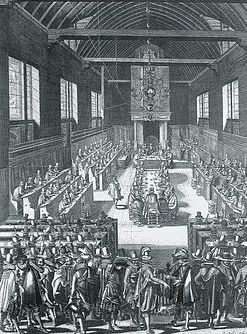
Let’s first begin by looking at where this TULIP acrostic came from. The five points of Calvinism really came from the five points of the followers of James Arminius. In 1610, one year after his death, his followers issued a formal protest to the Church of Holland regarding five points of faith that were major tenets guiding the official religion of Holland. “Church of Holland” is not like “First Baptist Church of Mayberry RFD.” The church and state were one and the same, with the church having more authority than the state. This excerpt from Wikipedia explains:
The third wave of the Reformation, Calvinism, arrived in the Netherlands in the 1560s, converting both parts of the elite and the common population, mostly in Flanders. The Spanish government, under Philip II started harsh persecution campaigns, supported by the Spanish inquisition. In reaction to this persecution, Calvinists rebelled. First there was the Beeldenstorm in 1566, which involved the destruction of religious depictions in Churches. Also in 1566 William the Silent, a convert to Calvinism, started the Eighty Years’ War to liberate the Calvinist Dutch from the Catholic Spaniards. The countries of Holland and Zeeland were conquered by Calvinists in 1572. A considerable number of people were Calvinist in Holland and Zeeland at that time already, while the other states remained almost entirely Catholic. The estates of Holland, led by Paulus Buys decided to support William the Silent, the Prince of Orange. All churches in the Calvinist territories became Calvinist and most of the population in these territories converted to or were forced to convert to Calvinism (Online source: http://en.wikipedia.org/wiki/History_of_religion_in_the_Netherlands).
Therefore, enter the Calvin Institutes, which was on par with Scriptural authority regarding the faith and order of Holland. In 1618, a national Synod was called to meet in Dort to consider the protest, supposedly, in the light of “Scripture.” But to the State of Holland, Scripture = ed Calvinism. This was a big, big, deal. The synod had 84 members, 18 secular commissioners, and 27 delegates from four different countries. It lasted seven months with sessions being held almost daily. Not only did the Synod of Dort rule against the protest, but issued five tenets that were contra to the five outlined in the Arminian protest. And not surprisingly, became known as the five points of Calvinism.
So, what was the Calvinistic intent behind these five points? These points are reflective of Calvin’s interpretation of Scripture, but what are those reflections? They bear his name, no? Holland during the Synod of Dort was a Calvinistic theocracy, no? Let’s first look at “T,” standing for Total Depravity. Here is the dirty little secret concerning this first point: many who partake in the TULIP debate do not realize that Calvin wasn’t only referring to the total depravity of unregenerate man, but also the total depravity of the saints. If the Calvin Institutes weigh in here, this is irrefutable. In 3.14.9, Calvin writes:
Although we see that the stains by which the works of the righteous are blemished, are by no means unapparent, still, granting that they are the minutest possible, will they give no offence to the eye of God, before which even the stars are not clean? We thus see, that even saints cannot perform one work which, if judged on its own merits, is not deserving of condemnation.
We must strongly insist on these two things: that no believer ever performed one work which tested by the strict judgment of God, could escape condemnation; and, moreover, that were granted to be possible (though it is not), yet the act being vitiated and polluted by the sins of which it is certain that the author of it is guilty, it is deprived of its merit. This is the cardinal point of the present discussion (3.14.11).
The next dirty little secret is that “T” is the premise for the remaining four points. One must remember that the five points of Calvinism apply to both justification and sanctification. The vast majority of those who engage the debate in our day miss that. Calvin believed that sanctification was justification in action; or in other words, justification was not a finished work, but perpetual:
Therefore, we must have this blessedness [the perpetual forgiveness of sins for justification; he quotes Ps 32:1 to make that point] not once only, but must hold it fast during our whole lives. Moreover, the message of free reconciliation with God is not promulgated for one or two days, but is declared to be perpetual in the church (2Cor 5:18,19). Hence believers have not even the end of life any other righteousness than that which is there described (Calvin Institutes 3.14.11).
This is why Calvin believed that the gospel should not only be preached to the unregenerate, but continually preached to the saved as well:
What Paul says of himself is applicable to all pastors; “For though I preach the gospel, I have nothing to glory of; for necessity is laid upon me; yea, woe is unto me if I preach not the Gospel” (1Cor 9:16). In short, what the apostles did to the whole world, every pastor should do to the flock over which he is appointed (Calvin Institutes 4.3.6).
This brings us to the “U” in TULIP, “Unconditional election.” And, unconditional/unmerited in sanctification as well. Like the “T,” the “U” must be rejected because of its premise which is: people are not regenerated prior to their confession of faith. Obviously, if man cannot do anything commendable to God after “conversion,” he certainly cannot do anything AT “conversion” that wouldn’t fall short of God’s condemnation. Hence, the “U” is actually a rejection of the new birth and regeneration. Man is completely out of the loop in both justification and sanctification (if nothing else, by necessity because anything we do in sanctification would affect justification—the two being the same). Therefore, Calvin’s election, whether unmerited or not, doesn’t include regeneration because that would lead a person to make a choice that would fall under God’s condemnation. Remember, the premise of the five points is total depravity in salvation and sanctification both; ie, nothing changes in man that imparts an ability to participate in either.
I am not that far in the Institutes as yet, but I assume that Calvin borrowed Augustine’s idea (that he got from Plato) that the new birth is not really a personal transformation, but a transport from the flesh realm into the spirit realm where manifestations of Christ’s active obedience are manifested, and not anything we do. In regard to a rough estimate, Calvin quotes Augustine on every 2.5 pages of the Institutes which are over a 1000 pages. Not only have New/Old Calvinists shared with me directly that Christians do not change, every now and then they actually write it in no uncertain terms:
1) Our flesh cannot get better. In Romans 7:18 Paul wrote, “For I know that NOTHING good dwells in me, that is, in my flesh…” Your flesh cannot be improved. Flesh is flesh, and spirit is spirit.
2) Our new nature, on the other hand cannot get better, because it has already been made new and perfect through regeneration. We have been given a “new heart” (new nature, or new spirit), and not a defective one, which would be absurd. This new spirit has been made “one spirit with Him” (1 Corinthians 6:17), such that when we “walk according to the Spirit” (i.e., the Holy Spirit), we also walk according to our own new spirit.
3) Those who deal with Sanctification by zeroing in on so-called “Progressive” Sanctification as the main point of Sanctification, are at best in Kindergarten (Online source: http://grace-for-life.blogspot.com/search?q=sanctification).
The author of the cited post then goes on to say that we “appropriate” what has already been done for us, but on the other hand, if we don’t change, what he is really talking about is a manifestation of Christ’s obedience, and not ours. This concept of Christ obeying for us can be seen in some of the aforementioned citations from Calvin.
That brings us to the “L,” limited atonement. The danger here is to debate this question and thereby give some credibility to the whole system which is based on total depravity of man in both justification and sanctification. But even a cursory approach to this tenet reveals some unfortunate fallout. If Christ only died for certain people, the offer of salvation to all men is not a legitimate offer. Not only that, there is a problem with calling on men to make a choice that could only be condemned by God. Like it or not, that is per Calvin himself. Calvin’s gospel preached to the masses would seem to be an invitation to offend God. But the only reason that it is offensive is that a salvation is being “neglected” (Hebrews 2:3). How do you “neglect” something that’s not a legitimate offer? In addition, Calvin seems to say that evangelism is the primary duty of the pastor/evangelist, and any kind of emphasis on the totally depraved evangelizing the totally depraved is absent from Calvin’s writings—which one would expect. Calvin states the following in chapter three of the Institutes:
We now understand what offices in the government of the church were temporary, and what offices were instituted to be of perpetual duration. But if we class evangelists with the apostles, we shall have two like offices in a manner corresponding to each other. For the same resemblance which our teachers have to the ancient prophets pastors have to the apostles. The prophetical office was more excellent in respect of the special gift of revelation which accompanied it, but the office of teachers was almost of the same nature, and had altogether the same end (section 4.3.5).
From these and similar passages which everywhere occur, we may infer that the two principle parts of the office of pastors are to preach the Gospel [remember, to both saints and sinners] and to administer the sacraments. But the method of teaching consists not merely in public addresses, it extends also to private admonitions (4.3.6).
Calvinists can harp till the cows come home that their doctrine is evangelistic friendly, but it just isn’t true. And even if it was, such a work would not be pleasing to God anyway because it is performed by the totally depraved who can do no meritorious work before God, but only that which brings condemnation. Again, like it or not, that is per the man Calvin himself.
The “L” is false because like the “U,” it circumvents regeneration, and valid participation of the saints in evangelism. And this is because of the “T.” Integration of elements containing accurate facts in TULIP does not give it the vitality that qualifies as God’s truth. God’s truth always accomplishes sanctification, and preaching the finished work of justification to the saints does not sanctify. We are not sanctified by justification. One might well remember that the Hebrew writer warned against doctrines that require a continual application of the onetime sacrifice of Christ (Hebrews 10:12-14).
So, again, “T” qualifies “U,” “L,” “I,” and “P.” U and L pertain to initial salvation, but also have negative consequences in regard to sanctification (remember, “T” applies to both sanctification and justification), and therefore must be rejected. “T,” makes a biblical approach to the new birth and regeneration impossible, and therefore is a false gospel. Christ said, “YOU MUST be born again.”I and P primarily deal with sanctification, and we will now look at those.
Again, “I” (irresistible grace) is thought to be pertaining only to salvation in the whole TULIP debate. Not. If grace is needed in sanctification as much as it is in salvation, and according to Calvin it most certainly is, then the totally depraved cannot resist whatever the Lord wills to do in his/her life. The totally depraved saints have no more free will in their sanctification than they did in their salvation. In fact, exercising their own will in sanctification is an attempt to finish justification by their own works. Calvin saw sanctification as having the same standard as justification because sanctification supposedly finishes justification. Therefore, the law has to be kept perfectly by somebody in order to maintain justification until judgment day. In Calvin’s theology, sanctification must be held to a justification standard. That is why Calvin taught the futility of Christians keeping the law. Law-keeping in sanctification is the same as law-keeping for justification. Hence, Calvin stated the following:
Even if it were possible for us [“us” meaning believers] to perform works absolutely pure, yet one sin is sufficient to efface and extinguish all remembrance of former righteousness, as the prophet says (Ezek 18:24). With this James agrees, “Whosoever shall keep the whole law, and yet offend in one point, is guilty of all” (Jas 2:10) [this was James’ standard for keeping the law for justification, not sanctification]. And since this mortal life is never entirely free from the taint of sin, whatever righteousness we could acquire would ever and anon be corrupted, overwhelmed, and destroyed, by subsequent sins, so that it could not stand the scrutiny of God, or be imputed to us [Christians] for righteousness [notice that Calvin saw imputation as progressive]. In short, whenever we treat of the righteousness of works, we must look not to the legal work but the command. Therefore, when righteousness is sought by the law [we have already obtained righteousness, we now seek to please the Lord], it is in vain to produce one or two single works; we must show an uninterrupted obedience [by offering God the works of Christ by faith only, not our own]. God does not (as many foolishly imagine) impute that forgiveness of sins, once and for all, as righteousness [righteousness in not imputed once]; so having obtains the pardon of our past life we may afterward seek righteousness in the law [this is a denial of imputation for the future in order to set us free from being judged by the law]. This were only to mock and delude us by the entertainment of false hopes. For since perfection is altogether unattainable by us, so long as we are clothed with flesh, and the law denounces death and judgment against all who have not yielded a perfect righteousness, there will always be ground to accuse and convict us unless the mercy of God interpose, and ever anon absolve us by the constant remission of sins [God’s declaration is not valid unless we live perfect lives]. Wherefore the statement which we set out is always true, if we are estimated by our own worthiness, in everything that we think or devise, with all our studies and endeavors we deserve death and destruction (Calvin Institutes 3.14.10).
So, even in sanctification, the saint is completely out of the loop, and all of his good works are elected by God and displayed as Christ’s manifested active obedience. “I” is not just for salvation, it is for sanctification as well:
There can be no doubt that Paul, when he treats of the Justification of man, confines himself to the one point—how man may ascertain that God is propitious to him? Here he does not remind us of a quality infused into us; on the contrary, making no mention of works, he tells us that righteousness must be sought without us; otherwise that certainty of faith, which he everywhere so strongly urges, could never stand; still less could there be ground for the contrast between the righteousness of faith and works which he draws in the tenth chapter to the Romans….
Let the children of God consider that Regeneration is necessary to them, but that, nevertheless, their full righteousness consists in Christ—let them understand that they have been ordained and created unto holiness of life and the study of good works, but that, nevertheless, they must recline on the merits of Christ with their whole soul—let them enjoy the righteousness of life which has been bestowed upon them, still, however, distrusting it so as not to bring before the tribunal of God any other trust than trust in the obedience of Christ (From Kenneth A. Strand, ed., Reform Essentials of Luther and Calvin: A Source Collection (Ann Arbor: Braun-Brumfield, 1971), pp.219-222).
Therefore, according to Calvin, all of our righteousness in sanctification must be a righteousness that is completely outside of us. In the same way that God elects some for salvation and passes over others in salvation, He also predetermines our good works in sanctification, and in both cases, this grace cannot be spurned by us.
Finally, we come to “P,” the perseverance of the saints. Though many evangelicals might assent to this fact, one must reject it and reword it as “once saved, always saved” because now the discussion becomes a statement that one is a “one-point Calvinist.” Because this fact comes from a body of information that does not sanctify, it must be rejected as a whole in regard to God’s truth. Rummaging through garbage dumps to collect isolated facts that can be compiled into a body of sanctifying truth is not the duty of a Christian according to wisdom.
And it would seem we are in a day like that during the Synod of Dort when a man was the standard of truth and not the Scriptures. After all, Charles Spurgeon, a Reformed hero, is often quoted in our day as having said:
It is a nickname to call it Calvinism; Calvinism is the gospel, and nothing else.
paul
Election Verses Foreknowledge Isn’t Even the Point; the Gospel is the Point
 I am amazed at how God’s people have been distracted throughout the years over the election/foreknowledge debate. Wow, what a boondoggle for people of Reformed theology who don’t want folks looking too closely at what Calvin, Luther, and Augustine really believed. And if Calvin is Luther/Augustine light, there is even a bigger problem.
Yes, the Calvin Institutes are 1000 pages of mind-numbing theology, but if you know how to look, you can find the crux of the issues before Calvin lulls you into a hypnotic state with his linguistic drones. I was poking around in the Institutes in an effort to discover what Calvin believed about the final judgment of mankind, and in the process, discovered Calvin’s blatant false gospel on pages 508 and 509. Like his New Calvinist children, he believes that sanctification maintains justification, or stated another way, sanctification is justification in action. This makes sanctification very, very, very, tricky business—don’t try it at home without Plato’s Philosopher Kings or John Piper.
Fact is, people who believe that God elected some before creation and passed over others are not heretics. You may not like their view of God, but they are not heretics. Fact is, people who believe that God elected based on what He foreknew people would do, are not heretics either. But folks who believe that we must maintain Christ’s representation for an ongoing justification by believing a certain way in sanctification are heretics. Maintaining justification by doing something, doing nothing, thinking a certain way, or anything else boils down to our participation in justification. If sanctification and justification are fused together —this is unavoidable. It’s a false gospel. Plainly, Calvin states on the aforementioned pages of the Institutes that justification is “perpetual”:
Moreover, the message of free reconciliation with God is not promulgated for one or two days, but is declared to be perpetual in the church (2Cor 5:18,19). Hence believers have not even to the end of life any other righteousness than that which is there described. Christ ever remains a Mediator to reconcile the Father to us, and there is a perpetual efficacy in his death, i.e., ablution, satisfaction expiation; in short, perfect obedience, by which all our iniquities are covered. In the Epistle to the Ephesians, Paul says not that the beginning of salvation is of grace, “but by grace are ye saved,” “not of works, lest any man should boast” (Eph 2:8,9).
A: “Moreover, the message of free reconciliation with God is not promulgated for one or two days, but is declared to be perpetual in the church (2Cor 5:18,19).”
The message of “free reconciliation” is “perpetual” “in the church,” ie, sanctification by faith alone- which has never been orthodox. Justification by faith alone has always been orthodox, but not the former. Moreover, 2Cor. 5:18,19[20] is clearly speaking of a ministry of reconciliation that we proclaim to the world as ambassadors, and is not a message to be continually propagated “in the church.”
B: “Hence believers have not even to the end of life any other righteousness than that which is there described.”
Yes, because to claim any good works is to do so in the context of justification. If “free reconciliation” is “perpetual,” then our efforts would be works salvation. But, by the same token, it is impossible to avoid that reality if the two are joined—regardless of any special formula that the Reformers supposedly came up with. No wonder the Institutes are 1000 pages; it goes back to the primary point of my first book: it’s a formula that attempts to instruct one on putting a round peg in a square hole. Secondly, the idea that the saints have NO righteousness is a denial of the new birth as actual new creature-hood, as opposed to being merely translated into a different realm.
C: “Christ ever remains a Mediator to reconcile the Father to us, and there is a perpetual -efficacy in his death, i.e., ablution, satisfaction expiation; in short, perfect obedience, by which all our iniquities are covered.”
Here, Calvin states that the “perfect obedience” of Christ is continually applied to our lives to cover for our inability to possess any righteousness. This is the continual imputation of Christ’s active obedience to KEEP us saved (“Mediator to reconcile”). This is heresy. In essence, we must continually practice a justification by faith alone in sanctification. We participate in maintaining justification by faith alone apart from works because justification is progressive. This is plainly a false gospel.
D: “In the Epistle to the Ephesians, Paul says not that the beginning of salvation is of grace, ‘but by grace are ye saved,’ ‘not of works, lest any man should boast’ (Eph 2:8,9).”
Calvin is clearly making sanctification part of the justification/salvation process. He makes no distinction between God’s graces in sanctification and justification. The grace of God based on the works of Christ to declare us righteous is not a finished work, though Christ Himself said it was.
paul

 Paul's Passing Thoughts
5 comments