The Protestant Culture of Death and the Folly of Discernment Blogging
 “So, anti-spiritual abuse blogs are confronting a religion that they remain a part of while that religion looks to suffering as a means of properly understand reality itself. Good luck with that.”
“This should also be instructive for discernment bloggers; even if you succeed in making the Calvinist abusers feel guilty what is going to be the result? A return to the foot of the cross and nothing else.”
When Protestants started rediscovering their real roots in 1970, many “gospel recovery movements” started a “quiet revolution” to take the church back from modern-day “legalistic Pharisees.” Few knew anything was going on until 2006, and even then it was the realization that something was going on, but nobody knew exactly what it was. In 2009 discernment blogs exploded in response to the spiritual abuse tsunami sweeping across the evangelical church.
2014 has ushered in the realization that discernment blogs are pointless because they confront Protestantism and Calvinism in particular about its bad behavior while remaining in the institutional church, and in many cases, Calvinism itself.
The cat is out of the bag. The rabbit is out of the hat. The elephant is out of the barn. However you want to state it, spiritual abuse is happening in the church; and if not abuse, rampant sin, and if not sin; boredom, because Protestantism is the same old ancient doctrine of death ideology as Islam or anything else. There is only one historical difference between Protestantism and Islam in regard to degree of abuse: American rule of law, and the separation of force and faith. Calvinists in our day state plainly that they would “go Old Testament” on dissenters if they were allowed. What is our first clue that something isn’t right? Presently, they are limited to character assignation and having your name removed from the book of life. Openly, they bemoan the loss of days gone by when burning stakes were as common as road signs while the average pew sitter makes no correlation between history and ideology whatsoever. Calvinists like Wade Burleson can actually brag about being a modern-day Puritan while at the same time claiming to be an advocate for the spiritually abused. The disconnect in logic is stunning.
It is extremely important to make a distinction between doctrine and ideology. The same ideology can take on many different expressions of doctrine; biblical or secular. Doctrine is the stated ethic of the ideology which usually comes from what we believe about the state of being. A lot of the debate noise on the internet, if not most of it, is from people with the same ideology either aware or unaware, debating doctrine. They think they have relevant differences because they disagree on doctrine. No, doctrine is the tentacles of the ideological octopus.
Epistemology is the “how” we know the state of being (what is), and perhaps why it is. For original Protestantism, reality is perceived through suffering. Christ came to die on the cross so man could obtain life. That’s true in respect to salvation, but Luther (following the lead of Augustine) made that an ongoing need for understanding reality and experiencing the wellbeing of the invisible. This led to the false doctrine of progressive justification and made understanding reality part and parcel with salvation. This drives a lot of the mentality behind the evangelical homeschool movement. The public schools are evil because unbelieving teachers do not have a proper grasp of reality.
So, anti-spiritual abuse blogs are confronting a religion that they remain part of while that religion looks to suffering as a means of properly understand reality itself. Good luck with that. They have been blogging their guts out for five years now, and where are the results? You are dealing with people who will never be appalled at suffering because it is key to understanding reality.
Let’s look at an example:
The ugly reality of crucifixion looms over the lives of Christ’s followers today, as it did Peter’s life. In the gospel, we are confronted with the unvarnished horror of ourselves—damned and cursed and exiled. We find ourselves ensnared in the curse itself—in Jesus, writhing in torture on a stake (John 3:14).
Gathering each week, we reenact the horror of Jesus’ sacrificial death. In baptism, we see the flood of God’s judgment against sin (1 Pet. 3:20-21). At the Lord’s Table, we swallow and digest the sign of our Lord’s torn skin and spattered blood (Justin Taylor: The Gospel Coalition .org blog; The Gospel at Ground Zero | Sept. 9, 2011).
So, when you go to church every week, for all practical purposes, it is really a celebration of death. And what to do when your conscience bothers you?
And whenever our consciences accuse, the gospel takes us away from denial or preoccupation and right back to Ground Zero—to the Cross (Ibid).
This should also be instructive for discernment bloggers; even if you succeed in making the Calvinist abusers feel guilty what is going to be the result? A return to the foot of the cross and nothing else. One does not keep a clear conscience before God through obedience, that would be, “trying to be the gospel rather than preaching the gospel.” Hence, the often espoused, “I have no problem with Christ, it’s His followers I disdain” has unfortunate merit. Classic Protestantism is unabashed in promoting a talk instead of a walk—a walk is works salvation—we must let Jesus do the walking for us. “It’s not about what we do—it’s about what Jesus has done.” This mindset is unsalvageable—come out from among them. Unfortunately, once someone experiences a way of life that answers every question with the fatalistic easy-button while vanquishing real responsibly for the sum and substance of their own life, repentance is extremely unlikely unless God intervenes.
What’s the solution? Abandon the institutional church and return to church as it was meant to be. Believers at large are the priesthood, not Protestant academia. There needs to be an exodus to explore the real truth marred by 500 years of the traditions of men.
Why are we begging the institutional church to do what’s right? Why have we been begging since 2009, and to no avail? Why are toothless tigers like Boz Tchividjian heroes for merely crying foul on behalf of victims? Have you noticed how discernment bloggers are constantly clamoring at the doors of the institutional church with bated breath for some notable evangelical to throw them a verbal breadcrumb? It goes viral because some stuffed shirt orthodox lackey states something along the lines of God’s displeasure with pedophilia. It’s pathetic.
Victims need to understand that their suffering is a Protestant epistemology that is deemed not only a necessary evil, but the only gateway to spiritual wellbeing. Hold out your begging cup named justice till the second coming if you must, but you have been doing so since 2009, and you will continue to do so with the same results. Stop suing them and being sued by them, stop begging them, and for crying out loud, stop giving them your money!
Come out from among them and be separate. Only truth sanctifies. Be honest; what is your real goal in life? Retool and start blogging about the solution; that’s the new spiritual frontier. Stop being enslaved to a spiritual caste system, Christ came to set you free.
paul
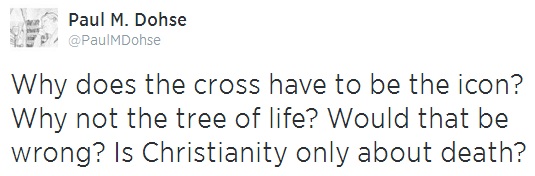
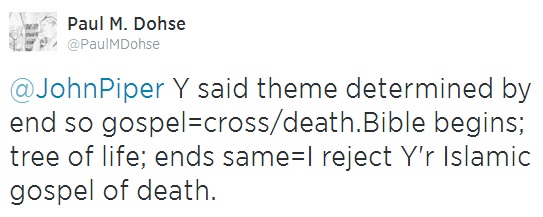
“< Tweet, Tweet

What the Quran says plainly is the Calvinist interpretation of the Bible.
Calvinism and Islam: The Tie That Binds; the Doctrine of Death
 Islam’s penchant for death is well documented and publicized often. In the Quran, the crown of martyrdom guarantees forgiveness of sins and entry into paradise. This is a consistent theme throughout the Quran. If words mean anything, and I think they do, a popular slogan among such groups like Hamas should be telling: “We love death more than the Jews love life.”
And that was Martin Luther’s same problem with humanity in general; the whole loving life more than death sort of thing. His 95 Theses was a morale indictment against the Popes, not the Catholic Church in particular; six months later, Luther hammered out the framework for the Reformation in his Heidelberg Disputation which is clearly a doctrine of death.
In fact, death and suffering is the prism for understanding reality itself according to Luther in his foundational document for the Reformation. This results in Calvinists like John MacArthur Jr. suggesting that Christians doubt their salvation when they don’t suffer enough. Therefore, clearly, Christians should desire suffering. Think about this in context of the fact that 90% of all biblical counseling in our day is under the control of Neo-Calvinism.
In said document that laid the foundation for the Reformation, Luther states the following:
This is clear: He who does not know Christ does not know God hidden in suffering. Therefore he prefers works to suffering, glory to the cross, strength to weakness, wisdom to folly, and, in general, good to evil. These are the people whom the apostle calls “enemies of the cross of Christ” [Phil. 3:18], for they hate the cross and suffering and love works and the glory of works. Thus they call the good of the cross evil and the evil of a deed good. God can be found only in suffering and the cross, as has already been said. Therefore the friends of the cross say that the cross is good and works are evil, for through the cross works are destroyed and the old Adam, who is especially edified by works, is crucified. It is impossible for a person not to be puffed up by his good works unless he has first been deflated and destroyed by suffering and evil until he knows that he is worthless and that his works are not his but God’s (Theses 21).
As will be discussed in volume 3 of TTANC, the doctrine of death is the basis for most religions of the world, and is grounded in the idea that the visible/tangible is evil and the invisible is good. This was Luther’s assertion as well:
He deserves to be called a theologian, however, who comprehends the visible and manifest things of God seen through suffering and the cross. The “back” and visible things of God are placed in opposition to the invisible, namely, his human nature, weakness, foolishness. The Apostle in 1 Cor. 1[:25] calls them the weakness and folly of God. Because men misused the knowledge of God through works, God wished again to be recognized in suffering, and to condemn wisdom concerning invisible things by means of wisdom concerning visible things, so that those who did not honor God as manifested in his works should honor him as he is hidden in his suffering (Theses 20).
Volume 3 will delve deeply into Dualism which almost always leads to a doctrine of death. Suffering alone, or knowledge about suffering, leads to spiritual awareness with death itself being the final escape from this material world. Why do Calvinists so disdain the doctrine of the Rapture? Because it bypasses death.
The commonality of death-love between Islam and Calvinism will be examined, as well as Calvinism’s other astonishing commonalties with Islam, particularly the “Gospel of Sovereignty.”
J. V. Fesko Exemplifies Deliberate Calvinist Deception
 What Dr. Robert Congdon now calls “Classic Calvinism” expressed in contemporary New Calvinism has redefined almost every word used in theological discussion. If the false gospel of Calvinism, the epic supercult of the ages is to be contended against, Calvinists must be exposed for redefining terms and words for the deliberate purpose of deception.
This is difficult to get our minds around; that nicely polished academics would communicate to us while not clarifying what they know is being assumed by most of those listening or reading. For example, “total depravity”— they know the unregenerate as the subject is assumed. However, if they keep talking about total depravity while the subject is Christians, the idea that Christians are totally depraved will be slowly assimilated into people’s minds. This is Brainwashing 101. Furthermore, it’s true, Christians sin; so, if that is all you talk about, the idea follows without it being stated outright: Christians do nothing but sin and cannot please God. If you never talk about the good works of Christians it is assumed that there aren’t any good works without that being stated clearly. This is a deliberate communication construct:
1. Deliberately overemphasizing some realties to the exclusion of others for purposes of a particular outcome. What IS NOT being said is just as important as what IS being said.
2. Talking about subject B while subject A is the context will eventually lead people to believe A=B. For example: talking about justification in a sanctification way; eventually, justification and sanctification become the same thing.
3. Transition manipulation: This takes a number of ideas under one context and manipulates the transitions between the ideas for purposes of a specific outcome. Most Christians are lazy thinkers and don’t pay attention to transitions.
4. The redefinition of words and terms. Example: the “new birth” as realm manifestation rather than new creaturehood.
5. Word splitting. If the normal meaning of a word is a roadblock to what you want to teach, make a case for other meanings, or synonyms, and then proceed with the synonym that fits the objective. This is different from redefinition—this assigns multiple meanings to a word in order to use it for a specific goal. A good example of this is when the definition of the word, “knowledge” becomes a problem for Calvinists. In this case, Bible knowledge. It would seem that for the Christian, Bible knowledge is Bible knowledge. But that creates a problem for Calvinism, so they split Bible knowledge into “fleshly knowledge” and “intimate knowledge.” They then choose intimate knowledge as the only valid knowledge. This is framed as, “knowing the Bible and knowing Jesus are two different things.” They can now make Bible knowledge anything they want it to be. Supposedly, factual knowledge followed by obedience cannot lead to intimacy with God (not so, Peter taught that knowledge leads to intimacy with God as well as our wives); hence, we must seek Jesus in all the Scriptures. The only true knowledge is that of “Jesus’ personhood” while factual knowledge of Jesus does nothing for our relationship with him. By the way, this is the stand taken by the postmodern Emergent church as well.
6. Metaphysical dogma: Always speak to people from the prism that interprets reality the way you want it to be interpreted. When people are confused by this, the assumption is that they are ignorant and unable to understand true realty. If you persistently communicate with people according to your own view of reality, they will eventually begin to be programmed accordingly. Only your view of reality is recognized as valid.
7. Nuance, and the generic use of words. While redefining some words, and attaching multiple definitions to others, some words are used generically to fill in gaps and connect large leaps in logic. There is no better example here than the word, “gospel.” Nuance is also used to shade or soften the full brunt of what is being said.
In Reformed circles, this is the Either/Or hermeneutic. This is Gnostic epistemology. EVERYTHING must be interpreted via material (evil) or invisible (true). In the final analysis, it is the Redemptive Historical hermeneutic.
8. Redefined use of words. This is not the redefinition of meaning, but the redefinition of application; using nouns as verbs, distorted modifiers, etc.
Elitism is used to condone these techniques. This is the mythological noble lie that teaches truth in story form for the consumption of the great unwashed masses. These preordained philosopher kings understand things that the masses are unable to understand, so they can’t let the normative understanding of words stand in the way of teaching creeds for social unity. As John MacArthur associate Rick Holland once stated: good grammar makes bad theology.
Here, an excerpt sent to this author will be used to make the point. According to the sender,
The Fruit Of The Spirit is…(book written by J. V. Fesko, Westminster Seminary,CA) [Academic Dean, Professor of Systematic Theology and Historical Theology].
If you go to Fesko’s bio on Westminster’s website, he is quoted as follows:
What I Want to Instill in My Students
“A passion to proclaim Christ and him crucified in word and deed and to serve the church to the glory of Christ.”
We may well begin our example here. A proclamation to the unregenerate is assumed, but what Fesko is really talking about is the perpetual proclamation of the gospel within the church. This is because Reformed soteriology holds to the idea that Christians need perpetual re-justification (re-salvation). John Calvin makes no bones about this in his Institutes (3.14.11). Reformed soteriology also holds to the idea that this efficacious re-justification can only be found in the formal institutional church (4.15.4).
The excerpt sent follows:
Unlike Old Testament Israel who had the law written upon tablets of stone, we have the law written upon the tablets of our hearts. We also have the indwelling power of the Spirit enabling us to be obedient, even causing us to walk in God’s statutes, to borrow Ezekiel’s words. This hopefully alerts us to the important point that so many Christians miss–namely, the nature of our sanctification. The law does not produce godliness. The law only condemns. Obedience does not produce godliness. Obedience that is carried out in the power of the flesh fails every time. Rather, only the Holy Spirit produces his fruit in us and enables us to be obedient, to produce good works. In other words, in our sanctification, for our growth in godliness, we must seek the power of the Holy Spirit. The Spirit alone is both the source and the power of our sanctification, good works, and obedience.
We must therefore seek the power of the Holy Spirit through God’s appointed means: through the Word, preached, read and meditated upon; the sacraments, baptism and the Lord’s Supper; and prayer. So often people cut themselves off from the means of grace: moving away from the church, failing to attend church, or even cutting themselves off from the sacraments. To do so is to cut ourselves off from the power of the Holy Spirit.
Much could be discussed here, like the eschatological law/gospel train wreck of the first sentence, but we will move on to…
We also have the indwelling power of the Spirit enabling us to be obedient, even causing us to walk in God’s statutes, to borrow Ezekiel’s words.
First of all, Calvinists who know what they believe do not believe that the Holy Spirit does work within us and through us. They do not believe that the power is “indwelling,” and they know it. “Indwelling” is redefined, and “obedience” is also redefined as what the Reformed call, “new obedience.” What’s that? It is not an action we do, it is an action done to us by the Holy Spirit that we ONLY experience. Calvinism also adds the perfect obedience of Christ to the atonement, and that obedience is imputed to our lives by faith alone in order to keep ourselves saved. Nothing is going on within the believer at all, that would be works salvation because justification and sanctification are made to be the same thing. Yet, they use the “in” terminally in order to not unsettle the herd. Calvinists like John Piper make it clear that Reformed soteriology disavows any work by the Spirit within the believer:
This meant the reversal of the relationship of sanctification to justification. Infused grace, beginning with baptismal regeneration, internalized the Gospel and made sanctification the basis of justification. This is an upside down Gospel…When the ground of justification moves from Christ outside of us to the work of Christ inside of us, the gospel (and the human soul) is imperiled. It is an upside down gospel.
In fact, one of the most popular terms among Calvinists in our day is, “the objective gospel outside of us,” or simply, the “objective gospel.” There is no need to be confused by these concepts; it is simply Gnosticism which teaches that material beings cannot know spiritual truth (the invisible). The manifestations of this philosophy always have an epistemology that births the wellbeing of the invisible world to the material world by way of experience. In Reformed theology, the epistemology is gospel contemplationism.
But the point here is that J. V. Fesko knows grade-A-well that “in” doesn’t mean “in.”
This hopefully alerts us to the important point that so many Christians miss–namely, the nature of our sanctification.
Here, Fesko will now define “sanctification.” This lays the groundwork for the rest of the theses that he wants to proffer. Unfortunately, most Christians do not have the discernment skills that would immediately qualify the definition of sanctification to prevent deception. Instead of drawing conclusions from the definition of the word, and how it is used in Scripture, Fesko wants to talk about its “nature.” The actual definition is skipped, and the word is defined by how it behaves, or its “nature.” Sanctification covers a wide spectrum of action, so Fesko can now attach any meaning to the word that he wants to at this point. He is skipping the actual definition, and making its “nature” the definition, and proceeding with the desired agenda.
This enables him to make an outrageous logical leap with the following:
The law does not produce godliness. The law only condemns. Obedience does not produce godliness. Obedience that is carried out in the power of the flesh fails every time. Rather, only the Holy Spirit produces his fruit in us and enables us to be obedient, to produce good works. In other words, in our sanctification, for our growth in godliness, we must seek the power of the Holy Spirit. The Spirit alone is both the source and the power of our sanctification, good works, and obedience.
The primary technique used in the above excerpt is #7, the Either/Or hermeneutic. But again, he skips a biblical definition of law, and its application, and redefines it as something that can only condemn. Therefore, there is EITHER the “power of the flesh,” OR the “power of the Spirit.” Notice how he uses the aforementioned techniques to say that the Holy Spirit obeys for us, and we only experience His obedience through realm manifestation, without actually saying it:
Rather, only the Holy Spirit produces his fruit in us [BY faith which is a conduit that enables us to experience works outside of us] and enables us to be obedient, to produce good works. In other words, in our sanctification, for our growth in godliness, we must seek the power of the Holy Spirit. The Spirit alone is both the source and the power of our sanctification, good works, and obedience.
Herein, “obedience” is redefined as “seeking.” If we “seek the power of the Holy Spirit,” the righteousness of Christ will be imputed to us by seeking alone (ie, faith alone/gospel meditation alone) and we will remain saved. So, how then do we seek?
We must therefore seek the power of the Holy Spirit through God’s appointed means: through the Word, preached, read and meditated upon; the sacraments, baptism and the Lord’s Supper; and prayer. So often people cut themselves off from the means of grace: moving away from the church, failing to attend church, or even cutting themselves off from the sacraments. To do so is to cut ourselves off from the power of the Holy Spirit.
Any questions? The church is our gas station for receiving a refilling of our salvation gas tank through formal preaching, the sacraments, and church attendance. To replace seeking with obedience, or forsaking the assembly of the institutional church, we “cut ourselves off from the power of the Holy Spirit.” Fesko deliberately adds the word, “power” to imply Christian living more than actual salvation, but salvation is what’s being referred to for all practical purposes.
Calvinist communication is saturated with ancient brainwashing communication techniques. The discerning Christian does well to be educated in regard to them accordingly.
A Conversation Between a Biblicist and a Calvinist
Biblicist: So, let me get this straight. A man can choose to make a wise decision like not running a red light, but he can’t choose God?
Calvinist: His choice is self-motivated; he doesn’t want to suffer the consequences of running a red light. Man cannot make a righteous choice, nor can he choose God.
Biblicist: But Christ, as well as the apostle John, called on people to believe in order to escape hell. That’s a good idea, no?
Calvinist: But again, the motive is self-preservation.
Biblicist: But, I thought if a man sees himself as a sinner, he can be saved.
Calvinist: Right.
Biblicist: So, if the motive is to escape hell, doesn’t that mean he knows that he deserves to go there? Doesn’t this belief enable him to make a wise decision/choice accordingly?
Calvinist: You are confusing practical worldly wisdom with spiritual wisdom.
Biblicist: What’s the difference?
Calvinist: One is worldly, one is spiritual.
Biblicist: So, what is practical and wise in the world is completely disconnected from spiritual wisdom? The worldly wise are no spiritual good, and vice versa.
Calvinist: Right, until a man is born of the Spirit, he cannot see the kingdom of God.
Biblicist: So basically, two realities?
Calvinist: Right.
Biblicist: And unless God regenerates, worldly wisdom has no benefit. Worldly practicality has no spiritual use or application.
Calvinist: Correct.
Biblicist: That’s Gnosticism. It completely disconnects knowledge in the material world from the spiritual world.
Calvinist: No it isn’t.
Biblicist: How is it not?
Calvinist: I heard Al Mohler say in a conference Q&A that Gnosticism is error.
Biblicist: So, If Al says it’s bad, that eliminates the possibility that Calvinism is Gnosticism?
Calvinist: He has been called the most intelligent Evangelical of this age.
Biblicist: Would that be this world or the other one, and is that worldly intelligence or spiritual intelligence, and from which view was that assessment made?
Calvinist: I don’t know.
Biblicist: Then how do you know that you’re not a Gnostic?
Calvinist: I already told you; Al Mohler says Gnosticism is error.
Biblicist: I see, or maybe I don’t.
Calvinist: If you obey an orthodox leader, that means you see.
Biblicist: Good grief!
paul

 Paul's Passing Thoughts
27 comments