Helping Tim Challies and Other Calvinists with Evangelism
Originally published January 29, 2015
 Yesterday, I was sent the following article about Calvinist evangelism written by blogger Tim Challies: How To Offend a Room Full of Calvinists. Miffed by the suggestion that somebody knows better than me how to offend Calvinists, I immediately read the article.
Apparently, according to Challies, Calvinists get offended when people suggest that their soteriology hinders evangelism. According to Challies, the argument goes like this:
Many people are firmly convinced that there is a deep-rooted flaw embedded within Reformed theology that undermines evangelistic fervor. Most blame it on predestination. After all, if God has already chosen who will be saved, it negates at least some of our personal responsibility in calling people to respond to the gospel. Or perhaps it’s just the theological-mindedness that ties us down in petty disputes and nuanced distinctions instead of freeing us to get up, get out, and get on mission.
Protestants en masse think Calvinism’s greatest sin is weak evangelism, and of course, that makes them very angry because it’s supposedly the last criticism standing. I could start with the fact that Calvinism is works salvation under the guise of faith alone, or progressive justification, or salvation by antinomianism. Pick one; any of the three will work. But I have a mountain of data on that subject already; let’s do something different. Yes, let’s use Challies’ own words in the post to refute his argument. Before we call on Challies to refute his own protest, we will address his take on church history.
We go to history to show that the great missionaries, great preachers, and great revivalists of days past were Calvinists, and that Reformed theology was what fueled their mission… There are only so many times I can point to Jonathan Edwards, George Whitefield and the Great Awakening, or William Carey and the great missionary movement of the nineteenth century, or Charles Spurgeon and the countless thousands saved under his ministry. Sooner or later I have to stop looking at my heroes and look to myself. I can’t claim their zeal as my own. I can’t claim their obedience as my own.
In the post, Challies argues that we know that a straight line can be found from Reformed theology to evangelistic zeal because of history. Supposedly, Calvinists throughout history were driven directly by this deterministic gospel to reach thousands. It is very interesting when you consider the examples given which will aid in making my point.
The Great Awakening had absolutely nothing to do with Reformed soteriology. We should know this as a matter of common sense to begin with because the Holy Spirit doesn’t colabor with a false gospel. The Great Awakening was fueled by the ideology of the American Revolution and was expressed to a great degree in churches, especially among African Americans. Fact is, guys like Edwards and Whitefield then got on their horses and rode around the countryside bloviating and taking credit for the freedom movement tagged with “The Great Awakening” nomenclature.
Fact is, the Great Awakening was a pushback against the Puritan church state driven by Reformed soteriology that came across the pond as a European blight on American history. I would liken Challies’ assessment to our present President taking credit for things he is against when the results are positive.
What about Spurgeon? That example is just too rich because it makes the last point for me. Spurgeon, who once said Calvinism was no mere nickname but the very gospel itself, was the poster boy for getting people to come to church in order to get them saved. That’s important, hold on to that because it’s our last point.
But before we get to the last point, let’s look at the major point: Challies argues against the idea that fatalism hinders evangelism, and then confesses that he doesn’t evangelize like all of the great Calvinists in history because of…fatalism. Calvinism doesn’t cause fatalism resulting in lame evangelism, but Challies doesn’t evangelize because of fatalism.
After all, if God has already chosen who will be saved, it negates at least some of our personal responsibility in calling people to respond to the gospel… We go to the pages of Scripture to show that God’s sovereignty and human responsibility are not incompatible, but that people truly are both free and bound, that God both chooses some while extending the free offer of the gospel to all.
So why does Challies not evangelize according to him? First, because he just doesn’t, but secondly, he is responsible:
It is my conviction—conviction rooted in close study of God’s Word—that Calvinism provides a soul-stirring motivation for evangelism, and that sharing the gospel freely and with great zeal is the most natural application of biblical truth. But it is my confession—confession rooted in the evidence of my own life—that my Calvinism too rarely stirs my soul to mission. The truths that have roared in the hearts and lives of so many others, somehow just whisper in me. The fault, I’m convinced, is not with God’s Word, or even with my understanding of God’s Word; the fault is with me.
He is responsible, but not often stirred. And what’s his solution? There isn’t one, it is what it is; he is responsible, but not called to evangelism. No corrective solution is offered in the post. Why not? Because, as he said, we are responsible, but unable. Responsibility and inability are not incompatible. So, Calvinism doesn’t hinder evangelism, but if you don’t evangelize, there is no solution. Others did it, and you don’t, the end. Well, I suppose that approach doesn’t prevent evangelism either!
And funny he should cite Edwards. Susan is doing a session on Edwards for TANC 2015 and is studying his sermon Sinners in the Hands of an Angry God. She approached me and wanted to discuss something about the sermon that she was perplexed about. Edwards spent the better part of an hour addressing the total hopelessness of man and his likelihood of ending up in an eternal hell, but in the end offers no counsel on how to escape. Why? Because if God is going to do something, he is going to do it, and man is responsible either way.
This now brings us to the final point with a bonus; we are going to help Challies with his evangelism shortcomings. There is, in fact, a solution for Tim’s lack of evangelistic zeal. He doesn’t properly understand Calvinism and its history. This isn’t about saving Tim from the false gospel of Calvinism, this is about being a good evangelist in the context of Calvinism. If I can’t save a Calvinist, I can at least teach them how to be a better Calvinist. Really, it’s disheartening when Calvinists don’t properly understand Calvinism.
This is how we will help Tim Challies. We will bring him back to the historical significance of Spurgeon using some of his own observations. First, let’s get a lay of the land; how does true Calvinistic evangelism work? First, it is the “sovereign” gospel which means the subject must not be told that they have a choice. This is some fun you can have with Calvinists. Ask them if they tell the recipients of their gospel message that they have a choice. Most will avoid answering because they don’t want to admit the answer is, “no.” By their own definition, that would be a false gospel speaking to man’s ability to choose God.
Secondly, if God does do something, if “the wind blows,” that puts the subject in two categories according to Calvin: the called and those who persevere. The called are those that God temporarily illumines, but later blinds resulting in a greater damnation. Those of the perseverance class are the truly elect. So, the “good news” is that you have a chance to make it. But, if you don’t make it according to God’s predetermined will, your damnation is greater than the non-elect. God has either chosen you for greater damnation or the jackpot, but I guess it’s worth a try if God so chooses.
But hold on, and this is huge: all of that can be bypassed by Calvin’s “power of the keys.” What’s that? If you are a formal member of a Reformed church, and the elders like you, whatever they bind on earth is bound in heaven and whatever they loose on earth is loosed in heaven.
Furthermore, according to Calvin, sins committed in the Christian life remove us from salvation, but membership in the local church and receiving the “impartations of grace” that can only be found in church membership supply a perpetual covering for sin. And here is the crux: one of those “graces” is sitting under “gospel preaching” of which Spurgeon was chief. In one way or the other, Spurgeon sold this wholesale and the results speak for themselves.
See, the solution for Challies is simple. There is a solution for the disobedience he himself is responsible for: simply invite people to church in order to “get them under the gospel.” And that often looks like this…
Or perhaps it’s just the theological-mindedness that ties us down in petty disputes and nuanced distinctions instead of freeing us to get up, get out, and get on mission.
Problem solved. That’s how Calvinism is a straight line from its theology to evangelism—you are saved by being a formal member of a Reformed church, and your salvation is sustained by remaining a faithful member of that church and obeying everything the elders tell you to do and think. But let’s not call it intellectual rape, let’s call it “keeping ourselves in the love of Jesus.” Let’s call it “preaching the gospel to ourselves every day.” Let’s call it “being faithful to the church every time the doors are opened.” Let’s call it “putting ourselves under the authority of Godly men.” Let’s call it “trusting God with our finances.”
You’re welcome Tim, glad I could help.
paul
This Is What Happens When You Challenge a Calvinist
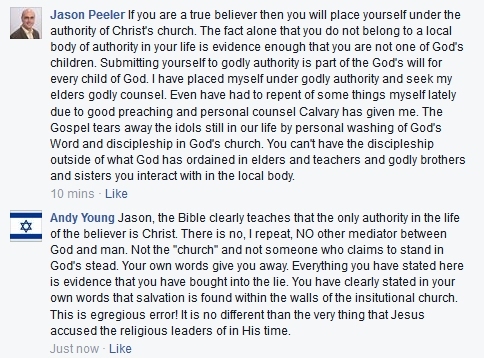
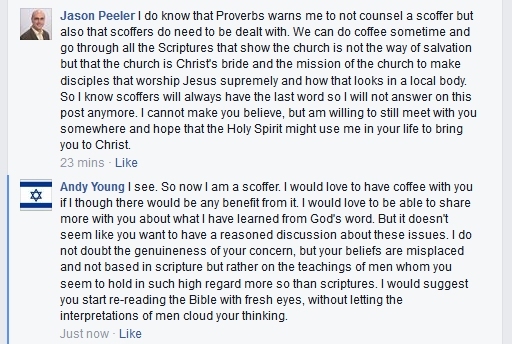
What follows is an exchange I had with a former Facebook “friend”. This conversation went the way every conversation goes with those who hold to Reformed/Calvinist theology. Take note of the following:
- An appeal to authority over reason
- “Ad hominem” attacks versus rational discussion
- The equivocation of orthodoxy with the “gospel”
The irony is that while Jason references “religious control freaks” in his post, he engages in the same kind of behavior.
Protestant orthodoxy is rooted in the same metaphysical premise as Platonism. You will never win a debate with a Calvinist because he begins with different assumptions about man and about reality. All his interpretive conclusions are based on these assumptions. The only thing you can do is expose the false teaching and faulty reasoning and allow others to come to their own conclusions.
I think the exchange below speaks for itself.
– Andy


Why Calvinist Husbands are Pathetic Cowards
 In order to shorten the title, I would like to also include husbands who function like Calvinists while denying the doctrine intellectually.
First, they deny the very gospel they proclaim and deny it with their lives. They would say “amen” to the whole idea that God removed the partition between the outer room and the Holy of Holies to give them free access to the throne of God without fear of condemnation, but they will not enter that room without the elders present or without permission from the elders. While saying “amen” to the whole idea of “one mediator between God and man,” they will hardly try any new thing in bed without permission from the elders, much less teach their wives something from their own God-given mind.
Pathetic.
Nor will they enter that room alone with their own thoughts and gifts on behalf of their wives who they are responsible to sanctify with the water of the word. They will not accept God’s invitation to meet face to face without hiding behind the elders for fear of being wrong about something. They do not approach the alter boldly on behalf of their wives, but rather bring other men to think for them and speak for them. They enter the room cowering behind the elders holding only what was originally given after digging it up in the back yard. They are under condemnation and therefore know that they always invest errantly—except when they obey the elders.
Pathetic.
And when their wives demand that they be real men and deliver on what they expected when they agreed to marry them, they run to the elders and have their wives brought up on church discipline which is NOT in Mathew 18 by the way. Nor or the elders by the way.
And by the way, that’s pathetic.
Nor will they defend those who have the courage to believe that Christ is the only mediator between God and men. They will stand by and watch injustice because they have given their souls to the elders. They clearly fear men more than God.
Pathetic.
And, for those who have wives who want mindless cowards for husbands, they fear their wives more than they fear God, in addition to the elders also. Who do they love more, and who are they really one with? If they are to leave parents and cleave to the wife, how much more should they leave the elders?
Sad.
paul
The “L” is the Death of Calvinism
 We have all heard of TULIP, but all you need to indict Calvinism in a litany of choices is the “L” in TULIP. You see, if God predetermined who is going to be saved by His choice alone, Jesus only died for the “elect,” but a sound non-Protestant understanding of justification refutes that in elementary fashion.
It’s true, Christ died for our sins, but also, all sin is imputed to the law. Where there is no law, there is no sin, so Jesus really went to the cross to end the law. The righteous demands of the law were nailed to the cross in totality and in one act.
Protestantism then asks: “What then of being righteous? We must not only be forgiven, but we must also be righteous.” This is where the law is not ended for Protestants. Jesus’ life/perfect law-keeping then replaces the real purpose of the resurrection. The resurrection becomes a confirmation that He lived a perfect law-keeping life (“it proved that God was pleased with Him”) so that perfect law-keeping can be imputed to our Christian life.
We hear this everywhere in Christian circles all of the time and it represents an egregious misunderstanding of the true gospel.
And this is sooooo elementary: that’s “under law.” Ouch. Yes, the hallowed academia of Protestant tradition missed this elementary point entirely. And that’s just plain embarrassing.
This replaces a right definition of the new birth (Spirit baptism) with Christ’s life/death/confirmation instead of death WITH Christ/death to the law and its condemnation/resurrection WITH Christ to new life/freedom to obey the law out of love and not fear of condemnation.
But let me conclude with the primary point of the post. If ALL people are born under the law of sin and death (the Spirit’s first use of the law), and they are, and Jesus died to end the law, and He did, then Christ obviously died for everyone.
All sin is imputed to the law, and Christ came to end the law. This makes assurance of salvation definitive: there is no law to judge you. However, this is not to exclude law all together; those who have been resurrected with Christ are free to use the law according to the Spirit’s second use of the law to sanctify. To us, that is using it to love God and others with all of our heart, soul, and…yes…minds. Right, we don’t do that perfectly according to the old us that were under the law of condemnation, but that person is dead.
In regard to law’s ability to condemn me, I no longer live, not because Christ kept that law for me, but because the one who was under it died with Christ. I now live as a new creature free to serve Christ with the “law of liberty,” viz, I am free to use it for pursuing peace and love without condemnation.
But, remember, Christ died to end the law; that means He died for all of those under it. Nothing is more evident.
paul
John MacArthur Jr. is Prime Example of a Confused Calvinist

Few Calvinists really know what Calvin believed. One of the best examples is the scholarly John MacArthur. In an article MacArthur wrote in 2014, he claims that sanctification is a paradox:
In Philippians 2:12–13, Paul presents the appropriate resolution between the two. He makes no effort to rationally harmonize the believer’s part and God’s part in sanctification. He is content with the paradox and simply states both truths, saying on the one hand, sanctification is of believers (Philippians 2:12), and on the other hand, it is of God (Philippians 2:13).
The truth is that sanctification is God’s work, but He performs it through the diligent self-discipline and righteous pursuits of His people, not in spite of them. God’s sovereign work does not absolve believers from the need for obedience; it means their obedience is itself a Spirit-empowered work of God.
John MacArthur Jr. ~ The Apparent Paradox of Sanctification: Wednesday, July 2, 2014
John Calvin believed no such thing. In fact, like Martin Luther, he believed that any merit given to man for works in sanctification amounted to a false gospel. So, in other words, while MacArthur proudly proclaims himself a Calvinist, Calvin would have deemed him unregenerate and the propagator of a false gospel. MacArthur is also a confused Protestant (as most are) because Luther would have attested to the same view of sanctification.
Both Luther and Calvin believed that sanctification is the progression of justification, so both (sanctification and justification) must be obtained by faith alone. A paradox view makes man a participant in some respect; Luther and Calvin both would have deemed that works salvation. While Calvinists are fond of accusing people of semipelagianism, this is what MacArthur would have been accused of by Calvin and Luther both. Calvin referred to salvation as “twofold” in regard to justification and sanctification (“twofold grace” or “double grace”). In his soteriology both are a part of the salvation process.
In order to present salvation as a twofold process, Luther presented the “believer” as a passive being; specifically, dead before and after salvation. Therefore, ALL acts performed by the “believer” are dead works according to Luther unless God acts and brings about a resurrection act in the life of the “believer” who is unable to distinguish between his own passive dead acts and God’s active acts. In this way, the Christian life was said to be “subjective.” The “believer” merely experiences the acts of God as if he/she is conducting them, but must believe that any good work experienced is of God and not ourselves. According to Luther, every act of people lost or saved can be forgiven if they believe every action by man is sinful. This is venial sin. But, the belief that one can do a good work is mortal sin and cannot be forgiven.
While Luther primarily framed all of this according to state of being, Calvin framed it in context of law. According to Calvin, perfect law-keeping defines justification, and it is impossible for anyone saved or otherwise to sufficiently obey any law at any time to the satisfaction of God. Calvin made this absolutely clear in 3.14.9-11 of his Institutes of the Christian Religion. He begins 3.14.11 by stating that no believer has ever performed a work that falls short of God’s condemnation.
Paradox allows for the possibility of a believer to perform a work pleasing to God other than a confession that we can’t. That’s antithetical to Reformed ideology.
People who call themselves Calvinists should know what Calvin believed. But we shouldn’t expect such because most Protestants don’t even know what Protestantism is to begin with. Including John MacArthur.
paul

 Paul's Passing Thoughts
5 comments