Eric From Clearcreek Chapel Area Risks Church Discipline to Save Me from “Bitterness”

Eric,
So much ideology is packed into your often-used 5-word Reformed statement: “You are a bitter man.” Like the other Reformed 5-word bumper sticker, “Jesus died for our sins,” it encompasses a whole body of philosophy. The thrust of these statements follows: excluding what doesn’t exist according to the ideology. I am either bitter or not bitter. Why? Because the only cause of bitterness is a lie and doesn’t exist according Reformed ideology: oppression.
There is no such thing as oppression according to Reformed theology, only grace. Grace is defined by the reality of existence that never receives what it fully deserves; therefore, no matter what people do to you, it falls short of what you fully deserve, therefore, all abuse should be received with thankfulness.
Hence, the Reformed definition of a bitter man or woman: one who doesn’t understand grace.
So, what you are saying is that I don’t understand grace. People are either bitter or not bitter–they either understand grace or don’t understand grace. They either understand that the sum total of life is zero making justice a myth or they don’t.
Hence, to put value on life is synonymous with bitterness because justice puts a value on life. Justice restrains those who refuse to treat others as they would want to be treated. According to Reformed philosophy, grace and justice are mutually exclusive and Calvin/Luther both stated that explicitly.
This is fundamentality what put me at odds with the Clearcreek elders though I was a long way from knowing it at the time (by the way, I noticed that your IP address is from Springboro), which is why I am not bitter. I was so blinded by Reformed ideology that it took the full wrath of their fundamental wickedness to wake me from my slumber. I could still be there learning to disassociate myself from reality more and more.
What does that look like? It can be defined by two sons who lost their fathers. When I lost my father whom I led to the Lord one day before his death, I cried out to God in mourning that cannot be described with words proclaiming, “You will take care of him now, you will take care of him now!” By the way, I was informed by elder Devon Berry before I left Clearcreek Chapel that God using me to lead my dad to the Lord, as well as everything else I had done at Clearcreek Chapel for 20 years was “walking in darkness.” Why? Because my worldview does not profess “Perplexity” in knowing anything other than “Christ and Him crucified,” viz, ALL wisdom is hidden in suffering (Luther).
Now let’s compare my worldview with the stoic public testimony of Pastor Rick Wilson’s son at Rick’s funeral: “My dad was a wicked sinner.”
Eric, Eric, Eric, do you really think I am bitter because I can longer hang with you guys? Really? What is the fundamental difference between you and ISIS? Nothing, because the fundamental worldview is exactly the same. In both cases, horizontal justice is a metaphysical concept rejected as true reality. How scary is that?
Eric, I am not bitter towards the Clearcreek caliphate, I am terrified that others will become members there. My duty to warn others about you is a joy, not a bitterness by any means.
But I understand what you are saying: grace and horizontal justice are mutually exclusive making justice a myth. Well, I’m sorry, I disagree, but you seem a little bitter about my bitterness.
And Eric, just a heads up, you could be brought up on church discipline for coming to my blog per the Clearcreek elders, but I won’t tell.
paul

The Heart/Flesh Debate
Originally published May 12, 2011
~ Penned and researched by Brian Jonson, West Chester, Ohio
Heart Versus Flesh
There are hundreds of passages that use the term “heart” to describe the seat of human emotion, intelligence, morality, volition and religious life in general. However, most often, “heart” is used in Scripture as an idiom for the mind.
There is also present in scripture the heart of the unredeemed and the heart of the redeemed. Oftentimes the characteristics of the unredeemed heart are applied to the redeemed. I believe this is a critical error. The chart below shows the context of the unredeemed versus the redeemed and how the term “heart” is applied. It is by no means exhaustive, but certainly is representative of all passages. Notice, the application of the description of the unredeemed heart is never applied to the redeemed.
Characteristics of the Heart of the Saved and Lost
Unredeemed |
Redeemed |
| Ge 6:5 – Then the LORD saw that the wickedness of man was great on the earth, and that every intent of the thoughts of his heart was only evil continually.
Ge 6:6 – The LORD was sorry that He had made man on the earth, and He was grieved in His heart. Ge 8:21 – The LORD smelled the soothing aroma ; and the LORD said to Himself, “I will never * again curse the ground on account of man, for the intent of man’s heart is evil from his youth; and I will never again destroy every living thing, as I have done. Ex 4:21- The LORD said to Moses, “When you go back to Egypt see that you perform before Pharaoh all the wonders which I have put in your power; but I will harden his heart so that he will not let the people go. De 5:29 – ‘Oh that they had such a heart in them, that they would fear Me and keep all My commandments always *, that it may be well with them and with their sons forever! De 8:14 – then your heart will become proud and you will forget the LORD your God who brought you out from the land of Egypt, out of the house of slavery. 1Sa 7:3 – Then Samuel spoke to all the house of Israel, saying, “If you return to the LORD with all your heart, remove the foreign gods and the Ashtaroth from among you and direct your hearts to the LORD and serve Him alone; and He will deliver you from the hand of the Philistines.” 2Ch 12:14 – He did evil because he did not set his heart to seek the LORD. 2Ch 25:2 – He did right in the sight of the LORD, yet not with a whole heart. 2Ch 26:16 – But when he became strong, his heart was so proud that he acted corruptly, and he was unfaithful to the LORD his God, for he entered the temple of the LORD to burn incense on the altar of incense. Ps 73:1 – Surely God is good to Israel, To those who are pure in heart ! Ps 78:8 – And not be like their fathers, A stubborn and rebellious generation, A generation that did not prepare its heart And whose spirit was not faithful to God. Jer 5:23 – ‘But this people has a stubborn and rebellious heart; They have turned aside and departed. Jer 17:9 – “The heart is more deceitful than all else And is desperately sick; Who can understand it? Eze 14:4 – “Therefore speak to them and tell them, ‘Thus says the Lord GOD, “Any man of the house of Israel who sets up his idols in his heart, puts right before his face the stumbling block of his iniquity, and then comes to the prophet, I the LORD will be brought to give him an answer in the matter in view of the multitude of his idols, Eze 20:16 – because they rejected My ordinances, and as for My statutes, they did not walk in them; they even profaned My sabbaths, for their heart continually went after their idols. Mr 7:21 – “For from within, out of the heart of men, proceed the evil thoughts, fornications, thefts, murders, adulteries, Lu 6:45 – “The good man out of the good treasure of his heart brings forth what is good; and the evil man out of the evil treasure brings forth what is evil; for his mouth speaks from that which fills his heart. Ac 8:21 – “You have no part or portion in this matter, for your heart is not right before God. Ro 1:21 – For even though they knew God, they did not honor Him as God or give thanks, but they became futile in their speculations, and their foolish heart was darkened. Ro 2:5 – But because of your stubbornness and unrepentant heart you are storing up wrath for yourself in the day of wrath and revelation of the righteous judgment of God, Eph 4:18 – being darkened in their understanding, excluded from the life of God because of the ignorance that is in them, because of the hardness of their heart;
|
Ge 20:5 – “Did he not himself say to me, ‘She is my sister’? And she herself said, ‘He is my brother.’ In the integrity of my heart and the innocence of my hands I have done this.”
Ge 20:6 – Then God said to him in the dream, “Yes, I know that in the integrity of your heart you have done this, and I also kept you from sinning against Me; therefore * I did not let you touch her. 2Ch 16:9 – “For the eyes of the LORD move to and fro throughout the earth that He may strongly support those whose heart is completely His. You have acted foolishly in this. Indeed, from now on you will surely have wars.” Ps 7:10 – My shield is with God, Who saves the upright in heart. Ps 66:18 – If I regard wickedness in my heart, The Lord will not hear; Ps 73:1 – Surely God is good to Israel, To those who are pure in heart! Ps 86:12 – I will give thanks to You, O Lord my God, with all my heart, And will glorify Your name forever. Jer 24:7 – ‘I will give them a heart to know Me, for I am the LORD; and they will be My people , and I will be their God, for they will return to Me with their whole heart. Jer 31:33 – “But this is the covenant which I will make with the house of Israel after those days,” declares the LORD, “I will put My law within them and on their heart I will write it; and I will be their God, and they shall be My people . Jer 32:39 – and I will give them one heart and one way, that they may fear Me always *, for their own good and for the good of their children after them. Eze 11:19 – “And I will give them one heart, and put a new spirit within them. And I will take the heart of stone out of their flesh and give them a heart of flesh, Eze 36:26 – “Moreover, I will give you a new heart and put a new spirit within you; and I will remove the heart of stone from your flesh and give you a heart of flesh. Mt 5:8 – “Blessed are the pure in heart, for they shall see God. Mt 12:34 – “You brood of vipers, how can you, being evil, speak what is good ? For the mouth speaks out of that which fills the heart. Mt 15:18 – “But the things that proceed out of the mouth come from the heart, and those defile the man. Lu 6:45 – “The good man out of the good treasure of his heart brings forth what is good; and the evil man out of the evil treasure brings forth what is evil; for his mouth speaks from that which fills his heart. Ro 2:29 – But he is a Jew who is one inwardly; and circumcision is that which is of the heart, by the Spirit, not by the letter; and his praise is not from men, but from God. Ro 6:17 – – But thanks be to God that though you were slaves of sin, you became obedient from the heart to that form of teaching to which you were committed, Heb 10:22 – let us draw near with a sincere heart in full assurance of faith, having our hearts sprinkled clean from an evil conscience and our bodies washed with pure water. 1Pe 1:22 – Since you have in obedience to the truth purified your souls for a sincere love of the brethren, fervently love one another from the heart, 1Jo 3:21 – Beloved, if our heart does not condemn us, we have confidence before God; Addendum: Hebrews 10:22 – let us draw near to God with a sincere heart and with the full assurance that faith brings, having our hearts sprinkled to cleanse us from a guilty conscience and having our bodies washed with pure water. |
As you look at the references above, you’ll easily see that the Bible never applies the ugly characteristics of an unregenerate heart to a redeemed person. Why then, should we? God has renewed the heart of a believer and it is unbiblical to accuse the Body of Christ of having hearts that are unregenerated.
Where then, is the battle? The Bible teaches that the battle against sin is in the flesh, NOT the heart. Notice, please:
Mt 26:41
Keep watching and praying that you may not enter into temptation; the spirit is willing, but the flesh is weak.
Jesus is speaking to a redeemed person. He shows them that the danger is in the flesh, not the heart (perhaps synonymous with spirit in this passage).
Ro 7:5
For while we were in the flesh, the sinful passions, which were aroused by the Law, were at work in the members of our body to bear fruit for death.
Paul teaches here that our sinful passions are from the flesh.
Ro 7:18
For I know that nothing good dwells in me, that is, in my flesh; for the willing is present in me, but the doing of the good is not.
A critical passage! We know the Bible teaches that our flesh was not redeemed at salvation and, in fact, awaits the glorification described so clearly in 1 Corinthians 15. Therefore, we have a “redeemed heart” incarcerated in “unredeemed flesh.” This is exactly why we struggle. Notice:
Ro 7:14
For we know that the Law is spiritual, but I am of flesh, sold into bondage to sin.
Ro 7:25
Thanks be to God through Jesus Christ our Lord ! So then, on the one hand I myself with my mind am serving the law of God, but on the other, with my flesh the law of sin.
Ro 8:3
For what the Law could not do, weak as it was through the flesh, God did: sending His own Son in the likeness of sinful flesh and as an offering for sin, He condemned sin in the flesh,
Ro 8:4
so that the requirement of the Law might be fulfilled in us, who do not walk according to the flesh but according to the Spirit.
Ro 8:5
For those who are according to the flesh set their minds on the things of the flesh, but those who are according to the Spirit, the things of the Spirit.
Ro 8:6
For the mind set on the flesh is death, but the mind set on the Spirit is life and peace,
Ro 8:7
because the mind set on the flesh is hostile toward God; for it does not subject itself to the law of God, for it is not even able to do so,
Ro 8:8
and those who are in the flesh cannot * please God.
Ro 8:9
However, you are not in the flesh but in the Spirit, if indeed the Spirit of God dwells in you. But if anyone does not have the Spirit of Christ, he does not belong to Him.
Ro 8:12
So then, brethren, we are under obligation, not to the flesh, to live according to the flesh —
Ro 8:13
for if you are living according to the flesh, you must die; but if by the Spirit you are putting to death the deeds of the body, you will live.
The heart is not mentioned anywhere in this key teaching. Romans 6 through 8 contain the key teaching on our struggle against sin. And, it is clear; the struggle is centered on the flesh, not the heart.
Further evidence of this:
Ro 13:14
But put on the Lord Jesus Christ, and make no provision for the flesh in regard to its lusts.
1Co 3:1
And I, brethren, could not speak to you as to spiritual men, but as to men of flesh, as to infants in Christ.
How do we cleanse ourselves and appear holy before the Lord?
2Co 7:1
Therefore, having these promises, beloved, let us cleanse ourselves from all defilement of flesh and spirit, perfecting holiness in the fear of God.
Ga 5:13
For you were called to freedom, brethren; only do not turn your freedom into an opportunity for the flesh, but through love serve one another.
Ga 5:16
But I say, walk by the Spirit, and you will not carry out the desire of the flesh.
Ga 5:17
For the flesh sets its desire against the Spirit, and the Spirit against the flesh; for these are in opposition to one another, so that you may not do the things that you please.
Ga 5:19
Now the deeds of the flesh are evident, which are: immorality, impurity, sensuality,
Ga 5:24
Now those who belong to Christ Jesus have crucified the flesh with its passions and desires.
Ga 6:8
For the one who sows to his own flesh will from the flesh reap corruption, but the one who sows to the Spirit will from the Spirit reap eternal life.
Institution as God’s Mediator
 The Bible states that there is one mediator between God and man, the Lord Jesus Christ (1Timothy 2:5). I now realize the real significance of that after eight years of research. I see “one” really means “one.” Something has happened this week that this ministry is taking note of: HBO’s documentary “Going Clear” on Scientology premiered 3/29/2015. Megan Kelly of Fox News interviewed one of the key figures featured in the documentary who shared an astonishing bit of information: members who offend leadership are locked up in a literal prison until they repent of whatever the offence is; release is contingent on signing a written confession. Kelly was incredulous that any adult would agree to such a thing and asked the guest if he could explain it. I was surprised when the guest said he could not explain it.
Maybe the explanation is too simple, but here it is: every false gospel opposed to the gospel of Jesus Christ is predicated on the idea of an additional mediator between God and man other than Christ. Even if one man or women is representative of the false doctrine, it will always be expressed in the form of an institution and its authority. Rather than all authority and mediation being in Christ, a subset of Christ’s mediation and authority is claimed; a claim that has no biblical merit whatsoever. These religious institutions always claim authority to grant salvation on behalf of God as co-mediators, but will also use the authority of government whenever they can get away with it.
So why do the institutional members of “the church” agree to every insane notion proffered by these institutions? It’s not complicated in the least: their salvation depends on it. The temptation is great; people relate truth with authority and want to be told how to get to heaven. Some sort of lofty authority gives the seekers confidence that God will accept their salvific pedigree. And Scientology has all of the elements common with these institutions, especially a strong emphasis on glorious infrastructure.
This documentary is important because Scientology is indicative of institutional religion in general. It claims authority and mediation it doesn’t have, quibbles over words, and entangles itself in the frivolous affairs of the world. And another important element–a major one should be noted as well: cults are spawned by authority. Hence, religious institutions often get a pass on being cultic because people don’t understand the catalyst of cultism: authority.
The alternative is a functioning body under one head. Gifts replace rank, and fellowship replaces authority. The goal is agreement on truth as defined by Christ and agreement according to conscience determines who fellowships together. Christ said, “All authority has been given to me.” ALL means “all.” If people get together for the purpose of following an authority anyway, why not Christ as opposed to some man or institution? If the divide in regard to what Christ is saying is too wide, go start your own group–Christ is the final judge anyway. A final point: institutions focus on getting people to heaven; fellowships focus on the unfinished work of service to God and others.
The following are relevant video clips that make the point.
Are Calvinists Saved?
 Originally published October 6, 2012
The begging of the question has a sound Scriptural argument.
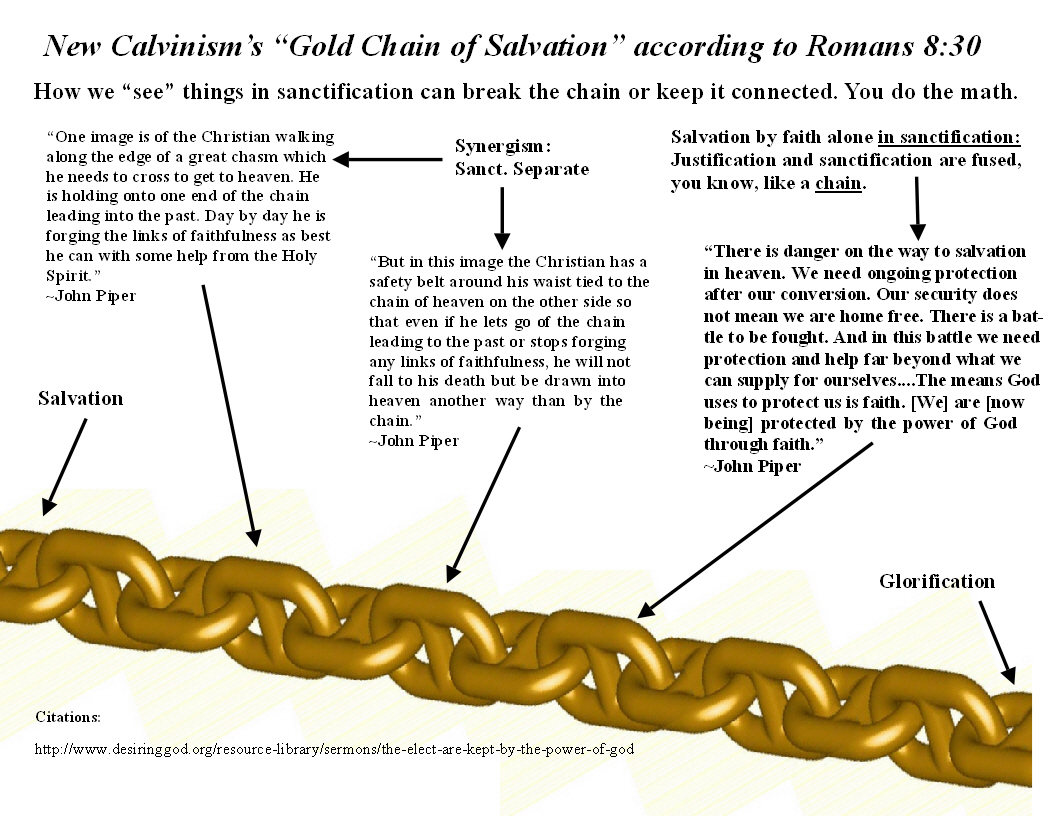
This ministry has made much of the critical importance of separating justification (salvation) and sanctification (growth in holiness, or kingdom living). The Reformed (Calvin/Luther Reformation doctrine/gospel) “never separate, but distinct” doublespeak doesn’t cut it in the arena of truth, and we will see why. “Never separate” =’s false gospel. If you get a little lost in the first part of my argument which gives the lay of the land, don’t worry, when I get into the specific Scriptural argument, it will clear things up and make it all come together for you. It must delight the ghosts of the Reformation that the argument has always been in the arena of freewill verses predestination. It’s the primary thrust of this ministry to change that argument. This isn’t a quibbling about semantics in the mainstream—this is about the truth of the gospel. As New Calvinist Russ Kennedy once thundered from the pulpit in his mousy voice: “Any separation of justification and sanctification is an abomination!” I have often argued from the standpoint of this issue. If sanctification is the middle of the Reformed “golden chain of salvation” then sanctification is part of finishing justification. This means that what happens in sanctification determines whether or not justification is properly finished. What’s a chain? John Piper even preached a message about the eternal importance of our contribution to the “links” in just the right way. In essence, sanctification becomes a spiritual minefield. This is exactly the same thing that the Reformed crowd has always accused Rome of: the fusing together of justification and sanctification. However, as we shall see, they are both guilty of the exact same heresy/false gospel. As we shall see, both teach that sanctification finishes justification. This is a linear gospel (one unified chain from salvation to resurrection (glorification) versus a parallel gospel with salvation on one plane as a finished work before the foundation of the world, and kingdom living that runs parallel with the finished work and reflects the reality of our salvation until glorification. Typical in the linear gospel is the idea that Christ died for all of our past sins, but we must now finish the work (with the Holy Spirit’s help [sanctified works salvation]) until glorification when we are completely transformed into complete holiness. This is the often-heard bemoaning of “Christ PLUS something.” 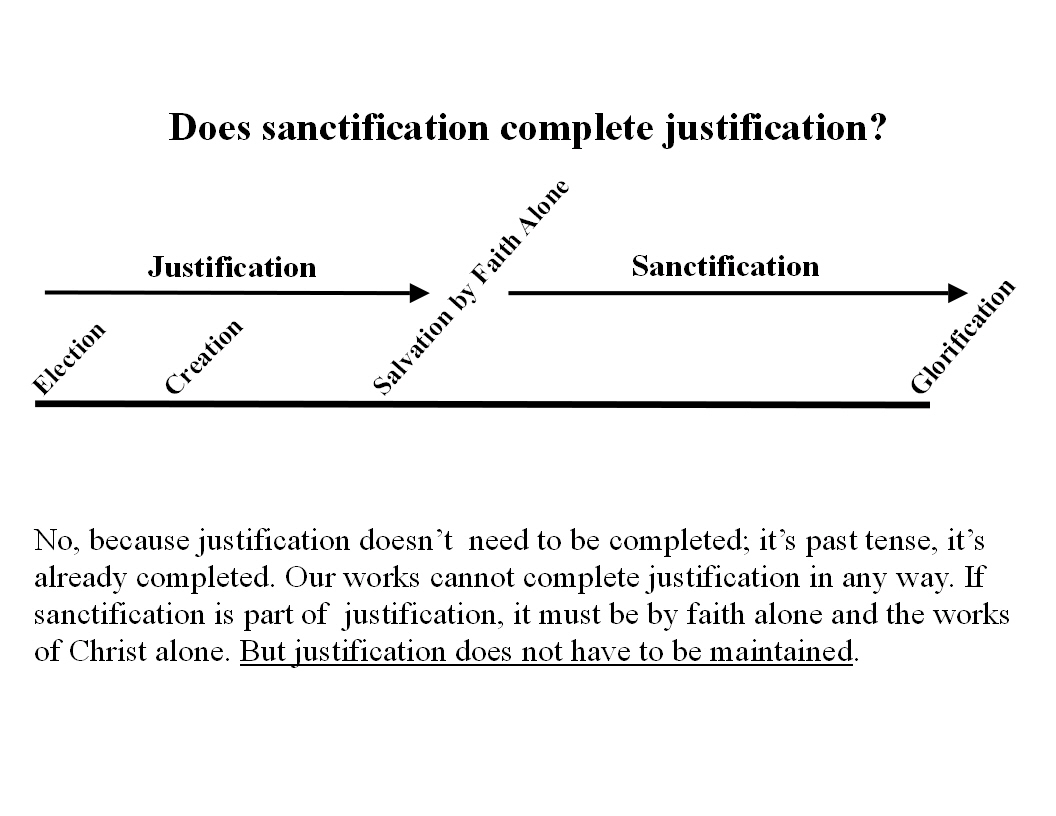 An excellent example is some strains of Freewill Baptists who teach that Christ died for all of our past sins, but with the help of the Holy Spirit, we must confess and repent of every sin we commit until the resurrection, e.g., Christ plus salvation by repentant prayer for sins committed after we are “saved.” My grandparents were saved out of this tradition. When my grandfather asked my grandmother if she thought that God could ever forgive him of all the sins he committed, she answered: “Yes, but you are going to have to pray awful hard!” Praise God that through the ministry of several individuals my grandparents eventually abandoned that gospel for the true one of salvation by faith alone as a finished work. Likewise, Rome teaches that you must let the Catholic Church finish your justification through ritual, e.g., Christ plus Catholic ritual. The Reformation gospel is also Christ plus something else, but the something else is ever-so-subtle. In both cases, sin must be dealt with in sanctification in order for the saint to remain justified until the final judgment. In other words, the righteous standard of justification must be maintained on our behalf. Like all other proponents of a linear gospel, the Reformed crowd contends that anything less than the perfection demanded of the law (“all sin is transgression of the law”) is “legal fiction.” So both Rome and the Reformers agree: justification must be maintained by sanctification, and in the case of the Reformers specifically, they believe that the perfect standard of the law must be maintained until glorification; otherwise, our justification is “legal fiction.” Here is where Reformed subtlety is uncanny: Christ keeps the law for us in sanctification. He maintains the perfect standard. All the fruit of sanctification (obedience/good works) flows from the life He lived on Earth and His death on the cross. Christ plus the works of Christ to finish salvation. “But Paul, what in the world is wrong with that?!” Here is what is wrong with it: works are still required to maintain justification. That is a huge problem, even if it is Christ doing the work. What did the Hebrew writer say about Christ’s work for justification not being complete? And even more subtle is the following Reformed idea: believing that the law is no longer a standard for maintaining justification is antinomianism. Antinomianism =’s legal fiction. Their definition of antinomianism is the removal of the law from justification as the standard for maintaining it. Traditionally, among Biblicists, antinomianism is the removal of the law from sanctification, and herein lays even further steroidal subtlety: the Reformed theologians would refute a removal of the law from sanctification as well, not only because they think justification and sanctification are the same thing, but because its perfect keeping is required to maintain a true declaration of the just that is not “legal fiction.”
  However, the Biblicist believes that the law is a standard for kingdom living and is no longer a standard for justification. Therefore, if we attempt to obey it with the Holy Spirit’s help, and to please/serve the Lord, it can have no bearing on our just state. While the Biblicists think they are therefore joint contenders with the Reformers against antinomianism, such is far from the truth. The Reformed mind believes the Biblicist is either a legalist or an antinomian, or both. The Biblicist is supposedly an antinomian because he/she has removed the law from justification as a just standard, or is a legalist because they think they should strive to keep the law in sanctification. Since sanctification finishes justification’s perfect standard of law keeping, our “own” attempts to keep the law in sanctification is an attempt to finish justification. Hence, what the Biblicist fails to understand is the Reformers belief that Christ must maintain the law for us in sanctification because justification and sanctification are not separate. Anything more or less is supposedly works salvation. On the other hand, because it is vital that Christ obeys the law for us in sanctification, the likes of John Piper and Tullian Tchividjian contend that those who are really preaching the Reformed gospel will indeed be accused of antinomianism. All in all, their position is easy to see if you pay attention. John Piper and many other Calvinists often state that, “Good works are the fruit of justification.” And, “Justification is the root, and sanctification is the fruit.” Well, the average Biblicist then thinks, “Yes, but of course, our salvation makes good works in sanctification possible.” But that’s not what they are saying. If you pay closer attention, they are saying that justification is a tree that produces its own fruit. Justification is the root, and whatever happens in true sanctification is the fruit of the root of the justification tree. Problem is, justification doesn’t grow. Justification is a finished work. What Calvinists refer to as “progressive sanctification” is really the fruit of the root: progressive justification. Another name for this that they throw around is “definitive sanctification.” The word “definitive” refers back to the definite completion of justification.
  Revision: this ministry now rejects the idea that orthodoxy is truth; orthodoxy is the traditions of men. Never in Scripture do we find premise for a body of teaching that explains the teaching. The above illustration is valuable for demonstrating that the fruit of justification is glorification, NOT sanctification. This brings us to the Scriptural argument which begins with a question I asked myself just this morning: “Paul, you are always harping about the crucial importance of the separation of justification and sanctification—a parallel gospel versus a linear one. But where does the Bible say specifically that this is critical?” First, the very definition of a lost person in the Bible is one who is “under the law”:
Romans 3:19 Now we know that whatever the law says it speaks to those who are under the law, so that every mouth may be stopped, and the whole world may be held accountable to God. Romans 6:14 For sin will have no dominion over you, since you are not under law but under grace. Romans 6:15 What then? Are we to sin because we are not under law but under grace? By no means! 1 Corinthians 9:20 To the Jews I became as a Jew, in order to win Jews. To those under the law I became as one under the law (though not being myself under the law) that I might win those under the law. Romans 7:1 Or do you not know, brothers —for I am speaking to those who know the law—that the law is binding on a person only as long as he lives? Romans 7:2 For a married woman is bound by law to her husband while he lives, but if her husband dies she is released from the law of marriage. Romans 7:3 Accordingly, she will be called an adulteress if she lives with another man while her husband is alive. But if her husband dies, she is free from that law, and if she marries another man she is not an adulteress.
The unsaved are “under the law” and will be judged by it in the end. This is the very definition of the unsaved. Calvinists define Christians the same way—we are supposedly still under the law and will be judged by it in the end. That’s why Christ must keep the law for us—because we are still under it. If not this position, why do many in the Reformed tradition hold to the idea that Christ’s perfect obedience is imputed to our sanctification? His death justifies us, and His perfect life sanctifies us. Hence, His death pays the penalty for past sins, and then His perfect life imputed to our sanctification keeps us justified. Why would an imputation to our sanctification be necessary if we are no longer under the law? This is known as the Reformed view of “double imputation” and has been called out as heresy by many respected theologians for this very reason: it implies that Christians are still under the law. In regard to sustaining the law in our stead, why? It has been totally abolished in regard to our just standing:
Romans 3:20 For by works of the law no human being will be justified in his sight, since through the law comes knowledge of sin. Romans 3:21 But now the righteousness of God has been manifested apart from the law, although the Law and the Prophets bear witness to it— Romans 4:15 For the law brings wrath, but where there is no law there is no transgression.
The keeping of the law by anybody DOES NOT do anything to justify mankind:
Romans 3:28 For we hold that one is justified by faith apart from works of the law.
Here is where the separation of justification and sanctification is vital on this first point: we ARE NOT under the law for justification, but rather UPHOLD THE LAW in sanctification. The two must be separate because of the differing relationships to the law:
Romans 3:31 Do we then overthrow the law by this faith? By no means! On the contrary, we uphold the law. Romans 6:15 What then? Are we to sin because we are not under law but under grace? By no means!
Furthermore, if we are still under the law (whether or not Christ obeys it for us to keep us in a just standing), this means we are still under the power of sin. Being under the law and also under its spell to provoke sin in the unregenerate is spoken of as being synonymous in the Bible. Those who are “under the law” are also under the power of sin and enslaved to it:
Romans 7:4 Likewise, my brothers, you also have died to the law through the body of Christ, so that you may belong to another, to him who has been raised from the dead, in order that we may bear fruit for God. Romans 7:5 For while we were living in the flesh, our sinful passions, aroused by the law, were at work in our members to bear fruit for death. Romans 7:6 But now we are released from the law, having died to that which held us captive, so that we serve in the new way of the Spirit and not in the old way of the written code. Romans 7:8 But sin, seizing an opportunity through the commandment, produced in me all kinds of covetousness. For apart from the law, sin lies dead.
If we are still under the law, and will be judged by it, whether or not Christ stands in the judgment for us with His own works, we are still enslaved to sin by virtue of being under the law…. for justification. And Calvinists know this to be true, that’s why they say we are still…. what? Right, even as Christians, “totally depraved.” And, “enemies of God.” Of course, throughout the Bible, Christians are spoken of as being friends of God and no longer His enemies. Our status as enemies of God is stated in the past tense. But the Reformed crew continually state that Christians are vile enemies of God and are enslaved to sin. They realize that this goes hand in hand with being under the law. To the contrary, dying to the law in the death of Christ….for justification—sets us free to be enslaved to the righteousness that is defined by the law. We are dead to the law for justification and alive to obey truth….for sanctification:
Romans 8:2 For the law of the Spirit of life has set you free in Christ Jesus from the law of sin and death. Romans 8:3,4 [emphasis by author] For God has done what the law, weakened by the flesh, could not do. By sending his own Son in the likeness of sinful flesh and for sin, he condemned sin in the flesh,….in order that the righteous requirement of the law might be fulfilled in us, who walk not according to the flesh but according to the Spirit. Romans 8:7 For the mind that is set on the flesh is hostile to God, for it does not submit to God’s law; indeed, it cannot. Romans 9:31 but that Israel who pursued a law that would lead to righteousness did not succeed in reaching that law. John 17:17 Sanctify them in the truth; your word is truth. James 1:25 But the one who looks into the perfect law, the law of liberty, and perseveres, being no hearer who forgets but a doer who acts, he will be blessed in his doing.
So, that is the separation that must be for the true Christian: Justification has no law for which we are judged, and we live by the law of blessings in sanctification. This brings us to another important separation in the two: the judgments. Those under the law and sin will stand in a final judgment which will be according to the law. Again, because Calvinists believe that we are still under the law, albeit that Christ obeyed/obeys it for us, Christians will supposedly stand in the same judgment as the damned who are under the law and enslaved to it. At that time, the children of God, according to Calvinists, will be “made manifest.” But because Christians are not under the law and cannot be judged by it, they will stand in a judgment for rewards and not a judgment that determines a perfect keeping of the law by Christ in our stead. Hence, there will be two different resurrections: one for those under the law and another for those under grace, and two different judgments for the same two groups. One for rewards, and one to determine if those under the law kept it perfectly. The latter judgment doesn’t go well for any standing in it.
Luke 14:12-14 He said also to the man who had invited him, “When you give a dinner or a banquet, do not invite your friends or your brothers or your relatives or rich neighbors, lest they also invite you in return and you be repaid. 13 But when you give a feast, invite the poor, the crippled, the lame, the blind, 14 and you will be blessed, because they cannot repay you. For you will be repaid at the resurrection of the just.” [Notice that this is a resurrection for the “just.” They are already determined to be just before they are resurrected]. 2Corinthians 5:9,10 So whether we are at home or away, we make it our aim to please him. 10 For we must all appear before the judgment seat of Christ, so that each one may receive what is due for what he has done in the body, whether good or evil. 1Corintians 3:11-15 For no one can lay a foundation other than that which is laid, which is Jesus Christ. 12 Now if anyone builds on the foundation with gold, silver, precious stones, wood, hay, straw— 13 each one’s work will become manifest, for the Day will disclose it, because it will be revealed by fire, and the fire will test what sort of work each one has done. 14 If the work that anyone has built on the foundation survives, he will receive a reward. 15 If anyone’s work is burned up, he will suffer loss, though he himself will be saved, but only as through fire. Hebrews 6:10 For God is not unjust so as to overlook your work and the love that you have shown for his name in serving the saints, as you still do. Revelation 20:6 Blessed and holy is the one who shares in the first resurrection! Over such the second death has no power, but they will be priests of God and of Christ, and they will reign with him for a thousand years. Revelation 20:11-15 Then I saw a great white throne and him who was seated on it. From his presence earth and sky fled away, and no place was found for them. 12 And I saw the dead, great and small, standing before the throne, and books were opened. Then another book was opened, which is the book of life. And the dead were judged by what was written in the books, according to what they had done. 13 And the sea gave up the dead who were in it, Death and Hades gave up the dead who were in them, and they were judged, each one of them, according to what they had done. 14 Then Death and Hades were thrown into the lake of fire. This is the second death, the lake of fire. 15 And if anyone’s name was not found written in the book of life, he was thrown into the lake of fire.
Don’t let anyone tell you that eschatology is a “secondary” or “nonessential” consideration. Your eschatology is your gospel. It will state your position regarding whether or not you fuse justification and sanctification together; ie, likening Christians to those under the law.
Yet another vital difference in sanctification and justification is repentance. Repentance for salvation (when you are justified) is different from our repentance in sanctification. Among many in the Reformed tradition where the “same gospel that saved you also sanctifies you,” the repentance is the same. Repentance unto salvation is not a onetime “washing,” but rather a means to continue “in the gospel” through what they call “deep repentance.” Biblicism holds to repentance in sanctification that restores his/her fellowship and communion with God as His children. They would see repentance unto salvation as differing, and only necessary for salvation—a onetime decision to take one’s life in a new direction by following Christ, and believing in his death, burial, and resurrection. Reformed repentance, according to the likes of Paul David Tripp and others is a “daily rescue.” Our original repentance was for rescue, and we need rescue today as much as we needed rescue when we were saved. Again, this indicates their belief that we are still under the curse of the law and need to be continually rescued from it while remaining under the bondage of sin. However, Christ made it clear to Peter (John 13:6-11) that those who have been washed (1Corinthians 6:11, Romans 8:30) do not need another washing. Those who drink of the living water do not thirst again (John 4:13,14). Lastly, though many other separations could be discussed, why saints can be considered just while they still sin at times is of paramount importance. There is no sin in our justification because there is no law, and where there is no law, there is no sin. Though unfortunate, there can be sin in our sanctification because it is totally separate from justification and can’t affect our just standing with God. Basically, all of the aforementioned makes it of necessity to deny the new birth. If we have God’s seed in us, and we do (1John 3:9), that dispels total depravity, and without total depravity, justification and sanctification cannot be fused together. The new birth is a huge problem for Reformed theology. If the old man that was under the law is dead (Romans 7:1ff), and the seed of God is in the saved person, and the sin due to our weakness in the flesh cannot be laid to our account for justification, then our justification is not “legal fiction” because we do not exhibit perfect obedience to the law. This is another grave consideration because Christ said, “You must be born again.” Obviously, despite their denials that they deny the new birth—you can’t be both totally depraved and born again. Reformation doctrine is clearly a false gospel. Its version of justification does not void the law, and denies the new birth while distorting everything in-between. Freewill verses predestination is hardly the issue, the very gospel itself is the issue.
paul
Curing the Protestant Disease of Noanswerosis
 As one crawling out of the present Protestant Dark Age, a focus on sanctification rather than keeping myself saved by not working has revealed a disease that infects all Protestants: Noanswerosis (pronounced no-anser-osis).
This is a word that joins, no—answer—osis. When a Protestant is “saved,” their brain is immediately infected with this disease. In fact, contemporary terms that refer to the Protestant gospel state such explicitly.
The subjective power of an objective gospel.
Or…
The objective gospel.
Or…
The centrality of the objective gospel outside of us.
Or…
Definitive justification experienced subjectively.
What are these terms saying? Well, these are contemporary terms that define the foundational document of the Protestant Reformation: Martin Luther’s Heidelberg Disputation to the Augustinian Order (1518). Luther’s 95 Theses was a moral disputation, his Heidelberg Disputation defined the worldview of the Reformation and was penned about 6 months after the 95 Theses. John Calvin’s Institutes of the Christian Religion further defines Luther’s foundational premise.
What’s the gist of it all? First, God is completely sovereign over everything. Reality is a movie produced and scripted by God. History is a meta-narrative, or metaphysical narrative prewritten by God. Also, this movie (reality) is a 3D movie and requires special glasses in order to see it.
In other words, without the 3D glasses the movie (reality) will be blurred and distorted. And, the 3D glasses are…the gospel. All of reality, according to authentic Reformed ideology, is a gospel story. Seeing yourself in the role of how it all plays out as a mere character in a prewritten play is a matter of faith. If you see yourself as in control of anything, you are making yourself God and attempting to write your own reality.
Therefore, the gospel is the only reality that is…objective. EVERYTHING in life that happens is part of the gospel narrative, or… “his-story” (history).
So, how in the world does this supposedly work in real life? Before we get to that, let’s discuss the immense benefits from seeing reality in this way. Basically, there is no use in getting stressed out about anything because it is just all a prewritten narrative by God that you have no control over. In some sense, more accurately, in a big way, you can step back and separate yourself from what is going on in the world. Don’t worry—be happy. There is no need to get upset about an event, it’s all part of God’s gospel narrative that helps us in seeing reality more clearly.
Stop right there. That’s key. The goal is more seeing. There is a reason for this madness; what else but the primary goal of all philosophies? Happiness or joy or wellbeing or peace or however else you want to frame it. “Faith” is defined as SEEING ONLY. In Luther’s construct, ALL doing is part of the material world and inherently evil. If you can see it, hear it, smell it, taste it, feel it, or DO it—it’s evil, period.
Seeing life more and more as a prewritten narrative that glorifies the gospel that you have no role in leads to more and more wellbeing. Hey, no matter what happens, to God be the glory. Every life event says something about the gospel. Actually, there is a specific interpretive paradigm, or if you will, the 3D glasses: “The holiness of God as set against the sinfulness of man.” Every life event lends more understanding to the depths of our own depravity versus the holiness of God. When something good happens to us “worms crawling upon the earth” (Calvin), that’s grace, that’s astounding mercy. When something bad happens, we are merely getting what we deserve.
That’s life, but what about the Bible? The Bible is an aid in seeing our depravity more and more and God’s holiness more and more. The Bible is the script of the gospel narrative. According to the Reformed academics that really understand Reformed ideology, the Bible is a gospel narrative that displays the fundamental narratives that play out in life. When you read the Bible, it is therefore your story also as seen in narrative archetypes.
So, a life of faith is really about seeing only, all of the doing has been predetermined by God. This is how we live our lives by faith alone; life is seeing and not doing. The doing is ONLY EXPERIENCED.
Now we are getting into how this philosophy actually functions in real life, supposedly that is. Pretty much, go ahead and live out your life… and here it comes… “subjectively.” This is an affirmation that everything you do is evil, even your good works, and you really have no way of knowing whether it is you doing the work or God. Take note: in understanding this philosophy, it is important to distinguish between personal works and what happens in reality. Everything that happens is predetermined by God as part of His prewritten historical narrative. But, how we see or perceive life events determines whether we are living by faith or not. There must be a distinction between actual events and perception.
Bible study, or teaching in general is focused on perception, and then we go about living our lives subjectively. Yes, we make an effort to live life, but in our effort to live life we confess that it is a subjective experience. What does that mean? Luther split subjective life into two categories: venial sin and mortal sin. If we believe that we can do a good work, that’s mortal sin. If we confess that even our good works are evil, that’s venial sin. Life is subjective because when we see our works in the world, we have no way of knowing whether it is God doing the work through us or ourselves doing a work…and you hear this often… “in our own efforts.” All of the incessant moaning you hear in church over “works done in our own efforts” is right out of the Heidelberg Disputation.
The Reformed have three schools of thought in regard to how the subjective life works. Theory one states that the subjective life of faith is a combination of manifestation and our actual works. Manifestation is realm manifestation. This is when the invisible realm births an event in the material realm. It is like the rain. You feel the rain, you experience the rain, but you have no control over the rain. The rain comes from heaven—you didn’t make it rain, you only experience the rain. This school holds to the idea that it is impossible to distinguish between our actual efforts and realm birthing, or realm manifestation. As long as the person believes that everything that he/she does is evil, and anything good that happened came from God—that’s venial sin and will be forgiven IF we confess that our good works are evil. It is a subjective life because we have no way of knowing what our works are and what the Spirit’s works are. We only confess that if anything we experience is actually a good work, we didn’t do it.
The second school is John Calvin’s Sabbath Rest Sanctification paradigm. If all of our works are sanctified by contemplation on the gospel, ie., our sinfulness as set against God’s holiness, we will be less tempted by our “good” works. In other words, we will be less tempted towards mortal sin—the belief that we actually did a good work. This is closely related to the imperative command is grounded in the indicative event. The more we contemplate the gospel, the more we are able to see that anything in our life that appears to be a good work is a work that flows from the gospel event. This is also connected to the Reformed doctrine of double imputation. Christ came to fulfil the law so that His obedience to the law during the time He lived on earth can be imputed to our lives by faith alone. So, if we experience any good work in our life and believe it is a manifestation of Christ’s obedience imputed to us—we are under venial sin and not mortal sin.
Venial sin is forgivable, but we must be faithful to the institutional church and return to the same gospel that saved us in order to receive a reapplication of Christ’s penal substitution and righteous obedience. They use 1John 1:9 and other Scriptures as a proof text for this doctrine. A perpetual return to the same gospel that saved us keeps us in the “vital union” with Christ which is yet another Reformed soteriological doctrine.
The third school emphasizes the Reformed doctrine of mortification and vivification. This doctrine encompasses the other two schools as well. Its contemporary expression is John Piper’s Christian Hedonism. This is also the official Reformed definition of the new birth. The new birth is mortification and vivification. Mortification entails a focus on our sinfulness and wormism. This is the death part of our baptism. This results in resurrection, or vivification. This is the resurrection part of our baptism. As we see the gospel narrative more deeply, we experience the joy of vivification in a deeper and deeper way. Seeing the depths of our sinfulness as set against God’s holiness (mortification) leads to a deeper and deeper experience of joy in our Christian lives (vivification). Hence, the new birth is not a onetime event in the Christians life, the Christian must continually return to the new birth process that leads to the ultimate goal of a joyful Christian life. Question. In the final analysis, is this not a rejoicing in evil that Paul stated as an antithesis of love?
Therefore, believing that the new birth is a onetime event assumes Christians move on to something else other than the gospel which also assumes Christians can do good works. That’s mortal sin. Also, a literal interpretation of the Bible assumes that biblical commands can be obeyed by the believer, that is also mortal sin according to Reformed ideology. This means that a grammatical historical view of the Bible is conducive to mortal sin while the historical redemptive view of Scripture keeps the “believer” under the auspices of forgivable venial sin.
This all translates into a dramatic devaluing of wisdom for living life in an effective way. This is what has been going on for hundreds of years. Obviously, answers are not the point or anywhere in the ballpark of life. Answers are not merely in the back seat—they aren’t even in the car. The only answer for an unfixable life is to be “joyful no matter what your circumstances are.”
This is where Noanswerosis comes from. What are the symptoms? When you counsel someone and give them solid answers from the Scriptures, they just sit there and look at you dumfounded. They will actually depart without acknowledging that the conversation actually happened. As Protestants, we are so accustomed to not having answers that the answers are now paralyzing us. It’s Noanswerosis.
Noanswerosis is caused by believing that having answers is mortal sin and applying the answers will condemn you to hell. Now you better understand where the Bible is coming from. Faith is not just seeing—it’s doing (see James). Happiness does not come from mere seeing—the blessing is IN the doing (James 1:25). Seeing only is a life built upon sand, a life of having answers and applying them is a life built upon a rock.
We have the answers, let’s keep learning and putting what we learn into practice while it is still daylight for the darkness is coming when no man can work.
paul

 Paul's Passing Thoughts
leave a comment