John Piper’s Works Salvation via Gospel Contemplationism
Originally posted August 7, 2013
“’Preaching the gospel to ourselves every day’ and ‘living by the gospel’ are not cute little truisms for sanctification help, they are the prescription for keeping your salvation.”
In the following video excerpt, John Piper explains how you keep your salvation through riveting YOURSELF to the works of Christ seen in the whole Bible. I have posted before on Piper’s view of how Christians continue to be saved by the same gospel that saved us. According to Piper, and the Calvinistic gospel in general, moving on to maturity in sanctification is works salvation. We have to keep our salvation by an ambiguous definition of what is not works in sanctification and what is works in sanctification. “Preaching the gospel to ourselves every day” and “living by the gospel” are not cute little truisms for sanctification help, they are the prescription for keeping your salvation.
Notice that he presents Romans 10:9, a clear onetime event that saved us (a justification verse), as something that we have to continue to confess in order to have assurance of salvation (a perpetual believing and confessing). This is works salvation and heresy of the first order.
Another Protestant Misnomer: Inerrancy
 This seems to be Protestant misnomer week here at PPT. I am fond of writing about the fact that everything that has ever come out of authentic Protestantism is a lie except for “Jesus Died for Our Sins,” and even that is a half-truth used in the commission of felonious theology.
This does not mean to say that every person who thinks they are a Protestant has no grasp of the truth; no, no, it means to say that they are misinformed and confused enough about true Protestantism to be saved. That’s a good thing, but one’s best life now is to properly understand what they call themselves.
To name a few misnomers that we talk about here at PPT, we have, elder authority, not in the Bible, we have church membership, not in the Bible, we have church discipline, not in the Bible, we have legalism, not in the Bible, we have Christian self-righteousness, not in the Bible, we have the church as the bride of Christ, not in the Bible, we have tithing, not a New Covenant concept; to name just a few. In this post, we will address the whole idea that Protestantism was founded on the inerrancy of Scripture.
This is not true. Not even close.
Protestantism was founded on the Redemptive Historical interpretation of Scripture. Sure, Protestant academia claims Grammatical Historical interpretation, but that is only for the purpose of coming to a Redemptive Historical conclusion; this is a classic example of Protestant doublespeak.
If you call yourself a Protestant, shouldn’t you know how the original Reformers interpreted Scripture? Here is a free booklet that explains all of this in detail; enjoy. It is an ebook that you can view and upload for free. Here is the link: Gospel T. ebook
Good luck in your journey to have your best life now by understanding what you call yourself.
paul
The Reformed False Gospel of “As If”
 Gospel Sanctification is the original false gospel of the Reformation that presently dominates the institutional church. Basically, it is the gospel of New Calvinism. It is often expressed by the truism, “We must preach the gospel to ourselves every day.” Most people assume this to be a biblical prescription for enhancing our sanctification, or a reminder to be thankful for our original salvation.
In reality, what is it? It is a perpetual return to the same gospel that saved us in order to keep ourselves saved. It confines all obedience to repentance via focusing on our sin. This ongoing need for repentance unto salvation is satisfied by returning to the same gospel that saved us because as many proponents state it: “We never stop needing the gospel.” This is because “Christians” are said to have an ongoing need for salvation.
Dr. John Piper, the elder statesman of New Calvinism, states the position in no uncertain terms:
“We are asking the question, How does the gospel save believers?, not: How does the gospel get people to be believers?… Believers need to be saved. The gospel is the instrument of God’s power to save us. And we need to know how the gospel saves us believers so that we make proper use of it.” Part 2 of a series titled, “How Does the Gospel Save Believers.”
Obviously, if salvation is not a onetime finished work by God alone, and we have to do something to obtain continued salvation – in this case a return to the gospel for re-forgiveness of sins – that is a form of works salvation. It also denies the new birth which makes us new creatures that have “passed (past tense) from death to life.”
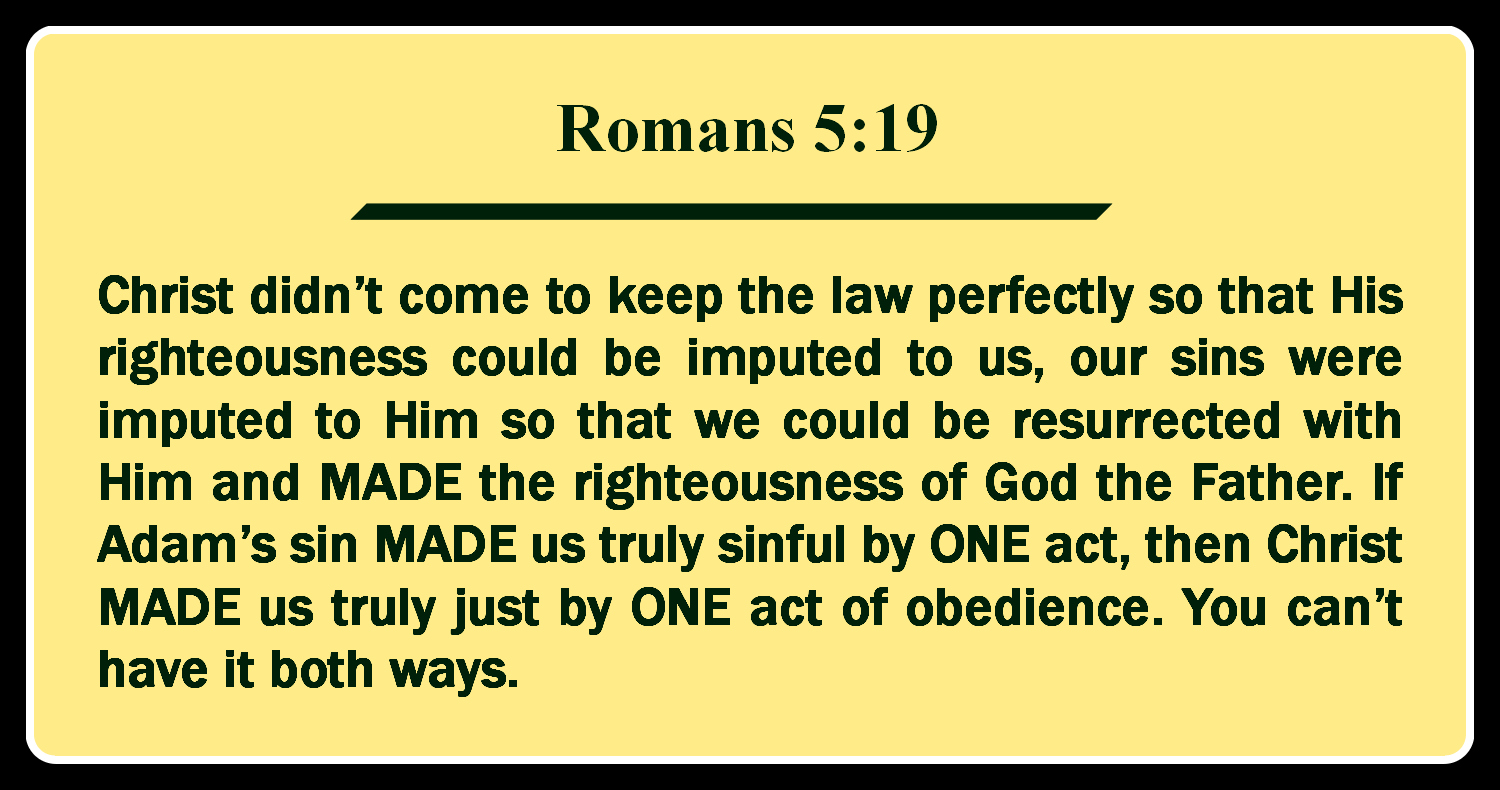
One aspect of this gospel is called “double imputation.” Each time we return to the same gospel that saves us, the perfect obedience of Christ is credited to our account. This is the idea that Christ came to die for our sins (Christ’s passive obedience), and also came to live a perfect life so that His obedience can be imputed to our lives each time we return to the gospel (Christ’s active obedience).
When proponents of Gospel Sanctification speak of the “obedience of faith,” what they mean to say is that Christians only EXPERIENCE the obedience of Christ imputed to us, and are not really performing the act directly. This leads many to believe that proponents are advocating direct obedience by the “believer,” but that is not the case at all.
Therefore, according to Gospel Sanctification, the “believer” is able to live a life of FAITH ALONE, or in other words, a like faith alone that saved him/her. This is nothing new. In his epistle to the Jewish Christians, James refuted a “faith without works.” In reality, FAITH WORKS through love (Galatians 5:6).
Of late there is a new truism roaming about that depicts this double imputation aspect of Gospel Sanctification: “On the cross Jesus was treated as if He lived our life so we could be treated as if we lived His life.” Notice that we are treated “as if” we live a godly life, but we really don’t. We are only experiencing the active obedience of Christ. If we are directly responsible for any act of obedience; that’s supposedly works salvation.


 Paul's Passing Thoughts
4 comments