Calvinism and the Problem with Perfection
 Originally published November 7, 2013
Augustine, Luther, and Calvin were first and foremost Platonists. They integrated the Bible with Platonism. Plato’s theory of forms posits the idea of two worlds; the mutable material world of illusion where reality can only be partially known, and another world where the immutable objective true forms exist. This material world is a shadow world; everything is shadows of the true forms. Therefore, man can only interpret and experience this world subjectively. The tendency is to interpret reality by observing the shadows. To the degree that mankind thinks the material world is reality according to the five senses, subjectivity and chaos will abound.
Therefore, Plato’s ethic was to improve the subjective experience of this life by accessing the true forms through ideas and mathematics—things that transcend the five senses (he believed math was an unchangeable rule and therefore not part of the shadow world). He believed that those who have the capability and willingness to bring more understanding of the objective into the subjective to be an elite minority. These were Plato’s philosopher kings whom he thought should rule society in order to decrease chaos as much as possible. Without philosopher kings, the world would be awash in a sea of subjectivity, everyone living by their own subjective presuppositions based on the shadows of this world. Hence, the arch enemy of the Platonic ideal is individualism.
Plato’s world of true objective forms was his trinity of the true, good, and beautiful. Experiencing the pure form of goodness in this world is impossible—only a shadow of good can be experienced subjectively. Plato’s social engineering has a doctrine, and to the degree that doctrine is applied, a higher quality of subjective existence occurs.
The Reformers put a slightly different twist on this construct. There is no doctrine to apply, only an orthodoxy that focuses on seeing and experiencing. Their version of Plato’s philosopher kings are pastors who possess the power of the keys. Orthodoxy is mediated truth determined by “Divines,” and passed down to the masses for the purpose of experiencing the objective power of the gospel subjectively. The Reformers made the true forms “the gospel,” and reality itself the gospel, ie., the work and personhood of Jesus Christ in particular.
Therefore, in the same way Plato envisioned a society that experiences the power of the true forms subjectively through ideas and immutable disciplines like mathematics, the Reformers sought a heightened subjective experience through a deeper and deeper knowledge of their own true, good, and beautiful—the gospel. And more specifically, instead of the gateway of understanding being reason, ideas, and immutable disciplines, they made the gospel itself the interpretive prism. So: life, history, the Bible, ie., everything, is a tool for experiencing true reality (the gospel) in a higher quality subjectivity. The Bible and all life events are a gospel hermeneutic. Salvation itself is the interpretive prism. All of reality is about redemption. Salvation itself is the universal hermeneutic.
But both constructs have this in common: Pure goodness and perfection cannot exist objectively in the material world. This is where Calvinism and Platonism kiss. The Bible only agrees with this if it is a “gospel narrative.” But if it is God’s full orbed philosophical statement to all men to be interpreted grammatically and exegetically, contradictions abound. To wit, if man possesses goodness and the ability to interpret reality objectively, Platonism and its Reformed children are found wanting. If Reformation orthodoxy is not evaluated biblically with the very theses of its own orthodoxy as a hermeneutic, even more wantonness is found.
The Apostles rejected Platonism because they believed goodness and perfection could indeed be found in this material world. There is no question of the quality of goodness inside of man that enables mankind to interpret reality objectively, the quantity of goodness notwithstanding. In contrast, a dominate theme in the Calvin Institutes is the idea that no person lost or saved can perform a good work. Like Plato’s geometric hermeneutics, the Reformers believed the Law lends understanding to man’s inability to do good because eternal perfection is the standard. The best of man’s works are tainted with sin to some degree, and therefore imperfect. Even if man could perform one perfect work, one sin makes mankind a violator of the whole law. The Reformers were adamant that no person could do any good work whether saved or lost.
Why all the fuss over this point? Why was Calvin dogmatic about this idea to the point of annoyance? Because he was first and foremost a Platonist. The idea that a pure form of good could be found within mankind was metaphysical heresy. Because such contradicts every page of the Bible, the Reformers’ Platonist theology was made the hermeneutic as well. Instead of the interpretation method producing the theology, they made the theology the method of interpretation. If all of reality is redemptive, it must be interpreted the same way.
For the Platonist, the coming of Jesus Christ in the flesh poses a huge problem. He is the truth. He came to the material world in a material body. Platonism became Gnosticism and wreaked havoc on the 1st century church. Notice how the first sentences of 1John are a direct pushback against the Gnosticism of that day:
1John 1:1 – That which was from the beginning, which we have heard, which we have seen with our eyes, which we looked upon and have touched with our hands, concerning the word of life— 2 the life was made manifest, and we have seen it, and testify to it and proclaim to you the eternal life, which was with the Father and was made manifest to us— 3 that which we have seen and heard we proclaim also to you, so that you too may have fellowship with us; and indeed our fellowship is with the Father and with his Son Jesus Christ. 4 And we are writing these things so that our joy may be complete.
Christ is the true, good, and beautiful, and He was touched, felt, seen, heard, and understood. Game over. This is the paramount melding of Plato’s two worlds resulting in a plenary decimation of his philosophy. Nevertheless, Calvin et al got around that by keeping mankind in a subjective realm while making the material world a gospel hermeneutic. Reality still cannot be understood unless it is interpreted by the gospel—everything else is shadows.
Martin Luther took Plato’s two worlds and made them two stories: our own subjective story, a self “glory story” that leads to a labyrinth of subjectivism, or the “cross story” which is the objective gospel. Luther made Plato’s two worlds two stories, but still, they are two realms: one objective and one subjective. In the final analysis mankind is still incompetent, and void of any good whether saved or lost.
Whether the Reformed gospel or Platonism, the infusion of objective goodness is the heresy. Man cannot have any righteousness in and of himself, whether lost or saved. The pushback against this idea can be seen throughout the New Testament. A few examples follow:
1John 2:4 – Whoever says “I know him” but does not keep his commandments is a liar, and the truth is not in him, 5 but whoever keeps his word, in him truly the love of God is perfected.
1John 2:20 – But you have been anointed by the Holy One, and you all have knowledge.21 I write to you, not because you do not know the truth, but because you know it, and because no lie is of the truth.
1John 2:26 – I write these things to you about those who are trying to deceive you. 27 But the anointing that you received from him abides in you, and you have no need that anyone should teach you. But as his anointing teaches you about everything, and is true, and is no lie—just as it has taught you, abide in him.
1John 2:29 – If you know that he is righteous, you may be sure that everyone who practices righteousness has been born of him.
1John 3:2 – Beloved, we are God’s children now, and what we will be has not yet appeared; but we know that when he appears[a] we shall be like him, because we shall see him as he is. 3 And everyone who thus hopes in him purifies himself as he is pure. 4 Everyone who makes a practice of sinning also practices lawlessness; sin is lawlessness. 5 You know that he appeared in order to take away sins, and in him there is no sin. 6 No one who abides in him keeps on sinning; no one who keeps on sinning has either seen him or known him. 7 Little children, let no one deceive you. Whoever practices righteousness is righteous, as he is righteous.
Romans 15:14 – I myself am satisfied about you, my brothers, that you yourselves are full of goodness, filled with all knowledge and able to instruct one another.
Christians can know goodness, and perform righteousness objectively. This speaks to the quality of the righteousness when it is performed—it is perfect and acceptable to God. We are not limited to a mere subjective experience in regard to righteousness. When we are resurrected, the quantity thereafter will be 100%, but our present righteousness is acceptable to God when it is performed by us. If it is accepted by God, it is perfect.
Even the unregenerate know good, and can perform it. The works of the law are written on their hearts, and their consciences either accuse or excuse them (Romans 2:12-15). Though enslaved to unrighteousness, they are free to perform righteousness (Romans 6:20). The very goodness of God can be understood from observing creation as well (Romans 1:20).
The only way the Reformers can make all goodness outside of man is to make the Bible a salvation hermeneutic. It is the only way they could integrate the Bible with their Platonist philosophy.
paul
The Nature of God
 I believe incredibly exciting times await God’s people as they break free from the Protestant Orthodoxy Dark Ages. The key will be the realization that God wrote the Bible for the average individual. We have an example of this regarding the nature of God; a subject thought to be too deep for the average disciple.
Our only head is Christ who teaches all, and the idea of being taught assumes the ability to understand. God’s people need to simply let the words in the Bible say what they plainly say, and we are individually responsible for doing so. One must free their minds from the tyranny of orthodoxy and journey into the Bible with their own God-given mind, and they will be responsible to God alone for doing so.
What then does the Bible teach us about God’s nature? The Bible states that God is love:
Beloved, let us love one another, for love is from God, and whoever loves has been born of God and knows God. Anyone who does not love does not know God, because God is love.
So we have come to know and to believe the love that God has for us. God is love, and whoever abides in love abides in God, and God abides in him.
Obtaining God’s Love
Protestant orthodoxy has a peculiar teaching known as the “vital union.” According to Reformed tradition, we maintain this vital union of “Christ in us and us in Christ” by “preaching the gospel to ourselves.” This is done by searching for sin in our lives so that we can return to the cross for forgiveness resulting in increased salvation. The following chart publicized by several Reformed organizations illustrates the process:
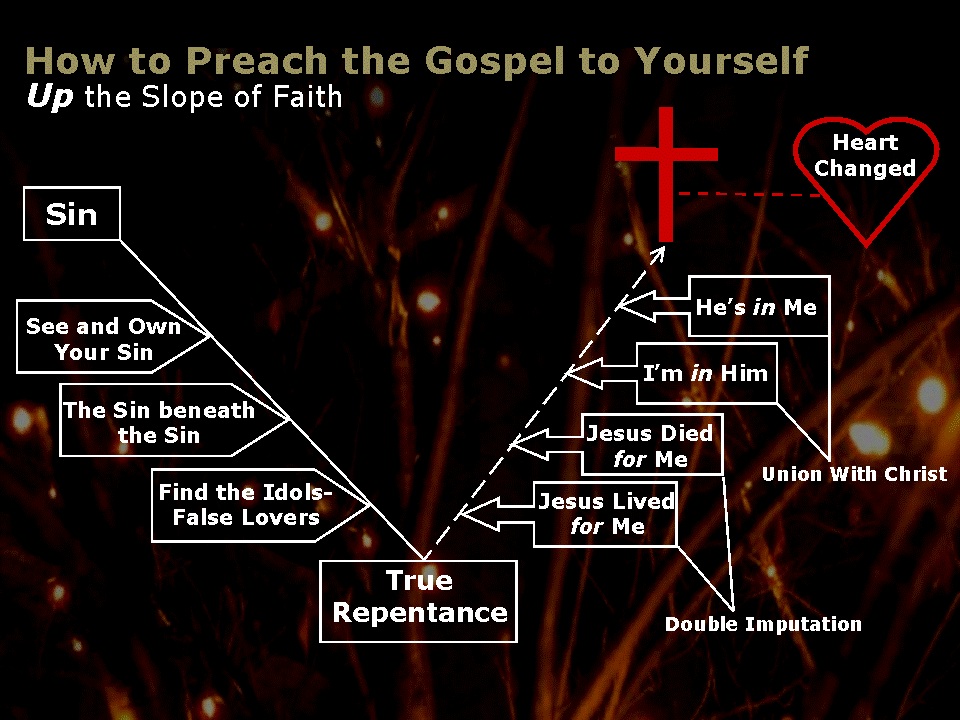
In case you think this is a “biblical” process for best results in growing as a disciple expressed in the illustration by “Heart Changed,” think again as illustrated by another chart published by several Reformed organizations as well:

In this chart, what is growing? Us, or our “salvation”? Many Reformed teachers in our day are fond of telling us how to “keep ourselves in the love of God” by “preaching the gospel to ourselves every day.” In fact, if we change, the following chart from the same camp shows the consequences:

…our salvation gets smaller! In contrast, we obtain God’s love once, and for all time, by believing in His Son, and experience assurance of that love but walking according to our new being.
Little children, let us not love in word or talk but in deed and in truth. By this we shall know that we are of the truth and reassure our heart before him…
But according to Protestant orthodoxy, if we make every effort to love God and others instead making every effort to find more and more sin in our lives, the gospel effect in our lives is diminished.
The Nature of God
How we obtain the love of God as prescribed by Protestant orthodoxy flows from its tenets regarding the nature of God. Primarily, God is defined as sovereign. Rather than sovereignty being an aspect of God’s nature, it is made to be the primary organizing principle—not love. This is an important distinction for those who take part in the exodus from Protestant darkness; will God’s nature be defined by a grammatical and exegetical interpretation of Scripture, or an interpretation based on orthodoxy?
Clearly, the Bible states that God is love. So, how does the Bible define love? Let’s see:
1Corinthians 13:1 – If I speak in the tongues of men and of angels, but have not love, I am a noisy gong or a clanging cymbal. 2 And if I have prophetic powers, and understand all mysteries and all knowledge, and if I have all faith, so as to remove mountains, but have not love, I am nothing. 3 If I give away all I have, and if I deliver up my body to be burned, but have not love, I gain nothing.
4 Love is patient and kind; love does not envy or boast; it is not arrogant 5 or rude. It does not insist on its own way; it is not irritable or resentful; 6 it does not rejoice at wrongdoing, but rejoices with the truth. 7 Love bears all things, believes all things, hopes all things, endures all things.
8 Love never ends. As for prophecies, they will pass away; as for tongues, they will cease; as for knowledge, it will pass away. 9 For we know in part and we prophesy in part, 10 but when the perfect comes, the partial will pass away. 11 When I was a child, I spoke like a child, I thought like a child, I reasoned like a child. When I became a man, I gave up childish ways. 12 For now we see in a mirror dimly, but then face to face. Now I know in part; then I shall know fully, even as I have been fully known.
13 So now faith, hope, and love abide, these three; but the greatest of these is love.
The so-called Reformed gospel of sovereignty calls for the total inability of man to love God even after their definition of conversion. One well known Reformed theologian wrote a book titled One Way Love. This staple Protestant belief is defined in the doctrine of double imputation which calls for the imputation of Christ’s alien righteousness to be imputed to our lives apart from anything we do other than preaching the gospel to ourselves. Much is made of living the Christian life by faith alone in order to maintain our “just standing.”
What it boils down to is God creating evil for His own glory. Whether you consider the teachings of Martin Luther or John Calvin, the founding fathers of Protestantism, this is an irrefutable fact. Luther taught that God created mankind with a passive will; in other words, a will that can only act if acted upon from an outside source. This testifies to God’s nature as defined by sovereignty. Hence, certain people are predetermined to suffer for eternity. In regard to this, John Calvin stated,
[God] arranges all things by his sovereign counsel, in such a way that individuals are born, who are doomed from the womb to certain death, and are to glorify him by their destruction.
~Institutes 3.23.6
I again ask how is it that the fall of Adam involves so many nations with their infant children in eternal death without remedy, unless it so seemed meet to God?…The decree, I admit, is dreadful; and yet it is impossible to deny that God foreknew what the end of man was to be before he made him, and foreknew, because he had so ordained by his decree.
~Institutes 3.23.7
This is contrary to love which is the true nature of God, being “kind,” and “Love does no wrong to a neighbor; therefore love is the fulfilling of the law.” The Reformed even make it a point to say that God did no wrong by creating man in an evil state because the end cause is God’s glory. If God brings good out of something evil, in the final analysis it is good because the end is good. It is also said that God created evil to make good better. However, that still does not dispose of the kindness issue. Love CANNOT be unkind to ANYONE.
Furthermore, it does not seek its own way, and you can insert “its own glory” in that list as well. Moreover, love does not rejoice in evil for any outcome, and always rejoices in truth and not the temporary demise of truth for some kind of better outcome. That notion is absurd.
In the final analysis, one of God’s attributes is sovereignty, but sovereignty is not the organizing principle of his nature because his nature is love.
paul
Elyse Fitzpatrick: The New Red Herring for John MacArthur
 Contemporary evangelicalism is so fraught with heresy and confusion one becomes endeared to those who at least have an accurate understanding of their false gospel. It’s so annoying to me that I am no longer interested in converting people who believe in Luther/Calvin progressive justification, but rather long to see them accurately understand what they profess. I dream of a TANC school of Calvinism where Calvinists are taught what Calvin really believed. For graduation they would receive a T shirt that reads, “Now Jonathan Edwards is really my homeboy.”
That’s why I miss Tullian Tchividjian. That is a man that understands Reformation soteriology. It was too much fun watching him drive John MacArthur et al completely nuts with his un-nuanced articulation of Reformed doctrine. But Tullian screwed up; so disappointing.
So who is the new replacement for proving that MacArthur et al stand for something different? Tullian comrade Elyse Fitzpatrick. The likes of Elyse give fodder for the accusation of antinomianism against the authentic Reformation gospel of progressive justification which is in fact antinomianism. Fitzpatrick, like her bro Tullian, lacks nuance and enables people to connect the dots; that’s why she is a threat and must be neutralized.
So, MacArthur’s camp is blogging about Elyse and her involvement in the “Hypergrace movement.” The series is titled “Abusing Grace.” Look, the fact is: they do not believe anything one whit different than Elyse Fitzpatrick. This is all a bunch of smoke and mirrors. Who wants specific citations from the mouth of Mac propagating the exact same gospel contemplationism of progressive justification? His best bro is John Piper who states in no uncertain terms that Christians continue to be saved by returning to the same gospel that saved them. Mac minion Phil Johnson defines saving faith as returning to the cross for a fresh set of downs on the way to the goal posts of final justification. They all believe the same thing.
So, in throwing people off track with their new red herring, they of course falsely accuse Fitzpatrick which gives her opportunity to defend herself without getting to the crux of the issue: she teaches an unfettered Reformed gospel and they don’t. Her defense on Facebook follows:
Well, okay, I’m going to say it again:
Do I care about holiness? Yes.
Do I care about our children being holy? Yes. (Ask ’em.)
It is simply my belief that true holiness grows only in the context of love for God and love for God only grows in the context of being reminded of God’s prior love for us in Christ.
Yes, I talk about grace and the gospel a lot. But it’s because I care about holiness, not because I think sin should abound.
Of course, abounding sin is not the issue; the issue is that Luther, in his foundational doctrinal statement of the Reformation, the Heidelberg Disputation, proffered the following perspective on active sin: it is our only duty to seek more salvation while obedience manifested by God is completely out of our control and really none of our business. MacArthur has said the same thing on several occasions in this way: it is his job to teach Scripture, but it is up to the Holy Spirit to apply it. He has even suggested that Christians sometimes realize they obeyed after the fact because it was the Holy Spirit who applied the truth and not them. The general idea can be understood via this quote from Reformed guru and Christian counselor Bill Baldwin:
Give me a man who preaches the law with its terror and Christ with his sweetness and forgets to preach the law as a pattern of the fruit of sanctification and what will result? In two months his parishioners will be breaking down his door begging to be told what behavior their renewed, bursting with joy, hearts may best produce. And when he tells them, they will be surprised (and he will not) to discover that by and large they have produced exactly that. And where they haven’t, take them back to Christ again that they may contemplate him in all his glorious perfection so that they may better understand what sort of God and man he was and is.
Likewise, MacArthur often propagates the transformation of believers by gazing at the glory of God in the face of Christ which is also John Piper’s “beholding as a way of becoming.”
Be not deceived; it’s all the same stuff. It’s all progressive justification by returning to the same gospel that saved us for more salvation because Christians supposedly need ongoing salvation.
paul
The Protestant Road to Salvation; Gaining Salvation with More and More Salvation by Using the Bible to be Brought Down to Hell
 The Heidelberg Disputation Series: Theses 15-18.
Listen to audio or download audio file.
Welcome truth lovers to Blog Talk radio.com/False Reformation, this is your host Paul Dohse. Tonight, part 10 of “The Magnum Opus of the Reformation: Martin Luther’s Heidelberg Disputation, Thesis 15 ff. The Protestant Road to Salvation; Gaining Salvation with More Salvation by Using the Bible to be Brought Down to Hell
Greetings from the Potters House and TANC ministries where we are always eager to serve all of your heterodox needs. Our teaching catalog can be found at tancpublishing.com.
If you would like to add to our lesson or ask a question, call (347) 855-8317. Remember to turn your PC volume down to prevent feedback. If you choose to use Skype to listen to the show, my advice is to just dial direct from your Skype account without using any of the Blogtalk links. 347-855-8317.
Per the usual, we will check in with Susan towards the end of the show and listen to her perspective.
Remember, you may remain anonymous. When I say, “This is your host; you are on the air, what’s your comment or question”—just start talking.
If you would like to comment on our subject tonight, you can also email me at paul@ttanc.com. That’s paul@Tom, Tony, Alice, Nancy, cat.com. I have my email monitor right here and can add your thoughts to the lesson without need for you to call in. You can post a question as well.
Tonight, we continue in our sentence by sentence evaluation of the HD (Heidelberg Disputation) starting with thesis 15. Yes, tonight, we really get into the meat of the Protestant gospel, and it ain’t pretty.
Due to the fact that I can’t decide where to stick this with a fork first tonight, let’s begin by reading the 15th thesis:
Thesis 15: Nor could free will remain in a state of innocence, much less do good, in an active capacity, but only in its passive capacity (subiectiva potentia).
The Master of the Sentences (Peter Lombard), quoting Augustine, states, »By these testimonies it is obviously demonstrated that man received a righteous nature and a good will when he was created, and also the help by means of which he could prevail. Otherwise it would appear as though he had not fallen because of his own fault.« He speaks of the active capacity (potentia activa), which is obviously contrary to Augustine’s opinion in his book ›Concerning Reprimand and Grace‹ (De Correptione et Gratia), where the latter puts it in this way: »He received the ability to act, if he so willed, but he did not have the will by means of which he could act.« By »ability to act« he understands the original capacity (potentia subiectiva), and by »will by means of which he could,« the active capacity (potentia activa).
The second part (of the thesis), however, is sufficiently clear from the same reference to the Master.
We discussed the two primary elements of Martin Luther’s bondage of the will in part 7. They are active will and passive will. Man has no active will, his will is passive. It’s like water; it just sits there until it is acted upon by something from the outside. In Luther’s bondage of the will construct, man is dead as a passive being. We normally think of death as a termination of life, but according to Luther, death is a realm where works can be performed, but they are dead works.
As often pontificated by the Reformed, their favorite illustration in regard to this is the resurrection of Lazarus in John 11. Supposedly, this is illustrative of sanctification (the Christian life). From there, the Reformed put metaphysical feet on it in various and sundry philosophical ways, but the major premise is the same.
A caution when studying Reformed ideology/philosophy: separate the major premises from the various applications or you will drive yourself nuts. The major premises such as the total inability of mankind are consistent, but the so-called life applications are not. Let me give an example.
Some of the Reformed believe that man is not active in any regard as far as the will. Everything that happens is because God acted upon man. Others believe man has a free will to do dead works in the material realm, but all manifestations of good works are the result of God acting upon man’s passive will. So, one view sees all human events as a result of God’s active will while others see the distinction in only good or evil acts. Man is passive in regard to good works, but has an active will in regard to all things evil.
Hence, it’s fine to go about your business and live life as it comes just so you believe that everything you do is evil. That qualifies you to be forgiven on Sunday. In the other application, you have no active will at all, but ALL things are preordained by God for His glory. Your goal is only to SEE and EXPERIENCE what God is doing. In the final analysis, these varying applications are not going to cause much of a rift in Reformed circles; the tie that binds is the total inability of man.
But here is another tie that binds: the idea that God created evil for His own glory. Most Protestants think that Protestants believe that Adam and Eve were sinless/holy/pure before the fall and they are just dead wrong in that idea, no pun intended. Authentic Protestant soteriology holds to the idea that Adam and Eve were created with passive wills as clearly stated by Luther in the thesis at hand. Either they had a propensity to do evil and God acted to prevent it until the appointed time, or God actively incited their fall as well.
It can be demonstrated clearly that the creation of evil by God is a Reformed mainstay, but the various philosophical applications make it possible for the Reformed to play all kinds of metaphysical shell games in order to keep people confused and controlled.
As stated before, the Reformation was first and foremost about philosophy and NOT theology. Clearly, the Reformation was about the integration of Dualism with the Bible. One aspect of Dualism insists that nothing can exist without a counterpart to define it. Without darkness, there can be no light, etc. When we get to thesis 28, we will see that Luther’s counterpart to love is evil. Since God is love, the only logical conclusion, other than the fact that Jonathan Edwards and many others have stated it directly, is that God Himself cannot exist without evil because He is the defining counterpart. Some suggest that God existed, but for all practical purposes was nonexistent until He created evil. This is nothing new. This is a resurgence of the exact same Platonist/Neo-Platonist/Gnostic doctrines that plagued the first century church. Take note of what James was pushing back against in that day:
James 1:13 – Let no one say when he is tempted, “I am being tempted by God,” for God cannot be tempted with evil, and he himself tempts no one. 14 But each person is tempted when he is lured and enticed by his own desire. 15 Then desire when it has conceived gives birth to sin, and sin when it is fully grown brings forth death.
16 Do not be deceived, my beloved brothers. 17 Every good gift and every perfect gift is from above, coming down from the Father of lights with whom there is no variation or shadow due to change. 18 Of his own will he brought us forth by the word of truth, that we should be a kind of firstfruits of his creatures.
Of course, the Reformed deny that they teach such things; specifically, that God created evil for His own glory, and dance around the fact with their shell-game communication skills. An example is the following excerpt from an article written by John MacArthur:
Evil originates not from God but from the fallen creature. I agree with John Calvin, who wrote,
. . . the Lord had declared that “everything that he had made . . . was exceedingly good” [Gen. 1:31]. Whence, then comes this wickedness to man, that he should fall away from his God? Lest we should think it comes from creation, God had put His stamp of approval on what had come forth from himself. By his own evil intention, then, man corrupted the pure nature he had received from the Lord; and by his fall drew all his posterity with him into destruction. Accordingly, we should contemplate the evident cause of condemnation in the corrupt nature of humanity-which is closer to us-rather than seek a hidden and utterly incomprehensible cause in God’s predestination. [Institutes, 3:23:8]
~ Is God Responsible for Evil? Grace to You catalogue #A189.
Ok, so it originates from the creature and not God as if that has nothing to do with how God created man. The only alternative is the idea that God created man in His holy image, and with a free will, but don’t hold your breath and wait for them to ever agree to that.
Note Calvin’s language very carefully. It wasn’t one, then another individual deceived by the serpent; it was a propensity inherent in the kind. Also, in the same section of 3.23.8, Calvin attributes the fall to God’s predestination for His glory. It is unclear if Calvin would have agreed with Luther’s bondage of the will via man’s passive will, but Calvin clearly believed that man was created with a level of integrity that could not obtain full fellowship with god even if man had not fallen:
Even If man had remained in his integrity, still his condition was too base for him to attain to God. How much less could he have raised himself so far, after having been plunged by his ruin into death and hell, after staining himself with so many defilements nay, even stinking in his corruption and all overwhelmed with misery?
~The Calvin Institutes 2.12.1. Henry Beveridge translation varies slightly.
Shockingly, the Henry Beveridge translation has it that man’s condition was too base to attain to God “without a Mediator” note capital “M.” Clearly, Calvin is saying that man needed a mediator before the fall.
Thesis 16: The person who believes that he can obtain grace by doing what is in him adds sin to sin so that he becomes doubly guilty.
On the basis of what has been said, the following is clear: While a person is doing what is in him, he sins and seeks himself in everything. But if he should suppose that through sin he would become worthy of or prepared for grace, he would add haughty arrogance to his sin and not believe that sin is sin and evil is evil, which is an exceedingly great sin. As Jer. 2:13 says, »For my people have committed two evils: they have forsaken me, the fountain of living waters, and hewed out cisterns for themselves, broken cisterns, that can hold no water,« that is, through sin they are far from me and yet they presume to do good by their own ability.
Now you ask: What then shall we do? Shall we go our way with indifference because we can do nothing but sin? I would reply: By no means. But, having heard this, fall down and pray for grace and place your hope in Christ in whom is our salvation, life, and resurrection. For this reason we are so instructed-for this reason the law makes us aware of sin so that, having recognized our sin, we may seek and receive grace. Thus God »gives grace to the humble« (1 Pet. 5:5), and »whoever humbles himself will be exalted« (Matt. 23:12). The law humbles, grace exalts. The law effects fear and wrath, grace effects hope and mercy. Through the law comes knowledge of sin (Rom. 3:20), through knowledge of sin, however, comes humility, and through humility grace is acquired. Thus an action which is alien to God’s nature (opus alienum dei) results in a deed belonging to his very nature (opus proprium): he makes a person a sinner so that he may make him righteous.
This thesis is a good summary of the Reformation gospel. Man remains unchanged accept for the ability to see how evil he is and his continued need for the same gospel that saved him. Any notion that there is anything in man that could choose God is double sin and hewing out cisterns for himself that cannot hold water.
Also assumed in the rhetoric is efficacious good works to maintain the law as a standard for justification.
Luther then states what “saved” sinning lost people are to do since they can do nothing but sin. One is to focus on their sin as a way to see a continued need for salvation resulting in more grace…for salvation and continued justification. Instead of being indifferent to sin, embrace it as a means of seeing your need for continued “grace,” herein a more nuanced word than outright “justification” or “salvation.” Again, this nuancing of words incessant with the Reformed began right here in the HD. Following is a contemporary example:
In the following video trailer from the 2011 Resolved Conference, Al Mohler states that the only purpose of the law in the life of a believer is to show us our ongoing need for salvation. Of course, he doesn’t word it that way. He states that believers have an ongoing need for Christ (which no Christian would refute), but note carefully: he is speaking in context of our initial salvation. So, instead of saying plainly that Christians need to be continually saved, or continually justified, he replaces that wording with “Christ.” However, again, the context is clearly salvation. He is saying that we need Christ in the same way that we needed Him for salvation.
Mohler is also saying that the law has the same relationship/purpose to unbelievers as it does believers: to show us our need for Christ. So, obviously, this is in contrast to any ability on the part of the believer to keep it. All the law can do is show NEED. Need for what? Well, what’s the context? Mohler also presents an either/or choice in regard to the law: it either shows us our need for Christ (again, what need specifically?), or we are using it to “rescue ourselves from sin.” Hmmm, what does it mean to “rescue ourselves from sin”? I believe Mohler deliberately uses the word “rescue” instead of “save” in order to add nuance to his point. “Rescue” is less direct, and could refer to a believer trying to overcome sin on his own. This is the same reason he replaces “salvation” with “Christ” in his prior point. It’s deliberate deception. Excluded is any mentioning that the law can be used by the believer to please God and glorify Him in all we do by “observing all that I have commanded.”
~Paul’s Passing Thoughts.com: Why Al Mohler is a Heretic; April 10, 2012
Thesis 17: Nor does speaking in this manner give cause for despair, but for arousing the desire to humble oneself and seek the grace of Christ.
This is clear from what has been said, for, according to the gospel, the kingdom of heaven is given to children and the humble (Mark 10:14,16), and Christ loves them. They cannot be humble who do not recognize that they are damnable whose sin smells to high heaven. Sin is recognized only through the law. It is apparent that not despair, but rather hope, is preached when we are told that we are sinners. Such preaching concerning sin is a preparation for grace, or it is rather the recognition of sin and faith in such preaching. Yearning for grace wells up when recognition of sin has arisen. A sick person seeks the physician when he recognizes the seriousness of his illness. Therefore one does not give cause for despair or death by telling a sick person about the danger of his illness, but, in effect, one urges him to seek a medical cure. To say that we are nothing and constantly sin when we do the best we can does not mean that we cause people to despair (unless we are fools); rather, we make them concerned about the grace of our Lord Jesus Christ.
Ok, so not much commentary needed here—this is pretty plain. As believers we are still sick, and hey, telling someone that they need a doctor continually is not bad news, but good news. All of the Christian life is seeking to be concerned about “grace.” Again, that means salvation. As we have discussed many times before, “grace” is a biblical word that has broad meaning including, for the most part, “help.” Though Luther calls any assertion that this would instill despair in people “foolish,” historical facts beg to differ.
Thesis 18: It is certain that man must utterly despair of his own ability before he is prepared to receive the grace of Christ.
The law wills that man despair of his own ability, for it »leads him into hell« and »makes him a poor man« and shows him that he is a sinner in all his works, as the Apostle does in Rom. 2 and 3:9, where he says, »I have already charged that all men are under the power of sin.« However, he who acts simply in accordance with his ability and believes that he is thereby doing something good does not seem worthless to himself, nor does he despair of his own strength. Indeed, he is so presumptuous that he strives for grace in reliance on his own strength.
Here we have it again. The sole use of the Bible is to show us our worthlessness so as to be brought down to hell in order to prepare ourselves to receive more salvation/justification. As Dr. Michael Horton has said, the sole Purpose of the Bible is to “drive us to despair of self-righteousness.” This is, of course, the mortification part of the Reformed doctrine of mortification and vivification.
With that, let’s go to the phones.
Sin, Sin, Sin, Sin, Sin, Sin, Sin, Sin
Got sin? You do if you are a Protestant, and a lot of it. The “T” in TULIP doesn’t stand for total depravity for no good reason, no pun intended. The only good thing is focusing on the bad thing: your nasty, wicked self.
Sin is a really big deal in Protestantism because we get ourselves into heaven by dwelling on the fact that we are “sinners.” If we can do any good work, if ALL of our works are NOT filthy rags—that’s not living by “faith alone” for our justification. Supposedly, if we think we can do anything good, that’s not living by faith alone in what Jesus has accomplished for us, but rather living in the “confidence of the flesh.”
The foundation of Protestant soteriology is the idea that “Christians” live under the possibility of condemnation and should fear accordingly. Christians remain under the condemnation of the law and remain covered by professing that they can do no good work. By continually returning to the same gospel that saved us for forgiveness of works, both good and bad, the righteousness of Jesus continues to be imputed to us. Hence, “We have no righteousness of our own in salvation or the Christian life.”
In contrast, the emphasis of our Christian lives should be LOVE. We still sin, but it is not sin unto condemnation, but rather sin against our Father as a family matter. We may receive chastisement, but we are in no danger of condemnation. Not so with the Protestant gospel: the “Christian” remains under eternal condemnation and is only covered through faith alone by returning to the same gospel that saved us. This is why Protestantism has always been weak in the area of discipleship. This is why there is an obsession with making saved people rather than disciples. And by the way, the only place we can find continued forgiveness for “sin that removes us from grace” (Calvin/Luther) is under the “authority” of the local church. Go figure.
Even in Baptist churches, pastors bemoan the fact that “10% of the congregants do 90% of the work.” Well, dah, I am surprised that even 10% are doing anything as the focus is keeping oneself saved by focusing on how inept we are.
More and more in counseling, I am telling people to stop focusing so much on sin. Clearly, especially in the Protestant contemporary biblical counseling movement, the specific instruction is to “find the sin beneath the sin” as a means of growing your salvation as if salvation grows to begin with. If our focus is sin- searching as a means of spiritual wellbeing, and good works tempt us to think we did something good (again, Luther/Calvin), what in the world will be the results? Well, look around for yourself—it’s called “the church.”
A focus on sin will not prevent sin or promote love. If there is something to be gained by finding sin, it will be far from us to fight against it. Why would we cut off our supply of blessings by making the cross smaller? It becomes a supply and demand issue.
The Bible endorses a focus on love, not sin-searching. We are to look for ways to love God and others, not ways to find the “sin beneath the sin” or some endeavor to “peel back the layers of sin.” No doubt, there is a CONTROL conspiracy involved with this supposed method of sanctification as well. Stripping people of an accurate evaluation of self is a very efficient way of controlling them. Being worthy enough to hold others accountable for their own good will not get you into heaven—only returning daily to the same gospel that saved you for a fresh set of downs to get into the salvation end zone.
And what will eventually happen to any marriage if the constant focus is your spouse’s sin? No wonder then that the present-day biblical counseling movement (mostly sponsored by Reformed churches) is overflowing with marriage counseling cases. Week in, and week out, teaching will knock down any notions that either spouse can do any work that is not “filthy rags.” And, the only real sin is not knowing that everything you do is sin; if you don’t know that, you may find yourself in so-called church discipline. We do know this: those who will not accept this premise are deemed “unteachable.”
We have not been given a spirit of fear under the law of sin and death and its condemnation. We, instead, have been given the Holy Spirit and boldness to love God and others without any fear of condemnation.
We are to be enslaved to love—not to a fear of condemnation.
paul

 Paul's Passing Thoughts
1 comment