Believers No Longer in Protective Custody
Originally published May 31, 2016
The ancient Greek cultural practice of “pederasty” was the homosexual relationship between an adult male (the “erastes”) and an early-adolescent male. In the city of Athens particularly, pederasty entailed a formal bond between an adult man and an adolescent boy outside his immediate family, consisting of loving and often sexual relations. As an erotic and educational custom it was initially employed by the upper class as a means of teaching the young and conveying to them important cultural values, such as bravery and restraint.
Athenian society generally encouraged the “erastes” to pursue a boy to love, tolerating behavior such as sleeping on the stoop of the youth’s home and otherwise going to great lengths to make himself noticed. At the same time, the boy and his family were expected to put up resistance and not give in too easily, and boys who succumbed too readily were looked down upon. As a result, the quest for a “desirable boy” was fiercely competitive. (source: wikipedia – Athenian Pederasty)
Often, fathers who wished to protect their sons from such unwanted advances, as described above, would send a household slave to accompany the boy wherever he went, particularly on his way to school. These slaves were known as “pedegogos”. The word literally means a “boy leader”. The pedegogos acted as a “guardian” for the young boy, to protect him.
It is important to understand the cultural use of this word “pedegogos” in the first century, because this is the word that the apostle Paul uses in describing the relationship between Old Testament believers and the Law.
“But the scripture hath concluded all under sin, that the promise by faith of Jesus Christ might be given to them that believe. But before faith came, we were kept under the law, shut up unto the faith which should afterwards be revealed. Wherefore the law was our schoolmaster to bring us unto Christ, that we might be justified by faith. But after that faith is come, we are no longer under a schoolmaster.” ~ Galatians 3:22-25
The King James uses the word “schoolmaster”, but it is this Greek word παιδαγωγος “pedegogos”. It is better translated as “guardian”.
But before we examine that word some more, we need to take some time to clear up a reformed miss-conception about this passage. It has to do with this expression “concluded all under sin”. Traditionally this has been taught to mean that the logical conclusion of scripture’s teaching is that all are under sin. We simply need to look at the grammar to see that this is not what Paul is saying. “All under sin” is a group of people that are the focus of his argument. The word translated “concluded” is the Greek word συνκλειω (soonk-lee-oh). It is a compound word made up of the prefix “soon” meaning “together with” and the word “kleio” meaning “to shut up” or “to enclose”. It has the idea of taking something into custody for the purpose of protection.
What Paul is teaching in this passage is that in the Old Testament, the role of scripture (or Law) was to take all of those “under sin” into custody for the purpose of protecting them. (Please note, that “under sin” is not the same as “under law”.) This is important to understand, and this protection was the “atoning” aspect of the Law. Because Jesus, “the Promise”, had not yet come to end the law and its condemnation, Old Testament believers were actually protected by the law, because sin was imputed to the law and not to the believer. The law took them into protective custody.
Paul repeats this idea in the very next verse:
“…before faith came, we were kept under the law…”
The word “kept” is the Greek word φρουρεω (froo-reh-oh). It means to be a watcher in advance, or to mount a guard or a sentinel, like a guard in a watchtower. Again, the idea is one of offering protection. Notice carefully that the phrase is “kept under the law” and not kept “under law”. To be kept under the law means that it is the law that is performing the “keeping” or “protecting”. This in no way whatsoever means that believers are still “kept (remain) under law” as reformed doctrine would have us believe. It means that the Old Testament believers were protected by the law.
Why was this protection necessary? Because “the Promise” had not yet come. The law, while it did not impart righteousness, in this manner it served as a protection from condemnation. And the law’s ability to condemn would not be ended until Jesus’ crucifixion. Therefore, this protection, this “atonement” was available until that time would come. Paul makes this very point in verse 24.
“Wherefore the law was our schoolmaster to bring us unto Christ…”
Notice that he is NOT saying that the law leads us TO Christ. The reformed interpretation of this is that the purpose of the law is to lead us to Christ to show us how much we are in need of salvation, but that is not the case. In the context of the passage, the law WAS (past tense) a guardian (pedegogos) until the time when Christ came. “Pedegogos” is a very provocative word, knowing what we know about its meaning. Paul could have used any other word do express the idea of a guardian or protector. But he specifically chose to use “pedegogos” knowing full well that his audience would have understood the cultural implications behind it. He was obviously wanting to make a very powerful point on the matter!
But what has happened since Christ died? What happened once “the Promise” came? There is no longer any need of a guardian. Why? Because the law is ended. The law can no longer condemn. Believers are not under law, they are under grace. This is a joyous reality! But there is also a sense of foreboding as revealed by the writer of Hebrews.
“This is the covenant that I will make with them after those days, saith the Lord, I will put my laws into their hearts, and in their minds will I write them; And their sins and iniquities will I remember no more. Now where remission of these is, there is no more offering for sin…For if we sin wilfully after that we have received the knowledge of the truth, there remaineth no more sacrifice for sins, But a certain fearful looking for of judgment and fiery indignation, which shall devour the adversaries.” ~ Hebrews 10:16-18, 26-27
When Christ died to end the law, He also ended its atoning work. Not only are believers no longer in need of a guardian, but there IS no guardian, period. That results in fear. If one is still under law the natural response is fear which comes from the reality of condemnation. No more protection from condemnation is available. Also, the only ones who CAN sin are those still “under law”. Those under grace CANNOT sin because they have been born again, and the law is ended. (1 John 3:8-9) A guardian is not necessary because they cannot be condemned.
I think people intuitively know this. I daresay that the reason so many “christians” are in constant fear of losing their salvation (or just fear in general) is because their theology keeps them “under law”. It is the cognitive dissonance produced when they know in their hearts that the law cannot save them, and they know that it can no longer protect them. This is why a proper understanding of the role of the law is so vital to the true gospel. Any gospel that makes law the standard for righteousness is a false one.
Andy

Believers No Longer in Protective Custody
The ancient Greek cultural practice of “pederasty” was the homosexual relationship between an adult male (the “erastes”) and an early-adolescent male. In the city of Athens particularly, pederasty entailed a formal bond between an adult man and an adolescent boy outside his immediate family, consisting of loving and often sexual relations. As an erotic and educational custom it was initially employed by the upper class as a means of teaching the young and conveying to them important cultural values, such as bravery and restraint.
Athenian society generally encouraged the “erastes” to pursue a boy to love, tolerating behavior such as sleeping on the youth’s stoop and otherwise going to great lengths to make himself noticed. At the same time, the boy and his family were expected to put up resistance and not give in too easily, and boys who succumbed too readily were looked down upon. As a result, the quest for a “desirable boy” was fiercely competitive. (source: wikipedia – Athenian Pederasty)
Often, fathers who wished to protect their sons from such unwanted advances, as described above, would send a household slave to accompany the boy wherever he went, particularly on his way to school. These slaves were known as “pedegogos”. The word literally means a “boy leader”. The pedegogos acted as a “guardian” for the young boy, to protect him.
It is important to understand the cultural use of this word “pedegogos” in the first century, because this is the word that the apostle Paul uses in describing the relationship between Old Testament believers and the Law.
“But the scripture hath concluded all under sin, that the promise by faith of Jesus Christ might be given to them that believe. But before faith came, we were kept under the law, shut up unto the faith which should afterwards be revealed. Wherefore the law was our schoolmaster to bring us unto Christ, that we might be justified by faith. But after that faith is come, we are no longer under a schoolmaster.” ~ Galatians 3:22-25
The King James uses the word “schoolmaster”, but it is this Greek word παιδαγωγος “pedegogos”. It is better translated as “guardian”.
But before we examine that word some more, we need to take some time to clear up a reformed miss-conception about this passage. It has to do with this expression “concluded all under sin”. Traditionally this has been taught to mean that the logical conclusion of scripture’s teaching is that all are under sin. We simply need to look at the grammar to see that this is not what Paul is saying. “All under sin” is a group of people that are the focus of his argument. The word translated “concluded” is the Greek word συνκλειω (soonk-lee-oh). It is a compound word made up of the prefix “soon” meaning “together with” and the word “kleio” meaning “to shut up” or “to enclose”. It has the idea of taking something into custody for the purpose of protection.
What Paul is teaching in this passage is that in the Old Testament, the role of scripture (or Law) was to take all of those “under sin” into custody for the purpose of protecting them. (Please note, that “under sin” is not the same as “under law”.) This is important to understand, and this protection was the “atoning” aspect of the Law. Because Jesus, “the Promise”, had not yet come to end the law and its condemnation, Old Testament believers were actually protected by the law, because sin was imputed to the law and not to the believer. The law took them into custody.
Paul repeats this idea in the very next verse:
“…before faith came, we were kept under the law…”
The word “kept” is the Greek word φρουρεω (froo-reh-oh). It means to be a watcher in advance, or to mount a guard or a sentinel, like a guard in a watchtower. Again, the idea is one of offering protection. Notice carefully that the phrase is “kept under the law” and not kept “under law”. To be kept under the law means that it is the law that is performing the “keeping” or “protecting”. This in no way whatsoever means that believers are still “kept (remain) under law” as reformed doctrine would have us believe. It means that the Old Testament believers were protected by the law.
Why was this protection necessary? Because “the Promise” had not yet come. The law, while it did not impart righteousness, in this manner it served as a protection from condemnation. And the law’s ability to condemn would not be ended until Jesus’ crucifixion. Therefore, this protection, this “atonement” was available until that time would come. Paul makes this very point in verse 24.
“Wherefore the law was our schoolmaster to bring us unto Christ…”
Notice that he is NOT saying that the law leads us TO Christ. The reformed interpretation of this is that the purpose of the law is to lead us to Christ to show us how much we are in need of salvation, but that is not the case. In the context of the passage, the law WAS (past tense) a guardian (pedegogos) until the time when Christ came. “Pedegogos” is a very provocative word, knowing what we know about its meaning. Paul could have used any other word do express the idea of a guardian or protector. But he specifically chose to use “pedegogos” knowing full well that his audience would have understood the cultural implications behind it. He was obviously wanting to make a very powerful point on the matter!
But what has happened since Christ died? What happened once “the Promise” came? There is no longer any need of a guardian. Why? Because the law is ended. The law can no longer condemn. Believers are not under law, they are under grace. This is a joyous reality! But there is also a sense of foreboding as revealed by the writer of Hebrews.
“This is the covenant that I will make with them after those days, saith the Lord, I will put my laws into their hearts, and in their minds will I write them; And their sins and iniquities will I remember no more. Now where remission of these is, there is no more offering for sin…For if we sin wilfully after that we have received the knowledge of the truth, there remaineth no more sacrifice for sins, But a certain fearful looking for of judgment and fiery indignation, which shall devour the adversaries.” ~ Hebrews 10:16-18, 26-27
When Christ died to end the law, He also ended its atoning work. Not only are believers no longer in need of a guardian, but there IS no guardian, period. That results in fear. If one is still under law the natural response is fear which comes from the reality of condemnation. No more protection from condemnation is available. Also, the only ones who CAN sin are those still “under law”. Those under grace CANNOT sin because they have been born again, and the law is ended. (1 John 3:8-9) A guardian is not necessary because they cannot be condemned.
I think people intuitively know this. I daresay that the reason so many “christians” are in constant fear of losing their salvation (or just fear in general) is because their theology keeps them “under law”. It is the cognitive dissonance produced when they know in their hearts that the law cannot save them, and they know that it can no longer protect them. This is why a proper understanding of the role of the law is so vital to the true gospel. Any gospel that makes law the standard for righteousness is a false one.
Andy
My Reply to Linda: Yes, I Am a Christian, But Not Sure You Are
 I am presently in the process of eliminating my personal Face Book account. A ministry account will be maintained for the TANC blog, Paul’s Passing Thoughts .com, and overseen by Pearl the PPT moderator. I recommend people befriend that account if they want to stay connected to our ministry.
The reason is simple: I no longer have patience for the evangelical regurgitation of orthodox talking points. Protestants don’t own their own faith that they have seen in the Bible with their own study. What they think they see and understand is what Protestant academics have told them, including the idea that they have authority to tell them what to believe. So, what is wrong with church? Church is wrong with church because it is predicated on a false gospel. That’s right, the Protestant Reformation was a false reformation founded on a false gospel. And this is why Dr. James White and others have refused to debate me publicly; the Protestant gospel as stated in its orthodoxy is the biblical definition of a lost person…under law as opposed to under grace.
Martin Luther and John Calvin et al proffered a gospel that is under law, but that is supposedly OK because Jesus keeps/kept the law for us and that obedience is imputed to our Christian status. This is a perpetual covering of sin, or sometimes referred to as “atonement,” but not an ENDING of sin that requires no further justification. Hence, we must “preach the gospel to ourselves every day” to “keep ourselves in the love of God” (CJ Mahaney) etc. White and others know that this is a simple matter of theological math, and do not intend to address it until enough people catch on. The only case they can make presently is for a historical-redemptive interpretation of Scripture that interprets every verse as a justification verse. Sanctification is defined as progressive justification via Protestant talking points.
So, while in the process of eliminating my personal Face Book account, I noticed a comment to me by a “Linda.” It follows:
“Are you a Christian Paul? And secondly do you believe that the Bible is the inspired Word of God? That would be my two questions for you. Romans says, ‘There is none righteous, no not one.’ That includes you and me. This doesn’t mean that we never do a kind act or good deed. It means that we don’t and can’t do enough of them to be declared ‘RIGHTEOUS’ by God. We could never do enough good deeds and kind acts to get us into heaven. Therefore we need the righteousness of Christ imputed unto us in order to go to heaven. God imputes this kind of righteousness to those who believe and accept HIS son Jesus and his shed blood as atonement for their sins and their UNrighteousness. We are part of God’s family by adoption. Nothing can make us righteous enough to go to heaven. The righteousness that is applied to our never dying soul can only come from Christ. The ‘part and parcel’ of our own being is puny compared with what God demands. In one place in scripture our puny ‘part and parcel’ is described as ‘filthy rags.’ So our own human effort at righteousness is from our flesh. Our flesh is not saved from sin and unrighteousness. Only our soul is. We are not capable of learning and loving enough to be declared righteous enough for heaven. We could learn and love enough to help another person with a kind act or good deed. But that does not fit our soul for heaven. I don’t understand your third question……’Christ imputing sin’ ????”
Her comment was in reply to previous comments made in regard to a post. She was replying to a comment I made regarding her initial comment. Her initial comment follows, and afterward my reply:
“I am a never dying soul whom Christ died and rose for, approved of by God because I have HIS righteousness. Just by learning and loving we are different. Better means ‘improved in some way.’ Not hard questions for me.”
“Linda, where does the Bible say you have the righteousness of Christ? That’s the first question. The second: Are we only approved of God because we ONLY have the righteousness of Christ and none of our own? What about the new birth? If we are literally born of God and now part of His lineage, would that not make us righteous? Do you mean to say that we have a righteousness LIKE Christ’s because we are a member of the same family, or ONLY His righteousness and none that is part and parcel with our own being? Are we truly righteous, or only declared righteous? Third question: was Christ’s role in salvation an imputation of sin AND righteousness, or just sin? On the one hand, you seem to state that we only have the righteousness of Christ, but on the other, you say we learn and love. How exactly do we learn and love if we ourselves are not righteous people? So, I am not trying to be a jerk here, I am simply resolute that Christians should have a clear definition of who they are. Yes, I know exactly what the Reformers believed about our identity, but I would like to see your clarification.”
This is the extreme Protestant cognitive dissonance resulting in the train wreck we call “church” that I no longer have patience for. People who are serious about following Christ need to take their true gospel and leave the institutional church for home fellowship networks. The institutional church is part and parcel with the authority that demands a denial of the obvious. Authority has replaced truth. Nevertheless, I do believe evangelicals will have to eventually address their under law gospel.
I will make this as simple as possible as I am weary of addressing it. Much, much, thanks to Andy Young who is helping to carry the water on this as well. Linda’s response is pretty much the Protestant gospel talking points that we hear often, and pregnant with cognitive dissonance. All in all, her answers to my questions are, “NO.” Please start by noting that. This is where we discuss another disservice the Reformers performed: adding chapters and verses to the Bible. This circumvents the need to read all of Scripture in context. You can form a theological argument by using John Immel’s pet peeve: Scripture stacking. Basically, Linda is using the same verses to argue for the same Protestant talking points that she has received from Protestant academics. As a result, if one examines her statements, the blatant contradictions are stunning.
Where to start? ALL of our works are filthy rags (Isiah 64:6), yet, we can do some stuff that is good? So, “all” doesn’t really mean “all”? Per the usual, Protestants profess a double false gospel because they don’t rightly understand the gospel taught by the father of the Reformation, Martin Luther. In fact, Luther taught that EVERY deed of man is evil, even those that appear good because man’s “good” deeds always have a flawed motive. Calvin taught the same. Hence, if one believes that we can do a good deed, that is “mortal sin” and cannot be forgiven by the church. But, if one believes that every work we do, even works that appear good, are actually evil, all of our sin can be forgiven by revisiting the same gospel that saved us, and that revisitation is only valid under the auspices and oversight of the clergy. This is Luther, this is Calvin, this is the Protestant gospel. I have documented this backwards and forwards as those who follow TANC Ministries know.
Now, for the Protestant part of this that Linda got right, and in fact a mainstay of Protestantism, but still a false gospel. Luther and Calvin orthodoxy already condemns her to hell, but they would agree with her making the law the standard for justification. Biblically, there is NO law in justification. The Bible testifies about justification, but law and justification are mutually exclusive. It doesn’t matter who keeps the law, there is no law in justification. What determines justification is the new birth. The law is strictly for love in the Christian life. Again, the law informs us about justification, and here is the information: law is not the standard for justification, the new birth is. The apostle Paul wrote the epistle of Galatians to make this very point. Again, I predict that folks are going to start catching on to this in the future and the who’s who of evangelicalism are going to have to make a defense; good luck to them as that attempt will be interesting. The Protestant under-law-gospel, also stated by Linda, has Christ fulfilling God’s “demands” in our stead when God’s only demand regarding justification is that we be born again.
In order to make the law the standard for justification, the Reformers resorted to Saint Augustine’s Neo-Platonism, which later became Gnosticism and wreaked havoc on the first century church. We see this in Linda’s talking points about “the flesh.” ALL of our works come from where? Right, the flesh which, like the Reformers, she deems as inherently evil. That’s Gnosticism. The Bible teaches that our bodies, or members, are “weak” not inherently evil. When the Bible speaks of the “desires of the flesh” and the “deeds of the flesh,” that speaks of when our members are used for sinful purposes. Obviously, if Linda would stop long enough to read her own Bible with her own understanding given to her by God, she would see that our body, or “flesh,” can also be used for holy purposes (Romans 12:1 among many other passages). And, what is more obvious than the fact that our bodies are declared to be the temple of God? Actually, a word study reveals that the Holy of Holies is being referred to.
This brings us to Linda’s Protestant confusion in regard to the difference between salvation and redemption. The former is the saving of the soul, the latter is the saving of the mortal body which can be used for evil or good depending on which desires we are obeying. Christians, through the new birth, have the ability to obey the desires of the Spirit stated in the Bible and the ability to say “no” to evil desires that remain part of the body’s weakness and mortality. Because Christ ended the law through the new birth, sin has been stripped of its ability to enslave and condemn. If Christ obeys the law for us, we are still under it and enslaved to sin. The old us that died with Christ violated the whole law with every sin; the new us that was raised with Christ fulfills the whole law with one act of love. Christ didn’t come to obey the law for us—He came to END the law. Christ didn’t come to cover our sin—He came to END our sin.
A book could be written here, but time won’t allow it; nevertheless, let’s address Linda’s confusion, typical among Protestants, in regard to gift and reward. We cannot birth ourselves, but we can obtain the baptism of the Spirit by faith alone in “the promise” (see Galatians chapter 3). Once the gift is received, it is ours to utilize by loving God and others. Exercising the gift is not taking credit for the gift. The Bible states that God would be unjust to forget our good works and service to the saints (Hebrews 6:10). “Unjust”? Yes, because as those literally born of Him (1John chapter 3), and literally a part of His literal family, our reward is due us as siblings working for the Father. As a slave to the former master, we could only earn death wages—now we can earn true reward. Read the Parable of the Talents and see what the outcome is for those who fear and want to give God back only what was given and nothing more. It shows a fundamental misunderstanding of the new birth.
As a policy, I don’t judge the salvation of others. I believe that there are Protestants who are confused enough about Protestantism to be saved. So, yes Linda, I am saved, but I find your assurance that you are saved indicative of your confusion. Protestant orthodoxy CLEARLY states that the motor of sanctification moving justification forward is doubt of salvation because being under condemnation is part and parcel with being under law…the standard for justification according to Protestantism. In Calvin’s words, if “Christians” are not still under condemnation, what further need is there for Christ and His righteousness?
So Linda, I am saved, but I recommend that you start thinking for yourself. All of the Protestant academics you trust will not stand in your stead at the judgment. You will be standing there alone.
And you better have more than a covering with sin underneath it, you better be a literal child of God before Him.
paul
Calvin’s False Gospel: On the Wrong Side of the Law; Galatians 3:15-25
 Originally published March 1, 2014
“If Christ had to keep the law perfectly, or if you will, fulfill it, the inheritance no longer depends on The Promise, but God in His grace gave it to Abraham through The Promise.”
“In a manner of speaking, Moses’ law was useless until Christ died. It was a will that promised an inheritance, but without the death of its testator, there is no inheritance; namely, eternal life. So why would Christ have to fulfill the law through obedience? His death alone resulted in the inheritance. Obedience to a will does not fulfil it, only death fulfills it. A will is a promise fulfilled by death only.”
The reason Calvinism is a false gospel is simple and glaring; Calvin was on the wrong side of the law. In fact, Calvin constructed the exact soteriology that the apostle Paul continually railed against. Simply stated, Paul sought to separate law from justification while Calvin sought to fuse law with justification.
Calvin condoned this by making Christ’s perfect obedience to the law part of the “atonement.” This is another caveat we will be discussing: Calvin also misused the word “atonement” and seems to have had a fundamental misunderstanding about what it is. As good Protestants we think of atonement as being central to the cross, and indeed it is VERY important, but not central. I will explain this further along—how Calvin’s understanding of atonement makes the L in TULIP an oxymoron.
Calvin made perfect law-keeping justification’s standard; Paul said, NO! law has nothing to do with being justified whatsoever! Calvin said Christ fulfilled the law for us, and His perfect obedience was imputed to us along with His personal righteousness. Hence, we are righteous positionally, and also righteous factually. Therefore, the “atonement” is a “covering”—no matter what the Christian does, when the father of wrath looks at us, He only sees Christ’s “doing and dying” and not anything we do. This is part and parcel with Martin Luther’s alien righteousness construct as well. It seems logical until you start reading the Bible. But this makes the concept of “covering” very important to the Reformation.
Also, this construct leads to various and sundry formulas for sanctification in which we conduct ourselves in a way that continually reapplies the “doing and dying” of Christ to our lives as opposed to “anything that we do”…and a lot of confusion following. And unfortunately, the elder’s soft whispering in our ear that says, “just trust us” as well. That’s not a good idea.
Let us now examine Galatians 3:15-25 to make these points:
15 Brothers and sisters, let me take an example from everyday life. Just as no one can set aside or add to a human covenant that has been duly established, so it is in this case (NIV).
Really, the crux of Christianity is the covenant God made with Abraham. EVERYTHING goes back to that. God’s complete plan for the ages is bound up in “The Promise.” That is another name, really the formal one, for the Abrahamic Covenant: “The Promise.” One must understand that Reformed theology and Calvinism in particular, is a complete deconstruction of biblical truth and the gospel. Reformed theology holds to the idea that The Promise was conditional. The idea, especially among renowned Southern Baptists, that common ground can be found with Calvinism is the epitome of biblical illiteracy, and this is just one point among many: Paul makes it clear in verse 15 that The Promise cannot be changed or annulled. Furthermore, it does not depend on anything that man does as demonstrated by the fact that God put Abraham in a deep sleep during the ceremony that consummated this covenant.
16 The promises were spoken to Abraham and to his seed. Scripture does not say “and to seeds,” meaning many people, but “and to your seed,” meaning one person, who is Christ (NIV).
Verse 16 is very helpful in understanding something basic about all biblical covenants, here referred to by Paul as “promises.” In the Bible, “promise” is an idiom for “covenant.” The two words are used interchangeably. All of the “promises,” plural, are built upon the one “promise,” singular. All of the covenants build one big historical picture, much of it future, but all based on the one Promise. It is interesting to note that Paul identifies the formally unregenerate Gentiles of his day as alienated from the Promises (plural) of Israel (Eph 2:12).
Verse 16 also makes a distinction in Abraham’s national descendants and spiritual descendants. Abraham is the father of Israel, but not all descendants of Israel are of the “seed of the woman” which is Abraham’s spiritual seed. But be sure of this: that does not negate the promises to national Israel (see Jer 31:31ff.) and those who are of “faith” within national Israel. The point of verse 16 is that belief in Christ denotes the only seed that can give life by “faith” alone apart from anything else. That’s why Paul continues in this way:
17 What I mean is this: The law, introduced 430 years later, does not set aside the covenant previously established by God and thus do away with the promise (Ibid).
The Promise is by faith alone and is the only seed that can give life. The law, which came 430 years later, does not CHANGE anything in regard to The Promise. ALL life is in faith alone, or the seed of faith. One must simply believe. Faith gives life completely separate from the law. Let us expedite the point with verse 21:
… For if a law had been given that could impart life, then righteousness would certainly have come by the law (Id).
You may argue that law can further define righteousness after the fact, but it cannot give life. The law is completely separate from justification/righteousness. The fulfillment of the law by anybody, including Christ, does not impart life—only faith imparts life. A keeping of the law for “atonement” changes the promise:
18 For if the inheritance depends on the law, then it no longer depends on the promise; but God in his grace gave it to Abraham through a promise (Id).
If Christ had to keep the law perfectly, or if you will, fulfill it, the inheritance no longer depends on The Promise, but God in His grace gave it to Abraham through The Promise. So, why the law? Paul will tell us:
19 Why, then, was the law given at all? It was added because of transgressions until the Seed to whom the promise referred had come. The law was given through angels and entrusted to a mediator. 20 A mediator, however, implies more than one party; but God is one (Id).
Moses was the mediator of the covenant of the law given at Mt. Sinai, and the angels enforced its inauguration. This was the unimaginable apocalyptic scene that guaranteed lack of interference from the forces of darkness. In the book of Revelation, we have a description of how angels will be used of God to once again enforce this covenant. Even though the law was added, this was not the addition of another seed of faith; ie., Moses, but there is only one seed that signifies The Promise and the only seed that can give life. Moses’ covenant cannot give life.
So why the law? Now we can talk about, “atonement,” well, sort of. The law was a covering of sorts by way of a will. Under the Old Covenant, if you believed God, you were in the will and guaranteed the inheritance. Remember what Paul said in verse 18?
For if the inheritance depends on the law…
The Old Testament law was a will that protected believers until Christ came and died for our sins. In that sense, they were “covered” until Christ came. Christ is the mediator of a “better” covenant because Moses’ covenant only protected believers from the consequences of sin until Christ came. Moses was the mediator of the will, but Christ is the testator:
22 But Scripture has locked up everything under the control of sin, so that what was promised, being given through faith in Jesus Christ, might be given to those who believe [Note what we have discussed in prior essays: “Scripture” and “law” are synonyms].
23 Before the coming of this faith, we were held in custody under the law, locked up until the faith that was to come would be revealed. 24 So the law was our guardian until Christ came that we might be justified by faith. 25 Now that this faith has come, we are no longer under a guardian.
Hebrews 9:15 – For this reason Christ is the mediator of a new covenant, that those who are called may receive the promised eternal inheritance—now that he has died as a ransom to set them free from the sins committed under the first covenant.
16 – In the case of a will, it is necessary to prove the death of the one who made it, 17 because a will is in force only when somebody has died; it never takes effect while the one who made it is living. 18 This is why even the first covenant was not put into effect without blood. 19 When Moses had proclaimed every command of the law to all the people, he took the blood of calves, together with water, scarlet wool and branches of hyssop, and sprinkled the scroll and all the people. 20 He said, “This is the blood of the covenant, which God has commanded you to keep.” 21 In the same way, he sprinkled with the blood both the tabernacle and everything used in its ceremonies. 22 In fact, the law requires that nearly everything be cleansed with blood, and without the shedding of blood there is no forgiveness (Id).
In a manner of speaking, Moses’ law was useless until Christ died. It was a will that promised an inheritance, but without the death of its testator, there is no inheritance; namely, eternal life. So why would Christ have to fulfill the law through obedience? His death alone resulted in the inheritance. Obedience to a will does not fulfil it, only death fulfills it. A will is a promise fulfilled by death only.
Moreover, in regard to justification, it would seem that the point of the Old Testament law was the temporary imputation of sin, and not the need for a righteous fulfillment. The law imputes NO righteousness, but in regard to justification was a “covenant of death” (2Cor 2:12, 3:6,7). More than likely, the idea is a will of death because it required a death, and can only bring death to those who attempt to be justified by it. Therefore, Christ was the “end of the law for righteousness.” If the definition of “sin” is lawlessness (and it is, see 1John), Christ didn’t merely cover sin—He ended it.
This brings us to “atonement” and the whole “covering” idea. First of all, it is likely that Christ was not crucified on the Day of Atonement because that day has exclusive Jewish cogitations for the future. It’s Jewish eschatology. It is the day when the sins of Israel are cleansed and they are restored as a nation:

(Online source: http://www.hebrew4christians.com/Holidays/Fall_Holidays/Yom_Kippur/YomKippur.pdf )
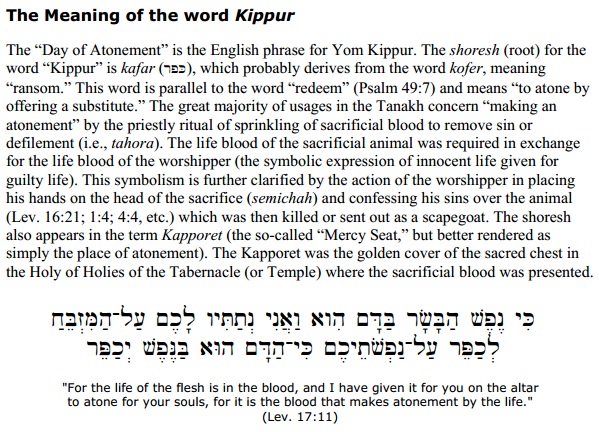
Secondly, atonement doesn’t allude primarily to “covering,” but rather an exchange:
(Ibid).
Therefore, the idea of a “limited atonement” makes no sense at all. First of all, the limitation would only pertain to Israel. Secondly, in regard to Calvin’s overall soteriology, “covering” is only a plausible rendering of atonement; covering versus exchange must be weighed in the balance. In Calvinism, a covering over of our wickedness by the righteousness of Christ is feasible, but what about an exchange of death for life, and sin for righteousness? In the end, what is the passing from death to life? (1Jn 3:14). If we are only covered and not changed, that must be interpreted as mere realm transformation that is only experienced, or the allegory of choice that fits a preferred presupposition.
It’s ironic, even camps that reject the Calvinist label buy into the Calvinist idea of atonement. More buy into the idea that Christ had to keep the law for us. Even more buy into the idea that we are merely covered and not changed: “We are all just sinners saved by grace.” “When God looks at us, He only sees Christ.” We have all said these things.
This is a fundamental misinterpretation of the law’s relationship to grace. And that must change; we mustn’t be on the wrong side of the law.
paul

 Paul's Passing Thoughts
leave a comment