Christianity and Islam: The Pot Calling the Kettle Black?
Originally posted March 10, 2014
Many relate to my personal testimony; despite my best efforts, I have been for the most part at odds with church. Julia Duin noted in her book Quitting Church that she has always sensed that something is fundamentally wrong with the Evangelical church.
I wonder if that mysterious fundamental reason has come to light. Note this statement by Al Mohler, arguably the most influential Evangelical of our day:
Niebuhr’s fifth model is where he seems to be pointing us, that is, to Christ the transformer of culture. These are the conversionists, and they are far more hopeful than the dualists. They understand the distinction between Christ and the culture, but they also understand that it is the mission of the church to transform the culture with the claims of Christ. We continually hear this kind of language: “Let’s go out and redeem the culture. Let’s go out and conquer the culture in the name of Christ. Let’s transform every dimension of the culture, whether the media and the arts, or business and finance, and let’s subdue them to the claims of Christ. Let’s have a more Christian military and a more Christian realm of arts.” This leads to a very progressive impulse, one which looks to a better world and a better condition if we will only do this. It promises transformation, hopes for cultural redemption, and leads to Christian activism. (Preaching the Cross: chapter 3, subheading; Niebuhr’s Treatment of Christ and Cutler, Niebuhr’s fifth model).
What a minute. Is this not the exact same vision as Islam? Moreover, do Muslims understand this better than most Christians? When Christian missionaries travel abroad, are they perceived this way whether they know it or not? When we hear of Christian missionaries being murdered or detained for “conspiracy to overthrow the state,” we immediately assume that’s a crock. Well, maybe not when you consider what the Crusades were all about coupled with this contemporary dominion mentality among leading Evangelicals.
Furthermore, Al Mohler is far from being the only one propagating these ideas. This same idea is the theses of Paul David Tripp’s book Broken-Down House. Many examples could be given, but I will not belabor the point past the following notation by blogger Joel Taylor:
While filming a promo in Dubai (UAE) for the new student missions conference, CROSS, John Piper (standing in front of the Burj Khalifa tower) makes this statement:
“And that tower and this city are coming down!”
Was that a wise thing to say while standing on United Arab Emirates soil? I wonder how the Arab people would understand his remark if they saw this?
It probably wouldn’t surprise them. The American church was founded on the Reformation, and many of its European stalwarts had their own standing armies. And ok, we have much spiritual tyranny and a divine right of kings mentality in the church today; ya think? If they muse about bringing down the Burj Khalifa tower what do you think they will do to you if you ask too many questions?
So this explains everything. It’s really not about the gospel. It’s not about making disciples, it’s about globalism. Making “disciples” is not the primary goal, it’s only a small part of a much larger vision. The whole idea that people can only find salvation in the “local church” is the ploy that funds the global vision while Christians believe it’s about the gospel. We are encouraged to bring people to church to get them saved for that very reason. It also brings to mind all of the hoopla about “lone rangers” who are not “under the authority” of a local church.
Do I think this clarifies the mission of home fellowships? Absolutely. Do you want to make disciples? Or do you want to fund world dominion? Christ’s mandate to the assemblies was to make as many disciples as possible before Christ returns. Why? Because He is not calling on Christians to renovate the earth—He is going to come back and blow up the whole thing and start over.
This is a short post, but one that opens up a very wide avenue of considerations. “There is no perfect church”: that’s not the issue; the issue is the fundamental mandate. That’s not merely a question of perfection, but the difference between eternal investment or a complete waste of time and money.
paul
Ground Zero: Pope Gregory and New Calvinist Gospel Contemplationism
 Originally published December 13, 2012
“Monks. That’s what we are missing here. Martin Luther. Ever heard of him? He was a monk.”
“In that Disputation, Luther postulates Pope Gregory’s take on the gospel which is the exact same calling card of present-day New Calvinism.”
“Powlison points to Pope Gregory and Augustine as the pioneers of biblical counseling using a ‘Christ-centered,’ ‘full gospel’ approach. And what was that approach?”
Let’s just take one contemporary example: a Presbyterian church that is now a mere shell of what it was; the remains of a war over the arrival of a New Calvinist pastor who exhibited outrageous behavior and leadership style. Today, some parishioners stand dumbfounded that the Presbytery took positive steps to keep said pastor in place.
As TANC, our newly formed think tank that researches Reformed theology continues to journey into church history for answers, the reasons for present-day tyranny in the church become clearer every day. First, it is driven by the gospel that founded the Reformation. Simply put, it is a gospel that does not believe that people change, but are rather called to contemplate the saving works of Christ in order for His righteousness to be manifested in one of two realms. Whether Baptist, Methodist, or whatever, this Reformed seed, the idea that people really don’t change is at the core of their function though they would deny it verbally. The Western church as a whole buys into this basic concept.
Secondly, the basic concept of spiritual elitists ruling over the totally depraved. You know, the they really can’t change crowd. The Reformation clarion call of total depravity—what’s our second clue if we need one? The spiritual is accessed through the chief contemplationists, and since they have the dope directly from God, they should rule over the totally depraved. Look, I have been a Baptist since 1983, and this is how it works. Again, we wouldn’t verbalize that, but to some degree it is true of all Western denominations because we are the children of the Protestant Reformation. What were we protesting? Naughty philosopher kings; past that, not much.
If we don’t change, the church doesn’t either. Think about that. And we wonder why things are a mess. Apparent growth in numbers is being driven by something else other than a true gospel. And the Reformers deny that while pontificating total depravity. It is testimony to the depth of which this Protestant construct has dumbed down the average parishioner; i.e., the totally depraved change. And nobody blinks. The assumption is that total depravity only pertains to the unregenerate, but that’s not the case according to the Reformed gospel and its time for people to start doing the math on that. The “Nones” and the massive exodus from the evangelical church is taking place for a reason.
I’m not ready to declare Pope Gregory the Great the father of the Reformation and present-day New Calvinism just yet, but recent discoveries reveal some things that should be fairly obvious. We aren’t stupid, just trusting, and that needs to end. Christians need to take advantage of the information age and start studying for themselves as the Christian academics of our day refuse to be forthcoming. They didn’t forget to mention that sola fide is also for sanctification. They didn’t forget to mention the total depravity of mankind AND the saints. They didn’t forget to mention that the new birth is a realm and not something that happens in us—it’s deliberate deception because the Reformed gospel is “scandalous.” The totally depraved are not “ready” for what the enlightened class of philosopher kings understand. By the way, many seminary students will testify to the fact that they are told as much by their seminary professors. Seminaries are where you go to be certified for the purpose of ruling over the totally depraved in order to, in Al Mohler’s words, “save them from ignorance.” Sorry, I prefer to let the Bible and Google save me from ignorance. Thank goodness for the Gutenberg press.
Monks. That’s what we are missing here. Martin Luther. Ever heard of him? He was a monk. What is the very premise of monkism? It’s the idea that the spiritual is obtained by contemplationism. And monkism is not unique to the Catholic Church—it is the link from the Catholic Church to the ancient concept of mystic dualism. Though it pans out in various different ways, it’s the idea that matter is evil and spirit is good. In other cases, it holds to the idea that both good and evil are necessary to understand true reality. Good defines evil, and evil defines good. The more you understand both, the more “balance” you have in the universe. Then there is the goal to birth the spiritual into the physical through meditation/contemplationism. Like I said, there are many takes on the basic approach.
Monks believe that the physical or world realm is a distraction from the spiritual realm. In some cases, they believe that all matter is merely a form of the perfect, or spiritual. Hence, monasteries. Traditionally, monasteries have been clearing houses for the dope from God through contemplationism. And since they have the dope, they should rule the totally depraved for their own good. In some spiritual caste systems, the monks rule directly, in others like the Catholic Church, the monks are the Scribes and Prophets for the rulers; i.e., the Popes.
The fact that monkism would be part and parcel to any doctrine formulated by Martin Luther is a no-brainer. Mysticism is simply going to be a significant factor, and so it is with Protestantism. This becomes more apparent when you consider the core four of the Protestant Reformation: Martin Luther, John Calvin, St. Augustine, and Pope Gregory the Great. Luther’s 95 Theses was a protest against naughty Popes, but he was completely onboard with the Catholic caste system. When his 95 Theses resulted in the unexpected societal eruption that took place, he presented a doctrinal disputation to the Augustinian Order in Heidelberg. And don’t miss this:
In that Disputation, Luther postulates Pope Gregory’s take on the gospel which is the exact same calling card of present-day New Calvinism. In theses 27 of his Disputation, Luther states the following:
Thus deeds of mercy are aroused by the works through which he has saved us, as St. Gregory says: »Every act of Christ is instruction for us, indeed, a stimulant.« If his action is in us it lives through faith, for it is exceedingly attractive according to the verse, »Draw me after you, let us make haste« (Song of Sol. 1:4) toward the fragrance »of your anointing oils« (Song of Sol. 1:3), that is, »your works.«
There could not be a more concise statement in regard to the New Calvinist gospel. Deeds in the Christian life come from the same acts in which Christ saved us. Secondly, they are not our acts, but the acts of Christ applied to our Christian lives by faith alone. Thirdly, when the works of Christ are applied to our Christian lives by faith alone, it will always be experienced by the exhilarating emotions of first love—this is the mark of Christ’s active obedience being manifested in the spiritual realm through the totally depraved. We “reflect” the works of Christ by faith alone. Even John MacArthur has bought into this nonsense, claiming that obedience to the Lord is “always sweet, never bitter.” Francis Chan states that it always “feels like love.” And of course, poke John Piper’s rhetoric anywhere and this same monkish mysticism comes oozing out.
Moreover, Luther states this same concept from many different angles in his Disputation, and theses 28 is clearly the premise for John Piper’s Christian Hedonism.
No wonder then that New Calvinists of our day sing the praises of Pope Gregory. Here is what heretic David Powlison stated in an interview with Mark Dever’s 9Marks ministry:
Caring for the soul, which we try [try?] to do in biblical counseling, is not new. Two of the great pioneers in church history would be Augustine and Gregory the Great. Even secular people will credit Augustine’s Confessions as pioneering the idea that there is an inner life. Augustine did an unsurpassed job of tearing apart the various ways in which people’s desires become disordered. Gregory wrote the earliest textbook on pastoral care. He pioneered diverse ways of dealing with a fearful person, a brash and impulsive person, an angry person, an overly passive person. He broke out these different struggles and sought to apply explicitly biblical, Christ-centered medicine—full of Christ, full of grace, full of gospel, and full of the hard call of God’s Word to the challenges of life.
Powlison points to Pope Gregory and Augustine as the pioneers of biblical counseling using a “Christ-centered,” “full gospel” approach. And what was that approach? It was primarily contemplationism and dualism. In fact, Gregory practically saw “doing” as a necessary evil. In Roland Paul Cox’s Masters dissertation, Gregory the Great and His Book Pastoral Care as a Counseling Theory, Cox states the following:
The overall theme in Gregory’s dichotomies is balance. It is possible that this comes from Gregory’s own struggles in balancing his desire for the contemplative life of a monk versus his reluctant, but active, service as ambassador to Constantinople and pope.“The Regula Pastoralis was in large part devoted to describing how to reconcile the two types of life. He came to the conclusion eventually that while the contemplative life was the better and more desirable of the two, the active life was unavoidable, and indeed necessary in order to serve one’s fellow man.…There could be no better exemplar of the two lives than Gregory himself, but he would have been less than human had he not from time to time mourned the fact that so much of his time must be given over to the active at the expense of the contemplative” [Jeffrey Richards, Consul of God : The Life and Times of Gregory the Great (London ; Boston: Routledge & Kegan Paul, 1980), 57.].
Powlison, in true Reformed tradition, invokes the either/or hermeneutic, or the either cross story or glory story hermeneutic of Luther’s Disputation by suggesting that any denial of this “Christ-Centered” approach is a wholesale denial of an “inner life.” In other words, suggesting that doing something should be emphasized as much as contemplationism is paramount to denying that there is an inner life. Such statements by Powlison are indicative of his utter lack of integrity.
In addition, Gregory’s penchant for mystic dualism is seen in the same dissertation:
Gregory’s view of health revolved around balance. In Pastoral Care 34 dichotomies are given. For each one Gregory discusses how either extreme is detrimental. The following are a few examples of Gregory’s dichotomies: poor/rich, joyful/sad, subject/superiors, wise/dull, impudent/timid, impatient/patient, kindly/envious, humble/haughty, obstinate/fickly, and gluttonous/abstemious. Further, Gregory explains how certain traits although they appear to be virtues are in reality a vice. For example, in describing the dichotomy of impatient and patient, Gregory says the following about the patient: “…those who are patient are to be admonished not to grieve in their hearts over what they suffer outwardly. A sacrifice of such great worth which they outwardly offer unimpaired, must not be spoilt by the infection of interior malice. Besides, while their sin of grieving is not observed by man, it is visible under the divine scrutiny, and will become the worse, in proportion as they claim a show of virtue in the sight of men. The patient must, therefore, be told to aim diligently at loving those whom they needs must put up with lest, if love does not wait on patient” [Pastoral Care: pp. 109, 110].
In other words, self-control is a vice. Unless cross-centered love is mystically applied according to Luther’s Disputation (theses 28), the latter evil of self-control is worse than the former sin of being offended since such offences serve to humble us (LHD theses 21).
What goes hand in metaphysical hand in all of this is good ole’ ancient spiritual caste tyranny. As Cox further observes,
Shortly after becoming pope, Gregory wrote Pastoral Care. In addition as pope, he reorganized the administration of the papal states, he maintained papal authority in the face of encroachments from the Patriarch of Constantinople, he established links with the Frankish Kingdoms, and most importantly (for these English writers), he sent a party of monks, led by Augustine, to convert the Anglo-Saxons.
Gregory was very influenced by the Rule of St. Benedict and Benedictine monks who came to Rome after the monastery that St. Benedict founded was burnt. In some letters, Gregory calls his work Pastoral Rule. “There is every reason to assume that Gregory in conceiving the plan for Liber Regulae Pastoralis [Pastoral Rule] intended to provide the secular clergy with a counterpart to this Regula [the Rule of St. Benedict].
….This culture of rulers and emperors also helps explain why Gregory saw Pastoral Care and Pastoral Rule as one in the same. By modern day standards, Gregory would be considered overly authoritarian.
A culture of “rulers and emperors” had precious little to do with it, but rather ancient spiritual caste systems that answered the supposed preordained call of God to control the totally depraved. With the sword if necessary. While many of these systems were based on mythology prior to the 6th century, Plato systematized the idea and gave it scientific dignity. But his trifold theory of soul consisting of king, soldier, and producer called for a sociological counterpart that was a mirror image to fit the need. Sir Karl Raimund Popper, considered the greatest philosopher of the 20th century, fingered Platonism as the primary catalyst for religious and secular tyranny in Western culture. And Plato’s mystic dualism (shadows and forms) added not just a little to the MO of the Reformers. According to church historian John Immel:
Calvin’s Institutes (1530) is the formal systematic institutionalization of Platonist/Augustinian syncretism that refined and conformed to Lutheran thinking and became the doctrinal blueprint for the Reformed Tradition [Blight in the Vineyard: Prestige Publishing 2011].
Christ promised us that He would build His Church and the gates of hell would not prevail against it. The idea that the Reformers rescued His church from the gates of the Roman Catholic Church is both laughable and the biggest hoax ever perpetrated on mankind. The idea that Christ needed, and continues to need the services of Plato’s philosopher kings is arrogance on steroids. Somewhere, God’s church moves forward. Let us shed the Reformed load that hinders and find our place in that true church.
paul
The Truth About Predeterminism: A Historical and Biblical Evaluation
 Good evening and welcome to False Reformation blogtalk radio. I am your host, Paul M. Dohse Sr.
If you would like to join the discussion tonight and add to what we are learning, call 347-855-8317 and remember to mute the speakers on your laptop or PC. And by the way, the question or comment does not have to pertain to the subject at hand—it can be off-point.
I am very excited to share what my research has yielded since I began this ministry in 2006, working at it part time until April of 2010, and thereafter full time until now. Resources can also be found at tancpublishing.com.
Tonight we will be discussing the subject of predeterminism, otherwise known as God’s election or predestination. Now, I realize that election and predestination primarily speak to God preselecting who will be saved and not saved, while predeterminism deals with the wider spectrum of human events.
Let me set the table for tonight’s discussion. Starting out in Reformed beliefs can be simple enough. God preselected those who will be saved, and left the rest to their own devices. And, there seems to be Bible verses that state this plainly.
You might even believe that election and freewill are both 100% true. You might believe that this is a paradox. I heard Rick Warren tell John Piper that this is his position, since the Bible states both, both are equally true. You could also argue that paradoxes like this exist in science. Let me give you an example from Dr. Bo Grissom as stated in last year’s conference:
Consider, for example, the physics of light where two seemingly contradictory theories are used side-by-side to explain its different properties.
The wave theory is used to understand the oscillation aspects of light (e.g., Polaroid sunglasses), while at the same time the particle theory is employed to explain other applications (e.g., photoelectric solar panels). Although these two theories are totally incompatible, each provides useful information in certain technical applications.
To date, scientists simply use the appropriate theory as needed for a particular design problem. There is no worry about whether light actually exists as a wave, or as a particle, just because it is not yet fully understood. This same approach may be taken in the spiritual realm and is probably the best stance to take in dealing with the apparent contradiction between individual free will and God’s total sovereignty.
When we extend this God’s predeterminism from salvation to every aspect of life, we are not just talking about election and predestination, or whether one is a 1 or 2 or 3 or 4 or 5 point Calvinist, we are now talking about determinism or predeterminism. Hence, the word used in our title tonight. And this is where we must go because Protestantism was founded on hard determinism not soft determinism.
The Protestant tradition is based on Redemptive Historical hermeneutics. What’s that? It is the belief that every facet of human life is predetermined. It is the belief that reality and the state of being is a prewritten story or grand narrative written by God. This is known as metanarrative, or metaphysical narrative, or a grand metaphysical narrative. In regard to authentic Protestantism, all of history is a predetermined gospel, or redemptive narrative also known as the “divine drama.”
This is also the basis of mythology which is NOT superstition. Mythology is merely the most ancient and basic foundations of religion. It is the idea that a force, nature, cosmos, or personal God has prewritten history. The story, as it unfolds, is the state of being. The author of being is always an invisible force who manifests his/her being in the material realm.
Mythology in its various forms also has mediators between the invisible and material. These are elitist guides who have special insight into the invisible realm that cannot be understood by the general populous. Therefore, in order to guide the masses, priests, philosophers, or whatever you want to call them, explain truth to the masses in a way that they can understand it, namely, via a story.
For the most part, people in cultures don’t take the mythological stories literally, they understand that the guides are merely repackaging what they are unable to understand in a way that they can apply it to their lives. Ancient cultures were not stupid people driven by superstition; they understood the mythological narratives to be creeds and catechisms to live by that come from purer truths that only the guides can understand.
Superstition then, is an unreasonable understanding and application of the mythological narrative. That’s what superstition is. It may also include many personal quirks applied to the superstition as well.
So, from the cradle of society comes mythology, and its orthodoxy is metanarrative. This of course requires a spiritual and social caste system or a empirical pecking order. This is why Hinduism is the most ancient of religions—because mythology is the most ancient of religions.
In this ancient construct, everything is predetermined in the story written by the force or personal God, and life is ONLY experienced. It’s like standing in the rain. You feel the rain, you experience the rain, but you have no control over the rain—the rain is a story that you only experience—your part in the narrative is only experienced.
In Hinduism, which is the best example, the spiritual strata is Bhramin, Kshatryia, Vaishya, Sudra, and Untouchables. But listen very careful to what Karma is in Hinduism. THIS IS KEY. I am citing Swami Bhaskarananda: Chapters IX to XI from the book “The Essentials of Hinduism,” Heading; “Predestination”:
Karma is the infant stage of Hinduism where saints believe they are responsible for their own actions, but as growth moves forward, the mature saint…
He becomes convinced that God has been doing everything by using his body, mind, energy and the senses. He feels that he is only an instrument in the hands of God, and whatever God has been doing to him is for his ultimate spiritual good. At this high level of spirituality the doctrine of predestination becomes the only valid doctrine to him. To him the doctrine of karma ceases to be a valid doctrine.
Therefore, these two doctrines, even though apparently contradictory to each other, are valid for people at different stages of spiritual growth.
Hang on to all of this as we are going to plug it back in later. This will all come together for you as we progress.
At this juncture, I am going to inject another key term: the total inability of man. Can we state anything other than the obvious fact that Hinduism representing the foundation of ancient religion is one soul with the total inability of man? Absolutely not.
When I first became a Christian, I was, I guess what you would call Arminian. I only borrow the term to make a point because Christianity is not either Calvinism or Arminianism, that’s perhaps the biggest red herring of all time.
I was later persuaded into believing what is often referred to as sovereign grace. Or, election. I was never crazy about it though I believed it to be true. To me, there were certain Bible verses that made individual election unavoidable.
Fast forward to the TANC Research era. When my research found that Protestantism was founded on the false gospel of progressive justification, I pretty much deemed the election issue as a diversion from the real issue of the gospel, and pronounced the election issue irrelevant.
I then adopted the aforementioned paradox view and stuck it in my back pocket. I am not going to take the time tonight to discuss why I decided to revisit the issue, but I did. And here was my approach:
I found the issue of law and gospel to be very definitive in the Bible, what I call “theological math,” and assumed that a deeper and deeper objective understanding of law and gospel would lead to more understanding of the more subjective and mysterious biblical issues. What we know are building blocks to what we don’t know. If not, conclusions are merely leaps in logic.
Deuteronomy 29:29 makes it very clear that there are things we are responsible for knowing and doing, but to some degree we are not going to understand everything. BUT, we also need to milk the objective cow for all we can get out of it. You stick with what you know positively and see where it leads you.
And here is where I have been led: I believe freewill is a metaphysical pillar. I believe it is one of the major tenets of being. I also believe that it better answers the more difficult questions such as, “Why did God allow sin into the world?” That is, if He did in fact allow it—we must remember that is a presupposition. God is not limited in any way by perceived attributes. Example: God is omniscient, but does that mean God in unable to not know something because of His omniscience? What if God doesn’t want to know something? Is He UNABLE to not know?
I have come to believe God did not elect individuals, but rather elected the means of salvation which includes people groups and Christ Himself. I believe God is sovereign and intervenes in the freewill affairs of men to guarantee predetermined outcomes which DOES NOT include every detail of life and history.
The Bible says that God created hell for the Devil and not man; therefore, men go to hell because they choose to go there against God’s desired will. Though the fall caused man to be ashamed and hide from God—God seeks him out and reasons with him.
This brings us to some very important reasons to consider the truthfulness of predeterminism. First, the primary pundit of predeterminism is the Protestant tradition. As we discussed prior, Protestantism is the false gospel of progressive justification. Therefore, predeterminism is fruit from the poisonous tree.
Secondly, and most importantly, the Reformed tradition has made the sovereignty of God the gospel itself. Don’t miss this; note this term: “sovereign grace.” We must understand that sovereign grace is a specified gospel. It is a soteriology or doctrine of salvation—please don’t miss this. Individual election is not a separate issue from the death, burial, and resurrection of Christ according to the Reformed camp.
A key concept of sovereign grace is the total inability of man. In 2008, Calvinist John MacArthur stated the following at a conference:
The doctrine of human unwillingness and inability is perhaps the most attacked doctrine wittingly or unwittingly. The idea that sinners are completely helpless to redeem themselves or to make any contribution to that redemption from sin and divine judgment is the most attacked because in the big picture, it is the most despised doctrine.
Consequently, it is the most distinctively Christian doctrine, contrary to all non-Christian views of men. All religions in the world are some form of a works righteousness system. And at the foundation of all those religions other than the true faith in the true gospel is the idea that people can be good and good enough to contribute to their salvation, to somehow merit favor with deity and a happy after life.
Because this is the universal foundational doctrine of all false systems of religion, it is therefore the most – because, I should say, the opposite of it is the foundation of all these religions, it is therefore the most attacked Christian doctrine. It is distinctively Christian because it affirms the absolute inability of man to do anything to contribute to his salvation.
That’s a crock. What MacArthur said is the well-traveled narrative and historical motif, but the exact opposite is true. The carte blanche religiosity most prevalent in all of human history is determinism. This has always been true in the secular realm as well. In the secular realm it is known as freewill skepticism. Somebody sent me a great video on this a couple of days ago and I found it most fascinating.
But look, mankind has been so saturated with a propensity towards determinism that its philosophical truisms pepper our speech. Quote, “Don’t tempt fate.” “It’s our destiny.” In sports: this team or that team is a “team of destiny.” “Oh well, I guess it just wasn’t meant to be.” One of the biggest hits ever was Doris Day’s Que Sera, Sera (Whatever Will Be Will Be). In 1964 you couldn’t go anywhere without hearing that song.
So, like the video I was sent the other day, MacArthur who I think represents the general mentality well is proffering the idea that freewill skepticism is counter intuitive—historically, the exact opposite is true. Calvinism is an extremely old shoe. It’s just a chip off the old block of ancient mythology—it follows that tradition.
So, freewill skeptic philosophers as well as Calvinists talk often about free will’s relationship to “American individualism.” And this is the next step to our discussion: determinism goes hand in hand with collectivism, and freewill goes hand in hand with individualism. Let me explain how this works.
If whatever rules the universe in the invisible realm has representatives or mediators in the material realm, that means the majority of humanity cannot know reality. The other alternative is what got Socrates executed. He taught that truth was intuitive to everybody and leveled the playing field which was a really bad idea because only 10% of the population made up the ruling class.
Therefore, his understudy Plato had to get out of Dodge and become a foreign exchange student for a while, but he studied in India and came back to Athens with a much better idea: the philosopher kings are able to obtain the gnosis and teach it to the masses, the warriors inforce the dictates of the philosopher kings, and the sole purpose of the masses is the collective good.
This was never more or less than Plato’s version of the Hindu caste system. The value of an individual is based on their ability to contribute to the common good as judged by the philosopher kings and enforced by the warriors if necessary.
Where did the crux of this system begin? In the garden with the serpent and Eve. The serpent, in essence said, “Eve, you aren’t able to correctly ascertain what God really said, you need me, a spiritually superior being, to properly interpret what God really said.” That’s where all of this starts. It worked well in the garden, why in the world would the construct ever change, right? This also makes mediators the obvious shoe-in for social engineering or societal wellbeing.
Now we have to figure out who the mediators are, right? How do we figure that out? Who is to say? That’s where predeterminism comes in as well. The mediators are always preordained by God before the foundation of the earth. This goes hand in hand with the social class strata.
Social classes determine who the rulers are, the warrior class, and the artisans. It becomes a matter of lineage or pedigree. And as you know, this has never changed in many, many cultures. In many cases upward mobility is forbidden.
Traditionally, collectivism, again, the idea that the worth of an individual is determined by ability to contribute to the common good, is the doctrine that is always associated with determinism and its spiritual caste. The preordained mediators keep the masses in tune with good karma. Immature citizens think they can actually control their fate, while the wiser artisans and producers know that whatever force they worship is completely sovereign. Hey, if the force didn’t want that philosopher king in power, he or she wouldn’t be in power. And of course, some cultures take it a step further and deem the rulers as the actual material manifestations of a god or several gods. Examples of this would be Japanese emperor worship during WWII and the Pope (the “Holy Father” of the Catholic Church).
I am going to pause here and mention how these ancient traditions show up in the contemporary Protestant church. The president of Southern Seminary, Al Mohler, stated at a conference in Florida that pastors are God’s appointed preordained ministers to save His people from ignorance. That’s what he said. In the Puritan tradition, upward mobility was considered a violation of the fifth commandment because it didn’t honor the social class you were born into. Folks, this is all the same stuff! A book written by Calvinist Paul David Tripp, How People Change, is a 200 + page treatise on how to become part of God’s metaphysical divine drama. You are not in control of anything, you just need to be able to see the world through eyes of faith; i.e., all of life is the unfolding of a preordained redemptive narrative (see endnote at end of transcript).
In addition, Calvin’s three-fold election construct that we discussed last week is identical to the election doctrine of Gnosticism, a later version of Neo-Platonism. The hylic coincide with Calvin’s non-elect, the psychic are the partially initiated, or temporarily illumined, and the pneumatic are the fully initiated or Calvin’s lot that persevere till the end. This is all the same stuff.
Now, we are getting ready to close the first segment so anyone wanting to call in can start ramping up while I finish the first segment with individualism which is mostly identified with freewill. Individualists commonly believe that they do not need a mediator to understand God or reality. Secondly, individualists would reject predeterminism out of hand. Thirdly, they would reject social caste out of hand and deem it as tyranny. Fourthly, they believe happiness is found in accomplishment and would reject anything that hinders upward mobility. Fifthly, they would reject total inability.
However, individualism is what is counter intuitive. Individualism is a unique American experiment which finally happened after man suffered unspeakable misery for 10,000 years at the hands of collectivism. EVERYONE agrees that there has never been a country like America in the history of the world. Well, why not? Why did it take so long? Because individualism is not our natural bent—collectivism is. No? After all of the mass graves and misery amassed by collectivism, why are politicians worldwide still hell-bent on implementing it?
Ever heard of the tower of babel? We wouldn’t even have the individualism that we have now unless God confused the languages. Man was continually commanded by God to spread out, fill the whole earth and subdue it. What did they do? They all gathered in a Hindu huddle at the tower of babel.
That’s the first segment. Conclusion: Calvinism is far from being unique. It’s just the same old warn-out collectivism that has been wreaking havoc on mankind since the garden. Determinism is nothing unique, the total inability of man is not unique—IT’S ALL THE WORLD HAS EVER KNOWN UNTILL AMERICA CAME ALONG. Status quo religious books like the Quran are saturated with the idea of predeterminism from the front cover to the back cover. I could go on and on with example after example.
Segment 2
What about the gospel of sovereign grace? This is a gospel that is defined by predeterminism. Apart from predeterminism, all gospels are deemed false—it must have the determinism element. Freewill is tantamount to a false gospel because it leaves room for man to have a role in the salvation “process” that supposedly starts with beginning justification which is experienced subjectively and ends with final justification. It’s a process of salvation instead of the finished work of salvation being applied to the specific point in time when a person believes the gospel. The life of the born again believer now becomes part of the salvation “process.”
Supposedly, saving faith can ONLY ASK to be part of the salvation process via John Calvin’s Sabbath rest where we must rest from our works because the same gospel that saved us also sanctifies us. We must rest from our works in the Christian life because it is now part of the process. Accordingly, no saint can know positively if they are the called class of elect, or the class that perseveres. Again, this is akin to the Gnostic election classes of hylic, psychic, and pneumatic. The called, like the psychic, are temporarily or partially illumined and have no way of knowing whether or not they will persevere until the end. Assurance is clearly ambiguous.
This is authentic Protestantism’s definition of saving faith. Ability to choose in any part of the salvation process is tantamount to the ability of man and therefore akin to works salvation. Not unlike spiritual maturity in Hinduism, as the good Protestant grows spiritually, he/she realizes more and more that they have no real role in the salvation process, but only experience God’s prewritten metaphysical narrative. Spiritual growth is defined by a progression from soft determinism to hard determinism.
In the Protestant “gospel of sovereign grace,” soft determinism is the minimal requirement because having freewill is tantamount to the ability to choose which is considered works salvation. Individuals then grow into their final salvation by evolving into hard determinism. This is by no means unique, but very prevalent among the world’s religions including movements like radical environmentalism.
Do Calvinists believe in total inability? Well, many environmentalists believe the very existence of man is detrimental to the earth!
Hard determinism is comfortable with the idea that there is no assurance of salvation which of course is a direct contradiction to the book of 1John. As far as the Reformed stating this in no uncertain terms, chapter 5 of It’s Not About Election is chock-full of citations from Calvin, Luther, and contemporary Calvinists like John Piper.
However, there is a get out of fate free card, right? What is it? The Reformed power of the keys. Simply stated, if you are a member of a Reformed church and you obey the elders and they like you, if you “humbly” put yourself under their authority with issues of error being beside the point—YOUR’RE IN because whatever they bind on earth is bound in heaven and whatever they loose on earth is loosed in heaven. Do you want to go to heaven? Well then, keep your mouth shut and put your money in the plate.
Now, back to this sovereign grace gospel and the next point about it—it makes God’s sovereignty paramount to the gospel and not God’s love. If man has a choice, or freewill which speaks to ability, this would violate God’s attribute of sovereignty. It would deny God is sovereign in all matters of life and being. In other words, God’s sovereignty and freewill are mutually exclusive. Beside the point that this again limits God because of an attribute assigned to Him, the stated biblical cause of God saving the world because of love is changed to God saving the world because of His sovereignty.
This also posits the idea that sin came into the world because of God’s sovereign will and not His permissive will. The unavoidable conclusion also posits the idea that sin coming into the world was God’s desired will. In contrast, God may have chosen not to know anything about what would come out of freewill as a creative principle. The Bible never states that God knew sin was going to come into the world and decided to permit it for some reason. The Bible states that sin was “found” in Satan at some point (Ezekiel 28:15).
Built-in inherent weaknesses or propensities are not part of God’s creation. Rather, God’s attribute of freewill assumes good results because all that God creates is good. Obviously, Lucifer and Adam were created with freewill, but nevertheless, freewill is not the problem. Reformed soteriology makes freewill synonymous with sin, and makes any kind of ability sin as well.
Many in the Reformed camp deny that they believe God’s sovereignty and freewill are mutually exclusive, but total inability assumes freewill is both impossible and sinful, so they cannot have it both ways. In their minds, man is only free to sin because freewill itself is sinful.
In reality, and according to the Bible, God is capable of being sovereign, but often chooses not to be. Again, he is not limited by any of His own attributes. God flexes His sovereignty in electing outcomes (sovereign will) and keeping promises through intervention, but at times chooses not to be sovereign. There are numerous examples of this throughout the Bible.
The Bible also documents cause and effect throughout. The Bible documents God’s intervention to prevent outcomes caused by the actions of men. The Bible also documents God’s active will, passive will, and permissive will. Cause and effect is also described in context of promises and incentive; if a person does this, God promises He will do that.
Hence, the gospel of God’s sovereign grace logically turns the Bible completely upside down if you interpret it grammatically, and that’s the point. Authentic Protestant tradition does not interpret the Bible literally, but according to a metaphysical redemptive story. Reality is a prewritten metaphysical narrative. This is nothing new—it’s the same old song and dance that’s been going on since the tower of Babel.
Really, what it does, if you really think about it—it makes the literal full counsel of God secondary, and the good news of Protestant authority primary. That’s one reason why incessant theological debate in evangelical circles is acceptable—it’s all theater—if you obey your elders and put your money in the plate you’re going to heaven anyway!
Why, for years, have you stood befuddled in regard to what evangelical elders can get away with saying and doing in the church? Because it’s really about the good news of Protestant authority and nothing more or less.
We are going to close tonight in the book of Genesis. I think we see what effect sin had on man; it made man ashamed and caused him to hide from God. Then we see God seeking man out and confronting Him. Shame does not equal total inability.
And this also affects evangelism. It is our role to seek others out on behalf of God. Why has evangelism always been so anemic among Protestants? This is why: Protestants have been taught that man is not only ashamed, but totally depraved with no ability to choose God once he/she is persuaded by the preaching of the word. The incentive to evangelize is not to see people saved, but to glorify God in both death and life. It is a mere proclamation that glorifies God either way, not an attempt to persuade. God is glorified when people are saved because he chose them, and God is also glorified when people reject the gospel because their greater damnation also glorifies God.
In the same aforementioned conference, John MacArthur referred to this idea of glorifying God in evangelism as a “savor of life to life and death to death.” Either way, it is a “savor” unto the Lord. This idea is not only a disincentive; it’s not biblically true and will therefore not find the Holy Spirt cooperative. MacArthur also stated in the same message that “total depravity or unwilling and unable [is]…a gospel theme.” Again, we see God’s sovereignty and man’s inability as foundational to the gospel, not God’s love.
In fact, many Calvinists argue that any gospel presentation that contains a reference to choice is a false gospel. The gospel is to be presented and the results left to God for His glory. If a person asks, “what shall we do?” they are to be told that they can only ask and hope for the best, but God will be glorified either way.
Also, in the same message, MacArthur stated:
The Spirit and the Son are in agreement that this work is a work of divine, sovereign power. And then, of course, we commented earlier, reading John 6:44, “No one can come to me unless the Father who sent me draws him.” John 8:36, “If the Son shall make you free, you shall be free indeed.” It’s the work of the Son. It’s the work of the Spirit. It’s the work of the Father who draws. In none of these texts, by the way, did Jesus defend the sinner’s ability. In none of these texts did Jesus defend free will. Yes, the sinner has will, and his will is activated by the Spirit in the work of salvation, but his will is not free.
Problems with this view follow: Jesus also said that He would be lifted up in order to draw ALL men to Himself (Jn 12:32). The Spirit also convicts men of sin and the judgment to come (Jn 16:8)—the Spirit works with us in evangelism.
God sovereignly elects the means of salvation and the final outcome of world history, but he does not elect individuals. When saints are called elect, it refers to their identification with a group or purposes elected by God, not the individual per se.
God elected salvation for all men, and the plan of salvation clearly includes an invitation to all of mankind. God sends His Spirit to convict and warn all men while God’s people proclaim His gospel from the word. The goal of evangelism is to “persuade” men to believe the word of God. Faith comes to men through this joint effort between the Spirit and God’s people. The new birth, or regeneration, then comes by faith (Rom 10:17, Gal 3:5).
In contrast, proponents of the gospel of sovereign grace must implement tenets like limited atonement and total depravity to make their case. Many of these tenets are blatant contradictions to the plain sense of Scripture.
And, in regard to Hindus claiming that all religions really agree with them unawares, they just may have a point.
Endnotes
Examples abound. A placard published on Facebook read, “All of your days have been written in God’s book. When you go through disappointment, don’t stop on that page. Stay the course. Keep believing. You may be tired, discouraged and frustrated, but don’t give up on your future.”
Even the late conservative evangelical Adrian Rogers once stated in a sermon:
“When you are surrendered to the will of God, focused on the Word of God, then the Holy Spirit begins to pray in you and through you. He energizes, motivates, and guides your prayer. One of the greatest lessons I’ve learned about prayer is this: the prayer that gets to Heaven is the prayer that starts in Heaven. Prayer is the Holy Spirit finding a desire in the heart of the Father, putting that desire in our heart, then sending it back to Heaven in the power of the cross. The prayer that gets to Heaven is the prayer that starts in Heaven. Our part is just to close the circuit” (online source: http://www.oneplace.com/ministries/love-worth-finding/read/articles/prayer-and-the-will-of-god-11630.html).
You can add to that a sermon by Dr. Devon Berry entitled, How to Listen to a Sermon in which he posits the idea that there is no such thing as edifying personal Bible study. The only thing that counts for receiving progressive grace is sitting under the preaching of elders because they get the word from God in the same kind of cycle described by Rogers. Berry is the chairman of the elders at Clear Creek Chapel in Springboro, Ohio which is a training center for the Christian Counseling and Educational Foundation which controls at least 90% of the biblical counseling going on in the evangelical church.


Destroying Eve-il is a Reformed Family Tradition: Today Danvers, Tomorrow the Gallows
Originally published August 1, 2012
Great pizza party last night with an author who is writing a sci-fi novel. As I sat and listened to him share his shocking plot designed to invoke terror in his future readers, my recent research for “Reformation Myth” made the chilling plot seem mundane in comparison to sexy witches being hung, burned, and impaled with images of Mary fitted with large spikes.
On the one hand, the Reformers were supposedly brilliant for recognizing Plato’s theory that pure truth and beauty is immutable, while on the other hand, their brutality was merely the “mentality of the age.” It is also understandable why Reformed folks are so big on, “all truth is God’s truth” because the Catholic church had a lot of ideas that the Reformers thought were pretty cool; specifically, that because of Eve, women in general are predisposed to evil, or Eveil.
Between sips of mocha that could barely be executed because of my fixated attachment to the narrative, the little angel on my right shoulder kept saying, “Excuse me, this is history, and it really happened.”
Indeed it did happen, and the war declared on witches by the Catholic Church and the Reformers resulted in casualties that surpass many, many wars waged throughout history. And, to say the least, the due process of law that determined who was a witch was, well, shall we say, a little lean. Since it was thought that 90% of all witches were women, if you were a woman, and dragged into court, your gender was a bad start to the process. In at least one case, a particularly pious woman didn’t even take her arrest seriously and was sarcastic towards her accusers—who later executed her. I guess there is only one thing worse than a witch—a sarcastic woman. Then, there was this also:
The climate of fear created by churchmen of the Reformation led to countless deaths of accused witches quite independently of inquisitional courts or procedure. For example, in England where there were no inquisitional courts and where witch-hunting offered little or no financial reward, many women were killed for witchcraft by mobs. Instead of following any judicial procedure, these mobs used methods to ascertain guilt of witchcraft such as “swimming a witch,” where a woman would be bound and thrown into water to see if she floated. The water, as the medium of baptism, would either reject her and prove her guilty of witchcraft, or the woman would sink and be proven innocent, albeit also dead from drowning (Helen Ellerbe: The Dark Side of Christian History,Chapter Eight: 1450 – 1750 C.E.).
It all started with the Catholics first, and the Reformers later joined the campaign that supplemented the inquisition:
Pope John XXII formalized the persecution of witchcraft in 1320 when he authorized the Inquisition to prosecute sorcery. .” Thereafter papal bulls and declarations grew increasingly vehement in their condemnation of witchcraft and of all those who “made a pact with hell.” In 1484 Pope Innocent VIII issued the bull Summis desiderantes authorizing two inquisitors, Kramer and Sprenger, to systematize the persecution of witches. Two years later their manual, Malleus Maleficarum, was published with 14 editions following between 1487-1520 and at least 16 editions between 1574-1669. A papal bull in 1488 called upon the nations of Europe to rescue the Church of Christ which was “imperiled by the arts of Satan.” The papacy and the Inquisition had successfully transformed the witch from a phenomenon whose existence the Church had previously rigorously denied into a phenomenon that was deemed very real, very frightening, the antithesis of Christianity, and absolutely deserving of persecution.
It was now heresy not to believe in the existence of witches. As the authors of the Malleus Maleficarum noted, “A belief that there are such things as witches is so essential a part of Catholic faith that obstinately to maintain the opposite opinion savors of heresy.” Passages in the Bible such as “Thou shalt not suffer a witch to live” were cited to justify the persecution of witches (Ibid.).
The following gives us an idea as to the extent that this was going on:
Contemporary accounts hint at the extent of the holocaust. Barbara Walker writes that “the chronicler of Treves reported that in the year 1586, the entire female population of two villages was wiped out by the inquisitors, except for only two women left alive.” Around 1600 a man wrote:
Germany is almost entirely occupied with building fires for the witches… Switzerland has been compelled to wipe out many of her villages on their account. Travelers in Lorraine may see thousands and thousands of the stakes to which witches are bound (Ibid.).
The general mentality of the Eveil motif was part and parcel with the war on witches:
The witch hunts were an eruption of orthodox Christianity’s vilification of women, “the weaker vessel,” in St. Peter’s words. The second century St. Clement of Alexandria wrote: “Every woman should be filled with shame by the thought that she is a woman.” The Church father Tertullian explained why women deserve their status as despised and inferior human beings:
“And do you not know that you are an Eve? The sentence of God on this sex of yours lives in this age: the guilt must of necessity live too. You are the devil’s gateway: you are the unsealer of that tree: you are the first deserter of the divine law: you are she who persuaded him whom the devil was not valiant enough to attack. You destroyed so easily God’s image, man. On account of your desert that is, death even the Son of God had to die.”
Others expressed the view more bluntly. The sixth century Christian philosopher, Boethius, wrote in The Consolation of Philosophy, “Woman is a temple built upon a sewer.” Bishops at the sixth century Council of Macon voted as to whether or not women had souls. In the tenth century Odo of Cluny declared, “To embrace a woman is to embrace a sack of manure…” The thirteenth century St. Thomas Aquinas suggested that God had made a mistake in creating woman: “nothing [deficient] or defective should have been produced in the first establishment of things; so woman ought not to have been produced then.” And Lutherans at Wittenberg debated whether women were really human beings at all. Orthodox Christians held women responsible for all sin. As the Bible’s Apocrypha states, “Of woman came the beginning of sin/ And thanks to her, we all must die”(Ibid.).
And the Reformers were completely onboard with the Eveil rage of that Day:
St. Augustine of Hippo (354 to 430 CE). He wrote to a friend:
“What is the difference whether it is in a wife or a mother, it is still Eve the temptress that we must beware of in any woman……I fail to see what use woman can be to man, if one excludes the function of bearing children.”
Martin Luther (1483 to 1546):
“If they [women] become tired or even die, that does not matter. Let them die in childbirth, that’s why they are there.”
St. Thomas Aquinas (1225 to 1274 CE):
“As regards the individual nature, woman is defective and misbegotten, for the active force in the male seed tends to the production of a perfect likeness in the masculine sex; while the production of woman comes from a defect in the active force or from some material indisposition, or even from some external influence.”
But the Reformers did way more than stand on the sidelines and cheer. When doing a pdf document search on Witch Hunts In Europe And America, An Encyclopedia by William Burns, “Calvin” got 32 hits including the following:
There are about five hundred recorded witch trials in the 150 years after Calvin’s arrival in Geneva. Given the high rate of survival of Genevan records, this probably represents the majority of cases that occurred. The witch-hunt in Geneva peaked relatively early, in the 1560s and early 1570s. The records show that, outside the witch-hunt of 1571, Geneva had one of the lowest rates of execution in Europe, about 20%. Geneva magistrates seem to have used banishment as an alternative to execution in cases where the guilt or innocence of the subject was in doubt, rather than following the practice of other areas which simply tortured until a confession was obtained. The relatively mild torture practiced by the Genevans kept individual witch cases from developing into large hunts, and in some cases the magistrates were uninterested in following up accusations even when an accused witch named others…
The comparatively small kingdom of Scotland, whose legal system blended English and Continental elements, had from the mid-sixteenth century on a zealous Calvinist clergy intent on creating a godly society. It executed the most witches of any British region. The other British area of high witch-hunting activity was the legally anomalous Channel islands….
William Perkins was Elizabethan England’s leading Calvinist theologian, and his posthumously published A Discourse on the Damned Art of Witchcraft (1608) had an unrivalled influence on subsequent Puritan demonologists in old and New England. Perkins’s approach was intellectually austere. He shunned reference to previous demonologists or actual cases of witchcraft, and based his argument almost entirely on the Bible, particularly Exodus 22.18, “Thou shalt not suffer a witch to live.” Perkins saw the essential nature of witchcraft as the making of the satanic pact, or “covenant,” which inverted the covenant relation between God and his elect that was basic to Puritan Calvinist theology. So closely does Perkins relate the witch’s contact with the Devil to the good Christian’s contact with God that he claims that to deny the possibility of physical contact with devils would be to deny the possibility of covenant with God. Perkins describes the making of the covenant as a simple agreement, without the necessity for the witch to sign in blood or kiss or have sex with the Devil. Other central aspects to the witch stereotype as the sabbat or the Devil’s mark he also ignored. Even maleficia played a minor role. Perkins’s principal target was not the maleficent witch, but the “good witch,” whom he described over and over as even more worthy of death than the evil witch. Perkins believed that all power to perform “magic” could only come from Satan.
William Perkins was the elder statesman of the very same Calvinist Puritans that boarded the Mayflower and landed on Plymouth Rock. John Robinson, their pastor and follower of Perkins, gave an impassioned speech to them before they boarded the ship. The Pilgrims, who were really political refugees, set up a Geneva style Calvinistic theocracy known as the American Colonies and was the spawning grounds for colonial Calvinism.
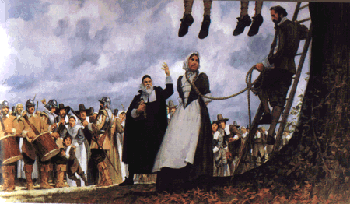
Go figure, not long after, in Salem Town and Salem Village, the infamous Salem witch trials occurred. The Puritan Cotton Mather was heavily involved and attended the execution of Salem Town’s pastor, George Burroughs, who was accused of aiding and abetting a covenant of witches. An actual account of the sad proceedings follow:
George Burroughs was executed on Witches Hill, Salem, on the 19th of August, the only minister who suffered this extreme fate.
Though the jury found no witches’ marks on his body he was convicted of witchcraft and conspiracy with the Devil. While standing on a ladder before the crowd, waiting to be hanged, he successfully recited the Lord’s Prayer, something that was generally considered by the Court of Oyer and Terminer to be impossible for a witch to do. After he was hung, Cotton Mather, a minister from Boston, reminded the crowd from atop his horse that Burroughs had been convicted in a court of law, and spoke convincingly enough that four more were executed after Burroughs. Below is the original account as first compiled and published in 1700 by Robert Calef in More Wonders of The Invisible World pages 103-104, and later reprinted or relied upon by others including Charles Wentworth Upham and George Lincoln Burr,
Mr. Burroughs was carried in a Cart with others, through the streets of Salem, to Execution. When he was upon the Ladder, he made a speech for the clearing of his Innocency, with such Solemn and Serious Expressions as were to the Admiration of all present; his Prayer (which he concluded by repeating the Lord’s Prayer) was so well worded, and uttered with such composedness as such fervency of spirit, as was very Affecting, and drew Tears from many, so that if seemed to some that the spectators would hinder the execution. The accusers said the black Man [Devil] stood and dictated to him. As soon as he was turned off [hung], Mr. Cotton Mather, being mounted upon a Horse, addressed himself to the People, partly to declare that he [Mr. Burroughs] was no ordained Minister, partly to possess the People of his guilt, saying that the devil often had been transformed into the Angel of Light. And this did somewhat appease the People, and the Executions went on; when he [Mr. Burroughs] was cut down, he was dragged by a Halter to a Hole, or Grave, between the Rocks, about two feet deep; his Shirt and Breeches being pulled off, and an old pair of Trousers of one Executed put on his lower parts: he was so put in, together with Willard and Carrier, that one of his Hands, and his Chin, and a Foot of one of them, was left uncovered.
—Robert Calef
Now, in our day, and unbelievably, the proud children of this Calvinist legacy pronounce themselves the experts on “biblical manhood and womanhood.” Specifically, an organization was formed in 1987 called “The Council on Biblical Manhood and Womanhood.” It is funded, organized, maintained, and directed by the who’s who of the American Neo-Calvinist movement including, Ligon Duncan, Wayne Grudem, John Piper, and Al Mohler. They formed a statement/declaration on this subject that was so well attended by their forefathers called the “Danvers Statement.” It is called the Danvers Statement because their declaration was finalized in—get this— Danvers, Massachusetts.
So, what’s relevant about that? Well, Danvers is the modern day location of Salem Town, the location of the Salem witch trials. In fact, these guys made it a point to have the meetings there that finalized the document. Ok, I mean, really, if you are a bunch neo-Nazis who want to start a forum on Judaism, would you make it a point to finalize your declaration at Auschwitz?
Furthermore, the Reformers didn’t get up one morning and decide to start burning witches—it all began with their Eveil doctrine. And the proponents of this movement not only swear by the theological genius of Calvin, but what they teach about the fall and Eve’s participation is word for word. Also, in regard to what is actually going on as far as treatment of women, all that is missing is the gallows. Whether it be women locked in basements as punishment, being spanked by their husbands, deprived of education, or their children being held hostage through manipulation of relatives by church elders—it is at least Witch Hunt Light.
Have I read the Danvers Statement? No, why would I? Christ said that false teachers are known by their fruit. The root of the fruit is the doctrine. Good trees don’t bear bad fruit, and Reformed leaders are little more than Adolf Hitler and Joseph Stalin in priestly garb.
paul


 Paul's Passing Thoughts
leave a comment