New Calvinist Leaders Now Worshipping Each Other—Dead or Alive
 I know I start a lot of articles this way, but I can’t say it enough: foul doctrine yields bad results. Before I get to the information that prompted this post (sent by a reader), what do I mean by “New Calvinism”? NC is a massive movement (supposedly a new reformation) sweeping across the world like a giant tsunami. It encompasses Sonship Theology, Gospel Sanctification, New Covenant Theology, Christian Hedonism, Redemptive Historical Hermeneutics, and Heart Theology. The movement has totally rewritten orthodox Christianity, and soon (if not already the case), considering seminary graduates for ministry in the local church will be a prohibitive risk. Dumbed-down congregants by the masses are ever-waiting with bated breath for the next profound unction to proceed from the mouths of New Calvinist gods. John Piper, who often writes and says outrageously unorthodox things—has over 300,000 followers on Twitter. One wonders if Christianity has ever been inflicted with such a large percentage of koolaholics, as others stand aghast and bewildered regarding the growth of this movement.
The leaders of this movement realize more and more that they can get away with saying and doing anything, and at times seem to be amused themselves at what they get a pass on. Hence, they now worship each other openly—dead or alive. Recently, a group of New Calvinist leaders wrote a book of essays for the purpose of praising John Piper. One of the authors that contributed to the book was none other than John MacArthur Jr. He also wrote a glowing forward in a book written by Piper that was full of outlandish statements. The essay book was presented to Piper at a conference (as a surprise) by his fawning protégé, Justin Taylor. Yes, they wanted to sing his praises—apparently for his great service to Christianity in developing a theology called “Christian Hedonism.” No, it isn’t a dream.
So then, no surprise that Chad Bresson, radio personality and elder at Clearcreek Chapel (a well known and respected church in the NC network), held a tribute to Geerhardus Vos at his grave. Geerhardus Vos is the supposed father of Redemptive-Historical Hermeneutics, a tenet of New Calvinism. But not really, the hermeneutic was developed by a liberal theologian in the eighteenth century—Vos supposedly redeveloped the hermeneutic and took it in a more conservative direction. He developed the hermeneutic into the very orthodox sounding name of “Biblical Theology” which is anything but. “Biblical Theology” was the theme of this year’s Gospel Coalition convention. Per the usual deception of the movement, the term “Redemptive-Historical” was rarely used, if at all because “Biblical Theology” sounds, well, “biblical.”
Bresson brazenly posted photographs of the tribute on his FaceBook page, but why not? After all—who’s going to call him on it? The photograph below shows Bresson reading writings by Vos graveside. One of the comments on his FB page in reference to the pictures said the following: “Standing in the midst of the obvious decay that is the hallmark of the already, speaks of the inbreaking ‘not yet’ through lumped throat and wet eyes.” Creepy, no?

Though I would be amiss not to mention the contrast between this behavior from New Calvinist gods and their supposedly everything Jesus theology, the fact of the matter is, they get a pass on all their hypocrisy, contradictions, and doublespeak as well. As Bresson has written or said on many occasions, he has a major problem with the belief that there is a future for national Israel because that’s eclipsing Christ with a sliver of geography. Apparently, it’s alright to do that if one of the gods of New Calvinism is under the sliver.
paul


Wed. Night Bible Study Makes Jay Adams Look Less Radical

“That’s his words, not ours. Therefore, our group concluded that even with our limited knowledge of biblical counseling, we could, in fact, help this Christian—and more than the ‘experts’ that he cited in the article.”
An extraordinary article was published in Christianity Today and published online yesterday ( http://www.christianitytoday.com/ct/2011/april/schizophrenic.html ). It is the testimony of a Christian struggling with Schizophrenia. The article, printed out, is six pages. I took the article with me to our church’s Wed. night Bible study and used it for open discussion.
After passing out copies to each parishioner, I informed them that we would be reading through the article together and stopping for discussion when warranted. As facilitator, I opened with the following question: “Is God’s word sufficient for just the ‘normal’ problems of life, or is it useful for deeper problems?” I then began reading as the others followed along.
The author writing his testimony opened with the following statement:
“I used my cane to hit the handicapped door opener. My hands shook and shadows danced on the wall. In the back of my mind, I saw train tracks. My head lay on the rail. A whistle blew, and I closed my eyes. It blew again and again. My eyes were shut tight. I was anxious and scared. Do suicides go to heaven?”
The parishioners seemed to be catching-up a little bit on this unorthodox Bible study I sprang on them, so I offered another interpretive / discussion question:
“If you were waiting for your car to be serviced at the auto repair center, and the person sitting next to you saw you reading your Bible, and asked that question, would you have an answer?” One member said “yes” and offered a pretty good theologically sound answer, which prompted my next question: “That’s good, but I’m wondering, should we see this as a divine appointment? Should we ask him, ‘what is going on in your life that would prompt such a question?’ I’m wondering, is this how a lot of people get saved? Is this how churches grow? Isn’t the gospel, if you think about it, problem centered?” The group agreed and suggested that such opportunities should be used to gain involvement in people’s lives. After all, this guy needs hope, right? And what does the Bible say about that? “But in your hearts set apart Christ as Lord. Always be prepared to give an answer to everyone who asks you to give the reason for the hope that you have. But do this with gentleness and respect” (1Peter 3:15).
While waiting for his doctor, the author shared what he was thinking:
“I sat in a comfortable leather chair. I thought of the life I could have lived. The life I lost.”
Here was my next question to the group: “If this Christian expressed this thought to the apostle Paul, what do you think Paul would say to him?” A deacon in our church immediately suggested some thoughts on Philippians 3:8 where Paul said he considered his past life rubbish when compared to the gospel—so, “what’s so special about this guy’s past life?” Hmmm, interesting thought, no? The deacon’s wife then pointed to Philippians 3:13,14: “But one thing I do: Forgetting what is behind and straining toward what is ahead, I press on toward the goal to win the prize for which God has called me heavenward in Christ Jesus.” At this point the group was very engaged and insightful observations from the Scriptures started coming in rapid fire. The group agreed as a whole that this line of thinking was not a helpful focus for our not so hypothetical counselee. We continued to read:
“A small, balding man in penny loafers came to greet me. He wore a Harris Tweed jacket with no tie—a failed attempt to set his patients at ease.”
We did not park long here, but I suggested that our counselee doesn’t know what the intentions of this doctor was in how he dressed. But, let’s say that it was his intentions; how does the counselee know it didn’t work for others? And would that be necessarily wrong? Could this indicate more unbiblical thinking? Probably. I then brought back to mind the author’s opening statement and directed the group to Philippians 4:8,9:
“Finally, brothers, whatever is true, whatever is noble, whatever is right, whatever is pure, whatever is lovely, whatever is admirable—if anything is excellent or praiseworthy—think about such things. Whatever you have learned or received or heard from me, or seen in me—put it into practice. And the God of peace will be with you.”
In light of this passage, should the counselee be thinking (the word is actually more along the lines of “dwelling”) about his head being on a railroad track with a train approaching? In fact, was that “true”? Are those thoughts “lovely”? The group’s response: “Obviously not.” Then came my next question regarding what Paul said the results of right thinking and right doing would be (“And the God of peace will be with you.”):
“We would all agree that this Christian needs “peace,” but does this promise pertain to our counselee even though he’s schizophrenic?” Their answer: “Absolutely!” Hmmmm, interesting.
Then came a very light moment, and a lightbulb moment when we discussed the first question the therapist asked our counselee:
“Well, David, how do you feel?”
My facilitating question was: “In light of what we have discussed, shouldn’t the doctor’s question be ‘How are you thinking—rather than ‘How are you feeling?’ If one knows how this Christian is thinking—wouldn’t his feelings be a given?’”
The group wholeheartedly agreed via laughter. Their smiling faces also seemed to say, as they rechecked the manuscript: “Doctors get paid for this?”
We then continued to read:
“It took me a moment to collect my thoughts. “I still see shadows everywhere. They seem to watch me. Whenever I close my eyes I see myself without a head. Sometimes it feels like invisible knives are swirling around me. The medicine is making it hard for me to walk, and often I feel like I am falling when I am just standing still. The suicidal thoughts are getting better. Just ideas, no actual plans.”
This statement evoked some questions in our minds: Does wrong thinking lead to bad feelings, and do those bad feelings then start to produce further negative thinking, with further negative feelings? The counselee is now using “[it] seems” and “it feels” as if we can almost see the downward spiral right here in this manuscript. Also, can the drugs really do the counselee any good while he is thinking this way?
We continued to read:
“Dr. Stanley nodded and scribbled something on my chart.
‘I see. I think you are doing better than the last time we met. How are you spending your time?’
‘I sleep most of the time. When I’m awake I play my Xbox. Sometimes I read and listen to music.’
‘Do you get out of the house much?’
‘No.’
I directed the group back to Philippians 4:8,9. Is this “doing” (sleeping and Xbox “most” of the time) advisable for this counselee right now? Again, regardless of his condition, does the promise of these verses and James 1:25 still stand? We think it does.
I then directed them to page two and read the following from what the author wrote:
“A little knowledge can be a frightening thing. I soon realized, for instance, that psychiatrists often go to school for 24 years so they can prescribe drugs that, according to some research, are only marginally better than a placebo. Almost all antidepressants increase the recipient’s risk for suicide. Why did I trust these people? Why did I pay $160 an hour to see them?”
That’s his words, not ours. Therefore, our group concluded that even with our limited knowledge of biblical counseling, we could, in fact, help this Christian—and more than the “experts” that he cited in the article.
Others who were reading ahead brought up another important issue from the following excerpt:
“While some members of our conservative church were supportive, it was amazing how often our questions were met with skepticism and hostility: ‘Are you secretly gay?’ ‘Do you have some unconfessed sin?’ ‘Are you possessed by a demon?’ ‘How dare you question God!’ The range of suspicions was staggering.”
Regarding this excerpt—our group’s conclusion: 1. Counseling /discipleship must be done the right way. 2. This is indicative of Job’s three friends: “C’mon job, confess your sins—you will be healed and we can all go back home.” 3. Christians must resist laziness in regard to helping other Christians (i.e., quick fixes and pat answers). 4. Christians must be gentle, humble, willing to sacrifice self, and willing to invest in others.
In, or around 1972, Jay Adams published a book entitled “Competent to Counsel.” The book introduced a radical concept to contemporary Christianity; namely, that the average Christian has what he needs in the Holy Spirit and the Scriptures to help others with the deep problems of life. Today, Dr. Adams and Donn Arms offer training that equips Christians to do just that through the Institute of Nouthetic Studies ( www.nouthetic.org ). Our church’s men’s ministry is implementing this training into our curriculum. We trust that it will make us better husbands, better fathers, better ministers of the word, and better evangelist. In Adams’ introduction to the program, he suggests that Christians have more in their discipleship bag than what they think—after Wednesday night, we would have to agree. Also, Dr. Jay’s contention is not looking so radical after all.
What We Don’t Need
We don’t need counseling that taints the “pure milk of the word” ( 1Peter 2:2) with those who ask the wrong questions (“How do you feel” verses “What do you think”). Though feelings in the Christian life are very important, the primary purpose of medication is telling in regard to other counseling disciplines. Neither should God’s word be tainted with those who make feelings the primary discipline through which all other spiritual disciples flow (i.e., John Piper). Nor do we need to solicit ancient philosophers and look for God’s truth in everything that crawls upon the Earth (i.e., CCEF). Furthermore, we do not need to integrate mysticism with the pure milk (i.e., NANC). Moreover, those who cry “Christ-centered counseling, NOT problem centered counseling” miss the point: the gospel itself is problem-centered. The good news addresses two major problems: sin, and separation from God. We are ambassadors on an alien planet, and those in the kingdom of darkness look for relief from their pain, and the happiness Christ talked about in the Sermon on the Mount—but they often do not understand the source of that pain.
Lastly, this excerpt, “Doctor, it has been three years. Will I ever get better?….’you need to accept that you will always be this way’ (the statement by his doctor was never refuted by the Author),” gives us pause because Romans 8:37 says, “No, in all these things we are more than conquerors through him who loved us.” Certainly, Jay Adams is right; we have to believe that Christians have more hope in our bags than that!
paul
I’m Not Kidding—That’s What He Said
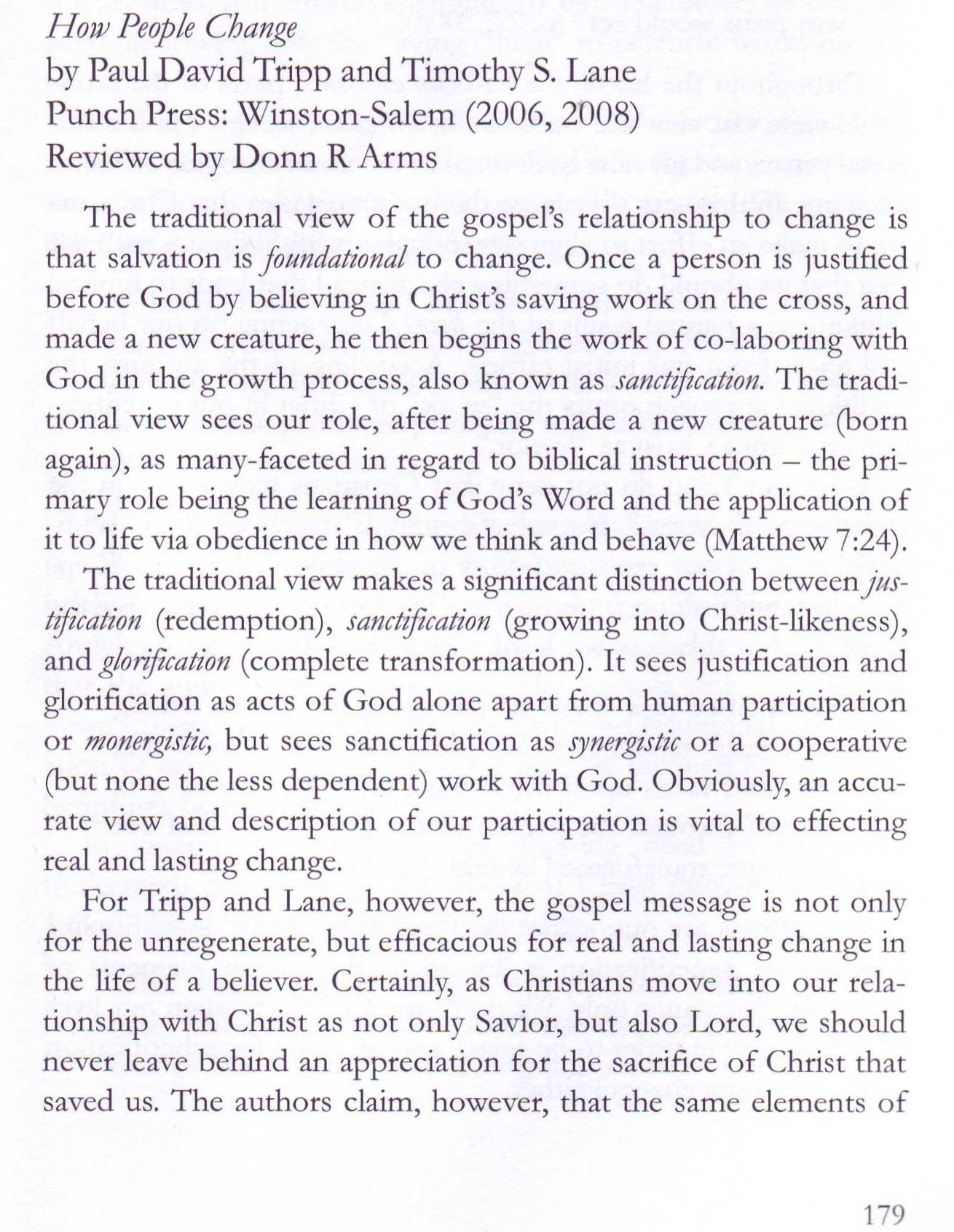
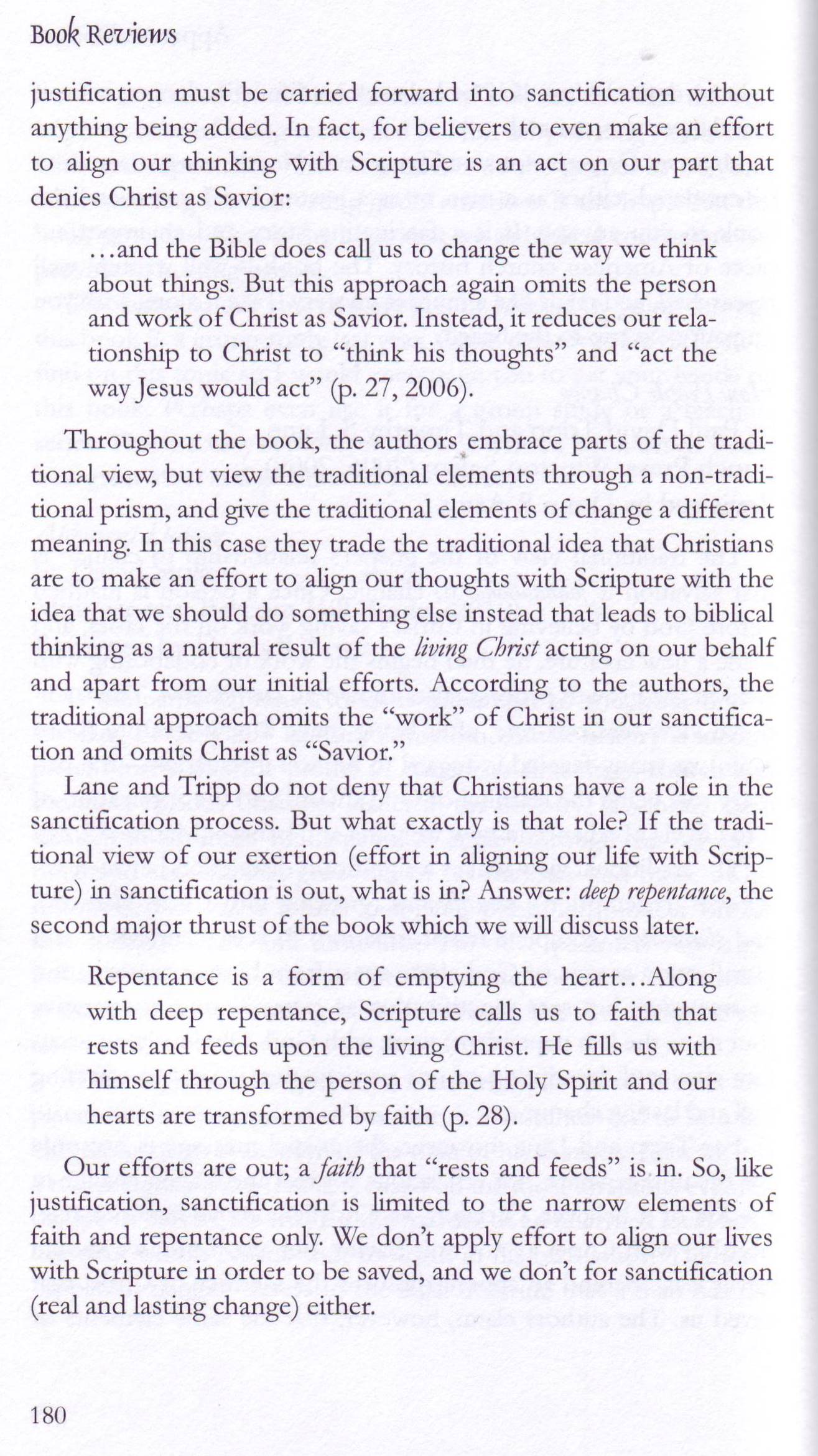
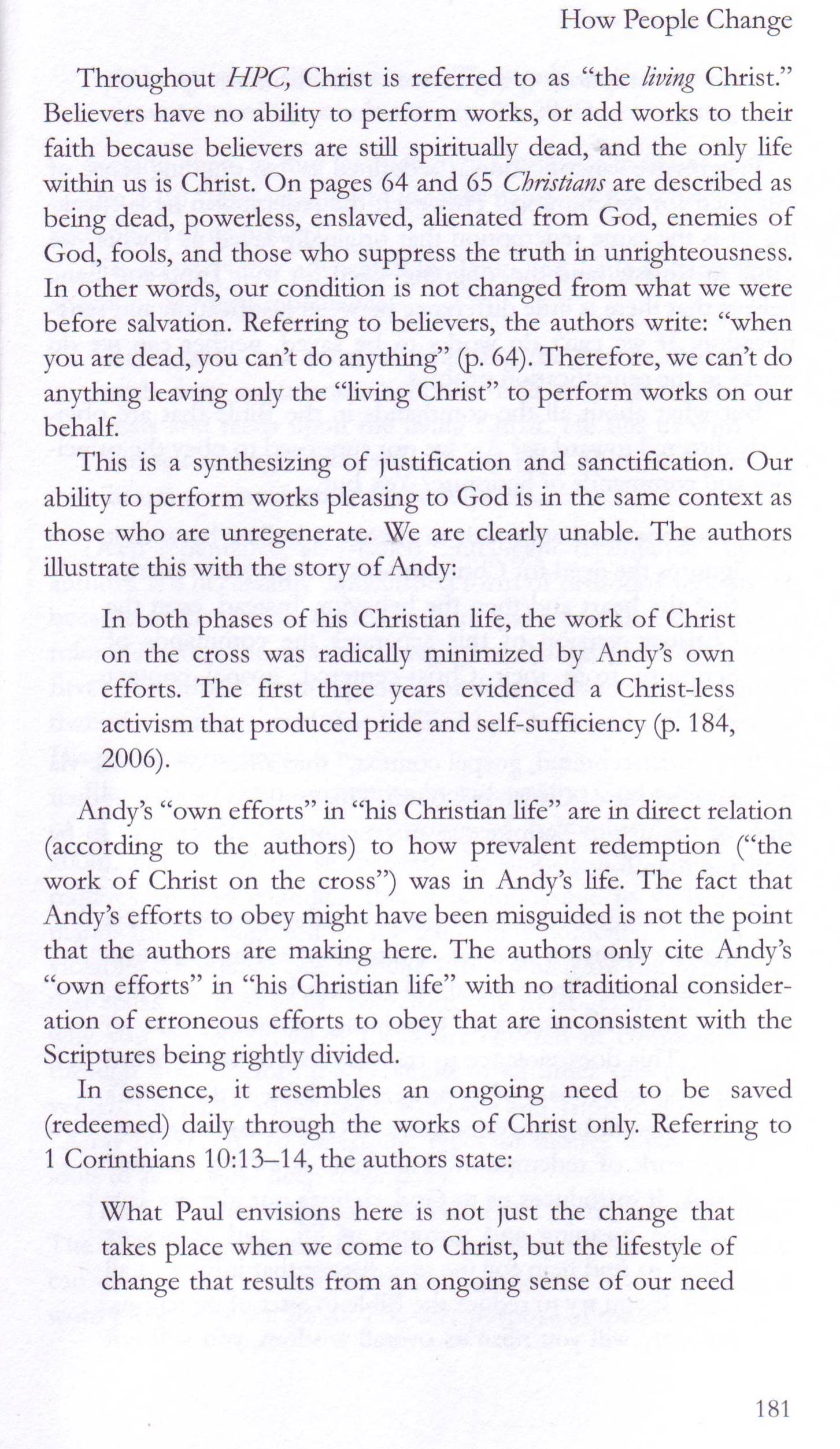
A reader sent me a manuscript from the 2011 John Bunyan Conference in Lewisburg, Pennsylvania. Basically, the yearly event is a New Covenant Theology love-fest. This year’s conference had many of the who’s who of NCT including John Reisinger and Fred Zaspel. NCT is a tenet of Gospel Sanctification which was mothered by Sonship Theology. NCT, like GS’s other tenets, was developed to bolster Sonship. The two, GS and NCT, go hand in hand. Determined to hold fast to the concept of being sanctified by the same gospel that saves us, advocates have been hard at work since 1980 (approx.) to make the rest of the Bible fit with the aforementioned concept. The result is the following: NCT, Heart Theology, Christian Hedonism, and a gospel-centered hermeneutic borrowed from Redemptive-Historical hermeneutics—invented by liberal theologian Johann Philipp Gabler (1753-1826).
The manuscript was the text of one of the speakers, Chad Bresson—radio personality and elder at Clearcreek Chapel in Springboro, Ohio. Clearcreek Chapel considers themselves a NCT church (according to another elder there, Dale Evans), and their doctrine is the epitome of Gospel Sanctification. The reader who sent the manuscript referred to Bresson as the “Golden Boy of Gospel Sanctification” in central Ohio. Gagingly, I would have to agree. The opening line of the manuscript, a twenty-nine page linguistic drone, finally surpasses the outrageous absurdity of Bresson’s “Another Brick in the Wall,” in which he creepily / cultishly suggested that the original sin in the garden was not disobedience, but the sin of not submitting to the authority of teachers/ elders. But truly, his thesis and opening line on this one takes the cake:
“Stephen was killed for preaching New Covenant Theology.” I’m not kidding—that’s what he said. I can just see him opening his message (after a silent pause) with this, supposedly, profound capture. First of all, nobody denies that NCT is a recent creation. Richard Barcellos, in his excellent critique of NCT, “In Defense Of The Decalogue,” voiced concern in the book’s preface that the movement was still in its developmental stages, and therefore, difficult to evaluate. That was in 2001. Bresson’s thesis is therefore indicative of NCT’s extreme arrogance—they are supposedly the gatekeepers of this newfound truth some two-thousand years later, and I will give you three wild guesses as to who they think would stone them today. This is why an us against them mentality saturates many GS / Sonship / NCT churches.
After suffering through about twelve pages of the obituary-like document, a few statements begged attention that somehow fail to alarm Christians of our day. First, that the New Covenant abrogated the law, and that all former covenants were cancelled by the NC as well. Of course, as Barcellos points out in his book, the first point blatantly contradicts Jeremiah 31:33, Matthew 5:17, and Romans 3:31. As far as the second point that caught my attention like a penguin singing “I Just Gotta Be Me” in the midst of the flock, it blatantly contradicts Ephesians 2: 11,12 where Paul likens the unregenerate to those “alienated from the commonwealth of Israel and strangers to the covenants [PLURAL NOT SINGULAR] of promise.” Furthermore, Paul then cites an excerpt from the Decalogue to make a point in Ephesians 6:1-3 making it clear that the “promise” thereof still applies to us today. All of the gallons of ink spilled by Bresson will not stand against these few verses of Scripture—truth does not bow to a myriad of words.
paul
In Search of Eschatological Significance, Part 2: Adams’ Challenge Demands a Closer Look
“All Scripture is profitable….that the man of God may be complete for every good work.” “Man does not live by bread alone, but by every word that comes from the mouth of God.” Therefore, eschatology (about 25% of Scripture) is just as important for living the Christian life as anything else in Scripture. How will properly understanding eschatology make one a better Christian, and better enable us to help other Christians? I don’t know yet, but the first step is making sure my present understanding is correct. If my goal is to know this for purposes of change—why not go to the change guru himself, Jay Adams, to investigate his biblical perspective on this issue?
So, I’m pre-everything, and reading “The Time is at Hand” by Adams. His eschatological views are not dispensational—that’s probably an understatement. As I said in part one, I found his initial arguments interesting, but they certainly did not put me in any fear that a change of position might be forthcoming. His argument in chapter three concerning duplication is compelling though I would disagree with him that this argument alone is the coup de grace for dispensationalism. However, in the latter part of chapter three, he presents the argument of what I call “finality.”
If you’re a dispy like me, you see the rapture as giving those who are left behind a second chance, but as Adams points out, Jesus often spoke of his “second coming” as closure for salvific opportunity (“….like the days of Noah, so will be…..”) What makes this argument even more disturbing is Adams’ citing of the wise and foolish virgins parable which embodies the imminent expectancy of pre-rapture. I could also raise him one with my lingering question concerning the “judgment of the nations” at the end of the tribulation period. If during the tribulation period, you can only buy or sell with the mark of the beast, how are a third category of people going to be able to help Christians during the tribulation period? (Matthew 25:31-46). And the life application issue is: the difference between second chance and no second chance with eternity hanging in the balance.
The challenge demands a closer look as I read forward.
paul



3 comments