Calvinist Catholicism, Denial of Sanctification, Denial of the New Birth, and Distortion of the Trinity Through “Emphasis”
 “Those of Reformed theology are not under grace. How do we know that? Because they say Christians are still under the dominion of sin. And plainly, according to the Bible, that equals being under the law and not under grace.”
The mystery of why sanctification is so anemic today is no longer a mystery. Traditionally, this has been the case for a long time in the Western church because the fathers of the Reformation discounted sanctification all together. Sure, they used the term, but it was disingenuous then, and continues to be such with those who use the term today. Weak sanctification leads to very unexciting lives which are no incentive to share the “new life” with others. We share what we are excited about, and being no better than what we were before our “conversion” is neither good news nor worth sharing. It seems the only thing we have to share is, “We are more humble than you because we know that we are empty vessels waiting to be filled and maybe the Lord will fill us and maybe he won’t.” Such a message just doesn’t set the world on fire.
The more I learn, the more I am convinced that there is really no difference between Catholicism and Protestantism: both are “under the law.” One is Jesus plus ritual to complete your justification and the other is Jesus plus making sure you do nothing in your sanctification to complete your justification (because the “just” shall live by faith [ALONE]). And in both cases, being faithful to the authority of the church secures your salvation. Calvin believed that we stay saved through daily repentance for daily salvation, and that forgiveness can only be found in Reformed churches:
Secondly, this passage shows that the gratuitous pardon of sins is given us not only once, but that it is a benefit perpetually residing in the Church, and daily offered to the faithful. For the Apostle here addresses the faithful; as doubtless no man has ever been, nor ever will be, who can otherwise please God, since all are guilty before him; for however strong a desire there may be in us of acting rightly, we always go haltingly to God. Yet what is half done obtains no approval with God. In the meantime, by new sins we continually separate ourselves, as far as we can, from the grace of God. Thus it is, that all the saints have need of the daily forgiveness of sins; for this alone keeps us in the family of God” (Calvin’s Commentaries, Vol. 45: Catholic Epistles).
And, Calvin’s homeboy, Luther, believed that Reformed elders have the authority to forgive sins:
Confession consists of two parts. One is that we confess our sins. The other is that we receive the absolution, that is, forgiveness, from the pastor as from God himself and by no means doubt but firmly believe that our sins are thereby forgiven before God in heaven (Timothy J. Wengert: A Contemporary Translation of Luther’s Small Catechism; Augsburg Fortress PUB 1994, p.49).
And on page 35….
Daily in this Christian church the Holy Spirit abundantly forgives all sins—mine and those of all believers. On the last day the Holy Spirit will raise me and all the dead and will give me and all believers in Christ eternal life.
The granting of eternal life is future, and is based on faithfulness to the established church. Look, I have been a pastor long enough to know that many Baptists associate their salvation with church membership. I have suggested cleaning up the roles in a few churches, and the response is always one that hints of this being synonymous with taking away one’s salvation. Where did they get that idea? Whether Catholic or Protestant, you can get your absolution in a booth or an alter call—there is no difference.
Calvinism, and the Reformed gospel in general, is “under the law.” In the Scriptures, being under the law equals being under the dominion of sin:
Romans 6:14—For sin will have no dominion over you, since you are not under law but under grace.
Romans 2:12—For all who have sinned without the law will also perish without the law, and all who have sinned under the law will be judged by the law.
Romans 2:15—For the law brings wrath, but where there is no law there is no transgression.
Those of Reformed theology are not under grace. How do we know that? Because they say Christians are still under the dominion of sin. And plainly, according to the Bible, that equals being under the law and not under grace. Quotes from the Reformed that establish this are myriad, I will note one:
We are enemies of God. We are God ignoring. We are God defying. We hate God. (CJ Mahaney: Resolved Conference 2008).
Comments by Reformed pastor Matt Chandler speaking of Christians as being “wicked sinners” have apparently been scrubbed from the internet (see here, and here), but nonetheless are indicative of the Reformed position.
This simply equals nothing less than, from the biblical perspective, Christians remaining in an unregenerate state though they call it regeneration. And this, they in fact do:
Bavinck too, wrote in connection with the regenerating work of the Spirit: “The regenerate man is no whit different in substance from what He was before his regeneration” (G. C. Berkouwer: Faith and Sanctification, p. 87).
Unchanging regeneration: such oxymorons are not few in Reformed writings. And though they would deny it, sanctification and the new birth are rejected as a matter logical conclusion. There can be no sanctification or new creaturehood where we are still under the bondage and dominion of sin. This is antithetical to being under grace. The Reformed think tank that launched the present-day New Calvinist movement which is a resurgence of authentic Calvinism, wrote an article in their theological journal entitled, “The False Gospel of the New Birth.” The article can be read here.
The argument that is used is one of emphasis which is Gnostic epistemology: sure, stars are true, but they only shine because of the Sun. Sure, shadows are true, but they wouldn’t exist without the Sun either. Sure, flowers are true, but they wouldn’t be able to grow without the Sun as well. What we want to do is focus on what really gives life: the Sun. To emphasize stars, shadows, or flowers over the thing that actually supplies the life will diminish life to whatever degree that the “good thing” is emphasized over the “best thing.”

Beginning to get the picture? It enables them to acknowledge the truth of sanctification and the new birth while deemphasizing them into oblivion. Out of sight; out of mind. To say that the new birth and our ability in sanctification are deemphasized in today’s church is certainly an understatement.
Said think tank, The Australian Forum, used the same argument to emphasize Christ over the Father and the Holy Spirit as well. Christocentricity is very important to Reformed theology. The core four of this think tank was Geoffrey Paxton, Jon Zens, Graeme Goldsworthy, and Robert Brinsmead. In a book where Paxton documents the Reformed heritage of Seventh-Day Adventism, he stated the following:
Luther and Calvin did not simply stress Christ alone over against the Roman Catholic emphasis on works-righteousness. The Reformers also stressed Christ alone over against all—be they Roman Catholics or Protestants (29) — who would point to the inside of the believer as the place where justifying righteousness dwells. Christ alone means literally Christ alone, and not the believer. And for that matter, it does not even mean any other member of the Trinity! (The Shaking of Adventism: p. 41).
Likewise, the same argument is made in regard to sanctification:
The distinction between the two types of righteousness will make the final emphasis of the Reformation easier to understand. The Reformers contended that the believer is righteous in this life only by faith. In saying this, they were not denying either the necessity or the reality of sanctification in all true believers. Rather, they were asserting that in this life sanctification is never good enough to stand in the judgment. The believer must look only to the righteousness of faith (the righteousness of the God-man) for his acceptance with God.
The inadequacy of sanctificational renewal was an integral part of Reformation teaching. Its corollary was the Reformers’ steadfast gaze at the righteousness of faith—namely, the doing and dying of the God-man, Jesus of Nazareth. Though the believer fights against sin and seeks to be a faithful law-keeper, sin nevertheless remains until his dying day Luther put it forcefully:
Paul, good man that he was, longed to be without sin, but to it he was chained. I too, in common with many others, long to stand outside it, but this cannot be. We belch forth the vapours of sin; we fall into it, rise up again, buffet and torment ourselves night and day; but, since we are confined in this flesh, since we have to bear about with us everywhere this stinking sack, we cannot rid ourselves completely of it, or even knock it senseless. We make vigorous attempts to do so, but the old Adam retains his power until he is deposited in the grave. The Kingdom of God is a foreign country, so foreign that even the saints must pray: ‘Almighty God, I acknowledge my sin unto thee. Reckon not unto me my guiltiness, O Lord.’ There is no sinless Christian. If thou chancest upon such a man, he is no Christian, but an anti-Christ. Sin stands in the midst of the Kingdom of Christ, and wherever the Kingdom is, there is sin; for Christ has set sin in the House of David.
(Ibid pp. 46,47).
Hence, at least Reformed theology is consistent in regard to Christians being under the law and also still under sin’s dominion. We must live by faith alone because we will supposedly stand in a future judgment that will determine righteousness by a perfect keeping of the law. And it’s true, those under the law will stand in such a judgment. But will we? The heart of the Reformation posited the idea that if we live by faith alone in sanctification, Christ will stand in the judgment for us.
But we know well what James thought of sanctification by faith alone.
paul
The Calvinist’s Greatest Fear: The Spiritual Peasantry Will Understand Law and Grace
“The two are completely separate; the law is left behind in the former and loved in the latter.”
Susan and I perceive constantly that most Christians don’t understand the difference between justification and sanctification. Said another way, they don’t understand the difference between law and grace. This is by design. Instead of outlawing the Bible like the Popes, the Reformers merely posited the Bible as a catechism that aped their orthodoxy derived from counsels and creeds. I won’t mention names, but prominent evangelical leaders have shared with me personally that they know the general populous of American Christians are theologically illiterate. And again, this is by design. And, most Christians in our day openly admit it, and in some cases are proud of it. The remainder admits they believe that the pastorate is an intermediary between them and what God wants us to understand.
There are a number of problems with this, but primarily, God thinks it’s a bad idea. The Bible is clearly written to Christians in general. And His word cannot be properly understood unless it is read in the context of justification/sanctification. Whatever your opinion of the American church, it is a product of parishioner illiteracy in regard to doctrine; that is certain and indisputable.
Though it takes a lot of study to see some things in simple form, the simple fact of Calvinism (and we are all Calvinists if we are Protestant) is that it makes “under” a verb and not what it is: a preposition. They could get away with this in medieval times because most people didn’t know the difference. In our day, we know the difference, but assume the pastorate has a set of metaphysical eyes given to them by God before the foundation of the world that we don’t have—so our eyes don’t even blink when their interpretations contradict the plain sense of Scripture.
As we have seen in our previous observations from the book of Romans, Christians are UNDER grace and were previously UNDER law. All people born into the world are born into it UNDER the law, and will be judged by it at the end of their lives if they don’t escape it. Christ was the only man ever born under the law that could live by it without sin and was therefore the only man ever born who could die for our sins. We escape the condemnation of the law by believing in what He did to make a way of escape for us. Calling on Christ to save us acknowledges that we all fall short of God’s glory and are therefore in danger of eternal separation from Him.
We are “under” grace, NOT “under” law:
Romans 6:14—For sin will have no dominion over you, since you are not under law but under grace.
The word for “under” here is hupo which is a primary preposition. Calvinism teaches that we are still under the law. This is the main reason that it is a false gospel. Now, they would vehemently deny this in the following way with red faces and veins popping out of their necks:
NONSENSE! We emphatically state constantly that no man is justified by the law unless he can keep it perfectly and we all know that no man can keep the law perfectly. We constantly cite James 2:10 which states that if we break the law at one point—we are guilty of breaking the whole law. HOW DARE YOU SLANDER US IN THIS WAY!!!
This argues the point by making “under” a verb (something we do or don’t do) rather than a position. Therefore, they are not arguing jurisdiction, they are arguing practice in regard to how we are justified. Position is the issue, not what we do; i.e., keeping the law or not keeping the law, or doing this/that in this way or the other way etc. Calvinists believe our position stays the same; therefore, what we do becomes critical. In fact, what we don’t do keeps us saved; e.g., “You don’t keep the law by keeping the law.”
There are four versions of “Christians” still being “under” the law, or under its jurisdiction. First, antinomianism which teaches that we are still under the law, but God cancelled our obligation to keep it because it promotes grace. Secondly, that we are still under the law, but the Holy Spirit helps us keep it so that we will pass the final judgment. Thirdly, that we are still under the law, but if we perform certain rituals within the church, by authority of the church, our sins are continually forgiven (perpetual pardon in the face of the law). Fourthly, we are still under the law, but Jesus keeps it for us while we continually contemplate His saving works in the Scriptures. This is the Reformed view. And of course—it’s no less a false gospel than the former three.
This is verified by their interpretation of Galatians 2:20—this exposes their heresy:
I have been crucified with Christ. It is no longer I who live, but Christ who lives in me. And the life I now live in the flesh I live by faith in the Son of God, who loved me and gave himself for me.
We supposedly remain spiritually dead, which as they know is clearly synonymous with being under the law in Scripture. So, Galatians 2:20 is interpreted as being applicable to our Christian life. We don’t live in our Christian life, we are still spiritually dead, but the living Christ within us keeps the law for us so that the “ground of our justification will be Christ in the final judgment.” Calvinists believe that we are not under the law in regard to the idea that we don’t keep it in our Christian life to be justified, Christ keeps it for us. Hence, “under” is a verb issue rather than a position issue. What we do becomes critical, not where we are positionally. Therefore, Calvinism makes our Christian life (sanctification) by faith alone as a way to maintain our just standing for the final judgment. Only problem is, we are still fulfilling a requirement of the law in cooperation with Christ—this is the problem of salvation being a verb issue rather than a preposition issue. If the law no longer has jurisdiction over us FOR JUSTIFICATION, who keeps it or doesn’t keep it is irrelevant FOR JUSTIFICATION.
Then what is Paul talking about in Galatians 2:20? He is talking about justification; not sanctification, this should be evident. Consider the context:
Galatians 2:16—yet we know that a person is not justified by works of the law but through faith in Jesus Christ, so we also have believed in Christ Jesus, in order to be justified by faith in Christ and not by works of the law, because by works of the law no one will be justified.
Galatians 2:17—But if, in our endeavor to be justified in Christ, we too were found to be sinners, is Christ then a servant of sin? Certainly not!
Galatians 3:11—Now it is evident that no one is justified before God by the law, for “The righteous shall live by faith.”
Consider verse 21 which immediately follows 2:20:
I do not nullify the grace of God, for if righteousness were through the law, then Christ died for no purpose.
Why do Calvinists apply Galatians 2:20 to sanctification? Because what we do is the issue, not our position, so Christ must obey the law for us. To the contrary, we are justified because the old self that lived in the flesh died with Christ. And when it did, we also died to the law. So, in regard to justification, we can only be justified if the life we lived in the flesh is dead and no longer under the law. Being alive in the flesh equals: being under the law. Now, obviously, our mortal bodies are still alive in one sense in that we are walking around, but in reality the old self is dead and the power of sin and the law are broken. In that sense, we are dead, and justified via the fact that Christ was resurrected for our justification (Romans 4:25). Notice that Paul states that he is dead in regard to his life “in the flesh.” This doesn’t mean that we are also spiritually dead in sanctification. The context of Galatians 2:20 is justification. Hopefully, Romans 6:5-14 will clarify this for you:
5 For if we have been united with him in a death like his, we shall certainly be united with him in a resurrection like his. 6 We know that our old self was crucified with him in order that the body of sin might be brought to nothing, so that we would no longer be enslaved to sin. 7 For one who has died has been set free from sin. 8 Now if we have died with Christ, we believe that we will also live with him. 9 We know that Christ, being raised from the dead, will never die again; death no longer has dominion over him. 10 For the death he died he died to sin, once for all, but the life he lives he lives to God. 11 So you also must consider yourselves dead to sin and alive to God in Christ Jesus.
12 Let not sin therefore reign in your mortal body, to make you obey its passions. 13 Do not present your members to sin as instruments for unrighteousness, but present yourselves to God as those who have been brought from death to life, and your members to God as instruments for righteousness. 14 For sin will have no dominion over you, since you are not under law but under grace.
As we have noted before in our Romans study, being under the law comes part and parcel with being lost and under the power of sin which is provoked by the law. The flesh under the law is like throwing gasoline on a fire (Romans 7:8-11). But notice in Romans 6:5-14 that there is both death and life. This passage in Romans also adds “death” to being under the law and the bondage of sin. Galatians 2:20 only speaks of our death to the law and sin (“Apart from the law, sin lies dead”), not the life we have in sanctification. Romans 5-14 speaks to both because the context includes both sanctification and justification:
13 Do not present your members to sin as instruments for unrighteousness, but present yourselves to God as those who have been brought from death to life, and your members to God as instruments for righteousness. 14 For sin will have no dominion over you, since you are not under law but under grace.
We have been brought from death to life. The life we live in the flesh has had the power and dominion of sin under the law broken because we died with Christ. We are dead and Christ lives for our justification:
Romans 4:23—But the words “it was counted to him” were not written for his sake alone, 24 but for ours also. It will be counted to us who believe in him who raised from the dead Jesus our Lord, 25 who was delivered up for our trespasses and raised for our justification.
In regard to justification and this life we live in the flesh, we are dead, and more importantly, also dead to the law as well, and only Christ is alive, but that doesn’t pertain to sanctification as well. In sanctification, we are alive, and UNDER GRACE. In justification, the old self is dead and no longer under the law. Calvinists believe we remain under the law in sanctification, and being under the law is synonymous with still being spiritually dead. Therefore, we remain dead in sanctification and under the judgment of the law, so the law must be fulfilled for us.
Being under grace is synonymous with being born again, new creatures, informed by the law, not under it (see Galatians 2:19), and lovers of the truth. Obedience to the law is now our means of loving the Lord and showing the world that we love Him. The law is the full counsel of God in regard to family harmony and kingdom living. It informs us on how to be separate from the world. In a word: sanctification. The law in regard to judging our justification has NO jurisdiction over us. We are no longer under it.
The very fact that Calvinists propagate a total depravity of the saints in which bondage to sin is not broken clearly illustrates that the law is still a standard for our justification; we are still under its jurisdiction for our just standing. A cursory perusal of Reformed writings can produce a motherload of citations to establish this fact, but one from Reformed icon G. C. Berkouwer should suffice:
Bavinck too, wrote in connection with the regenerating work of the Spirit: “The regenerate man is no whit different in substance from what He was before his regeneration” (Faith and Sanctification p. 87).
Clearly, this can only mean one thing: the one that is “no whit different” must also remain under the law. His position hasn’t changed, so lest one attempt to be justified by the law, what is done in sanctification becomes paramount in eternal issues as opposed to it being a Divine family matter. The Reformed camp uses the book of Galatians to argue for this when the book actually addresses their specific error. They use the book of Galatians, as mentioned, particularly 2:20, to argue a supposed Pauline position that the Galatians were doing things in their sanctification that was affecting the status of their just standing. Again, the Reformed crowd makes what we do in sanctification the issue, not our position which biblically proposes that nothing done in sanctification can affect justification. The Reformed use of Galatians to argue this propagates a fusion of justification and sanctification which makes the law the standard for justification from salvation to glorification.
However, the book of Galatians is the antithesis of such as it shows a clear dichotomy between justification/sanctification and the application of the law in each. In justification: NO application. In sanctification: obedience. In regard to no law in justification, but the law informing our sanctification, consider Galatians 2:19:
For through the law I died to the law, so that I might live to God.
We have also noted in our Romans study:
But now the righteousness of God has been manifested apart from the law, although the Law and the Prophets bear witness to it—
We are justified apart from the law, but we would not know anything about these issues if not informed by the “Law and the prophets.” Furthermore, after belaboring the point about their being no law in justification, in both Romans and Galatians Paul makes his point by asking “What saith the Scriptures?” (Romans 4:3 and Galatians 4:30). And the absolute classic point on this is Galatians 4:21:
Tell me, you who desire to be under the law, do you not listen to the law?
There is no law in justification, but the law informs our obedience in Sanctification. Scriptural examples are myriad, but consider Galatians 5:2-7:
2 Look: I, Paul, say to you that if you accept circumcision, Christ will be of no advantage to you. 3 I testify again to every man who accepts circumcision that he is obligated to keep the whole law. 4 You are severed from Christ, you who would be justified by the law; you have fallen away from grace. 5 For through the Spirit, by faith, we ourselves eagerly wait for the hope of righteousness. 6 For in Christ Jesus neither circumcision nor uncircumcision counts for anything, but only faith working through love.
7 You were running well. Who hindered you from obeying the truth?
Verses 2 through 6 are about justification by faith alone apart from the law. Verse 7 concerns sanctification—running and obeying which we are free to do aggressively without fear of it affecting our justification. The two are completely separate; the law is left behind in the former and loved in the latter. I once heard a Reformed pastor fuming from the pulpit over a statement that he heard at a conference: “He said that the law leads us to Christ, and then Christ leads us back to Moses. THAT’S BLASPHEME!!!”
No it isn’t. When the law was increased through Moses, it had a dual purpose: to increase sin in order to show those under the law their need for salvation, and as can be ascertained by many other texts, for the saved to better glorify God:
Romans 5:20—The law was brought in so that the trespass might increase. But where sin increased, grace increased all the more,
Galatians 3:19—Why then the law? It was because of transgressions….
paul
The Potter’s House 12/30/2012: Law and Grace; Romans Chapter 4

We now come to chapter four in our study of Romans. Thus far, Paul has emphasized that all men, whether Jew or Gentile, are saved by faith alone. This salvation is a revelation of God’s righteousness, and is imputed to us when we believe in Jesus Christ. We have learned that the gospel is the full counsel of God which of course includes the death burial, and resurrection of Christ. We have learned that Paul was very concerned with a spiritual caste system that would render the Gentiles as second-class citizens in the church. Though the church is uniquely Jewish, God shows no partiality in regard to race and gives the various gifts of salvation to all men freely.
What we have in the book of Romans is a radical dichotomy between justification and sanctification; or said another way, salvation and its imputed righteousness set against the Christian life as kingdom citizens living on earth as aliens and ambassadors. However, there is NO dichotomy between law and gospel. Why? Because both are the full counsel of God. In the Bible, “law,” “truth,” “gospel,” “Scriptures,” “holy writ,” “the law and the prophets,” and other terms are used interchangeably to speak of the closed canon of God’s full counsel for life and godliness. Christ as well as Paul made it absolutely clear: man lives by every word that proceeds from God and ALL Scripture is profitable to make the servant of God complete in every good work.
Now listen: though the life application of some Scripture changes with time and circumstances, it still remains that all Scripture informs us in regard to our walk with God in the way we pray, think, and act. We do not stone rebellious children in our day. Nay, when we have a rebellious teen in the church, we do not gather the congregation together and stone him/her to death. With that said, does the fact that God at one time instructed the Jews to do so inform us in regard to many applications for teen rebellion in our day? Absolutely. Oh my, the contemporary applications in our day are almost endless. Not only that, Old Testament ritual and symbolism offers a built-in protective hermeneutic for the Scriptures as a whole. What do I mean by that? Well, you can mess with words, but symbolism is very difficult to mess with. If it’s a lampstand, it’s hard to change that to a Honda Civic. Right?
Paul delves into a paramount truth for Christians in the book of Romans: The relationship of the law to the unsaved verses the saved. And here it is: the lost are UNDER the law, and the saved are UNDER grace, but informed by the law. Let me repeat that: the lost are UNDER the law, and the saved are UNDER grace, but informed by the law. And we can see this right in the same neighborhood of the text that we are in.
Romans 3:21—But now the righteousness of God has been manifested apart from the law, although the Law and the Prophets bear witness to it—
That verse pretty much says it all. We are justified apart from the law, and as we will see, Paul means totally apart from the law. But we are informed by it. Paul states in Romans 3:28:
For we hold that one is justified by faith apart from works of the law.
Now note what he states after a few verses following in Romans 4:3,
For what does the Scripture say?
Paul strives to make the point in this letter that law is not even on the radar screen in regard to justification. And this is extremely important to know in our day for many teach that law is on the justification radar screen and therefore Christ must keep the law for us in order to maintain our justification. Not so, there is no law to keep in regard to justification—a righteousness APART from the law, the very righteousness of God has been imputed to our account in full. Paul even writes (and this is very radical) that Christians are sinless in regard to justification because there is no law in justification to judge us:
Romans 7:1—Or do you not know, brothers—for I am speaking to those who know the law—that the law is binding on a person only as long as he lives?
Romans 7:6—But now we are released from the law, having died to that which held us captive….(v.8) Apart from the law, sin lies dead.
Now, the law can judge our sin in our Christian life, but that can’t touch the fact that we are “washed.” Therefore, in sanctification, we only need to wash our feet to maintain a healthy family relationship with our Father God and Brother, the Lord Jesus Christ. Turn with me and let’s look at this in John 13:1-11:
Now before the Feast of the Passover, when Jesus knew that his hour had come to depart out of this world to the Father, having loved his own who were in the world, he loved them to the end. 2 During supper, when the devil had already put it into the heart of Judas Iscariot, Simon’s son, to betray him, 3 Jesus, knowing that the Father had given all things into his hands, and that he had come from God and was going back to God, 4 rose from supper. He laid aside his outer garments, and taking a towel, tied it around his waist. 5 Then he poured water into a basin and began to wash the disciples’ feet and to wipe them with the towel that was wrapped around him. 6 He came to Simon Peter, who said to him, “Lord, do you wash my feet?” 7 Jesus answered him, “What I am doing you do not understand now, but afterward you will understand.” 8 Peter said to him, “You shall never wash my feet.” Jesus answered him, “If I do not wash you, you have no share with me.” 9 Simon Peter said to him, “Lord, not my feet only but also my hands and my head!” 10 Jesus said to him, “The one who has bathed does not need to wash, except for his feet, but is completely clean. And you are clean, but not every one of you.” 11 For he knew who was to betray him; that was why he said, “Not all of you are clean.”
Clearly, “washing” refers to salvation, and differs from needing the lesser washing of the feet. The example is set against the unregenerate betrayer among them. Note that Jesus said that even though we needed to wash our feet, we are still “completely clean.” My, my, what a strong contrast to much of the teachings in our day; i.e., the idea of “deep repentance” that is the same repentance that saved us and keeps us saved—as long as we are in a Reformed church where such forgiveness is available.
Secondly, this passage shows that the gratuitous pardon of sins is given us not only once, but that it is a benefit perpetually residing in the Church, and daily offered to the faithful. For the Apostle here addresses the faithful; as doubtless no man has ever been, nor ever will be, who can otherwise please God, since all are guilty before him; for however strong a desire there may be in us of acting rightly, we always go haltingly to God. Yet what is half done obtains no approval with God. In the meantime, by new sins we continually separate ourselves, as far as we can, from the grace of God. Thus it is, that all the saints have need of the daily forgiveness of sins; for this alone keeps us in the family of God (Calvin’s Commentaries, Vol. 45: Catholic Epistles).
So, Paul in chapter four, in his endeavor to get this into the heads of Christians, approaches it from another angle: the life of Abraham, the father of faith. This is so powerful. Again, you can fiddle with words in translation, but rearranging the order of Abraham’s biography would be a difficult endeavor and the order of his life from the Old Testament account solidifies what Paul is teaching here about justification:
Romans 4:1-8—What then shall we say was gained by Abraham, our forefather according to the flesh? 2 For if Abraham was justified by works, he has something to boast about, but not before God. 3 For what does the Scripture say? “Abraham believed God, and it was counted to him as righteousness.” 4 Now to the one who works, his wages are not counted as a gift but as his due. 5 And to the one who does not work but believes in him who justifies the ungodly, his faith is counted as righteousness, 6 just as David also speaks of the blessing of the one to whom God counts righteousness apart from works: 7 “Blessed are those whose lawless deeds are forgiven, and whose sins are covered; 8 blessed is the man against whom the Lord will not count his sin.
We had a fellowship last night and a brother pointed out a common problem among Christians; they often don’t know when something should be simply applied and not figured out. And this is one—faith declares us completely righteous and no sin will be counted against us. Justification is a gift. Righteousness is a gift. If the gift is righteousness and God says so, that is the end of the discussion. Unlike a gift, any kind of work in justification equals a wage that is due. Paul then deals with the issue of justification through circumcision (something we do):
9 Is this blessing then only for the circumcised, or also for the uncircumcised? For we say that faith was counted to Abraham as righteousness. 10 How then was it counted to him? Was it before or after he had been circumcised? It was not after, but before he was circumcised. 11 He received the sign of circumcision as a seal of the righteousness that he had by faith while he was still uncircumcised. The purpose was to make him the father of all who believe without being circumcised, so that righteousness would be counted to them as well, 12 and to make him the father of the circumcised who are not merely circumcised but who also walk in the footsteps of the faith that our father Abraham had before he was circumcised.
What Paul is saying is that God deliberately waited to have Abraham circumcised so that he would be the father of the uncircumcised as well as the circumcised. Also, to make the point that no ritual saves us whether circumcision or baptism, and followed by an attitude that we are justified accordingly by the ritual alone, and can hence live anyway we want to. As we have discussed previously in this study, an attitude of obedience is part and parcel with saving faith. Obedience and saving faith are two sides of the same coin. This is NOT so-called “lordship salvation,” but a statement regarding the fact that saving faith is not accompanied by a libertine attitude towards God’s full counsel, but rather a love for the truth. No obedience saves anybody, but saving faith is also endowed with a love for the truth with natural results following. However, as we will see later in this same book, the flesh is weak and faith alone does not carry the day in sanctification like it does in justification; so, many other factors come to bear in sanctification. This is where the sanctification by justification rave of our day is most unfortunate.
This is not the only place in Scripture where Paul uses the chronology of Abraham’s life to argue for righteousness completely separate from the law:
Galatians 3:15—To give a human example, brothers: even with a man-made covenant, no one annuls it or adds to it once it has been ratified. 16 Now the promises were made to Abraham and to his offspring. It does not say, “And to offsprings,” referring to many, but referring to one, “And to your offspring,” who is Christ. 17 This is what I mean: the law, which came 430 years afterward, does not annul a covenant previously ratified by God, so as to make the promise void. 18 For if the inheritance comes by the law, it no longer comes by promise; but God gave it to Abraham by a promise.
This is the foolishness of any idea that the law is still a standard for our justification and the law must be maintained by Christ in our sanctification, or that Christ’s life was for the purpose of imputing his obedience to our sanctification. The promise of justification by faith alone was ratified before the law ever came through Moses—430 years before. Why would Christ have to maintain a perfect keeping of a law that had nothing to do with the promise whatsoever? Hence, look at the perfect fit we have in Romans 4:13-15:
13 For the promise to Abraham and his offspring that he would be heir of the world did not come through the law but through the righteousness of faith. 14 For if it is the adherents of the law who are to be the heirs, faith is null and the promise is void. 15 For the law brings wrath, but where there is no law there is no transgression.
Again, no law, no transgression. Transgression is not absent in justification because Christ maintains the law for us in sanctification—there is no transgression to be counted against our justification because there is no law in justification period. It’s based on promise—not law. Christ came to die in order to fulfill the promise that was given 430 years before the law. And this brings us to a previous point. As some know, because of the focus of the particular ministry I am in, I use the ESV translation of the Bible. The ESV is a contemporary translation by New Calvinists and is their Bible of choice. Now note how Romans 4:16 is translated in the ESV:
That is why it depends on faith, in order that the promise may rest on grace and be guaranteed to all his offspring—….
“Depends” is a very interesting choice of words here. Actually, there is no merit at all for the use of that word in Romans 4:16. The word, or even that idea doesn’t appear in any interlinear, expanded translation, or manuscript such as the Received text, Majority text, or Critical text. But it does have merit in regard to the Reformed view of justification; i.e., maintaining our just standing requires a continuance of faith alone in sanctification. Our justification “depends” on that. “Depends” also hints of an ongoing or continual dependence.
Paul then concludes with a definition of this saving faith:
16 That is why it depends on faith, in order that the promise may rest on grace and be guaranteed to all his offspring—not only to the adherent of the law but also to the one who shares the faith of Abraham, who is the father of us all, 17 as it is written, “I have made you the father of many nations”—in the presence of the God in whom he believed, who gives life to the dead and calls into existence the things that do not exist. 18 In hope he believed against hope, that he should become the father of many nations, as he had been told, “So shall your offspring be.” 19 He did not weaken in faith when he considered his own body, which was as good as dead (since he was about a hundred years old), or when he considered the barrenness of Sarah’s womb. 20 No unbelief made him waver concerning the promise of God, but he grew strong in his faith as he gave glory to God, 21 fully convinced that God was able to do what he had promised. 22 That is why his faith was “counted to him as righteousness.” 23 But the words “it was counted to him” were not written for his sake alone, 24 but for ours also. It will be counted to us who believe in him who raised from the dead Jesus our Lord, 25 who was delivered up for our trespasses and raised for our justification.
Herein we have a definition of saving faith: it has a stubborn trust in the promises of God regardless of life circumstances. It hopes in God regardless of the hopeless motif continually posited by the world. And, Abraham grew in faith as he gave glory to God. What’s that mean? We have a clue from Matthew 5:14-16;
14 “You are the light of the world. A city set on a hill cannot be hidden. 15 Nor do people light a lamp and put it under a basket, but on a stand, and it gives light to all in the house. 16 In the same way, let your light shine before others, so that they may see your good works and give glory to your Father who is in heaven.
We are all saved and justified with an initial faith that varies according to the grace of God (Romans 12:3), but certainly, our faith in sanctification grows as we exercise it through obedience while giving glory to God. Obedience demonstrates trust. Applying God’s truth to our life demonstrates that we believe that He knows best and blessings will result. Peter said that we should be diligent to “add to our faith” (2Peter 1:5-11). Faith is a gift that justifies us once, and for all time with the very righteousness of God. But we participate in the growth of our faith through application of the full counsel of God. This is what the book of James is about (see James 1:25), and only one example among many in holy writ.
Of course, the life of Christ was very awesome for many reasons, but His life was not for the purpose of obeying the law perfectly so that His obedience to the law could be imputed to us in sanctification for the purpose of maintaining our just standing. The law is not the standard for maintaining justification; it is finished. Christ was the only Man ever born into the world under the law who could be the perfect sacrifice required by God. All others born under law are under its curse and provoked to sin by it. But note the last verse here in chapter four:
23 But the words “it was counted to him” were not written for his sake alone, 24 but for ours also. It will be counted to us who believe in him who raised from the dead Jesus our Lord, 25 who was delivered up for our trespasses and raised for our justification.
Paul states that our justification came through Christ’s resurrection, not His life. The Reformed construct of Christ living for our sanctification and dying for our justification is simply nowhere to be found in Scripture, and if it is, as with a myriad of other textual examples, Paul fails to mention such a crucial fact in these last verses.

Apparently, I am Fed-up With All the Whining About Symptoms of Calvinism
 Apparently, I begin the New Year completely fed-up with all of the whining about the symptoms of Calvinism which is a false gospel. Christians seem to be oblivious to the fact that ill behavior flows from bad ideas. The blogosphere is saturated with incessant whining about the spiritual abuse and tyranny foisted on the American church by Calvinism, but yet, they refuse to address the core of the problem. Hence, many blogs have become little more than the National Inquirer adorned in Bible verses.
But though annoying, there is a reason for it: we are Protestants. Our foundation is Calvin and Luther who believed that Christians remain totally depraved and ignorant. Therefore, present-day Christianity in this country is predicated on the idea that we must be led by a sanctified pre-ordained academia. Like Catholicism? Absolutely, because the Reformers maintained Rome’s metaphysical presuppositions; especially in regard to mankind, and only changed their doctrine which strives for the exact same goal: CONTROL.
That’s why we have such a comfortable relationship with St. Augustine and the fact that our Protestant founding fathers were his followers. This is why we whine about spiritual abuse but continue to give these guys our money:
Ya, they’re bad guys, but we need them. I mean, look what David did, but he was God’s anointed. Israel needed him.
And why do we continually whine about symptoms while giving them our money when their philosophy and doctrine is clearly anti-God and anti-Bible? Because: we do not deem ourselves capable of speaking to their doctrinal error. We are not qualified. We could falsely accuse them because we have supposedly not been preordained to see Christocentric reality the way they do. God gave them metaphysical eyes that we don’t have. And if we step out and teach with the authority of the word, and without their permission, we may be found naked by them. Our hidden “ignorance” may be exposed. Reformed despots have worked for 510 years to develop this unspoken bondage.
So, we know our place and only speak to the behavior. We are exactly like the slaves in the South during the Civil War who were powerless to do anything but complain about the abuse. Or so they thought. Others questioned that assumption and sought solutions. The results speak for themselves. America now has a two-term black President. Christians should take note of that. Like him or love him, Obama is solution oriented. And any Christian who likes to speak their mind probably benefits from the Civil Rights Movement because the hangman’s noose differs little from the burning stake stoked with green wood for those who dared to understand Scripture apart from Reformed elders. The abuse we see today is Reformed Light tamed by the U.S. Constitution.
Look, rat on the behavior—keep doing that, but when are folks going to start blogging about the philosophy and the doctrine?
When they think they have the authority and capability to do so.
Well, touché. Yes, I know about the behavior, but what about the fact that these guys believe that we are resaved every day and that we can only receive daily forgiveness that maintains our justification in their churches? Heeeellllloooooo.
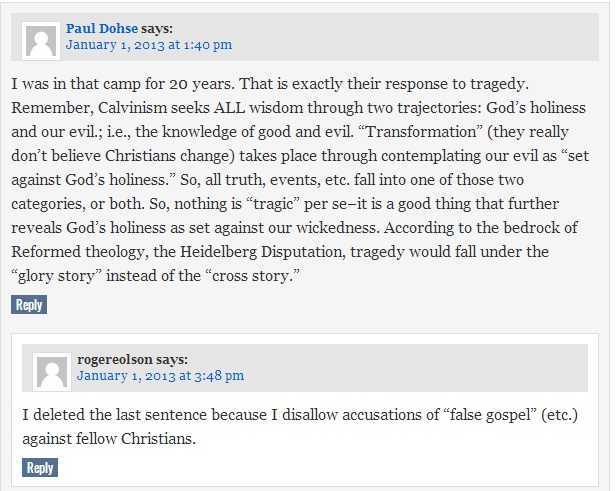
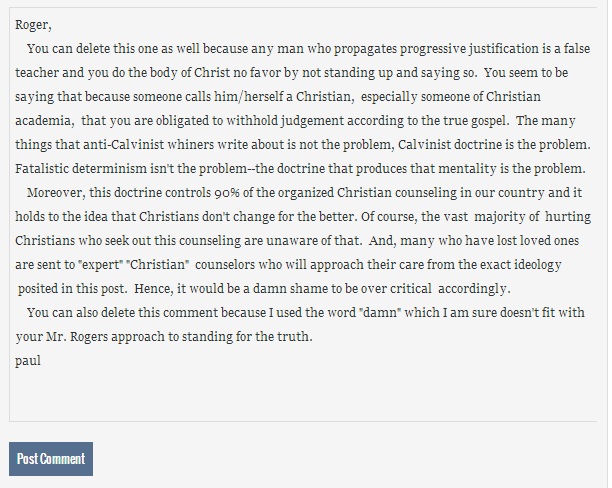
I posted a comment on a blog and the response from the author hit a nerve and prompted this post (here). My response was so knee-jerk that I stopped and pondered why I responded in that way. Hence, the title of this post. I’m clearly exasperated. But I let the comment stand.
Stop whining and study to show thyself approved. And then blog about it. Until the doctrine is dealt with, we will continue to be slaves to heretics rather than the Chief Shepherd.
paul

It Takes Just One Spark to Start a Fire
After laboring for almost 6 years now, it appears that a pastor gets it and is willing to say so. Reformation theology is an egregious false gospel that propagates progressive justification. This isn’t some nonessential quibbling over semantics–a truth-driven gospel is the critical issue here. Some pastors reject Calvinism for the wrong reasons. Some know it’s a false gospel but don’t want to lose any friends or appear radical. But there is one more category: those who get it and are willing to say so. Truth is the real issue with them. Well, we know of one in that category: Dr. Lance Ketchum, and we present a recent article written by him that states very important things about this issue. The link follows: Gospel Centrism and Its Neo-orthodox Foundations
We pray that other pastors will heed his wisdom and stand against the false Reformation gospel.
paul



4 comments