LifeWay’s “Gospel Project” Will Keep Children From Entering the Kingdom
 Proponents of New Calvinism’s false gospel of progressive justification are targeting children through LifeWay Publisher’s Gospel Project. The church now stands silent as this massive program will prevent untold thousands of children from entering the kingdom. And I have news for American pastors: your ignorance on this issue will not excuse you before Christ in regard to the eternal wellbeing of Children, especially if you are soliciting them to attend your VBS. Spiffy teacher’s manuals with the word “gospel” on them doesn’t equal truth-driven gospel.
Much could be said biblically about God’s preference for children, but it’s interesting to note that God made a specific covenant between Himself and children, and New Calvinism seeks to interfere with that covenant. The apostle Paul explains the covenant as follows:
Ephesians 6:1 – Children, obey your parents in the Lord, for this is right. 2 “Honor your father and mother” (this is the first commandment with a promise), 3 “that it may go well with you and that you may live long in the land.”
The fifth commandment is the command with a promise, and the four after it are uncharacteristic of the first five in regard to being short statements. This means they probably relate back to the fifth commandment: children dishonor their parents by stealing, etc. New Calvinism circumvents this covenant (which is obviously still in force or Paul would not have referred to it), and thereby circumvents the promises to children associated with it, circumvents their ability to honor their parents, and circumvents their ability to love God.
How so? New Calvinism’s gospel-centered theology is progressive justification and sanctification by faith alone. The “big picture” method of “Bible learning” is the vehicle for enabling Christians to live by faith alone in their Christian lives. This is nothing new and is the mentality that James pushed back against in his epistle. The Bible becomes a tool for gospel contemplationism, and whatever we see in the “gospel story” is imputed to our lives. This imputation is always accompanied by gratitude (fueled by the “crosswork” that we see in the Bible), joy, and a willing spirit. All obedience out of duty is “obedience in our own efforts” which would include anything that we don’t feel like doing. Ya, teach that to kids. Brilliant.
Kids will be instructed to see all of the commands in the Bible as works that Christ accomplished for us while He lived on earth. That’s what the term, Christ for us means. We are still totally depraved and unable to keep the law in sanctification, so Christ lived for our sanctification and died for our justification. As we see all of the commands in the Bible that Christ kept for us, that obedience is imputed to our (justification) account by faith alone.
Note: we supposedly have a salvation account that needs continuing forgiveness and righteousness deposits to keep us saved. The Bible is then a tool that enables us to “see” what Christ has done, not anything we do. This is a supposed increase of faith that only perceives without any direct acts of love which would be deemed a “rightousness of our own.”
Instead of Christ obtaining our salvation by “one act” of obedience, we must contemplate his many “saving acts” (John Piper) in all of the Bible so that those acts will be continually deposited in our salvation account. Salvation is not a finished act according to this false gospel.
Worse yet, it makes the standard for justification a perfect keeping of the law; therefore, part of Christ’s salvific works was perfect obedience during His life on earth so that His works can be imputed to our sanctification by faith alone—the same way we were saved. This effectively keeps us “under the law” which is a designation for the lost throughout the New Testament. For all practical purposes, we are still under the law and that’s why Jesus must obey for us. Since sanctification finishes our justification (really progressive justification), if we don’t live the Christian life by faith alone—we are toast. Supposedly. Children will be taught that “making every effort” (2Peter 1:5-11) to obey mommy and daddy is works salvation.
Hence, there is really no choice to obey “in our own efforts” and therefore no way to love God and please Him. Supposedly, If we really love Jesus, it shouldn’t take effort. As Francis Chan states: “If it feels like work—it’s work. If it feels like love—it’s love.” There are just no words for the vileness that is behind the efforts to teach this to our children.
Moreover, it’s plainly a false gospel that denies the new birth. In the new birth, the “Helper” enables us to appropriate the fact that our minds are now enslaved to the law rather than sin (Romans 7:25). The ability to obey the law and please God is the very definition of a born again believer (Romans 8:7).
Of course, these doctrinal ideas will be assimilated into their minds by methods that teach on their level of understanding. The production is also top notch and designed to mesmerize children.
But this will be the result: the ability for our children to use the Bible to love God and others with all of their heart, soul, and minds will be circumvented. And our view of sanctification reveals what our view of justification is. We are either free from the law to serve another with our actual obedience, or enslaved to the law which necessitates a substitution for our loving acts using the Bible for the mere purpose of gospel contemplationism.
paul
The Potter’s House 2/10/2013: The Gospel According to Moses; Part 1

 Yesterday, I was invited to teach at Church of the Messiah which is a Christian movement that seeks to rediscover our Judeo-Christian roots. Since we are deeply invested in the subject of law and gospel right now via the book of Romans I thought it would be a good supplement.
The more we study through the Scriptures we realize that there is little difference between the Old Testament and New Testament. Believers of Old looked toward the cross; we look back to the cross. The ministry of the Holy Spirit is fundamentally the same. I think the primary variance is marked by the inclusion of the Gentiles into the commonwealth of Israel. But at any rate, believers of Old understood all of the salvific implications of Messiah’s arrival:
Luke 2:22 – And when the time came for their purification according to the Law of Moses, they brought him up to Jerusalem to present him to the Lord 23 (as it is written in the Law of the Lord, “Every male who first opens the womb shall be called holy to the Lord”) 24 and to offer a sacrifice according to what is said in the Law of the Lord, “a pair of turtledoves, or two young pigeons.” 25 Now there was a man in Jerusalem, whose name was Simeon, and this man was righteous and devout, waiting for the consolation of Israel, and the Holy Spirit was upon him. 26 And it had been revealed to him by the Holy Spirit that he would not see death before he had seen the Lord’s Christ. 27 And he came in the Spirit into the temple, and when the parents brought in the child Jesus, to do for him according to the custom of the Law, 28 he took him up in his arms and blessed God and said,
29 “Lord, now you are letting your servant depart in peace, according to your word; 30 for my eyes have seen your salvation 31 that you have prepared in the presence of all peoples, 32 a light for revelation to the Gentiles, and for glory to your people Israel.” 33 And his father and his mother marveled at what was said about him. 34 And Simeon blessed them and said to Mary his mother, “Behold, this child is appointed for the fall and rising of many in Israel, and for a sign that is opposed 35 (and a sword will pierce through your own soul also), so that thoughts from many hearts may be revealed.”
36 And there was a prophetess, Anna, the daughter of Phanuel, of the tribe of Asher. She was advanced in years, having lived with her husband seven years from when she was a virgin, 37 and then as a widow until she was eighty-four. She did not depart from the temple, worshiping with fasting and prayer night and day. 38 And coming up at that very hour she began to give thanks to God and to speak of him to all who were waiting for the redemption of Jerusalem.
Christ chastised Nicodemus for not comprehending the new birth which is normally thought of as a New Testament element of salvation:
John 3:1 – Now there was a man of the Pharisees named Nicodemus, a ruler of the Jews. 2 This man came to Jesus by night and said to him, “Rabbi, we know that you are a teacher come from God, for no one can do these signs that you do unless God is with him.” 3 Jesus answered him, “Truly, truly, I say to you, unless one is born again he cannot see the kingdom of God.” 4 Nicodemus said to him, “How can a man be born when he is old? Can he enter a second time into his mother’s womb and be born?” 5 Jesus answered, “Truly, truly, I say to you, unless one is born of water and the Spirit, he cannot enter the kingdom of God. 6 That which is born of the flesh is flesh, and that which is born of the Spirit is spirit. 7 Do not marvel that I said to you, ‘You must be born again.’ 8 The wind blows where it wishes, and you hear its sound, but you do not know where it comes from or where it goes. So it is with everyone who is born of the Spirit.”
9 Nicodemus said to him, “How can these things be?” 10 Jesus answered him, “Are you the teacher of Israel and yet you do not understand these things? 11 Truly, truly, I say to you, we speak of what we know, and bear witness to what we have seen, but you do not receive our testimony. 12 If I have told you earthly things and you do not believe, how can you believe if I tell you heavenly things? 13 No one has ascended into heaven except he who descended from heaven, the Son of Man. 14 And as Moses lifted up the serpent in the wilderness, so must the Son of Man be lifted up, 15 that whoever believes in him may have eternal life.
Also, when we look at Old Testament covenants, we must be careful to give diligent study because it seems that many of them are relevant now and will continue to be:
Ephesians 2:11 – Therefore remember that at one time you Gentiles in the flesh, called “the uncircumcision” by what is called the circumcision, which is made in the flesh by hands— 12 remember that you were at that time separated from Christ, alienated from the commonwealth of Israel and strangers to the covenants of promise, having no hope and without God in the world. 13 But now in Christ Jesus you who once were far off have been brought near by the blood of Christ.
Notice that “covenants” is in the plural and the Gentiles were alien to these covenants. Also note that they are called “covenants of promise.” The covenants are still in place until the promise attached to any given covenant is fulfilled.
Exodus 19-24 was used by the apostle Peter to write his first letter. How different is the Sinai event from the fundamental principles of the New Testament gospel? Not much. As we shall see, the relationship of obedience, law, death, and resurrection is no different.
I ask you to now take note of our first illustration that we will be utilizing:

Israel arrives at Mt. Sinai three lunar moons after leaving Egypt (three months). Between Egypt and Sinai, it was the Lord’s flight school:
Exodus 19:4 – You yourselves have seen what I did to the Egyptians, and how I bore you on eagles’ wings and brought you to myself.
This is a reference to how eagles teach their young to fly. They drop them from a great height and then fly under them before they hit the ground, and the events leading up to Sinai look very much like that.
When Israel arrives, God calls Moses up to the mountain; there, He proposes a covenant:
Exodus 19:5 – Now therefore, if you will indeed obey my voice and keep my covenant, you shall be my treasured possession among all peoples, for all the earth is mine; 6 and you shall be to me a kingdom of priests and a holy nation. These are the words that you shall speak to the people of Israel.”
The covenant is based on three things: obedience, kingdom of priests, and holy nation. At some point this happens—God gets what He wants. We know this because that’s what we are right now according to Peter:
1Peter 2:9 – But you are a chosen race, a royal priesthood, a holy nation, a people for his own possession, that you may proclaim the excellencies of him who called you out of darkness into his marvelous light. 10 Once you were not a people, but now you are God’s people; once you had not received mercy, but now you have received mercy.
This is very likely a direct reference to Exodus 19:5 by Peter. More than likely, this is consummated at Sinai and has always been reality. Therefore, we begin to see inappropriate dichotomies between the Old and New Testaments.
Moses then returns and informs the people that God wants to make a covenant with them. Interestingly, they agree to commit to whatever covenant God draws up. The key word here is commitment. The Israelites didn’t do anything to earn the right to enter into a covenant with God; rather, they committed to trust him: “we will do” is future tense. Even the writers of the Jewish midrash recognize that it is a matter of trust (The Jewish Study Bible: Jewish Publication Society; Oxford University Press 2004, p.162). This reminds of how Christ often called people to salvation: “Follow me.” Following doesn’t save you; the commitment to follow saves you. Trust is also belief.
When the people agree to the covenant, God calls for three days of consecration and sends Moses back down to lead the people in preparation for His arrival and the covenant ceremony. God’s form of theophany terrifies the people, and God recites the Book of the Covenant to Moses which includes the Decalogue (the Ten Commandments). The Decalogue is probably a sort of table of contents for the Book of the Covenant. The Book of the Covenant, though not precisely, seems to follow the Decalogue’s line of thought.
Once Moses receives the covenant, he rehearses it to the people. This brings us to our next illustration:
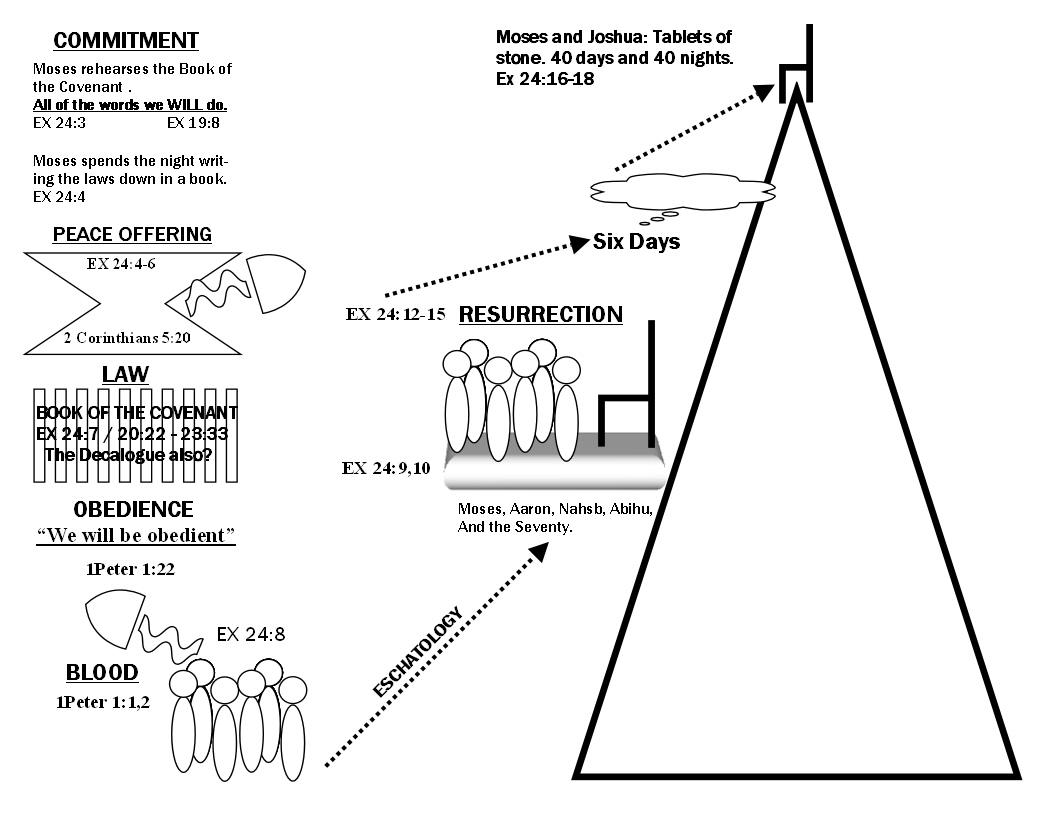
Interesting: Moses doesn’t take time to write it all down in a book until the people agree to the details. He then begins early the next morning in preparation for the ceremony. He has young men slaughter the appropriate sacrifices and throws some blood on the alter while procuring the rest in basins. But the ceremony begins with a peace offering—this is key. The fact that we were enemies makes the call to be reconciled with God paramount and is the theme of many gospel presentations in the New Testament. Our ministry is one of reconciliation:
2 Corinthians 5:18 – All this is from God, who through Christ reconciled us to himself and gave us the ministry of reconciliation; 19 that is, in Christ God was reconciling the world to himself, not counting their trespasses against them, and entrusting to us the message of reconciliation. 20 Therefore, we are ambassadors for Christ, God making his appeal through us. We implore you on behalf of Christ, be reconciled to God. 21 For our sake he made him to be sin who knew no sin, so that in him we might become the righteousness of God.
Ephesians 2:15 – by abolishing the law of commandments expressed in ordinances, that he might create in himself one new man in place of the two, so making peace, 16 and might reconcile us both to God in one body through the cross, thereby killing the hostility. 17 And he came and preached peace to you who were far off and peace to those who were near.
So far, we have two critical elements to include in our gospel presentations: trust (commitment: “follow me”), and reconciliation (peace with God).
Moses then read the Book of the Covenant which would be Exodus 20:22-23:33. When the people once again agreed to obey, he threw the remainder of the blood on them. Again, at this point, no law from the Book of the Covenant has yet been obeyed, but the commitment to do so resulted in the sprinkling of blood. Peter makes a direct reference to this as well:
1Peter 1:22 – Having purified your souls by your obedience to the truth for a sincere brotherly love, love one another earnestly from a pure heart,
The Israelites were purified by obedience—that’s what brought the covering of blood. And this is a critical third element to any gospel: obedience—the willingness to obey “truth.” The Book of the Covenant, like the rest of God’s canon is “truth.” And only truth sanctifies:
John 17:17 – Sanctify them in the truth; your word is truth.
A commitment to the truth saves (2Thessalonians 2:10), the law then informs our sanctification. But “I will obey” brings the blood. Trust, reconciliation, obedience. Not necessarily in that order. In the application of the blood of Christ, the old self dies with Christ and is no longer enslaved to sin, but is now enslaved to the law by nature (Romans 7:25). We are enslaved to the law by nature because of the new birth made possible by Christ’s resurrection. We are endowed with the same power that raised Him from the dead (Ephesians 1:19, 20). Once again, 1Peter 1:1, 2 is a direct reference to this Old Testament passage:
To those who are elect exiles of the Dispersion in Pontus, Galatia, Cappadocia, Asia, and Bithynia, 2 according to the foreknowledge of God the Father, in the sanctification of the Spirit, for obedience to Jesus Christ and for sprinkling with his blood: May grace and peace be multiplied to you.
Moses and the other pre-designated individuals go up the mountain to meet God after the ceremony. The scene is inescapably eschatological. Eating a meal with God during this encounter points to the marriage supper of the Lamb in my book. In regard to the cup that symbolizes the new covenant in His blood, Christ said He would not drink of it again until that supper in His kingdom. The remembrance was instituted at what is commonly known as the last supper (Mark 14:22-25).
Not only does Matthew 4:4 and 2Timothy 3:16 state that ALL Scripture is efficacious, some estimate that 25% of the Bible is eschatological. And as we have seen in our Romans series, eschatology is gospel. The paramount questions on this wise are, how many resurrections, and how many judgments? The answers to these questions should match our gospel and thus reveal it. Being mindful of what we have learned in Romans, you can relate this to the third illustration:

Peter’s gospel emphasis is seen in the Sinai event. And our gospel should always include trust, commitment, reconciliation, obedience, and the death, burial, and resurrection demonstrated in Christ’s blood. Christ’s obedience to the cross should also be explained in relationship to our death and freedom from the law as well as our enslavement by nature to law through the new birth that endowed us with the Spirit’s resurrection power.
paul

My Answer to Justin Taylor and Pyro Blog Regarding the “Gospel-Centered” Take on “Gossip.”
 “None of these videos will make sense for anyone who doesn’t follow this brand of blogging or this brand of gospel centrism. I admit that.”
~Frank Turk
“By the way, the term, ‘gospel-centered’ saturates the Pyro blog, and it means much more than you think it does. Understanding the meaning of this term is key to understanding why they think the crying out on behalf of raped children is gossip…. This is much more than just a common understanding of how we are saved—this is a radical worldview.”
“Susan also came from such circumstances and slept one night in contemplation with a gun under her pillow. ‘Survivor’ is a word that is only worthy of irony in the minds of New Calvinists like Frank Turk who have a twisted worldview. And one only needs to read the SGM legal brief to know exactly who Frank Turk is mocking.
As the New Calvinist cartel circles the wagons around CJ Mahaney, an abnormal number of blog posts concerning “gossip” have appeared on the Evangelical blogosphere. I checked my calendar to see if perhaps February 12 is Gossip Awareness Day. Hmmmm, not finding it on the calendar.
Dan Phillips is one of the authors of the Team Pyro blog along with Frank Turk. Phil Johnson, most prominent in the John MacArthur venquilitrist show, is a former author on the blog. Phillips posted the exact same article that Justin Taylor posted (and the same day) on the Gospel Coalition blog. The post insinuates that the survival of a local church is paramount to all else. “Gossip” is a “church-killer.” Bill Gates would be asking me for money if I had a nickel for every time we hear this from the who’s who of New Calvinism:
Yes, yes, what they did to you is horribly wrong! But exposing this under any circumstances could destroy that church, and whoever destroys the temple of God will be destroyed by God!
Per the normal, an exegetical argument from the Bible was not executed, but rather run of the mill Reformed orthodoxy. That brings us to the gospel-centered motif that drives almost everything in the American church in our day. By the way, the term, “gospel-centered” saturates the Pyro blog, and it means much more than you think it does. Understanding the meaning of this term is key to comprehending why they think the crying out on behalf of raped children is gossip. And it starts with orthodoxy. In the Reformed construct, elders receive the word from God, and then repackage it in a way that can be understood by the totally depraved unenlightened masses. Hence:
It is wholly an issue of whether or not authority comes from God through the Scripture to the elders and pastors of your church and is therefore the basis for their credibility and their exercise of spiritual responsibility.
This was a comment made by Frank Turk in the comment thread of a Post by Johnson entitled “Should Type-R Charismatics Get A Free Pass?” Type-R refers to Reformed Charismatics. And yes, according to Team Pyro, they should get a pass because….
I have warm affection and heartfelt respect for most of the best-known Reformed charismatic leaders, including C. J. Mahaney, Wayne Grudem, and Sam Storms. [Let’s call them “Type-R Charismatics.”] I’ve greatly benefited from major aspects of their ministries, and I regularly recommend resources from them that I have found helpful. I’ve corresponded with the world-famous Brit-blogger Adrian Warnock for at least 15 years now and had breakfast with him on two occasions, and I like him very much. I’m sure we agree on far more things than we disagree about. And I’m also certain the matters we agree on—starting with the meaning of the cross—are a lot more important than the issues we disagree on, which are all secondary matters.
Got that? ALL other issues apart from their “meaning of the cross,” i.e., gospel-centered are “secondary.” This is the tie that binds. “Cross-centered” and “gospel-centered” are often used interchangeably. This is much more than just a common understanding of how we are saved—this is a radical worldview. The uniqueness of it can be further demonstrated by this:

We are glad that you admit it Frank. Refreshing. But before we continue, let me interject an example of the kind of hypocrisy that comes part and parcel with this worldview. Here are the five points outlined in the post by Pyro and TGC blogs:
1. Ask, “Why are you telling me this?”
2. Ask, “What’s the difference between what you’re telling me and gossip?”
3. Ask, “How is your telling me that thought, that complaint, that information going to help you and me love God and our brothers better, and knit us closer together as a church in Christ’s love?”
4. Ask, “Now that you’ve told me about that, what are you going to do about it?”
5. Say, “Now that you’ve told me about that, you’ve morally obligated me to make sure you talk to ____ about it. How long do you think you need, so I can know when this becomes a sin that I will need to confront in you?”
But yet, consider this by Phil Johnson:
Shortly after that (in early 1992), John MacArthur, Lance Quinn, and I met with Paul Cain and Jack Deere in John MacArthur’s office at Jack Deere’s request. Deere wanted to try to convince John MacArthur that the charismatic movement—especially the Vineyard branch—was on a trajectory to make doctrinal soundness and biblical integrity the hallmarks of Third-Wave charismatic practice. He brought Cain along, ostensibly so that we could see for ourselves that Cain was a legitimate prophet with a profound gifting.
But Cain was virtually incoherent that day. Lance Quinn remarked to me immediately afterward that it seemed as if Cain had been drinking heavily. (In retrospect it seems a fair assumption that this may indeed have been the case.) Even Deere apologized for Cain’s strange behavior that day, but Deere seemed to want us to assume it was because the Spirit was upon Cain in some unusual way. They both admitted to us that Cain’s “prophecies” were wrong at least as often as they were right. When we cited that as sufficient reason not to accept any of their prophecies at face value, they cited Wayne Grudem’s views on New Testament prophecy as justification for ignoring the errors of prophecies already proven false while giving credence to still more questionable pronouncements (Ibid.)
If Johnson and Quinn confronted Cain about their concerns before they gossiped to Deere about it, they may have known exactly why Cain was acting the way he was. Furthermore, why was his demeanor relevant to what he specifically stated? Moreover, unbeknownst to Deere or anyone else for that matter, Cain could have been on medication for a medical problem. That is why Matthew 18 states that if you have a concern or issue with someone; first, go to them “ALONE.” This is only a grain of sand on the beach in reference to the kind of hypocrisy that is constantly vomited out of the Pyro blog and is indicative of their grossly distorted worldview.
What is that view? I have written on this extensively, but here I go again. Volumes could be written about this, but I am stating what coincides with the subject of justice. Luther’s Heidelberg Disputation was written about six months after the 95 Theses disputation. It is really the magnum opus of the Reformation. Calvin then took Luther’s HD worldview which he got from Pope Gregory/Augustine and developed it into a full orbed philosophical statement adorned with Bible verses. That would be the Calvin Institutes.
Reformed theology sees all reality from Luther’s Theology of the Cross. Basically, there is only two prisms from which to interpret the world: the glory story (existentialism), or the cross story (all reality is seen through objective redemption history outside of us). The cross story objectively categorizes all of life into two categories: God’s holiness and our sinfulness. Reality is the difference between the two and defines each more fully leading to greater and greater understanding. The first known counseling manual written by a clergyman was based on this concept; i.e., Gregory’s “Pastoral Care,” which is the model for most Reformed pastoral counseling in our day. Everything else is the glory story which is considered to be a gargantuan cesspool of subjectivism; specifically, anything at all about us.
….I think that the idea that Christians have been given The Truth, and The Truth is utterly embodied in Christ, and that we shouldn’t pretend like other explanations of reality have any worth because they have no eternal worth is, at its core, the only true monotheism. Its unquestionable that this is the reason we evangelize and not merely discuss our faith as if it was one of several viable choices (Frank Turk: Unleash the Response; Pyro blog).
It’s really a great gig if you want to believe in it. You can totally separate yourself from the realities of the world by focusing your whole mindset on our worthlessness, powerlessness, and hopelessness. All of our hope is in Christ and everything He has done—not anything we do. At all. To the degree that we are able to empty ourselves, we can detach ourselves emotionally from the world. This mindset enabled Puritan Christopher Love’s pregnant wife to write him a seemingly celebratory letter prior to his impending execution for meddling in English political affairs. Love could have escaped execution and not left his wife with a quiver-full to care for on her own by merely promising to mind his own business. He refused. Luther’s worldview, articulated by Calvin, spawned the most radical religious sect ever known to man—the Puritans, who are the envy of New Calvinists—particularity Phil Johnson.
Therefore, all of the misfortunes and tragedy of life serve to humble us. They eradicate the glory story, and lift up the cross story. Luther specifically states this idea in his HD. Life is about deathly humbling that brings about resurrections. These resurrections are experienced by joy in our deprivation for the clay vessel is being shattered and thereby allowing the glory of the cross to shine forth into the world. We have this treasure in earthen vessels; the glory of Christ, which can only be manifested when we suffer the way He did. All suffering is a cross event. Are we not to take up our cross and follow Him daily? Got cancer? Awesome! Another cross event! Been raped? What an awesome opportunity to show forth the forgiveness you have received! There aren’t any victims, just preordained cross opportunities.
This is why the Reformers were indifferent to suffering and didn’t take the concept of justice seriously. Calvin called justice, “mere iniquity” (CI 3.12.4). This is why New Calvinists disdain the idea of victims, justice, and “survivors.” They often preface these words in what we grammatically call scare quotes. Scare quotes preface the word with the idea of “supposedly,” or “so-called.” So, let me give you an example from Pyro blog:
OK: enough is enough. I’m opening this post and the comments below for one reason only: SGM “Survivors”.
Note the scare quotes utilized by Frank Turk. Interesting. You see, Susan and I counsel people who have left abusive church organizations, and when we asked one counselee to tell us about other families that left—this is what we heard:
Some turned their back on the faith. Some do church at home, and some committed suicide. Not many marriages survived.
Susan also came from such circumstances and slept one night in contemplation with a gun under her pillow. “Survivor” is a word that is only worthy of irony in the minds of New Calvinists like Frank Turk who have a twisted worldview. And one only needs to read the SGM legal brief to know exactly who Frank Turk is mocking.
This would also explain why Pyro continually defends the president of SGM, a defendant in the class action sexual abuse lawsuit filed against SGM. The following screen shots from Pyro illustrate this below, including Frank Turks indictment of SGM whistleblower Brent Detwiler:


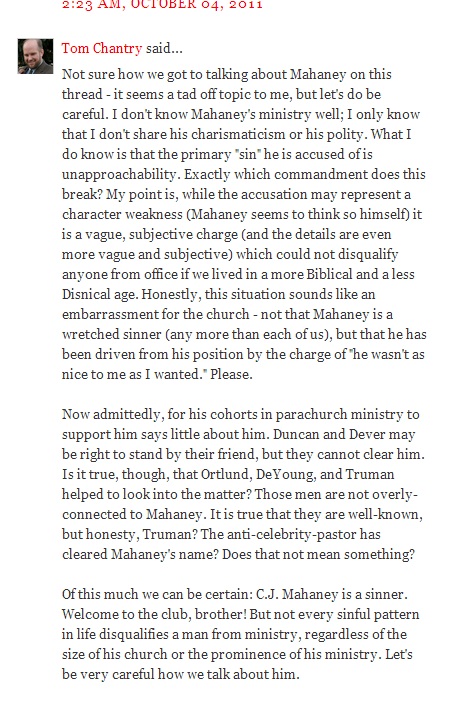


This Reformed worldview is the reason for the present-day tsunami of spiritual/sexual abuse in the church. While the Reformed accuse dispensationalists of escapism their doctrine is a gnostic-like escape from the here and now. It has always appealed to intellectual elitists and run along the upper socio-economic paths. It avoids the messy, painful experience of fighting for the most vulnerable among us. Embracing pain and suffering as the gateway to joyful resurrections is the pastoral easy-button. This gives them time to blog about the “deep things” of God and supply cover for abusers.
The logic is the same, the mentality is the same, and the behavior is therefore the same: coldblooded, vindictive, and controlling.
paul




10 comments