The Christocentric Redemptive Historical Hermeneutic and “Touchdown Jesus”
 When you are Reformed, you have to get to heaven by faith alone. It’s easy being saved by faith alone, but how do you live the Christian life by faith alone? It would seem that there is stuff in the Bible that God tells us to do. But if we obey, that’s works salvation. What to do?
So the Reformers came up with a way to get to heaven by faith alone via being continually/perpetually saved by faith alone. Hence, we must “preach the gospel to ourselves every day.” Self-serve perpetual salvation. So, that necessitated making the whole Bible about salvation. Instead of reading the Bible for instruction on kingdom living, the Bible became a way to live by the same gospel that saves us until the end.
How do we pull that off? Well, we make every verse in the Bible about Jesus’ “personhood.” Hence, “He’s not a precept, He’s a person.” “It’s His-story.” “It’s not about what we do—it’s about what Jesus has done” etc. So, how do we make every verse in the Bible about Jesus? Just “look to Jesus.” There is no better example of how this works than the infamous “Touchdown Jesus.” I explain in another article:
The Bible is full of symbolism and rich imagery—more so than most literature. And that presents a grave danger. We don’t have the liberty to go into the Bible with the bull of our imagination in a china shop. Imagery and ambiguous verbiage can become idols that are a god of our own making because variances of interpretations are myriad. You merely pick the one of your own imagination and preference, or the same from the musings of others. So here is the point: we can make passages like Exodus 25-27 a tool for creating truth of our own making. In fact, whole denominations are formed based on interpretations of the imagery in these chapters.
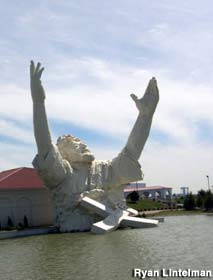
What better example than the infamous “Touchdown Jesus” that was an icon of a church in Monroe, Ohio. The statue of Jesus was 60ft. high and was merely a couple of hundred ft. from I-75. That is, until it was struck by lightning. The flames could be seen for miles in the night and the pictures thereof can be best described as apocalyptic. The next day, it was the talk of the nation. But telling was the hundreds of testimonies recorded on the news and in newspapers; i.e., “what the image meant to me.” Yikes! The hundreds of different interpretations were staggering, and the statue never spoke one word! Most interesting was a comment by an unbeliever who worked in the Monroe area: “Obviously, God did it.” Often, there is a disconnect between the secular mindset and the Christian mindset which involves the disintegration of common sense that is a natural endowment; mysticism often abandons the matter and faith becomes a license for mindlessness.
The appeal of idols is the supposed objective prism that leads to subjective “truth.” That’s the appeal; we can make idols speak the truth of our own preference. When a verse of Scripture has to be about Jesus, whatever our imagination comes up with is correct because it’s about Jesus, and if it’s about Jesus, a Jesus outcome must be correct.
It’s a Touchdown Jesus approach, and is the taking away and adding to the word of God on steroids. Good luck to those who propagate it.
paul
The Brilliant Dr. Ed Welch and Gospel-Driven Failure
 As the resurgence of the Authentic Calvinism pandemic spreads across this country, the absurdity becomes easier to write about every day. In the name of faith, the way Christians are being led into turning off their minds is astounding. But it is a rheostat modus operandi, so those who are being gradually assimilated into this philosophy don’t see it happening. Unfortunately, the lost world and Christian producers are perplexed by all of this.
CCEF is the counseling education wing of Westminster Seminary. Dr. David Powlison, Paul David Tripp, and Dr. Ed Welch, among others, have effectively spread this philosophy throughout the rest of the biblical counseling world. An indifferent attitude toward humanity in general is the result. Different world philosophies will perceive humanity differently. But more and more, Christianity is in league with nihilism which is a kissing cousin to authentic Reformed theology.
It has its roots in Gnosticism which has always been an elitist philosophy among the upper class. Philip J. Lee classifies Gnosticism as an upper socioeconomic phenomenon in his book, Against the Protestant Gnostics. It is no accident that New Calvinism is primarily an upper class phenomenon. Those who have to live in the real world to survive are perplexed by the logic; i.e., those who have to maintain a real job (or three jobs) in a horrible economy to survive. They have to trust Christian academia to deliver up the deeper things of God’s truth that they don’t have time to study, and pay good hard-earned money for it. Perhaps in all of church history, this sacred trust has never been violated in a greater way than in our day. Lee also classifies it as driven by hopelessness with the solution being an escape from realty. At the crux of Reformed theology is the idea that all reality is perceived from understanding how worthless we are as the way to understand God’s holiness. This enables us to abandon the pain and reality of the present world. Happiness is replaced by resurrection experiences that bring joy in understanding our utter worthlessness because we are completely free from the consequences. Hence, as one New Calvinist stated it:
What, then, is the subjective power of this message? Firstly, we find that there is real, objective freedom, the kind that, yes, can be experienced subjectively. We are freed from having to worry about the legitimacy of experiences; our claims of self-improvement are no longer seen as a basis of our witness or faith. In other words, we are freed from ourselves, from the tumultuous ebb and flow of our inner lives and the outward circumstances; anyone in Christ will be saved despite those things. We can observe our own turmoil without identifying with it.
This is really the primarily appeal of Reformed theology: sanctified escapism through worm theology. Dr. Welch recently posted Being a Loser and the Freedom to Fail on CCEF’s blog. It begins this way:
After accepting a CEO position at a non-profit, in which he could make or break the organization’s future, he said, “I believe that one of the great comforts of the gospel is the freedom to fail.” I heard this echoed recently by a friend when he made a somewhat risky vocational decision. Though he struggles with the opinions of others, he was able to say: “the worst I can do is fail.” He smiled as he said it, and I rejoiced in his spiritual maturity, which clearly surpasses my own.
There are so many benefits available in the death and resurrection of Jesus. The freedom to fail is a fine one, given how most of us feel like a failure.
The metaphysical stupidity of this is revealed in the following rhetorical question: Who would like to have a gospel-centered heart surgeon scheduled to perform your quadruple bypass? As you’re being wheeled into the operating room, he looks at you with a smile on his face as says: “I believe that one of the great comforts of the gospel is the freedom to fail.”
This philosophy is wreaking havoc on the church en masse, and then Christians are going to these guys to fix the problem! It’s like going to Dr. Kevorkian for the following presentation problem: “I’m suicidal.” The brilliant Dr. Welch continues:
Then listen to Scripture. You’ll find a number of divine responses. Here are just two.
The brother in humble circumstances ought to take pride in his high position. But the one who is rich should take pride in his low position, because he will pass away like a wild flower. (James 1:9-10)
Consider how you, as a brother in humble circumstances, have been singled out from the beginning of time to belong to God and, as you throw your lot in with Jesus, you have all of Christ’s inheritance. Your stature, indeed, is quite high.
I appreciate those words, and sometimes they are helpful, but I find more comfort— and some humor—in these:
For consider your calling, brothers: not many of you were wise according to worldly standards, not many were powerful, not many were of noble birth. But God chose what is foolish in the world to shame the wise; God chose what is weak in the world to shame the strong; God chose what is low and despised in the world, even things that are not, to bring to nothing things that are, so that no human being might boast in the presence of God. (1 Cor.1:26-29)
In context, the apostle Paul is actually speaking to the problem of false teachers like Ed Welch that intimidate Christians of the lower uneducated socioeconomic class with vain philosophy. Paul’s point is that God uses those of the lower class to refute puffed-up intellectuals with His wisdom. Welch uses these same verses to make the case that we should glory in our ineptness. Not so. The opposite is true.
I am presently in a deep study concerning God’s wilderness Tabernacle. He had specific plans concerning the Tabernacles construction, but also left much of the project to the creativity of the Israelites. He also demanded a skillful performance. All that was instructed was to be performed, “skillfully.” And our sanctification is no different. We are to make the best of the talents we have been given. Christ had no comforting words for those who do not approach our duties in sanctification with all zeal. The Tabernacle wasn’t built by spiritual slackers. Drawing from Welch’s last paragraph, these are NOT the words that I will be speaking to Susan as they are wheeling her in for surgery next month:
(Speaking softly, while stroking her hair softly): now Susan, I have chosen a gospel-centered surgeon for you. He has freedom in Christ, so he is not judged by the world’s standards—he has the freedom to fail. And you know sweety, we all fail every day. He also told me that like most of us, he feels like a failure. So my dear, let’s give this man the freedom to be human—after all, it’s not about what we do, but what Jesus has done. There are more important things in life than boasting about a successful surgery.
Though we may find humor in what is ridiculous, these are the chief surgeons of the biblical counseling movement in our day. And that’s not funny—it’s terrifying.
paul
The Potter’s House 2/17/2013: The Gospel According to Moses; Part 2

NOTE TO FRIENDS OF PPT:
No! I have not converted to Judaism. Church of the Messiah is a Christian movement that explores Judeo-Christian roots. Remember, the “church” was predominately Jewish for the first (approximately) fourteen years from Pentecost. I am doing three Saturday lessons there from Exodus. We are finding them to be a nice supplement to our Romans series.
LESSON PLAN
Like last week, we will observe overarching principles, and then examine details as time allows. More than likely, today will be basic principles, especially in regard to how we approach the text, and then next week will be Googleology. You will get what I mean by that later, but I am in the process of doing a lot of research on the tabernacle particulars. Though this lesson stresses approach, it is not discounting the fact that truth is often concluded in the arena of council from different perspectives. But our goal ought to be God’s goal.
Moreover, this brings up a much larger issue in our day: many pastors are not honest in regard to their approach to any given passage of Scripture, especially in regard to the Christocentic hermeneutic. Most parishioners really have no idea what they are being fed. That needs to change.
APPROACH
Well, here we are, we are at the portion of the Old Testament where God gives Moses instruction for the portable temple that the Israelites will be using for their place of worship. I will at least speak for myself and say that when you approach a body of Scripture like this, you say to yourself, “What do you do with this?”
But that question becomes a crucial starting point: What, in fact, do we do with this? And is there a right approach and a wrong approach? And does it matter? Should there be a goal in the approach? Yes, and I will interject part of my theses here: It’s based on Exodus 19:5,6:
Now therefore, if you will indeed obey my voice and keep my covenant, you shall be my treasured possession among all peoples, for all the earth is mine; 6 and you shall be to me a kingdom of priests and a holy nation. These are the words that you shall speak to the people of Israel.
This is really the hermeneutic for what follows. Once the Israelites agree to that, God sets out to build the holy nation. It starts with a covenant, a preliminary civil law, and now the planning for the center of worship. It is also predicated on the following: the capability of his people (priests), the sufficiency of God’s wisdom (a holy nation), and the responsibility of God’s people (obedience), and His goal of holy nation. What we have here in Exodus is the beginning process for building that nation, and its collision with the milieu of life. The apostles make it clear that we are to learn how to live life from what we learn of these events (1Corinthians 10:6).
The Bible is full of symbolism and rich imagery—more so than most literature. And that presents a grave danger. We don’t have the liberty to go into the Bible with the bull of our imagination in a china shop. Imagery and ambiguous verbiage can become idols that are a god of our own making because variances of interpretations are myriad. You merely pick the one of your own imagination and preference, or the same from the musings of others. So here is the point: we can make passages like Exodus 25-27 a tool for creating truth of our own making. In fact, whole denominations are formed based on interpretations of the imagery in these chapters.
What better example than the infamous “Touchdown Jesus” that was an icon of a church in Monroe, Ohio. The statue of Jesus was 60ft. high and was merely a couple of hundred ft. from I-75. That is, until it was struck by lightning. The flames could be seen for miles in the night and the pictures thereof can be best described as apocalyptic. The next day, it was the talk of the nation. But telling was the hundreds of testimonies recorded on the news and in newspapers; i.e., “what the image meant to me.” Yikes! The hundreds of different interpretations were staggering, and the statue never spoke one word! Most interesting was a comment by an unbeliever who worked in the Monroe area: “Obviously, God did it.” Often, there is a disconnect between the secular mindset and the Christian mindset which involves the disintegration of common sense that is a natural endowment; mysticism often abandons the matter and faith becomes a license for mindlessness.
We find a starting point in this discussion. Obviously, God was teaching then and now through Exodus 25-27. But what is He teaching? I will be honest with you; this can be one of the easiest bodies of Scripture to teach in the entire Bible. All you have to do is Google “Jewish Tabernacle” and document the mass of opinions surrounding the elements of the Tabernacle. Then, you present multiple views on each, and say the magic words, “What do you think?” Note that verse ten of the first chapter concerns the Ark of the Covenant. The lesson can be over at that point just on discussion of why God wanted certain materials used and what they symbolize. Googling, “Why did God want gold used in the Tabernacle” yields 2,510,000 results in .29 seconds. That was easy.
RESPONSIBILITY
In our postmodern world, the philosophers smile knowingly and say, “See, 2,510,000 opinions, just on gold in the Tabernacle; hence, we really can’t know anything for certain.” Therefore, people in our culture make big bucks spreading the gospel of we can’t know anything for certain—it’s great work if you can get it. This must be rejected by God’s people with prejudice. Why? Let’s let Moses speak to that in Deuteronomy 29:29;
The secret things belong to the Lord our God, but the things that are revealed belong to us and to our children forever, that we may do all the words of this law.
With this one sentence spoken by Moses in circa 1500 BC, postmodern thought is turned completely upside down.
So, we want to honor God in these passages. Our God is a God of love. He will never deny our desperate pleas for answers. James said to pray for wisdom, especially in the midst of trials. There is something to know right there—we can know—we can possess wisdom. But yet, that’s not the end of the story. God delights in His creation, and He created intellect. He delights in His subjects endeavoring to seek Him with their God-given intellect. He rewards those who seek Him. According to Peter, even angels desire to study and investigate the mysteries of God. God is one who colabors with His servants. Many things we will never understand, but be sure of this, we will be responsible for what we are able to know as He has gifted each person, and he will not be pleased with those who bury their brains and then give Him what is His when he returns. At least invest your brain in something that will gain a little interest for Him, but He expects much more. This is controversial, but let me slip it in. Please do not get exercised over this. I am just little ole’ Paul Dohse and my opinion will not bring the world to an end anytime soon.
The Jewish wisdom construct is completely antithetical to Protestant thought. The Jewish wisdom construct holds each person responsible for the sum and substance of the intellect that God has gifted them with. If you don’t believe that, show me one place in the New Testament where Christ didn’t respect the intellect of a person. Good luck. This is not the Reformation viewpoint. Their viewpoint was predicated on the idea of the preordained enlightened few ruling over the unenlightened masses. Like their Romish counterparts, the philosophy is grounded in spiritual caste. Remember, God gave the Book of the Covenant to Moses first—true. But it was also read to the people and made clear that they were responsible for all of it. And that is the pattern throughout the rest of God’s canon. Remember, God desires a kingdom of priests. What’s a priest? This doesn’t exclude the need for the organization of leadership, but yet the point of responsibility is made.
CONTRADICTIONS?
The first thing I would like to look at is God’s mathematical hermeneutic. You say, “Oh yes, the symbolism pertaining to the measurements of the Tabernacle!” We could start with the fact that the Tabernacle was about 40 ft. long, and I could sit back and let fate do the rest while sipping my latte. In fact, if you Google “The Jewish Tabernacle was 40 ft. long” you get 2,790,000 results in .34 seconds. That was easy. Now look, I am not discounting symbolism in these things, but let me share the safe and valuable point I would like to make. If you don’t do the logical math, God’s word can appear to have contradictions. In The Decalogue, we are commanded to not make any image on earth or in heaven for the purposes of worship. But yet, in the instructions for the Tabernacle, Moses is instructed to do exactly that. What’s the math? Don’t do this + God says to do that = don’t do that unless God specifies otherwise. In this case we can deduct that when we make images of things in heaven, bad things happen. But when we do it under God’s instruction, good things happen. In some things we have liberty, but in others, we should do it under God’s tutelage. “But Paul, according to the pastor, God told them to build the Touchdown Jesus.” No he didn’t. God’s word never contradicts itself, and it fully equips us not to be led astray. Which brings us to our next point.
GOD’S OBJECTIVE TRUTH
The whole Mt. Sinai event and the wilderness experience screams of God’s objective truth. The Israelites had been in Egyptian bondage for over 400 years. God extracts them in an act of divine intervention. We are talking about at least 200 years of Egyptian saturation. How much of the Abrahamic worldview and the customs that supported it remained? I assume very little. The Decalogue and the Book of the Covenant, when set against Egyptian culture, was probably culture shock. We may assume that God gave them the first stepping stones that they could bear. Remember, all of this must be seen through the execution of what God and His people agreed to by the covenant—that they would be a kingdom of priests and His holy nation in the world.
But what we have here is wilderness deprogramming away from the rest of civilization. God is rebuilding His people from the ground up. He first reveals His intentions, but set against the slavery they are accustomed to, He seeks their agreement regardless of the fact that He is God. It could even be argued that He displayed Himself to them in power before seeking their agreement. He is God, but yet seeks a mutual fellowship. It’s not an I’m God so it’s my way or the highway mentality. A healthy thing to remember is the fact that in the end, God and His city come down to Earth to dwell with man.
Nevertheless, when it comes to the loving principles that are the only ways that will truly heal, God is completely uncompromising. There is a way that heals, and a way that doesn’t heal. We will find God completely uncompromising when it comes to that wise. And in regard to what we read in this wilderness experience, it is the wisdom of God in action as set against the milieu of life and there is much to be learned from it.
THE SUFFICIENCY OF GOD AND HIS TRUTH
Another thing the wilderness event teaches us is that God and His wisdom are sufficient. God didn’t bring anybody in from the outside to help. To the contrary, staying clear of outside influence is continually emphasized. This takes place in the wilderness for that reason. All truth is not God’s truth—truth is what God says it is. If Egyptians happen to stumble upon something useful, God will let us know, but a clock that doesn’t work isn’t useful because it is right twice a day. If any truth in the Book of the Covenant or the prescribed ways of worship seem to parrot that of the Egyptians, God sanctifies it, not the mere similarity. And facts used in the commission of falsehood are not truth, truth has a moral aspect. We must see the wilderness event as God’s prescription for a holy nation that pleases Him. A full-orbed thinking manual for life and godliness is assumed. What was good for God’s holy nation is certainly sufficient for our lives. We are talking about a nation. This includes the full spectrum of individual thinking to the principles of civil government. Again, certainly, this is sufficient to inform our individual lives.
CONCLUSION
Therefore, the Old Testament should not be seen as culturally obscure or intellectually archaic. This would indeed be a grave miscalculation. We have in our very hands the account of God rescuing His people from what is the epitome of the world: Egypt. We have the detailed account of God’s intentions: to reeducate his people and equip them for becoming His holy nation in the world. This is rather major. Furthermore, the “experts” of the world are not invited to the seminar. Whoever they are, we don’t need them. The assumption is that they are from a nation. So are we. Does their nation have some wisdom that can aid us in being more holy? Did God forgot something? Sure, they have things we can use for practical matters; more than likely, the Tabernacle was made from materials that they brought from Egypt. But the manner of worship and how the materials are used are sanctified by God.
We are not free to interpret these passages anyway we want to. That makes the word of God a mere idol for our own device. We have a responsibility to rightly divide the word of truth. That means God has not left us without the means to do that. His word most inform the full spectrum of wisdom: metaphysics, epistemology, ethics, and politics. That is why we live by every word that comes from His mouth. And all this for one purpose, to build a holy nation for His glory. Next week, in our endeavor to understand what is behind God’s general contracting of the Tabernacle, this is what our eyes should be looking for….
how does this information make us a better and more holy nation for God’s good pleasure? Remember, the apostle Peter said that this is our specific identity (1Peter 2:2).

Why SBC Infighting Will Never End
I have been a Southern Baptist since 1983, and I certainly don’t remember any significant tension between Calvinists and Arminians in the association until recently. That’s because most Calvinists in the SBC have been Reformed Light for the most part. Circa 1981 began a concerted effort to take over the SBC with the rediscovered Reformed authentic gospel. That’s Luther’s centrality of the objective gospel outside of us. Until maybe ten years ago, few Calvinists in the SBC held to that soteriology. They are now known as “aggressive Calvinists” in the SBC.
Right, because the authentic gospel of the Protestant Reformation comes part and parcel with spiritual tyranny and indifference to human suffering. So, do I think it’s a good thing that SBC notables are pushing back against the “aggressive” Calvinists? No, not really. One camp is dying a painless death akin to gangrene, and the leaders of the other camp make you feel the pain. At least in the latter, you know something is going on that needs attention. Then you hope you can figure out the cure.
Fact is, both camps are Protestants, and Protestantism is founded on weak sanctification. And when you have weak sanctification, there will always be infighting. The Reformers had a different doctrine than Rome, but it was predicated on the same philosophy: spiritual caste. It’s an ancient philosophy that believes in the enlightened few ruling over the unenlightened masses. Rome was terrified that the unenlightened masses would get their hands on God’s word. They thought that was like handing a four-year-old a loaded musket or a really sharp knife. The Reformers had the same attitude even though they partook in the printing of Bibles. But one, it is unclear as to whether mass production was intended, and two, it is clear that the Reformers believed that the ignorant masses needed a dumbed down explanation of truth called orthodoxy. Hence, Calvin started the study Bible thing that is all the rage in our culture. Don’t forget, Luther and Calvin both believed that saints remain totally depraved. And don’t forget that two Catholics helped start the Reformation and were revered by Luther and Calvin till the end.
The Reformation was really a fight among philosopher kings for the mutton. And this fight between SBC academics is no different. T4G/TGC verses the John 3:16 crowd is all the same song and dance: philosopher kings fighting for the mutton. How do we know? I will tell you.
Jerry Vines, et al are not stupid; they know that this authentic Calvinism taking over the SBC is progressive justification which is clearly an in-your-face false gospel. So why not tell it like it is? Why not express outrage that the president of Southern Seminary propagates a false gospel? The answer to that is fairly simple: they don’t believe that the average Southern Baptist is able to understand what progressive justification is. And sadly, they are probably right, but no thanks to them. Look, I’m a pastor, and I can tell you that the American pastorate is saturated with the idea that the average parishioner cannot understand doctrine. Therefore, at best, Southern Baptists will live by biblical generalities and whatever the philosopher kings think they might be able to understand. The doctrinal illiteracy of the American church knows no bounds and that is by design; it reflects the spiritual caste mentality that has dominated the pastorate in Western culture for centuries.
Therefore, New Calvinists can’t be called on their false gospel; the other philosopher kings have to rally the spiritual peasantry around issues like the sinners prayer. While the SBC’s flagship Seminary is overseen by a heretic, thank goodness that resolution passed by an “overwhelming majority.”
paul



10 comments