The Elephant in the Room: The Historical-Redemptive Gospel
 How Should We Read Our Bibles?
There isn’t a bigger elephant in the Sunday school room or the sanctuary than the issue of Bible interpretation. The reason for this follows: the method of interpretation that comes natural to us is assumed.
What is that method? This gets into an area of study called hermeneutics (the theory of interpretation), and the two primary theories thereof are exegesis and eisegesis. These are big theological words that the average Protestant is not supposed to know. This is because the Protestant interpretation of the Scriptures is based on authority.
We will get to exegesis and eisegesis, but the crux of the issue is authority. The Reformers came from Romanism and clearly, their interpretive construct was based on authority; i.e., the average parishioner was not free to interpret the Bible and follow it according to one’s own conscience:
Rightfully and nobly did the Protestant Reformers claim religious liberty for themselves; but they resolutely refused to concede it to others. [1]
The very foundation of Protestant interpretation is based on authority; that is, the leaders dictate meaning. Therefore, traditionally, the need for Protestants in general to understand interpretive principles would be unnecessary, and as a result, Protestantism functions that way till this very day. In the early days of the Reformation, private interpretation was outlawed [2]; in our day, education regarding the tools needed to interpret the Bible are merely excluded.
This fact brings us to an interesting word, “orthodoxy.” Traditionally, this word is associated with “truth” as a synonym. This is not the case at all. Orthodoxy is the authority of truth based on counsels of any given sect. [3] The opinions of these counsels regarding the meaning of “truth” are known as “creeds” and “confessions.” These are “truths” (actually, opinions concerning the meaning of any given subject) repackaged for those who have limited understanding, and usually recited and learned through catechisms [4].
Authority Versus Individual Interpretation
Hence, Protestant interpretation is based on authority and not individual interpretation. The structure of this interpretive process is orthodoxy formed through counsels, distributed by creeds/confessions, and practiced through catechisms. In Europe and early Colonial America, it was a matter of civil law, in our day the process is tempered by the freedom to choose your own orthodoxy, but it is still orthodoxy. Once a typical American parishioner chooses who they want to believe, they will follow that leader as an authority. A like tendency caused the Apostle Paul to confront the believers at Corinth (1COR 3:1-9).
Of course, the authoritative method of interpretation is at the root of every cult. Traditionally, when people seek to find God, they begin by finding an authority that they are comfortable with. This is why many people prefer authoritative interpretation in a free society: it allows them to choose their own general truth while leaving the hard task of thinking to others. The Apostle Paul said this would be particularly problematic in the last days (2TIM 4:3-5).
The visible authority structure within the church is known as “church polity” or church government. [5] Again, the whole construct is based on authority. If authority is the interpretive prism, roles in the church are going to be seen as positions of authority rather than gifts. When Christ ministered here on earth, disciples were free to follow Him or not follow Him under their own free volition (JN 6:66-69). Christ made it clear to the disciples that their roles in the kingdom were not that of authority (Matthew 20:20-28).
The word “office” inserted in the English translations when associated with “bishop” or “deacon” were added in to the translations and do not appear in the Greek manuscripts while in other places these roles are spoken of as gifts (EPH 4:11-16). We have been given authority to proclaim the gospel of the kingdom on earth, but that is a vertical authority and not horizontal. Those who protest the gift idea versus the authority idea often cite the following text:
Hebrews 13:17 – Obey your leaders and submit to them, for they are keeping watch over your souls, as those who will have to give an account. Let them do this with joy and not with groaning, for that would be of no advantage to you.
The word for “obey” in this verse is πείθω (peithō) which means to persuade by argument. The word “submit” is ὑπείκω (hypeikō) which means “to surrender.” Here is the best rendering according to a heavy paraphrase:
Be persuaded by your leaders’ arguments from Scripture and don’t be stubborn in regard to the truth for this is no advantage to your own spiritual wellbeing. Besides, they have to give an account for how they led you, and let that account be a joyful recital to the Lord rather than a sorrowful report.
Why is this important? Because every person is personally culpable before God for following the truth, not men. Paul was an apostle, yet the Bereans verified what he taught according to their own understanding of Scripture (Acts 17:11). Paul told the Corinthians that he should only be followed as he followed Christ (1COR 11:1). Every individual will stand before God to give an account of the sum and substance of their own lives, not who they followed among mortals.
The Exegesis and Eisegesis of Hermeneutics
The theological word for the science of biblical interpretation is hermeneutics. The first consideration of hermeneutics must be exegesis and eisegesis. Exegesis draws conclusions from written text depending on the grammatical meaning and arrangement of words. Eisegesis approaches the text with an interpretive prism. One who uses the exegetical approach will even approach the text to learn how the text itself should be interpreted. Eisegesis assumes one must approach the text with a proper presupposition in order to properly understand it.
Therefore, this takes us right back to the basic question of authority versus the freedom of individual interpretation. Eisegesis will approach the text with a prescribed method of interpretation while exegesis will look for the best way to interpret the text from the text itself. The interpretive prism for eisegesis comes from an authority. The common contention from those of the authority camp is that everybody approaches the Bible with presuppositions, and this is unavoidable; so, it is important to use the right interpretive prism. Since we are supposedly incapable of approaching the Bible objectively, we should bow to their authority in regard to the proper interpretive prism.
Historical-Grammatical Versus Historical Redemptive: The Elephant in the Room
Eisegesis and exegesis really boils down to authority versus individualism, and so does the two major methods of interpretation in the church: historical-grammatical method and the historical-redemptive method. This is where we get into discussion about the elephant in the room. These two devices of interpretation yield completely different results. When we sit under any given teacher, he/she will be using one of these hermeneutics. The two different approaches will sound the same because each uses all of the familiar terms, “gospel,” “justification,” etc., but the terms mean different things in each construct. This is the elephant in the sanctuary and the Sunday school room that no one is talking about.
As suggested by the terms themselves, one interprets the Bible grammatically, and the other interprets the Bible through a Redemptive prism. The latter seems perfectly reasonable: “Isn’t the Bible primarily about Redemption?” The former would judge that assertion by a grammatical evaluation of the text. In other words, conclusions are drawn by the arrangement of words, their meaning, and what those words meant to people in that historical context. This is exegesis.
The redemptive method presupposes that the Bible is a gospel narrative about the works and personhood of Christ. It presupposes that this is the dominate theme of the Bible and everything else in the Bible is secondary and points back to Christ. For example, biblical commands aren’t really meant for us to obey, but rather illustrate the works that Christ has accomplished for us and illustrative of what we are unable to do. This bypasses the normal grammatical interpretation of an imperative expectation, and interprets it as a finished work that God in fact does not want us to do. This is assumed because of the redemptive presupposition. As Neo-Calvinist Paul David Tripp has said, biblical commands must be seen in their “gospel context.” [6]
The Gospel Transformation Study Bible and the Redemptive-Historical Gospel
Dr. Kathleen Nielson, in a promotional video for the Gospel Transformation study Bible, stated that the historical-redemptive theme is not imposed on the text, “it’s actually in there!” This, we by no means deny, but are the works of Christ and His personhood something that every verse in the Bible points to? Nielson, like many from the redemptive-historical camp, use the grammatical approach to determine that something is in the text, and then make that an authoritative interpretive prism.
I have talked face to face with pastors who use this hermeneutic. As one stated to me, “You might have to cover multiple chapters in one sermon in order to see the Christocentric theme God is showing you at the time.” Others are even more direct:
At this time, resist the temptation to utilize subsequent passages to validate the meaning or to move out from the immediate context. Remembering that all exegesis must finally be a Christocentric exegesis.
Look for Christ even if He isn’t there directly. It is better to see Christ in a text even if He isn’t, than to miss Him where He is. [7]
Again, we see that a “Christocentric exegesis,” something that is in the text grammatically, becomes the authoritative eisegesis. And this elephant is a big one, because interpreting the Bible this way is intrinsically tied to the gospel that comes part and parcel with the redemptive method. The historical-redemptive method is a tool for enabling the believer to live by faith alone in their Christian walk. The historical-redemptive method is actually a gospel in and of itself. To interpret the Bible grammatically is to conclude that God actually wants us to exert our own will in response to commands in the Bible. To proponents of the redemptive-historical method, this is works salvation because Christ is not obeying for us in our Christian life. This is what the Reformation motto, “Christ for us” means. The Neo-Calvinist John Piper has stated it this way, “[Christ] 100% for us.” [8] Piper has also said that “necessary sanctification” comes from faith alone in the Christian life (Ibid).
Therefore, according to proponents of the redemptive model, a historical-grammatical interpretation of Scripture necessarily leads to works salvation and making what we do in the Christian life “the ground of our justification” (Ibid). For all practical purposes, Paul David Tripp has stated such:
….and the Bible does call us to change the way we think about things. But this approach again omits the person and work of Christ as Savior. Instead, it reduces our relationship to Christ to “think his thoughts” and “act the way Jesus would act.” [9]
Here, Tripp concedes that the Bible can be interpreted grammatically, “and the Bible does call us to change the way we think about things.” Grammatically, one assumes the commandments are to us and that we are called to do them. Again, Tripp clearly recognizes this fact. But what does he say the results are?
But this approach again omits the person and work of Christ as Savior.
What happens if we “omit” Christ as “Savior”? Clearly, Tripp is stating that if we interpret the Bible literally and obey it, we are circumventing Christ’s salvific work. Much more than mere semantics are at stake here. The elephant in the room is absolutely huge! This is about the gospel.
The historical-redemptive method of interpretation is all the rage in contemporary Christianity. Projects and programs that promote this method of interpretation and target all age groups abound. Almost all Christian publishers are on board with the historical-redemptive hermeneutic. The latest project that has been unveiled towards this endeavor is Crossway Publishers’ The Gospel Transformation Bible. It will be available 10/19/13.
The subtitle is, “Christ in all of Scripture, Grace for all of Life.” This is typical of those who promote this method of interpretation and its gospel. Christians will assume that the title only pertains to justification by faith alone, but it doesn’t. “Transformation” or change has to do with the Christian life, and in the subtitle, “Grace” replaces “gospel” to veil the real crux of this doctrine. Basically, it teaches that Christians are transformed by continually revisiting the same gospel that saved them. Not only that, we keep ourselves saved by doing such. This is what is behind the Neo-Calvinist mantra, “We must preach the gospel to ourselves every day.” John Piper has said that the question is not only how one gets saved, but how one must use the same gospel that saved him/her to keep themselves saved. [10] Piper has also said that we must “see” the same gospel that saved us over and over again as a requirement to enter heaven. [11]
Note: This is what’s so critical about the Reformed historical-redemptive interpretative model according to many Calvinists, it enables us to fulfill what is “required of us” to enter heaven (Ibid). In essence, once saved, how we read our Bible determines whether we keep our salvation or not. So therefore, those who promote The Gospel Transformation Bible actually see it as a resource for maintaining one’s salvation.
The “Gospel-Driven” Life
The question that is invariably raised is, “How do proponents of the historical-redemptive model explain obedience and the Christian life?” Primarily, they say Christians must “experience” obedience, but must not be the ones who perform it in the Christian life. By revisiting the gospel afresh, the works of Christ are “manifested” in our lives. When this happens, the obedience is experienced by a willing, joyful spirit. As we use the historical-redemptive model to see how sinful we are (a deeper realization of our sin, the realization that originally saved us), and thereby gaining a greater appreciation for what Jesus did for us, we experience “vivification.” This is some sort of joyful rebirth. Proponents of this hermeneutic, primarily those of Reformed theology, refer to this as “mortification and vivification.” A “daily dying and rising,” a “living out of our baptism.” [12] [13]
The Origin of the Historical-Redemptive Hermeneutic
Where did this hermeneutic originate? Even though Martin Luther’s 95 Theses launched the Reformation, the framework of the Reformation’s doctrine and gospel was articulated by Martin Luther six months later. Essentially, Luther’s Heidelberg Disputation to the Augustinian Order in 1518 is the heart and soul of the Reformation. Calvin’s Institutes of the Christian Religion is a greatly expanded treatise of Luther’s framework. However, every fundamental element of Reformation doctrine can be found in Luther’s Disputation, and this by no means excludes the historical-redemptive hermeneutic. [14]
The primary theme of Luther’s Disputation is known as The Theology of the Cross. It was comprised of the glory story and the cross story. Luther believed that salvation must be maintained by an incessant emptying of self. One’s focus must be OUTWARD only. Any semblance of an inward look was the “glory story.” The outward focus on Christ and His works, and nothing about us whatsoever is the “cross story.” A beginning focus on the cross saves us, and a continued focus on the cross story keeps us saved the same way we were originally saved: by faith alone. Sola Fide also pertains to the Christian walk/life. The historical-redemptive model came from Luther’s Theology of the Cross.
Luther believed the outward focus and utter eradication of self leads to a subjective power displayed by the Holy Spirit that we experience. However, we are not to be concerned with it because there is no way for us to distinguish between our own efforts and those of the Spirit. [15] Mortification and vivification can be ascertained in Theses’ 16 and 17 of the Disputation.
Never have Christians been so oblivious to such a critical issue. What we believe about the gospel and how we convey it to the world is at stake. Every Sunday in America, historical-grammatical parents deliver their children to historical-redemptive teachers while clueless in regard to the ramifications. This reality actually creates mixed families and marriages via two different gospels. One spouse buys into sanctification by faith alone while the other one doesn’t. Eventually, you have a mixed marriage.
The issue with these two hermeneutics is not a matter of semantics and preference—these are two different gospels. This issue is the elephant in the sanctuary and the Sunday school room.
ENDNOTES
1. Nabu Public Domain Reprints: The Principles of the Westminster Standards Persecuting; William Marshall, D.D., Coupar – Angus. Edinburgh, William Oliphant & Co. 1873, p. 13.
2. Ibid., pp. 19-22, 28.
3. Bruce Overton: MacMillan’s Modern Dictionary; The Macmillan Co. New York 1943.
4. Ibid.
5. Ibid. designated as synonymous with “politic” : the science of government.
6. Paul David Tripp: How People Change; Punch press 2006, p. 26.
7. The Biblical Theological Study Center: A Christo-Presuppositional Approach to the Entire Scriptures; Max Strange. Online source: http://goo.gl/5sGjP).
8. John Piper: Desiring God .org blog: Video, If you had 2 minutes with the Pope, what would you say?
9. Paul David Tripp: How People Change; Punch press 2006, p. 27.
10. John Piper: Desiring God .org blog; How Does The Gospel Save Believers? Part 2. August 23, 1998 Bethlehem Baptist Church.
11. Ibid, Part 3.
12. Michael Horton: The Christian Faith: A Systematic Theology for Pilgrims On the Way; Zondervan 2011, p. 661.
13. Paul Washer: The Gospel Call and True Conversion; Part 1, Chapter 1, heading – The Essential Characteristics Of Genuine Repentance, subheading – Continuing and Deepening Work of Repentance.
14. In its fundamental elements. It was not referred to as the historical-redemptive hermeneutic for many years afterward.
15. Heidelberg Disputation: Theses 24.
Inseparable: The Reformation’s Principles of Persecution and its Gospel, Part One
 You can’t separate the gospel of the Reformation from New Calvinism, and you can’t separate that gospel from its practice. Part and parcel with the Reformation gospel is the insistence that church and state be united for the purpose of purifying “the realm.” The church is over the spiritual and the sacraments, and the civil magistrate should enforce the edicts of the church. The civil authorities may have oversight of practical matters, but to not enforce the edicts of the church in spiritual matters is to override God’s “power of the keys.” Ultimately, the state is the servant of the church. Be sure of this: the present-day New Calvinist movement sees America as a rogue government unwilling to submit to the power of the keys. They will gravitate towards any party willing to get in bed with the church as opposed to a government that is contra principles of persecution. The Reformation was predicated on principles of persecution.
What we need to understand in situations like the SGM class action lawsuit is that Mahaney et al think they are being subjected to authority that God has not approved. They will improvise as much as possible in creating a persecuting sub-culture while working to bring America into the beginnings of a church/state government, and any kind of ugliness thereof would be better than what we have now. Also, the outright rejection of an idea that the New Calvinist tsunami is a segue to remarriage with Rome and the prophesied coming super church/state empire of the antichrist is a naïve out of hand dismissal.
The persecuting principles of the Reformers were its first cries coming forth from the womb; specifically, in Scotland where the Reformation first found formidable life. This series of posts are based on William Marshall’s The Principles of the Westminster Standards Persecuting (William Marshall, D.D., Coupar – Angus. Edinburgh: William Oliphant & Co. 1873).
The book’s inside cover quotes contemporaries of the Reformation to frame the thesis of the book:
Persecution is the deadly sin of the Reformed churches, that which cools every honest man’s zeal for their cause, in proportion as his reading becomes more extensive—Hallam.
In regard to this thesis, every holocaust has had its cowardly bystanders wearing the uniform of the prosecutors while raising a safe objection. The following statement by John Owen exemplifies such:
I know the usual pretenses for persecution. “Such a thing is blasphemy,” but search the Scriptures, look at the definitions of divines, and you will find heresy, in what head of religion soever be, and blasphemy very different. “To spread such errors will be destructive to souls.” So are many things which yet are not punishable with death. Let him who thinks so go kill Pagans and Mahometans. “Such a heresy is a canker,” but is a spiritual one, let it be prevented by spiritual means; cutting off men’s heads is no proper remedy for it. If state physicians think otherwise, I say no more, but I am not of that college—Owen.
So, I disagree, but if the state agrees with the church, well, then I have to bow to their authority, but I disagree. And such will be the commentary of some New Calvinists if they ever obtain force from the state which apparently makes the sin sanctified—the fact that there are some goodhearted souls within the movement. Good men should keep their peace while heads roll because to label the movement as tyranny would be a “generalization.” The ideology is not to blame, only the men who don’t see things exactly the way we see them. The persecuted should also understand this and shrug their shoulders in agreement while gladly placing the noose around their own neck voluntarily.
In regard to the Scottish Reformers, Marshall stated the following:
The Protestant Reformers in leaving Rome did not leave all Romanism behind them. In particular, they brought with them the prosecuting principles of Rome, and worked them freely and vigorously in support of the Reformed faith. They changed the Pope but not the popedom,
And….
Rightfully and nobly did the Protestant Reformers claim religious liberty for themselves; but they resolutely refused to concede it to others.
John Knox, the vaunted Scottish Reformer, though primarily concerned with Catholicism, made it clear that no aberration of Reformed doctrine should be tolerated by the state. According to Marshall:
Knox, the father of the Scottish Reformation, and the presiding genius of it, brought with him to his native country the Geneva theocracy; and it was copied as closely as the differences between the Swiss republic and the Scottish monarchy would permit….Such was the Church and State system of the Scottish Reformers in those days; and hence the melancholy selections from their history which I have now to offer.
The first Parliament, in which the Reformers became ascendant, was held in 1560. It adopted a Protestant Confession; a “summary of tenets constituting the essence of the Reformed religion;” one of the “tenets” being the theocratic one, “that to kings and rulers it belongs to reform and purify religion.”
Marshall continued to state that the same Confession prohibited the practice of Catholicism or any other aberration of the Reformed gospel, and such violations would entail confiscation of goods for the first offence, “suffering” and “banishment” for the second, and “death” for the third violation. Marshall then concludes:
Thus the very first legislation of the Scottish Reformers was deeply tainted with persecution.
Marshall continues:
The same year [1561] the First Book of Discipline was framed by a Committee of the Kirk, of which John Knox was a leading member….”Seeing that Christ Jesus is He whom God the Father hath commanded onely to be heard and followed of His sheepe, we judge it necessary that His gospell be truly and openly preached in every church and assembly of this realme; and that all doctrine repugnant to the same be utterly repressed, as damnable to men’s salvation….that the obstinate maintainers and teachers of such abominations ought not to escape the punishment of the civill magistrate….We dare not prescribe unto you what penalties shall be required of such, but this we fear not to affirm, that the one and the other deserve death.”
Apart from this committee, according to Marshall, Knox stated the following in a public sermon:
None provoking the people to idolatry ought to be exempted from the punishment of death.
I will conclude this first part with Marshall’s assessment of how the Scottish Reformers took control of the Scottish press:
Our early Reformers claimed like control over the press. “Immediately after the Reformation, the General Assembly took particular notice of the four printing presses then in Scotland, and they were careful that nothing should be published, at least by ministers, till it was communicated to the brethren, and revised by persons appointed by them.”
Marshall’s book is widely available and cites extensive sources. It should have its own place on every Christian’s bookshelf. In part two, we will look at Marshall’s assessment of persecuting principles found in the Westminster Confession.
paul

Free download: tancpublishing.com
Deuteronomy 21:18-21: The Parent Trap; Stoning and Good Parenting are Mutually Exclusive
 Any good Protestant is always confused. It’s how the Reformers wanted us, and they did their job well. As William Marshall admitted in The Principles Of The Westminster [Confession Of Faith] Standards Persecuting, free thought and interpretation was only for Reformed leaders and not the spiritual peasantry. Like their Catholic predecessors, taking the sword to those who disagreed with them was in the confessions of faith, and fully embraced by Reformers like Knox, Calvin, and Luther. All three demanded the freedom to interpret Scriptures according to their own consciences, but this was never meant for the masses.
And obeying the Reformers was not a violation of one’s conscience; they were to assume their consciences did not know better than the Reformers. Likewise, the church state of that era declared by divine royal decree that obeying the state in violation of your conscience was not a violation of your conscience because the state declared it so, and since the state declared such, God would bind it in heaven.
Hence, confusion reigns in the evangelical church (because we are stuck someplace between freedom and orthodoxy), especially in regard to the relationship between the Old Testament and New Testament. Some sort of socio-historical metaphysical dichotomy is assumed. So, when we read Deuteronomy 21:18-21, confusion reigns:
18 “If a man has a stubborn and rebellious son who will not obey the voice of his father or the voice of his mother, and, though they discipline him, will not listen to them, 19 then his father and his mother shall take hold of him and bring him out to the elders of his city at the gate of the place where he lives, 20 and they shall say to the elders of his city, ‘This our son is stubborn and rebellious; he will not obey our voice; he is a glutton and a drunkard.’ 21 Then all the men of the city shall stone him to death with stones. So you shall purge the evil from your midst, and all Israel shall hear, and fear.
There is nothing strange from another socio-historical reality here, this is merely good counseling for parents. God made a promissory covenant with Abraham, used Egypt to grow his family into a nation, and then formed the nation at Mt. Sinai. They were his chosen nation among the nations, and it was a theocracy. The Law given was the national standard that covered civil, health, and wise living concerns. This also included good parenting. God would know about these things.
Right now, because of Israel’s rebellion, the kingdom is temporarily in heaven and not on earth during the times of the Gentiles. When that time is ended, God will reinstate his chosen nation on earth, and it will be a theocracy with Jesus Christ ruling the nations with an iron rod from upon David’s throne in Jerusalem. You know all of that persecution Israel has suffered from other nations over the years? That won’t be the case. See all of the injustice all around us? Won’t be happening. It will be nations done right. Perhaps that will be the motto: Israel; we do nations right. I think the Millennial Kingdom is the righting of wrongs prior to the new heavens and new earth where righteousness will dwell in perfection.
Now here, God’s counseling for parents to Israel posits some principles in regard to human nature, and specifically of the adolescent variety.
1. Loving parents sometimes had their children put to death. This wasn’t a process to save children from bad parents.
2. This act is not a reflection of poor parenting. In fact, it showed their overall wisdom as parents.
3. Children, once they reach a certain age, are responsible for their own actions. Imperfect parenthood will not save them from culpability before God. Bad parents were not stoned to death, bad children were.
4. Some children are simply stiff-necked, stubborn, rebellious, self-consumed, without conscience, haters of wisdom and wise counsel, and unable to be reasoned with. And they resolutely refuse to change.
5. Accountability in lesser forms brings about positive change away from being uncounselable.
6. Accountability in lesser forms can save a child from death.
7. The possibility of death saves from death. In other words, consequences teach us something about the actions leading up to the end result. Hence, removing consequences is a form of hatred that often feels like love, using some occasional opportunities to teach about mercy notwithstanding.
True, context is important here. We are not in that time or under that Law, so there are some modifications in APPLICATION, but the wisdom in regard to raising children is nonetheless to be drawn out.
In our time, this portion of Scripture is the key to dealing with out of control adolescents. There is hope for out of control adolescents if they understand that they are responsible for their own actions and those actions will increasingly compound and end in a bad way. This will save a child from death, teach about sin, bring peace to homes, and bring about change in thinking and behavior.
Unfortunately, many parents refuse to do two things that save their children from death:
1. Define their children biblically because they think it reflects on their parenting. It must be their fault that their child is uncounselable and cannot be reasoned with. However, God was a perfect parent to Israel; but yet, they rebelled and even murdered His Son.
2. Hence, they bear the blame and refuse to hold their children accountable.
This often results in their own death at the hands of the child (I TIM 1:9), the deaths of others in general, or the death of the child via the state or other circumstances. Parents do not see accountability as a vessel for wisdom and change. How bad can sin be if it has no consequences? Instead, the message is sent that children can always depend on mercy. The following of every desire that enters into their mind can depend on the mercy safety net because after all, God is a God of love.
He is, but He also hates children who don’t honor their parents. That fact can’t go away no matter how much we want it to. Parents think God will always forgive their children if they do. This isn’t so. Consequences in life point to eternal consequences if God is not honored as well. If children will not honor their parents, they will not honor God.
The commandment to honor parents is the “first commandment that has a promise.” By teaching our children to honor us and making this an unnegotiable option with increasing consequences for not obeying, we bring many blessings into their lives. Instead, parents make it about themselves by obeying their own unbiblical bad feelings. This particular issue has even led me to give merit to the idea of “false guilt.” If there is such a thing, this is it. Calling our children what God calls them is an act of love, but telling them they are good when they are rebellious is an act of hate that will lead our children to death. Hence, many of the vile think they are good because mommy told them so. And because they are good and God is so loving, the following of every evil desire will ultimately lead to a soft pat on the head by God. This is a most horrifying thing to put into the minds of children.
Be sure of this: it explains the abominable adolescent behavior that we hear of in today’s media.
Please note, the parents had to take the child to the ruling elders, or judges and state their case. They couldn’t do it on their own judgment or authority. This also pertained to older children still living at home. Apparently, this refers to one who will not listen to counsel, is lazy, and refuses to make their own way in life:
This our son is stubborn and rebellious; he will not obey our voice; he is a glutton and a drunkard.
Please note: here is the case that had to be made and judged by the elders:
and, though they discipline him,
The child would not be stoned to death in cases where the child was provoked to anger by the parents:
Ephesians 6:1 – Children, obey your parents in the Lord, for this is right. 2 “Honor your father and mother” (this is the first commandment with a promise), 3 “that it may go well with you and that you may live long in the land.” 4 Fathers, do not provoke your children to anger, but bring them up in the discipline and instruction of the Lord.
Please note: parents don’t punish, they discipline. And they instruct. This is worthy of repeating from a different angle:
Parents don’t punish, they discipline and instruct. Punishment makes it about the parents being inconvenienced. Punishment is what the government does. Punishment is the end of the line in many cases. Discipline has to do with hope, punishment is hopeless, and can also be likened to the final judgment of God. Life disciplines, hell punishes. Consequences as part of the discipline process warns of impending punishment.
The situation we have here in Deuteronomy is a full orbed construct of parental discipline and instruction that warns of an ultimate consequence for refusing to be teachable and insisting on being a perpetual source of sorrow to one’s parents. Here we have sorrowful parents leading their own son to a slaughter that they warned him of continually with tears. We know this because they were instructors, not punishers.
But even here there are certain realities that cannot be dismissed: a pleading along the way, and a change of heart as the stones come pouring in. The end result can discipline. These processes instruct. Perhaps the son finally sees the end of his folly and makes a final appeal to God. Perhaps he becomes like the thief on the cross.
There is also another angle that cannot be dismissed as well: parents are not assigned to a hopeless situation with no end in regard to adolescents who cannot be reasoned with and refuse to change. Even secular authorities understand that this situation will never end well, and as a necessity, offer parents a final solution. In most states, it is against the law for adolescents to be “unruly.”
Sadly, when an adolescent is entered into the program, it begins with a “contract” between the probation officer (the child is convicted and automatically put on probation), the parents, and the child. The contract is really a pretty good discipline plan. A continuum of contract infraction eventually leads to the final end: incarceration. I say this is sad because the secular authorities are way ahead of Christians on this. While we look at Deuteronomy 21:18- 21 as a contemporary metaphysical anomaly, in principle, it would make perfect sense to secular authorities.
Susan and I counsel people to first implement the secular contract (we have obtained a copy of it) in the home, and make the filing of an unruly child complaint the final solution there. The final solution of the secular process that still takes place in the home is incarceration. The parents take the child to be incarcerated rather than stoned. Unfortunately, most parents don’t see these processes as curative discipline/instruction and focus on the possibility of incarceration. This is the utter shame of the parent. Perhaps the children got rejection of wisdom from the parents themselves.
God said that this policy/counsel would have the following effect:
and all Israel shall hear, and fear.
If the government’s policy on unruly adolescents was more known among parents and society in general, would their be far less instances of youth crime and rebellion? I think so.
Fear is a great motivator. Remove fear of consequences, and the flesh will run rampant. The church’s overall ignorance in implementing practical anthropology in the sanctification process is evident. When was the last time you heard of this happening?:
1 Timothy 5:17 – Let the elders who rule well be considered worthy of double honor, especially those who labor in preaching and teaching. 18 For the Scripture says, “You shall not muzzle an ox when it treads out the grain,” and, “The laborer deserves his wages.” 19 Do not admit a charge against an elder except on the evidence of two or three witnesses. 20 As for those who persist in sin, rebuke them in the presence of all, so that the rest may stand in fear.
so that the rest may stand in fear.
Making much of consequences, noting the end of sin, has always had a purifying effect on the saints:
Acts 4:10 – Immediately she fell down at his feet and breathed her last. When the young men came in they found her dead, and they carried her out and buried her beside her husband. 11 And great fear came upon the whole church and upon all who heard of these things.
Parents must love their children by accessing them truthfully and biblically, and holding them accountable. This is discipline and instruction, not punishment. Paving a road to punishment in this life and the life to come is not love, it is hatred. We assume that loving our children comes naturally; that’s not true. We are commanded to love our children because we can unwittingly hate them by paving for them a road of death.
This is the ultimate parent trap.
paul
New Calvinism’s Contribution to the Church: it Reveals What Calvin Really Believed
“A question we often hear is, ‘What is the difference between an Old Calvinist and a New Calvinist?’ The answer: maybe the music style and dress code, but that’s about it, Old Calvinists that don’t know what Calvin really believed about soteriology notwithstanding.…. This is the one area where New Calvinists can recommend themselves: they have a firm handle on Calvinology.”
Once upon a time, there was a family in Christianville that was highly respected among all of the town’s people. They owned the town’s water purification plant and purified the town’s water with a formula that had been in their family for centuries.
Then a distant relative of the family moved into town. He was obviously a fellow of the baser sort. “Well, every family has a black sheep” the town’s people reasoned. But then they found out this relative had also purified water in other towns with the same family formula resulting in the death of thousands. Apparently, for the first few years, the formula appears to improve the health of people, but ill effects follow in the long term.
The prestigious family objected and insisted that the family member had tampered with the original formula. What will Christianville do now?
No doubt, New Calvinism must be exposed and stopped, but its unwitting service to the church should not go unmentioned: it has exposed the original family formula, the same formula that evangelicals have fustigated the Catholic Church for over the years. For some reason, we are willing to buy into the idea that three Catholics founded an anti-Catholic movement and never stopped being Catholics. Truly, our Enlightenment forefathers would be ashamed of us for believing such.
Supposedly, the “Reformers” modified the original formula enough to bring life out of death. Now there is debate between the New Calvinists and the Old Calvinists in regard to the originality of that formula. Old Calvinists say the New Calvinists modified the formula. That’s not the case. A question we often hear is, “What is the difference between an Old Calvinist and a New Calvinist?” The answer: maybe the music style and dress code, but that’s about it, Old Calvinists that don’t know what Calvin really believed about soteriology notwithstanding. This is the one area where New Calvinists can recommend themselves: they have a firm handle on Calvinology.
Old Calvinists are obviously very threatened by what the New Calvinists have brought to light. Those who proudly label themselves with something that they misunderstood to begin with fall significantly short of being impressive. But their dilemma is understandable to a point. The Reformers interpreted all reality through Martin Luther’s Theology of the Cross. This seeks to use the Bible as a tool for gospel contemplationism only. The sole purpose of the Bible is to show us our sin (mortification), and God’s holiness, leading to a gospel visitation afresh (vivification). The Bible aids us in perpetual rebirth experiences. This is known as the Redemptive Historical use of the Bible.
But that is not the normative in regard to how people interpret literature or reality. Naturally, we interpret literature grammatically. Intuitively, we are exegetical beings. The way words are arranged in a sentence interprets our realty. Until Adam named the animals, they had no part in reality. You say, “Yes they did, even though they were unidentified, they were there—they had presence.” No, the word “unidentified” gives them their meaning in reality. Words interpret our reality. In the Redemptive Historical construct, all the words in the Bible must serve to show us our need to be saved perpetually—those words must continually show us our ruined state so that we can experience salvation (vivification) rather than being a participant in it via sanctification. That would be works salvation according to the Reformers.
To simplify this, it is fair to say that the Reformers brought an Eastern way of interpreting reality into the Western religious world. So, as Christians throughout the centuries read their Bibles, they are/were naturally drawn away from the original Reformed epistemology. The New Calvinists basically rediscovered the original epistemology of the Reformers. Their interpretive construct is critical for living by faith alone in sanctification as a way to maintain justification.
The proof in the pudding is interaction with Old Calvinists who scoff at the idea that New Calvinism is the same thing as their vaunted Reformed heritage. I cite here a debate I recently had with Calvinistic pastor Bret L. McAtee on a social network. The debate represents something that the laity must overcome in regard to seeking out truth and standing for it: academic antagonism. This is a Reformed mainstay. Much of the populous is eliminated from the debate because of a standard set up by the Reformers themselves. This was borrowed from the Eastern concept of social caste. The Reformers established a whole other standard of truth through councils, creeds, and catechisms attended by, “Divines.” Notably, those who drafted the Westminster Confession of Faith are known as the “Westminster Divines.” This is no more or no less than the Hindu Sage. True, Hinduism looks inward to interpret reality beyond the five senses while Reformed theology looks outward. But both interpret reality through an anti-grammatical construct. New Calvinists state implicitly that a literal, grammatical interpretation must bow to the redemptive interpretive process and its mortification /vivification experience.
Point being, throughout my debate with Pastor Bret L. MacAtee, he resorts to this, you’re a peasant and I am a sage communication technique. He also tried to use the Reformed debate technique of assumptive metaphysics. What’s that? That is the assumption that the reality established by the Reformers is truth because they state it so. And this has worked well. Most Christians associate truth with “orthodoxy.” Orthodoxy is a truth established by men. The Reformers play word games here by calling documents such as the Westminster Confession, “subordinate truth,” but that is disingenuous. In fact, those who reject orthodoxy are referred to as “heterodox,” and as we shall see, MacAtee makes that synonymous with rejecting the gospel itself. Part and parcel with debating a Calvinist is their attempt to set the metaphysical parameters of the debate. I did not allow this to happen.
Let’s review these important points: a debate with a Calvinist will always involve academic antagonism and metaphysical assumption.
Note: Posts on social internet threads don’t always appear in the intended order because of varied response times to particular points. Also, it was a lengthy thread, and only the posts that articulate my summation here are included, and in the order that best clarifies the points that are being made.
McAtee got the ball rolling by using academic antagonism right out of the gate:
BM: And that New Calvinism is authentic Calvinism is a howler of a statement.
PD: Bret, It’s a “howler” because you get your information from men. I get my information from 6 years of research on the Reformation and the Calvin institutes. You are clueless.
BM: LOL … Your indicting the wrong Chap Paul. Want to compare our reading over the years in Calvin and Calvin studies?
You’d lose.
And … I’ve read your books as well.
Those well versed in Reformed theology need not bow to this antagonism. We are in the truth business and are not bound by the musings of men. One must bring the debate to one or more subjects where Calvinism is vulnerable; in this case, progressive justification:
PD: Oh, so you believe in Progressive Justification?
BM: Nope … I believe in eternal justification, objective justification and then subjective justification … rightly explained and understood.
PD: “Nope”? Really? So tell me what book and chapter in the Calvin Institutes where Calvin talks about Progressive Justification.
PD: You there Brett?
BM: Yes yes Paul … I’ve read your open letter. An open letter that suggests you don’t know what you’re talking about and are a theological novice.
Two things here. First, his description of what he believes about justification is in fact New Calvinism to a “T.” New Calvinists, like Calvin, believed that grace remains completely outside of the believer and is only objective truth outside of us. Justification during our Christian life continues and is experienced subjectively. “Eternal justification” could refer to election or final justification which he seems to have left out. Nevertheless, note his description in relationship to the New Calvinist mantras, the centrality of the objective gospel outside of us and the subjective power of the objective gospel. The illustration below shows the kinship between New Calvinism and what McAtee stated:
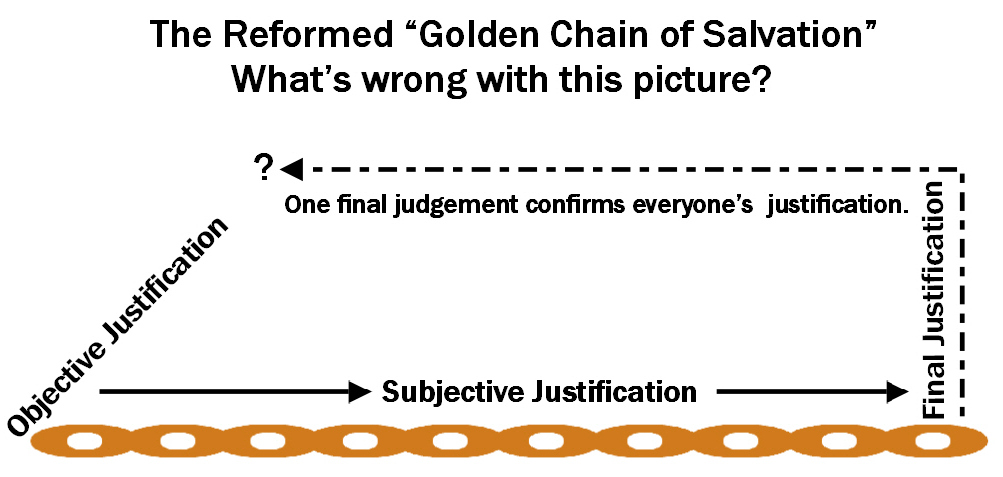
One Achilles’ heel for Calvinists is while denying that they believe in progressive justification, the title of book three and the fourteenth chapter of the Calvin Institutes is, “The Beginning of Justification. In What Sense Progressive.” This is what I was trying to get McAtee to explain. He once again resorted to academic antagonism by calling me a “theological novice” while this is one of several questions that he wouldn’t answer.
PD: So, when Calvin said that justification is progressive, he really didn’t mean that justification is progressive. Is that what you are saying?
BM: I’m saying you don’t know the difference between progressive and perpetual.
PD: Both move forward in time.
PD: No? Am I missing the definition in its “gospel context”?
PD: Both move forward in time—yes or no big guy.
This is the whole motif that Calvinists are on some higher plane of understanding to the point where what seems obvious to the peasantry really isn’t realty. Hence, “progressive” and “perpetual” are supposedly different concepts that the common man is unable to understand. Again, I ignored the academic antagonism and asked him if both words have the idea of moving forward in time. He wouldn’t answer the question; instead, he posed a question based on Reformed pseudo-church history:
BM: Only an idiot could believe that Cardinal Sadolet and Rome hated Calvin because he agreed with them on Justification.
This response combines academic antagonism and metaphysical assumption. The assumption is that, according to the Reformed motif, there was a great gulf in the view on justification between Rome and the Reformers, and the only reason Rome hated the Reformers is because of their diametrically opposed views on justification. This is not reality at all for a couple of reasons. First, Calvin got his theology from St. Augustine who is a celebrated spiritual hero in the Catholic Church till this day. Secondly, Augustine, Luther, nor Calvin ever renounced their own membership in the Catholic Church. Here is how I sated it further along in the debate:
PD: Bret, let me also say that a cursory observation of church history shows that Augustine, Calvin, and Luther never left the Catholic Church. Yet, you are incredulous that their take on justification would be basically the same. So is it, A. You just don’t know any better, or B. You know, but you are deliberately keeping your flock dumbed down? Augustine was a die-hard Catholic till the end while Calvin cites him more than 400 times in the Institutes. And the idea that they had the same basic approach to justification as Rome is an over the top idea?
McAtee continued to bear down with heavy doses of academic antagonism and metaphysical assumptions with this statement:
BM: Like all idiots you are reading Calvin through a keyhole and then reinterpreting him through the Keyhole instead of letting his whole corpus of thought inform you. You are an example of someone that got in way over his head into areas he was not yet ready to think about. You may yet return to Biblical Christianity Paul and leave your heterodox ways and thinking.
Please remember at this point that he refused to answer the simplest of questions: did Calvin mean progressive by “progressive,” and does both perpetual and progressive have the idea of moving forward in time? Instead, he suggests that all of Calvin’s massive literary droning would have to be read and studied to properly understand what Calvin meant by the very use of specific words. Of course, that is a ridiculous notion, but not a rare argument among the Reformed. The same argument is often used to defend John Piper who has also written a huge mass of literary droning. Note also that my “heterodox” (other than orthodoxy) is likened to a departure from “Biblical Christianity.” The mode of operation is to demean and argue from a reality that results in the desired outcome.
McAtee then introduces another Reformed technique of debate that we will call, drowning by orthodoxy. He then began to copy and paste a mass of Reformed orthodoxy that would take two days to read. The assumption is that I am not familiar with what he pasted into the stream. It assumes the response, “Oh my! I don’t understand any of this deep orthodoxy! And there is so much of it! Hark, I know nothing! What to do? His mind is so far above me!” Actually, I am very familiar with the information posted, especially his references to articles in the Trinity Review. Ironically, if that is a strong enough word, the founder of the Trinity Review bought into New Calvinism during the 90’s. I stated the following later in the thread:
PD: Furthermore Bret, you said you read my book, but yet you quote John W. Robbins’ Trinity Review above to make your point. As clearly documented in my book on pages 63-65, I show that Robbins bought into the Forum’s teachings via the SDA theologian Robert Brinsmead in 1995. As you know, New Calvinism came out of the Forum and Graeme Goldsworthy is popular in the movement till this day. Robbins reprinted Brinsmead’s magnum opus on justification in the Trinity Review, yet, you cite The Trinity Review as proof that Calvinists are not New Calvinists. Now if anything is funny, that is.
One of his several references to the Trinity Review follows:
The Trinity Foundation – Calvin on the “Pernicious Hypocrisy” of Justification by Faith and Works
http://www.trinityfoundation.org
That some serious slippage has occurred away from the classical Protestant doctrine of justification sola fide has been well documented in many religious publications. Certain teachers – Douglas Wilson.
Furthermore, his excerpts copied and pasted from the Calvin Institutes contained things like the following:
…a great part of mankind imagine that righteousness is composed of faith and works [but according to Philippians 3:8-9] a man who wishes to obtain Christ’s righteousness must abandon his own righteousness…. From this it follows that so long as any particle of works-righteousness remains some occasion for boasting remains with us [Institutes, 3.11.13].
This is yet another technique used by Calvinists to confuse those who are trying to nail their false doctrine by making distinctions between justification and sanctification—they continually refer back to justification and Sola Fide. Any attempt to make theological distinctions between the two is answered with more and more Reformed sanctification by justification orthodoxy. Even his Institute pasting was in context of what the Trinity Review said about it. This elicited the following responses from me:
PD: Brett, smothering me in all of this orthodox propaganda isn’t answering my question. Have you read CI 3.14 on what Calvin said about progressive justification or not? Why are you citing other people? I asked you as someone who says he reads the CI. You deny that your information comes from men, and then you cite a bunch of men. I want to know your specific evaluation of CI 3.14
[Note: all of his citations avoided the aforementioned title of CI 3.14 which resulted in the following reply: “I’m citing Calvin Paul. Read the quotes from the Institutes. You can’t make CI 3.14 disagree with the rest of what Calvin said on the subject. Good grief man … this is elementary hermeneutics” ( i.e., progressive doesn’t mean “progressive” because of other things Calvin wrote)].
PD: Right, he is applying justification truth to sanctification, so what’s your point?
PD: No Bret, I am not confused by your discussion of sanctification in a justification way.
I will shortly pause here and introduce yet another debate tactic of the Calvinist: the divine unction by a philosopher king declaring me to be unregenerate. Simply pronouncing a curse on your opponent has to be the quintessential easy button:
O Foolish Dohse … who has bewitched you?
Like all good Calvinists, McAtee believes in Calvin’s “power of the keys” that gives Reformed elders the power to loose or bind sin on earth. I have received several veiled threats by Reformed elders to bind my sin on earth. Some not so veiled.
McAtee’s comment about “elementary hermeneutics” was also addressed:
PD: “Elementary hermeneutics” ? Which hermeneutic? You act like there is only one.
BM: I’m talking about the place of Hermeneutics in interpreting literature. You’re hermeneutic on Calvin sucks.
PD: Redemptive or Grammatical Bret? Which one?
BM: Paul … I’m not talking about hermeneutics in terms of reading Scripture. I’m talking about hermeneutics in terms of reading Calvin which should be Historical Grammatical.
Here, McAtee seems to infer that there is a different hermeneutic for interpreting literature, and a different hermeneutic for interpreting the Bible. I will let that statement stand on its own and move on to the part of the debate where McAfee concedes that perpetual forgiveness, the same kind of forgiveness that saved us, needs continued application in the church:
PD: (Quoting BM) “Do you really want to advance the idea that Calvin and Rome agreed on Justification? Is that really your position Paul?” (Answer) Both held to a linear gospel which is progressive justification. They disagreed on how to get from justification to glorification.
But when it gets right down to it, BOTH by ecclesiastical absolution. Citations from CI available upon request.
BM: LOL!
PM: Bret, may I list the very fair questions you have not answered yet?
BM: Paul … purple.
BM: Paul … should I post again the very fair quotes from Calvin’s own pen indicating that he did not believe in progressive justification and so did not believe that one had to be sanctified before one could be justified?
PD: Of course not, he believed sanctification was progressive justification. But here is the better question: Why did he believe a justifying forgiveness of sins needed to be continually sought IN the church?
After all of his vehement denial that Calvin believed in a progressive justification, he begins to concede that a perpetual forgiveness for sin in the church for the purpose of keeping us justified is needed:
BM: “Not by righteousness which we have done, but according to his mercy he saved us”; that being justified by his grace, we might become the heirs of everlasting life, (2Ti 1: 9; Tit 3: 4, 5). By this confession we strip man of every particle of righteous, until by mere mercy he is regenerated unto the hope of eternal life, since it is not true to say we are justified by grace, if works contribute in any degree to our justification. The apostle undoubtedly had not forgotten himself in declaring that justification is gratuitous, seeing he argues in another place, that if works are of any avail, “grace is no more grace,”
(Rom 11: 6). And what else does our Lord mean, when he declares, “I am not come to call the righteous, but sinners to repentance?” (Mat 9: 13). If sinners alone are admitted, why do we seek admission by means of fictitious righteousness?
BM: Why do we expect corn plants to be irrigated outside a corn field?
PD: So, the point you are making here agrees with Calvin in context of sanctification. Justification must continually be sought in sanctification to retain a just standing before God.
BM: Section 11. In addition to the two former arguments, a third adduced against the Sophists, to show that whatever be the works of the regenerate, they are justified solely by faith and the free imputation of Christ’s righteousness….[Finally, BM quotes from the infamous 14th chapter of book three from the Institutes. Curiously, he only cites the section. Calvin’s point in sections 9-11 (BM’s long copy and paste is omitted here) is that Christians are not capable of doing any meritorious work before God. Therefore, they need “perpetual reconciliation” in the church. BM cites theses sections from the Calvin Institutes to make the very point that he denied throughout the whole debate].
PM: Bret, why did Calvin believe that a justifying forgiveness had to be continually sought in the church?
BM: The Church is the body of Christ where Christ is proclaimed. Where else would one go to be reminded that they are forgiven? [Do Christians need to be “reminded” that they have been forgiven? Peter said that we only forget that we are forgiven when we fail to ADD works to our faith (2PET 1:5-11)].
PD: Bret, he wasn’t talking about being “reminded” he was talking about perpetual “reconciliation.”
PD: What does “reconciliation” mean Bret?
PD: Do we need continual reconciliation?
BM: Paul … does Christ ever live to intercede for us?
Why?
PD: So, you are saying that is to keep us justified?
BM: Are you saying that we could be justified without His ongoing Intercession? Could we be justified by a Christ who was not at the right hand of the Father as our continual advocate? If Justification is merely in the death of Christ then there was no reason for Him to have been resurrected, ascended and set apart for the continual Priestly work of Intercession.
PD: Then why did Calvin teach that we have to continually seek that forgiveness in the church? If Christ is doing all of the work in heaven?
BM: Why do we expect corn plants to be irrigated outside a corn field?
[Note: We have to keep ourselves justified by staying in the cornfield of justification. He is conceding what he denied throughout the whole debate].
BM: The Church is the body of Christ. The minister the voice of Christ pronouncing the reminder of sins forgiven.
[Note: We have to be continually reminded that we are forgiven in order to stay justified].
PD: So, there is a continued need for forgiveness of sins to remain justified?
BM: Ask Jesus,
5 Then he poured water into a basin and began to wash the disciples’ feet and to wipe them with the towel that was wrapped around him. 6 He came to Simon Peter, who said to him, “Lord, do you wash my feet?” 7 Jesus answered him, “What I am doing you do not understand now, but afterward you will understand.” 8 Peter said to him, “You shall never wash my feet.” Jesus answered him, “If I do not wash you, you have no share with me.” 9 Simon Peter said to him, “Lord, not my feet only but also my hands and my head!” 10 Jesus said to him, “The one who has bathed does not need to wash, except for his feet, but is completely clean.
PD: You make my point for me. Calvin clearly said the whole washing of the body is continually needed.
PD: Jesus said it isn’t needed, Calvin said it is. That is, “the washing” which Calvin called “ablution.”
McAtee unwittingly cited John 13:5-10 in an effort to make his point. Jesus’ point in the passage is that once a person is washed (justified: 1COR 6:11) they are clean and have no further need of washing. There is a need to seek forgiveness for daily sin that disrupts our family relationship with God. That is probably what Christ is talking about in regard to the washing of feet. I would probably include 1John 1:9 here as well. This is further seen in what Christ told the woman at the well. When one drinks the water of salvation, they will never thirst again. In other words, there is no need for a perpetual returning to the well of salvation/justification.
paul



34 comments