Know Your Cuts of Calvinism
Originally published June 2, 2013
1. Total Depravity: Pertains to the saints also.
2. Justification by Faith Alone: Pertains to sanctification also.
3. Mortification and Vivification: Perpetual death and rebirth for living by faith alone in sanctification to maintain justification. The reliving of our baptism “again and again.”
4. Double Imputation: Christ’s passive obedience to the cross for justification, and His active obedience as a substitution for our obedience in sanctification.
5. Deep Repentance (aka Intelligent Repentance): Seeks the death of mortification in re-experiencing our new birth.
6. New Obedience (aka New Fruit): The experience of Christ’s active obedience in sanctification (vivification).
7. The New Birth: Perpetual mortification and vivification.
8. The Objective Gospel: All reality is interpreted through the redemptive works of Christ.
9. Christ for Us: Christ died for our justification, and lived a perfect life for our sanctification.
10. The Imperative Command is Grounded in the Indicative Event: Biblical commands show forth what Christ has accomplished for us and what we are unable to do in sanctification. Works are experienced only as they flow from the indicative event of the gospel.
11. Neo-Nomianism (New Law, aka New Legalism): The belief that we can please God by obeying the law in sanctification.
12. Progressive Sanctification: The progression of justification to glorification.
13. Progressive Imputation: Whatever is seen in the gospel narrative and meditated upon is imputed to our sanctification, whether mortification or vivification.
14. The Golden Chain of Salvation: See cut 12.
15. Good Repentance: Repenting of good works.
16. In-Lawed in Christ: Christ fulfilled the law perfectly and imputed it to our sanctification.
17. Redemptive Historical Hermeneutics (the Christocentric Hermeneutic, aka the Apostle’s Hermeneutic): The Bible as historical narrative for the sole purpose of showing forth Christ’s redemptive works.
18. Faith: A neutral entity within us with no intrinsic worth that is able to reflect the object of its focus outside of us. The object of focus can be experienced within, but remains outside of us.
19. The Heart: The residence of evil desires and faith. It can be reoriented (the “reorientation of the heart” or “reorientation of desires”) to reflect Christ via mortification and vivification.
20. Flesh: The world realm where evil is manifested and experienced.
21. Spirit: The Spirit realm where the imputed works of Christ are manifested and experienced (not applied through our actions).
22. Christian Hedonism: Seeks to experience the joy of vivification.
23. Obedience of Faith: New Obedience.
24. Christ in Us: “By faith,” and faith only has substance and reality to the degree of the object it is placed in; i.e., Christ outside of us.
25. Vital Union: Makes experiencing the gospel possible. Makes mortification and vivification possible.
26. Eclipsing the Son (aka the Emphasis Hermeneutic): Focusing on anything other than Christ. Anything that is not seen through a Christocentric prism creates shadows that we live in. The obstacles that create the shadows may be truth, but they aren’t the “best truth.” “They may be good things, but not the best thing.”
27. Sabbath Rest: Sanctification. We are to “rest and feed” on Christ for our Christian life. The primary day this is done is Sunday. Through preaching and the sacraments we “kill” (mortification, or the contemplation of our evil and misery) resulting in vivification throughout the rest of the week.
28. The Subjective Power of the Gospel: The manifestation of the gospel that flows from gospel contemplationism. We never know for certain whether it is a result of our efforts or the Spirit’s work (although the Spirit’s work is always experienced by joy); hence, the power of the objective gospel is subjective (Heidelberg Disputation: Thesis 24).
29. Mortal Sin: Good works by the Christian not attended by fear that they may be of one’s own effort (HD 7).
30. Venial Sin: Good works by the Christian attended with fear (HD 7).
31. Power of the Keys (aka Protestant Absolution): Reformed elders have the authority to bind or loose sin on earth (Calvin Institutes 3.4.12).
32. Redemptive Church Discipline: In all cases to convert one to cuts 1-31. This redeems them to the only one, true faith. This can be a long process, and said person is not free to leave a given church until the elders bind or loose.
33. Preach the Gospel to Yourself: See cuts 1-32.
The Nature of God
 I believe incredibly exciting times await God’s people as they break free from the Protestant Orthodoxy Dark Ages. The key will be the realization that God wrote the Bible for the average individual. We have an example of this regarding the nature of God; a subject thought to be too deep for the average disciple.
Our only head is Christ who teaches all, and the idea of being taught assumes the ability to understand. God’s people need to simply let the words in the Bible say what they plainly say, and we are individually responsible for doing so. One must free their minds from the tyranny of orthodoxy and journey into the Bible with their own God-given mind, and they will be responsible to God alone for doing so.
What then does the Bible teach us about God’s nature? The Bible states that God is love:
Beloved, let us love one another, for love is from God, and whoever loves has been born of God and knows God. Anyone who does not love does not know God, because God is love.
So we have come to know and to believe the love that God has for us. God is love, and whoever abides in love abides in God, and God abides in him.
Obtaining God’s Love
Protestant orthodoxy has a peculiar teaching known as the “vital union.” According to Reformed tradition, we maintain this vital union of “Christ in us and us in Christ” by “preaching the gospel to ourselves.” This is done by searching for sin in our lives so that we can return to the cross for forgiveness resulting in increased salvation. The following chart publicized by several Reformed organizations illustrates the process:
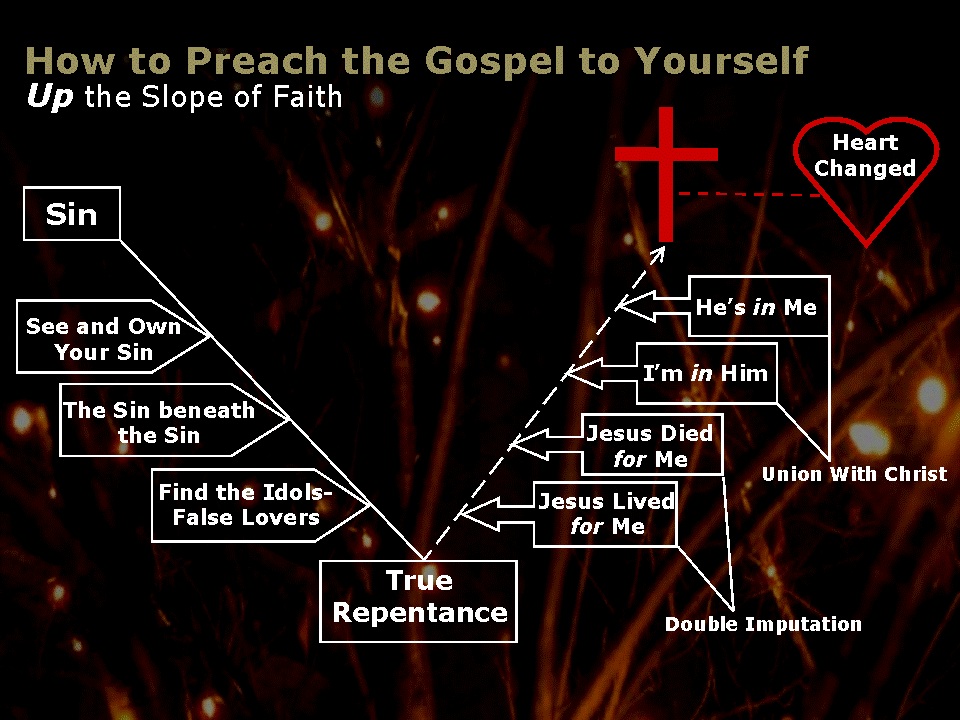
In case you think this is a “biblical” process for best results in growing as a disciple expressed in the illustration by “Heart Changed,” think again as illustrated by another chart published by several Reformed organizations as well:

In this chart, what is growing? Us, or our “salvation”? Many Reformed teachers in our day are fond of telling us how to “keep ourselves in the love of God” by “preaching the gospel to ourselves every day.” In fact, if we change, the following chart from the same camp shows the consequences:

…our salvation gets smaller! In contrast, we obtain God’s love once, and for all time, by believing in His Son, and experience assurance of that love but walking according to our new being.
Little children, let us not love in word or talk but in deed and in truth. By this we shall know that we are of the truth and reassure our heart before him…
But according to Protestant orthodoxy, if we make every effort to love God and others instead making every effort to find more and more sin in our lives, the gospel effect in our lives is diminished.
The Nature of God
How we obtain the love of God as prescribed by Protestant orthodoxy flows from its tenets regarding the nature of God. Primarily, God is defined as sovereign. Rather than sovereignty being an aspect of God’s nature, it is made to be the primary organizing principle—not love. This is an important distinction for those who take part in the exodus from Protestant darkness; will God’s nature be defined by a grammatical and exegetical interpretation of Scripture, or an interpretation based on orthodoxy?
Clearly, the Bible states that God is love. So, how does the Bible define love? Let’s see:
1Corinthians 13:1 – If I speak in the tongues of men and of angels, but have not love, I am a noisy gong or a clanging cymbal. 2 And if I have prophetic powers, and understand all mysteries and all knowledge, and if I have all faith, so as to remove mountains, but have not love, I am nothing. 3 If I give away all I have, and if I deliver up my body to be burned, but have not love, I gain nothing.
4 Love is patient and kind; love does not envy or boast; it is not arrogant 5 or rude. It does not insist on its own way; it is not irritable or resentful; 6 it does not rejoice at wrongdoing, but rejoices with the truth. 7 Love bears all things, believes all things, hopes all things, endures all things.
8 Love never ends. As for prophecies, they will pass away; as for tongues, they will cease; as for knowledge, it will pass away. 9 For we know in part and we prophesy in part, 10 but when the perfect comes, the partial will pass away. 11 When I was a child, I spoke like a child, I thought like a child, I reasoned like a child. When I became a man, I gave up childish ways. 12 For now we see in a mirror dimly, but then face to face. Now I know in part; then I shall know fully, even as I have been fully known.
13 So now faith, hope, and love abide, these three; but the greatest of these is love.
The so-called Reformed gospel of sovereignty calls for the total inability of man to love God even after their definition of conversion. One well known Reformed theologian wrote a book titled One Way Love. This staple Protestant belief is defined in the doctrine of double imputation which calls for the imputation of Christ’s alien righteousness to be imputed to our lives apart from anything we do other than preaching the gospel to ourselves. Much is made of living the Christian life by faith alone in order to maintain our “just standing.”
What it boils down to is God creating evil for His own glory. Whether you consider the teachings of Martin Luther or John Calvin, the founding fathers of Protestantism, this is an irrefutable fact. Luther taught that God created mankind with a passive will; in other words, a will that can only act if acted upon from an outside source. This testifies to God’s nature as defined by sovereignty. Hence, certain people are predetermined to suffer for eternity. In regard to this, John Calvin stated,
[God] arranges all things by his sovereign counsel, in such a way that individuals are born, who are doomed from the womb to certain death, and are to glorify him by their destruction.
~Institutes 3.23.6
I again ask how is it that the fall of Adam involves so many nations with their infant children in eternal death without remedy, unless it so seemed meet to God?…The decree, I admit, is dreadful; and yet it is impossible to deny that God foreknew what the end of man was to be before he made him, and foreknew, because he had so ordained by his decree.
~Institutes 3.23.7
This is contrary to love which is the true nature of God, being “kind,” and “Love does no wrong to a neighbor; therefore love is the fulfilling of the law.” The Reformed even make it a point to say that God did no wrong by creating man in an evil state because the end cause is God’s glory. If God brings good out of something evil, in the final analysis it is good because the end is good. It is also said that God created evil to make good better. However, that still does not dispose of the kindness issue. Love CANNOT be unkind to ANYONE.
Furthermore, it does not seek its own way, and you can insert “its own glory” in that list as well. Moreover, love does not rejoice in evil for any outcome, and always rejoices in truth and not the temporary demise of truth for some kind of better outcome. That notion is absurd.
In the final analysis, one of God’s attributes is sovereignty, but sovereignty is not the organizing principle of his nature because his nature is love.
paul
The Baptism of the Spirit Fulfills All Righteousness—Not Jesus’ Law-keeping
 Then Jesus came from Galilee to the Jordan to John, to be baptized by him. John would have prevented him, saying, “I need to be baptized by you, and do you come to me?” But Jesus answered him, “Let it be so now, for thus it is fitting for us to fulfill all righteousness.” Then he consented. And when Jesus was baptized, immediately he went up from the water, and behold, the heavens were opened to him, and he saw the Spirit of God descending like a dove and coming to rest on him; and behold, a voice from heaven said, “This is my beloved Son, with whom I am well pleased.”
However you want to slice or dice justification (dikaiosynē), it is plainly stated by Jesus that His baptism by John “fulfill[ed] all righteousness (also dikaiosynē).” In what way? I think it is safe to say that the baptism of the Holy Spirit fulfills all righteousness. In other words, it’s the baptism of the Spirit that makes us righteous new creatures and not an imputed righteousness based on perfect law-keeping. The baptism of the Spirit also includes following Christ in death as well; ie, the death of the old self.
The word baptism (baptizō) means “to immerse,” so what actually happened can be paraphrased in this way:
“John immersed Jesus momentarily under the water; when He came up, behold, the heavens were opened to him, and he saw the Spirit of God descending like a dove and coming to rest on him; and behold, a voice from heaven said, “This is my beloved Son, with whom I am well pleased.”
Right then, the Father proclaimed that He was pleased with Christ which kind of shoots down the idea that a perfect obedience to the law was required by Jesus for purposes of making us righteous via imputation. The only imputation that the Bible speaks of is our sin imputed to Christ, not Christ’s righteousness imputed to us, though that mantra is widely accepted as gospel truth.
In contrast, the righteousness of God made us just through the new birth which makes us God’s literal children. We are righteous because we are literally born of God in His likeness. The new birth, or baptism of the Spirit, creates a new state of being, not a mere imputation of perfect law-keeping by Jesus.
I believe this event connects righteousness to the new birth apart from the law as stated in Romans 6:
What shall we say then? Are we to continue in sin that grace may abound? 2 By no means! How can we who died to sin still live in it? 3 Do you not know that all of us who have been baptized into Christ Jesus were baptized into his death? 4 We were buried therefore with him by baptism into death, in order that, just as Christ was raised from the dead by the glory of the Father, we too might walk in newness of life.
5 For if we have been united with him in a death like his, we shall certainly be united with him in a resurrection like his. 6 We know that our old self was crucified with him in order that the body of sin might be brought to nothing, so that we would no longer be enslaved to sin. 7 For one who has died has been set free from sin. 8 Now if we have died with Christ, we believe that we will also live with him. 9 We know that Christ, being raised from the dead, will never die again; death no longer has dominion over him. 10 For the death he died he died to sin, once for all, but the life he lives he lives to God. 11 So you also must consider yourselves dead to sin and alive to God in Christ Jesus.
We know that the promise of the Spirit was made to Abraham and Christ (Galatians 3:16, Psalms 16:10, Acts 2:27, 13:35), and that the same Spirit that raised Christ from the dead also raises us to new life as well (Ephesians 1:19,20, Romans 8:11, 2Corinthians 4:14).
I believe John’s baptism of Jesus and what followed took place to establish this truth: it is the new birth that establishes justification apart from the law.
paul

The Heidelberg Disputation Series Part 11, Theses 19-22: Martin Luther’s Zero Sum Life Ideology
 Though the Heidelberg Disputation is the doctrinal foundation of the Reformation and has withstood the test of time, it is an obscure document that few Christians know anything about. Why? Because it reveals the obvious fact that the Protestant Reformation was mostly about philosophy and NOT Scripture. We will see the philosophy behind the theological rhetoric of the five solas, beginning with thesis 19.
LIVE: Friday night 8/7/2015 @ 7pm.
Program live link: http://www.blogtalkradio.com/falsereformation/2015/08/07/the-heidelberg-disputation-series-part-11-theses-19-22
Join the discussion live: 1.347.855.8317
Welcome truth lovers to Blog Talk radio .com/False Reformation, this is your host Paul Dohse. Tonight, part 11 of “The Magnum Opus of the Reformation: Martin Luther’s Heidelberg Disputation, The Five Lies of Protestantism.”
Greetings from the Potters House and TANC ministries where we are always eager to serve all of your heterodox needs. Our teaching catalog can be found at tancpublishing.com.
If you would like to add to our lesson or ask a question, call (347) 855-8317. Remember to turn your PC volume down to prevent feedback. If you choose to use Skype to listen to the show, my advice is to just dial direct from your Skype account without using any of the Blogtalk links. 347-855-8317.
Per the usual, we will check in with Susan towards the end of the show and listen to her perspective.
Remember, you may remain anonymous. When I say, “This is your host; you are on the air, what’s your comment or question”—just start talking.
If you would like to comment on our subject tonight, you can also email me at paul@ttanc.com. That’s Tom, Tony, Alice, Nancy, cat, paul@ttanc.com. I have my email monitor right here and can add your thoughts to the lesson without need for you to call in. You can post a question as well.
Tonight, we continue in our sentence by sentence evaluation of the HD with thesis 19. This is where we get into the true heart of the Protestant Reformation which concerned philosophy, or state of being.
Here, I suppose, is the dirty little secret: a real understanding of the Protestant Reformation and how it affects today’s church culture necessitates an understanding of world philosophy. Most Christians see philosophy as altogether separate from a grammatical historical interpretation of Scripture, and for that reason, church as we know it today is egregiously misunderstood.
The 5 Solas of the Reformation are a front for the real intent of the movement. These five principles not only find their basis in world philosophy, but are also disingenuous on their face.
Scripture alone: a grammatical interpretation is insinuated and assumed; that’s a lie.
Faith alone: faith alone for salvation as a finished work is insinuated and assumed; that’s a lie.
Grace alone: God’s grace alone in salvation/justification is insinuated and assumed; that’s a lie.
Christ alone: His death on the cross for salvation/justification is insinuated and assumed; that’s a lie.
The glory of God alone: Christians working in love for the glory of God is insinuated and assumed; that a lie.
These five lies that leave out the rest of the story come from a worldview totally alien to Scripture. The true meaning of these five solas are antithetical to Scripture to begin with, and then leave out half of the premise for each. Together, they summarize a philosophy in theological terms that hates life, calls for a church state, and a church modeled after Plato’s Republic. As a result, Protestant history is a litany of despotism and mass murder.
Though the HD is the doctrinal foundation of the Reformation and has withstood the test of time, it is an obscure document that few Christians know anything about. Why? Because it reveals the obvious fact that the Protestant Reformation was mostly about philosophy and NOT Scripture. Tonight, we will see the philosophy behind the theological rhetoric of the five solas, beginning with thesis 19.
Thesis 19: That person does not deserve to be called a theologian who looks upon the »invisible« things of God as though they were clearly »perceptible in those things which have actually happened« (Rom. 1:20; cf. 1 Cor 1:21-25).
This is apparent in the example of those who were »theologians« and still were called »fools« by the Apostle in Rom. 1:22. Furthermore, the invisible things of God are virtue, godliness, wisdom, justice, goodness, and so forth. The recognition of all these things does not make one worthy or wise.
Here, Luther, like all good Augustinian Neo-Platonists, rejects the idea that man can know anything about God through empirical observation. As discussed previously, Luther divided all reality into the glory story, or the story of man, and the cross story. This is Luther’s metaphysics, or state of being: realty has two realms; the evil material world, and the invisible spiritual world where virtue dwells.
Nothing good can happen in the material world that is good except one thing and one thing only: an endeavor to determine the depths of man’s evil as a way to better understand our redemption. On one wise empirical study is good according to Luther if it leads to a deeper and deeper knowledge of our evil. That’s the cross story, and that’s what a theologian of the cross does. As we have discussed earlier in this series, the cross is Luther’s epistemology.
Thesis 20: He deserves to be called a theologian, however, who comprehends the visible and manifest things of God seen through suffering and the cross.
The manifest and visible things of God are placed in opposition to the invisible, namely, his human nature, weakness, foolishness. The Apostle in 1 Cor. 1:25 calls them the weakness and folly of God. Because men misused the knowledge of God through works, God wished again to be recognized in suffering, and to condemn »wisdom concerning invisible things« by means of »wisdom concerning visible things«, so that those who did not honor God as manifested in his works should honor him as he is hidden in his suffering (absconditum in passionibus). As the Apostle says in 1 Cor. 1:21, »For since, in the wisdom of God, the world did not know God through wisdom, it pleased God through the folly of what we preach to save those who believe.« Now it is not sufficient for anyone, and it does him no good to recognize God in his glory and majesty, unless he recognizes him in the humility and shame of the cross. Thus God destroys the wisdom of the wise, as Isa. 45:15 says, »Truly, thou art a God who hidest thyself.«
So, also, in John 14:8, where Philip spoke according to the theology of glory: »Show us the Father.« Christ forthwith set aside his flighty thought about seeing God elsewhere and led him to himself, saying, »Philip, he who has seen me has seen the Father« (John 14:9). For this reason true theology and recognition of God are in the crucified Christ, as it is also stated in John 10 (John 14:6) »No one comes to the Father, but by me.« »I am the door« (John 10:9), and so forth.
So, the visible things of God are set in opposition to the visible things of God. Things that are seen are man’s “human nature, weakness, foolishness” etc. Notice also something else we have discussed before: Luther interprets weakness as evil. Weakness, or things weaker than God, are inherently evil according to Luther.
Also notice that because all works can be perceived and are of the material world, they must be considered evil: “Because men misused the knowledge of God through works, God wished again to be recognized in suffering.”
Everything in the material world is evil and folly, including knowledge. The only true knowledge is hidden in the suffering of the cross. In other words, ALL reality is interpreted through redemption.
But wait a minute here! What about Scripture alone? What about the insinuation that the Scriptures are our authority for all spiritual wisdom? See what a lie that is? Scripture alone in what regard? Answer: to aid in seeing the folly of man in a deeper and deeper way and interpreting all realty through redemption. This is known as the historical-redemptive hermeneutic that by the way is used by probably 90% of all evangelical pastors standing in the pulpits of the institutional church in our day.
Also, now you know what Christ alone really means; it means all of reality is interpreted through Christ…alone. No, this isn’t talking about trusting in the death of Christ alone for salvation, or Christ plus nothing for salvation, this is talking about the interpretation of all reality.
And you can add the glory of God alone to that as well. That’s not just about giving God all of the glory, that pertains to the glory story versus the cross story. That’s about interpreting all reality by the cross story and not man’s story. Any consideration of information other than God’s holiness and our wickedness only seeks to glorify man and not God. EVERYTHING is either about man’s glory or God’s glory, and there is no in-between. Those of you still wasting your God-given time by going to the evangelical institutional church, pay close attention to what is being said by your leaders from the pulpit and even in casual conversation; see if it doesn’t boil down to this for all practical purposes.
Note this by Luther as well: “it pleased God through the folly of what we preach to save those who believe.” Wow, this is pretty subtle, but pretty common even today if you are paying attention to what evangelical leaders say and the words they use. Notice that this preaching on the cross continues to save “those who believe.” This is just one more thing that I continue to wear you out with and have cited John Piper on this many times; this whole idea that salvation is a process according to Protestantism that involves preaching the gospel to ourselves every day in order to keep our justification moving forward.
Thesis 21: A theology of glory calls evil good and good evil. A theology of the cross calls the thing what it actually is.
This is clear: He who does not know Christ does not know God hidden in suffering. Therefore he prefers ,works to suffering, glory to the cross, strength to weakness, wisdom to folly, and, in general, good to evil. These are the people whom the apostle calls »enemies of the cross of Christ« (Phil. 3:18), for they hate the cross and suffering and love works and the glory of works. Thus they call the good of the cross evil and the evil of a deed good. God can be found only in suffering and the cross, as has already been said Therefore the friends of the cross say that the cross is good and works are evil, for through the cross works are dethroned and the »old Adam«, who is especially edified by works, is crucified. It is impossible for a person not to be puffed up by his »good works« unless he has first been deflated and destroyed by suffering and evil until he knows that he is worthless and that his works are not his but God’s.
We are moving along quickly tonight because this group of theses kind of explain themselves if you haven’t noticed. Obviously, people who do not accept this dualism, according to Luther, are “enemies of the cross.” Some Reformed guy wrote an article, actually, I think a series of articles titled, “Paul Dohse—Enemy of the Cross.” What was his beef? I don’t agree with all of this stuff. Where did he get his name for me? Right here out of the Heidelberg Disputation. What an honor.
Again, Luther reiterates that all works by men are evil, and because they believe in any kind of valid works in the material world, what they call good is actually evil and what God calls evil, they call good. By the way, this includes all of the wisdom of man as well. If you know what to listen for among mainline spiritual leaders in our day you will hear these principles that flow from this document continually which is absolutely amazing. Just yesterday, I heard John MacArthur bemoan that men do not “see the sin in their good works.” Where does he get that? Right here in the HD 1518. This is why I wanted to do this series because this document lays bare the what and the why of what we see in our church culture today. This is a timeless document and doctrine.
Let me pause here for a moment and explain how this insanity supposedly works in the real world. What I am about to say makes perfect sense if you have been following the series. Actually, Susan and I visited a local church here in the area and a professor from Cedarville University was preaching, and articulated the so-called practical application perfectly using James 3:14-17 as a proof text.
The evil material world is the waters that we swim in, or the “earthly” realm where we dwell. It is the realm of “evil wisdom.” Pure wisdom only comes from above and can only be experienced or seen in the earthly realm. This is also known as the “flesh realm.” It is perfectly ok that we dwell in this material realm just so we know that it is all evil. Sure, much appears good, and there is practical wisdom from the standpoint of worldliness, and it is perfectly ok that we participate in the practical aspects of the world just so we understand that it is all evil except for what God does.
…unless he has first been deflated and destroyed by suffering and evil until he knows that he is worthless and that his works are not his but God’s.
This is explained, and this is something else that I wear people out with, by describing the Christian life as “subjective.” The gospel, or the cross story is the only thing that is objective, but our experience of it is subjective. In other words, events in life are full of works and we really don’t know what we are doing and what God is doing, but if we continually profess that anything we do is evil, that is only venial sin that can be forgiven. However, if we believe that we can do anything that pleases God, that’s mortal sin and cannot be forgiven. Luther stated it this way:
He, however, who has emptied himself (cf. Phil. 2:7) through suffering no longer does works but knows that God works and does all things in him. For this reason, whether God does works or not, it is all the same to him. He neither boasts if he does good works, nor is he disturbed if God does not do good works through him. He knows that it is sufficient if he suffers and is brought low by the cross in order to be annihilated all the more. It is this that Christ says in John 3:7, »You must be born anew.« To be born anew, one must consequently first die and then be raised up with the Son of Man. To die, I say, means to feel death at hand (thesis 24).
Right, because life is subjective, we should be practically indifferent to what God decides to do or not do. The goal is self-inhalation by ascertaining our wickedness, and perhaps aided by suffering that God brings into our lives, resulting in resurrection, or a joy experience of some sort. This is the foundation of the Protestant doctrine of mortification and vivification which is their definition of the new birth. The new birth does not happen once, but is experienced throughout our lives as we continually revisit the same gospel that saved us. Look, again, if you want extensive citations on this doctrine from the leading evangelicals of our day, get the booklet “It’s Not About Election” at tancpublishing.com.
If we think that there is anything objective within us; in other words, we think we can know something, chaos will ensue. What they like to say is that this will lead to the church “drowning in a sea of subjectivism.” This gets back to the two man chart that we use often that illustrates the official name for this gospel in the contemporary vernacular: “the centrality of the objective gospel outside of us.” You can even go to the video website objectivegospel.org where the who ’s who of present-day evangelicalism attest to this worldview, and where did it come from? You know.
Before we move on to the next thesis, let me share an example of how this all connects with real life. The following is a letter that was shared with this ministry some time ago:
To the Ruling Elders of Southwood:
On September 4, 2011, our daughter and her family from Atlanta were here and we attended the Sunday worship at Southwood. After the service, our 13 year old granddaughter, who is well grounded in scripture, stated that she was very confused by the message. She had come away hearing that every good thing she does is wrong. Why would she believe that? We have gone back and listened again to that message, entitled “Duh,” and here is what we found:
The message is from Galatians 3:1-6. Paul is chastening the church for falling prey to the persuasion of the Judaizers, exhorting them again that God’s love for them was not by any of their own works but through the miraculous work of Christ and the Holy Spirit. Jean seems to take the written word beyond its intent. He subtly changes ‘God’s love’ to ‘God’s favor.’ He changes legalism to performance. He takes Jewish law and extends it to almost any action one does. Here are some paraphrased quotes from the sermon. “To keep God’s favor, the Galatians were believing they needed Christ and a dash of obedience which looks like those things called Christian disciplines. Christian walk Christianity is from the Devil. Faithfulness is feeling condemned for work you haven’t finished (as contrasted with faith: resting completely in Christ). Faith is a litmus test for teachers and leaders; the difference between faith in Christ alone and faithfulness is like the difference between truth and falsehood, between Heaven and Hell. Faith alone is all we will teach.” (Here Jean says this is what Paul is teaching but he gives no supporting scriptures to support his interpretation.) “Discern as false any book, sermon, or Bible study where you hear a dash of self justifying obedience. Self justifying obedience is from Satan.
Jean’s statements, combined with the tone and inflections in his delivery, imply that he is scornful of Christian disciplines, preachers, Christian writers, the Christian walk, obedience, faithfulness, good works, and an individual’s efforts. This message can lead to the conclusion that everything we do is evil and, by extension, that God and the Holy Spirit can do nothing through us. The message lacks balance and leaves sanctification out of the equation. A new believer under this teaching would be moribund after accepting Christ, hidebound in fear that he can do nothing right. While it is true none of us have all pure motives, it is also true that God commands us to go forward and that the Holy Spirit will be with us. God says we are His instruments for spreading the Truth. We cannot do this if we are strapped by guilt; we can do this if we seek partnership with the Holy Spirit.
From here Jean goes back to Paul saying “…since you were 100% depraved when you were brought into the Kingdom by the Holy spirit and by no works of your own, why are you trying to be perfected by your own human efforts? You are being deceived by the Devil.” I believe Jean is paralleling Paul in this. Jean then goes on to “We are like alcoholics ; we use Bible study, prayers, small groups, etc. as a crutch and the church rewards our ‘addiction’ with its approval. How would you know if you were addicted? Stop everything. If you feel anxiety, then you are afraid of leaving your ‘fix.’” So we ask: what does God have us do? Jean’s answer is “rest totally in Jesus.” So in turn we ask, what does Scripture say about resting totally in Jesus? But we hear no clear answer from the pulpit.
Thesis 22: That wisdom which sees the invisible things of God in works as perceived by man is completely puffed up, blinded, and hardened.
This has already been said. Because men do not know the cross and hate it, they necessarily love the opposite, namely, wisdom, glory, power, and so on. Therefore they become increasingly blinded and hardened by such love, for desire cannot be satisfied by the acquisition of those things which it desires. Just as the love of money grows in proportion to the increase of the money itself, so the dropsy of the soul becomes thirstier the more it drinks, as the poet says: »The more water they drink, the more they thirst for it.« The same thought is expressed in Eccles. 1:8: »The eye is not satisfied with seeing, nor the ear filled with hearing.« This holds true of all desires.
Thus also the desire for knowledge is not satisfied by the acquisition of wisdom but is stimulated that much more. Likewise the desire for glory is not satisfied by the acquisition of glory, nor is the desire to rule satisfied by power and authority, nor is the desire for praise satisfied by praise, and so on, as Christ shows in John 4:13, where he says, »Every one who drinks of this water will thirst again.«
The remedy for curing desire does not lie in satisfying it, but in extinguishing it. In other words, he who wishes to become wise does not seek wisdom by progressing toward it but becomes a fool by retrogressing into seeking »folly«. Likewise he who wishes to have much power, honor, pleasure, satisfaction in all things must flee rather than seek power, honor, pleasure, and satisfaction in all things. This is the wisdom which is folly to the world.
The problem is not in your cranium set. Yes, in this thesis, Luther likens accrued knowledge to lustful sin that can never be satisfied. You have read quotes from Luther that proclaim his disdain for reason, now you know where it comes from.
At any rate, we will pick up again next week in this same thesis, let’s now go to the phones.

 Paul's Passing Thoughts
leave a comment