Justification by New Birth Full Seminar
Introduction
What is the Law?
What is the New Birth and How Does it Justify Us?
Are We to Continue in Sin That Grace May Abound?
What is “The Promise”?
Sanctification, Atonement, and Redemption are Not Salvation
The True Believer’s Calling
The Difficult Verses
Home Fellowship is a Gospel Statement
Justification by New Birth Seminar Afternoon Sessions
The Tragic Results of Puritan Ideology
Originally published January 19, 2017
The following is a transcript of Susan Dohse’s third session from the 2014 Conference on Gospel Discernement and Spiritual Tyranny, originally presented on June 22, 2014.
~ Edited by Andy Young
 The Puritans, who first settled the Massachusetts Bay Colony, believed three key ideas. First, They believed that every aspect of their life, both the personal and social was grounded in sacredness. Their very presence in the New World was posited on the assumption that God in His Providence had saved the discovery of the New World until after the reformation of His church. Second, the Puritans believed that they were called by God to settle in the New World and to establish,
“a due form of government, both civil and ecclesiastical.” ~ John Winthrop, Christian Charity
This government was to be grounded in the Scriptures of the Old and New Testaments. Third, they believed and affirmed that society existed only and through Divine Providence. They held to an intense commitment to a morality, a form of worship, and a civil society designed to conform to God’s commandments.
One of the most important values in the Puritan cultural system is covenants. Covenants were most basic and pervasive symbol in the Puritan society, and it touched every aspect of their life. Three covenants became the foundation of private, social, and civil life in the Puritan culture:
- The covenant of grace
- The church covenant
- The civil covenant
– Three distinct covenants, but in practice “Trinitarian”, three but one.
The covenant of grace is the individual church of saints by calling; the whole body of God’s elect. God only knows who were saints and who were not. The church covenant is the visible church, a visible political union of saints.
“It is the duty of every saint to join a church, for, As Thomas Hooker put it though the saints constitute the matter of Christ’ kingdom, its form is only by a mutual covenant…For purposes of Church Covenants, therefore, Saints were ‘such as have not only attained the knowledge of the principles of Religion, and are free from gross and open scandals, but also do together with the profession of their faith and repentance, walk in blameless obedience to the Word, so as that in charitable discretion they may be accounted Saints by calling (though perhaps some or more of them be unsound and hypocrites inwardly).’”
~ The Cambridge Platform
Those who remained outside of the church covenant, though they attended church regularly, were spoken of as unregenerate. Cotton Mather, Thomas Hooker, and Governor Bradford of Plymouth regarded the church covenant as a covenant of grace, so you can see how they flipped and merged these covenants together.
 The civil covenant kept a churches’ state distinct in theory but not in practice. The Puritans held to the practice that God set up ministers to declare his will and magistrates to execute his will. Ministers had authority to counsel, advice, and admonish, and magistrates had the authority to command, judge, and punish. The civil covenant was in reality the physical enforcement and public advancement of whatever the churches desired. The church was not just part of one’s social life. It was the end and aim of all life. Therefore, all institutions were subordinated to the church. The Cambridge Platform states,
“As it is unlawful for church officers to meddle with the sword of the magistrate, so it is unlawful for the magistrate to meddle with the work of the proper church officers. It is the duty of the magistrates to take care matters of religion and to improve his civil authority for the observing of the duties commanded in the second table. They are called gods. The end of the magistrate’s office is not only the quiet and peaceable life of the subject in matters of righteousness and honesty but also in matters of godliness, yea of all godliness.”
So though they stated it in the civil covenant that church affairs were separate from the civil affairs, they qualified it after they stated it by saying that the end of the magistrate’s office is not only the quiet and peaceable life of the subject but in all matters of righteousness and honesty and all matters of godliness.
The church covenant gave form to the covenant of grace, and the civil covenant gave power to the church covenant. With these three covenants, society in New England was organized into this Holy Commonwealth. The church members chose the magistrates, but the ministers knew who the godly were and greatly influenced whom the members elected. The covenant of grace they held to tenaciously, which included the doctrines of predestination and election. All events are foreknown and foreordained by God and God would save whom He chose to and damn those He chose to as well.
The question foremost in the mind of a Puritan was, “Am I saved?” Being endlessly reminded that they were born sinners and remained sinners unless redeemed by God, the Puritan heart was constantly in search of a sign from God that they might be one of the elect. Faith in God did not assure salvation, for even the faithful could be damned. It was taught by the Puritan preachers that the gift of salvation was given at birth. You were given one of the souls that was to be saved. Believing is salvation by “faith alone.” The Puritan hoped and prepared for an experience of conversion. So they believed that “faith alone” is what provides or gives us salvation, and once they desired salvation, they prepared for the experience of conversion.
Well, conversion defined by the Puritan mind was “the soul is touched by the Holy Spirit so that the heart is turned from sinfulness to holiness.” Conversion represented human consent to the reality of divine election. It was God’s will that man consent to the reality of his sinfulness and in the experience of that recognition of his total depravity, consent to the reality of divine forgiveness in Jesus Christ. Conversion was an intense, even mystical experience through which God revealed signs that you were one of the saved. This theme of consent runs throughout Puritan society. Man consents to God’s judgment and divine activities, so man’s consent is required at all the key points in human existence.
When one joined a congregation, one had to demonstrate the truth and validity of one’s consent to divine will. Upon acceptance by the congregation, one had to consent to join and abide by its rules. To be a member of the Puritan Church, you had to convince the elders that you had experienced conversion. In today’s modern church, you give a testimony of how you were saved.
 To be a member of the Puritan Church though, the word “convince” is very important. You had to convince the elders. An application was made and a conversion narrative written that provided evidence that you had received “divine grace.” Because human nature was depraved and self-deceived, even after conversion there was always doubt. How could you be sure your conversion was real and not self-deception? How does one distinguish the real thing from the counterfeit? For this reason, the Puritans fostered a culture of intense self-scrutiny. Self-discipline and introspection was stressed. These were spiritual strivings practiced to determine if they carried genuine marks of sainthood. Events of everyday life were to be examined constantly for signs of confirmation of one’s election. Conversion was a rejection of the worldliness of society and a strict adherence to Biblical principles.
While repression was evident in their actions, they were taught that God could forgive anything. While God could forgive anything, man could only forgive by seeing a change in behavior. Actions spoke louder than words, so actions had to be constantly controlled by the individual and by the laws of the community. In order to have faith, it was as important to cultivate good works and strive to become a more spiritual person. Works were to prepare an individual to receive grace, if he was so predestined. Many also argued that anyone who had received God’s grace would naturally be inclined to good works. The grace of God’s gift would inspire that soul to act in giving and loving ways toward others.
The experience of conversion did not happen suddenly. It proceeded in fits and starts, punctuated by doubt as the divine power worked its way on that fragile human material. Much of Puritan preaching was concerned with the experience of conversion–why not everyone will be converted; how conversion comes about, whether in a blinding flash as with Paul on the road to Damascus or following well-defined stages of preparation; how one can distinguish real conversion from the counterfeit. These were sermon topics frequently, and they heard it often.
Although assurance of salvation could never be obtained, the hope of being chosen by God fortified the Puritans to contend with the reckless abandon in society, faithfulness in the church, and to endure the hardships in trying to create a Christian Commonwealth in the New World.
The clergy advised their church members to pray, study the Bible, and hope to receive grace. He or she was quite aware of the powerful experience of grace and conversion, but they also had to accept that if an individual was not predestined to be saved, there was nothing he or she could do about it. Many may have lived virtuous lives, but if they did not experience grace and conversion, they would not be saved.
 Because many who did not experience grace became discouraged, the clergy tried to find ways to encourage good behavior, even if they knew that only the few were predestined for salvation. This is where we get a lot of the devotional step and those intense prayers that we read online, you know, that we should start emulating and praying, it was this daily self-introspection, searching the heart to get a clue or hint of actual conversion.
To make sure that the church leaders were not fooled into admitting hypocrites, they were required to give a personal narrative of their conversion experience before the congregation and answer questions. This was to weed out those who were genuinely converted from the hypocrites. So the clergy had a list of specific elements of narratives of conversion that they expected to hear. When the candidates’ narrative did not adhere to the model, they were denied membership.
“When a man or woman cometh to join unto the church so gathered, he or she cometh to the elders in private…And if they satisfy the elders and the private assembly… that they be true believers that they have been wounded in their hearts for their original sins and actual transgressions and can pitch upon some promise of free grace in Scripture for the ground of their faith and that they find their hearts drawn to believe in Christ Jesus for their justification and salvation and these in the ministry of the word reading or conference and that they know completely the sum of Christian faith. And sometimes though they be not come to a full assurance of their good estate in Christ. Then afterwards, in convenient time, in the public assembly of the church…the elder turneth his speech to the party to be admitted and requires him or sometimes asks of him, if he’d be willing to make known to the congregation the work of grace upon his soul; and biddeth him, as briefly and audibly, to as good hearing as he can, to do the same…
“Whereupon the party if it would be a man speaks himself; but if it would be a woman, her confession made before the elders in private is most usually read by the Pastor who registered the same. At Salem the women speak themselves for the most part in the church; but of late it is said they do this upon the weekdays, and there is nothing done on Sunday, but their entrance into the covenant.”
~ Thomas Letchford
So they have a separate meeting for women on weekday where she is interviewed in private without her husband present. She presents her narrative, and they judge her on the basis of what is written.
This ordeal was regarded as a sufficient barrier to all who were not saints, and it kept out of the church many who really were saints but who disliked these public professions and confessions. Those who remained outside of the church covenant, though they attended regularly, were called unregenerate so that for all practical purposes the elders and ministers could know who the invisible and the invisible church was. They could identify it by who were official members. You were a visible saint if you were accepted as a member of the church. And if you were not a member, either by personal choice or rejection, you were unregenerate.
Thomas Letchford, in questioning Cotton Mather, said, “What do you do about the visible saints who are really hypocrites, that they could write a good narrative, that they could give a good profession of faith, say the right things, what do you do about those?” Cotton Mather replied, “Better a hypocrite in the church than a man who is profane.” Mather goes on to explain that hypocrites are useful to God and the church. Well, everybody had to go to church or be fined, so even if you were a hypocrite, you were useful in the church. This goes hand in hand with Augustine and Calvin’s doctrine that salvation can be found in the church.
Sidebar: Here are some of the sad results of this Puritan dogma:
“August 1637: A women of Boston congregation, having been in much trouble of mind about her spiritual estate, at length grew into utter desperation and could not endure to hear of any comfort. So as one day she took her little infant and threw it into a well and then came into the house and said now she was sure that she should be damned, for she had drowned her child. But some stepping presently forth saved the child.”
“May 1642: A cooper’s wife, having been long in a sad melancholy distemper, near to frenzy and having poorly attempted to drown her child, but prevented by God’s gracious providence, did now again take an opportunity, being alone, to carry her child, age three, to a creek near her house. And stripping it of the clothes threw it into the water and mud. But the tide being low, the little child scrambled out. And taking up its clothes, came to its mother who had sat down not far off. She carried the child again and threw it so far as it could not get out. But then it please God that a young man coming that way saved it. She would give no other reason for it but that she did it to save her child from misery, and withal that she was assured she had sinned against the most Holy Ghost and that she could not repent of any sin.”
Preaching for the Puritan ministers was vital to the community, for they viewed it as the means to regeneration. From behind the pulpit, leaders in the new world sought to bring their community steadily closer to that Christian model. The “meeting house” was the place of instruction where the community learned its duties. It was the geographical and social center and a place to learn how to build their Zion in the wilderness. The Puritans refused to call their church a “church” so as to distinguish themselves from the Church of England.
The sermons were thoroughly theological and thoroughly practical based upon common acceptance of Calvin’s theology. It was left to the minister alone to discover the practical applications of it. There was hardly a public event in which a sermon was not featured. There were election day sermons, artillery sermons, fast day and thanksgiving day sermons where they would explain why God was humbling or rewarding them, execution sermons, funeral sermons, and dying men’s sermons. Puritan preachers were instructed to preach much about the misery of the state of nature. Arthur Dent’s instruction about the nature of man said that man was nothing but a gulf of grief, a sty of filthiness.
Puritan men and women of the upper and middle class became prolific writers. They kept diaries and wrote poetry and prayers. Puritan personal literature was devotional in nature, centering on the “contemplative” life. Everyone had to speak honestly of his own experience as they experienced a growing manifestation of a growing self-consciousness. Puritan writings yielded three things:
- self-examination
- self-hood
- self-identity
Self-examination was not to liberate the mind and heart, it was to constrict, confine, and control your mind and heart. Self-hood was a state to be overcome and obliterated. Self-identity was found only through the act of total submission to God. This contemplative life was a process. Puritan literature carried the single message of all Christians sharing the same plight, all Christians having the same calling, all Christians undertaking the same wayfaring pilgrimage.
“Nature of one makes many, but grace of many makes one. For the Holy Spirit, which is as a fire, melts all the faithful into one mass lump.” ~ William Dell
By much beholding the glory of the Lord in the glass of the gospel and acting out our perceptions, we are changed into the same image” ~ Richard Mathers
When they saw Christ, which they called the “mirror of reflection”, they were to see no reflection of themselves. They were to disappear. Using a faulty interpretation of 1 Corinthians 13:8, to the Puritans, sin disfigured that reflection. They spoke not of the stain of sin but of the dunghills, the lumps of lewdness, the slough and slime. When you looked into that “mirror” of self-reflection, you were to see yourself in this manner.
“[God] will have our hands actively in it, and in it not for one instance but for the whole course of a man’s life. We must be soaked and boiled in affliction if we would have some relish acceptable unto God.” (uncited author)
“First take a glass and see where it is dirty and labor to discern your very crime. Experimentally persuade yourself that you are the biggest sinner in the world. Plunge yourself into the foul waters of your heart till you know there is none worse than thyself.” ~ John Bunyan
The Puritans’ humanity was fulfilled as it was plunged and purged, “washed clean of the vomit in its cheeks,” its sullied flesh destroyed, its whole body of sin transformed, emptied, melted, rendered a pure and shining surface on which the individual in his daily thoughts and actions would reflect back an unstained image of his redeemer.

Richard Baxter
Self versus God becomes the motivating force of their activism. In their language of the day and in their writings and in their sermons they added many “self” compounds to their language: self-credit, self-fullness, self-honor, self-intended, self-practiced, self-safety, self-confident, self-sufficiency, self-trial, self-denial, self-acquaintance, self-abhorring, self-abasing, self-determinism. The redeemed are marked by self-emptiness and self-revenging. Man’s fall was his turning from God to himself, and his regeneration consists of his returning of himself to God. Hence, self-denial and the love of God is the same thing.
“Understand this, and you understand what original and actual sin is, and what grace and duty are. It is self that the scripture principally speaks against. The very names “self” and “own” should sound in the watchful Christian’s ears as very terrible awakening words that are next to the same name as “sin” and “Satan”.
~ Richard Baxter, “The Benefits of Self-Acquaintance”
What they unknowingly created was this force of “I” –ness in their violent vocabulary of self-abhorrence. The state of mind they reveal in their devotional writings might be described in modern terms as schizophrenic single-mindedness. The struggle between God and man entail the relentless psychic strain, and in Puritan New England, where Calvinistic theology insisted upon this, anxiety about election was not only normal but mandatory. Hysteria, breakdowns, and suicides were not uncommon.
Their meditative literary works, or “spiritual biography”, provided a guide for living up to the demands of dogma. But in the process of emphasizing “I” –ness, in the end all it did was minimize Christ rather than exalting him.
Two more sad results of Puritan dogma:
Increase Mather, leading Puritan minister, as he lay “feeble and sore-broken upon his deathbed”, faced his life’s end with desperate fear and trembling. He was tormented by the thought that he might be bound for hell.
John Tappin, who died in Boston in 1673 at the age of 18, suffered a bitter spiritual torment as well in the face of death. All the while he had been a godly youth, professing to be a believer, he bemoaned his hardness of heart and mildness of mind and feared he was headed for eternal damnation.
 From the earliest upbringing Puritans were taught to fear death. Ministers terrorized young children with graphic descriptions of hell and the horrors of eternal damnation. “At the last judgment, your own parents will testify against you.”
Fear of death was also reinforced by showing young children corpses and taking them to public hangings. Accordingly, young children were continually reminded that their probable destination was hell. Cotton Mather put the point bluntly.
“Go unto the burying place, children. You will see graves as short as yourselves. Yes, you may be at play one hour and dead, dead the next.”
Even their schoolbooks repeatedly reminded Puritan children about death and hell.
“’Tis not likely that you will all live to grow up. Learn the alphabet this way – ‘T’ is for ‘time.’ Time cuts down all both great and small.”
“Surely there is in all children, though children are not all alike, a stubbornness and stoutness of mind arising from natural pride which must be in the first place broken and beaten down so that the foundation of their education can be laid in humility and trapableness, and other virtues may in their time be built thereon.” ~ Reverend John Robinson.
Parents and other adults begin to break the child’s will beginning somewhere around the age of one or two years old. Also at this time, while the child is being weaned from his mother’s milk, the parents began to establish limits, all in the effort to break the child’s compulsive and assertive nature. The parents were very eager and very forceful to make the child walk, because they believed that if the child crawled on all fours he was too close to the animal kingdom.
To enforce this purity of doctrine the Puritans needed a network of schools throughout the colony to teach the younger generation the Puritan beliefs and Calvin’s doctrine. The first task was to establish a college to graduate suitable rigorous ministers and to train schoolmasters for lower education. The Puritans referred to such a school as a “School of the Prophets”. (It is no coincidence that the title “professor” is derived from the word “prophet”) One such school was called “New College” or “the college at New Towne.” It was a divinity school that grew into what is now known as Harvard University. The school was meant to superintend the lives of the colonists and prevent any further deviations from “proper” doctrine.
With Harvard established, they had the supporting structures in place. They implemented aspects of their Platonic paradigm of community child-rearing. One such structure was indentured servitude. In 1645, each town was compelled to provide a schoolmaster to teach a wide range of subjects. There was no point for government schools if there were no masses to be taught, so another law was established compelling every child in the colony to be educated – compulsory education. Parents ignoring the law were fined. Wherever the government officials judged the parents to be unfit, the government had the power to seize the children and apprentice them out to other families. Children were regarded as the absolute property of their parents, for if they were “property” then they could be confiscated.
A practice common among the English Puritans was called the ‘putting out” of children. This is where children were placed at an early age in other homes where they were treated as an apprentice. It was done by parental consent. This custom was practiced with the pretense of the parents’ desire to glorify God by avoiding the formation of strong emotional bonds with their children, bonds that might temper the strictness of the child’s discipline. In reality, the teaching was that if you loved your children too much you were sinning because you are taking away from glory that rightfully belonged to God. You were allowing your children to be an idol.
English poor laws of 1563 and 1601 stated”
“Permit the poor children to be taken out of the hands of their parents by the statutes for apprenticing poor children that are placed out by the public for the advantage of the commonwealth”
As a result of all this a controlling a punitive culture emerged. Laws were written and enforced that curtailed parental rights, creation of community schools, established Puritan precepts as a civil requirement, imposed community taxation, encouraged citizens to report on non-conforming relatives and neighbors. Informal snooping was considered to haphazard, so an “official snooper” was formed. These officers were called “tithing men”, because each one had supervision over the private affairs of his ten nearest neighbors. Of course the tithing men were appointed by the ministers of the churches who would then be sufficiently armed with enough material with which to derive a sermon for the following Sunday, preaching about the evils that were occurring within the community.
I will remind you once again of the gospel according to John Immel:
- All people act logically from their assumptions.
- It does not matter how inconsistent the ideas or insane the rationale. They will act until that logic is fulfilled.
- Therefore, when you see masses of people taking the same destructive actions, if you find the assumptions, you will find the cause.
If you want to understand why mental disorder, anxiety, depression, and suicide were epidemic in the Puritan community, you need only look to the environment of control, fear, and condemnation their Calvinist orthodoxy produced. It is no coincidence then that we see the same patterns of anxiety and depression occurring among the laity in today’s institutional church, particularly in those churches where authentic reformed Protestantism dominates or is making a resurgence. To borrow a phrase from James Carville in the early 1990’s, “It’s the theology, stupid.”
When we closely examine the real history of the Puritans, their lifestyle, and the necessary results of their theology, we must ask ourselves why any rational person would want to emulate them. I strongly urge you to consider once again the statement by George Santayana, which I cited in my previous session, “Those who do not remember the past are condemned to repeat it.”
~ Susan Dohse
Christianity’s Complete Disregard for the Plain Sense of Scripture is Nauseating
Christianity is a mindless horde of man-followers and little else. Truth, viz, orthodoxy, comes from men who buy their credentials and license to rule over the salvation of others. Only orthodoxy is learned at seminary and passed on from generation to generation. Truth is communicated through pithy truisms, mantras, and contemporary music using singers who sound like they are being tortured while they sing.
This is why I have so few friends on Face Book. Even with the few that I have, memes and comments that blatantly contradict Scripture flow like the bowl movements of a newborn. For some strange reason, I am compelled to comment on particular ones that happen to catch my attention.
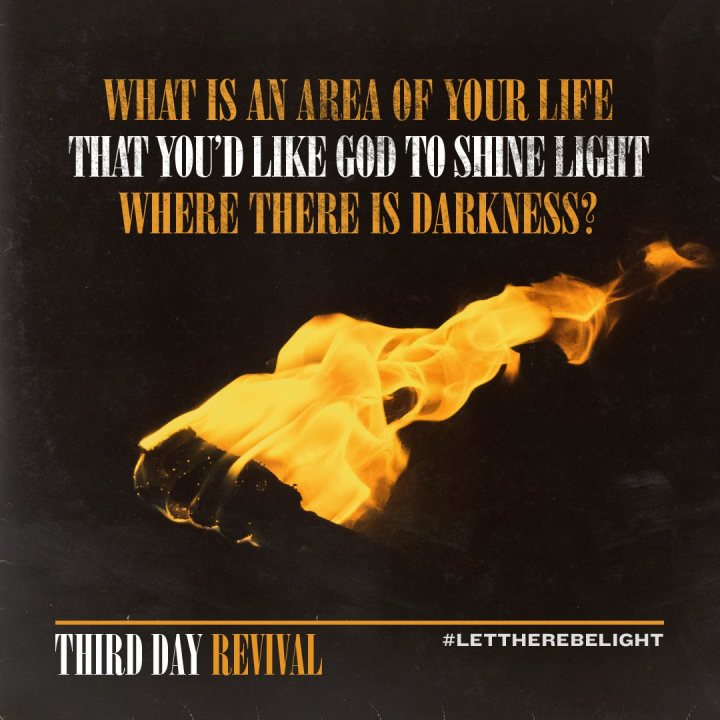
Don’t you know, people who are gifted musically are also spiritual authorities. Hence, the attached meme by the “Christian” moaners Third Day. Like I have said before though I am a pragmatic soul, there is a strange power behind true love because Susan and I ended up married regardless of our incessant fussing over this issue while we were dating. As one who was churched for over 50 years, she was incredulous that I saw nothing positive about church, and constantly pointed out the biblical error in the lyrics of her favorite songs. Once, she deliberately sought to antagonize me by suggesting that Toby Mac knew more about the gospel than I did which invoked hysterical laughter, and it kinda went downhill from there real fast. Of course, we are past all of that now and still friends on Face Book.
Sigh. Do Christians still have parts of their lives that are “in darkness”? Say, is there an area of your life in darkness that you would like the Lord to shine a light on? Where to start with this BS (boloney sausage)? First of all, if it is in darkness, how would you even know that it needs light? Well, I guess it depends on what exactly the meme means by darkness to begin with which is ambiguous like all other things church. However, I suppose we can be reminded that God’s elect only know one thing; that we can’t know. Nevertheless, we have areas that we know are darkness, and know that our only hope is for God to shine light on it, so, ya know, that we will then know it is light, or something like that.
This is why I always enjoy watching evangelicals witness to unbelievers. You can just see what they are thinking by the looks on their faces while these people are talking: “What the hell?”
I could go on and on, but I expend most of that energy ranting to Susan in the car even when she doesn’t turn on the radio. Suffice to say that the Bible presents light and darkness as two totally separate states of being. And, if a believer is walking “like” they are still in darkness, the Bible gives specific instruction on what to do about it which doesn’t include begging the Lord to do something about it and waiting to see if He wants to or not.
Here is an opportunity to look at yet another word or two that Christians are in total confusion about. But let’s not be confused about this: Christians are confused in regard to EVERY metaphysical word and concept in the Bible or elsewhere. For example, you will hear them throw around words like “grace” and “law” more often than they go to the bathroom; now ask them to define those words and behold the deer-in-the-headlights look, or the regurgitation of what someone else told them.
But we are talking about the words, darkness and light. A popular use of these terms among Christians is to prove from the first chapter of Genesis that every verse in the Bible is about Jesus. And, they believe that because they heard it at church. And here is what they heard: Paul stated in 2Corinthians 4:6 that God brought light from darkness which refers to Christ and the gospel. Only problem is that Paul wasn’t citing Genesis, he was citing Isaiah, and so it goes.
To whom shall we go to find truth? Christian musicians represent a plethora of different denominations. Which one of those denominations will be proved correct at the “final tribunal”? And if Christians don’t even know what any given Bible word means, why would we presume that they know what the true gospel is?
paul



1 comment