
To the Degree that Justification by New Birth is Understood, Everything Else, Especially the End Times, Will Become Clear
 The Bible is both simple and complex. It is simple to include as many as possible in salvation, but complex in order to substantiate its validity as truth. As I have said before, I have never met an atheist nurse because you have to study Physiology to become one. That kind of complexity working together didn’t just happen accidently; to say it did would be a deliberate denial of reality.
As I was studying Galatians yesterday, I noted Paul writing that the first and second temple correlated with the Old Covenant and slavery to condemnation under the law. However, the Jerusalem in heaven corresponds to freedom.
I think that is a freedom to love aggressively according to the law without fear of condemnation. Again, justification by new birth has two perspectives on the law; the Spirit’s two uses of the law, while justification by faith, which is really not justification by faith in the biblical sense, only propagates a single perspective on the law. Simply stated, a perspective that the law gives life for justification and perfect law-keeping is therefore imputed to our Christian life to keep us saved. Hence, Christians are not doing any good works, but rather obeying the church so that Christ’s perfect law-keeping is perpetually imputed to our lives.
Hence, why is church a train wreck? It’s generally accepted that everyone there is unable to do anything good. That’s church orthodoxy, viz, Martin Luther’s “alien righteousness.” And, the idea that church is society’s moral compass is accepted as pretense, because after all, how are we going to get people in here if they believe otherwise? The idea that spiritual growth is about realizing the depths of our depravity is a hard truth that we will assimilate them into once we get them in here.
But that’s all an aside, here is what I want to mention in this short post: it occurred to me that the third temple of the tribulation period is referred to as a legitimate temple that God recognizes. To me, this means something in the present age must come to an end because in our present time, a temple on earth represents slavery.
Some food for thought. But I guess the bigger point follows: the more we understand the details of justification by new birth and its related covenants, the more the rest of the Bible will become clear. I do not think God wants us to be confused about what’s in the Bible. However, I do think all of the confusion arises from the false premises of justification by faith and its errant presuppositions.
paul
What to do if you are being Held Hostage at a New Calvinist Church
Originally Published February 28, 2013
 Nobody wants to be humiliated publicly in a Sunday morning church service in front of hundreds of people. Especially if it is a church where you have been a member for several years, and in many cases, the center of where the majority of your closest friends gather on a regular basis. Not to mention strangers who may be there visiting. Your employer may be a member there, and family members who still trust the leadership may be members there as well.
This is why you are staying put in a church you want to leave. After you informed the elders that you were leaving they placed you under “redemptive church discipline.” This is in-house counseling that deals with “longstanding patterns of sin.” What patterns of sin? Anything that the elders think is such—that’s what. You may have also done something very stupid: entered into formal counseling at said church and revealed intimate details about yourself. Ouch, that is now information that could become public during your excommunication day.
You are now officially a hostage. If you leave you will be excommunicated and humiliated publicly. You are probably in this position because you know something about the leadership that is damaging or you have challenged them doctrinally. You are also not one who is usually excluded from this process: those with power, influence, and money. Your resources are limited. You are in a very bad spot. Walking away could cost you your job, all the friends that you have, and at least some of your family. You are not alone. I contend that thousands of Christians are being held hostage at New Calvinist churches in this way. They are playing along until an opportunity provides itself for a way out. If it ever does.
Let me continue to emphasize that Christians need to wise up and prevent themselves from getting into these situations. If you are the type that is willing to look the other way on everything don’t worry about it, but if you have an inclination to care about the truth, you need to be discerning. Because you are on your own and other churches will not stand with you (if any do, it would be a first), don’t join any church. It’s not necessary. You can be faithful to an assembly and not be a member. If they won’t let you serve in certain areas because you are not a member, so be it. The Scriptures are (I think deliberately) ambiguous regarding formal church membership. Even though many New Calvinist churches think they have authority over you whether you are a member or not—not being a formal member affords some protection. Actually, a lot of protection. In our day, don’t join any church formally—just don’t do it.
And if you do, for crying out loud, do not sign a church covenant. I am going to say this as lovingly as I can: in our day, if you sign a church covenant you are just plain stupid. I love you, but you are stupid. Not only that, in most New Calvinist churches, you are not allowed to leave membership for “unbiblical reasons.” And I will give you three wild guesses as to who determines what is “unbiblical.” If you are a member of a New Calvinist church “in good standing” (i.e., you don’t ask questions) and want to leave for doctrinal reasons, do so carefully. This ministry has, and continues to counsel people who want to leave these churches with as little drama as possible and it’s not easy. If you are in a church that strongly emphasizes formal membership—flee and don’t look back.
Back to those who find themselves in the belly of the beast. You have bitten off the whole enchilada. You are a member. You signed a church covenant. Much of your life is invested in the church. They have counseling records on you, etc.
First, don’t attempt to plead your case biblically; you’re wasting your time, these people play by their own rules. I should repeat that: don’t attempt to plead your case biblically; you’re wasting your time, these people play by their own rules. Do keep detailed records. Communicate as much as you can by email and ask lots of questions. Tape-record all meetings (check laws in your state, but in all but a handful of states it is legal to record private conversations as long as one party (that would be you) is aware the conversation is being recorded) and ask lots of questions. Here’s why: In most states what they are doing is a criminal act. In most states it is against the law to control somebody’s free will of moral actions with threats of reputation loss or financial loss. In the milieu of the mess, get them on record saying they will do this if you do that. Get them on record saying that you are not free to take your family and leave. Get their response on record regarding your concerns that you will lose your job, your family, your reputation, etc. Get them on record stating that they have the authority to void your salvation. Here is how the law reads in Ohio:
2905.12 Coercion.
(A) No person, with purpose to coerce another into taking or refraining from action concerning which the other person has a legal freedom of choice, shall do any of the following:
(1) Threaten to commit any offense;
(2) Utter or threaten any calumny against any person;
(3) Expose or threaten to expose any matter tending to subject any person to hatred, contempt, or ridicule, to damage any person’s personal or business repute, or to impair any person’s credit;
While gathering information, if at all possible, obtain an attorney that will work with you in the situation and contact the elders of said church when you leave post preference. Advise the church that you will be present with your attorney during the excommunication. In most cases the elders will back off and allow you to leave with your family quietly. I have seen this work quite well in lesser degrees of application.
If you can’t afford an attorney, gather good information that violates the coercion laws in your state and then contact the local police. If the church follows through with the excommunication, file criminal charges against the elders.
For further questions regarding this issue, email us at mail@tanc.online
paul
Old Covenant and New Covenant; What We Know
The Old Covenant was:
- A guardian until Christ came (Galatians 3: 23-29).
- All sin is imputed to the law (Galatians 3:22, 1John 3:4, possibly Hebrews 9: 1-5).
- A ministry of condemnation and death (2Corinthians 3: 7-11).
- Christ came to redeem believers from the captivity/guardianship of the OC (Galatians 4: 4,5).
- As a covenant that held “the called” captive, the law demanded a ransom for the release of those who committed sin under the first covenant (Hebrews 9:15).
- It was a will ratified by blood, and like all wills, consummated by a death resulting in an inheritance (Hebrews 9: 16-27).
- During the time of the OC, it was a slavery to both believers and unbelievers, or like slavery to believers because they were captive to it, but now, it only represents slavery to sin by the unregenerate. Being captive under the OC was a legitimate standing for believers while the OC was active, but now, any return to it is a slavery to sin and claiming to be under a ministry of death (Galatians 4:21-31).
- The temple and the Jerusalem on earth correspond to the OC, the temple and new Jerusalem in heaven correspond to the New Covenant (Galatians 4:21-31).
The Promise is:
- “The Promise” is the gospel and a promise to Abraham, Christ, Israel, and the Gentiles that includes several promises and covenants that are unfolded in time.
- The Promise is completely separate and apart from law.
The New Covenant is:
- It set the captives free from the OC and released gifts to mankind (Ephesians 4: 7-10).
- It ended sin; in that, sin under the law and its subsequent condemnation is ended, and is no longer existent for believers (Romans 3:19, 20, 4:15, 5:13, 7:6.8. 10:4, 1Timothy 1:9, Galatians 2:19, Colossians 2:14).
- It baptized Jews and Gentiles into one body (Ephesians). In fact, it eradicated all differences among people and made them all heirs in Christ (Galatians 3:28).
- It made our bodies the temple of God where the Spirit dwells, and made us all priests with Christ as the one and only High Priest (numerous).
- It demands a literal family operation functioning as a body under one head (numerous).
- Christ, through His death and resurrection, established the NC baptism of the Spirit for all believers under the NC.
- The NC baptism changes the believer’s relationship to the law: the condemnation of the OC is ended, and the believer is free to obey the law in order to love God and others without any fear of condemnation. When a person is under the OC (under law) it is under the Spirit’s first use of the law to convict the world of sin and the judgement to come. Under the NC, the believer is “free to serve another” ( Romans 7 and 8).
In comments below, add your building blocks to our understanding.
God Rewards Our Efforts!
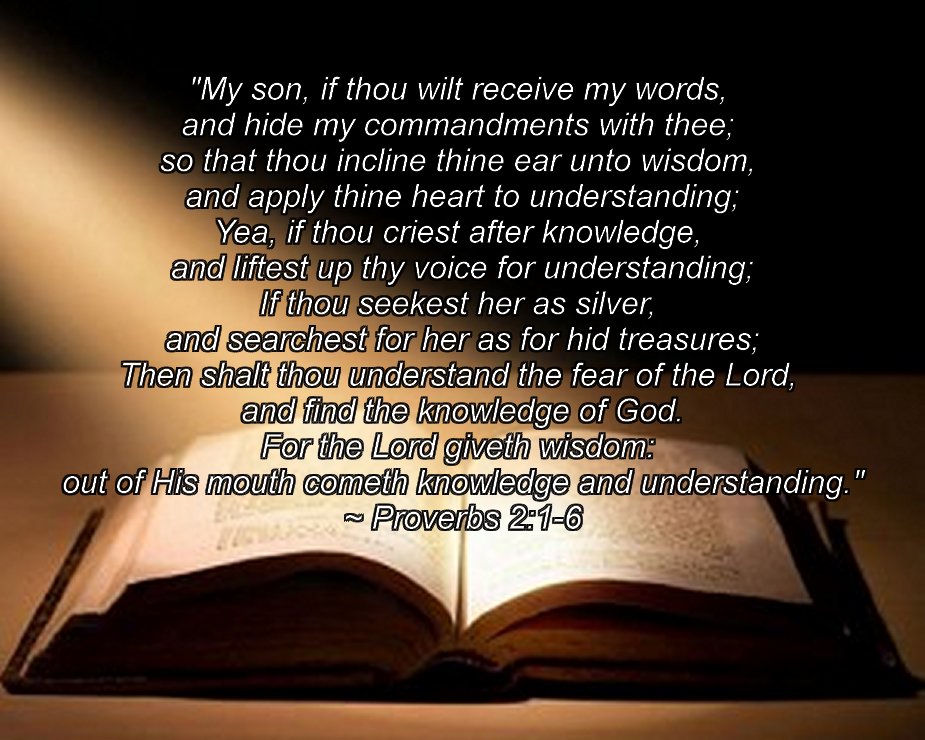
The Bible makes it clear that man CAN attain knowledge by seeking to understand and obey God’s commandments. Moreover it is clear that God rewards them who seek Him and who have a desire to show love to Him through obedience. One of the many problems with Protestant orthodoxy (aside from a woeful misunderstanding of the law) is conflating merit with salvation.
~ Andy



1 comment