Paul's Passing Thoughts

The Gospel’s Ground Zero: Romans 8:2, and Why The Church Must Misrepresent It

Posted in Uncategorized by Paul M. Dohse Sr. on June 4, 2019

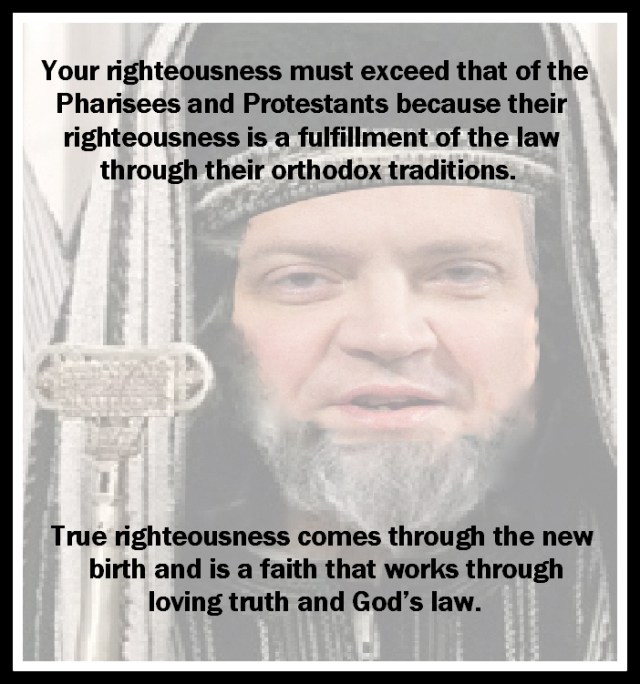
ppt-jpeg4Church must make the two laws in Romans 8:2 two different realms or two different spiritual forces in order to misrepresent the new birth and the baptism of the Spirit, which is critical to the institution’s survival.  When the verse is evaluated based on the simple meaning of the word used in the verse, “nomos,” it is clear that this refers to two different written standards. In context, two different laws that originated with God. The word is used about 197 times in the New Testament and in every case refers to a written law or God’s written law. In contrast, other words are used when referring to an invisible force or spirit, primarily “pneuma.”

“Yes, but how can there be two laws of God, that makes no sense at all” many will say. Really? Two laws of God are talked about all of the time in church; specifically, Old Covenant/New Covenant, New Testament/Old Testament, etc. Popular theologies are even based on the idea that the Old Covenant was written for the Jews only, and the New Covenant (New Testament) was only written for the Gentiles. At any rate, Romans 8:2 is ground zero for the gospel because in order for the gospel of justification by faith to stand, “nomos” in the verse must be “pneuma” or some other word that refers to a spirit realm or invisible force.

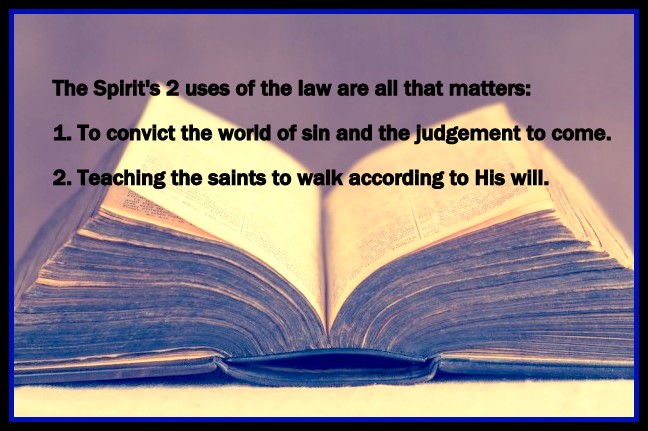
Critical to the gospel of justification by faith is a single perspective on the law in regard to it being the standard for justification. If the law of God has more than one purpose; ie., other than “to show sin,” the gospel of justification by faith collapses. The Spirit’s two uses of the law determined by the new birth/Spirit baptism must be confined to one use of the law, therefore, “nomos” in Romans 8:2 must be a realm rather than God’s written law and thereby redefining the new birth and Spirit baptism.

According to the true gospel, that is justification by new birth, the new birth changes a person’s relationship to the law of God and rejects the law’s single purpose of showing sin. According to justification by faith, the new birth is merely an illumination that enables the “believer” to colabor with God’s law to see how sinful we are which aides in returning to the “same gospel that originally saved us.” It’s a single purpose of the law used in a perpetual re-justification/re-salvation or progressive justification. Proponents of justification by faith deny that it is progressive justification overseen by the church by God’s authority and I have come to believe that they are lying about that and know it. Justification by faith stands or falls on the single purpose of God’s law to show sin. Of course, this is deceptively nuanced thorough sanctification-speak. In justification by faith, sanctification is merely the progression of justification, or “justification in motion.” According to mainstream Protestant pastor John Piper,

Now I want to stop and make sure that you are hearing what I believe the Scripture is saying, because it is not commonly said, but our lives hang on it. There is a real sense in which our justification depends on our sanctification.

Note that Piper is not saying that our sanctification is the natural result of new creaturehood with justification being a finished work in the believer (you are only born into a family once), but justification depends on things that happen in the progression of a “believer’s” life, meaning clearly that justification isn’t a finished work. The redefinition of “nomos” in Romans 8:2 also makes double imputation (a critical doctrine of justification by faith) possible but that is not a subject we will delve into here.

What’s really going on in Roman’s 8:2? We are justified, once and for all time (see Romans 8:1), which completely changes our relationship to the law. Before the old us died with Christ, we were under “the law of sin and death” (see Romans 7), but were raised with Christ and are now under the “law of the Spirit of life.” Same law, two different relationships determined by the new birth. Once you understand this, finally, the Bible starts making sense and the relationship of law and gospel starts making sense. Jurisdiction is the issue here, not a realm. Jurisdiction can include realm in some cases, but not in this case. Here, jurisdiction has to do with life and death; according to Romans 7, the old you is dead, and the law of sin and death no longer has jurisdiction. However, the new you that was raised with Christ is under grace, or the Spirit’s second use of the law; to sanctify via the truth of God’s word.

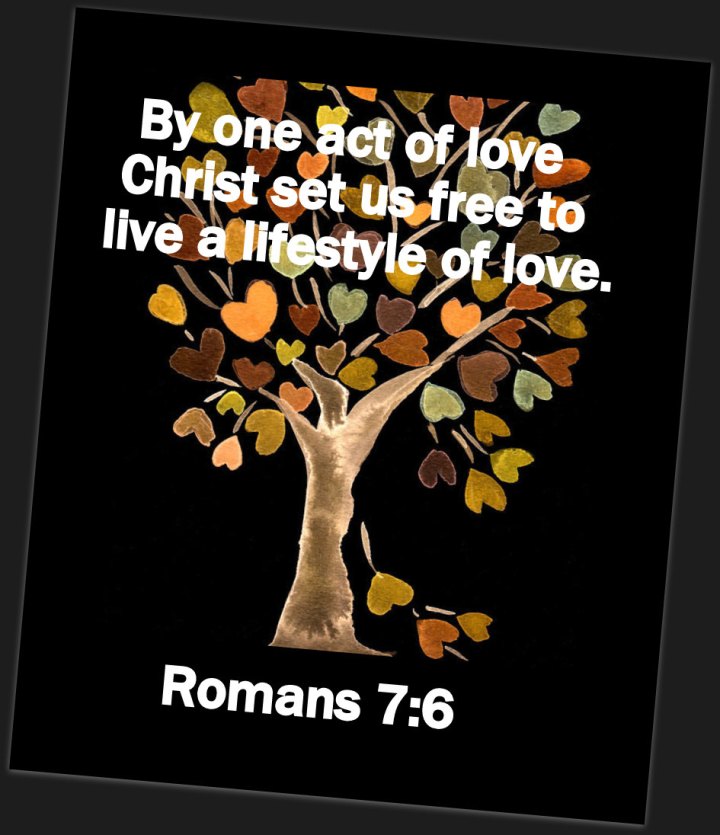
Furthermore, finally, assurance of salvation is possible because there is no law to judge us, that is, the first law we were under before we were born again. Under justification by faith and its singular perspective on the law (in regard to the definition of righteousness/justification), there is no way to know what your motives are in Christian life. Am I doing this good deed to justify myself in God’s eyes, or purely for love? Well, under grace, or under the law of the Spirit of life, the law for purposes of justification is gone along with the old you, so the only remaining motive is love. “Where there is no law there is NO sin,” so any attempt to outscore sin with good deeds is a nonstarter to begin with. Our faith works, THROUGH LOVE, not law-keeping (Galatians 5:6).

Failure to understand the Spirit’s two uses of the law according to Romans 8:2 leads to a singular perspective on the law regarding justification resulting in a false law-based gospel, while on the other hand, dissecting the law for purposes of bogus secondary and wacky theologies. That’s church in a nutshell.

God’s law (the Bible) has clear and specified roles that lead to an overall understanding of the Bible. If you have the law right, you have the Bible right. The Old Covenant was a will. The will promised that ALL sin would be imputed to the law and that Christ would then come and end the law. The will is “The Promise” which promised that the Spirit would raise Christ from the grave and establish the baptism of the Spirit. This baptizes Jew and Gentile into  the “one new man,” and ends the law with all of the sin imputed to it. Old Testament believers had their sin COVERED by the law (atonement), which made the Old Covenant a “protector” or “guardian” until “faith came” (Christ) and consummated the will. In order for a will to be activated, there must be a death (see Hebrews).

However, this doesn’t mean that the believer is not under a law; it means that the new birth changes the believer’s relationship to the law. The law is stripped of all condemnation, and is our guide for love. Neither does this mean that there are no consequences for failure to love, but condemnation is not the result. That is a matter of a loving Father’s chastisement which is another element of this that will not be addressed in this article.

Also, the word of God as a seed has to do with the new birth, and is not the same exact thing as the baptism of the Spirit, although under the New Covenant consummated by the death of the Testator, both happen at the same time. The word of God as a life-giving seed is another topic, but suffice to say here that Old Testament believers were born again by the “implanted seed.” During the Old Covenant, their sins were covered, under the New Covenant, sin is ended, but nevertheless, they were born again and righteous as a state of being just like those under the New Covenant.

How church redefines all of these terms is an endless study. “Seed,” is redefined as a mere illumination that enables us to see our own sin and inability to do any good work, rather than the very life of God being inside of us as His offspring. This, in fact, makes us righteous as a state of being, and yes, SINLESS, and therefore righteous as a state of being. Look, we have documented this extensively, the Reformation was sparked by the Catholic Church moving away from Augustine’s idea of total depravity, viz, the idea that ALL righteousness remains outside of the “believer.”

But all in all, church denies the new birth and the baptism of the Spirit as defined by the Bible, and accordingly, must misrepresent Romans 8:2.

paul

PS. I realize my distinction between the new birth and the baptism of the Spirit raises a lot of questions and it should! This is uncharted territory deliberately avoided by the church. Per our ministry mode of learning; it is accomplished collectively by the body of Christ. Learning ONLY comes through a collective body effort, NOT top-down hierarchical spiritual authority.

The Twelve Pillars of Contrast: God’s Prescribed Home Fellowships Versus the Institutional Church

Posted in Uncategorized by Paul M. Dohse Sr. on June 4, 2019

I. God’s Kingdom is NOT on Earth

This paves the way for dominion theology and the marriage of faith and force. It also causes misplaced priorities among God’s people.

II. Focus on Individual Sanctification NOT Collectivism

In case anybody hasn’t noticed, the institutional church has no answers for victorious Christian living. In fact, the concept is openly mocked. The focus is the success of the institution as a salvation vessel. Ministry success is measured by the growth of infrastructure, not individuals.

III. Priesthood of Believers

Vertical aspect: One authority being Christ and His word as the one mediator between God and man. Horizontal aspect: fellowship and gifts, NOT authority and spiritual caste.

IV. Salvation is Finished

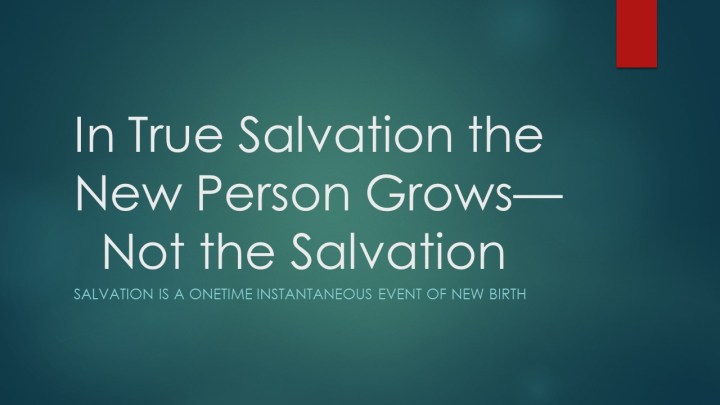
Justification is complete when the believer passes from death to life via the new birth.

V. The Judgment

Christians will not stand with unbelievers in a final judgment to determine justification. All people who stand in the final judgment are already condemned. Christians will stand in a separate judgment to determine rewards.

VI. Meeting Financial need, NOT Institutional Taxes

New Testament tithing is according to meeting need. Tithing to an institution is nowhere to be found in the New Testament.

VII. God’s Prescribed Model by Default

It is clear that the beginning of the “church” took place in homes; yet, the idea that this model was transitional or a contrary institutional model is nowhere to be found in the New Testament.

VIII. The Church Discipline Myth

The New Testament prescribes “self-discipline” and the “Lord’s discipline” but nowhere speaks of a discipline performed by the church. Fellowship is based on active fellowship and NOT authority. Eldership is a gift, NOT the authority of God by proxy. Elders are to use their gift of teaching to persuade God’s people for their own benefit and the building up of the body of Christ to God’s glory.

IX. Salvation is of the Jews

Gentiles did not replace Israel, but are made partakers of the commonwealth of Israel through the baptism of the Holy Spirit.

X. Rejection of Gospel Centrality

The Father, Son, and Holy Spirit are tri-equals in Justification and sanctification. We baptize in the name of all three. IF there is a centrality, and we do not believe there is, it would the Holy Spirit and not Christ. He is the promise to mankind and Christ.

XI. The Saints are Not Only Positionally Righteous, We are Personally Righteous

Salvation is NOT a covering, it is an ending of sin and a new birth. It is the death of the former and resurrection of the new. The saints are the literal offspring of God.

XII. Weakness is Not Necessarily Evil

We reject the philosophical notion of a strict dichotomy between an evil realm and a righteous realm defining two different realities. Christ was 100% man and 100% righteous, but weaker than He was while in heaven with the Father. Likewise, though weaker in our mortal state, the saints are holy as their Father is holy. Though sin is present in our mortal bodies and can harass us, our souls are righteous.

Because of Trump We Must Now Ask Ourselves; How Free Are We?

Posted in Uncategorized by Paul M. Dohse Sr. on May 31, 2019

ppt-jpeg4The present hot mess we are seeing in American politics boils down to one word: FREEDOM. The question of freedom is the pinnacle of human existence. Mankind was created for individual freedom. Thereafter, all political questions boil down to man’s ability to be free. By ability to be free, we mean the following: will individual freedom lead to the detriment of humanity, or a better humanity? And who is the judge of that? What is really the crux of TDS? (Trump Derangement Syndrome). Answer: Donald Trump thinks individuals have a high ability to be free. That’s it. That’s why. This is what makes him so hated.

No, the question of sin is not the pinnacle of human existence: the essence of sin is a desire to control others; sin merely uses condemnation to do that. This, according to the Bible in general and Genesis 4:6,7 in particular. You can go to church and hear about how bad you are because the church wants to control you through condemnation, or you can watch CNN. In both cases, you are unable, you need a pastor to watch over you, or the state, or until America came along, both, whether you liked it or not.

Look, total inability is not just a religious doctrine, it is a secular political doctrine as well. Communism, socialism, and fascism are all predicated on total inability. Of late, evangelicals are perplexed about the Southern Baptist Convention’s move towards Marxism. This shouldn’t perplex us at all, both are clearly predicated on the same doctrine of total inability. Especially in light of the Neo-Protestant movement (1970-present), communism is much closer to reality than Americanism. To the degree that man is free to self-rule, humanity is in peril. Mankind is unable, and must be overseen.

The doctrine of total inability dominated world history until the advent of Americanism. The application of total inability is social caste. From circa 10,000 BC to 350 AD, it was the pagan-state. From 350 AD to 1776, it was the church-state. After Americanism eradicated the church-state, communism filled the void. The basis of the dominate worldview was/is dualism which was later articulated by Plato (circa 400 BC). Dualism teaches that the material world is evil and only the invisible world is good. Hence, since mankind is of the material world, well, you do the philosophical math. Plato later systematized the theory. Plato’s theory was based on social caste, or in other words, a society ordered by philosopher kings, warrior class, and producer class. Since no truth or knowledge can be known by material mankind, philosopher kings were/are predetermined to guide mankind through the material world of subjective reality.

America was born out of Enlightenment thought, which we could say in very simple terms (like the preponderance of this thumbnail presented), is framed in the philosophy of Aristotle. The latter believed reality can be known (A=A/B=B), promoted the ability of mankind, and upward mobility. In other words, reality is objective. There was still a social caste, but minus the predeterminism and the addition of upward mobility. In more other words, your social caste can be earned. This is elitism which is a much more merciful tyrant than socialism. Americanism didn’t go far enough with the total ability of mankind, but yet, look at the results nevertheless.

Platonism holds to the idea that one’s social status is predetermined by lineage or other means while Aristotleism holds to the idea of social mobility. Rather than being born into the right to rule over others, you can earn it. However, capitalism and the free market of Americanism trumps socialism and elitism both. Pun may be applied if you wish. In capitalism, one can excel in social status based on personal accomplishment alone and apart from any formal credentials of elitism or socialism, and much to the disdain of socialists and elitists. Don’t miss the point: capitalism is the purest form of individualism and self-rule, and its greatest nemesis is excessive taxation. Excessive taxation is a deliberate attack on capitalism by socialism and elitism both because it is a vehicle for true individualism.

So, it seems strange that those who have benefited from capitalism, like movie stars, evangelists, academics, etc., would be socialists or elitists, but it shouldn’t seem strange. These people do not think they are successful because of capitalism. They believe they would be of the uppercrust anyway because of their pedigree or personal ability. This is why socialists will hate Trump more than elitists, but both will hate him. Socialists see individualism as a dire threat to humanity; a bunch of unparented children turned lose on the world. Elitists see capitalism as an unjust vehicle that empowers dumb hillbillies to have stuff they didn’t earn. If some uneducated dweeb lives in a house or drives a car as nice as yours, that lowers your status and primary purpose in life; to be deemed higher than the little people, and to be worshipped by them.

Socialists and elitists hate capitalism, and want to destroy it because that would give them the power they want; they think capitalism gives them less power because it empowers the little people, and in fact, it does. Let me put this in context of evangelicals who are, at least among the Neo-Protestants, trying to usher in socialism. The rest have some confused notion of Americanism being born out of Christianity. This isn’t true; the primary catalyst was the idea of individual freedom, which of course included Christians, but on no wise was exclusively a Christian idea. In fact, historically, for the most part, at odds with professing Christianity. Evangelicals must destroy capitalism altogether and hope what they want arises out of the ashes; it is their only real hope of regaining the church-state. Remember, Protestantism was created in a church-state and for the express purpose of a church-state. ALL Protestant orthodoxy was written and created in the context of church-state. This is irrefutable history.

We must understand that socialism, and to some degree elitism, is comprised of powerbrokers. Those who control the minds of people have a place at the power table of socialism. One’s status at the table depends on how many people they control. Socialism is all about control, but prefers to control the populous by non-violent means. This means a heavy emphasis on mind control. So, if Neo-Protestants are successful in ushering in socialism, would they have a place at the Marxist table? You bet they would as the Neo-Protestants control an impressive number of people. At that table, telling their group to cooperate with the government and support the government would be traded for the enforcement of orthodoxy which is exactly how it worked in the good ole’ days. The example here is evangelicals, but you can add any other people group to that. The leaders will not lose their social status because capitalism is destroyed, it will probably be improved, while their useful idiots will pay the price when it is too late to do anything about it. In regard to Neo-Protestantism and other people groups, whether feminism or something else, only the great unwashed followers benefit from capitalism, not the leaders.

The arrival of Trumpism has revealed what has been going on for many years; we aren’t really as free as the founding fathers intended us to be, and we were on the verge of losing America altogether as it was originally intended. Moreover, because of elitism’s hindrance of capitalism, I would argue that we have never been free enough to begin with.

But now you know in simple terms why all hell is breaking loose and TDS has become pandemic. Let me close with what Attorney General William Barr stated in a recent interview that highlights the point of this article:

“Sometimes people can convince themselves that what they’re doing is in the higher interest and better good,” he said during an exclusive interview in Alaska on Thursday. “They don’t realize that what they’re doing is really antithetical to the democratic system that we have.”

Exactly, the socialists and elitists know what is best for the country more than the little people that capitalism empowers. And, even a half-pregnant version of freedom turned the world upside down for the better.

Those results are the judge: A=A, B=B. Let’s at least hang on to that.

paul

Spurgeon’s False Gospel

Posted in Uncategorized by Paul M. Dohse Sr. on May 31, 2019

Church “Family”?

Posted in Uncategorized by Andy Young, PPT contributing editor on May 30, 2019

Since my family left the institutional church for good 5 years ago, there have been many times my wife or I have encountered people from those old churches, and invariably at some point in the conversation they will say, “Hey, we really miss you guys!” or, “We really miss your family!”

Really? You miss us? Does your phone not work? Did you lose our number? I don’t seem to recall getting an invitation over to your house lately.  If we really mean that much to you, how come you have never reached out to us since we left?

When someone from the institutional church tells you they “miss you”, what they really mean is we miss you at church.

~ Andy