Environmentalism, Famous People, Fear, Desires, Image Worship, and Honest Debate
 The news stopped me dead in my tracks mentally. A giant mural of teen “environmental activist” Greta Thunberg is going up in San Francisco’s Union Square. Recently, Leonardo DiCaprio praised Thunberg as a “leader of our time” following a day of just chillin’ out together. Shockingly, she has even spoken before the UN Assembly and invited to speak at a TED Talk. She is 15 years old.
A fact reality check: in the 1960’s global freezing was going to destroy the world by sometime in the 1980s; it didn’t happen, and frankly, even as adolescents, we knew better.

In the 60s the book, Silent Spring was all the rage and required reading in our junior High School Literature class. The thesis of the book follows: for the first time in human history, man had acquired the ability to destroy the world. Hence, the scientific world was divided into to camps: those who improve and empower a society made up of the collective efforts of free individuals, and those scientists who believe that man must be saved from himself by minority elitists. Indeed, presuppositions concerning mankind are central to all of this. Is mankind totally depraved? Is mankind totally unable? In the total depravity of man ideology, whether of secular political ideology or religion, the truly wise are experts in the knowledge that enables the totally depraved to have their best existence according to what has been preordained for them. They are experts in the knowledge that man knows nothing, which is the beginning of wisdom. Supposedly. It is a zero sum life ideology, a kind of nihilism if you will.
But, does man really have the ability to destroy the world? Well, if you look at man’s 

execution of the most earth-destroying power at his disposal to date, that would be the dropping of the atomic bomb on Hiroshima, Japan. Not only were several thousand survivors walking around in the horrific destruction and death immediately after the blast, but today Hiroshima is a thriving modernized city full of life. It is unlikely that all-out nuclear war in our day would destroy the earth. For sure, it wouldn’t be a picnic for maybe 20 years afterward, but total annihilation of humanity? Unlikely.
The most formidable threat to the earth is a thing we call natural disasters. Man has no

way to create the destructive powers of natural disasters and is powerless against them for the most part. Yet, so far, earth has shown restraint in annihilating itself. Of course, environmentalist claim that man’s abuse of nature causes natural disasters. On the one hand, Silent Spring announced the dawning of man’s ability to destroy himself, while on the other hand, he causes natural disasters that have obviously been around since the beginning of creation. Environmentalism and the total inability of man (total depravity) go hand-in-glove. On the one hand, secular scientists like to promote the idea of a very, very old earth unlike religious zealots who tout the idea of a very young earth, yet, nature in its immeasurable powers hasn’t managed to destroy itself or man in more than a billion years. But yet, supposedly, the end is near because of man and the only way of saving mankind is submitting our misguided notion of freedom to the all-knowing elitists.
Past all of that, the Bible is clear on how life as we presently know it comes to an end, and how.
Why do people believe in the environmental movement? Why do factual arguments fall on deaf ears? Answer: because regardless of commonsense facts, like many other things people believe, it’s what they want to believe. The Bible states that people have a propensity towards living by DESIRES. Unfortunately, for the most part, people are desire-driven. This is what drives me absolutely nuts when I am watching Fox News. They have these ideologues on in order to be “fair and balanced.” Regardless of black and white facts, these people answer with totally bankrupt reasoning. Why? Their thinking and reasoning is desire-driven; it’s what they want to believe.
Why do they want to believe it? Answer: fear. Government in general and elitists in particular offer a safety net. People who fear individualism think you stand or fall on your own. It’s a lack of self-confidence, and the total depravity of man ideology rejects self-confidence altogether. People want to play in the sandbox of life, but they want mommy watching from the kitchen window. They don’t trust the goodness of man to help them in times of need, they trust the elitists. Besides, government has the power to take from greedy individuals and give it to whomever might need it…you. Government elitists are Robinhood; they take from the evil rich people and give to the poor. The Bible says to work with your hands so you can give to people in need.
Truth is whatever your fears and desires say it is. Facts don’t determine truth; individual desires determine truth. And your truth along with your bankrupt self-esteem needs a cheerleader; a hero, really, an image in the form of a person. Yes, your argument isn’t facts, it is those great people of the present and past who confirm your beliefs. They are the monuments of what you believe.
And what do these images represent about your beliefs? Like all image worship, whatever you want it to represent. We will begin with the illustration of straightforward image worship of things made with wood, stone, marble, and Styrofoam, and then we will move on to how living beings of our selection serve the same purpose.
Absolutely noting is more illustrative of idol/image worship than the giant statue of Jesus (60 feet high) located on the property of Solid Rock Church in Monroe, Ohio. One of the co-pastors is Darlene Bishop; Ohio’s own version of Beth Moore. The first statue on the property, which was made from a type of Styrofoam formed on a metal frame was struck by lightening some years ago. I am going to read from some articles I wrote about it during that time.

Located between Cincinnati, Ohio, and my hometown of Dayton, Ohio is the small town of Monroe. This small town boasts big things, and displays them prominently at the corners of its main drag where it crosses I-75, the highway that connects our country’s north and south borders from Florida to Michigan. Specifically, on the edges of this super-highway, we have a statue ( representing an imaginative likeness of Jesus Christ) built by Solid Rock Church that towers some forty-feet high, the equivalent to a four-story building. I have worked on the exterior of four-story buildings; trust me, that’s a big Jesus statue. The statue has invoked all kinds of responses over the years from satire to admiration, and even claims of spiritual transformation upon the gazing thereof. In the same area, and inescapable as well from anybody’s notice at 65 miles per hour, or more, is one of the largest flea markets in the world. Cattycorner to the flea market is Larry Flint’s Hustler Magazine superstore. Surely, no other town in the USA can wow so many people three times in less than fifteen seconds. “Wow mom! `Look at that big Jesus, is that what He really looked like?” Wow mom! Look at that big yellow shopping mall! Hey mom! What’s that?”
Well, you probably heard; the statue depicting Jesus, also sarcastically referred to as the “Touchdown Jesus” and “Butterball Jesus,” was recently struck by lightening and burned with a very impressive inferno against the night sky. Due to the flammable materials used to build the structure, the flames were of, well, biblical proportions. It almost goes without saying that the response to this event has been huge. Pagans are probably proclaiming a new holiday, celebrating the day that Zeus supposedly dissed Jesus, while atheist couldn’t wait to get to work the next day to taunt their Christian coworkers. Christians who loved the statue blame Satan, while Christians who despised the structure give God Himself all the credit, claiming that He destroyed what amounted to a detestable graven image. Others joyfully refer to the remaining metal frame as the “praying mantis.”
For sure, two facts clearly illustrate that God was somehow involved. First, the Bible makes it clear that God is in total control of all lightning:
Job 36:32
He fills his hands with lightning and commands it to strike its mark.
Job 37:11
He loads the clouds with moisture; he scatters his lightning through them.
Job 37:15
Do you know how God controls the clouds and makes his lightning flash?
Job 38:35
Do you send the lightning bolts on their way? Do they report to you, ‘Here we are’?
Secondly, a reliable source has informed me that the statue, and adjacent building were properly grounded, making the strike a significant anomaly.
So, why would God strike this structure with lightning and burn it to the ground? And if He did it because He didn’t like the image, why wouldn’t He just strike everything else with lightning that He doesn’t like, such as the Hustler superstore on the other side of the highway?
…I thought I did my duty by writing at least one post about the Touchdown Jesus (statue) burning down . But I was eating breakfast while reading the newspaper this morning and observed an article entitled, “Solid Rock pastors: ‘Let not your heart be troubled.’” This is the apparent title of the sermon “pastor” Darlene Bishop and her co-pastor husband will preach tomorrow morning to encourage those who are discouraged about the tragic event. The article also mentioned the website address of their church, “Solid Rock” (SRC). Between the article and the website, I discovered that my initial report concerning the height of the statue only took the torso into account; if you include the fingertips of its raised arms, we’re talking about a 62-foot-high statue. Information on their website also confirmed the claim that people have been saved by viewing the former image as they drove past on I-75, while others were given hope when all else seemed lost. The website did not display any of these testimonials, but that’s quit alright, such subjects are never lacking in rich material.
Yes, a crises has occurred in the lives of many because a 62-foot-high Styrofoam Jesus no longer stands. Pastor Darlene is quoted as saying (in the same Dayton Daily News article) that she wants to assure the multitudes that this is only temporary; apparently, the sanctifying power of this image will soon be restored. Though just an image, in both the article and the website, Pastor Darlene claims the image projects the following messages to people: Christ is alive, there is hope, Jesus cares about you, Jesus died for your sins, and rose again three days later, and you will be saved if you believe that. Hmmmm, pretty impressive. Other messages projected by the image to people and reported directly to me are as follows: “it’s cartoonish,” “it’s the most retarded thing I have ever seen in my life,” “it makes Christians look foolish,” it’s racist,” “it’s a freak show,” “couldn’t the money have been used for something more worthy?”
That’s the problem with images, they project ambiguity; and worse yet, they often project whatever people want them to project. It is often the same reason we prefer pets over people: “You wuv me soooo much don’t you Sparky? Ya you do, ya you do. Isn’t my girlfriend soooo stupid? Ya, you know, don’t you Sparky?” Of course, dogs always reply with a smile, hanging tongue, and wagging tale. Pets would be far-less popular if they could argue with us. In the same way, many prefer gods of their own making (symbolized by idols) that never correct us. Images of God presented by us tell God that we accept him as our friend, but on our own terms. However, if you are a friend of God, It is on His terms, Scripture makes this absolutely certain. In fact, images are often reflective of outright rebellion against God:
“For although they knew God, they did not honor him as God or give thanks to him, but they became futile in their thinking, and their foolish hearts were darkened. Claiming to be wise, they became fools, and exchanged the glory of the immortal God for images resembling mortal man and birds and animals and creeping things.”
Likewise, the Bishops call the image “King of Kings,” but it is more like Burger King, where you can always have it your way. Therefore, when it’s convenient, the Bishops quote Scripture. According to Darlene (as quoted in the same article), the Bible says that Christians are supposed to always make good things out of bad, so therefore, since the lightning strike was a bad thing, SRC must turn that situation into good by rebuilding the statue. Actually, the verse of Scripture she is referring to says that it is God who “works all things for the good of those who love Him,” not us, but the larger issue at hand is the fact that the second commandment in Exodus, chapter 20, strictly forbids making an image of “anything in heaven.” Bottom line: the image is a blatant affront to Scripture, and this couple could care less. In fact, they state on the website that rebuilding the image is a mission assigned to them by God.
This, of course, is a lie, but yet another indication of why we like pets so much: “ya Sparky, Sparky, you want mommy to rebuild the statue don’t you? Suuuuure you do, give mommy a kiss.” But, also, according to pastor D, a breed among humans known as “Homo thinking sapiens” are strongly suggesting to her that God struck the image with lightning because He didn’t like it. Her answer to that was more-or-less: then why did He wait seven years to do it? Darla, Darla, Darla, hellooooooo, He waited much longer than that to torch Sodom and Gomorrah. He also struck your statue as opposed to the porno superstore right across the highway! And I might mention my point about the porno store was suggested to me by a person who would not profess to be a follower of Jesus Christ. As a matter of fact, I have had several “unbelievers” mention to me in a nonchalant way that, “obviously, God did it.”
Furthermore, the title of the message scheduled for tomorrow is taken from the words of Christ while He encouraged His disciples to stand strong during the paramount event of all universal history. She will use these same words to preach a message about a Styrofoam statue. Apparently, they also have a message on their sign in front of the church that says, “He will return,” likening the rebuilding of the statue to the second coming of Jesus Christ. God told Jeremiah that His word is a “consuming fire,” and in light of that, such flippancy toward God’s word is ill-advised to say the least, especially in the same area where God has recently made a statement with a few million volts.
But I must say, a profound thought was suggested to me in all of this. Maybe the statue is important to the pastors of SRC as a “filter.” Yes, maybe the pastors want to draw those who are strongly persuaded by subjective images, dreams, anything that well-dressed people say, and other such nebulous venues…

The point of these articles follows: images serve us by representing whatever we want them to represent even as a so-called truth authority, but I also wrote an article about how music and even the Bible serve the same purpose. In said article, I use the following lyrics from the Christian rock band Jars of Clay:
And all your words fall to the floor and break like China cups
And the waitress grabs a broom and tries to sweep them up
I reach for my tea and slowly drink in
Cause it’s not the way that it has to be
Don’t trade our love for tea and sympathy
With all due respect, what the heck does that mean? That’s the point; it means whatever the listener wants it to mean. In reference to so-called “crossover” music, particular Christian songs are ambiguous concerning the subject of the song: is the singer talking about Jesus or her boyfriend? EXACTY. The answer is “yes” depending on who is listening.
Likewise, even the Bible is used for this purpose; in fact, maybe more than anything else. Be sure of this: when you hear a Churchian say that “the Bible is our authority,” this clearly means the following; whatever they want or desire the Bible to say or whatever their favorite celebrity pastor says that it says.
This leads to something John Immel addressed at one our conferences: authority hopping. Clearly, people are used to represent a truth regardless of who they really were. When church scholars are confronted with hardcore proof of what a particular person taught (or did), all of a sudden, a mere mortal is no longer their authority, but the Bible. However, the Bible is being used as an authority in the exact same way the mortal was.
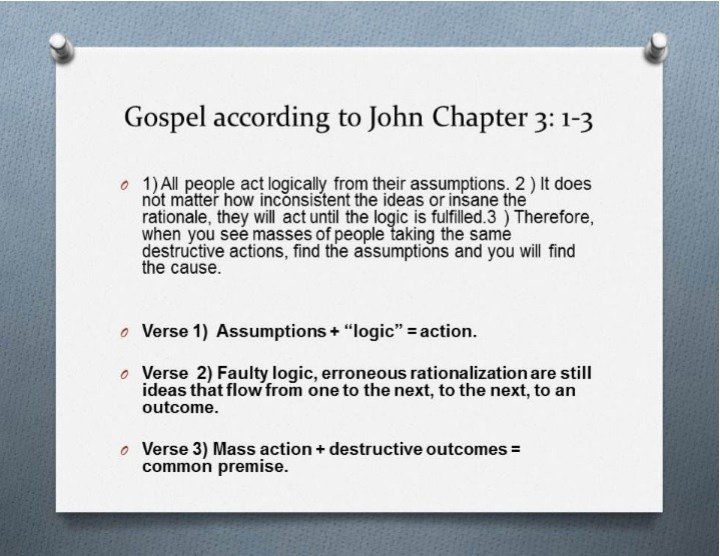
Before they jump to “biblical authority” as a last resort, they will usually use the “but he was right about some things” defense. Or, “you can’t throw out the baby with the bathwater.” Hence, you can’t condemn Islam either because of a few bad apples and the “majority of Muslims are people of peace.” This is the paramount defense for ideologies formed by evil desires. Though I am a strong proponent of the “gospel according to John Immel,” the ideology that begins his thesis is predicated on sinful desires. Falsehood is always selling something and the advertising target is the evil desires that drive people. But at any rate, no one destroys the above argument more than Bridget Gabriel with her “irrelevant majority” argument. History’s atrocities, as she points out, have always been carried out by the minorities of any give people, movement, or institution while the majorities of those people, movement, or institution do nothing. Certainly, the church’s inability to curb evil in its midst is one of the prime examples. Regardless of its bad fruit, the masses support it because it supplies something they want.
This all started when I stumbled upon the story about Greta Thunberg, and ended with something else I stumbled upon later in the week: the veneration of Puritans by Tim Challies on his Facebook page. He is a well-known Reformed sycophant. One may note that the definition of “sycophant” is a perfect description of Challies: “a self-seeking, servile flatterer; fawning parasite.” Challies has found fame and fortune by extolling the virtues and supposed profundity of celebrity teachers belonging to the New Calvinist movement who often display their superior spirituality by claiming to be readers of the Puritans. For certain, this way of displaying your deep orthodoxy and Reformed pedigree is in vogue among Churchians.
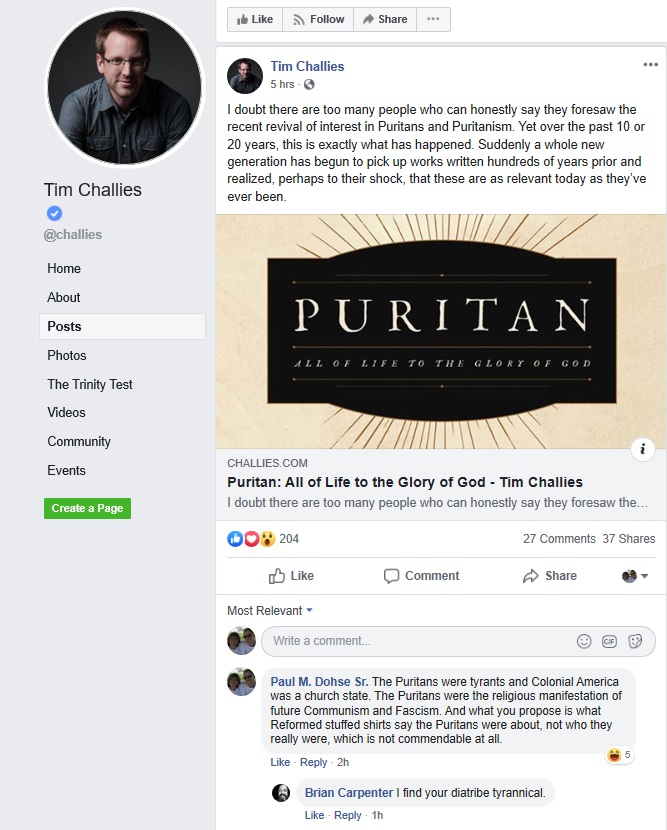
This ministry, and especially Susan, has documented the deviance of the Puritans extensively. Touting them as a source of spiritual invigoration is cognitive dissonance of the highest order. So why do it? The Puritans supply an arrogant identity for people and represent religious pedigree. In the same way, not that long ago, the veneration of Ernesto “Che” Guevara was in vogue among teenagers which included wearing T-shirts with his image on the front. Why would American teenagers venerate a Communist psychopath in this way? Well, it’s what the image and the idea meant to them and supplied a hip identity in a world where teenagers have been taught they are at least unable or totally depraved. This leads to identity seeking because you are dissatisfied with your own identity and have never been taught about self-identity building. This is one way among many that governments, institutions, movements, religions, or whatever, control people: A; you are a loser by virtue of your humanity. B; but wait, in a far-away place long, long ago there was this mysterious genius who changed the world. Be like that mysterious hero. Oh, and by the way, here is what he believed, and because he was so special and you are a loser, you need to believe that also. These human images become bedtime stories and pseudo moralism for the masses.
I couldn’t help myself, I commented on the stream which resutled in a pushback from several of Challies’ readers. There is no reason to document the details of what followed; suffice to say, all of the usual arguements were presented to protect their Puritan idol worship including “they did good things,” “some were bad, but most weren’t,” a denial that the Salem witch trials really happened, and a denial that the Puritans executed Quakers for believing in infused grace.
Here is how you prevent the wasting of your time when debating people: if you note a rediculous argument, this is not an honest discussion, you are debating what that person wants to believe, viz, evil desires, or desires that lend no value to personal growth.
This is the sole difference between idol worship and truth seeking.
Desiring to Have Authority Over Your Wife is the Essence of Sin
 No surprise that the submission of women issue is trending in the under-law evangelical church. The under-law gospel of justification by faith (which is supposedly not under law because Jesus keeps the law for us) is not only a false gospel, but a mindset. Personally; been there, done that. I was once enslaved to a desire for my wife’s submission to what I was submitting to: additional mediators other than Christ.
Thanks to the true gospel of justification by new birth, I want my wife to be my companion in life’s journey, not my servant. As I have emphasized prior, one of the primary characteristics of sin is its desire to control others. That’s how the Bible describes sin: it is driven by a desire to enslave and uses condemnation to do so. This desire displays itself from the playground of an elementary school to the highest echelons of statecraft. Why do people want to control others? Sin.
In case you missed it; Christ used persuasion and not authority. Now, He will bring His authority to the world scene in the future, and if you read how that happens, it’s rather obvious that He hasn’t implemented His authority yet, and He certainly hasn’t given it to men to compel faith or any kind of behavior indicative of faith. Um, that would include marriage.
And by the way, you can’t make your wife do anything. If you are in a Muslim country you can beat her or even kill her, but if she would rather die than obey you, guess what? Yes, you can kill her, but you can’t make her do anything. To begin with, freewill is a major pillar of reality, so you better get a learning on how to be a good leader and persuader. This also applies to childrearing. In case you haven’t noticed, teenagers have this reality well figured out.
Of course, in church where words don’t necessarily mean anything, “head” in Ephesians chapter 5 is translated as “boss” or having authority. Clearly, if you read the chapter, Paul is using the analogy of a human body. This is the analogy that the Bible uses to explain how the “body of Christ” is to function; like a body, because you know, it’s a body.
Here, I will rip off what I have written about this previously:
Now listen. Here is my thumb. Last week, I drilled a hole in it. As a member of my body, I have NO authority over my thumb. I cannot command my thumb to heal. As with most all bodily functions, they are what we call, “involuntary.” Different cells that make up different body members and organs are a body within a body and literally have a complex mind of their own. My head, viz, my mind, has NO authority over my body.
HOWEVER, I can edify my body and submit to its needs in order for all the cells to better perform their function. Get it? That’s the illustration here. It’s body, not authority. You can’t tell your body to do squat. You can desire your body to do something, but if that particular member is unhealthy, no amount of bossing is going to make it do what it doesn’t want to do or can’t do.
You must submit to the needs of your body in order to have a healthy overall function. That’s knowledge of your body, and edification of your body members. That’s good choices and knowledge that edifies. This is what the Bible is talking about when men are instructed to live with their wives according to knowledge. Here, in Ephesians, we find that ill behavior towards our body is ill behavior towards yourself. Your wife should annoy you by not properly edifying herself, not a lack of edifying you. Your body health is directly related to your wife’s wellbeing as you are one body. It cannot be denied that the husband is to take leadership in this endeavor and the wife needs to respect his efforts in doing so.
Elders do not live with your wife; they don’t know squat about you wife. In every case where marriage counseling is needed, the husband has been asleep at the switch. Premarital counseling and all other marriage counseling should be limited to an understanding of Ephesians 5, then the husband needs to get off his sorry lazy rump and edify his wife in the same way he edifies his own body. This, as opposed to letting spiritual morons with 4 or 5 useless titles after name do the thinking for them. Together, the husband and wife are the walk of the new man that does the kingdom’s bidding.
As Christ is the lead edifier of the man, the man is the lead edifier of his wife; the role is not one of authority. Eldership is a gift for edification in general. It is interesting how the church looks at this. Most evangelical parishioners don’t realize it, but official church orthodoxy sees church membership as the first step of church discipline. So, by virtue of being a church member, you are under elder church discipline because elder teaching “disciplines” the believer. Therefore, if the teaching is not followed, “corrective” church discipline is needed.
Where there is authority leadership and edification are completely unnecessary; accomplishments are achieved because one party commands it. Authority is not the function of a cooperative body operating by mutual submission of needs.
paul
The Problem With Church and Women Preachers According to Andrew
Pastor John MacArthur is back in the Church news and what is presently trending in the Church drama kingdom. Many who follow him have gone to their Twitter accounts and posted their accolades concerning his uncompromising stand on the word of Gawd (pronounce with hard G). His total compromise with the wacky New Calvinist cartel notwithstanding.
So, what is it this week that distracts from a focus on the justification by faith false gospel that isn’t justification by the law because Jesus keeps it for us? Not the usual favorite, election, but ah yes, the controversy of women preachers. MacArthur preached a sermon against women preachers that has gone viral. Note: this means Beth Moore is receiving an unacceptable market share of layman slave labor.
In the sermon, he focuses on 1Corintians 14:
34 Women should remain silent in the churches. They are not allowed to speak, but must be in submission, as the law says. 35 If they want to inquire about something, they should ask their own husbands at home; for it is disgraceful for a woman to speak in the church.
As a former SBC pastor I was all-in on the anti-women preachers thing…and the cognitive dissonace that goes along with it in the church. MacArthur uses this passage to make a case for women not preaching in the church or being elders, but Houston, we have a problem.
The passage does not say it is a shame for women to preach in the church, it states that it is a shame (disgrace or immoral) for women to say anything in the church…period. MacArthur uses this passage for the pastor issue, and no one even blinks; the whole grammatical concept of total silence does not create the slightest spark of individual thought but rather a running to the PC to extol MacArthur’s Scriptural brilliance.
Meanwhile, no one thinks anything about women teaching children’s Sunday School classes. “Silence” all of a sudden doesn’t mean “silence”; it only means silence in regard to preaching. Of course, many other examples of women speaking in the church to serve its purposes could be added; point here follows, it’s logically inconsistent to say the least. But welcome to church, and welcome to why people are not getting saved because of their God-given commonsense.
Let’s be honest; these inconsistencies are driven by a traditional lust for authoritative caste systems and then labeled with the haughty “Sola Scriptura” which is rank propaganda. People go to church because thinking is hard, and they are all too happy to pay the John MacArthurs of the world to think for them while getting a ticket to heaven to boot. Supposedly. And let me be a bit more clear: people go to church because they are lazy thinkers.
In our home fellowship movement, our learning is collective. A collective effort by Christ’s body is the only way that the full counsel of God’s word is going to be understood. This brings up Andy Young’s interesting take on this passage of which initially I was skeptical, but recently less so.
Though Andy is not yet dogmatic about this, he suggests that Paul is referring to a secular ekklesia of that day. This is the Greek word for the political assemblies of that day, and is the word borrowed for Christian assemblies and for some weird reason translated “church” in English translations. In the Roman ekklesias, by law, women were not allowed to speak. All of a sudden, a context where women are forbidden to speak at all makes perfect sense. In context of a Christian assembly fellowship, you have all kinds of problems with logical consistency if that is what Paul is talking about.
“But wait,” I thought, Paul also said “as in all the congregations of the Lord’s people.” So, Paul is identifying what ekklesia he is talking about, right? Ironically, I remembered that argument from a prior sermon by MacArthur on the same passage some years ago. But once again I find that instead of MacArthur being a grammatical technician, he is, in reality, a grammatical sluggard and there are many, many examples of this. Paul mentions the Christian ekklesias immediately prior to this sentence on women speaking, and the prior statement could actually be a demarcation for purposes of writing about the other; this also fits the context of Paul’s discussion on another issue.
Paul is also addressing the cultural feminist movement that had inundated the assemblies at Corinth which included women with shaved heads speaking in ecstatic tongues during the Christian gatherings and fellowship. Paul is addressing this kind of anti-social behavior in the name of Christianity. It stands to reason that feminists were also speaking out at Roman ekklesias in violation of the law as a way to practice civil disobedience for protest purposes. Or, as another way to prove that they were free from their husband’s authority over them, may have been asking the assemblymen questions about civil policies in the open forum.
At any rate, this take on women not speaking at all makes sense; in context of Christian assembly, it makes no sense at all. Hence, I don’t think Paul is talking about a Christian assembly.
And by the way, in our day, if there is a woman out there that can articulate the true gospel of justification by new birth; I say, let her preach. It wouldn’t be the first time God has called woman to do a man’s job when men won’t do it, and it goes without saying that there is a severe shortage of real men in the church.
paul



leave a comment