Some Comments Just Have to be Posted
|
Submitted on 2012/02/03 at 3:31 pm
From the New Calvinist Bible, Matthew 21:28-32: Jesus asked the men who had come to test him, “But what do you think? A man had three sons, and he came to the second son and said, ‘Son, go, work today in my vineyard.’ He answered and said, ‘I will not,’ but afterward he regretted it and went. Then he came to the third son and said likewise. And he answered and said, ‘I go, sir,’ but he did not go. Which did the will of his father, the second son or the third son?” One of the really smart men listening to Jesus said to him, “The third son. While it is true that the second son repented and went to the vineyard, he obviously never understood the graceful message the father intended to convey to him. Sadly, the second son spent his life trying to please his father by working hard and following what the father had commanded. The third son, on the other hand, understood that the father never really expected obedience to his commands. The third son realized that, despite all the knowledge the father had revealed to him and all the resources he had been given by the father to do the work in the vineyard, he was in fact totally deficient of all ability to tend the vineyard as the father had commanded. The third son had learned from his teachers that the father almost always meant just the opposite of what he said to his sons, especially when the father said something that sounded like a command. Moreover, the third son trusted that the father’s first son, who had died years earlier, had already done all the work necessary for the vineyard to thrive. Again, that’s what the third son’s teachers had taught in class, and the third son felt at peace with their teaching. Importantly, the third son’s teachers had instructed that, in order to never feel compelled to go and work in the vineyard, the third son should remind himself daily of the good news that the father didn’t mean what he commanded and that the deceased first son had already done all the work. Note 1: The original manuscripts explicitly mention only two sons. However, the Editors interpreted the penumbras of the best original manuscripts and found there were actually three sons. These penumbras were found to exist throughout the best original manuscripts whenever the text included imperative statements. Note 2: Original manuscripts contain a warning by Jesus in verses 31b and 32. This warning has been omitted by the Editors because all such warnings impart fear and obedience to commandments, which are Old Testament concepts that were carried over into some of the New Testament writings inadvertently. |
Pictures of Kenya

“Comfort came when I realized my thinking about the trip was wrong.”
In just four days, my son-in-law (David), daughter, and granddaughter will board a plane for Kenya. They will be there for six weeks ministering to a network of churches organized by their Puerto Rico ministry. They will be accompanied by my present pastor, Andy Powell.
Of course, I’m concerned. In countries like Kenya, things can change fast. You can go to bed at night, and wakeup the next morning without a way out of the country and in a bad situation.
I’m for putting it all on the line for the Lord, but admittedly, I’m strong on the endeavor being as orthodox as possible. And though I love my son-in-law dearly, we have some significant theological differences. The thought of losing any of them is hard enough, but my misery would be greatly multiplied if I thought bad theology was part of the mix.
David and I have no differences in regard to the gospel, our disagreements concern church polity and some sanctification issues. I’m not going to lie; I would be delighted to see them going over there to train pastors with the full-blown Institute of Nouthetic Studies counseling program. I am also very big on going, wherever we go, with the authority of the word, and culture be damned.
So, denial gave way to reality, and reality gave way to distress. One thing I have learned from getting Jay Adams stuff thrown in my life-path, a time of distress means it’s time to take a life inventory—a time of evaluation. As Christians, we don’t let emotions run the show.
Face it, they’re going. Now what? Decision time. What’s my response? Does my response matter? How should I think about this? Where should I start? Well, maybe with the big picture and not just his gankey theology. The big picture? Where should I start? With the Kenya pictures from the last trip? Are they conspiratorial? Probably, but I have nothing else.
I haven’t seen those pictures for two or three years, but they are still burned into my mind. They tell a story. It’s a story of one of the poorest and destitute regions in the world. The epicenter of their ministry is a region east of Nairobi, which is one of the heaviest populated cities in the world. And a large segment of that population are homeless children orphaned by political riots and the Aids epidemic. One of the pastors in David’s network goes into Nairobi to search for orphans:
Come here little one, I would like to speak with you. Do you have a mother and father? Do you have a place to live? Where?
If the answers are all negative, other than the one about the cardboard box, the pastor will take the child and place him/her with a family that is part of the network, who usually live hand to mouth.
The last time David and my daughter (Heather) went to Kenya, they took bags full of over-the-counter medications/ Band-Aids , etc. I will never forget the pictures of the long line of children ending with my doctor-like son-in-law administering first aid to minor injuries and ailments that these people usually have to live with. This was amazing to me.
And then there is the hunger for the word. During the last trip, pastors walked for miles to get to the conferences—not having the resources to return home. Heather and David also have a Bible distribution program there as well, and I do believe that is powerful within itself. The network meets in structures that are wood frameworks with cardboard nailed to them. The more elaborate structures employ scrap sheet metal.
Much more could be said, but in remembering those pictures, I remembered something else: It’s a David ministry. You see, missionaries are not lining up to minister in that region because there is no way to plant self-sustaining churches there. Resources to start a work in that area are extremely limited. And that’s David, always filling the gap where others will not, whether here in the states, in Puerto Rico, or half way around the world.
That’s the big picture. The rest is what it is. Bigger theological packages often deliver a lot less hope, if any at all. Comfort came when I realized my thinking about the trip was wrong. I ask all who stop by PPT to remember David, Heather, and Hannah in your prayers. And by the way, donations for their trip can be sent to PO box 583, Xenia, Ohio 45385. If the Lord leads in that way, be sure to designate the purpose.
paul
Important Correction on Biblical Counseling Post
What previously stated:
These are two completely different gospels. One is monergistic substitutionary sanctification, and the other is synergistic regeneration. How the gospel is presented from each of these different viewpoints must necessarily be radically different. Moreover, counseling is necessarily, and radically different as well.
Now corrected and reads:
These are two completely different gospels. One is monergistic substitutionary sanctification, and the other is monergistic justification and synergistic sanctification. How the gospel is presented from each of these different viewpoints must necessarily be radically different. Moreover, counseling is necessarily, and radically different as well.
The Only Real Difference Between First and Second Generation Biblical Counseling is Romans 8:30
“Are two different gospels operating under the same nomenclature of ‘help can be found here’ acceptable or not? Both are not the truth, and one or the other will help, or add further hurt.”
Heath Lambert recently published the book, The Biblical Counseling Movement After Adams. The contemporary motif of our day is the idea that Dr. Jay E. Adams started the biblical counseling movement (first generation), and then others such as David Powlison of Westminster’s CCEF built on the foundation laid by Adams. The ever-morphing result is called “second generation” biblical counseling. Lambert’s book is a lengthy treatise that supposedly informs us of the differences between the two generations.
I am going to bypass all of those issues and focus on the one difference that matters—how each generation interprets the gospel. As the president of the annexed NANC used to say, “Fasten your seatbelts and put on your crash helmets,” because my thesis is that one of these generations is founded on, and operates by a false gospel.
As many know, especially my wife, I have spent almost five years researching the present-day New Calvinism movement. The movement has its roots in the Progressive Adventist movement fathered by Robert Brinsmead. The magnum opus of that movement was their interpretation of Romans 8:30. I will pause now and quote an individual who witnessed that remarkable movement firsthand:
In 1971, Brinsmead scheduled a flurry of summer institutes to bring us his latest emphasis. There was more excitement than usual; the latest round of tapes had prepared us for something big. Bob had been studying the Reformation doctrine of justification by faith, comparing it to Roman Catholic doctrines. Reading Luther, he saw that justification is not just a means to the end of perfect sanctification. When we are justified by faith, not only does God impute Christ’s righteousness to us but we also possess Christ Himself—all His righteousness and all His perfection. Eternity flows from that fact.
And those whom he predestined he also called, and those whom he called he also justified, and those whom he justified he also glorified’ (Rom. 8:30).
The same ones he justified he also glorified. We began to realize we had inserted extra steps into Paul’s chain of salvation: sanctification and a final atonement brought about by blotting out sins. Those added steps, in fact, were the heart of the Awakening message—but we had ignored the heart of the real gospel: being justified by faith, we ‘rejoice in hope of the glory of God.’ Our righteousness is in heaven, said Brinsmead:
“The righteousness by which we become just in God’s sight, remain just in His sight and will one day be sealed as forever just in His sight, is an outside righteousness. It is not on earth, but only in heaven…only in Jesus Christ” (Martin L. Carey: Judged by the Gospel: The Progression of Brinsmead’s Awakening )
Brinsmead further articulated this magnum opus in the theological journal, Present Truth:
Then in the golden chain of salvation, Romans 8:30, justification spans our Christian life all the way from calling or conversion to glorification: “Whom He called, them He justified; whom He justified, them He also glorified.” Here justification, our standing before God, is coterminous with sanctification, our being conformed to the image of God’s Son, in Romans 8:29. In 1 Corinthians 1:30 the apostle mentions Christ as our righteousness or justification before he names Him as our sanctification. But in 1 Corinthians 6:11 the order is reversed: “You are washed, you are sanctified, you are justified in the name of the Lord Jesus, and by the Spirit of our God.”
Accordingly, Luther taught that to accept justification by faith in Christ is our whole work for the whole Christian life. We never learn this too well. For the forgiveness of sins is a continuous divine work until we die. Christ saves us perpetually (Luther’s Works, American ed. (Philadelphia: Muhlenberg Press; St. Louis: Concordia, 1955- ), Vol.34, pp.164, 167, 190) [Present Truth: volume 25, pages 11,12].
Now, the term, “golden chain of salvation” did not originate with Brinsmead, but when that term was used by theologians of old, it doesn’t seem to be in reference to Romans 8:30. The term seems to have a contemporary meaning when associated with Romans 8:30, and that is how it will be used in this post. Furthermore, Brinsmead attributes the magnum opus of Progressive Adventism to Martin Luther, and Carey attributes it to Brinsmead who again, states that he learned it from the writings of Luther.
But the need for further research aside, this post will focus on the what. And the what is the following:
[1] Brinsmead’s interpretation of Romans 8:30 combines justification and sanctification, and perpetuates the need for a just standing before God until glorification.
[2] And the need for a progressive justification until glorification, ie.,“Christ saves us perpetually.”
[3] And sanctification is missing from Romans 8:30 because it is “coterminous” with Justification. “Conterminous” means, 1. having the same border or covering the same Area 2. being the same in extent; coextensive in range or scope.
[4] This Romans 8:30 golden chain can be definitively traced throughout the New Calvinism community as a single mainframe that holds the doctrine together and determines its modus operandi.
[5] The Romans 8:30 golden chain manifests itself as, Gospel Sanctification, Sonship Theology, New Covenant Theology, and Christian Hedonism which all dwell in the community of New Calvinism.
Hence, New Calvinists can run, but they can’t hide—their interpretation of Romans 8:30 identifies them. And it also identifies what they will teach, and how they will counsel.
The Two Romans 8:30 and Their Gospels
Therefore, one version of Romans 8:30 suggests that sanctification is missing from the verse because justification and sanctification are the same, and justification is perpetual till glorification. The second interpretation of Romans 8:30 suggests that sanctification is missing from the verse because justification and sanctification are completely separate; and justification is a finished work that makes sanctification possible, but does not directly power it. This position would hold that sanctification is powered by regeneration, and not justification. Hence, Romans 8:30 is missing sanctification because justification is a finished work that guarantees glorification.
These are two completely different gospels. One is monergistic substitutionary sanctification, and the other is monergistic justification and synergistic sanctification. How the gospel is presented from each of these different viewpoints must necessarily be radically different. Moreover, counseling is necessarily, and radically different as well.
And these two views of Romans 8:30 define the difference between the two generations of biblical counseling. David Powlison says so. In a seminar presented by David Powlison at John Piper’s church while Piper was on sabbatical, Powlison stated the following:
This might be quite a controversy, but I think it’s worth putting in. Adams had a tendency to make the cross be for conversion. And the Holy Spirit was for sanctification. And actually even came out and attacked my mentor, Jack Miller, my pastor that I’ve been speaking of through the day, for saying that Christians should preach the gospel to themselves. I think Jay was wrong on that. I – it’s one of those places where I read Ephesians. I read Galatians. I read Romans. I read the gospels themselves. I read the Psalms. And the grace of God is just at every turn, and these are written for Christians (David Powlison: What is Biblical Counseling May 8, 2010. Online source for MP3s ; http://goo.gl/Dumep).
David Powlison’s mentor, Dr. John Miller, whom he mentions in the above citation, was the father of Sonship Theology. Jay Adams wrote a book in contention against the doctrine in 1999. By way of reiterating Powlison’s articulation, Adam’s made the following statement on page 34 of Biblical Sonship:
The problem with Sonship is that it misidentifies the source of sanctification (or the fruitful life of the children of God) as justification. Justification, though a wonderful fact, a ground of assurance, and something never to forget, cannot produce a holy life through a strong motive for it….On the other hand, regeneration, (quickening, or making alive; Ephesians 2:25) is the true source of sanctification.
The major difference between the first and second generations of biblical counseling is their gospel models. One model will attempt to help people with the reductionist gospel of sanctification by justification. The other will attempt to help people with the full armor of regeneration.
Though CCEF is a lost cause and was wicked from its conception, the realty of how counselors interpret Romans 8:30 is a gut-check for the president and board members of the critically ill NANC. Are two different gospels operating under the same nomenclature of “help can be found here” acceptable or not? Both are not the truth, and one or the other will help, or add further hurt.
Let’s be honest, how important is truth to those who claim to be in the truth business?
paul
Classic New Calvinist Double Speak: Tchividjian; Christians Are Not Totally Depraved, But they are Totally Depraved
Again, as I am getting further and further behind schedule because New Calvinist heretics continue to herald outrageous error while cowardly HIV’s (highly respected leaders with international visibility) remain silent, I have to stop in the middle of a project to address something that I stumbled across while doing research. Apparently, questions about New Calvinism’s total depravity of the saints are causing enough stir to demand some answers. So Tullian Tchividjian (hereafter: TT) wrote a response on his blog.
As he sat down to write his response, a little mouse overheard him talking to himself and reported the following to me after running all the way up here from Florida:
“Hmmmm, how ate-up in the brains are my beloved Kool-aid drinking followers? Should I just plainly admit it, or use doublespeak? I don’t think they are quite ready for the whole truth yet, so I will use doublespeak. Now let me see, how can I say that we are totally depraved, while saying at the same time that we aren’t? Hmmmmm.”
Does the mouse story seem farfetched? So what? Christians will believe anything these days—why can’t I have some fun? TT’s treatise on how we are totally depraved, but not totally depraved, can be read here. First, TT gets us warmed up with a traditional view of what totally depravity is, and isn’t. Ie., it doesn’t mean we are all as evil as we could be because of God’s restraints. TT spends the first half of the post on that, and cites five Bible references.
After assenting to the fact that we are born again (and keep in mind that the New Calvinist definition of the new birth is NOT orthodox), he states the following:
But once God regenerates us by his Spirit, draws us to himself, unites us to Christ, raises us from the dead, and grants us status as adopted sons and daughters, is there any sense in which we can speak of Christian’s being totally depraved?
Yes.
I, by no means, am going to stop here and write a book on what New Calvinists really believe about the new birth, but notice in his statement that he stops short of a description of new creaturehood. The apostle Paul said of the new birth:
2 Corinthians 5:17
Wherefore if any man is in Christ, he is a new creature: the old things are passed away; behold, they are become new.
One might also note that TT conveniently leaves out the fact that the old man died with Christ’s death which means the power of sin over us is broken:
What shall we say, then? Shall we go on sinning so that grace may increase? 2 By no means! We are those who have died to sin; how can we live in it any longer? 3 Or don’t you know that all of us who were baptized into Christ Jesus were baptized into his death? 4 We were therefore buried with him through baptism into death in order that, just as Christ was raised from the dead through the glory of the Father, we too may live a new life. 5 For if we have been united with him in a death like his, we will certainly also be united with him in a resurrection like his. 6 For we know that our old self was crucified with him so that the body ruled by sin might be done away with, that we should no longer be slaves to sin— 7 because anyone who has died has been set free from sin (Romans 6:1-7).
TT then continues to build on his thesis:
Theologians speak of total depravity, not only in terms of “total inability” to come to God on our own because we’re spiritually dead, but also in terms of sin’s effect: sin corrupts us in the “totality” of our being. Our minds are affected by sin. Our hearts are affected by sin. Our wills are affected by sin. Our bodies are affected by sin. This is at the heart of Paul’s internal struggle that he articulates in Romans 7: “For I do not do what I want, but I do the very thing I hate.”
Note what he is stating here carefully—words mean things: because we are still affected by sin in our mortal bodies, or because it is still there—there is still a “total inability” to come to God in the same way that there was before we were saved. In other words, and for all practical purposes, sanctification is a continual coming to Christ by faith. TT relates this further by writing in the same post:
Paul’s testimony demonstrates that even after God saves us, there is no part of us that becomes sin free–we remain sinful and imperfect in all of our capacities, in the “totality” of our being. Even after God saves us, our thoughts, words, motives, deeds, and affections need the constant cleansing of Christ’s blood and the forgiveness that comes our way for free.
No it’s different. Sin’s relationship to us as believers is not the same as when we were unbelievers—it’s present, but its power over us is broken. TT at the very least deemphasizes that, and for the most part denies it. But the smoking gun here is the fact that TT reveals a theological flaw in New Calvinist thinking that repentance unto salvation and repentance in sanctification are the same. This reflects their belief that the relationship to sin and its power over us is the same as it was when we were unregenerate. Again, words mean things—what does the “blood” refer to? It refers to our justification, or Christ’s death on the cross for our “washing” (1Cor.6:11). But we don’t need that kind of washing/forgiveness anymore; we only need forgiveness for sin in sanctification that disrupts our relationship to the Father as adopted sons (John 13:9-11).
TT then elaborates on how New Calvinism fleshes out in an unbiblical fusion of sanctification and justification:
The reason this is so important is because we will always be suspicious of grace (“yes grace, but…”) until we realize our desperate need for it. Our dire need for God’s grace doesn’t get smaller after God saves us–in one sense, it actually gets bigger. Christian growth, says the Apostle Peter, is always “growth into grace”, not away from it. Many Christians think that becoming sanctified means that we become stronger and stronger, more and more competent.
And,
The truth is, however, that Christian growth and progress involves coming to the realization of just how weak and incompetent we continue to be and how strong and competent Jesus continues to be for us. Spiritual maturity is not marked by our growing, independent fitness. Rather, it’s marked by our growing dependence on Christ’s fitness for us. Because we are daily sinners, we need God’s daily distributions of free grace that come our way as a result of Christ’s finished work. Christian growth involves believing and embracing the fact that, even as a Christian, you’re worse than you think you are but that God’s grace toward you in Christ is much bigger than you could ever imagine.
In other words, total depravity is a good thing because the more we realize how sinful we are, the smaller we get and the bigger the cross and our need for it becomes. This can be illustrated by the following chart published by a New Calvinist organization:
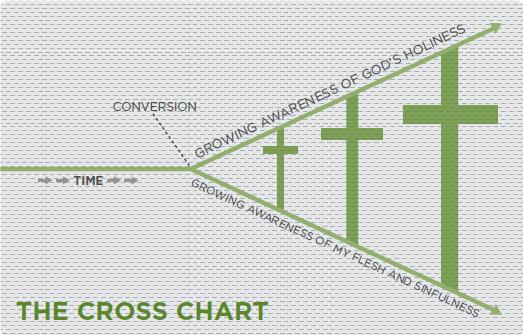
Basically, this is indicative of the New Calvinist gospel that makes much of sin so that Jesus is magnified. It is the antithesis of the true gospel.
TT concludes:
Because of total depravity, you and I were desperate for God’s grace before we were saved. Because of total depravity, you and I remain desperate for God’s grace even after we’re saved.
Thankfully, though our sin reaches far, God’s grace reaches infinitely farther.
Conclusion? We are still totally depraved. And what is really the difference between this and the apostle’s literary gasp concerning the amplification of sin so grace can abound?
In my book, nothing.
paul



1 comment