The Sevenfold Thesis of TTANC volume 1
 Pages 77 and 78:
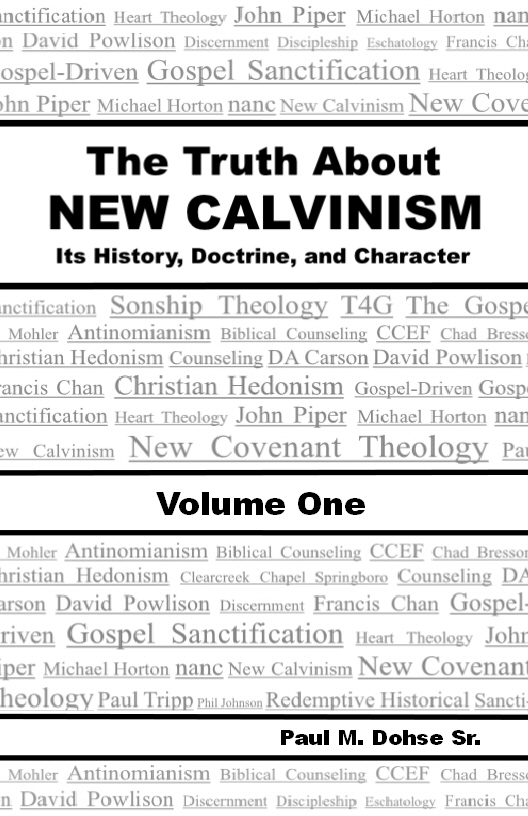
The thesis of this book is sevenfold. First, New Calvinism is an expression of antinomian reductionism; specifically, gospel reductionism. It reduces the believers role in God’s spiritual work and plan to the least common denominator—primarily gospel contemplationism.
Second, it reduces the gospel to the saving work of Christ only—eclipsing the Father and Holy Spirit.
Third, because the believer’s role is reduced to a point that is not according to Scripture, he/she is deprived of the abundant life in a way God wants us to experience it for His glory and the arousing of curiosity from those who don’t have the hope of the gospel.
Fourth: it reduces the Scriptures to a historical gospel narrative only—a tool for contemplation. This also “relaxes” the law as a form of antinomianism. While that prism is singular, the system needed to make it work is so complex that it relegates God’s people to a pope-like reliance on those who fancy themselves as masters of meta-narrative interpretation.
Fifth: while reductionist theologies seek to reduce the believer’s role to the least common denominator, supposedly to make much of God and little of man, the elements that attempt to make it seem plausible are often complex and mutating. Therefore, instead of majoring on the application of what is learned from Scripture, believers are constantly clamoring about for some new angle that will give them a “deeper understanding” of the gospel that saved them.
Sixth: Christ and the apostles clearly warned that such doctrines would constantly trouble the church until the return of Christ, and in fact has been the primary nemesis of God’s people throughout redemptive history.
Seventh: All hope in contending against this doctrine is lost if one focuses on all of the theological systems and theories that attempt to make it plausible. This harkens back to lessons learned in contending against first century Gnosticism. For example, as mentioned in chapter five, New Covenant Theology alone has eighty elements. Presently, that is.
Is it Just Me?
 Um, is it just me, or does 2Peter 2:1 pose a problem for limited atonement?
Spiritual and Sexual Abuse in the Church: I Can See Clearly Now
 In preparation for the second volume of The Truth About New Calvinism and The Reformation Myth, I am reading a hefty amount of material written by Socrates and Plato. Though Socrates was obviously a very annoying person, reading his writings is a real eye-opener in regard to how the first philosophical academy of the western world shapes our present-day thinking from some twenty-five hundred years ago. His very same bases of thought, attitude, and communication techniques that can be seen today are eerily exact—not just similar—exact.
Volume one of TTANC focused on the roots and doctrine of the present-day New Calvinist movement. In preparation for volume two, I dined with church historian John Immel who pointed me to the fact that New Calvinists hold to true Reformation doctrine. Immel then suggested that I research the connections between the Reformers and Augustine, and then Augustine’s connections to Plato. He also provided some clues as to what he believes the connections are. Immel is not one who desires to put ideas in people’s minds; he is more or less a modern-day herald of the need for people to think for themselves.
Mark that. It’s an element that contributes greatly to spiritual and sexual abuse in the church. People – thinking for themselves = abuse. That’s the first part of the equation, we will add to it later. Lest you think that I am alone in seeing hefty significance and a direct relationship between the Soc./Plato Academy and modern-day behavior, consider what others say. In Harper Magazine’s endorsement of “The Wisdom And Ideas Of Plato” by Eugene Freeman and David Appel, they stated the following: “Now anybody can understand and appreciate the basic thoughts that support our modern life.” Though true, not everybody “appreciate[s]” them. Renowned philosopher Karl Popper blamed 20th century totalitarianism on Plato specifically:
Karl Popper blamed Plato for the rise of totalitarianism in the 20th century, seeing Plato’s philosopher kings, with their dreams of ‘social engineering’ and ‘idealism’, as leading directly to Joseph Stalin and Adolf Hitler (via Georg Wilhelm, Friedrich Hegel, and Karl Marx). In addition, Ayatollah Khomeini is said to have been inspired by the Platonic vision of the philosopher king while in Qum in the 1920s when he became interested in Islamic mysticism and Plato’s Republic. As such, it has been speculated that he was inspired by Plato’s philosopher king, and subsequently based elements of his Islamic Republic on it (Wikipedia: online source: http://en.wikipedia.org/wiki/Philosopher_king).
Volume 2 of TTANC will trace New Calvinism from its contemporary birth (the Australian Forum:1970), and back to its Reformed roots. It will also lightly survey the Reformation’s philosophical underpinnings that came from the Soc./Plato Academy. However, The Reformation Myth will address these same things in much deeper detail. Both books will address this from three perspectives: history; doctrine; and character.
Immel’s primary concern is spiritual tyranny, but an understanding of church history is critical to understanding what makes spiritual tyranny tick. In my research for TRM, the subject of abuse has become so entangled in the results that I have decided abuse will dominate the “Character” section of the book. The fact that Plato’s philosopher king concept dominates today’s church is inescapable—with the same results following that have always marked this philosophy’s existence throughout history.
Socrates believed that true knowledge could not be obtained through observation of the material. He also believed that truth was eternal, and immutable, and a higher good than the gods. One could only access truth through the mind, or ideas; ie, the nonmaterial. The mind was the conduit to the realm of truth which in essence was god, and like the real God, cannot be fully known. To Socrates, the first step to wisdom was realizing that definitive truth cannot be known, but yet, man had a duty to orchestrate life by the best truth that could be ascertained from the mind. In other words, truth was already in each person, and true education was a rediscovering of information already known. It is unclear to me at this point whether Socrates believed that truth indwells us all in the fullness of the truth cosmos, or indwells each of us to varying degrees.
The method for discovering the truth that is in us, according to Socratism, is to ask ourselves questions. When Socrates taught, the teaching began with a question concerning life, and through a lengthy dialogue of questions and answers, the best solution was drawn from the mind’s connection to pure truth. This entailed three things: hard, certified work; the recognition that we cannot know anything definitively; the belief that truth cannot be known through observation of solid matter; and the belief that the only measure of moralism was in regard to what best served the masses verses the few. His understudy, Plato, later identified these characteristics as belonging to philosopher kings, and believed such should rule over the masses for the betterment of society’s whole. In regard to the moral fitness (which cannot be definitively ascertained anyway) of the philosopher king, it was irrelevant because his knowledge was essential to the society as a whole and his personal life only affected him—not society. Hence, in societies that function by philosopher kings (knowingly [rare] unwittingly, or by default [most often]), the written law is not much more than a strong suggestion in most cases.
Plato divided the ideal society into three parts: philosopher king, soldier, and producer. It doesn’t take a genius to figure out where this all ends up; the soldiers serve the king, and the producers do not understand the basic fundamentals of truth. All–knowing kings + soldiers = you had better know your place + keep your ideas to yourself because you don’t know that you don’t know.
Now enter St. Augustine. Patron saint of the Catholic Church, father of Reformation philosophy/doctrine, and a follower of Plato. Luther was a member of the Augustinian Order, and Calvin quoted him on every (on average) 2.5 pages of his institutes. Augustine was a dyed in the wool Catholic till the end, and revered as its “Doctor of Grace.” No less credit was given to him among the Reformers. Basic Platonist philosophy drawn from Augustine is really what made the Catholic Church and the Reformation tick, with the same results following. The Reformation was really a spat between Rome and the Reformers about who was going to control the ideas.
For all practical purposes, they were two different camps of philosopher kings at war for control of the producers. The primary crux of the argument, if any, was the idea that the Reformers were moral despot philosopher kings verses the decadence of the popish sort. At any rate, this side of the Reformation, the indifferent attitude towards justice, mercy, and freedom of thought is abundantly evident. By and large in today’s church, we don’t have pastors, we have philosopher kings. They are supposedly so paramount to the wellbeing of the church city-state, that concerns over their outrageous behavior should be overlooked for the Platonist good of the whole. Besides, morals, according to Socrates, are not definitive anyway.
Excellent studies that expound on how Augustine integrated Platonism into theology are not difficult to obtain. To cite just a few examples, Socrates’ “truth” became “gospel “; Plato’s two worlds became Spirit and flesh; and much later, Historicism, which was a product of Platonism, became the hermeneutic for interpretation. But in regard to human carnage, Popper’s complaint has become the same in the church. Whether a philosophy is dressed up in Bible verses or not, the results are the same.
In my mind, nothing else can explain the indifference among church leaders regarding the spiritual and sexual abuse now rampant in the church. And what better example than the ABWE/ Donn Ketchum scandal. The ABWE/GARB brain trust first covered for Ketchum for some twenty years and were part of a massive cover-up. Now the same men who perpetrated the cover-up and were directly responsible for putting additional children in harm’s way are honored continuously in GARB circles. One is being honored via a multi-million dollar athletic center that is being named after him. The infamous Jack Hyles was honored with a Bible college that bears his name. Even the formally laudable John MacArthur Jr. is covering for serial sheep abuser CJ Mahaney.
Why? Because they are the philosopher kings. Their higher knowledge leads us through the maze of what’s best for the church as a whole. After all, thousands of souls would be lost without them; so, best that the sexually abused go away quietly for the sake of the bigger picture. And besides, we are all “sinners saved by grace” anyway. In the Platonist vernacular: we are all those who “neither know nor think that [we] know” (Socrates: The Apology).
I’m convinced that the key to getting rid of sexual/spiritual abuse in the church is to totally rethink the organized church that is the breeding ground for the church’s philosopher kings. What is left that is good about the organized church will not stand up against the philosopher kings posing as pastors; so, who needs them?
And let me remind you of who really makes the organized church possible: the producers. I am confident that eventually the producers are going to figure out that they are paying the salaries of those who expect us to offer up our children to the sexual cravings of the philosopher kings.
I have to believe that the whole, “Who are you to judge? Put your money in the plate, buy our books, and keep your mouth shut” routine cannot go on for much longer.
paul
Challenging the Tsunami of Mindless Christian Truisms
Come now, let’s be honest with ourselves; we think much of the Bible is “in a manner of speaking.” We think God’s word is a book of pithy truisms to live by. We like that because (continuing to write on major themes of the TANC 2012 conference) truisms are easy, thinking is hard. As discussed at the conference, the first gospel wave (1950-1970) focused on getting people save while poo-pooing Christ’s command to “make disciples.” Making disciples is hard and takes lots of thinking and doing. The second gospel wave (1970-present) states the following via New Calvinism: discipleship is hard, but Jesus does it all for you.
This sounded good to the first gospel wave because they could shirk the “easy believeism” rap under the auspices of “orthodox” Reformed theology. The rest is history, along with the clichés to live by propagated by a combined effort of both groups. The biggie one is, “We are all just sinners saved by grace.” “Sinner” is an individual who sins as a lifestyle. Retagging sinners is easy—making disciples is hard. Disciples CHANGE. New Calvinist heretic Michael Horton adds his brilliance to Reformed easy believeism by claiming that those who think hard and work hard in sanctification are trying to “be the gospel rather than proclaiming the gospel.” And, “not our doing, but Christ’s doing and dying.”
Biblically illiterate truisms are deeply rooted in the psyche of contemporary Christians, and the espousing thereof is habitual. Susan and I enjoy challenging each other on them as we consciously reexamine all of our thinking. I pounced on the opportunity to challenge a sanctified truism just the other day when she tossed this one my way for consideration: “We need God’s grace every day.” Susan welcomes these challenges and the discussion lasted throughout the day. We concluded together that this cliché is not biblical—we received all of the “grace” that we needed when we were saved, and do not continue to need it. “Grace” is a justification/salvation concept, and both gospel waves like that truism because only salvation is important, or they believe we need salvation every day.
How about this one: “I didn’t do it, Christ did it through me.” Oh really? This is simply not true. And I remind you, the Holy Spirit sanctifies through truth—not error (John 17:17). This harkens back to John Immel’s brilliant three-part presentation at TANC 2012 regarding our moral responsibility to think and live up to the life that “bears our name.” Ya, why did God invent names? And why are they different? This speaks to the self-esteem issue that John aptly addressed at the conference.
“But Paul, the Bible states that it is God who gives us the will to do His good pleasure.” See, this is what I am talking about. Is this not a prime example of the average Christian’s inability to think? I even had a well-known Reformed elder state this argument to me. But what is a gift? Once we get it, we own it, and are responsible for what we do with it! For crying out loud, because life is a gift, and we didn’t create it ourselves, this means that God doesn’t expect anything? Really? “But Paul, the Bible states specifically that it is God who is doing the work in us.” So, how does that = us not doing anything including critical thinking? The Apostle Paul’s specific argument in Philippians 2:12, 13 is the following: because God works in us, we have no excuse, and that should inspire us to work even harder because God is helping us. This passage states that God works in us; how does that = God does it all? In fact, you should cite this biblical truth to a counselee who states that they “can’t” do something. I like Jay Adams’ answer to that: “You can’t, or you won’t?”
Listen to me, not accepting every Christian truism in this tsunami, but rather rethinking them, has radically changed our home. Christians today don’t even think the Holy Spirit working within can make them good housekeepers: “Well, I have never been a good housekeeper (maintaining a clean and orderly house). That’s just not me.” Right: if the Holy Spirit doesn’t do the housecleaning “through you,” it just doesn’t happen. No wonder that the world isn’t coming to the church for answers to the deep problems of life—we don’t even have sense enough to know that God doesn’t clean the house for us!
What about this one in the next sentence? “God hates the sin, but loves the sinner.” And remember, Christians are also, “sinners” saved by grace. This is soooooo easy. We like this. If we happen to please God, wonderful! But if not—no big deal—He loves us anyway. Besides, depending on which gospel wave influences you most, working hard in spiritual matters is either optional or circumvents what God has already decided to accomplish in your life. If there was any chemical reaction going on in our brains that would evaluate this truism further, we would remember that even if there is truth to this cliché, the results are the same: God ends up sending the lovable “sinner” to hell along with the sin.
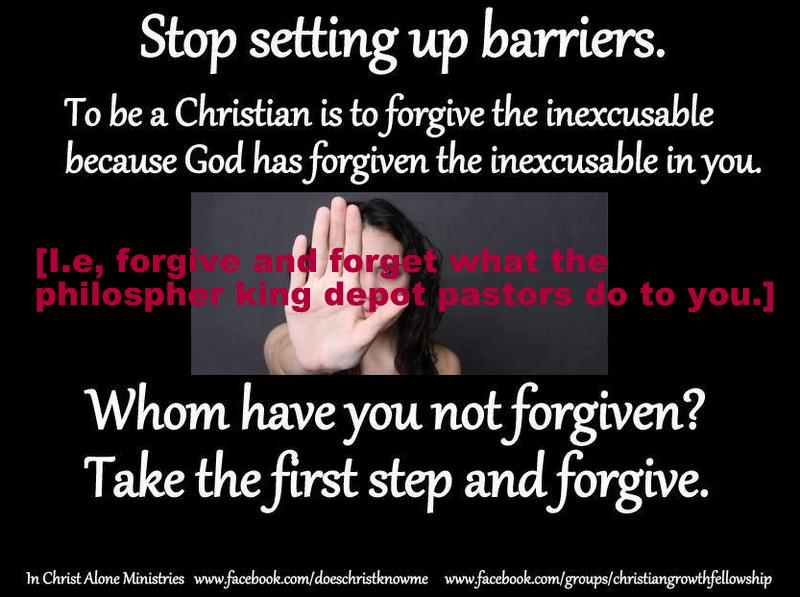
And Facebook is a treasure trove of these platitudes. I observed one this morning that instigated this post:

Oh my. Where to even start? Rethinking this poster is going be the subject of our family devotion this afternoon. And comments on it are welcome here.
paul



leave a comment